Vol.8 (2018) No. 5
ISSN: 2088-5334
User Perceived Quality Model for Web-Based System Assessment
Siti Rohana Ahmad Ibrahim
#, Jamaiah H. Yahaya
#, Aziz Deraman
*, Abdul Razak Hamdan
#,
Yusmadi Yah Jusoh
1 #Center for Software Technology and Management, Faculty of Information Science and Technology, Universiti Kebangsaan Malaysia, 43600, Bangi, Selangor, Malaysia
E-mail: [email protected], [email protected], [email protected]
*
School of Informatics and Applied Mathematics, Universiti Malaysia Terengganu, Kuala Terengganu, Malaysia E-mail: [email protected]
1
Faculty of Computer Science and Information Technology, Universiti Putra Malaysia, Serdang, Selangor, Malaysia E-mail: [email protected]
Abstract
—
The critical issue in software quality is to maintain the relevance of the software to the dynamics requirements and expectations. For the last forty years, many software quality models have been developed that focused on the technical and behavioral aspect of the software and little attention towards user perspective of quality. Our previous works in certification exercises have revealed the needs and rationale for software certification from user approach. This is aligned with the development of new social network software; the new development approaches such as agile method and the varieties of commercial software in the market which led to user dominance and control over the software. Thus, users are more criticised and demanded in the quality aspects of the software service that accessible to a wide range of people from various categories of users. The users of the web-based systems can be defined in several categories with different interests and perspectives, but this research only focuses on web users in general. The new structure of the quality model is defined. The enhanced quality model and system are valuable to overcome the limitations of previous models and further improve the application in software certification and assessment process.Keywords— software quality; software certification; quality model; user perspective; web users
.
I. INTRODUCTION
In general, the quality of software can be defined as the product that meets user anticipation, needs, and requirements. For the last forty years, several research projects have been carried out that investigated ways to establish and maintain software product quality. A systematic software processes have been developed to ensure that software product was produced with a high-quality standard that met user’s requirements and expectation. Despite that, there are still issues, reports, and complaints from the users and community related to poor quality of software delivered to them [1]. At the same time, many software projects fail because of lack of user involvement, insufficient user requirements and lack of management support. The other factors related to software failure are user constraints, insufficient knowledge and skill of software developers and also technology change [2], [3]. Thus, the quality issues of software products are still hovering among users, stakeholders, and developers in the industries. One alternative approach to confirm the quality of
a software product is through a certification process which is carried out based on prescribed criteria. One of the studies proposed several potential types of research and developments of this effort in software certification [4]. Previous studies have revealed and demonstrated that software certification could be conducted via three different perspectives and approaches: end product quality, development process and personnel and this is known as software certification triangle [5]. Furthermore, in the current technology demand and expectation, the certification process could also be done through the involvement of user within their environment. In contrast, previous works in certification were carried out that involved third-party agency such as government or private agency and also implemented in the testing laboratories where executing the software out of the operational environment [5], [6].
to [7] and [8], even though software technology and development have shown enhancement and improvement but failures in software development projects are still being reported and recounted. Referring to [7] and [8], “A software project is considered failed if it is over budget and cost, over schedule, does not meet the business objective and does not meet user requirements.” Furthermore, from the economic and social perspectives, customers will lose their trust and buoyancy towards the organization. Also to economy view, the project fails then maintenance cost will increase.
In this research, we focus more on the requirements and limitations of end-users at each operational stages and processes. The scope of this research is web-based application system, as an individual or organizational usage and the users frequently use this type of applications in their daily activities. At this level, the users of the system involve in the assessment exercise and provide all the necessary information regarding the assessed and targeted system from their perspectives.
The remaining of this paper is section 2 presents material and methods which consist of a discussion of the background issues in software quality and methods and approaches. Section 3 presents the results and discussion, while section 4 concludes this paper with a conclusion.
II. MATERIAL AND METHOD
A. Issues In Software Quality
Previous works have revealed that software quality could be evaluated through internal attributes, external attributes, and quality in use. The internal attributes are the insight of product to create a good quality. Examples of internal attributes are the inspections of an incorrect logic from the program code and the memory usage. The external attributes are associated with the user’s experience in using the product in their environments such as reliability, usability, and efficiency. The quality in use is referred to the user’s perception of a quality aspect of the product [9]. Some researchers believed that its quality demonstrated the software originality and novelty without corresponding to the underlying development process used [10]. Also, software quality attributes such as flexibility, usability, maintainability, and efficiency, are difficult to measure directly because these attributes are assessed by the developer and user based on their experiences and utilization of the software [10].
1) Software Quality from Technical Perspective: Since
the 1970s, some software product quality models have been invented and the well-known models among software practitioners and quality researchers are McCall [12], [13], Boehm [12], [13], ISO9126 [12], [13], [25], SQuaRE [16], Dromey and Pragmatic Quality Model (PQF) [11], [31]. This quality models emphasis more on a technical or behavioral aspect of software and very minimum consideration towards the view and perspective of a user or human factors in the assessment.
As an example, software product assessment is used in the ISO 9126 as a reference model, and the process assessment is used ISO/IEC 15504 as a reference model. Technical aspects were the primary focus of these reference models in the development process and product quality [32].
The new enhanced model of ISO9126 which is called the ISO 25010 or part of System and Software Quality Requirements and Evaluation (SQuaRE) standard is still centering on the technical aspects of software. Attributes such as functionality, suitability, performance efficiency, compatibility, usability, security, reliability, maintainability, and portability are still embedded in this new model, but there are additional new attributes in ISO 25010 compare to ISO 9126 which are compatibility and security [16], [66]. In the present, the literature study reveals that the scope of technology and behavioral perspective in assessment standard are remaining in software quality models [15], [32]. Previous studies showed that users from various categories preferred the certification and quality assessment process implemented and carried out by the users themselves via the self-certifying method in their environment [11]. In this new approach, the assessment and certification of software products can be conducted by the users and in the same operating environment. Furthermore, “user-centricity approach can be defined as a new paradigm where the requirements and limitations of end-users of software products are given extensive attention at each stage of the processes and user has control through her involvement in using the product” [22], [32]. These requirements link back to the basic definition of software that quality is defined as “fitness for use” and “conformance to requirements.” The term “fitness of use” means characteristics such as functionality, efficiency, usability, and maintainability while “conformance to requirements” means that software has or adds value to the users [6].
2) The User-Centricity in Software Quality: Previously,
the software was recognized as essential and vital tools to remain excel and competitive in businesses. Today, software is more than a tool to support businesses, but it is also vital to the social society as a whole. It has been recognized as parts of everyone in life from all categories of users or people [63]. The emergence of social network application software such as Twitter, Facebook, Instagram, Friendster and many more show the relevance and influential of software and computer devices in people’s life. The integration of human’s activities and ICT appliances connects people anytime and anywhere through software applications. This scenario creates a new paradigm where people and users are the key actors in the situation, and this is called user centricity paradigm [53].
Similarly, the user-centricity approach has been applied and implemented in software design and development [69]. It has been adopted earlier where users involved in the decision processes [17], [18]. Patton [17] debated that software developers in some circumstances paid less consideration about the benefits of user’s viewpoint during the initial process of software development. Typically, users prefer to use the software that meets their expectation and do not concern much about the underlying code and design. Therefore, as a developer, she needs to understand the wants and needs of the user through what she builds, who will use it and how to use it.
build” [17], [32]. Thus, we believe that the software quality in assessment and measurement of must align to this approach as well.
The opinions by Patton [17] have been supported with Gulliksen et al. [19] that mentioned user-centered system design (UCSD) was focused on the usability of the system. Users who have experienced using the system can achieve their satisfaction and expectation. Also, Gulliksen et al. defined UCSD is a process of development that involved usability work and user involvement in system life cycle. He also proposed 12 principles of UCSD to support the meaning of UCSD include development, communication, and assessment regarding the user-centered process to make the attractive system [19].
Iivari & Iivari [20] studied user-centeredness (UC) in different perspectives and concerned with the system design rather than focus on user interface only. Usually, the user will attract the system through the user interface but sometimes it difficult to find the useful information. Besides, the user should know the design of the system to facilitate them use the system more effective and practical.
User-centered design (UCD) is related to the usability; it focuses on the user with a goal and needs throughout the product development [21]. UCD is making the system usable with interactive system development that will be used by the system’s end-users [50]. UCD methodologies such as user focus, users’ work practices, and tasks, active and direct user participation to understand the user role with their task and context of use. The involvement of the user in the design process is vital to get user feedback and develop the excellent system [49].
3) The Roles of User Centricity: User centricity are
applied and considered in many other domains such as engineering, healthcare, management, and business. This shows the importance of the user’s role in various domain. Another work carried out by Khan et al. [22] who explored web-based systems assessment and adopting the centricity quality approach. The development of user-perceived quality factor through a tree structure and was called a Factor Criteria Attributes Metric (FCAM). Text, structure, general quality, non-textual and physical properties are the five criteria of FCAM. These criteria were broken down into relevant attributes and subjective metrics that web users may evaluate. The model focused on identifying objectives and metrics and used them in compliment to other models without covering the views of designer or developer [22], [33].
Literature study showed that there was a related work conducted the user-centricity in Federated Identity Management (FIM) leaded by IBM Switzerland and European Commission IST Project that suggested attributes such as user control, privacy, and security. The properties of user control such as confidentiality, integrity, revocability, unlink-ability, policy, user-chosen IP, verifiability, generated tokens, illegal sharing prevention, non-transferability, and non-replay. Besides, the high-level properties such as accountability, notification, anonymity, data minimization, attribute security, and privacy [23] which were defined in this model.
Quasthoff and Meinel describe user centricity as: “User centricity in identity management systems does not only refer to design processes leading to better usability, customer satisfaction or something similar” [18]. The previous study conducted by Ahn et al. [25] discussed managing the individual and critical attributes related to the user perspective. It focused on the user-centric in identity management. Similarly, in this approach, the researcher claims that user should have better control to the identity information regarding their responsibilities and rights. Therefore, users will protect for their private information by itself. A user is a remarkable person who is responsible in the middle between the identity provider and relying party. In healthcare, user centricity is explained to improve health, services and cost reduction. Two main categories of users identified such as real users (patient) as an electronic healthcare infrastructure and users of the system (medical practitioners and pharmacists) as a health professional [18].
4) The Importance of User-Perceived: The social
network application software that available today such as Facebook, Twitter, and Friendster has shown the influence of computers in creating relationships and bonds among people all over the world. Users choose these apps as their alternative medium for communications, interactions, and businesses. Cheung et al. [36] studied the impact of Facebook as the medium for education and learning. Thus, more efforts were given towards user’s perspective on performance system of China E-government by Zhang et al. [36]. This is significant because users are more aware of their needs and expectations towards their system.
In the system design and development approach too, many efforts have been given toward user involvement [34] such as agile [62] and extreme programming. Ali et al. [38] also focused on system design and development from user’s perspective to ensure that the user interface of the developed system fulfill user expectation and enable users to use the system iteratively effectively. They developed a crime news retrieval system using user perception approach. In cloud computing too, the invention towards user-centric approach is being explored particularly in investigating user ability to determine the quality monitor and measures [46].
Furthermore, quality is a subjective matter that needs the people thinking and perception to estimate the value of the measurement. Users may have different perception towards to the quality of the software from their perception and experience [51].
5) The Evolution of Software Quality: The evolution of
end-product quality approach. It is also referred to more specifically the quality in-use factors [26][65]. During this time, Software Engineering Institute through its Quality Subgroup of the Software Metrics Definition Working Group and the Software Process Measurement Project Team had proposed a framework for discovery, reporting, and measurements of problems and defects of software. Mechanisms for describing and specifying the software measures used to understand and predict software quality and software process efficiency. The attributes used were size, defects, effort and time [23].
The evolution continued and from years 2000 and onward, we realized and observed the emergence of cloud computing infrastructure, social network software and user involvement in software development such as incremental development and agile method. The development of certification model embedded in software quality procedures was getting more relevant and appropriate to ensure quality assurance and guarantee of standard in software products [52], [64]. Also, with the user domination in software development and application, there is a demand for a paradigm shift in quality assessment and certification. Based on our previous experiences in certification research and exercises, a demand for user-based quality assessment and certification in the software industry is arising and aligned with the design and development activity [28], [29]. In developing a model that focuses on user-centric quality approach, the metrics and measures are collected through a different group of users. The different categories of users can be classified as a public user, expert user, management user and technical user [33].
B. Methods
This research was carried out in mixed methods which involved quantitative and qualitative approach. The qualitative approach included an interview and brainstorming with experts in software assessment and certification. Generally, in the brain-storming approach, we conducted a series of workshop with researchers on our team and invited experts in this specific areas. The main phases of this research were: 1) theoretical study, 2) identify user-perceived attributes, 3) proposed model development, and 4) testing and evaluation of the model.
In phase 1 which was the theoretical study phase consisted of literature reviewed and studied the state-of-arts in software quality, assessment, and certification. The theoretical and conceptual frameworks of this study were constructed [30], [31]. In this research, the previously developed software product certification model (SCM-Prod) [10], was studied and enhanced in the model development phase. SCM-Prod model was adapted and enhanced to give more efforts on user’s perspective in the assessment model.
In phase 2, we identified, reviewed and analyzed quality attributes on user perspective and centric approach. Based on a literature study, the user-perceived attributes or characteristics were grouped into five main classifications: perspective and perception, requirements, control, privacy, and security. The classification and attributes were verified and validated by experts. Four experts in software quality and certification were invited to join the review process. They are from the academic background and have
experience in research and collaboration works in this area. Most of them have involved in this area for more than ten years. The expert review process was carried out iteratively to achieve a conclusive decision among the experts. The experts have recommended some modifications in items and sentences related to the measures. The modifications were implemented to ensure the validation and consistency of the terms and definitions in theory and practice.
The next phase is the model development phase. As mentioned earlier, this study adapted SCM-prod model and proposed an enhanced certification model that focuses more on user-centricity in the assessment. This model then was tested and validated through a case study using a web-based system operating in Universiti Kebangsaan Malaysia.
III.RESULTS AND DISCUSSION
Yahaya did the previous study, and Deraman [31] discovered that there were two main categories of attributes in determining software quality: the behavioral and impact attributes. The behavioral attributes refer to the technical aspect of quality which generally known as the non-functional aspect of quality. The Pragmatic Quality Factor (PQF) consists of attributes which are functionality, maintainability, reliability, efficiency, portability, usability and integrity. While the impact attributes which also inclusive in PQF model are the characteristic that relates to the impact of the system to the users in the environment. Examples are the user perspective and requirements. Literature study showed that the quality impact of a software product was not only influenced by the technical or behavioral factors of the software but also from human and user perspectives [31]. It reflects the impact of the software on the environment. The impact attributes previously defined in PQF model were reviewed and applied in the current work and focused on the human aspect of the quality were given more attention and consideration.
A. User-Perceived Quality Attributes and Structure
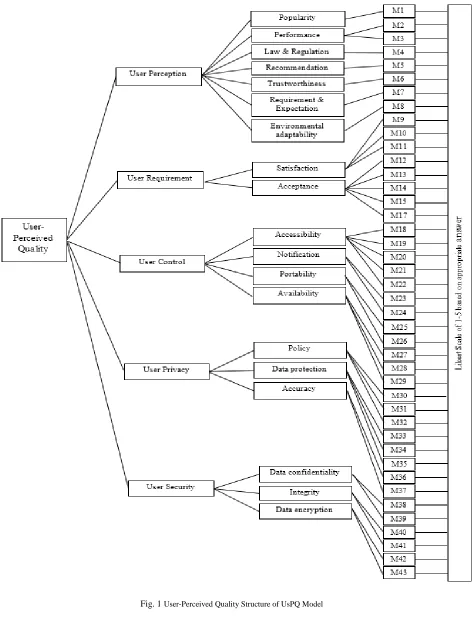
The theoretical study disclosed that user-perceived quality factors could be classified into five main attributes which are user perception, user requirements, user control, user privacy and user security as shown in Table 1. The initial work was presented in our previous paper [46].
TABLEI
USER-PERCEIVED QUALITY ATTRIBUTES,METRICS,MEASUREMENT AND SOURCES
Metrics Measurements Source
Attributes: User Perception Popularity - The popularity of the system in the
environment.
[32] [54] [60] [68] [70] Performance - Measure the overall performance of the
system.
- Measure performance in term of dependability, efficiency, usability, and conformity.
Law & Regulation
- Product complies with the laws and regulations of the organization. Recommendat
ion
- Recommend the system to others.
Trustwort hiness
accuracy (outputs).
Requirement & Expectation
-Product complies with user requirement and expectation.
Environmenta l adaptability
- Measure the portability, scalability, reusability, and interoperability (compatibility and openness) for the adaptive of the software product.
Attribute: User Requirement Satisfaction - Useful and easy to use the software
- User-friendliness
- Frequent use of the importance of this system
[39] [32] [40] [57] [67] Acceptance - Overall satisfaction with using this system
- The discretionary decision when using this system
- Frequent complain of the system
- Relevant and useful functions of the system - Responsiveness, effectiveness, correctness,
and variability
- The interface design (design, text, and graphics)
Attributes: User Control Accessibility - Language provided by the system
- The benefit of the language to access the system
- Links to the other systems - Easy to manage, flexible and
more options.
- Option to use the system via different web browsers
[19] [39] [40] [41] [56]
Notification - New or information displayed by the system
- Notification of the system from different media (such as email or telephone) Portability - System accessible through various devices
such as desktop, laptop, tablet and smartphone.
- The system is capable of operating in different versions of operating system. Availability - System readiness
- The system is delayed or downtime for certain time.
- The system is available and accessible in reasonable times.
Attributes: User Privacy Policy - The system applied the privacy policy
- Policy requirement and specification - Encryption to protect data in the system
[19] [27] [44] [58] Data
protection
- The encryption technology used in the system
- Personal information is protected from unauthorized access
- Automatic log off function is provided after the set time limit
Accuracy - Frequent of updating personal information - The accuracy of the data
Attribute: User Security
Data confidentiality
- Unauthorised users had disclosed or copied - The person who to disclosure of
information will take appropriate action.
[14] [42] [59] Integrity - The other party had modified personal
information.
- The sufficient of username and password to control the system
Data encryption
- Protection data encryption by the security technology
- Encryption technology for username and password
The attributes-metrics relationship can be structured into a Factor-Attribute Metric-Measure model or FAME as
discussed in [33]. In this structure model, each attribute is broken down further into relevant metrics. Each metrics is then broken down into several measurements which can be measured by appropriate values and scales. Measurement is described as “the process by which numbers or symbols are assigned to attributes of entities in the real world in such as a way to describe them according to clearly defined rules” [45]. In this model, the measurements used are the Likert scale of 1 to 5. The proposed model is illustrated in Fig. One which adopted the FAME structure. The same approach and concept was applied by [33] and IEEE (2005) of software quality framework [35].
B. Validation of UsPQ
The proposed UsPQ quality model was applied and validated through a case study. A web-based system operated in Universiti Kebangsaan Malaysia was chosen as a candidate for this case study. The system is referred as Product A in this paper, is already operating in this environment for almost 20 years. Product A system was first built in 1994 and was implemented phase by phase until it completed as a whole in 1997.
The hardcopy assessment form was designed and distributed to the users of Product A system. Researcher managed to collect back 50 forms from respondents who were among the students, lecturers and also administrative staff who have access to the system. The respondents were required to assess the system based on the assessment form designed from the UsPQ quality model. Based on the measurements of the metrics and given the values of each measure, users were able to answer all the questions in this approach. As mentioned earlier, the values of inputs were ranges from 1 to 5.
Table 2 shows the metrics structured in UsPQ model: M1, M2, M3 ... Mt represent the metrics of any attribute defined in this model, while U1, U2, U3 ... Un represents the assessor of the system. In this model will be the users of the system and P11, P12 ... Pnt is the assessment values given by the assessor (or the user of the system) for each metrics.
TABLEII
THE CONCEPTUAL STRUCTURE OF USPQ MODEL
Metric
Users
M1 M2 M3 M4 M5 ….. Mt
U1
U2
Un
P11 P12 P13 P14 P15 P1t
P21 P22 P23 P24 P25 P2t
Pn1 Pn2 Pn3 Pn4 Pn5 Pnt
Based on the structure (refer to Table 2), we calculate the average score for all attributes and metrics. The formulas are as follows:
i) The average score for each metric:
Tk = ∑nj=1
P
ij /n, k =1, 2...t (1)Fig. 1 User-Perceived Quality Structure of UsPQ Model
ii) Average score (A) for attributes:
Ax = ∑tk=1
T
k /t, k = 1, 2...t (2)Where t is the number of metric defined in the attributes and x represents some attributes.
iii)Quality score:
Qs = (Ax /5) * 100 (3)
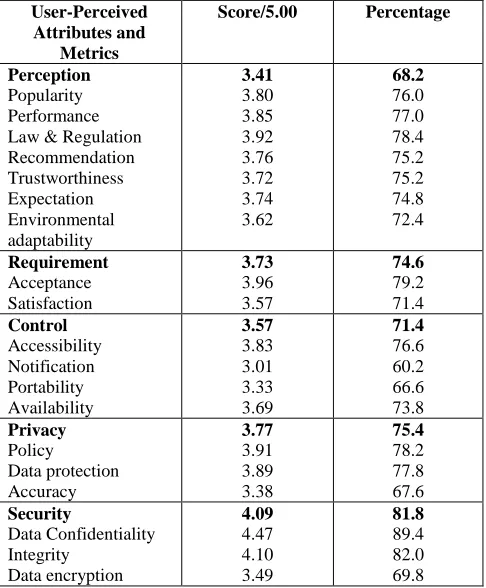
The average scores are computed for all attributes defined in this model associated with the metrics and measures. The results are shown in Table 3 and Table 4. The analysis shows that the highest score obtained by the attributes Security. It obtained a score of 4.09/5.00 or 81.8%. This shows that the users of Product A are very satisfied with the security aspect provided by the system. The lowest scores attained in this study are the Perception which consists of Popularity, Performance, Law & Regulation, Recommendation, Trustworthiness, Expectation and Environment Adaptability. The detail scores achieved by all attributes and metrics are shown in Table 4.
TABLEIII
USER-PERCEIVED ATTRIBUTES –THE AVERAGE SCORES
User-Perceived Attribute
Score/5.00 Percentage
Perception 3.41 68.2%
Requirement 3.73 74.6%
Control 3.57 71.4%
Privacy 3.77 75.4%
Security 4.09 81.8%
TABLEIV
ATTRIBUTES AND METRICS OF USER-PERCEIVED QUALITY MODEL –THE AVERAGE SCORES
User-Perceived Attributes and
Metrics
Score/5.00 Percentage
Perception Popularity Performance Law & Regulation Recommendation Trustworthiness Expectation Environmental adaptability
3.41 3.80 3.85 3.92 3.76 3.72 3.74 3.62
68.2 76.0 77.0 78.4 75.2 75.2 74.8 72.4
Requirement Acceptance Satisfaction
3.73 3.96 3.57
74.6 79.2 71.4 Control
Accessibility Notification Portability Availability
3.57 3.83 3.01 3.33 3.69
71.4 76.6 60.2 66.6 73.8 Privacy
Policy Data protection Accuracy
3.77 3.91 3.89 3.38
75.4 78.2 77.8 67.6 Security
Data Confidentiality Integrity
Data encryption
4.09 4.47 4.10 3.49
81.8 89.4 82.0 69.8
Fig. 2 illustrates the scores and results in a radar or web chart. The scores of all the attributes are plotted into the web chart based on the percentage score obtained in this study. The graph shows the outer layer of the web indicates the better achievement of this system based on user perceived quality attributes.
The findings and results of this case study were reported to the administrator of the web-based system. In general, the administrators agreed on the assessment and certification results of this software products. However, there are some
comments and suggestions according to the result of testing such as adding respondents to the assessment of web-based system and to perform more detailed analysis of each metric and measurement as it is crucial to get the accurate results. The analysis is used to improve the web-based system in the future based on an assessment by users.
Fig 2 Radar or web chart of quality scores by attributes
IV.CONCLUSION
This paper has presented a new software quality model based on user-perceived quality attributes. The quality model, UsPQ is constructed based on a user-centricity approach where the users of the system evaluate and assess the system on their insights, perceptions, and views. The new enhanced model of software quality is beneficial to justify the acceptance and satisfaction of the users towards the usage of the system. It adds the human aspect and the impact to the environment in the quality model which are the absence of current and previous software quality models. It represents quality from a different perspective and provides an alternative approach to assess software product. For future work, the proposed model can be enhanced where users can be classified into different categories such as management, expert, technical and public. It is recommended that the UsPQ model be tested in more significant number of users and applied in other applications such as certification model as the quality standard or benchmark and assessment model of quality.
ACKNOWLEDGMENT
Malaysia Ministry of Education funds this research under
the Exploratory Research Grant Scheme
(ERGS/1/2012/TK06/UKM/02/12).
REFERENCES
[1] P. Savolainen and J. J Ahonen, “Software development project success and failure from the supplier’s perspective : A systematic literature review,” JPMA, 30, (4), pp. 458-469, 2012.
[2] N. Gorla and S.-C. Lin, “Determinants of software quality: A survey of information systems project managers,” Information and Software Technology, 52, (6), pp. 602-610, 2010.
[3] J. Patton, “User-Centricity,” IEEE Software, 24, (6), 2007, pp. 8-11. [4] A. Deraman and J. H. Yahaya, “Research and Development in
[5] J. Voas, “The Software Quality Certification Triangle. Crosstalk”, The Journal of Defense Software Engineering, November 1998, pp. 12-14. [6] N. Z. Haryani Zakaria, A. R. Hamdan, J. Yahaya, and A. Deraman,
“User-Centric Software Quality Model for Sustainability: A Review,” Lecture Notes on Software Engineering, 4(3), pp. 199-204, 2016. [7] J. Ropponen and K. Lyytinen, “Components of Software Development
Risk: How to Address Them? A Project Manager Survey’s”, IEEE Trans. Software Engineering, 26, (2), pp. 98-112, 2000.
[8] R. Berntsson-Svensson and A. A Aurum, “Successful Projects and Products: An Empirical Investigation,” ACM Proceeding of ISESE'06, Rio de Janeiro, Brazil, 21 - 22 September 2006, pp. 144-153. [9] A. Hussain and E. O. C. Mkpojiogu, “An Application Of The ISO/IEC
25010 Standard In The Quality-In-Use Assessment Of An Online Health Awareness System”, Jurnal Teknologi (Sciences & Engineering), vol. 77, (5), (2015) pp. 9-13
[10] J.H.Yahaya, A. Deraman, and A. R. Hamdan, “SCfM_Prod: A software product certification model,” 3rd International Conference on Information and Communication Technologies: From Theory to Applications, ICTTA, 2008, pp. 1-6.
[11] J.H.Yahaya, A. Deraman, and A. R. Hamdan, “Continuously ensuring quality through software product certification: A case study.” 2010 International Conference on Information Society, i-society, 2010, pp. 183-188.
[12] O. Gordieiev, V. Kharchenko and M. Fusani, “Software Quality Standards and Models Evolution: Greenness and Reliability Issues,” International Conference on Information and Communication Technologies in Education, Research, and Industrial Applications
ICTERI 2015, 2015, pp. 38-55.
[13] O. Gordieiev, V. Kharchenko, and Mario Fusani, “Evolution of Software Quality Models: Usability, Security and Greenness Issues,” Recent Advances in Computer Science, 2015, pp.519- 523.
[14] G. H. Walton, T. A. Longstaff, and R. C Linger, “Computational Evaluation of Software Security Attributes,” Proceedings of the 42nd Hawaii International Conference on System Sciences, 2009, pp. 1-10. [15] G. Panovski, “Product Software Quality,” Master’s thesis, Department
of Mathematics and Computing Science, Eindhoven University of Technology, 2008.
[16] ISO/IEC 25010 “Systems and Software Engineering – Systems and Software Quality Requirements and Evaluation (SQuaRE),” 2011. [17] J. Patton, “Understanding User-Centricity,” IEEE Software, 24, (6),
November/December 2007, pp. 9-11.
[18] M. Quasthoff and C. Meinel, “User-Centricity in Healthcare Infrastructures,” Internet Technologies and Systems Hasso Plattner Institute, Germany, 2007, pp. 141-151.
[19] J. Gulliksen, B. Goransson, I. Boivie, J. Persson, S. Blomkvist, and A. Cajander, “Key Principles for User-Centred System Design’. Springer, 2015. Pp. 17-36F.
[20] J. Iivari and N. Iivari, N, “Varieties of User-Centeredness,” Proceeding of The 39th Hawaii International Conference on System Sciences, 2006. Pp. 1-10.
[21] M. Brhela, H. Methb, A. Maedchea, and K. Werdera. “Exploring Principles of User-Centered Agile Software Development: A Literature Review,” Journal Information and Software Technology, 61(C):163-181, May 2015.
[22] K. M. Khan, M. Samaka, C. V. Eeno, and S. Budihardjo, “Assessing User-Centric Quality of Web-Based System,” Int. Journal of Software Engineering, IJSE, 3, (1), January 2010, pp 13-27.
[23] A. Bhargav-Spantzel, J. Camenish, T. Gross, and D. Sommer, “User Centricity: A Taxonomy and Open Issues,” Department of Computer Science, Purdue University, IBM Zurich Research Lab, Switzerland. 2007.
[24] J. Kim & Y. Park, “Two Directions of User-centric Approach to Identifying New Service Opportunities: Vacuum to Solution and Practice to Niche,” 3rd International Conference on Information and Financial Engineering IPEDR, 2011, pp. 487-491.
[25] G.J. Ahn, M. Ko, and M. Shehab, M, “Privacy-enhanced User-Centric Identity Management.” IEEE International Conference on Communications Society. 2009, pp. 1-5.
[26] ISO 9126, “ISO 9126 Software Quality Characteristics”. http://www.sqa.net/iso9126.html, accessed 11 Feb 2014.
[27] R.H. Weber, "Internet of things: Privacy Issues Revisited," Computer Law & Security Review, Vol. 31, (5), October 2015, pp. 618-627. [28] M. Johnson, “User Involvement, Social Media, and Service Evolution:
The Case of Habbo,” In Proceedings of the 43rd Hawaii International Conference on System Sciences – 2010, IEEExplore.ieee.org.
[29] M. Johnson, “How Social Media Changes User-Centred Design: Cumulative and Strategic User Involvement concerning Developer– User Social Distance,” Doctoral Dissertations, Aalto University publication series, 2013.
[30] S.R. Ahmad Ibrahim, J.H. Yahaya, and A. Deraman, “The Development of Self - Certification of User Centric Approach for Software Product Assessment: The Theoretical Framework.” Proceedings of the 6th Malaysian Software Engineering Conference, UKM Bangi, 4-5 Dec 2012.
[31] J.H.Yahaya, A. Deraman, S.R. Ahmad Ibrahim, A. R. Hamdan, and Y.Y. Jusoh, “User-Centric Approach of Software Certification: The Conceptual Model,” Proceedings of the 21st International Business Information Management Association Conference, Vienna, Austria, June 2013, pp. 77-85.
[32] J.H.Yahaya, & A. Deraman, “Measuring The Unmeasurable Characteristics of Software Quality Using Pragmatic Quality Factor,” Proceedings of 2010 3rd IEEE International Conference on Computer Science and Information Technology, Chengdu, China, July 7-10, 2010, pp. 197-202.
[33] J.H.Yahaya, A. Deraman, A. R. Hamdan, and Y.Y. Jusoh, “User-Perceived Quality Factors for Certification Model of Web-Based System,” International Journal of Computer, Electrical Automation, Control and Information Engineering, World Academy of Science, Engineering and Technology, 8, (5), pp. 673-679, 2014.
[34] M. Bano and D. Zowghi, “A Systematic Review on the Relationship between User Involvement and System Success,” Information and Software Technology, vol. 58, February 2015, Pages 148-169. [35] IEEE, “IEEE Standard for a Software Quality Metrics Methodology,”
http://ieeexplore.ieee.org/stamp/stamp.jsp?tp=&arnumber=749159, accessed 4 Oct 2016.
[36] C. M. K Cheung, P.-Y. Chiu, and M. K. O. Lee, “Online social networks: Why Do Students Use Facebook?”, Computers in Human Behavior, 27, (4): 1337-1343, 2011.
[37] H. Zhang, S. Zhang, M. Xiong, and S. Tang, “Improving Performance of E-Government System from the User Perspective.” IEEE International Conference on Green Computing and Communications and IEEE Internet of Things and IEEE Cyber, Physical and Social Computing, pp. 2108-2113, 2013.
[38] N. M. Ali, M. Mohd, N. F. Yacob, et al.,“ Investigating User Perception in a Development of Crime News Retrieval System.” International Journal of Digital Content Technology and its Applications, 6, (10), pp. 118–126, 2012.
[39] K. M. Khan, & M. Samaka, “Assessing User-Centric Quality of Web-Based Systems,” Int. J. of Software Engineering, IJSE, 3, (1), pp. 13– 28, 2010.
[40] L. Hasan and E. Abuelrub, “Assessing the quality of websites,” Applied Computing and Informatics, 9, (1): 11-29, 2011.
[41] M. M. Jeon, M. Jeong, “Customers’ Perceived Website Service Quality and Its Effects on E-Loyalty,” International Journal of Contemporary, (29), 1, 2017.
[42] S. Sicari, A. Rizzardi, L. A. Grieco and A. Coen-Porisini, “Security, Privacy, and Trust in the Internet of Things: The Road Ahead,” Computer Networks, vol. 76, 15 January 2015, pp. 146-164.
[43] J. Pande, C. J. Garcia, and D. Pant, “Optimal Component Selection for Component-Based Software Development using Pliability Metric.” ACM SIGSOFT Software Engineering Notes, 38, (1), pp. 1-9, 2013. [44] A. Ahmad, R. Mukkamala, “A Novel Information Privacy Metric,”
Information Technology - New Generations, 18 July 2017 pp. 221-226. N. Fenton and J. Bieman, “Software Metrics: A rigorous and practical approach,” Third edition, Taylor & Francis Group, Boca Raton, Florida. 2015.
[45] M. Hussain & H.M.Abdulsalam, “Software quality in the clouds: a cloud-based solution.” Cluster Computing, 17(2), pp.389-402, 2014. [46] J. H. Yahaya, A. Deraman, S. R. Ahmad Ibrahim, and Y. Y. Jusoh.
Software Certification Modeling: From Technical to User Centric Approach. Australian Journal of Basic and Applied Sciences, 7(8): 9-18, ISSN 1991-8178, 2013.
[47] A. Chammas, M. Quaresma, and C. M. Alvão, “A Closer Look on the User Centred Design,” 6th International Conference on Applied Human Factors and Ergonomics (AHFE 2015) and the Affiliated Conferences, AHFE 2015. Procedia Manufacturing 3 (2015), pp. 5397-5404.
[49] J. Brunner, E. Chuang, and C. Goldzweig, et al.,”User-centered design to improve clinical decision support in primary care,” International Journal of Medical Informatics, March 2017, pp. 1-15.
[50] S. M. Darwish, “Software test quality rating: A paradigm shift in swarm computing for software certification,” Journal of Knowledge Based-Systems. 110, pp. 167-175. 2016.
[52] I. O. Said, Z. Shukur and M.A. Ibrahim, “A Certification Criteria for Software of Measuring Instruments Based on Malaysian Environment,” IEEE, 2017.
[53] H. Azman, A. Salman, N. A. Razak and S. Hussin, “Determining Critical Success Factors for ICT Readiness in a Digital Economy: A Study from User Perspective,” Advanced Science Letters, Vol. 21, 1367-1369, 2015.
[54] H. Tao, Y. Chen, J. Pang, “A Software Trustworthiness Measure Based on the Decompositions of Trustworthy Attributes and Its Validation,” Industrial Engineering, Management Science and Applications 2015, pp.981-990.
[55] A. Ahmad, O. Rahman, M.N. Khan, “Consumer's Perception of Website Service Quality: An Empirical Study,” Journal of Internet Commerce, 15, (2), pp. 125-141, 2016.
[57] A. A. M.-Any, H. Winklhofer, C. Ennew, “Measuring Users’ Value Experience on a Travel Website (e-Value) What Value Is Cocreated by the User?”, Journal of Travel Research, 54, (4), pp. 496–510, 2015. [58] M. Seckler, S. Heinz, S. Forde, A.N. Tuch, “Trust and Distrust on the Web: User Experiences and Website Characteristics,” Computers in Human Behavior, vol. 45, April 2015, pp. 39-50.
[59] N.S. Safa, M. Sookhak, R. V. Solms, S. Furnell, “Information security Conscious Care Behaviour Formation in Organizations,” Computers & Security, vol. 53, September 2015, pp. 65-78.
[60] U. Abelein, B. Paech, “Understanding the Influence of User Participation and Involvement on System Success – a Systematic Mapping Study,” Empirical Software Engineering, February 2015, vol. 20, (1), pp. 28-81.
[61] A. Hussain, E.O.C. Mkpojiogu and F.Mohmad Kamal, “Eliciting Satisfying User Requirements for an e-Health Awareness System Using the Kano Model,” Recent Advances in Computer Science, pp. 156-165, 2015.
[62] L.R. Vijayasarathy, C.W. Butler, “Choice of Software Development Methodologies: Do Organizational, Project, and Team Characteristics Matter?”, IEEE Software, vol. 33, (5), Sept-Oct 2016, pp. 86-94. [63] N. Z. H. Zakaria, A. R. Hamdan, J. Yahaya, and A. Deraman,
“User-Centric Software Quality Model for Sustainability: A Review,” Lecture Notes on Software Engineering, Vol. 4, (3), August 2016. [64] F. Pinciroli, “Improving Software Applications Quality by
Considering the Contribution Relationship among Quality Attributes,” Procedia Computer Science, vol. 83, 2016, pp. 970-975.
[65] A. A. Sanjay, M. N.Omoregbe, B. Crawford and R.Soto, “A Systematic Literature Review of Open Source Software Quality Assessment Models,” SpringerPlus 2016, 5, (1), 8 November 2016. [66] K. Sheoran and O. P. Sangwan, “An Insight of Software Quality
Models Applied in Predicting Software Quality Attributes: A Comparative Analysis,” Reliability, Infocom Technologies and Optimization (ICRITO) (Trends and Future Directions), 4th International Conference on 17 December 2015.
[67] P. Bharati and A. Chaudhury, “Product Customization on the Web: An Empirical Study of Factors Impacting Choiceboard User Satisfaction,” Information Resources Management Journal, vol. 19, (2), 30 Mar 2015, pp. 69-81.
[68] B. Alonso, R. Barreda, L. Dell’Olio, and A. Ibeas, “Modelling User Perception of Taxi Service Quality,” Transport Policy, vol. 63, April 2018, pp. 157-164.
[69] B. I. Akhigbe, E. R. Adagunodo, and B.S. Afolabi, “Modelling User-Centered Attributes: The Web Search Engine as a Case Knowledge Organization. Vol. 42, (1) 2015, pp. 25-39.