Using DNA to predict educational trajectories in early
adulthood
Ziada Ayorech1, Robert Plomin1, Sophie von Stumm2
1 King's College London, MRC Social, Genetic and Developmental Psychiatry Centre, Institute
of Psychiatry, Psychology & Neuroscience, London, SE5 8AF, UK
2 Department of Education, University of York, University of York, Heslington, York, YO10
5DD, UK.
Abstract
At the end of compulsory schooling, young adults decide on educational and
occupational trajectories that impact their subsequent employability, health and even life expectancy. To understand the antecedents to these decisions, we follow a new approach that considers genetic contributions, which have largely been ignored before. Using genome-wide polygenic scores (EA3) from a genome-wide association (GWA) study of years of education in 1.1 million individuals, we tested for genetic influence on early adult decisions in a UK-representative sample of 5,839 18 year olds. EA3 significantly predicted educational trajectories in early adulthood
(Nagelkerke r2= 10%;χ2 (4) =571.77, p<.001), indicating that young adults partly adapt their aspirations to their genetic propensities—a concept known as gene-environment correlation. Compared to attending university, a one standard deviation increase in EA3 was associated on average with a 51% reduction in the odds of pursuing full-time employment (OR=0.47; 95% CI [0.43-0.51]), an apprenticeship (OR=0.49; 95% CI [0.45-0.54]), or becoming NEET (Not in Education, Employment or Training; OR=0.50; 95% CI [0.41-0.60]). EA3 associations were attenuated when controlling for previous academic achievement and family socioeconomic status. Overall this research illustrates how DNA-based predictions offer novel opportunities for studying the socio-developmental structures of life outcomes.
Introduction
Emerging adulthood is a unique developmental period in the late teens and early
twenties when young people gain autonomy over their life decisions (Arnett, 2014). In
most countries, the onset of emerging adulthood coincides with the end of
compulsory schooling, when young adults can choose for the first time whether or not
to continue formal education. Young adults select diverse paths, with some opting to
pursue a university degree, others seeking full-time employment or starting a family,
and others delaying or completely disengaging in economic activities. Those who
neither enroll in further education nor engage with the labor market – that is,
individuals who are Not in Education, Employment or Training (NEET) -- are at
greater risk of later unemployment, marginalization, criminality, poor mental and
physical health, and lower life expectancy (Bradley & Corwyn, 2002; Crowley, Jones,
Cominetti, & Gulliford, 2013; Feng, Ralston, Everington, & Dibben, 2017; Goldman‐
Mellor et al., 2016; Kelly, Dave, Sindelar, & Gallo, 2014). Each of these outcomes
bears substantial costs for the individual and also constitutes an economic burden to
society. By comparison, the economic benefits of increased educational and
occupational trajectories within society translate to a higher standard of living overall.
For these reasons, understanding the antecedents to decisions on educational
trajectories during emerging adulthood is of major societal importance.
Genetics of educational trajectories
Research on predicting individual differences in educational and occupational
trajectories has largely focused on differences in the socioeconomic status (SES) of
the family in which children are reared, or in their educational achievement (Bradley
& Corwyn, 2002; Hart & Risley, 1995; Van de Werfhorst, 2001; Werfhorst, Sullivan, &
Cheung, 2003; I. R. White, Blane, Morris, & Mourouga, 1999). Results indicate
children of high-SES families attain higher levels of education (Parker et al., 2012),
the highest earning professions in later life (Macmillan, Tyler, & Vignoles, 2015) when
compared to their low-SES peers.
Although SES and educational achievement are typically viewed as environmental
variables, quantitative genetic findings indicate that they show substantial genetic
influence, like other complex human traits (Knopik, Neiderheiser, DeFries, & Plomin,
2017; Robert Plomin, DeFries, Knopik, & Neiderheiser, 2016). For example, both
family SES and children’s educational achievement show significant genetic
influence (Calvin et al., 2012; Krapohl & Plomin, 2015; Trzaskowski et al., 2014).
Moreover, correlations between SES and educational achievement are in part
genetically mediated (Belsky et al., 2016; Marioni et al., 2014). It is reasonable to
assume then that these genetically influenced differences impact decisions on
educational trajectories, so that individuals make educational choices that are in line
with their educational aptitudes and their genetic propensities. Finding genetic
influence on broad life choices at the beginning of emerging adulthood would indicate
that young people are not passive recipients of their environment but instead actively
modify and create their experiences in part due to their genetic propensities—a
concept known as gene-environment (GE) correlation.
GE correlation has traditionally been investigated using family-based methods
including the twin method, which compares identical and fraternal twin pairs.
However only two studies have applied the twin design to study educational choices
(Ayorech, Krapohl, Plomin, & von Stumm, 2017; Rimfeld, Ayorech, Dale, Kovas, &
Plomin, 2016). Rimfeld and colleagues (2016) found nearly 50% of differences in
whether children take an advanced school leaving exam (A-levels) versus leaving
school two years earlier with a lower certificate are due to genetic factors, while the
choice of what subjects to take during A-levels showed even more genetic influence
Using the same twin sample, we demonstrated that parents’ educational choices
influence their offspring’s educational choices—for genetic reasons (Ayorech et al.,
2017). For example, genetics contributed to 50% of the likelihood that children of
parents without a university education would surpass the constraints typically
associated with low SES and continue past compulsory education to sit A-level
examinations.
Beyond twin studies, DNA-based methods including genome-wide polygenic scores
(GPS), which aggregate genetic variants identified in genome-wide association
(GWA) studies, can be used to investigate GE correlation in educational choice. GPS
are a game changer for studies of GE correlation. Unlike the twin design, which
estimates genetic influence by comparing phenotypic resemblance between siblings
growing up in the same home, GPS estimates are based on unrelated individuals.
For this reason, GPS can test for the influence of GE correlation on an environmental
measure that is the same for all family members, such as the family’s socioeconomic
status, which is not possible using classical twin methods. Previous studies have
demonstrated the utility of GPS for understanding environmental selection
developmentally (Belsky et al., 2016), as well as interactions between individuals’
family SES and their educational attainment (Papageorge & Thom, 2017).
We have previously used a GPS for years of education (EA2; Okbay et al., 2016) to
study genetic influence on intergenerational educational mobility (Ayorech et al.,
2017). We found large mean EA2 GPS differences between offspring of
university-educated parents, who themselves took A-level examinations, and offspring of
Taken together, research suggests that genetic differences contribute to differences
in decisions on educational trajectories after compulsory education, and that parents
and their offspring are similar in their educational paths for genetic reasons. The
present study extends this literature by using summary statistics from the largest
years of education GWA (EA3; Lee et al.., 2018), based on a sample of 1.1 million
individuals, to calculate GPS to test for genetic influence on a range of educational
choices. Specifically, we use GPS to predict going into full-time employment,
apprenticeships or becoming NEET (Not in Education, Employment or Training), as
compared to opting for continuing formal education. In addition, we test the extent to
which GPS predict early adult education decisions beyond the predictive power of
family SES and past academic achievement.
The present study
Using 5,839 unrelated genotyped participants from the UK-representative Twins
Early Development Study (TEDS), we assessed the extent to which the GPS from
the latest GWA based on educational attainment (EA3; Lee et al., 2018) in an adult
sample could predict educational trajectories at the beginning of emerging adulthood
at age 18. The EA3 GPS was used to test for genetic differences between those who
continue to university or take a gap-year, those who pursue full-time employment or
an apprenticeship, and those who are NEET. In a second step, we controlled these
analyses for an individual’s family SES and past academic achievement. Finding that
family background and past achievement attenuate the association between EA3 and
educational decision in emerging adulthood would suggest that the effect of EA3 on
educational trajectories is not direct, but that EA3 acts on family- and
individual-specific factors that in turn influence young adult’s occupational and educational
aspirations. Although our mediation analyses unpack one possible mechanism by
individual’s cognitive ability and family background, there are many other
unmeasured mechanisms that deserve future research effort.
The unique contribution of the present study includes the increased power to detect
effects due to the considerably larger sample size compared to previous analyses
(Belsky et al., 2016) and the age of the current sample, which is at the beginning of
emerging adulthood, a unique period of identity exploration in the late teens and early
twenties (Arnett, 2014). In addition, we used summary statistics based on the largest
(N = 1.1 million individuals) educational achievement GWA (Lee et al., 2018) that
explains three times as much variance in years of education as the GWA (Rietveld et
al., 2013) used in previous studies similar to ours. Finally, our mediation analyses
capitalize on the longitudinal data available from our sample to unpack the
mechanisms that drive genetic influence on educational opportunities.
Materials and Methods
Sample
The sample was drawn from the Twins Early Development Study (TEDS) and
consisted of 5,839 genotyped unrelated individuals (one member of a twin pair) with
data on family SES, past academic achievement and trajectories after compulsory
education. TEDS is a birth cohort of over 10,000 twin pairs born between 1994 and
1996. The TEDS sample is representative of the British population on ethnicity,
family SES and parental occupation (Haworth, Davis, & Plomin, 2013) as is the
genotyped subsample (Selzam et al., 2016). The Institute of Psychiatry, Psychology
and Neuroscience ethics committee granted project approval and consent was
obtained prior to data collection.
The measures included data about the family’s socioeconomic status, and about the
twins’ previous academic achievement and academic and non-academic choices at
the end of compulsory education.
Family socioeconomic status (SES).
Converging evidence suggests that several factors together represent a family’s
socioeconomic status better than any single factor (White, 1982). As a result, we
based family SES on maternal age at birth of eldest child, the mean score of
maternal and paternal highest education level, as well as mothers’ and fathers’
occupation level according to the Standard Occupational Classification (Office for
National Statistics, 2000) at first contact, when the twins were age 2.
Previous academic achievement.
Previous academic achievement was based on self-reported exam grades from the
General Certificate of Secondary Education (GCSE), a standardized examination
undertaken by all school students in the UK at the end of compulsory education at
the age of 16. We have previously demonstrated the accuracy of self-reported exam
results in our sample (Rimfeld, Kovas, Dale, & Plomin, 2015).
From the available achievement data we created a mean GCSE grade score
representing the average grade achieved for the three compulsory core subjects,
mathematics, English and science (mean of any science subject taken). Grades were
coded to range from 4 (G; the minimum pass grade) to 11 (A*; the highest possible
grade).
Trajectories after compulsory education.
A questionnaire, designed to assess destinations at the end of compulsory
education, was sent to all TEDS families at the end of the academic school year
when twins reached age 18. The full questionnaire was completed either by twins
themselves or by their parents. Individuals indicated the main activity they had been
twelve months; options included studying at university, working full-time,
apprenticeship or training, taking a year gap in schooling before entering university
(gap year), unemployment or full-time parent.
Accuracy of self-report measures of educational and occupational choices was
maintained by requiring agreement across multiple questions. For example, those in
the university group indicated that they intend to go to university within the next 12
months, provided the name of the university for which they held a place, the name of
the course they are registered for and provided results for their A-level (General
Certificate of Education Advanced Level) examination, which is a two-year course
required in the UK for university entry. Those participants in the NEET group
indicated they have been NEET for the previous 12 months, intend to be NEET for
the next 12 months, and have not completed their A-levels.
In the UK a gap year is considered a constructive time out to travel and often work
abroad, taken in the transition between life stages, before continuing to formal
education at the end of the year. Although the gap year students in the present study
did not hold a place at a university when they indicated their intent, it is expected that
most will continue studying.
Statistical Analyses
Construction of EA3
The EA3 GPS was calculated for each of the 5,839 unrelated genotyped
individuals in the TEDS sample based on summary statistics from the largest years
of education GWA (Lee et al., 2018). Following quality control (see Supplementary
Methods S1 for details), genotypic data for 515,100 genotyped or imputed SNPs
EA3 was constructed using a Bayesian approach, LDpred (Vilhjálmsson et al., 2015),
which estimates causal effect sizes from GWA by assuming a prior for the genetic
architecture and LD information from a reference panel. The constructed EA3 GPS is
the weighted sum of trait-increasing alleles for each unrelated genotyped individual in
the TEDS sample. We applied a causal fraction of 1, which assumes that all SNPs
contribute to the development of the trait. The EAR GPS was adjusted for the first ten
principal components of the genotype data, chip, batch and plate effects using the
regression method. The standardized residuals were used for all subsequent
analyses. Further details on creating polygenic scores using LDpred are available in
Supplementary Methods S2.
Predicting education trajectories from DNA
A multinomial logistic regression was conducted to test whether the EA3 polygenic
score could significantly predict educational and occupational trajectories following
compulsory education. Multinomial logistic regression is an extension of binary
logistic regression that allows for more than two unordered categories of the outcome
variable. Using maximum likelihood estimation, multinomial logistic regression
evaluates the odds of categorical membership depending on the value of an
exposure or predictor variable. For a nominal dependent variable with k categories,
the model estimates k-1 logit equations. Although all combinations of k groups are
compared, a single group is selected as a reference category and prediction of
membership in this group is compared to each of the other groups. Each model
within the regression has its own intercept and coefficients as the predictor variable
can affect each category differently (Aldrich & Nelson, 1984).
Here, we used the decision to go to university as the reference category and then
tested whether we could predict, using the EA3 alone, who would pursue a university
degree compared to taking a gap year, pursuing full-time employment or
2001) and Nagelkerke r2(Nagelkerke, 1991) were used to indicate, respectively, the
relative fit of the model and the variance explained in trajectories by EA3. Odds ratios
were calculated to test the likelihood of membership in each group as compared to
going to university with a one standard deviation increase in EA3.
Comparative model
Finally, to test the extent to which EA3 can predict educational trajectories above and
beyond the predictors of family SES and past academic achievement, we performed
an additional multinomial logistic regression analysis. Here family SES and GCSE
scores were added to the previous model, and model coefficients and fit statistics
were compared between the original model (EA3 predicting educational trajectories)
and this comparative model.
Results
Data on decisions made at the end of compulsory education were available for 5,839
genotyped individuals of which 3,390 (58%) pursued a university education, 651
(11%) chose to take a gap year, 1,071 (18%) sought full-time employment, 598
(10%) began an apprenticeship, and 129 (2%) were NEET. Comparisons are
available with UK national averages at the time our TEDS data were collected
(https://www.gov.uk/government/uploads/system/uploads/attachment_data/file/
532793/Main_text_SFR22_2016.pdf). TEDS participants were similar to UK national
averages for pursuing university (58% vs 55%), for gap-year students (11% vs 7%),
for full-time employment (18% vs 16%) and for apprenticeships (10% vs 9%).
However, TEDS participants include notably fewer young adults considered NEET
than the UK national average (2% vs 13%).
EA3 differences across groups.
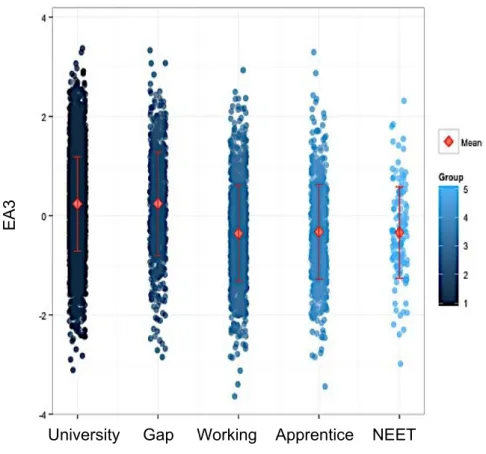
Mean EA3 differed across groups [F (4,5838)= 149.77, p< .001]. Figure 1 shows the
groups (diamond) and the spread of EA3 scores within each group. The density of
the columns refers to the size of the groups while the length of the columns indicates
how far apart EA3 scores are for members within that group. Although some data
points appear slightly off the central line for their respective group, the relative
distance of a single dot from the central line should not be interpreted.
Young adults who pursued a university degree (M=0.33;SD=0.95) or who took a gap
year prior to going to university (M=0.31;SD=1.03) had EA3 scores more than half a
standard deviation greater than those who ended formal education and sought
full-time employment (M=-0.35;SD=0.94), an apprenticeship (M=-0.31;SD=0.89) or were
NEET (M=-0.29;SD=0.90).
Figure 1. Distribution of the educational attainment (EA3) genome-wide polygenic score according to education status at the end of compulsory schooling. The diamond indicates the mean and the line represents the standard error.
University Gap Working Apprentice NEET
E
A
Predicting educational trajectories from DNA.
A multinomial logistic regression indicated that the EA3 GPS significantly predicted
educational and occupational trajectories at the end of compulsory education [X2 (4, N=5,389) = 571.77, p<.001] and explained 10% of the variance (Nagelkerke r2= 0.103).
Odds ratios were calculated from the multinomial logistic regression (Table 1) and
represent the likelihood of going to university compared to each of the other post-
compulsory education options, given an individual’s EA3. An odds ratio of one
indicates there is no difference in the likelihood of being in a given post-compulsory
choice group relative to being in the university group. An odds ratio greater than one
indicates an increased likelihood of membership in a given group relative to the
university group. An odds ratio below one indicates a decreased likelihood of
membership in a given group relative to the university group.
Compared to adolescents who went to university, a one-SD increase in EA3 was
associated on average with a 51% decrease in the odds of being in full-time
employment (OR=0.47; p<. 01), doing an apprenticeship (OR=0.49; p<.01) or
becoming NEET (OR=0.50; p<.01). The odds of taking a gap year did not differ from
the odds of going to university with a one-SD increase in EA3 (OR=0.98; p=0.65).
Table 1. Odds ratios for educational trajectories compared to entering university based on the genome-wide polygenic score (EA3)
Intercept (SE) B (SE) Odds Ratio (CI 95%)
Gap year
-1.64 (0.05)** -0.020 (0.05) 0.98 (0.90-1.07) Working
-1.16 (0.04)** -0.76 (0.04)** 0.47 (0.43-0.51) Apprenticeship
-1.73 (0.05)** -0.71 (0.05)** 0.49 (0.45-0.60) NEET
-3.26 (0.09)** -0.69 (0.10)** 0.50 (0.41-0.60)
Note: NEET= not in education, employment or training. All comparisons are made using university as
Comparative model
To test if EA3 added significantly to the prediction of educational decisions beyond
previous academic achievement (GCSE) and family SES, we added family SES and
children’s GCSE achievement to the multinomial logistic regression (Table 2). Family
SES and GCSE scores explained 39% of the variance (Nagelkerke r2= 0.39) in decisions on educational trajectories at the end of compulsory education. When EA3
was added to the model, it contributed significantly to the prediction (p<.01). All
predictors together explained 40% of the variance (Nagelkerke r2= 0.40), suggesting that 1% of the variance explained by EA3 GPS is unique to its association with
educational decisions. By comparison, 9% of the EA3 effect (see model 1)
overlapped with the predictors of family SES and GCSE scores.
Compared to adolescents who went to university, a one-SD increase in EA3 was
associated with a 15% decrease in the odds of seeking full-time employment
(OR=0.85; p<. 01), and a 21% decrease in the odds of doing an apprenticeship
(OR=0.79; p<.01) when family SES and previous academic achievement were added
to the model. Similar to model 1, the odds of taking a gap year (OR=1.00; p=0.82
compared to pursuing university did not differ when GCSE and family SES were
accounted for. In contrast to model 1, the odds of becoming NEET (OR=1.05;
p=0.73) no longer differed from the odds of going to university once family SES and
GCSE achievement were accounted for.
Table 2. Odds ratios for educational trajectories compared to entering university based on individuals’ genome-wide polygenic score, socioeconomic status and past academic achievement.
Intercept (SE) B (SE) Odds Ratio (CI 95%)
Gap year
SES 0.22 (0.06)** 1.25 (1.11-1.40)
GCSE -0.25 (0.06)** 0.78 (0.69-0.88)
Working
EA3 -1.50 (0.06)** -0.16(0.06)** 0.85 (0.76-0.95)
SES -0.51 (0.06)** 0.60 (0.53-0.68)
GCSE -2.04 (0.08)** 0.13 (0.11-0.15)
Apprenticeship
EA3 -1.76 (0.06)** -0.24 (0.06)** 0.79 (0.69-0.89)
SES -0.37 (0.07)** 0.69 (0.60-0.79)
GCSE -1.61 (0.08)** 0.20 (0.17-0.24)
NEET
EA3 -4.31 (0.21)** -0.05 (0.15) 1.06 (0.78-1.42)
SES -0.66 (0.17)** 0.51 (0.36-0.73)
GCSE -2.34 (0.19)** 0.10 (0.07-0.14)
Note: SES= socioeconomic status; EA3= genome-wide polygenic score; NEET= not in education,
employment or training. All comparisons are made using university as the reference group; R2
=0.40(Nagelkerke). Model χ2 (12) =2061.87, p<.001; **=p<.001
Discussion
We report a polygenic score investigation of the factors contributing to early adult
educational and occupational trajectories in a UK sample of over 4,000 young adults.
Understanding the antecedents to decisions on educational and occupational paths
made at the end of compulsory education is important for improving societal
provisions for educational opportunities. Our findings also have general implications
for developmental psychology, because they elucidate aspects of the interplay
between genetic propensities and environment, called gene-environment correlation.
Here, we showed that genome-wide polygenic scores (EA3) from the largest GWA of
educational attainment, based on 1.1 million individuals (Lee et al., 2018) explain
10% of the variance in educational trajectories at age 18, specifically, attending
university, pursuing full-time employment or an apprenticeship, or becoming NEET.
Although 10% represents only a small fraction of the known SNP heritability of
educational attainment (Krapohl & Plomin, 2015) this is still a meaningful amount of
variance in the psychological literature, where typical effect sizes are even smaller
upper bound limit for polygenic scores derived from GWA analysis. For this reason,
any discrepancy between polygenic score prediction and SNP-based estimates
reiterates that polygenic scores are a noisy measure of the true additive genetic
factor based on measured SNPs. Considerably larger sample sizes are needed to
detect the thousands of genetic variants each of which has a miniscule effect. As a
result, the application of polygenic scores to shape educational policy is currently
premature. Nonetheless, the unique predictive status of polygenic scores, which are
not subject to reverse causality, make them attractive variables in the social sciences
for investigating the complex contribution of genetic and environmental factors to
human behavior (Belsky et al., 2016).
The present study adds to previous investigations of the genetic contributions to
labour market outcomes (Belsky et al., 2016; Domingue, Belsky, Conley, Harris, &
Boardman, 2015; Papageorge & Thom, 2017). Emerging adulthood provides a
unique and novel opportunity to investigate GE correlation because it is the time
when young adults gain more autonomy in their educational trajectories. Our
mediation analyses allowed us to investigate the mechanisms driving these genetic
influences on emerging adult trajectories.
Even when controlling for family SES and past academic achievement, EA3 still
differentiated those children who pursue a university degree after compulsory
education from those who end their formal studies to pursue full-time work or an
apprenticeship. These results suggest that the choice of whether or not to continue
with formal education at age 18 cannot be completely explained by genetic
influences that are common to academic ability or family SES. It is possible that the
remaining genetic influence on education decisions is due to other genetically
influenced traits, like personality, psychopathology and behavior problems (Krapohl
The substantial reduction in polygenic score prediction after accounting for SES and
academic achievement (10% to 1%) is noteworthy. This reduction is not surprising
given the substantial heritability of both SES and academic achievement and the
genetic correlations between SES and academic achievement (Marioni et al., 2014)
and between early and later academic achievement (Rimfeld et al., 2018). However,
understanding the developmental processes by which these genetic correlations
emerge remains for future research. That said, the odds associated with EA3 for
becoming NEET no longer differed from the odds of going to university, once family
SES and GCSE achievement were controlled for. These results suggest that this
EA3 effect can be explained entirely by differences in past achievement and family
SES.
Finding that children’s genetic variation correlates with their family SES may seem
perplexing because a child’s genotype cannot affect their family’s SES. Because
parents and their offspring are genetically related, children’s EA3 can be considered
an approximation of their parents’ genotypes. For this reason, we would predict that
the effect of EA3 on SES would be even stronger for the parents’ own EA3, although
these data are not available in TEDS.
It is important to reiterate that genetic effects happen both between and within
families. It is not the case that children of highly educated and high SES parents
automatically inherit the genetic variants for more years of education and also grow
up in an educationally endowed environment. For example among pairs of siblings,
the sibling with the higher polygenic score typically goes on to complete more years
of schooling as compared to their lower-scoring co-sibling, despite being born to the
same parents and raised in the same family home (Belsky et al., 2018; Domingue et
manuscripts are in preparation using TEDS data to investigate within-family
differences in educational and health outcomes as a function of sibling differences in
polygenic scores. These future publications represent an important direction for
polygenic score analyses, which can elucidate the role of gene-environment interplay
in the mechanisms of intergenerational transmission of success (Belsky et al., 2018;
Lee et al., 2018).
We also stress that polygenic scores are probabilistic, not deterministic, with some
individuals performing better or worse than would be expected given their genetic
propensities (see spread of data in Figure 1). These deviations open the possibility
for an exciting application of polygenic scores for studies of resilience and positive
genetics (Plomin et al., 2009).
Our polygenic score estimates are substantially lower when compared to SNP and
twin heritability estimates of educational phenotypes. Polygenic scores capture only a
fraction of the known heritability of academic achievement as measured by traditional
pedigree-based methods like the twin design (Polderman et al., 2015). The gap
between predictive validity of EA3 for educational phenotypes and other methods is
characteristic of the missing heritability gap, which is likely to be due to rare variants,
gene-gene interaction and gene-environment interaction, as well as measurement
error. We chose not to correct for any of these factors because the predictive utility
of polygenic scores depends on the polygenic score as measured with these
shortcomings.
There are no necessary policy implications of finding genetic influence on
educational trajectories. Genetic influences on behavioral phenotypes reflect what is,
not what can be. Sweeping changes in educational policy can have profound
example, policies such as a required minimum number of years of education or
tailored help for individuals with difficulties in learning can increase educational
attainment in the entire population and even reduce differences among individuals.
Genetic influences do not imply immutability.
Technological advancements and related cost reductions have brought us to the
cusp of remarkable scientific opportunity for studying genetic influences. With these
advancements come important ethical considerations. Although predictions about a
person’s educational attainment are limited with current GPS, a careful and
considerate discussion of the future applications of GPS is urgent (Plomin, 2018).
Our findings support gene-environment correlation as a mechanistic pathway for
genetic influence. Indeed, finding genetic influences on decisions at the end of
compulsory education is indicative of active gene-environment correlation, in which
individuals select and modify their environmental experiences in part based on their
genetic propensities. Active GE correlation is key to understanding how genotypes
use the environment to develop into phenotypes. As young adults gain autonomy in
their life decisions and have the opportunity to select into environments that match
their genetic propensities, genetic effects are expected to amplify. Our results
indicate genome-wide polygenic scores offer a novel approach to elucidate this
complex interplay and to study genetic influence on broad life trajectories.
Limitations
Our results must be considered in light of the following limitations. First, academic
decisions at the end of compulsory education were based on participants’ intended
trajectories at age 18. It is possible that some individuals may change their minds
later in adulthood. For example, some young people may choose to return to
university before completing their degree. However, in the UK only 6% of 2013-14
university enrollees, who previously obtained their A-levels, failed to complete their
degree, suggesting that the majority of young adults follow through their initial
educational decisions (
https://www.hesa.ac.uk/data-and-analysis/performance-indicators/summary).
Second, although we considered the influence of family social status on children’s
educational choices, there are other socio-structural variables that were not
accounted for. It is possible, for example, that educational choices are influenced by
differences in how geographically or financially accessible university is for people, as
well as the degree of implicit bias in university admission procedures.
Third, the results from this study provide a snapshot of the predictive potential of the
current polygenic scores for years of education in a European sample. The TEDS
sample is representative of the British population on ethnicity, family SES and
parental occupation (Haworth et al., 2013) but the genotyped subsample is limited to
the 93 percent of the sample with European ancestry. Our findings need to be tested
for generalization to other countries with different educational policies, and to
non-European samples.
Conclusions
Applying DNA-based methods to understanding the developmental structure of
real-world outcomes represents a tipping point for research on complex human behavior.
Unlike classical family designs that require special relatives such as twins or
adoptees, polygenic scores can be calculated on any group of unrelated individuals
with genomic data available. Polygenic scores will become widely used in
developmental psychology as indices of genetic propensities for many traits (Plomin
not subject to reverse causality and can be measured from DNA taken during any
time from infancy to old age, although the strength of prediction will depend on
the developmental stage at which the investigated phenotype is measured (Plomin &
von Stumm, 2018) . In the current study, we used EA3 to elucidate genetic influences
on decisions on educational trajectories in young adulthood. Our findings highlight
the advantages of using genetically sensitive methods to investigate and understand
individual differences in life course development.
ACKNOWLEDGEMENTS
We gratefully acknowledge the ongoing contribution of the participants in the Twins
Early Development Study (TEDS) and their families. TEDS is supported by a
program grant to RP from the UK Medical Research Council (MR/M021475/1 and
previously G0901245), with additional support from the US National Institutes of
Health (AG046938) and the European Commission (602768; 295366). RP is
supported by a Medical Research Council Professorship award (G19/2). SvS is
supported by a Jacobs Foundation Research Fellowship award (2017-2019).
References