Volume 2007, Article ID 34013,12pages doi:10.1155/2007/34013
Research Article
Inverse Filtering for Speech Dereverberation Less Sensitive to
Noise and Room Transfer Function Fluctuations
Takafumi Hikichi, Marc Delcroix, and Masato Miyoshi
Media Information Laboratory, NTT Communication Science Laboratories, NTT Corporation, 2-4 Hikaridai, Seika-cho, Soraku-gun, Kyoto 619-0237, Japan
Received 16 November 2006; Accepted 2 February 2007
Recommended by Liang-Gee Chen
Inverse filtering of room transfer functions (RTFs) is considered an attractive approach for speech dereverberation given that the time invariance assumption of the used RTFs holds. However, in a realistic environment, this assumption is not necessarily guar-anteed, and the performance is degraded because the RTFs fluctuate over time and the inverse filter fails to remove the effect of the RTFs. The inverse filter may amplify a small fluctuation in the RTFs and may cause large distortions in the filter’s output. Moreover, when interference noise is present at the microphones, the filter may also amplify the noise. This paper proposes a design strategy for the inverse filter that is less sensitive to such disturbances. We consider that reducing the filter energy is the key to making the filter less sensitive to the disturbances. Using this idea as a basis, we focus on the influence of three design parameters on the filter energy and the performance, namely, the regularization parameter, modeling delay, and filter length. By adjusting these three design parameters, we confirm that the performance can be improved in the presence of RTF fluctuations and interference noise.
Copyright © 2007 Takafumi Hikichi et al. This is an open access article distributed under the Creative Commons Attribution License, which permits unrestricted use, distribution, and reproduction in any medium, provided the original work is properly cited.
1. INTRODUCTION
Inverse filtering of room acoustics is useful in various ap-plications such as sound reproduction, sound-field equal-ization, and speech dereverberation. Usually, room trans-fer functions (RTFs) are modeled as finite impulse response (FIR) filters, and inverse filters are designed to remove the effect of the RTFs. When the RTFs are knowna priori or are capable of being accurately estimated, this approach has been shown to achieve high inverse filtering performance [1– 4]. However, in actual acoustic environments, there are dis-turbances that affect the inverse filtering performance. One cause of these disturbances is the fluctuation in the RTFs re-sulting from changes in such factors as source position and temperature [5–9]. As a result, an inverse filter correctly de-signed for one condition may not work well for another con-dition, and compensation or adaptation processing may be-come necessary.
The sensitivity issue with inverse filtering in relation to the movement of a sound source or microphone has been addressed in several papers. In [8,9], the sensitivity of in-verse filters is quantified in terms of the mean-squared error (MSE), defined as the power of the deviation of the
equal-ized impulse response from the ideal impulse. This MSE is theoretically derived based on statistical room acoustics. These studies claim that the region in which the MSE is be-low−10 dB is restricted to a few tenths of a wavelength of a target signal, revealing a high sensitivity to small positional changes. That is, when an inverse filter designed for a cer-tain location is applied to recover signals observed at another location, the performance easily degrades and the MSE be-comes high.
Inverse filters are usually obtained by inverting the autocorrelation matrix of the RTFs. Accordingly, in order to realize stable inverse filtering, either regularization [10] or the truncated singular value decomposition method [11–13] has been applied. With the latter method, the small singular values of the autocorrelation matrix of the RTFs are treated as zeros. Both methods have been applied to a sound repro-duction system, and have been experimentally verified.
x1(n)
. . .
xP(n)
s(n)
Speaker
. . .
H1(z)
HP(z)
Room soundfield Mic.
Figure 1: Single-source multimicrophone acoustic system.Hi(z)
represent room transfer functions.
the inverse filter may also amplify the noise. We expect the filtered signal to be less degraded when the filter energy is small. Hence, we believe that reducing the filter energy is the key to making the filters less sensitive. To confirm this belief, we focus on the influence of three parameters used in the design of inverse filters: the regularization parameter, filter length, and modeling delay. By selecting proper parameter values, we expect to reduce the filter energy, and hence make the filter more robust to RTF variations and noise.
The organization of this paper is as follows. The follow-ing section describes the acoustic system with a sfollow-ingle source and multiple microphones considered in this paper. It then describes how inverse filters are calculated and analyzes the effect of the three design parameters on the filter energy. Section 3 reports experiments undertaken in the presence of noise.Section 4describes experimental results for an in-verse filter with RTF fluctuations caused by source position changes.Section 5provides an analysis of the RTF fluctua-tions caused by source position changes.Section 6concludes the paper.
2. PROBLEM FORMULATION
2.1. Acoustic system in consideration
We consider an acoustic system with a single sound source and multiple microphones as shown inFigure 1. The source signal is represented as s(n), where n denotes a discrete time index, and the signals received by the microphones are
xi(n),i =1,. . .,P, whereP is the number of microphones. Microphone signalsxi(n) are given by
xi(n)=hi(n)∗s(n) +wi(n) (1)
=
J
k=0
hi(k)s(n−k) +wi(n), i=1,. . .,P, (2)
where ∗ denotes the convolution operation, hi(k), k = 0,. . .,J, denotes the room impulse response between the source and theith microphone, andwi(n) denotes noise. The RTFs are expressed as
Hi(z)= J
k=0
hi(k)z−k, i=1,. . .,P. (3)
We assume hereafter that these RTFs have no common zeros among all the channels.
Equation (2) can be expressed in a matrix form as
x(n)=HTs(n) +w(n), (4)
where
x(n)=
⎡ ⎢ ⎢ ⎣
x1(n) .. . xP(n)
⎤ ⎥ ⎥
⎦, xi(n)=
⎡ ⎢ ⎢ ⎢ ⎢ ⎣
xi(n)
xi(n−1) .. .
xi(n−M+ 1)
⎤ ⎥ ⎥ ⎥ ⎥
⎦, i=1,. . .,P,
w(n)= ⎡ ⎢ ⎢ ⎣
w1(n) .. . wP(n)
⎤ ⎥ ⎥
⎦, wi(n)=
⎡ ⎢ ⎢ ⎢ ⎢ ⎣
wi(n)
wi(n−1) .. .
wi(n−M+ 1)
⎤ ⎥ ⎥ ⎥ ⎥
⎦, i=1,. . .,P,
s(n)= ⎡ ⎢ ⎢ ⎢ ⎢ ⎣
s(n)
s(n−1) .. .
s(n−J−M+ 1)
⎤ ⎥ ⎥ ⎥ ⎥ ⎦,
H= H1,. . .,HP
,
Hi=
⎛ ⎜ ⎜ ⎜ ⎜ ⎜ ⎜ ⎜ ⎜ ⎜ ⎜ ⎜ ⎜ ⎜ ⎜ ⎜ ⎝
hi(0) 0 . . . 0
hi(1) hi(0) . .. ... ..
. hi(1) . .. 0
hi(J) ... . .. hi(0) 0 hi(J) hi(1) ..
. . .. ... ... 0 . . . 0 hi(J)
⎞ ⎟ ⎟ ⎟ ⎟ ⎟ ⎟ ⎟ ⎟ ⎟ ⎟ ⎟ ⎟ ⎟ ⎟ ⎟ ⎠ ⎫ ⎪ ⎪ ⎪ ⎪ ⎪ ⎪ ⎪ ⎪ ⎪ ⎪ ⎪ ⎪ ⎪ ⎪ ⎪ ⎪ ⎬ ⎪ ⎪ ⎪ ⎪ ⎪ ⎪ ⎪ ⎪ ⎪ ⎪ ⎪ ⎪ ⎪ ⎪ ⎪ ⎪ ⎭ M
(J+M),
(5)
andMis the block size of the microphone signals for each channel. The objective of dereverberation is to recover source signals(n) from the received signalx(n). This is achieved by filtering the received signal with the inverse filter of room acoustic systemH.
2.2. Inverse filter calculation
Generally, the inverse filter vector, denoted asg, is calculated by minimizing the following cost function:
C= Hg−v2, (6)
whereadenotes thel2-norm of vectora, where
g= g1(1),. . .,g1(M),. . .,gP(1),. . .,gP(M)
PM
T ,
v=[0, . . ., 0
d
, 1, 0,. . ., 0]T, (7)
input signal delayed by d-taps. Hereafter, we consider that impulse responseshi(n) are normalized by their norm. When RTF matrixHis given, such inverse filter set can be calculated as
g=H+v, (8)
whereA+ is the Moore-Penrose pseudoinverse of matrix A [15]. The inverse filter set is calculated based on the multiple-input/output inverse theorem (MINT) [1]. The filter set with minimum length is obtained by settingMso that matrixH is square, which leads toM =Mmin = J/(P−1). The filter length can be set atM > J/(P−1) as well.
2.3. Inverse filters with disturbances
When noise is present at the microphones, distortion occurs in the output signal of the inverse filter. The larger the filter energy is, the larger the distortion can be. Thus, we introduce the filter energy into the cost function expressed in (6). By taking the filter energy into consideration, the cost function is modified as follows:
C= Hg−v2+δg2, (9)
whereδ(≥0) is a scalar variable. This parameter determines how much weight to assign to the energy term, and thus determines a tradeoffbetween the filter’s accuracy and the amount of distortion. The same formulation is applied as the one used in multichannel active noise control systems [14,16]. We would like to derive a solution that minimizes this cost function. Equation (9) can be rewritten as
C=(Hg−v)T(Hg−v) +δgTg
=gTHTHg−gTHTv−vTHg+vTv+δgTg. (10)
By taking derivatives with respect togand setting them equal to zero, the following solution is derived:
gr=
HTH+δI−1HTv, (11)
where I is an identity matrix. This solution has a similar form to that of Tikhonov regularization for ill-posed prob-lems [11–13,17]. We hereafter refer toδas a regularization parameter, andgras an inverse filter vector with regulariza-tion.
Equation (11) is an optimum solution when the interfer-ence noise is white noise with small varianceδ, and the term
δIcorresponds to the correlation matrix of the noise. If the colored noise is considered as a more general case, its corre-lation matrix is replaced with termδIas
gr=
HTH+R n
−1
HTv, (12)
whereRnis the noise correlation matrix.
Then, let us consider the situation where RTFs fluctu-ate. Suppose fluctuated RTFs denoted as H+H, where H andH represent the mean RTF and the fluctuation from the
mean RTF, respectively. In this case, we consider the ensem-ble mean of the total squared error,
C=E(H+H)g−v2
=E(Hg−v+Hg )T(Hg−v+Hg )
=(Hg−v)T(Hg−v)
+E(Hg−v)THg + (Hg )T(Hg−v) +gTHTHg
=gTHTHg−gTHTv−vTHg+vTv+gTE HTHg, (13)
where E· represents the expectation operation. In this derivation, we assumeEHis a zero matrix. Then, the fol-lowing filter minimizes the cost function expressed in (13):
gr=
HTH+RH
−1
HTv, (14)
whereRH=EHTH. From discussions described above, we can treat the disturbances by using the filter expressed in the following form:
gr=
HTH+R−1HTv, (15) whereH is eitherHor the mean RTFH, andRis the cor-relation matrix of either the noiseRnor the fluctuationRH. If the fluctuation could be regarded as white noise,R=δI could be applied to the inverse filter. In the following experi-ments, we investigate the performance of the inverse filter of the form
gr=
HTH+δI−1HTv, (16) where
H = ⎧ ⎨ ⎩
H (noise case),
H (fluctuation case). (17)
2.4. Influence of design parameters on filter energy
Regularization parameter δ increases the minimum eigen-value of matrix (HTH+δI) in (16), and hence reduces the norm of the inverse filter. Increasing the regularization pa-rameter is thus believed to reduce the sensitivity to RTF vari-ations and noise. On the other hand, increasing this param-eter reduces the accuracy of the inverse filter with respect to the true RTFs.
The effect of the filter length can be expected as follows. Equation (16) will give the minimum norm filter for a given lengthM. By increasing the filter length, we compare var-ious filters with different lengths, and consequently expect that the filter with the smallest norm can be found.
A modeling delaydis also used to make the inverse filter stable. When a nonzero modeling delayd(d≥1) is used, we also expect the filter norm to be reduced because the causal-ity constraint is relaxed. The filter may correspond to the minimum-norm solution that could be obtained in the fre-quency domain [18].
•Room height: 250 cm
•Microphone height: 100 cm
•Loudspeaker height: 150 cm
M4 M3 M2 M1
20 cm 20 cm 20 cm
100 cm 100 cm
100 cm 100 cm
445 cm
355
cm
Microphone Loudspeaker
Figure2: Source and microphone arrangement. M1, M2, M3, and M4 denote the microphones.
3. EXPERIMENTS ON THE EFFECT OF NOISE
Experiments were performed to verify the effectiveness of our strategy in the presence of additive white noise.
3.1. Experimental setup
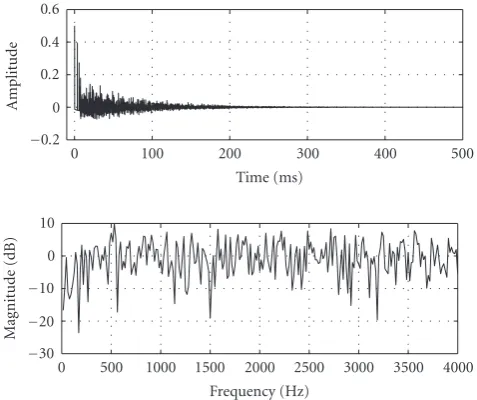
Figure 2shows the arrangement of the source and the micro-phones used in the experiment. Four micromicro-phones are used (P=4), and room impulse responses between the source and the microphones are simulated by using the image method [19]. The sampling frequency is set at 8 kHz. The impulse responses are truncated to 4000 samples (J =3999), corre-sponding to−60 dB attenuation (the reverberation time of the room is 500 ms).Figure 3shows an example of the im-pulse response and its frequency response.
We define the input and output SNRs as follows. For the
ith microphone, the input SNR is defined as
SNRin=10 log10
" #N n=0y2i(n)
#N n=0wi2(n)
$
, (18)
whereyi(n) is the reverberant signal without noise, andwi(n) is the noise. In the experiment, we adjust the input SNR by controlling the amplitude of the noise signal. The output SNR is defined as
SNRout=10 log10
" #N n=0
y(n)Tg r
2
#N n=0
w(n)Tg r
2
$
, (19)
wherey(n)= HTs(n) is the reverberant signal vector. This output SNR is obtained by filtering the reverberant and the noise signals separately and taking the power ratio of the output signals.
−0.2 0 0.2 0.4 0.6
A
m
plitude
0 100 200 300 400 500
Time (ms)
−30
−20
−10 0 10
M
ag
nitude
(dB)
0 500 1000 1500 2000 2500 3000 3500 4000 Frequency (Hz)
Figure3: Waveform of a room impulse responseh1(n) and its
fre-quency characteristics.
3.2. Evaluation criteria
In order to avoid any dependency of the results on the source signal, we used uncorrelated white signals with a duration of 3 seconds for both source signal and noise rather than speech. The dereverberation performance is evaluated by using the signal-to-distortion ratio (SDR) defined as
SDR=10 log10
" #N n=0s2(n)
#N n=0
s(n)−%s(n)2
$
, (20)
wheres(n) is the original source signal and%s(n) is the output signal of the inverse filter defined as%s(n)=x(n)Tg
r.
3.3. Results
Figure 4shows the filter energy with various modeling de-lays and regularization parameters when the minimum filter lengthM=Mmin=1333 is used, as described inSection 2.2. The energy decreases with increases in both the modeling de-lay and the regularization parameter, and shows the mini-mum value whenδ=10−1andd=500.
Figure 5shows the inverse filter calculated withδ=10−6 andδ =10−1when the modeling delay is fixed atd=500. We clearly observed that the filter energy was reduced by in-creasing the regularization parameter.
0 1 2 3 4 5 6 7 8
Filt
er
energ
y
10−9 10−4 10−3 10−2 10−1
Regularization parameter
d=0
d=100
d=200
d=300
d=400
d=500
Figure4: Filter energy as a function of regularization parameter and modeling delay (filter length is fixed atM=1333).
−0.2
−0.1 0 0.1 0.2
0 200 400 600 800 1000 1200
(a)
−0.2
−0.1 0 0.1 0.2
0 200 400 600 800 1000 1200
(b)
Figure5: An example of inverse filterg1(n) calculated withδ =
10−6(a) andδ=10−1(b) (modeling delay is fixed atd=500).
decreased and the deviation of the equalized response from the ideal one became large.
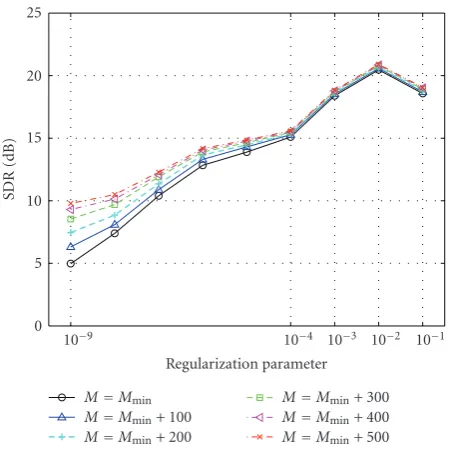
In the second experiment, the modeling delay was fixed atd=500, and the effect of filter lengthMwas investigated with various regularization parameters δ. Figures 7 and8 show the filter energy and corresponding performance in this case. InFigure 7, the energy decreases with increases in both the filter length and the regularization parameter, although the effect of the filter length is less significant when a large
0 5 10 15 20 25
SDR
(dB)
10−9 10−4 10−3 10−2 10−1
Regularization parameter
d=0
d=100
d=200
d=300
d=400
d=500
Figure6: Performance as a function of regularization parameter and modeling delay with an SNR of 20 dB (filter length is fixed at
M=1333).
0 1 2 3 4 5 6 7 8
Filt
er
energ
y
10−9 10−4 10−3 10−2 10−1
Regularization parameter
M=Mmin
M=Mmin+ 100
M=Mmin+ 200
M=Mmin+ 300
M=Mmin+ 400
M=Mmin+ 500
Figure7: Filter energy as a function of regularization parameter and filter length (modeling delay is fixed atd=500).
regularization parameter such as δ = 10−1 to δ = 10−2 is used. In Figure 8, the best performance was obtained with
δ = 10−2 for all the filter lengths used in this experiment, which corresponds to the input SNR level. The performance was also improved by using the larger filter length.
In the third experiment, we evaluated the performance for several SNR values by using modeling delay d = 500 and filter length M = 1333 (minimum case), or M =
0 5 10 15 20 25
SDR
(dB)
10−9 10−4 10−3 10−2 10−1
Regularization parameter
M=Mmin
M=Mmin+ 100
M=Mmin+ 200
M=Mmin+ 300
M=Mmin+ 400
M=Mmin+ 500
Figure8: Performance as a function of regularization parameter and filter length with an SNR of 20 dB (modeling delay is fixed at
d=500).
obtained with input SNRs of 10, 20, 30, and 40 dB. As the input SNR increases, the regularization parameter that pro-vides the best performance decreases. We observe that the best regularization parameter corresponds to the input SNR. We also observe that the performance evaluated with SDR is bounded by the input SNR level. In addition, when the input SNR is 20 dB, the output SNR defined in (19) is about 20 dB, indicating that the input noise is not amplified.
By using a proper delay and a larger filter length, the in-verse filter’s energy and equalization error can be reduced. Furthermore, appropriate choice of the regularization pa-rameter is effective for reducing the equalization error. In the next section, we investigate the applicability of this strategy to the RTF fluctuations.
4. EXPERIMENTS FOR RTF FLUCTUATIONS
Simulations are undertaken to investigate the effect of the RTF fluctuations on the inverse filter. Here, we consider the fluctuations caused by source position fluctuations in the horizontal plane for the sake of simplicity. The more general case of three-dimensional fluctuations is not investigated in this paper.
4.1. Experimental setup
We consider the same room as in the previous experiment shown inFigure 2. As for the source positions, we simulate the fluctuations in source position as follows. As shown in Figure 10, we considerNequally spaced new positions placed on a circle of radiusrcentered at the original position. As a model of fluctuation, we assume that the source is located at each of theseNpositions with equal probability, and that the
averaged RTF over these positions is obtained through either measurement or estimation. This averaged RTF is referred to as “reference RTF,” and is used to calculate inverse filters according to (16). In the following simulation, the number of source positons is fixed toN=8.
4.2. Evaluation procedure
The performance of the inverse filter for fluctuations in the source position is evaluated as follows.
(1) An inverse filter set is calculated based on the reference RTFs according to (16).
(2) For each new source position j (j = 1,. . ., 8), equal-ization is achieved by filtering reverberant signals with the inverse filter set calculated in (1).
(3) SDR values are calculated for all of the dereverberated signals obtained in (2), and the SDR values are aver-aged over the 8 positions to obtain the overall perfor-mance measure.
4.3. Results
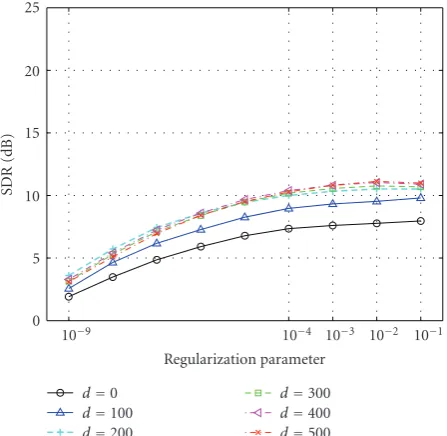
The influence of the design parameters on performance is evaluated in the same manner as in the previous experiment. Figure 11shows the performance of an inverse filter designed with various modeling delays dand regularization param-eters δ with radius r = 1 cm. This radius corresponds to one eighth of a wavelength of the center frequency of sig-nals in consideration. Conventional studies have shown con-siderable degradation in the performance for this displace-ment. In general, the performance shows a similar tendency to that obtained in the previous experiment. That is, the per-formance is inversely proportional to the filter energy, and improved with increases in the regularization parameter and modeling delay. We observed that the best performance was obtained at δ = 10−2 andd = 500. However, the perfor-mance is rather flat compared with that inFigure 6. For a change of source position ofr=1 cm, the best performance was 12 dB.
In the second experiment, the modeling delay was fixed atd = 500, and the effects of filter lengthM and regular-ization parameterδ were investigated. Figure 12shows the performance in this case. Here also, we observed that the performance is inversely proportional to the filter energy. Furthermore, the performance depends on the regularization parameter less than in the case of additive noise. In the case of additive noise, the noise correlation matrixRnin (12) could be well approximated toδI. On the contrary, the correlation matrix of the fluctuationRHin (14) could not be correctly approximated toδI.
Figure 13shows the performance for position variations ofr =1, 2, 3, and 4 cm. The modeling delay was set atd =
0 5 10 15 20 25 30 35 40
SDR
(dB)
10−9 10−4 10−3 10−2 10−1
Regularization parameter 10 dB
20 dB
30 dB 40 dB (a)
0 5 10 15 20 25 30 35 40
SDR
(dB)
10−9 10−4 10−3 10−2 10−1
Regularization parameter 10 dB
20 dB
30 dB 40 dB (b)
Figure9: Performance as a function of regularization parameter for SNR values of 10, 20, 30, and 40 dB (d=500). Filter length was set at
M=1333 (a), andM=1333 + 500 (b), respectively.
1 2 3
4
5
6
7
8 Original position
rcm
New position
Figure10: Source positions considered in the experiment.
Again, by using an appropriate delay and filter length, the inverse filter’s energy could be reduced, and accordingly the inverse filtering performance could be improved. Further-more, an appropriate choice of regularization parameter was effective. However, the effect of adjusting this regularization parameter is less obvious than with additive noise.
In the next section, we analyze the RTF fluctuations caused by position changes, and discuss the differences be-tween the results for RTF fluctuations and additive noise.
5. DISCUSSION
5.1. Comparison between RTF fluctuations and noise
We compare the results for RTF fluctuations shown in Figure 9 and the results for noise shown in Figure 13. As shown in Figure 9, the dereverberation performance has a maximum point for a certain regularization parameter value,
0 5 10 15 20 25
SDR
(dB)
10−9 10−4 10−3 10−2 10−1
Regularization parameter
d=0
d=100
d=200
d=300
d=400
d=500
Figure11: Performance as a function of the regularization param-eter and modeling delay (filter length is fixed atM=1333).
0 5 10 15 20 25
SDR
(dB)
10−9 10−4 10−3 10−2 10−1
Regularization parameter
M=Mmin
M=Mmin+ 100
M=Mmin+ 200
M=Mmin+ 300
M=Mmin+ 400
M=Mmin+ 500
Figure12: Performance as a function of the regularization parame-ter and additional filparame-ter length (modeling delay is fixed atd=500).
in consideration) as shown in Figure 13, although the best value for the regularization parameter is almost the same, that is,δ=10−2, the corresponding SDR was around 12 dB, and the curve was much broader than inFigure 9. That is, the performance does not depend greatly onδ.
The cause of the difference between these two results is discussed here. We analyze the effect of using this fil-ter in the fluctuation case on the performance using the fluctuation model described in Section 5.1. Let us denote the RTF matrix corresponding to each source position as Hj = H+Hj, where H represents the reference RTF ma-trix averaged over the positions, andHjrepresents the fluc-tuation between the reference RTF and the RTF for the jth new postion. If the source switches back and forth among all the possible positions with equal probability, we can con-sider that the periods in which the source locates at each po-sition are rearranged and put together. Then, the total er-ror may be calculated as the sum of erer-rors for all the posi-tions as
C= 1 N
N
j=1
Hjg−v2= 1
N
N
j=1
H+Hj
g−v2. (21)
By considering sufficienty large number of N, we replace spatial averaging with an expectation,
C=E(H+H)g−v2
=E(Hg−v+Hg )T(Hg−v+Hg ).
(22)
This turns out to be (13).
−2 0 2 4 6 8 10 12 14
SDR
(dB)
10−9 10−4 10−3 10−2 10−1
Regularization parameter 1 cm
2 cm
3 cm 4 cm (a)
−2 0 2 4 6 8 10 12 14
SDR
(dB)
10−9 10−4 10−3 10−2 10−1
Regularization parameter 1 cm
2 cm
3 cm 4 cm (b)
Figure13: Performance as a function of the regularization param-eter for position variations ofr=1, 2, 3 and 4 cm (d=500). Filter length was set atM=1333 (a), andM =1333 + 500 (b), respec-tively.
Let us evaluate the difference in performance between
EHTHandδI. First, we compare autocorrelation traces of an example RTF fluctuation and of a random signal used in the experiment. Figure 14shows these autocorrelations. There is a discrepancy between these two correlations. This may explain why the adjustment of the regularization pa-rameter is of limited efficiency in the presence of RTF fluc-tuations.
−0.5 0 0.5 1
Cor
re
la
ti
o
n
0 1000 2000 3000 4000 5000 6000 7000 8000 Time (samples)
(a) Autocorrelation trace of RTF fluctuations,r=1 cm
−0.5 0 0.5 1
Cor
re
la
ti
o
n
0 1000 2000 3000 4000 5000 6000 7000 8000 Time (samples)
(b) Autocorrelation trace of a random signal
Figure14: Autocorrelation coefficients.
Table1: Regularization performance.
Regularization matrixR (1)δI,δ=10−2 (2)EHTH ≈ (1/8)#8
j=1HTjHj
Average SDR (dB) 12.0 15.7
defined as
(1) R=δI,δ=10−2, (2) R=EHTH ≈(1/8)#8
j=1HTjHj,Hj=Hj−H.
The performance of the inverse filter calculated with (15) is shown inTable 1. The performance with the correlation ma-trix in (2) is improved by 3.7 dB compared with the mama-trix in (1). This result shows the effect of incorporating the au-tocorrelation of the RTF fluctuations. If the time structure of the fluctuations could be obtained, for example by estimating the averaged autocorrelation of the fluctuation, more robust inverse filters could be obtained. Future work should include finding ways to estimate such fluctuation’s time structure.
5.2. Results of speech dereverberation
Finally, the dereverberation performance is shown using speech signals.Figure 15shows spectrograms of the (a) orig-inal, (b) reverberant, and (c), (d) dereverberated speech sig-nals. The reference RTFs were used to calculate the inverse filter, and the RTFs corresponding to the 5th new position in Figure 10were used to calculate the reverberant speech and for dereverberation. The source position change is 1 cm. The filter length was set at M = 1333, and the modeling delay was d = 500. The SDR of the reverberant speech is 1.8 dB.Figure 15(c)shows a spectrogram of the
dereverber-ated speech signal filtered by the inverse filter with the reg-ularization parameter δ = 10−9. Although the figure ap-pears less reverberant thanFigure 15(b), there is some degra-dation and an SDR of 10.9 dB was obtained. Figure 15(d) shows a spectrogram of the dereverberated speech filtered by the inverse filter withδ = 10−2. When the proper reg-ularization parameter was used, the SDR improved by up to 17 dB. This SDR value is 5 dB higher than that obtained using a white signal as shown in Figure 13. This diff er-ence comes from the fact that the distortion mainly occurs in the higher frequency range, where speech has low en-ergy.
0 500 1000 1500 2000 2500 3000 3500 4000
Fre
q
u
en
cy
(H
z)
0 0.5 1 1.5 2
Time (s) (a) Clean speech
0 500 1000 1500 2000 2500 3000 3500 4000
Fre
q
u
en
cy
(H
z)
0 0.5 1 1.5 2
Time (s) (b) Reverberant speech (SDR=1.8 dB)
0 500 1000 1500 2000 2500 3000 3500 4000
Fre
q
u
en
cy
(H
z)
0 0.5 1 1.5 2
Time (s)
(c) Recovered speech with fluctuation (δ=10−9,
SDR=10.9 dB)
0 500 1000 1500 2000 2500 3000 3500 4000
Fre
q
u
en
cy
(H
z)
0 0.5 1 1.5 2
Time (s)
(d) Recovered speech with fluctuation (δ=10−2,
SDR=17 dB) Figure15: Spectrograms of speech signals.
6. CONCLUSION
With a view of extending the applicability of inverse-filter-based dereverberation, this paper examined a design method for an inverse filter, in which the filter design parameters were adjusted to reduce the filter energy. The regulariza-tion parameter, modeling delay, and filter length were se-lected to improve the performance when the RTFs fluctu-ated and when slight interference noise was present at the microphone signals. Simulation results showed that the in-verse filtering performance could be improved by properly adjusting the design parameters, which led to a reduction in the filter energy. Consequently, this approach was shown to be effective for both RTF fluctuation and interference noise.
We discussed the differences between the results we ob-tained for RTF fluctuations and white noise. We observed that the performance with the regularization parameter did not improve greatly with regard to the RTF fluctuations, while the performance for the white noise showed a clear peak corresponding to the input SNR level. This is because RTF fluctuations are not random, and the regularized in-verse filter implicitly assumes that the fluctuation is
ran-dom. To demonstrate this, we used the autocorrelation of the fluctuation to calculate the inverse filter. The simula-tion result revealed that the RTF fluctuasimula-tion had time struc-tures. Future work thus includes finding ways to incorporate such fluctuation’s time structures into the filter design pro-cess.
0 500 1000 1500 2000 2500 3000 3500 4000
Fre
q
u
en
cy
(H
z)
0 0.5 1 1.5 2
Time (s)
(a) Reverberant and noisy speech (SNRin=20 dB,
SDR=0.5 dB)
0 500 1000 1500 2000 2500 3000 3500 4000
Fre
q
u
en
cy
(H
z)
0 0.5 1 1.5 2
Time (s)
(b) Recovered speech (δ=10−9, SDR=5.1 dB)
0 500 1000 1500 2000 2500 3000 3500 4000
Fre
q
u
en
cy
(H
z)
0 0.5 1 1.5 2
Time (s)
(c) Recovered speech (δ=10−2, SDR=15.9 dB,
SNRout=20 dB)
Figure16: Spectrograms of speech signals.
ACKNOWLEDGMENT
The authors thank Mr. Takeaki Kubota of Nagoya University for arranging the experimental data and conducting the sim-ulation described in the discussion (Section 5).
REFERENCES
[1] M. Miyoshi and Y. Kaneda, “Inverse filtering of room acous-tics,”IEEE Transactions on Acoustics, Speech, and Signal Pro-cessing, vol. 36, no. 2, pp. 145–152, 1988.
[2] K. Furuya and Y. Kaneda, “Two-channel blind deconvolution of nonminimum phase FIR systems,”IEICE Transactions on Fundamentals of Electronics, Communications and Computer Sciences, vol. E80-A, no. 5, pp. 804–808, 1997.
[3] T. Hikichi, M. Delcroix, and M. Miyoshi, “Blind dereverbera-tion based on estimates of signal transmission channels with-out precise information on channel order,” inProceedings of IEEE International Conference on Acoustics, Speech, and Signal Processing (ICASSP ’05), vol. 1, pp. 1069–1072, Philadelphia, Pa, USA, March 2005.
[4] Y. Huang, J. Benesty, and J. Chen, “A blind channel identification-based two-stage approach to separation and dereverberation of speech signals in a reverberant environ-ment,” IEEE Transactions on Speech and Audio Processing, vol. 13, no. 5, pp. 882–895, 2005.
[5] J. Mourjopoulos, “On the variation and invertibility of room impulse response functions,”Journal of Sound and Vibration, vol. 102, no. 2, pp. 217–228, 1985.
[6] T. Hikichi and F. Itakura, “Time variation of room acoustic transfer functions and its effects on a multi-microphone dere-verberation approach,” inProceedings of the Workshop on Mi-crophone Arrays: Theory, Design and Application, Piscataway, NJ, USA, October 1994.
[7] M. Omura, M. Yada, H. Saruwatari, S. Kajita, K. Takeda, and F. Itakura, “Compensating of room acoustic transfer functions affected by change of room temperature,” inProceedings of IEEE International Conference on Acoustics, Speech, and Signal Processing (ICASSP ’99), vol. 2, pp. 941–944, Phoenix, Ariz, USA, March 1999.
[8] B. D. Radlovi´c, R. C. Williamson, and R. A. Kennedy, “Equal-ization in an acoustic reverberant environment: robustness re-sults,”IEEE Transactions on Speech and Audio Processing, vol. 8, no. 3, pp. 311–319, 2000.
[9] F. Talantzis and D. B. Ward, “Robustness of multichannel equalization in an acoustic reverberant environment,” The Journal of the Acoustical Society of America, vol. 114, no. 2, pp. 833–841, 2003.
[10] H. Tokuno, O. Kirkeby, P. A. Nelson, and H. Hamada, “Inverse filter of sound reproduction systems using regularization,” IE-ICE Transactions on Fundamentals of Electronics, Communica-tions and Computer Sciences, vol. E80-A, no. 5, pp. 809–820, 1997.
[11] P. C. Hansen, “The truncated SVD as a method for regulariza-tion,”BIT Numerical Mathematics, vol. 27, no. 4, pp. 534–553, 1987.
[12] Y. Tatekura, Y. Nagata, H. Saruwatari, and K. Shikano, “Adap-tive algorithm of itera“Adap-tive inverse filter relaxation to acoustic fluctuation in sound reproduction system,” inProceedings of the 18th International Congress on Acoustics (ICA ’04), vol. 4, pp. 3163–3166, Kyoto, Japan, April 2004.
[13] Y. Tatekura, S. Urata, H. Saruwatari, and K. Shikano, “On-line relaxation algorithm applicable to acoustic fluctuation for in-verse filter in multichannel sound reproduction system,” IE-ICE Transactions on Fundamentals of Electronics, Communica-tions and Computer Sciences, vol. E88-A, no. 7, pp. 1747–1756, 2005.
[15] D. A. Harville,Matrix Algebra from a Statistician’s Perspective, Springer, New York, NY, USA, 1997.
[16] S. J. Elliott, C. C. Boucher, and P. A. Nelson, “The behavior of a multiple channel active control system,”IEEE Transactions on Signal Processing, vol. 40, no. 5, pp. 1041–1052, 1992. [17] J. W. Hilgers, “On the equivalence of regularization and certain
reproducing kernel Hilbert space approaches for solving first kind problems,”SIAM Journal on Numerical Analysis, vol. 13, no. 2, pp. 172–184, 1976.
[18] A. Kaminuma, S. Ise, and K. Shikano, “A method of design-ing inverse system multi-channel sound reproduction system using least-norm-solution,” inProceedings of the International Symposium on Active Control of Sound and Vibration (Ac-tive ’99), vol. 2, pp. 863–874, Fort Lauderdale, Fla, USA, De-cember 1999.
[19] J. B. Allen and D. A. Berkley, “Image method for efficiently simulating small-room acoustics,”The Journal of the Acoustical Society of America, vol. 65, no. 4, pp. 943–950, 1979.
[20] R. Martin, “Noise power spectral density estimation based on optimal smoothing and minimum statistics,”IEEE Transac-tions on Speech and Audio Processing, vol. 9, no. 5, pp. 504–512, 2001.
Takafumi Hikichiwas born in Nagoya, in 1970. He received his Bachelor and Mas-ter of Electrical Engineering degrees from Nagoya University in 1993 and 1995, re-spectively. In 1995, he joined the Basic Re-search Laboratories of NTT. He is currently working at the Signal Processing Research Group of the Communication Science Lab-oratories, NTT. He is a Visiting Associate Professor of the Graduate School of
Infor-mation Science, Nagoya University. His research interests include physical modeling of musical instruments, room acoustic model-ing, and signal processing for speech enhancement and dereverber-ation. He received the 2000 Kiyoshi-Awaya Incentive Awards, and the 2006 Satoh Paper Awards from the ASJ. He is a Member of IEEE, ASA, ASJ, and IEICE.
Marc Delcroix was born in Brussels in 1980. He received the Master of Engineer-ing from the Free University of Brussels and Ecole Centrale Paris in 2003. He is currently doing his Ph.D. at the Graduate School of Information Science and Tech-nology of Hokkaido University. He is do-ing his research on speech dereverberation in collaboration with NTT Communication Science Laboratories. He received the 2006
Satoh Paper Awards from the ASJ. He is a Member of IEEE and ISCA.
Masato Miyoshireceived the M.E. degree from Doshisha University in Kyoto in 1983. Since joining NTT as a Researcher that year, he has been engaged in the research and development of acoustic signal process-ing technologies. Currently, he is a Group Leader of the Media Information Labora-tory of NTT Communication Science Lab-oratories in Kyoto. He is also a Visiting As-sociate Professor of the Graduate School of
Information Science and Technology, Hokkaido University. He