Volume 2007, Article ID 47695,20pages doi:10.1155/2007/47695
Research Article
Wavelet Transform for Processing Power Quality Disturbances
S. Chen and H. Y. Zhu
School of Electrical and Electronic Engineering, Nanyang Technological University, 50 Nanyang Avenue, Singapore 639798
Received 29 April 2006; Revised 25 January 2007; Accepted 17 February 2007
Recommended by Irene Y. H. Gu
The emergence of power quality as a topical issue in power systems in the 1990s largely coincides with the huge advancements achieved in the computing technology and information theory. This unsurprisingly has spurred the development of more so-phisticated instruments for measuring power quality disturbances and the use of new methods in processing and analyzing the measurements. Fourier theory was the core of many traditional techniques and it is still widely used today. However, it is increas-ingly being replaced by newer approaches notably wavelet transform and especially in the post-event processing of the time-varying phenomena. This paper reviews the use of wavelet transform approach in processing power quality data. The strengths, limitations, and challenges in employing the methods are discussed with consideration of the needs and expectations when analyzing power quality disturbances. Several examples are given and discussions are made on the various design issues and considerations, which would be useful to those contemplating adopting wavelet transform in power quality applications. A new approach of combining wavelet transform and rank correlation is introduced as an alternative method for identifying capacitor-switching transients.
Copyright © 2007 S. Chen and H. Y. Zhu. This is an open access article distributed under the Creative Commons Attribution License, which permits unrestricted use, distribution, and reproduction in any medium, provided the original work is properly cited.
1. INTRODUCTION
Power quality is an umbrella terminology covering a mul-titude of voltage disturbances and distortions in power sys-tems [1,2]. It is often taken as synonymous to voltage qual-ity as electrical equipment is generally designed to operate on voltage supply of certain “quality.” However, “quality” is a subjective matter as it depends very much on the individ-ual requirements and circumstances. Voltage that is consid-ered good for operating water heater may not be adequate for powering computers. In essence, power quality is a com-patibility issue between the supply systems and loads [3]. As long as both can coexist without causing any ill effects on each other, the quality can be regarded as good or ade-quate. Hence, the scope of power quality is often extended to include imperfections in the design of supply system such as unbalanced transmission/distribution lines, poor connec-tions, and inapt groundings.
Nonetheless, the majority of disruptions recognized as power quality problems involve electromagnetic phenomena that cause the supply voltage to deviate from its ideal char-acteristics of constant frequency (50/60 Hz), constant volt-age magnitude (nominal values), and completely sinusoidal [1]. These phenomena can be divided into two broad
cat-egories of time-varying and steady-state (or intermittent) events. The former group comprises voltage transients, dips, swells, and interruptions. They normally occur for a brief period of time (several milliseconds), but are often severe enough to cause wide-ranging disruptions to many electrical loads. Voltage dips lasting 5-6 cycles are known to cause pro-grammable logic controller (PLC) in factories to malfunc-tion. The latter group includes voltage unbalances, harmonic and interharmonic distortions, voltage fluctuation, notch-ing, and noise. These steady-state (or semi-steady-state) phe-nomena would act subtly over a certain period of time be-fore disruption occurs or intolerable condition surfaces. Har-monic voltage causes additional stress on equipment insu-lation, shortening their useful life. The eventual insulation breakdown often occurs after the equipment is being sub-jected to the distortion over extended period of time.
and characterisation, followed by solution assessment and design. Further processing may be necessary if the results are to be presented in some special way. Designer of power conditioner would need to know the worst-case distur-bance/distortion levels with much detailed, and both the magnitude and phase angle are equally important for the conditioner operation. On the other hand, a facility manager evaluating the overall quality level would prefer an overview of the measurements incorporating some statistical sum-maries. In such cases, magnitude would probably be suffi -cient. Regulator monitoring customers’ compliance to limits would need the data processed and the results presented ac-cording to the methods stipulated in the regulation, standard or contract. Although one can argue that similar techniques can be applied in all scenarios, but the degree of processing or summarization is often different, largely affected by the length of the evaluation period.
With the advancement in measurement technology, an increasing volume of data is being gathered and it needs to be analyzed. It is highly desirable if the analysis is auto-mated. Signal processing is therefore called upon for identi-fication, classification and characterization. The techniques used vary, depending on the characteristics of the phenom-ena. As power systems use AC (alternating current), the RMS (root-mean-square) quantity is the most commonly used measure for voltage magnitude. Although it is meant for periodic waveform, it is often taken as a rough estimate of the nonperiodic or time-varying voltage variations. Voltage dips, swells, and interruptions are often characterized and classified using this quantity. When more explicit informa-tion is needed, such as evaluating disturbance propagainforma-tion, time-frequency decomposition methods are necessary. Dis-crete Fourier transform (DFT) is a convenient way of visual-izing stationary and periodic signal from its frequency con-tent viewpoint. It is also applied to nonstationary signals but with added windowing to focus on certain period of time. This is called short time Fourier transform (STFT), allowing some tracing of the magnitude variations. Harmonic distor-tions are typically handled in this manner but the constraint placed on the frequency resolution makes it difficult to ex-tend STFT to the analysis of interharmonics.
Fast voltage transients require the peak magnitudes and rise times to be determined accurately. For oscillatory tran-sient, its predominant frequency needs to be derived before computing its magnitude. DFT is often used even though these waveforms are not periodic and last for less than one fundamental cycle since it is often necessary to determine their spectra content. Estimation techniques such as Kalman filtering are also called upon when there are uncertainties in the data. For other analyses that consider the effect of sensitive loads such as flickering of incandescent lamp due to voltage fluctuation, the data processing needs to mimic the behavior of lamp responses, human visual and psy-chological perception. Finally, after identification, classifica-tion, and characterizaclassifica-tion, the relevant information needs to be stored for future reference. Although the signal pro-cessing undertaken in these steps can be taken as some form of compression, further processing and threshold
op-eration is often carried out to reduce the amount of data stored.
Wavelet transform (WT) is increasingly being proposed for the above processing in place of Fourier-based tech-niques. The primary reason for advocating WT is that it does not need to assume that the signal is stationary or periodic, not even within the analysis window. This makes it highly suitable for tracing changes in signal including fast changes in high-frequency components. WT is a time-scale decom-position technique and is generalized as a form of time-“frequency band” analysis method. It not only traces sig-nal changes across the time plane, but it also breaks sigsig-nal up across the frequency plane. In discrete wavelet transform (DWT), signal is broken into multiple frequency bands, in-stead of a discrete number of frequency components as in DFT. With this character, WT is more appropriate if one is unsure of the exact frequency. Fortunately, most analyses do not require the exact frequency since a lumped quantity (fre-quency band) is sufficient to achieve their purposes. How-ever, with power system engineering heavily entrenched in Fourier’s techniques, it remains questionable if wavelet tech-niques are applicable and useful for the representation and analysis of voltage disturbances encountered in power sys-tems [5].
This paper reviews the wavelet transform as a signal processing tool for processing power-quality-related distur-bance waveforms.Section 2provides a succinct introduction of WT and dwells into the properties of its basis functions. It explains the flexibilities and options inherent in the WT procedure, and demonstrates how they can be employed in power quality analysis. The challenges as well as opportu-nities presented by this new signal processing technique are traded side-by-side with respect to the requirements in ana-lyzing power quality data. InSection 3, some exemplary uses of WT in power quality studies are presented. This is fol-lowed bySection 4detailing various important factors that must be considered when contemplating wavelet approach in power quality applications.Section 5describes a new ap-proach of combining rank correlation with WT for identify-ing the capacitor-switchidentify-ing event. The conclusions and rec-ommendations are given on which power quality phenom-ena WT is suitable for use and vice versa.
2. WAVELET ANALYSIS
numerical solutions for partial differential equations [7]. In recent years, it is increasingly being used in many power system applications including power quality measurement and assessment [8].
Wavelet analysis is a form of time-frequency technique as it evaluates signal simultaneously in the time and frequency domains. It uses wavelets, “small waves,” which are functions with limited energy and zero average,
+∞
−∞ψ(t)dt=0. (1)
The functions are typically normalized, ψ = 1 and cen-tered in the neighborhood oft = 0. It plays the same role as the sine and cosine functions in the Fourier analysis. In wavelet transform, a specific wavelet is first selected as the basis function commonly referred to as the mother wavelet. Dilated (stretched) and translated (shifted in time) versions of the mother wavelet are then generated. Dilation is denoted by the scale parametera while time translation is adjusted throughb[9],
ψa,b(t)= √1 aψ
t−b a
, (2)
whereais a positive real number andbis a real number. The wavelet transform of a signal f(t) at a scaleaand time trans-lationbis the dot product of the signal f(t) and the partic-ular version of the mother wavelet,ψa,b(t). It is computed by circular convolution of the signal with the wavelet function
Wf(a,b)=f,ψa,b
=
+∞
−∞ f(t)·
1 √
aψ
∗t−b
a
dt.
(3)
A contracted version of the mother wavelet would corre-spond to high frequency and is typically used in temporal analysis of signals, while a dilated version corresponds to low frequency and is used for frequency analysis.
With wavelet functions, only information of scalea < 1 corresponding to high frequencies is obtained. In order to obtain the low-frequency information necessary for full rep-resentation of the original signal f(t), it is necessary to deter-mine the wavelet coefficients for scalea >1. This is achieved by introducing a scaling function φ(t) which is an aggre-gation of the mother waveletsψ(t) at scales greater than 1. The scaling function can also be scaled and translated as the wavelet function,
φa,b(t)= 1 √
aφ
t−b a
. (4)
With scaling function, the low-frequency approximation of f(t) at a scaleais the dot product of the signal and the par-ticular scaling function [9], and can be computed by circular convolution
Lf(a,b)=f,φa,b
=
+∞
−∞ f(t)
1 √
aφ
∗t−b
a
dt. (5)
Implementation of these two transforms (3) and (5) can be done smoothly in continuous wavelet transform (CWT) or discretely in discrete wavelet transform (DWT). The details are described inAppendix A.
2.1. Multiresolution analysis
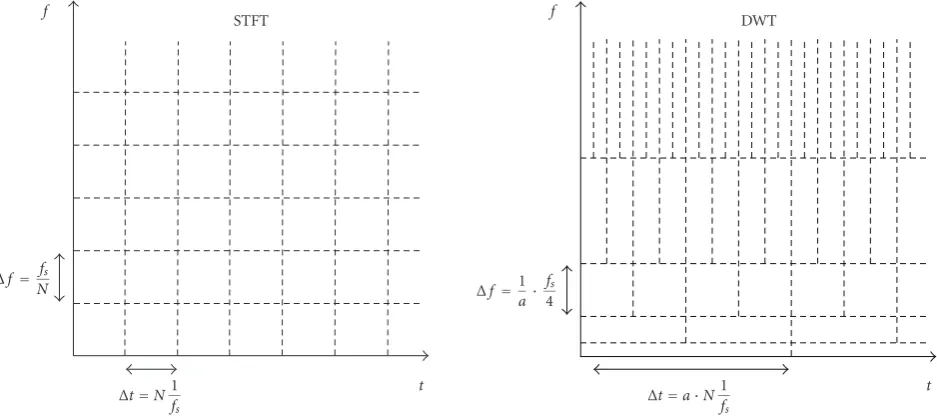
One important trait of wavelet transform is that its nonuni-form time and frequency spreads across the frequency plane. They vary with scale a but in the opposite manner, with the time spread being directly proportional toawhile fre-quency spread to 1/a. This effect is best illustrated by the time-frequency boxes as shown in Figure 1for short time Fourier transform (STFT) and DWT. In STFT, the time and frequency resolutions (ΔtandΔf) are constant as illustrated by the fixed square boxes over the time-frequency plane. On the other hand, the resolutions of DWT vary across the planes. At low frequency when the variation is slow, the time resolution is coarse while the frequency resolution is fine. This enables accurate tracking of the frequency while allow-ing sufficient time for the slow variation to transpire before analysis. On the contrary, in the high-frequency range, it is important to pinpoint when the fast changes occur. The time resolution is therefore small, but the frequency resolution is compromised. However, it is generally not necessary to know the exact frequency in this range.
It is to be noted that as the resolutions vary, the area of the time-frequency boxes remain unchanged. This area is lower-bound by a limit as stipulated by the Heisenberg un-certainty principle “the more precisely the position is deter-mined, the less precisely the momentum is known in this instant and vice versa.” This principle asserts that one can-not know the exact time-frequency representation of a sig-nal (i.e., what spectral components exist at what instants of time). What one can know is the time interval in which cer-tain band of frequencies exists, which is a resolution prob-lem. In DWT, this principle still holds but it is manipulated to achieve the optimal time and frequency resolutions at dif-ferent frequency ranges.
This adjustment of the resolutions is inherent in wavelet transform as the wavelet basis is stretched or compressed during the transform. A high scale corresponds to a more “stretched” wavelet having a longer portion of the signal be-ing compared with it. This would result in the slowly chang-ing coarser feature of the signal to be determined accurately. On the contrary, a low scale uses compressed wavelet to sift out rapidly changing details that correspond to high frequen-cies. Compressed wavelet provides the necessary precision time resolution while compromising the frequency resolu-tion. This ability to expand function or signal with diff er-ent resolutions is termed as multiresolution analysis, which forms the cornerstone of many wavelet applications.
STFT
f
t
Δt=N1 fs Δf = fs
N
DWT
f
t
Δt=a·N1 fs Δf=1
a· fs 4
Figure1: Comparison of time and frequency resolutions (fs: sampling frequency;N: number of sample points per analysis window).
especially in the storage and handling of images. Last but not least, the localization property of wavelet enables discontinu-ities or breakdown points to be easily and vividly identified. It is therefore widely applied for detection of the onset of cer-tain events and to pin down the exact instant of the occur-rence.Section 3describes several power quality applications that make use of these capabilities.
3. WAVELET APPLICATIONS IN POWER QUALITY
The ability of wavelet transform in segregating a signal into multiple frequency bands with optimized resolutions makes it an attractive technique for analyzing power quality wave-form. It is particularly attractive for studying disturbance or transient waveform, where it is necessary to examine diff er-ent frequency componer-ents separately. This section discusses several popular uses of wavelet transform in the analysis of power quality disturbances.
3.1. Characterization of voltage transients
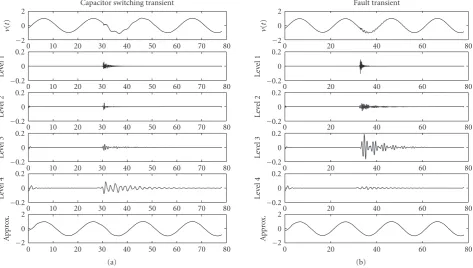
The time and space localization property of wavelet trans-form makes it highly suitable for analysis of discontinuities or abrupt changes in signal. In power systems, there are many voltage transients due to lightning strikes, equipment switching, load turning-on, and faults. With multiresolution analysis, the DWT provides a logarithmic coverage of the frequency spectrum as depicted inFigure 1. This has been shown to be useful in characterizing voltage transients caused by capacitor switching and faults [10].Figure 2shows how two voltage transient waveforms can be expanded into vari-ous levels (scales) corresponding to several frequency bands. In level 1, which is the highest frequency, several short bursts are observed for capacitor switching. Compared to the two distinct and separated bursts for fault, this can be used as
the discriminating feature between the events. In addition, significant ringing is observed at level 4, which may be the system natural frequency that is significantly affected by the switched capacitor.
In the above example [10], there is no redundant in-formation being used in the analysis as only one low-frequency scale (highest scale) is used alongside the other high-frequency scales. This corresponds to one approxima-tion term Aj0 and multiple detail terms Dj as defined in Figure 14, wherej0is the total number of decomposition lev-els. However, some redundancies may be useful as they may give more obvious discriminating patterns. In [11], all the approximation termsAj in successive decomposition levels are also employed alongside the detail termsDjto form the discriminating patterns between fault transient and capacitor switching transient.
Similar wavelet expansion approach is also being pro-posed for analyzing current drawn by arc furnace [12]. The wavelet expansion helps to identify which frequency ranges the disturbance energy is concentrated. The same technique is also applied to inrush, fault, and load currents for diff er-entiating between transformer magnetization inrushes, in-ternal short circuit faults, inin-ternal incipient faults as well as external short circuit faults and load changes [13]. The re-constructed bands of signals from wavelet coefficients in the respective scales form the unique patterns necessary for dis-crimination.
3.2. Characterization of short-duration voltage variations
Capacitor switching transient 2 0 −2 v ( t )
0 10 20 30 40 50 60 70 80
0.2 0 −0.2
Le
ve
l
1
0 10 20 30 40 50 60 70 80
0.2 0 −0.2
Le
ve
l
2
0 10 20 30 40 50 60 70 80
0.2 0 −0.2
Le
ve
l
3
0 10 20 30 40 50 60 70 80
0.2 0 −0.2
Le
ve
l
4
0 10 20 30 40 50 60 70 80
2 0 −2 A ppr o x.
0 10 20 30 40 50 60 70 80
(a) Fault transient 2 0 −2 v ( t )
0 20 40 60 80
0.2 0 −0.2
Le
ve
l
1
0 20 40 60 80
0.2 0 −0.2
Le
ve
l
2
0 20 40 60 80
0.2 0 −0.2
Le
ve
l
3
0 20 40 60 80
0.2 0 −0.2
Le
ve
l
4
0 20 40 60 80
2 0 −2 A ppr o x.
0 20 40 60 80
(b) Figure2: Wavelet expansion of voltage transients.
the operation of many modern electronic equipment. The important characteristics that indicate their severity are the magnitude and duration of the variations. Traditionally, RMS computation is used to derive the magnitude while the duration is taken as the time period the RMS magnitude stays below/above certain threshold (<90% for dips and>110% for swells. Although RMS method is generally considered as sufficient, the wavelet approach has been shown to produce more accurate results that would be useful for determining the causes of such variations.
Figure 3shows the waveform of a short-duration volt-age dip (70%; 5 cycles) followed by a 10-cycle interruption in (a), and the corresponding characterization using wavelet method. First, (b) and (c) shows the use of CWT in sift-ing out two frequency components of 50 Hz and 650 Hz and constructing their respective profiles [14]. The 650 Hz profile shows several sharp peaks denoting discontinuities, which are the occurring or ending instants of the disturbances. They are used to determine the durations of the dip and interrup-tion. On the other hand, the 50 Hz profile shows magnitude of the dip and interruption, respectively. It can be shown that this approach works well too for very short voltage variation with duration less than half a cycle.
This method has also been suggested for analyzing high-frequency oscillatory transients. CWT is used to isolate the 1500 Hz component and if its profile shows sharp and short peaks, then the disturbance is one of the voltage variations. If it shows a long series of peaks, then it corresponds to high-frequency transients. The same argument can also be applied to the 650 Hz component for low-frequency transients.
Instead of CWT, it is more efficient to employ DWT with-out many compromises to the characterization accuracy. The multiresolution analysis capability of DWT ensures that fine time resolution is maintained at the high-frequency bands for determining the occurring and ending instants. Although the time resolution at the low-frequency band loses preci-sion, it is not used to determine the times and hence it is still sufficient to approximate the magnitude variations. This is illustrated by (d) and (e). (d) is the DWT detail coefficients, which contain the high-frequency details with fine time reso-lution for pinpointing the time instants, while (e) is the DWT approximation coefficients reflecting the magnitude change.
3.3. Classification of various power quality events
The different levels of wavelet coefficient over the scales can be interpreted as uneven distribution of energy across the multiple frequency bands. This distribution forms patterns that have been found to be useful for classifying between dif-ferent power quality events. If the selected wavelet and scaling functions form an orthonormal (independent and normal-ized) set of basis, then the Parseval theorem relates the energy of the signal to the values of the coefficients. This means that the norm or energy of the signal can be separated according to the following multiresolution expansion:
f(t) 2dt= k
Aj
0(k)
2
+
j≤j0
k
Dj(k) 2 . (6)
2 0 −2
0 100 200 300 400 500
(a) Voltage waveform 0.4
0.2 0
0 100 200 300 400 500
(b) CWT 650 Hz profile 1
0.5 0
0 100 200 300 400 500
(c) CWT 50 Hz profile 1
0 −1
0 100 200 300 400
(d) DWT level 4 coefficients 5
0 −5
0 100 200 300 400
(e) DWT approx. coefficients
Figure3: Characterization of a short-duration voltage dip.
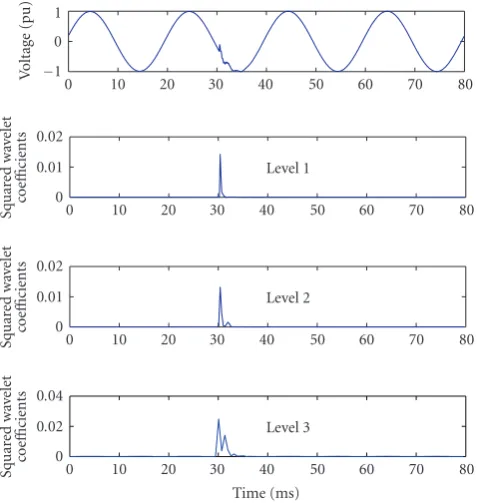
statistics of these values are used to identify transformer en-ergization, converter operation, capacitor energizing and re-striking. The maximum value of the squared coefficients in each scale or its average is found to be different before, dur-ing, and after transformer energization. Changes in these val-ues are used as the feature for its identification. Similarly, converter operation results in voltage notches, which are treated as discontinuities by wavelet transform and shown up in the frequency scales. Counting the number of high-valued squared coefficients over one fundamental period would lead to the event. Capacitor energization or breaker restriking on opening are known to cause rather dramatic voltage steps. When processed using DWT, high squared co-efficients are found across various scales.Figure 4shows a capacitor energizing transient waveform and the correspond-ing squared coefficients for three detail levels. The maximum values in each of the levels can be used as the feature to rec-ognize the event. In [16], the averages or selections of coef-ficients are used as inputs to a self-organizing mapping neu-ral network to distinguish between transients caused by load switching and capacitor switching.
Instead of using the maximum or average values, the energy distribution pattern in the wavelet domain can be computed as sums of the squared coefficients as in (6).
1 0 −1
Vo
lt
ag
e
(p
u
)
0 10 20 30 40 50 60 70 80
0.02 0.01 0
Sq
uar
ed
w
av
elet
co
e
ffi
cients
0 10 20 30 40 50 60 70 80
Level 1
0.02 0.01 0
Sq
uar
ed
w
av
elet
co
e
ffi
cients
0 10 20 30 40 50 60 70 80
Level 2
0.04 0.02 0
Sq
uar
ed
w
av
elet
co
e
ffi
cients
0 10 20 30 40 50 60 70 80
Level 3
Time (ms)
Figure 4: Capacitor-switching transient waveform and squared wavelet coefficients.
Figure 5 shows this energy distribution pattern for several commonly encountered power quality events. Differences between these patterns provide the differentiation features. Isolated capacitor switching shows more energy being dis-tributed among the lower levels, corresponding to higher fre-quencies than the back-to-back switching. This reflects the differences between the high-frequency transients in the for-mer condition and the low-frequency transients in the lat-ter. Impulsive transient shows energy being generally con-fined to the highest frequency band (level 1). The pattern for voltage dip shows energy in the low-frequency region (level 5), which includes the fundamental frequency. However, the transients at the starting and ending instants manifest them-selves as energy components in other lower scales (levels 3 and 4). These transients are not as pronounce when energiz-ing transformer. Often, there are some uncertainties with the waveforms or patterns due to the varying system and com-ponent parameters. Hence, fuzzy reasoning is used to extend the identification rules derived from these energy distribu-tion patterns [17]. Probabilistic neural network is another possible approach but it requires significant amount of data for training [18,19].
4. WAVELET METHOD DESIGN ISSUES
4 2 0
1 2 3 4 5
Wavelet expansion levels back-to-back capacitor
switching transient
4 2 0
Isolated capacitor switching transient
1 2 3 4 5
Wavelet expansion levels 0.4
0.2 0
Voltage dip
1 2 3 4 5
Wavelet expansion levels 0.4
0.2 0
Lightning impulsive transient
1 2 3 4 5
Wavelet expansion levels 0.4
0.2 0
Transformer energization inrush
1 2 3 4 5
Wavelet expansion levels 0.1
0.05 0
Pure sine wave
1 2 3 4 5
Wavelet expansion levels
Figure5: Energy distribution pattern in wavelet domain for various power quality events.
time-frequency decomposition, it is usually how exact one can anticipate the frequency contents of a signal that influ-ences the choice of technique, the associated design settings, and the subsequent implementation. For wavelet transform, these are the choice of mother wavelet, CWT or DWT, and the number of expansion levels.
4.1. Selection of mother wavelet
Successful application of wavelet transform depends heavily on the mother wavelet. The most appropriate one to use is generally the one that resembles the form of the signal. This is particularly true for achieving good data compression ra-tio since a close resemblance would produce high coefficients in certain selective scales and near-zero coefficients in the re-maining scales. However, this may not necessarily be as use-ful when forming patterns for identification and classifica-tion. Unique pattern for each event is more important than confining the coefficients to certain scales. Typically, if the representation can be spread across multiple scales, it tends
to reduce the dependency on specific scales and thus helps to desensitize the identification and classification process. This would also make the process more robust and reduce erro-neous identification.
There is a wide range of mother wavelets to choose from and each of them possesses unique properties as described in Appendix B. For power quality applications, it has been quoted to preferably be oscillatory, with a short support and has at least one vanishing moment [11,19]. The oscillatory feature is trivial as power networks are ac and many phenom-ena including transients are oscillatory in nature. A short support is a good trait as it keeps the number of high co-efficients small. In addition to having less data to operate on, it also makes it easier to set thresholds for detection. Van-ishing moments is another useful quality to have as it helps to suppress regular part of the signal, highlighting the sharp transitions. Unfortunately, support size and number of van-ishing moments often go hand-in-hand and a compromise is necessary. Generally, most power quality applications would select a mother wavelet with short support but has one or two vanishing moments.
Among the several wavelet functions that were men-tioned in the literature, theDaubechiesfamily of wavelets are the most widely used [12,13,15–18]. This is perhaps due to its wavelets satisfying the necessary properties as described in the previous paragraph.Daubechieswavelets are also well known and widely used in other applications. It is flexible as its order can be controlled to suit specific requirements. Among the different dbN (N-order) wavelets, db4 is the most widely adopted wavelet in power quality applications. It has sufficient number of vanishing moments to bring out the transients while maintaining a relatively short support to avoid having too many high-valued coefficients. Choos-ing the right mother wavelet often requires several rounds of trials, depending very much on the designer’s experience and knowledge of the signal to be analyzed. Oftentimes, only subtle differences are observed from using one wavelet to an-other. The lack of explicit expressions for many wavelet func-tions also makes it difficult to compare them with mathemat-ical rigours. Sometimes, it is the implementation issues such as the efficient DWT computation via FIR filtering that con-stitutes the overriding factor.
4.2. CWT or DWT
Level 1 Level 2 Level 3 Level 4 Level 5 Level 6 Approx. level
W
av
elet
expansion
le
ve
ls
5 kHz 2.5 kHz 1.25 kHz 625 Hz 312.5 Hz 156.25 Hz 78.125 Hz 0 Hz
Nyquist frequency for 10 kHz sampling rate High-frequency transients System-response transients
Characteristic harmonics
Fundamental frequency
Figure6: Frequency division of DWT filter for 10 kHz sampling rate.
This rather rigid way of splitting the frequency bandwidths may pose some difficulties to certain applications.
On the right-hand side of Figure 6, the typical power quality phenomena of interest are listed [10]. Despite the rather rigid division in frequency, DWT is still deemed fit if the events of interest can be localized to within one or two bands. At high frequencies, the frequency bandwidths are wide leading to poor frequency resolutions. It can be seen that the high-frequency transients fall within a bandwidth between 2 kHz and 3 kHz and further processing is necessary to determine the predominant frequency if it is oscillatory. The wide bandwidth also admits many frequencies, mak-ing the filtermak-ing less selective at the high-frequency range. Therefore, if knowing specific frequency component is im-portant, CWT or Fourier method is more suitable than DWT. However, if only an aggregate information within certain fre-quency bands are needed, DWT would be a more convenient and efficient choice.
4.3. Number of decomposition levels
The number of decomposition or expansion levels is very much related to the selection of CWT or DWT. For CWT, there is no rigid manner of decomposition, and hence the number of levels is arbitrary and as required. Frequently, it is decided according to the center frequency of the selected mother wavelet. For the CWT example shown inFigure 3, scales of 256 and 19.7 are selected for the 50 Hz and 650 Hz components, for using a complex mother waveletcmor1–1.5 (center frequency of 1) and sampling rate of 12.8 kHz (256 samples per fundamental cycle). On the other hand, with limited levels in DWT, it has to be decided carefully and it depends on how many divisions are to be made to the low-frequency ranges. Four to five levels of decomposition seem to be the most popular [13,15–17], while some use seven to eight levels [10,12], or even as many as thirteen levels [18]. InNDWT decomposition levels, there will beN−1 detail levels and 1 approximation level. Most applications use both the detail and approximation levels but some use only the
de-tail levels. The approximation level is almost always used to trace the fundamental frequency component only.
4.4. Wavelet or Fourier
It is inevitable that the wavelet techniques would be com-pared to the popular Fourier techniques. The Fourier the-ory is deeply entrenched in many areas of power system en-gineering, and this leads to a “risk” or “trap” that wavelet techniques are used to represent or mimic Fourier-based ex-pressions. Fourier techniques rely on relatively good knowl-edge of the signal spectrum. The design of measurement and processing systems are heavily dependent on this knowl-edge. Otherwise, spectral leakage can be significant leading to the need for windowing, which adds to the implementation complexity.
In discrete Fourier transform (DFT), the window length has a pronounce effect as it determines the frequency resolu-tion. The evaluated coefficients are basically magnitude and phase angle of each discrete frequency component. Wavelet techniques on the other hand are form of time-frequency analysis with predefined or accompanied windowing. Its co-efficients denote information contained within successive bands of frequency. It is more forgiving for any slip-up in anticipating the frequency content of the signal. Therefore, it can be generalized that wavelet method is attractive when one is not absolutely certain about the frequencies that make up the signal. This is often the situation for voltage transient and wavelet methods are strongly advocated for analyzing transient signals with abrupt changes.
4.5. Wavelet for harmonic and interharmonic analysis
The ability to segregate between frequencies also leads to pro-posals to use wavelet transform in the analysis of harmonics and interharmonics. However, as these phenomena by defi-nitions are sinusoids, it is always questionable if it is sensi-ble to represent them using other basis functions besides the customary sine and cosine functions. Wavelet transform with some time information does possess the ability to track vari-ations. However, it is arguable that this tracking can also be achieved through windowing such as in STFT.
To analyze harmonic and interharmonic distortion prob-lems, it is necessary to know individual or groups of harmon-ics and interharmonharmon-ics. In IEC Standard 61000-4-7 [20], a window length of 10 (or 12) cycles is recommended for use in 50 (or 60) Hz power systems, producing frequency-domain representations in 5 Hz bins. These 5 Hz bins are then com-bined to produce harmonic and interharmonic groupings and components for which compatibility levels and limits are specified.
mother wavelet and number of decomposition levels, this approach has been shown to produce comparable results as those using DFT [21]. However, the design and implemen-tation can be rather complex and it has yet to be proven to bring about much advantage when compared to DFT. In addition, harmonics and interharmonics are character-istically defined as sinusoids, making DFT the more con-venient method, especially when results are to be checked against standard or guideline. Specifically, wavelet transform can be employed to track their variation, but as these phe-nomena are normally considered as steady-state or quasi-steady-state, the usual DFT is an equally effective analysis method.
5. WAVELET TRANSFORM AND RANK CORRELATION FOR IDENTIFICATION OF CAPACITOR-SWITCHING TRANSIENTS
Among the many voltage disturbances in power systems, os-cillatory transients caused by capacitor switching are com-monly encountered as capacitors are used to improve the customers’ load power factor or for utility voltage support. These transients typically take the form of underdamped re-sponse as follows:
V(t)=A0·sin2π f0t+ϕ0+e−α1t·A1·sin2π f1t+ϕ1
+e−α2t·A2·sin2π f2t+ϕ2+· · ·,
(7)
where the subscript 0 denotes the fundamental frequency, and the remaining subscripts refer to the oscillatory tran-sients. Each transient component is characterized by its amplitude Ax, oscillating frequency fx, and damping fac-torαx.
These characteristics are often used to identify and de-tect capacitor switching. The oscillating frequency and mag-nitude variation were used to determine the size and lo-cation of the shunt capacitor [22]. In [15], Santoso used the typical frequency and the variation of step voltage af-ter switching to characaf-terize capacitor switching transient. Despite these past efforts, differentiating capacitor switching transients from other disturbances remains a challenge. This is because the transient behaviour depends considerably on the system conditions and the capacitor. Particularly, varia-tions in system condivaria-tions and capacitor power ratings alter these characteristics, posing challenges to measurement and detection techniques that focus on these quantities. Wavelet techniques, with their bandpass property, are therefore more robust than Fourier methods as they are less frequency selec-tive. The transient amplitude and the manner it decays away are heavily affected by the system and component variations. This impact can be largely nullified by using other measures such as the ranks instead of the absolute magnitudes of the captured transient waveform. This section introduces the use of rank correlation for analyzing the underdamped response of the transient component as a mean to identify capacitor-switching events.
5.1. Extracting the transient component
Energizing a capacitor bank typically results in two major transient components, inrush transient and energizing tran-sient. The former is due to an initial downward surge of the voltage as the charged system capacitance tries to transfer its charges to the uncharged capacitor. This transient can be sig-nificant when turning on large capacitors and it also occurs when turning on loads that are fitted with power factor cor-rection capacitor. This inrush transient is typically of high frequencies in tens of kHz, making it difficult to measure. Hence, it is not commonly used for identification. In addi-tion, capacitors are often fitted with 1 mH inductance to limit this inrush, affecting the measurement.
After the initial inrush, the system would eventually charges up the combined capacitance. This charging causes another voltage and current surge, cumulating to the ener-gizing transient. It is oscillatory but damped out gradually by the system resistance. Unlike inrush transient, it is more substantially affected by the system conditions. Its frequency is much lower, at around 1 kHz, and it can be readily mea-sured and used for identification. However, finding the exact frequency is difficult unless all of the system parameters are known. Even if relying on prior knowledge of the system or past measurements, it is more practical to estimate the prob-able frequency range. This then requires an analysis method that is not heavily dependent on having precise information on this frequency. Wavelet methods fit this requirement as they are band-limited filters and not confined to any specific frequency.
In this method, CWT is preferred over DWT due to its more flexible frequency selection. DWT, with its dyadic cal-culation structure, confines its scale and frequency band to discrete values, making it difficult to contain all transient in-formation within a single band for identification. The center-frequency of a CWT scale is adjusted to match as closely as possible to the expected dominant frequency of the ener-gizing transient. In addition, with its inherent redundancy, the time resolution is maintained ensuring sufficient data is available in all bands for use in the identification.
Once the dominant frequency is trapped, its magnitude variatione−α1t·A1is reflected by the change in the energy
content of the particular frequency band. Such information on the voltageVc(t) at a particular scalescand time instant t0can be obtained using the following expressions:
WVc
t0,sc
=
+∞
−∞Vc(t)
1 √s
cψ
∗t−t0
sc
dt
=Vc,ψt0,sc
=Vc∗ψsc
t0.
(8)
The corresponding energy density at this scale and at this time instant can be calculated as
PW
t0,sc
= WVc
t0,sc 2. (9)
magnitude of this band, is
EW
sc,t0
= t0+T1/2
t0
PW
t,sc
dt= t0+T1/2
t0
W
Vc
t,sc 2dt,
(10)
whereT1is the period of the oscillatory transient. By sliding the computation window over time, changes in the energy content reflects the magnitude variation. The magnitude of this energy varies with its initial value A1, which depends among many parameters on the point-on-wave when the ca-pacitor is switched.
5.2. Rank correlation
Rank correlation is a kind of nonparametric statistical meth-od that evaluates the similarity between two signals through their ranks. It is used here to evaluate the similarity between the variation in the transient amplitude and that of a prede-fined signature waveform. The correlation gives a value close to 1 if they match, verifying that the disturbance is similar to the signature. Instead of comparing the absolute magnitudes, rank correlation evaluates whether the shape of a signal fits that of another signal. This method is immune to the mea-surement methods as it only concerns with the shape and not on the actual value. It is easy to implement and appear to be a good choice for comparing the amplitude variation of capacitor-switching transients. There are two main types of rank correlation methods, the Spearman and the Kendall [23], and the former is used in this method.
Spearman rank correlation is a distribution-free analogy of correlation analysis. It compares two independent ran-dom variables, each at several levels (which may be discrete or continuous). It judges whether the two variables covary (i.e., vary in similar direction) or as one variable increases, the other variable tends to increase or decrease. Spearman rank correlation works on ranked (relative) data. The small-est value is replaced with a 1, the next smallsmall-est with a 2, and so on. It measures the nonlinear relationship or the similarity between two variables despite their different magnitudes. It is suitable for use with skewed data or data with extremely large or small values. Ties are assigned if some variables have iden-tical values, and the average of their adjacent ranks is used in the comparison. With “ties,” the Spearman rank correlation coefficient is calculated as
ρs=
1− 6 N3−N
N
i=1
Ri−Si 2
+ 1 12
k
f3 k −fk
+ 1 12
m
gm3 −gm
1−
k
f3 k −fk
N3−N
1/2 1−
m
g3 m−gm
N3−N
1/2 ,
(11)
whereNis the length of the two variables;RiandSiare the ranks of respective variables;fkandgmare the number of ties in thekth ormth group of ties among theRi’s orSi’s. The
co-Source
Line 1 CAP40
1 mH
C40AL C40BL
0.15 mH 0.15 mH
40-MVAr 40-MVAr TR 1
TR 2 13.8 kV
Load 3.8-MVAr
13.8 kV 138 kV
E138
Load
Figure7: Single-line diagram of a 138 kV 60 Hz illustrative system.
efficientρsindicates agreement. A value near 1 indicates good agreement while a value near zero or negative, poor agree-ment.
5.3. Dynamic simulations and verifications
A 138 kV 60 Hz test system as shown inFigure 7is used to illustrate this method [24]. Two 40 MVAr capacitor banks at the 138 kV busbars are used to simulate the two types of capacitor switching—isolated and back-to-back. The three-phase fault current at the 138 kV bus is approximately 13.7 kA, giving a short circuit capacity of about 1890.6 MVA. For the study of switching transient, the test system can be simplified to a Thevenin equivalent with a series resistanceRs of 0.58Ω, series inductanceLsof 15.39 mH givingXsof 5.8Ω andX/Rratio of 10. The system stray capacitance is taken to be 1200 nF and used only in the analysis of isolated switch-ing. For the back-to-back switching, one of the two 40 MVAr capacitor banks is assumed to be already connected when the other one is switched.
200 100 0 −100 −200
Vo
lt
ag
e
(k
V
)
0 5 10 15 20 25 30 35
Time (ms) Phase A
Phase B Phase C
Figure8: Voltage waveforms of a capacitor-switching transient.
140 120 100 80 60 40 20 0
Vo
lt
ag
e
(k
V
)
0 2 4 6 8 10
Time (ms) Signature
Phase A
Phase B Phase C
Figure9: Amplitude variations of signature and transient.
a three-phase system, the instantaneous magnitudes of the phase voltages are generally different, with one phase low, close to zero while the other two phases much higher. There-fore, the transient on that particular phase would be much smaller compared to the other two.
On the other hand, if the ranks of the signature and tran-sients are compared as shown inFigure 10, the correlation coefficients are much higher and more consistent. As can be seen from the graphs, the ranks for the phases very much coincide with that of the signature despite the amplitude dif-ferences. Even for phase A with small transient amplitude, the correlation remains good and much better than the abso-lute correlation ofFigure 9. However, to maintain high accu-racy, only the two most significant phases are used for iden-tification. Their average value is compared to some thresh-old, such as 0.9, to deduce on whether the transient is caused by capacitor switching. In the following subsections, several simulations are carried out to verify the robustness of this wavelet-based rank correlation method.
150
100
50
0
Rank
0 2 4 6 8 10
Time (ms) Signature
Phase A
Phase B Phase C Figure10: Ranks of signature and transient.
1 0.5 0 −0.5 −1
Vo
lt
ag
e
w
av
ef
o
rm
(p
u
)
0 2 4 6 8 10 12 14 16
Time (ms) Instant 1
Instant 2
Figure11: Switching instants on phase A voltage waveform.
5.3.1. Effect of different switching instants
Table1: Results of isolated capacitor switching.
Capacitor size Switching instant Phase A Phase B Phase C Average of two highest phases
20 MVAr 1 0.786 0.933 0.691 0.860
2 0.956 0.797 −0.362 0.876
40 MVAr 1 0.887 0.989 0.929 0.959
2 0.971 0.967 0.364 0.969
60 MVAr 1 0.897 0.951 0.932 0.941
2 0.956 0.940 0.541 0.948
80 MVAr 1 0.825 0.916 0.886 0.901
2 0.914 0.907 0.493 0.911
Table2: Results of back-to-back capacitor switching with 40 MVAr connected.
Capacitor size Switching instant Phase A Phase B Phase C Average of two highest phases
20 MVAr 1 0.558 0.952 0.747 0.850
2 0.955 0.833 −0.414 0.894
40 MVAr 1 0.712 0.922 0.864 0.893
2 0.918 0.890 −0.006 0.904
60 MVAr 1 0.689 0.847 0.813 0.830
2 0.833 0.842 0.530 0.838
80 MVAr 1 0.649 0.798 0.781 0.789
2 0.771 0.793 0.066 0.782
5.3.2. Effect of different capacitor ratings
Tables1,2, and3also show the results of switching capac-itors of lower and higher ratings than the 40 MVAr used to generate the signature. Nevertheless, the correlation results remain high above 0.75, and they are still reasonably good for identifying capacitor switching. This is because although different capacitor size would result in different characteristic frequency, the relative frequency variation is small. In these cases, the frequency variations are smaller than ±50 Hz in isolated switching cases and±100 Hz in back-to-back cases. These ranges are still very much covered by the selected CWT bandwidth, producing satisfactory rank correlation results. The declining trend indicates that the correlation deterio-rates as the actual system response moves away from that of the signature. A lower threshold value may be necessary if there exists such large uncertainties.
5.3.3. Isolated or back-to-back switching
Comparing Tables2and3toTable 1, the influence of exist-ing capacitance in the network can be observed. InTable 2, a 40 MVAr capacitor is assumed to be in service when another capacitor is switched. InTable 3, the connected capacitor is assumed to be twice as big at 80 MVAr. Generally, different responses are expected but the characteristics of these switch-ing transients tend to overlap in both frequency and time. Therefore, the selected signature, which is derived from iso-lated switching of a 40 MVAr capacitor, is still largely eff ec-tive for back-to-back switching except for a few conditions
where the size of the switched capacitor also differs from the 40 MVAr used in the signature.
5.3.4. Effects from different system conditions
It is always difficult to be completely certain about all of the system parameters. Any uncertainty may affect the identifica-tion accuracy.Table 4shows the correlation results when the system inductance is half or double of that used to derive the signature. The results confirm the robustness of the method as the rank correlation coefficients remain good, greater than 0.9. Although these variations change the transient damping time constant from 6 milliseconds to 9 milliseconds, it how-ever does not affect the performance of the method. Similar studies were also conducted for different system resistances and system capacitances, and the correlation remains good. For the cases on system capacitance, the uncertainties show weaker impact compared to those from back-to-back switch-ing. In such cases, the connected capacitor would dominate the system capacitance and affects the transient characteris-tics. However, as shown inTable 2, the proposed method is still applicable albeit needing a lower threshold.
5.3.5. Noncapacitor-switching transients
Table3: Results of back-to-back capacitor switching with 80 MVAr connected.
Capacitor size Switching instant Phase A Phase B Phase C Average of two highest phases
20 MVAr 1 0.174 0.781 0.136 0.477
2 0.765 0.672 −0.486 0.718
40 MVAr 1 0.315 0.788 0.751 0.769
2 0.744 0.812 −0.336 0.778
60 MVAr 1 0.477 0.826 0.761 0.794
2 0.800 0.817 −0.298 0.809
80 MVAr 1 0.575 0.841 0.770 0.805
2 0.829 0.826 −0.258 0.827
Table4: Results with changes to system parameters.
System change Switching instant Phase A Phase B Phase C Average of two highest phases
50%Ls 1 0.847 0.959 0.955 0.957
2 0.941 0.963 −0.008 0.952
200%Ls 1 0.811 0.867 0.903 0.885
2 0.849 0.904 0.213 0.876
50%Rs 1 0.886 0.988 0.935 0.962
2 0.970 0.970 0.369 0.970
200%Rs 1 0.892 0.989 0.916 0.953
2 0.971 0.965 0.369 0.968
50%Cs 1 0.884 0.969 0.907 0.939
2 0.971 0.944 0.399 0.957
200%Cs 1 0.884 0.964 0.939 0.952
2 0.962 0.974 0.282 0.968
Table5: Results of other disturbances.
Transient events Cases Phase A Phase B Phase C Average of two highest phases
Reactor switching 1 −0.088 0.830 −0.645 0.371 2 0.882 −0.241 −0.595 0.321
Transformer energization 1 −0.036 0.849 −0.667 0.407 2 0.849 −0.282 −0.550 0.284
Line energization 1 −0.060 0.815 −0.604 0.377 2 0.906 −0.097 −0.587 0.404
line energized is 50 km long, both connected to the 138 kV busbar. The results inTable 5show low average correlations that can be easily rejected by setting an appropriate thresh-old. Generally, the characteristic frequencies of these tran-sients are not close to that of the capacitor switching. The rank correlation results would therefore be low or even neg-ative. For some phases and at certain switching instants, the correlation appears high at about 0.85. However, closer in-spection reveals that the transients are very small, and can be discounted in the first place. The good correlation there is due to the very low energy content having similar profile as that of signature. Fortunately, the other two phases show poor correlation, helping to reject their identification. From these results, it is illustrated that by selecting an
appropri-ate threshold such as 0.70, the majority of these disturbances can be differentiated from the transients caused by capacitor switching.
6. CONCLUSIONS
most important decisions that can affect its performance sig-nificantly. Wavelet transform is more forgiving than other methods when the form of the signal is not clearly known. It is ideal for handling phenomena with fast changing or abrupt transients. In this paper, it is shown to be eff ec-tive for characterizing and classifying switching transients, fault transients, and short-duration voltage variations. The response frequency of these disturbances tends to fluctuate with changes in the system but generally remains within cer-tain band that can be easily covered by wavelet techniques. These characteristics are exploited in a new capacitor switch-ing transient identification method. The method adopts the use of rank correlation in place of the customary absolute correlation, overcoming several challenges that are brought about by uncertainties in the system conditions. However, Wavelet method is found to be not useful for phenomena whose characteristics are customarily defined using Fourier or other basis functions, such as harmonics and interhar-monics. As the understanding of wavelet transform grows, there will be more attempts at applying it to power quality analysis but it remains to be seen if it can be as successful on other issues as on transients.
APPENDICES
A. WAVELET TRANSFORMS
Wavelet transform is carried out by convolving a wavelet with a signal or function. The wavelet can be manipulated in two ways: stretched or squeezed (scaled) and moved to various locations on the signal. If it matches the signal well at a spe-cific scale and location, then a large transform value is ob-tained. However, if they do not correlate well, a low value en-sues. The transform is usually computed at various locations on the signal and at various scales. It is done in a smooth continuous fashion for the continuous wavelet transform (CWT) or in discrete steps for the discrete wavelet transform (DWT).
Compared to other time-frequency analysis, CWT de-composes signal with less restriction on its resolution. It can operate at any scale, up to the highest scale that is limited only by the Nyquist sampling theorem [9]. CWT is also con-tinuous in terms of time shifting. During computation, the scaled mother wavelet is shifted smoothly over the full do-main of the signal. Accordingly, a one-dimensional signal is translated into a two-dimensional time-frequency represen-tation by the coefficients of CWT. This smooth transition of the scaled mother wavelet implies that there are many over-laps in the transform making the CWT representation highly redundant.
Instead of the highly redundant CWT, DWT is often used as it is more efficient computationally and requires less mem-ory storage. Unlike CWT where the expansion is performed on any arbitrary scale, DWT follows a certain discrete ex-pansion pattern determined by the selection of a factora0. The most widely used pattern is called dyadic expansion with a0 = 2 and the expansion is implemented for scales a = a0j, where j =1, 2, 3,. . .. The information in the
high-frequency bands as carried by the details Dj is computed as
Dj[n]=W
fa0j,n
=
N−1
m=0
f[m]·1
a0j ψ∗
m−n a0j
,
(A.1)
where N is the total number of samples of the ana-lyzed signal. Similarly, the information in the low-frequency band as carried by the approximations Aj are coefficients of DWT with the scaling func-tion
Aj[n]=L
fa0j,n
=
N−1
m=0
f[m]·1
a0j φ∗
m−n a0j
.
(A.2)
A.1. Frequency responses of wavelet and scaling functions
The stretching or compressing of wavelet and scaling func-tions to derive high- and low-frequency information is akin to filtering through a highpass filter and a lowpass filter. In-deed, wavelet and scaling functions can be interpreted as im-pulse responses of highpass and lowpass filters, respectively. Figure 12 shows a widely used mother wavelet, db2 and its Fourier transforms for several normalized scales. They resemble the frequency responses of bandpass filters. The bandwidth and center frequency of each pass band vary with the scale a. At low scale, corresponding to high frequency, the pass band is wide with high center frequency. Asa in-creases and approaches 1, the center frequency reduces and the bandwidth becomes narrower too, as the frequency re-sponse shifts to the left. This demonstrates that the frequency resolution or localization becomes better towards the low fre-quencies.
The frequency response of the scaling function φ can be interpreted as the impulse response of a lowpass filter. The companion scaling function of db2 wavelet function is shown inFigure 13alongside its Fourier transforms for vari-ous normalized scales. It clearly shows a lowpass characteris-tics but the bandwidth and cut-offfrequency reduce as scale aapproaches infinity.
2 1.5 1 0.5 0 −0.5 −1 −1.5
ψ
0 0.5 1 1.5 2 2.5 3
(a) 1
0.9 0.8 0.7 0.6 0.5 0.4 0.3 0.2 0.1 0
N
o
rm
aliz
ed
mag
nitude
o
f
|
ψ
|
0 0.2 0.4 0.6 0.8 1
ω/π a1
(b)
Figure12: (a) db2 mother wavelet and (b) its Fourier transforms at various scales.
A.2. Fast implementation of DWT
Recognizing the above frequency responses, the dyadic DWT decomposition is often implemented as a cascaded high-pass and lowhigh-pass filtering with downsampling as shown in Figure 14. The highpass filterh[n] is determined from both the wavelet and scaling functions, while the lowpass filter g[n] is determined from the scaling function only
h[n]=
1 √
2ψ
t 2
,φ(t−n)
, (A.3)
g[n]=
1 √
2φ
t 2
,φ(t−n)
. (A.4)
The highpass filtering produces the details Dj (high fre-quency) of the decomposition, while the lowpass filtering produces the approximationsAj (low frequency). First, the original signal is passed through the two filters producing the detailD1 and approximateA1 coefficients for j = 1 (scale a = 21). After downsampling by a factor of 2, the
approxi-1.4 1.2 1 0.8 0.6 0.4 0.2 0 −0.2 −0.4
φ
0 0.5 1 1.5 2 2.5 3
(a) 1
0.9 0.8 0.7 0.6 0.5 0.4 0.3 0.2 0.1 0
N
o
rm
aliz
ed
mag
nitude
o
f
|
φ
|
0 0.2 0.4 0.6 0.8 1
ω/π a∞
(b)
Figure13: (a) Scaling function of db2 and (b) its Fourier trans-forms at various scales.
mate coefficientsA1are passed through the same filters again to obtain the coefficients for j = 2 (scale a = 22). After another downsampling, the approximate coefficientsA2are then filtered again to obtain the next level of coefficients. This filtering operation can be taken as successive segregations of the same function f, with each segregation providing incre-mental information for a particular frequency band.
In this way, a given signalf(t) is expanded in terms of its orthogonal basis of scaling and wavelet functions. In essence, it is represented by one set of scaling coefficients, and one or several sets of wavelet coefficients
f(t)= k
A1(k)φ(t−k) + k
j=1
Dj(k)2−j/2ψ
2−jt−k
=
k
Aj0(k)2
−j0/2φ2−j0t−k
+
k
j≤j0
Dj(k)2−j/2ψ
2−jt−k,
Signalf HP LP
D1 A1
D2 A2
HP
LP HP
LP
D3
A3
HP LP
Highpass filter Lowpass filter Down-sampling
High frequencies
Low frequencies
Figure14: Fast DWT decomposition.
whereA1 is the scaling coefficient as computed from (A.2) while Dj is the j-level wavelet coefficients computed from (A.1).kdenotes the translation in time and scales j denote the different frequency bands, from high to low frequencies for j = 1, 2,. . .. They can be computed via DWT filters of (A.3) and (A.4) as follows:
Aj+1(k)=
n
h(n−2k)Aj(n),
Dj+1(k)=
n
g(n−2k)Aj(n).
(A.6)
B. FAMILIES OF WAVELET FUNCTIONS
One reason for the popularity of wavelet technique is the vast choices of wavelets as the basis function, compared to the fixed choice of sine and cosine functions for Fourier analy-sis. This enables wavelet analysis to be adapted according to the expected characteristics of the signal. A coarse (irregu-lar) wavelet is more suitable for signal with sharp or abrupt transitions, while those smooth ones are better analyzed us-ing regular wavelets.Figure 15shows some commonly used wavelet functions and their associated scaling functions plot-ted on their immediate left. Each function possesses own unique properties that lend them to be more appropriate for certain range of applications. Some of the essential properties are listed and explained below.
(i) Support size: the speed of convergence to zero as time or the frequency goes to infinity, which quantifies both time and frequency localisations.
(ii) Symmetry: useful in avoiding dephasing in image pro-cessing.
(iii) Number of vanishing moments: useful for compres-sion purposes as it separates smooth and transient parts of the signal.
(iv) Regularity: useful for getting nice features, like smoothness of the reconstructed signal or image, and for the estimated function in nonlinear regression analysis.
(v) Presence of scaling function: needed for representing the low frequencies.
The effectiveness of CWT and DWT is influenced by the choice of mother wavelet and its scaling function, if it exists. Different types of mother wavelets have different properties. There are many wavelet functions and they can be divided into three types according to their orthogonality, namely, redundant wavelets, orthogonal wavelets, and biorthogonal wavelets. Orthogonal and biorthogonal wavelets analysis lead to no redundancy. In addition, biorthogonal wavelets have an added advantage as their filters are symmetric and can be used to reconstruct the original signal. However, not all the properties are significant for power quality applications. The following sections describe several important properties that need to be considered when choosing wavelet functions for power quality applications, which a summary of several pop-ular wavelet functions is given inTable 6.
B.1. Number of vanishing moments
A waveletψis defined to havepvanishing moments if
+∞
−∞t
kψ(t)dt=0 for 0≤k < p, (B.1)
wherepandkare integers. This means thatψis orthogonal to anyp−1 degree polynomial. Therefore, if a signal has reg-ular part whose degree of order is less thanp−1, the regular part can be readily suppressed during wavelet transform. For a signal f(t) that is continuously differentiable at point zero, it can be expanded into the following Taylor expansion series:
f(t)
=f(0) +t f(0)+t2f(2)(0) +· · ·+tp−1f(p−1)(0)+g(t), (B.2)
whereg(t) is the irregular part of the signal f(t). Asp−1 de-gree polynomial would be suppressed by wavelet transform, bothg(t) andf(t) would have the same detail coefficients.
Haar 1.5
1 0.5 0 −0.5 −1 −1.5
0 0.5 1 1.5 0 0.5 1 1.5
1.5 1 0.5 0 −0.5 −1 −1.5
db2 1.4
1.2 1 0.8 0.6 0.4 0.2 0 −0.2 −0.4
0 1 2 3 0 1 2 3
2 1.5 1 0.5 0 −0.5 −1 −1.5
Meyer 1.2
1 0.8 0.6 0.4 0.2 0 −0.2 −0.4
−10 −5 0 5 10 −10 −5 0 5 10
1.5
1
0.5
0
−0.5
−1
Coif2 1.4
1.2 1 0.8 0.6 0.4 0.2 0 −0.2
0 5 10 15 0 5 10 15
2 1.5 1 0.5 0 −0.5 −1
Figure15: Some popular wavelet functions and respective scaling functions.
regular parts of a signal and would focus on the irregular parts [9,25,26]. This would help to reveal the irregular parts and is very useful when processing transient signals.
B.2. Support size
Support size quantifies the localization in time and fre-quency. If the analyzed signal has a nondifferentiable point that falls within the support of a wavelet function, there may be many high wavelet coefficients. Hence, to keep the number of nonzero coefficients low, it is normally advis-able to keep the support size small. However, the wavelet functions used are often orthogonal wavelets, whose support size always increases or decreases in tandem with the num-ber of vanishing moments. For an orthogonal wavelet hav-ing pvanishing moments, its support size is at least 2p−1 [9,27]. As a larger number of vanishing moments are gen-erally preferred for signal suppression purpose, there needs to be a trade-offbetween the number of vanishing moments
and the support size. Although it helps to identify transients or abrupt changes, the subsequent large support size would result in many high coefficients. In general, if a signal is highly irregular, it would be better to decrease the support size at the cost of reducing the number of vanishing mo-ments.
B.3. Regularity