
Improved Models of Distortion Cost for Statistical Machine Translation
Spence Green, Michel Galley, and Christopher D. Manning
Computer Science Department Stanford University Stanford, CA 94305
{spenceg,mgalley,manning}@stanford.edu
Abstract
The distortion cost function used in Moses-style machine translation systems has two flaws. First, it does not estimate the future cost of known required moves, thus increas-ing search errors. Second, all distortion is penalized linearly, even when appropriate re-orderings are performed. Because the cost function does not effectively constrain search, translation quality decreases at higher dis-tortion limits, which are often needed when translating between languages of different ty-pologies such as Arabic and English. To ad-dress these problems, we introduce a method for estimating future linear distortion cost, and a new discriminative distortion model that pre-dicts word movement during translation. In combination, these extensions give a statis-tically significant improvement over a base-line distortion parameterization. When we triple the distortion limit, our model achieves a+2.32 BLEU average gain over Moses.
1 Introduction
It is well-known that translation performance in Moses-style (Koehn et al., 2007) machine transla-tion (MT) systems deteriorates when high distortransla-tion is allowed. Thelinear distortion cost modelused in these systems is partly at fault. It includes no es-timate of future distortion cost, thereby increasing the risk of search errors. Linear distortion also pe-nalizes all re-orderings equally, even when appro-priate re-orderings are performed. Because linear distortion, which is a soft constraint, does not effec-tively constrain search, adistortion limitis imposed on the translation model. But hard constraints are ultimately undesirable since they prune the search space. For languages with very different word
or-Followers of all of the Christian and Islamic sects engaged
Verb
NP-OBJ PP
! NP-SBJ
[image:1.612.317.538.200.251.2]for them in waiting
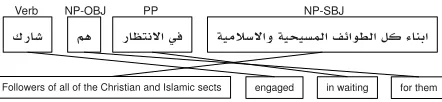
Figure 1: The oracle translation for this Arabic VOS sen-tence would be pruned during search using typical dis-tortion parameters. The Arabic phrases read right-to-left, but we have ordered the sentence from left-to-right in or-der to clearly illustrate the re-oror-dering problem.
ders in which significant re-ordering is required, the distortion limit can eliminate theoracle, or “best,” translation prior to search, placing an artificial limit on translation performance (Auli et al., 2009).
To illustrate this problem, consider the Arabic-English example in Figure 1. Assuming that the En-glish translation is constructed left-to-right, the verb
CAJ
shaaraka must be translated after the noun phrase (NP) subject. IfP phrases are used totrans-late the Arabic sourcesto the English targett, then
the (unsigned) linear distortion is given by
D(s, t) =p1f irst+
P X
i=2
pilast−1+ 1−pif irst (1)
where pf irst and plast are the first and last source
word indices, respectively, in phrasei. By this
for-mula, the cost of the step to translate the NP sub-ject before the verb is 9, which is high relative to the monotone translation path. Moreover, a con-ventional distortion limit (e.g., 5) would likely force translation of the verb prior to the full subject un-less the exact subject phrase existed in the phrase table.1 Therefore, the correct re-ordering is either
improbable or impossible, depending on the choice of distortion parameters.
1Our constrained NIST MT09 Arabic-English system, which placed second, used a limit of 5 (Galley et al., 2009).
The objective of this work is to develop a dis-tortion cost model that allows the disdis-tortion limit to be raised significantly without a catastrophic de-crease in performance. We first describe an admis-sible future cost heuristic for linear distortion that restores baseline performance at high distortion lim-its. Then we add a feature-rich discriminative dis-tortion model that captures e.g. the tendency of Ara-bic verbs to move right during translation to English. Model parameters are learned from automatic bitext alignments. Together these two extensions allow us to triple the distortion limit in our NIST MT09 Arabic-English system while maintaining a statisti-cally significant improvement over the low distor-tion baseline. At the high distordistor-tion limit, we also show a+2.32 BLEU average gain over Moses with
an equivalent distortion parameterization.
2 Background
2.1 Search in Phrase-based MT
Given a J token source input string f = fiJ ,
we seek the most probableI token translation e =
eIi . The Moses phrase-based decoder models the
posterior probability pλ eI1|f1J
directly according to a log-linear model (Och and Ney, 2004), which gives the decision rule
ˆ
e= arg max
I,eI
1
( M X m=1
λmhm eI1, f1J
)
wherehm eI1, f1J
areMarbitrary feature functions
over sentence pairs, andλm are feature weights set
using a discriminative training method like MERT (Och, 2003). This search is made tractable by the use of beams (Koehn et al., 2003). Hypotheses are pruned from the beams according the sum of the cur-rent model score and a future cost estimate for the uncovered source words. Since the number of re-ordering possibilities for those words is very large— in theory it is exponential—an inadmissible heuris-tic is typically used to estimate future cost. The baseline distortion cost model is a weighted feature in this framework and affects beam pruning only through the current model score.
When we say linear distortion, we refer to the “simple distortion model” of Koehn et al. (2003) that is shown in Equation (1) and is converted to a cost by multiplying by −1. When extended to phrases,
the key property of this model is that monotone de-coding gives the least costly translation path. Re-orderings internal to extracted phrases are not pe-nalized. In practice, we commonly see n-best lists of hypotheses with linear distortion costs equal to zero. More sophisticated local phrase re-ordering models have been proposed (Tillmann, 2004; Zens and Ney, 2006; Koehn et al., 2007; Galley and Man-ning, 2008), but these are typically used in addition to linear distortion.
2.2 Arabic Linguistic Essentials
In this paper we use Arabic-English as a case study since we possess a strong experimental baseline. But we expect that the technique presented could be even more effective for high distortion language pairs such as Chinese-English and Hindi-English. Since the analysis that follows is framed in terms of Arabic, we point out several linguistic features that motivate our approach. From the perspective of the three criteria used to specify basic word order typol-ogy (Greenberg, 1966), Arabic is somewhat unusual in its combination of features: it has prepositions (not postpositions), adjectives post-modify nouns, and the basic word order is VSO, but SVO and VOS configurations also appear.
The implications for translation to English are: (1) prepositions remain in place, (2) NPs are in-verted, and most importantly, (3) basic syntac-tic constituents must often be identified and pre-cisely re-ordered. The VOS configuration is espe-cially challenging for Arabic-English MT. It usu-ally appears when the direct object is short—e.g., pronominal—and the subject is long. For example, translation of the VOS sentence in Figure 1 requires both a high distortion limit to accommodate the sub-ject movement and tight restrictions on the move-ment of the PP. The particularity of these require-ments in Arabic and other languages, and the dif-ficulty of modeling them in phrase-based systems, has inspired significant work in source language pre-processing (Collins et al., 2005; Habash and Sadat, 2006; Habash, 2007).
dlimit-4
stepk Fk ∆cost D(s, t) D(s, t) + ∆cost
0 3 3 1 4
1 5 2 0 2
2 7 2 0 2
3 0 −7 4 −3
4 0 0 3 3
[image:3.612.127.477.61.132.2]8 8
Figure 2: Translation sequence in which the distortion limit is reached and the decoder is forced to cover the first skipped word. Future cost estimation penalizes the two monotone steps, yet total distortion cost remains unchanged.
subject, and adjective and noun—baseline phrase-based systems rely on the language model to spec-ify an appropriate target word order (Avramidis and Koehn, 2008). Returning to Figure 1, we could have an alternate hypothesisThey waited for the followers of the Christian and Islamic sects, which is accept-able English and has low distortion, but is semanti-cally inconsistent with the Arabic.
3 The Cost Model
In this section we describe the new distortion cost model, which has four independent components.
3.1 Future Cost Estimation
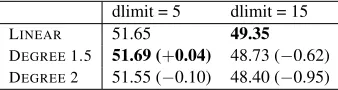
Despite its lack of sophistication, linear distortion is a surprisingly effective baseline cost model for phrase-based MT systems. It can be computed in constant time, gives non-decreasing values that are good for search, and does not require an ancillary feature to adjust for the number of components in the calculation (e.g., language model scores are ad-justed by the word penalty). Moreover, when a large training bitext is used, many local re-orderings are captured in the phrase table, so the decoder can often realize competitive performance by finding a best set of phrases with low distortion. But linear distortion is not the only unlexicalized alternative: we can use any function of the jump width. Table 1 shows de-velopment set (MT04) performance for polynomials of degree 1.5 and degree 2. The linear model is more effective than the higher order functions, especially at a higher distortion limit.
Nevertheless, Table 1 shows an unacceptable de-crease in translation performance at the high distor-tion limit for all three polynomial models. In Moses, the reason is due in part to a dramatic underestima-tion of future re-ordering cost. Consider Figure 2 in which a distortion limit of 4 is used. The first
dlimit = 5 dlimit = 15
LINEAR 51.65 49.35
DEGREE1.5 51.69 (+0.04) 48.73 (−0.62)
DEGREE2 51.55 (−0.10) 48.40 (−0.95) Table 1: BLEU-4 [%] dev set (MT04) scores (uncased) for several polynomial distortion models. Higher degree polynomial distortion models underperform at a high dis-tortion limit (15).
word is skipped, and translation proceeds monoton-ically until the distortion limit forces the decoder to cover the first word. At low distortion limits, sin-gle phrases often saturate the distortion window, so underestimation is not problematic. But at high dis-tortion limits, the decoder can skip many source po-sitions at low cost before the search is constrained by the distortion limit. Words and phrases sprinkled carelessly throughout the hypotheses are evidence of errant search directions that have not been appropri-ately penalized by the distortion cost model.
To constrain search, we add an admissible future cost estimate to the linear model.2By definition, the
model has a least cost translation path: monotone. Therefore, we can add to the baseline calculation
D(s, t)the cost of skipping back to the first
uncov-ered source word and then translating the remaining positions monotonically. It can be verified by induc-tion on|C|that this is an admissible heuristic.
Formally, letjrepresent the first uncovered index
in the source coverage setC. LetCj represent the
subset ofC starting from positionj. Finally, letj0
represent the leftmost position in phrasepapplied at
translation stepk. Then the future cost estimateFk
[image:3.612.342.511.184.229.2]is
Fk=
|Cj|+ (j0+|p|+ 1−j) ifj0> j
0 otherwise
For k > 0, we add the difference between the
current future cost estimate and the previous cost estimate∆cost = Fk−Fk−1 to the linear penalty
D(s, t).3 Table 2 shows that, as expected, the
dif-ference between the baseline and augmented models is statistically insignificant at a low distortion limit. However, at a very high distortion limit, the future cost estimate approximately restores baseline per-formance. While we still need a distortion limit for computational efficiency, it is no longer required to improve translation quality.
3.2 A Discriminative Distortion Model
So far, we have developed a search heuristic func-tion that gives us a greater ability to control search at high distortion limits. Now we need a cost model that is sensitive to the behavior of certain words dur-ing translation. The model must accommodate a potentially large number of overlapping source-side features defined over the (possibly whole) transla-tion sequence. Since we intend to train on auto-matic word alignments, data sparsity and noise are also risks. These requirements motivate two choices. First, we use a discriminative log-linear framework that predicts one of the nine discretized distortion classes in Figure 3. Letdj,j0 indicate the class
cor-responding to a jump from source wordjtoj0
com-puted as(j+ 1−j0). The discriminative distortion
classifier is then
pλ dj,j0|f1J, j, j0=
exphPM
m=1λmhm f1J, j, j0, dj,j0
i
P di
j,j0
exphPM
m=1λmhm
fJ
1, j, j0, dij,j0
i
where λm are feature weights for the
hm(f1J, j, j0, dij,j0) arbitrary feature functions.
This log conditional objective function is convex and can be optimized with e.g. a gradient-based procedure.
3One implementation choice is to estimate future cost to an artificial end-of-sentence token. Here the decoder incurs a penalty for covering the last word prior to completing a hypoth-esis. Although this implementation is inconsistent with Moses linear distortion, we find that it gives a small improvement.
dlimit = 5 dlimit = 15
BASELINE 51.65 49.35
[image:4.612.338.512.60.98.2]FUTURECOST 51.73 51.65
Table 2: BLEU-4 [%] dev set scores (uncased) for the linear distortion with future cost estimation.
!
"
#
$
%
Figure 3: Distortion in Arabic-English translation is largely monotonic, but with noticeable right movement as verbs move around arguments and nouns around mod-ifiers. The ability to predict movement decreases with the jump size, hence the increasing bin boundaries.
Second, we expect that many words will not be useful for predicting translation order.4 In a large
training bitext, it can be extremely tedious to iden-tify informative words and word classes analytically. Our final decision is then to optimize the parame-ter weightsλmusingL1regularization (Andrew and
Gao, 2007), a technique that can learn good models in the presence of many irrelevant features.5 The L1 regularizer saves us from filtering the training
data (e.g., by discarding all words that appear less than an empirically-specified threshold), and pro-vides sparse feature vectors that can be analyzed separately during feature engineering.
We train two independent distortion models. For a transition from source wordj to j0, we learn an
outboundmodel in which features are defined with respect to wordj. We have a correspondinginbound
4To train the models, we inverted and sorted theintersection alignments in the bitext. In our baseline system, we observed no decrease in performance betweenintersectionand e.g. grow-diag. However we do expect that our method could be extended to multi-word alignments.
5We also add a Gaussian priorp(λ)vN(0,1)to the ob-jective (Chen and Rosenfeld, 1999). Using bothL1andL2
[image:4.612.317.540.142.288.2]1 2 3 4 5 6 7 8 9 −6
−5 −4 −3 −2 −1 0
First
Quintile
Outbound Distortion Model
1 2 3 4 5 6 7 8 9 −6
−5 −4 −3 −2 −1 0
Middle
Quintile
1 2 3 4 5 6 7 8 9 −6
−5 −4 −3 −2 −1 0
Last
Quintile
To left Distortion Class To right
(a)CAJ/ VBD shaaraka(“he engaged”)
1 2 3 4 5 6 7 8 9 −6
−5 −4 −3 −2 −1 0
First
Quintile
Inbound Distortion Model
1 2 3 4 5 6 7 8 9 −6
−5 −4 −3 −2 −1 0
Middle
Quintile
1 2 3 4 5 6 7 8 9 −7
−6 −5 −4 −3 −2 −1 0
Last
Quintile
From right Distortion Class From left
(b)¨k§r¯ / JJ al-aamriikii(“American”)
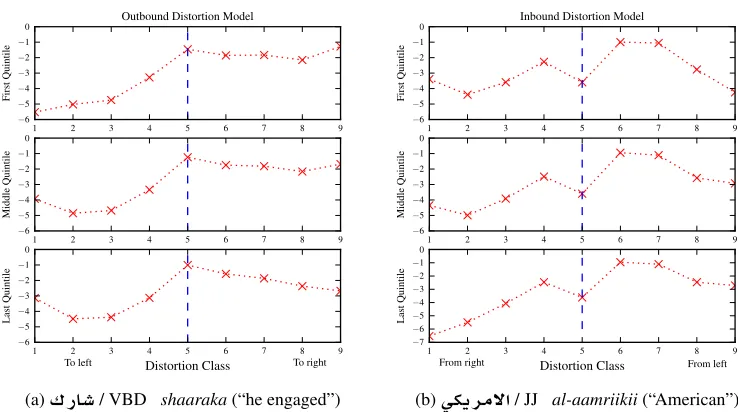
Figure 4: Selected discriminative cost curves (log scale) over three quintiles of the relative position feature. We condition on the word, POS, and length features. The classes correspond to those shown in Figure 3. (4a) The VSO basic word order is evident: early in the sentence, there is a strong tendency towards right movement around arguments after covering the verb. However, right movement is increasingly penalized at the end of the sentence. (4b) Adjectives post-modify nouns, so the model learns high inbound probabilities for jumps from positions earlier in the sentence. However, the curve is bi-modal reflecting right inbound moves from other adjectives in NPs with multiple modifiers.
model trained on features with respect to j0. At
training time, we also add sentence beginning and ending delimiters such that inbound probabilities are learned for words that begin sentences (e.g., nouns) and outbound probabilities are available for tokens that end sentences (e.g., punctuation).
As a baseline, we use the following binary features: words, part-of-speech (POS) tags, rela-tive source sentence position, and source sentence length. Relative source sentence position is dis-cretized into five bins, one for each quintile of the sentence. Source sentence length is divided into four bins with bounds set empirically such that training examples are distributed evenly. To simplify the de-coder integration for this evaluation, we have cho-sen context-free features, but the framework permits many other promising possibilities such as agree-ment morphology and POS tag chains.
Our models reveal principled cost curves for spe-cific words (Figure 4). However, monotonic decod-ing no longer gives the least costly translation path, thus complicating future cost estimation. We would need to evaluate all possible re-orderings within the
k-word distortion window. For an input sentence of
lengthn, Zens (2008) shows that the number of
re-ordering possibilitiesrnis
rn=
kn−k·k! n > k
n! n≤k
which has an asymptotic complexity Θ(kn).
In-stead of using an inadmissible heuristic as is done in beam pruning, we take a shortcut: we include the linear future cost model as a separate feature. Then we add the two discriminative distortion fea-tures, which calculate the inbound and outbound log probabilities of the word alignments in a hypothe-sis. Since hypotheses may have different numbers of alignments, we also include an alignment penalty that adjusts the discriminative distortion scores for unaligned source words. The implementation and behavior of the alignment penalty is analogous to that of the word penalty. In total, the new distortion cost model has four independent MT features.
4 MT Evaluation
4.1 Experimental Setup
[image:5.612.116.485.77.283.2]dlimit = 5 MT03 MT05 MT06 MT08 Avg
MOSESLINEAR 52.31 52.67 42.97 41.29
COUNTS 52.05 52.32 42.28 40.56
FUTURE 52.26 (−0.05) 52.53 (−0.14) 43.04 (+0.07) 41.01 (−0.28) −0.09 DISCRIM+FUTURE 52.68* (+0.37) 53.13* (+0.46) 43.75** (+0.78) 41.82** (+0.53) +0.59
Table 3: BLEU-4 [%] scores (uncased) at the distortion limit (5) used in our baseline NIST MT09 Arabic-English system (Galley et al., 2009). Avg is a weighted average of the performance deltas. The stars for positive results
indicate statistical significance compared to the MOSESLINEARbaseline (*: significance atp≤0.05; **: significance
atp≤0.01)
dlimit = 15 MT03 MT05 MT06 MT08 Avg
MOSESLINEAR 51.04 51.35 41.01 38.83
COUNTS 49.92 49.73 39.44 37.65
LEX 50.96 51.21 41.87 39.38
FUTURE 52.28** (+1.24) 52.45** (+1.10) 42.78** (+1.77) 41.01** (+2.18) +1.66 DISCRIM+FUTURE 52.36** (+1.32) 53.05** (+1.70) 43.65** (+2.64) 41.68** (+2.85) +2.32
[image:6.612.115.496.60.115.2]num. sentences 663 1056 1797 1360 4876
Table 4: BLEU-4 [%] scores (uncased) at a very high distortion limit (15). DISCRIM+FUTURE also achieves a
statistically significant gain over the MOSESLINEARdlimit=5 baseline for MT05 (p≤0.06), MT06 (p≤0.01), and
MT08 (p≤0.01).
decoder with the same standard features: four translation features (phrase-based translation prob-abilities and lexically-weighted probprob-abilities), word penalty, phrase penalty, linear distortion, and lan-guage model score. We disable baseline linear dis-tortion when evaluating the other disdis-tortion cost models. To tune parameters, we run MERT with the Downhill Simplex algorithm on the MT04 dataset. For all models, we use 20 random starting points and generate 300-best lists.
We use the NIST MT09 constrained track training data, but remove the UN and comparable data.6 The
reduced training bitext has 181k aligned sentences with 6.20M English and 5.73M Arabic tokens. We create word alignments using the Berkeley Aligner (Liang et al., 2006) and take the intersection of the alignments in both directions. Phrase pairs with a maximum target or source length of 7 tokens are ex-tracted using the method of Och and Ney (2004).
We build a 5-gram language model from the Xinhua and AFP sections of the Gigaword corpus (LDC2007T40), in addition to all of the target side training data permissible in the NIST MT09 con-strained competition. We manually remove
Giga-6Removal of the UN data does not affect the baseline at a distortion limit of 5, and lowers the higher distortion base-line by −1.40 BLEU. The NIST MT09 data is available at
http://www.itl.nist.gov/iad/mig/tests/mt/2009/.
word documents that were released during periods that overlapped with the development and test sets. The language model is smoothed with the modified Kneser-Ney algorithm, retaining only trigrams, 4-grams, and 5-grams that occurred two, three, and three times, respectively, in the training data.
We remove from the test sets source tokens not present in the phrase tables. For the discriminative distortion models, we tag the pre-processed input us-ing the log-linear POS tagger of Toutanova et al. (2003). After decoding, we strip any punctuation that appears at the beginning of a translation.
4.2 Results
proba-Ar
Reference dutch national jaap de hoop scheffer today, monday, took up his responsibilities...
MosesLinear-d5 over dutchman jaap de hoop today , monday , in the post of...
MosesLinear-d15 dutch assumed his duties in the post of nato secretary general jaap de hoop today , monday...
Discrim+Future the dutchman jaap de hoop today , monday , assumed his duties...
Figure 5: Verb movement around both the subject and temporal NPs is impossible at a distortion limit of 5 (MOSESLINEAR-d5). The baseline system at a high distortion limit mangles the translation (MOSESLINEAR-d15).
DISCRIM+FUTURE(dlimit=15) correctly guides the search. The Arabic source is written right-to-left.
bilities, and the alignment penalty.
The main objective of this paper is to improve performance at very high distortion limits. Table 4 shows performance at a distortion limit of 15. To the set of baselines we add LEX, which is the lex-icalized re-ordering model of Galley and Manning (2008). This model was shown to outperform other lexicalized re-ordering models in common use.
Statistical significance was computed with the approximate randomization test of Riezler and Maxwell (2005), which is less sensitive to Type I errors than bootstrap re-sampling (Koehn, 2004).
5 Discussion
The new distortion cost model allows us to triple the distortion limit while maintaining a statistically sig-nificant improvement over the MOSESLINEAR base-line at the lower distortion limit for three of the four test sets. More importantly, we can raise the distortion limit in the DISCRIM+FUTURE configu-ration at minimal cost: a statistically insignificant
−0.2 BLEU performance decrease on average. We also see a considerable improvement over both the MOSESLINEAR and LEXbaselines at the high dis-tortion limit (Figure 5). As expected, future cost es-timation alone does not increase performance at the lower distortion limit.
We also observe that the effect of conditioning on evidence is significant: the COUNTSmodel is cate-gorically worse than all other models. To understand why, we randomly sampled 500 sentences from the excluded UN data and computed the log-likelihoods of the alignments according to the different models.7
In this test, COUNTSis clearly better with a score of 7We approximated linear distortion using a Laplacian dis-tribution with estimated parametersµˆ = 0.51andˆb = 1.76 (Goodman, 2004).
−23388 versus, for example, the inbound model at
−38244. The explanation is due in part to optimiza-tion. The two discriminative models often give very low probabilities for the outermost classes. Noise in the alignments along with the few cases of long-distance movement are penalized heavily. For Ara-bic, this property works in our favor as we do not want extreme movement (as we might with Chinese or German). But COUNTSapplies a uniform penalty for all movement that exceeds the outermost class boundaries, making it more prone to search errors than even linear distortion despite its favorable per-formance when tested in isolation.
Finally, we note that previous attempts to improve re-ordering during search (particularly long-distance re-ordering (Chiang, 2007)) have delivered remark-able gains for languages like Chinese, but improve-ments for Arabic have been less exceptional. By relaxing the distortion limit, we have left room for more sophisticated re-ordering models in conven-tional phrase-based decoders while maintaining a significant performance advantage over hierarchical systems (Marton and Resnik, 2008).
6 Prior Work
There is an expansive literature on re-ordering in statistical MT. We first review the development of re-ordering constraints, then describe previous cost models for those constraints in beam search de-coders. Because we allow re-ordering during search, we omit discussion of the many different methods for preprocessing the source input prior to mono-tonic translation. Likewise, we do not recite prior work in re-ranking translations.
word sequence as a coverage setC that is processed
sequentially. A source token is “covered” when it is aligned with a new target token. For a fixed value of k, we may leave up to k −1 positions
uncov-ered and return to them later. We can alter the con-straint slightly such that for the first uncovered posi-tionu /∈C we can cover positionjwhen
j−u < k j /∈C
which is the definition of the distortion limit used in Moses. Variations of the IBM constraints also ex-ist (Kanthak et al., 2005), as do entirely different regimes like the hierarchicalITG constraints, which represent the source as a sequence of blocks that can be iteratively merged and inverted (Wu, 1996). Zens and Ney (2003) exhaustively compare the IBM and ITG constraints, concluding that although the ITG constraints permit more flexible re-orderings, the IBM constraints result in higher BLEU scores.
Since our work falls under the IBM paradigm, we consider cost models for those constraints. We have said that linear distortion is the simplest cost model. The primary criticism of linear distortion is that it is unlexicalized, thus penalizing all re-orderings equally (Khalilov et al., 2009). When extended to phrases as in Equation (1), linear distortion is also agnostic to internal phrase alignments.
To remedy these deficiencies, Al-Onaizan and Papineni (2006) proposed a lexicalized, generative distortion model. Maximum likelihood estimates for inbound, outbound, and pairwise transitions are computed from automatic word alignments. But no estimate of future cost is included, and their model cannot easily accommodate features defined over the entire translation sequence. As for experimental re-sults, they use a distortion limit that is half of what we report, and compare against a baseline that lacks a distortion model entirely. Neither their model nor ours requires generation of lattices prior to search (Zhang et al., 2007; Niehues and Kolss, 2009).
Lexicalized re-ordering modelsare the other sig-nificant approach to re-ordering. These models make local predictions about the next phrase to be translated during decoding, typically assigning costs to one of three categories: monotone,swap, or dis-continuous. Both generative (Tillmann, 2004; Och and Ney, 2004; Koehn et al., 2007) and discrimina-tive training (Tillmann and Zhang, 2005; Zens and
Ney, 2006; Liang et al., 2006) algorithms have been proposed. Recently, Galley and Manning (2008) in-troduced a hierarchical model capable of analyzing alignments beyond adjacent phrases. Our discrimi-native distortion framework is not designed as a re-placement for lexicalized re-ordering models, but as a substitute for linear distortion.
Finally, we comment on differences between our Arabic-English results and the well-known high dis-tortion system of Zollmann et al. (2008), who find optimal baseline performance at a distortion limit of 9. First, they use approximately two orders of mag-nitude more training data, which allows them to ex-tract much longer phrases (12 tokens v. our maxi-mum of 7). In this setting, many Arabic-English re-orderings can be captured in the phrase table. Sec-ond, their “Full” system uses three language models each trained with significantly more data than our single model. Finally, although they use a lexical-ized re-ordering model, no details are given about the baseline distortion cost model.
7 Conclusion
We have presented a discriminative cost framework that both estimates future distortion cost and learns principled cost curves. The model delivers a statis-tically significant +2.32 BLEU improvement over
Moses at a high distortion limit. Unlike previous discriminative local orientation models (Zens and Ney, 2006), our framework permits the definition of global features. The evaluation in this paper used context-free features to simplify the decoder integra-tion, but we expect that context-dependent features could result in gains for other language pairs with more complex re-ordering phenomena.
Acknowledgements
References
Y Al-Onaizan and K Papineni. 2006. Distortion models for statistical machine translation. InACL.
G Andrew and J Gao. 2007. Scalable training of L1-regularized log-linear models. InICML.
M Auli, A Lopez, H Hoang, and P Koehn. 2009. A systematic analysis of translation model search spaces. InWMT.
E Avramidis and P Koehn. 2008. Enriching morpholog-ically poor languages for statistical machine transla-tion. InACL.
A Berger, P Brown, S Della Pietra, V Della Pietra, A Kehler, and R Mercer. 1996. Language translation apparatus and method using context-based translation models. US Patent 5,510,981.
D Cer, M Galley, D Jurafsky, and C D Manning. 2010. Phrasal: A statistical machine translation toolkit for exploring new model features. InNAACL, Demonstra-tion Session.
S Chen and R Rosenfeld. 1999. A Gaussian prior for smoothing maximum entropy models. Technical Re-port CMU-CS-99-10S, Carnegie Mellon University. D Chiang. 2007. Hierarchical phrase-based translation.
Computational Linguistics, 33(2):201–228.
M Collins, P Koehn, and I Kucerova. 2005. Clause re-structuring for statistical machine translation. InACL.
M Galley and C D Manning. 2008. A simple and effec-tive hierarchical phrase reordering model. InEMNLP.
M Galley, S Green, D Cer, P-C Chang, and C D Manning. 2009. Stanford University’s Arabic-to-English statisti-cal machine translation system for the 2009 NIST eval-uation. Technical report, Stanford University.
J Goodman. 2004. Exponential priors for maximum en-tropy models. InNAACL.
JH Greenberg, 1966. Some universals of grammar with particular reference to the order of meaningful ele-ments, pages 73–113. London: MIT Press.
N Habash and F Sadat. 2006. Arabic preprocessing schemes for statistical machine translation. InNAACL.
N Habash. 2007. Syntactic preprocessing for statistical machine translation. InMT Summit XI.
S Kanthak, D Vilar, E Matusov, R Zens, and H Ney. 2005. Novel reordering approaches in phrase-based statistical machine translation. In ACL Workshop on Building and Using Parallel Texts.
M Khalilov, J A R Fonollosa, and M Dras. 2009. Cou-pling hierarchical word reordering and decoding in phrase-based statistical machine translation. InSSST.
P Koehn, F J Och, and D Marcu. 2003. Statistical phrase-based translation. InNAACL.
P Koehn, H Hoang, A Birch, C Callison-Burch, M Fed-erico, N Bertoldi, B Cowan, W Shen, C Moran,
R Zens, C Dyer, O Bojar, A Constantin, and E Herbst. 2007. Moses: Open source toolkit for statistical ma-chine translation. InACL, Demonstration Session.
P Koehn. 2004. Statistical significance tests for machine translation evaluation. InEMNLP.
P Liang, B Taskar, and D Klein. 2006. Alignment by agreement. InNAACL.
Y Marton and P Resnik. 2008. Soft syntactic constraints for hierarchical phrased-based translation. InACL.
R C Moore and C Quirk. 2007. Faster beam-search de-coding for phrasal statistical machine translation. In
MT Summit XI.
J Niehues and M Kolss. 2009. A POS-based model for long-range reorderings in SMT. InWMT.
F J Och and H Ney. 2004. The alignment template ap-proach to statistical machine translation. Computa-tional Linguistics, 30:417–449.
F J Och. 2003. Minimum error rate training for statistical machine translation. InACL.
K Papineni, S Roukos, T Ward, and W-J Zhu. 2001. BLEU: a method for automatic evaluation of machine translation. InACL.
S Riezler and J T Maxwell. 2005. On some pitfalls in au-tomatic evaluation and significance testing in MT. In
ACL Workshop on Intrinsic and Extrinsic Evaluation Measures for Machine Translation and/or Summariza-tion (MTSE’05).
C Tillmann and T Zhang. 2005. A localized prediction model for statistical machine translation. InACL.
C Tillmann. 2004. A unigram orientation model for sta-tistical machine translation. InNAACL.
K Toutanova, D Klein, C D Manning, and Y Singer. 2003. Feature-rich part-of-speech tagging with a cyclic dependency network. InNAACL.
D Wu. 1996. A polynomial-time algorithm for statistical machine translation. InACL.
R Zens and H Ney. 2003. A comparative study on re-ordering constraints in statistical machine translation. InACL.
R Zens and H Ney. 2006. Discriminative reordering models for statistical machine translation. InWMT.
R Zens. 2008. Phrase-based Statistical Machine Trans-lation: Models, Search, Training. Ph.D. thesis, RWTH
Aachen University.
Y Zhang, R Zens, and H Ney. 2007. Chunk-level re-ordering of source language sentences with automati-cally learned rules for statistical machine translation. InSSST.

![Table 4: BLEU-4 [%] scores (uncased) at a very high distortion limit (15). DISCRIM+FUTURE also achieves astatistically significant gain over the MOSESLINEAR dlimit=5 baseline for MT05 (p≤.0 06), MT06 (p≤.0 01), andMT08 (p ≤.0 01).](https://thumb-us.123doks.com/thumbv2/123dok_us/1412897.676819/6.612.115.496.60.115/uncased-distortion-discrim-achieves-astatistically-signicant-moseslinear-baseline.webp)