A comparison of models of word meaning in context
Georgiana Dinu Universität des Saarlandes
Saarbrücken, Germany [email protected]
Stefan Thater Universität des Saarlandes
Saarbrücken, Germany [email protected]
Sören Laue
Friedrich-Schiller Universität Jena, Germany
Abstract
This paper compares a number of recently pro-posed models for computing context sensitive word similarity. We clarify the connections between these models, simplify their formula-tion and evaluate them in a unified setting. We show that the models are essentially equivalent if syntactic information is ignored, and that the substantial performance differences previously reported disappear to a large extent when these simplified variants are evaluated under identi-cal conditions. Furthermore, our reformulation allows for the design of a straightforward and fast implementation.
1 Introduction
The computation of semantic similarityscores be-tween words is an important sub-task for a variety of NLP applications (Turney and Pantel, 2010). One standard approach is to exploit the so-called distribu-tional hypothesisthat similar words tend to appear in similar contexts: Word meaning is represented by the contexts in which a word occurs, and semantic similarity is computed by comparing these contexts in a high-dimensional vector space.
Such distributional models of word meaning are attractive because they are simple, have wide cover-age, and can be easily acquired in an unsupervised way. Ambiguity, however, is a fundamental problem: when encountering a word in context, we want a dis-tributional representation which reflects its meaning in this specific context. For instance, whilebuyand
acquire are similar when we consider them in iso-lation, they do not convey the same meaning when
acquireoccurs instudents acquire knowledge. This is particularly difficult for vector space models which compute a singletype vectorsumming up over all occurrences of a word. This vector mixes all of a
word’s usages and makes no distinctions between its—potentially very diverse—senses.
Several proposals have been made in the recent literature to address this problem. Type-based meth-ods combine the (type) vector of the target with the vectors of the surrounding context words to obtain a disambiguated representation. In recent work, this has been proposed by Mitchell and Lapata (2008), Erk and Padó (2008) and Thater et al. (2010; 2011), which differ in the choice of input vector representa-tion and in the combinarepresenta-tion operarepresenta-tion they propose.
A different approach has been taken by Erk and Padó (2010), Reisinger and Mooney (2010) and Reddy et al. (2011), who make use oftoken vectors
for individualoccurrencesof a word, rather than us-ing the already mixed type vectors. Generally speak-ing, these methods “select” a set of token vectors of the target, which are similar to the current con-text, and use only these to obtain a disambiguated representation.
Yet another approach has been taken by Dinu and Lapata (2010), Ó Séaghdha and Korhonen (2011) and Van de Cruys et al. (2011), who propose to use latent variable models. Conceptually, this comes close to token-based models, however their approach is more unitary as they attempt to recover a hidden layer which best explains the observation data.
In this paper, we focus on the first group of ap-proaches and investigate the precise differences be-tween the three models of Erk and Padó and Thater et al., out of which (Thater et al., 2011) achieves state of the art results on a standard data set. Despite the fact that these models exploit similar intuitions, both their formal presentations and the results obtained vary to a great extent. The answer given in this paper is sur-prising: the three models are essentially equivalent if syntactic information is ignored; in a syntactic space the three methods implement only slightly different
intuitions. We clarify these connections, simplify the syntactic variants originally proposed and reduce them to straightforward matrix operations, and evalu-ate them in a unified experimental setting. We obtain significantly better results than originally reported in the literature. Our reformulation also also supports efficient implementations for these methods.
2 Models for meaning in context
We consider the following problem: we are given anoccurrenceof a target word and want to obtain a vector that reflects its meaning in the given context. To simplify the presentation, we restrict ourselves to contexts consisting of a single word, and useacquire
in contextknowledgeas a running example.
EP08. Erk and Padó (2008) compute a contextu-alized vector foracquireby combining its type vec-tor (~w) with the inverse selectional preference vector ofknowledge(c). This is simply the centroid of the vectors of all words that take knowledge as direct object (r):
v(w,r,c) = 1
n
∑
w0f(w0,r,c)·w~0 !
×~w (1)
where f(w0,r,c)denotes the co-occurrence associa-tion between the context wordcand wordsw0related tocby grammatical relationrin a training corpus;
nis the number of wordsw0and×denotes a vector composition operation. In this paper, we take×to be point-wise multiplication, which is reported to work best in many studies in the literature.
TFP10. Thater et al. (2010) also compute contex-tualized vectors by combing the vectors of the target word and of its context. In contrast to EP08, however, they use second order vectors as basic representation for the target word.
~
w=
∑
r,r0,w00
∑
w0f(w,r,w0)·f(w0,r0,w00)
!
~er,r0,w00 (2)
That is, the vector for a target wordwhas components for all combinations of two grammatical rolesr,r0and a context wordw0; the inner sum gives the value for each component.
The contextualized vector foracquireis obtained through pointwise multiplication with the (1st-order)
vector forknowledge(~c), which has to be “lifted” first to make the two vectors comparable:
v(w,r,c) =~w×Lr(~c) (3)
~c=∑r0,w0 f(c,r0,w0)~e(r0,w0) is a first order vector
for the context word; the “lifting map"Lr(~c)maps
this vector to∑r0,w0 f(c,r0,w0)~e(r,r0,w0)to make it
com-patible with~w.
TFP11. Thater et al. (2011) take a slightly different perspective on contextualization. Instead of comb-ing vector representations for the target word and its context directly, they propose to re-weight the vector components of the target word, based on distribu-tional similarity with the context word:
v(w,r,c) =
∑
r0,w0
α(r,c,r0,w0)·f(w,r0,w0)·~e(r0,w0) (4)
where α(r,c,r0,w0) is simply cos(~c, ~w0) if r and r0 denote the same grammatical function, else 0.
3 Comparison
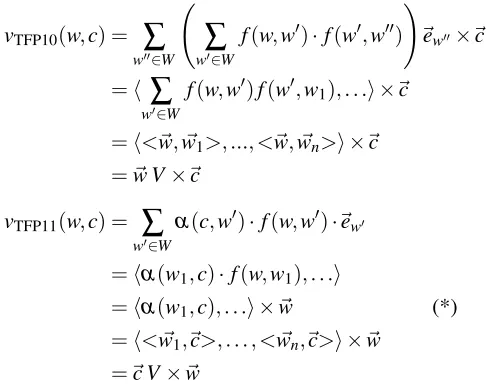
The models presented above have a number of things in common: they all use syntactic information and “second order” vectors to represent word meaning in context. Yet, their formal presentations differ substan-tially. We now show that the models are essentially equivalentif we ignore syntax: they component-wise multiply the second order vector of one word (target or context) with the first order vector of the other word. Specifically, we obtain the following deriva-tions, whereW ={w1, ...,wn} denotes the vocabu-lary, andV the symmetricn×ninput matrix, where
Vi j= f(wi,wj)gives the co-occurrence association
between wordswiandwj:
vEP08(w,c) =1
n
∑
w0f(w0,c)·w~0×~w
=1
n
∑
w0f(w0,c)· hf(w0,w1), . . .i
×~w
=1
nh
∑
w0f(w0,c)·f(w0,w1), . . .i ×~w
=1
nh<~c, ~w1>, . . . , <~c, ~wn>i ×~w
=1
vTFP10(w,c) =
∑
w00∈W
∑
w0∈W
f(w,w0)·f(w0,w00)
!
~ew00×~c
=h
∑
w0∈Wf(w,w0)f(w0,w1), . . .i ×~c
=h<~w, ~w1>, ..., <~w, ~wn>i ×~c
=~w V×~c
vTFP11(w,c) =
∑
w0∈W
α(c,w0)·f(w,w0)·~ew0
=hα(w1,c)·f(w,w1), . . .i
=hα(w1,c), . . .i ×~w (*)
=h< ~w1,~c>, . . . , < ~wn,~c>i ×~w
=~c V×~w
where<~v, ~w>denotes scalar product. In step (*), we assume thatα(w,c)denotes the scalar product of~w
and~c, instead of cosine similarity, as TFP11. This is justified if we assume that all vectors are normalized, in which case the two are identical.
As it can be observed the syntax-free variants of EP08 and TFP11 are identical up to the choice in normalization. TFP10 proposes an identical model to that of TFP11, however with a different interpretation, in which the roles of the context word and of the target word are swapped.
4 Evaluation
We have just shown that EP08, TFP10 and TFP11 are essentially equivalent to each other if syntactic information is ignored, hence it is a bit surprising that performance results reported in the literature vary to such a great extent. In this section we consider syntactic variants of these methods and we show that performance differences previously reported can only partly be explained by the different ways syntactic information is used: when we simplify these models and evaluate them under identical conditions, the differences between them disappear to a large extent.
To evaluate the three models, we reimplemented them using matrix operations similar to the ones used in Section 3, where we made few simplifications to the TFP10 and EP08 models: we follow TFP11 and we use component-wise multiplication to com-bine the target with one context word, and add the resulting composed vectors when given more con-text words1. Furthermore for TFP10, we change the
1Note that some of the parameters in the EP08 method
(omit-Model GAP ∆Literature
EP08 46.6 + 14.4 (32.2)∗ TFP10 48.3 + 3.9 (44.4) TFP11 51.8 ±0.0
[image:3.612.70.313.56.249.2]TFP10+11 52.1 N/A
Table 1: GAP scores LST data.
∗The best available GAP score for this model (from Erk and
Padó (2010)) is reported only on a subset of the data - this subset is however judged by the authors to be “easier” than the entire data; all other methods are tested on the entire dataset.
treatment of syntax in the line of the much simpler proposal of TFP11. Specifically:
v(w,r,c) =Lr−1(VVT)w,:×Vc,: (TFP10)
v(w,r,c) =Vw,:×Lr(VVT)c,: (TFP11)
whereV is aI×J syntactic input matrix, i.e. the columns are (word, relation) pairs. For simplification, the columns ofV are reordered such that syntactic relations form continuous regions.Lris a lifting map
similar to that of Equation (3) as it mapsI- intoJ -dimensional vectors: the resulting vector is equal to the original one in the column region of relationr, while everything else is 0. In the above equations we use the standard Matlab notation,Vw,: denoting a row vector in matrixV.
We evaluate these models on a paraphrase ranking task, using the SemEval 2007 Lexical Substitution Task (LST) dataset: the models are given a target word in context plus a list of potential synonyms (substitution candidates) ranging over all senses of the target word. The models have to decide to what extent each substitution candidate is a synonym of the targetin the given context.We omit the precise de-scription of the evaluation setting here, as we follow the methodology described in Thater et al. (2011).
Results are shown in Table 1, where the first col-umn gives the GAP (Generalized Average Precision) score of the model and the second column gives the difference to the result reported in the literature. TFP10 and EP08 perform much better than the origi-nal proposals, as we obtain very significant gains of 4 and 14 GAP points.
We can observe that the differences between the three methods, when simplified and tested in an uni-fied setting, largely disappear. This is to be expected as all three methods implement very similar, all moti-vated intuitions: TFP11 reweights the vector of the targetacquire with the second order vector of the contextknowledge, i.e. with the vector of similarities ofknowledge to all other words in the vocabulary. TFP10 takes a complementary approach: it reweights the vector ofknowledgewith the second order vector ofacquire. In both these methods, anything outside theobject(object−1respectively) region of the space, is set to 0. The variant of EP08 that we implement is very similar to TFP11, however it compares knowl-edgeto all other words in the vocabulary only using occurrencesas objectswhile TFP11 takesall syntac-tic relations into account.
Note that TFP10 and TFP11 operate on comple-mentary syntactic regions of the vectors. For this reason the two models can be trivially combined. The combined model (TFP10+11) achieves even bet-ter results: the difference to TFP11 is small, however statistically significant at levelp<0.05.
Implementation details. Straightforward imple-mentations of the three models are computationally expensive, as they all use “second order” vectors to implement contextualization of a target word. Our re-formulation in terms of matrix operations allows for efficient implementations, which take advantage of the sparsity of the input matrixV: contextualization of a target word runs inO(nnz(V)), wherennzis the number of non-zero entries. Note that ranking not only a small set of predefined substitution candidates, as in the experiment above, but also ranking the en-tire vocabulary runs inO(nnz(V)). On this task, this overall running time is in fact identical to that of sim-pler methods such as those of Mitchell and Lapata (2008).
In our experiments, we use GigaWord to extract a syntactic input matrixV of size≈2M×7M.V is only 4.5×10−06dense. Note that because of the sim-ple operations involved, we do not need to compute or store the entireVVT matrix, which is much denser thanV (we have estimated order of 1010entries). The sparsity ofV allows for very efficient computations in practice: the best single model, TFP11, runs in less than 0.2s/0.4s per LST instance, for ranking the
candidate list/entire vocabulary in a Python imple-mentation using scipy.sparse, on a standard 1GHz processor.
5 Conclusions
In this paper, we have compared three related vec-tor space models of word meaning in context. We have reformulated the models and showed that they are in fact very similar. We also showed that the different performances reported in the literature are only to some extent due to the differences in the models: We evaluated simplified variants of these and obtained results which are (much) better than previously reported, bringing the three models much closer together in terms of performance. Aside from clarifying the precise relationship between the three models under consideration, our reformulation has the additional benefit of allowing the design of a straightforward and efficient implementation.
Finally, our focus on these methods is justified by their clear advantages over other classes of models: unlike token-based or latent variable methods, they are much simpler and require no parameter tuning. Furthermore, they also obtain state of the art results on the paraphrase ranking task, outperforming other simple type-based methods (see (Van de Cruys et al., 2011) and (Ó Séaghdha and Korhonen, 2011) for results of other methods on this data).
Acknowledgments. This work was partially sup-ported by the Cluster of Excellence “Multimodal Computing and Interaction", funded by the German Excellence Initiative.
References
Georgiana Dinu and Mirella Lapata. 2010. Measuring distributional similarity in context. InProceedings of EMNLP 2010, Cambridge, MA.
Katrin Erk and Sebastian Padó. 2008. A structured vector space model for word meaning in context. In Proceed-ings of EMNLP 2008, Honolulu, HI, USA.
Katrin Erk and Sebastian Padó. 2009. Paraphrase assess-ment in structured vector space: Exploring parameters and datasets. InProceedings of the Workshop on Geo-metrical Models of Natural Language Semantics. Katrin Erk and Sebastian Padó. 2010. Exemplar-based
Jeff Mitchell and Mirella Lapata. 2008. Vector-based models of semantic composition. InProceedings of ACL-08: HLT, Columbus, OH, USA.
Diarmuid Ó Séaghdha and Anna Korhonen. 2011. Prob-abilistic models of similarity in syntactic context. In
Proceedings of EMNLP 2011.
Siva Reddy, Ioannis Klapaftis, Diana McCarthy, and Suresh Manandhar. 2011. Dynamic and static pro-totype vectors for semantic composition. InProc. of IJCNLP 2011.
Joseph Reisinger and Raymond J. Mooney. 2010. Multi-prototype vector-space models of word meaning. In
Proceedings of NAACL 2010, Los Angeles, California. Stefan Thater, Hagen Fürstenau, and Manfred Pinkal. 2010. Contextualizing semantic representations using syntactically enriched vector models. InProceedings of ACL 2010, Uppsala, Sweden.
Stefan Thater, Hagen Fürstenau, and Manfred Pinkal. 2011. Word meaning in context: A simple and effective vector model. InProceedings of IJCNLP 2011. Peter D. Turney and Patrick Pantel. 2010. From frequency
to meaning: Vector space modes of semantics. Journal of Artificial Intelligence Research, 37:141–188. Tim Van de Cruys, Thierry Poibeau, and Anna Korhonen.