How to cite: Gaum, T. & Laubscher, J. 2019. The implementation of alternative dispute-resolution methods by architectural practitioners in South Africa. Acta Structilia, 26(1), pp. 97-119. © Creative Commons With Attribution (CC-BY) Published by the UFS http://journals.ufs.ac.za/index.php/as
Tariené Gaum
Mrs. Tariené Gaum,
Part-time Lecturer, Department of Architecture, Tshwane University of Technology, No 201 Fairfield, 1164 Dormer Avenue, Queenswood, South Africa. Phone: + 27 63 695 4584, email: <wilcockst@tut. ac.za> ORCID: https://orcid. org/0000-0003-3328-9026
Jacques Laubscher
Prof. Jacques Laubscher, Head of Department, Department of Architecture, Tshwane University of Technology, PO Box 95469, Waterkloof, 0145, South Africa. Phone: + 27 12 382 5252, email: <laubscherj@tut. ac.za> ORCID: https://orcid. org/0000-0002-2086-7563
DOI: http://dx.doi.
org/10.18820/24150487/as26i1.4 ISSN: 1023-0564
e-ISSN: 2415-0487
Acta Structilia 2019 26(1): 97-119
The implementation
of alternative
dispute-resolution methods by
architectural practitioners
in South Africa
Peer reviewed and revised February 2019 Published June 2019
*The authors declared no conflict of interest for the article or title
Abstract
professionals and candidates to determine the implementation of ADR methods. This questionnaire was distrusted by the Chief Operations Officer, Mrs Barbara van Stade to the aforementioned SACAP database. The survey response amounted to 396 participating architectural practitioners, resulting in 2.91% of registered architectural professionals and candidates in the South African built environment. Consequently, this is the most comprehensive study on the preferred use of ADR methods by architectural practitioners in the built environment of South Africa. This study specifically focuses on architectural practitioners who have been involved in settling disputes between the period of 2012 to 2016. The findings reveal a shifting preference in ADR methods used since what the previous study found in 2012. Although previous studies indicate adjudication as the preferred method to resolve disputes, the data reveals that architectural practitioners increasingly make use of negotiation, followed by mediation and then arbitration. This study identifies current ADR trends, and provides a perspective on the future development of ADR mechanisms for architectural professionals in the South African built environment.
Keywords: Alternative dispute resolution (ADR), architectural practitioners, built environment, South African Council for the Architectural Profession (SACAP)
Abstrak
Sleutelwoorde: Alternatiewe geskilbeslegtingprosedure (ADR), argitektuur-praktisyns, Suid-Afrikaanse Raad vir die Argitektuurprofessie (SACAP)
1.
Introduction
According to Statistics South Africa (2018), the South African construction industry has recorded a negative growth since 2016, losing approximately R1.7 billion in value.
In countries facing difficult economic times, the built environment often experiences an increase in risk and liability issues, leading to regular dispute occurrences (El-Adaway & Kandil, 2009: 819; Loosemore, 2009: 95; Soo & Lam, 2012: 115). Annual reports from major South African construction companies indicate that losses are mainly attributed to disputes and the poor economic status of a country (Group Five, 2013; Murray & Roberts, 2013; WBHO, 2013). Several studies have been conducted on the complex nature of the South African construction industry and the number of role players contributing to disputes arising from contracts (Povey, 2005; Povey, Cattell & Michell, 2006; Verster, 2006; Verster & Van Zyl, 2007; Maritz, 2007; 2009; Van Zyl, Verster & Ramabodu, 2010; Bvumbwe & Thwala, 2011; Maiketso & Maritz, 2012; Du Preez & Verster, 2012; 2013; Powell & Nielsen, 2013; Sithole, 2016; Balogun, Anzari & Thwala, 2017). Studies on effective dispute resolution include and discuss the different mechanisms and procedures that assist in resolving disputes (Powell & Nielsen, 2013; Sithole, 2016; Balogun et al., 2017).Available alternative dispute-resolution (ADR) mechanisms used to resolve disputes include arbitration, mediation, adjudication, negotiation, fact-finding, mini-trials, conciliation, neutral evaluation, and expert determination (Bunni, 2000: 105; McCreary, Gamman & Brooks, 2001: 329; Seifert, 2005: 149; Gebken & Gibson, 2006: 264). Despite the fact that ADR mechanisms and processes specifically designed to assist both parties in dispute settlement exist in the South African construction industry (Butler & Finsen, 1993), the rate at which disputes occur in the architectural environment is unclear (De Oliveira, 2012: 80; Wilcocks, 2016).
practitioners prefer to implement when faced with these disputes. Identifying such methods and their specific benefits will assist practitioners in ensuring that proper decision-making processes are put in place to deal with disputes
,
in future building projects.
2.
Literature review
In order to understand the use of ADR methods in the South African built environment, it is important to introduce the current theory on the various ADR concepts included in this study. The existing theory focuses on the general description of ADR mechanisms, goals, advantages and disadvantages, the general application of ADR in the South African built environment, causes of disputes, and dispute methods commonly used in the South African built environment.
2.1 ADR concept, mechanisms and main goal
The majority of ADR practitioners prefer the acronym ADR to refer to appropriate/amicable dispute-resolution methods (Goldsmith, Pointon & Ingen-Housz, 2006: 7). According to the Collins Dictionary of Law (Stewart, 2006: 22), “Alternative Dispute Resolution (ADR) is used to resolve disputes through means other than by approaching the ordinary courts”. For the purpose of this study, ADR is defined as a legal method that allows for the resolution of a conflict and/or dispute through a process that is tailored for the particular form of conflict and/or dispute.
The main goal of ADR is to provide a wide range of mechanisms/ procedures that are appropriate to all parties, in order to resolve disputes effectively withoutthe use of litigation (Finsen, 2005: 221-222; Du Preez, Berry & Oosthuizen, 2010: 164). These mechanisms/ procedures include agent resolution, ombudsman, adjudication, conciliation, negotiation, mediation, and arbitration (Pretorius, 1993: 3; Finsen, 2005: 32; Verster & Van Zyl, 2007: 3; Verster, Ramabodu & Van Zyl, 2013; Wiese, 2016).
2.2 Advantages and disadvantages of ADR
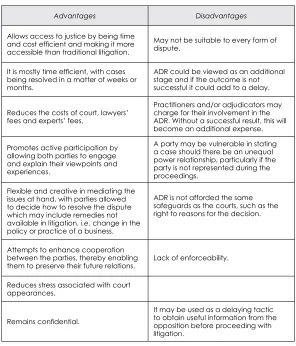
Table 1: Advantages and disadvantages of ADR
Advantages Disadvantages
Allows access to justice by being time and cost efficient and making it more accessible than traditional litigation.
May not be suitable to every form of dispute.
It is mostly time efficient, with cases being resolved in a matter of weeks or months.
ADR could be viewed as an additional stage and if the outcome is not successful it could add to a delay.
Reduces the costs of court, lawyers’ fees and experts’ fees.
Practitioners and/or adjudicators may charge for their involvement in the ADR. Without a successful result, this will become an additional expense.
Promotes active participation by allowing both parties to engage and explain their viewpoints and experiences.
A party may be vulnerable in stating a case should there be an unequal power relationship, particularly if the party is not represented during the proceedings.
Flexible and creative in mediating the issues at hand, with parties allowed to decide how to resolve the dispute which may include remedies not available in litigation, i.e. change in the policy or practice of a business.
ADR is not afforded the same safeguards as the courts, such as the right to reasons for the decision.
Attempts to enhance cooperation between the parties, thereby enabling
them to preserve their future relations. Lack of enforceability.
Reduces stress associated with court appearances.
Remains confidential.
It may be used as a delaying tactic to obtain useful information from the opposition before proceeding with
litigation.
2.3 ADR in the South African built environment
[image:5.421.70.366.68.414.2]mediation, arbitration, adjudication, mini-trial, private judging, summary jury trial, early neutral evaluation, last offer arbitration and mediation, and last offer arbitration (Sithole, 2016: 36). Some of the methods are institutionalised in the Dispute Resolution Boards (DRBs) (Fenn, Lowe & Speck, 1997: 514), Dispute-Review Boards and Dispute Adjudication Boards (DAB) (Bunni, 2000; Seifert, 2005), among others (Steen, 1994; CRCCI, 2007; Ehrlich, 2012: online).
The built environment of South Africa makes provision for ADR methods in a variety of contracts. These include, among many others, the Joint Building Contracts Committee Principal Building Agreement (JBCC PBA) (2018), the General Conditions of Contract for Construction Works (GCC) (2015), International Federation of Consulting Engineers (FIDIC) (2017), the Professional Client/Consultant Services Agreement Committee (PROCSA) (2017), and the South African Institute of Architects Client-Architect Agreement (SAIA CAA) (2008). It is necessary to understand that new procedures and methods are vital to expand the fast-track nature of the construction industry. The development and implementation of ADR methods often increase with accelerated rates of construction, design and procurement documents (Finsen, 2005: 214-216). Finsen (2005: 216) and Verster (2006: 17) argue that ADR is an essential part of the management of construction projects playing a fundamental role in the successful completion of complex projects. According to Povey (2005: 2), the facilitator of the ADR process could be a practising professional with the necessary experience, or a retired industry professional. Facilitators must be registered with the Association of Arbitrators (AOA: 2014).
2.4 Cause of disputes within the South African built environment
• Contractual issues – e.g. improperly or poorly drafted contracts • Management issues – e.g. poor management of time, targets,
tendering, procedures
• Design issues – e.g. change in design, scope, conditions, poor quality, errors, delays
• Communication issues – e.g. poor communication from client and contractor, unclear site instructions, lack of information, unavailability of information
• Quality issues – e.g. non-performance, defects, poor quality, control, and assurance
• Payment issues – e.g. non-payment, delayed payments, claims • Human issues – e.g. conflicting cultural backgrounds, stress,
behaviour, personalities, misunderstandings
• External issues – e.g. project uncertainty, skills shortage, labour unrest, economic environment.
2.5 Dispute methods commonly used in the South African built
environment
A study conducted by Van Zyl, Verster and Ramabodu (2010: 521) revealed that negotiation, conciliation, mediation, adjudication and arbitration are the most preferred ADR methods used in the built environment of South Africa. These methods can be divided into two main types of ADR, namely adjudicative and non-adjudicative. Table 2 illustrates the categories of ADR methods under adjudicative and non-adjudicative.
Table 2: Adjudicative and non-adjudicative ADR methods
Non-Adjudicative
(Disputing parties seek a compromise)
Adjudicative
(A neutral third party decides on the dispute)
Negotiation Mediation Conciliation
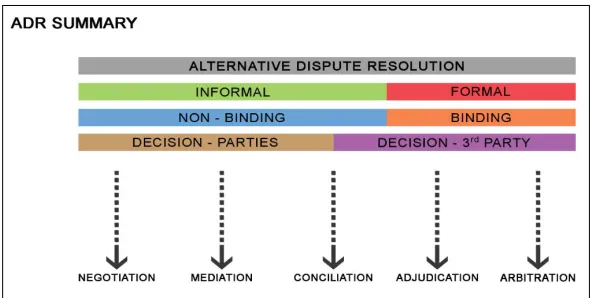
Although there are many different methods/procedures of ADR, Figure 1 shows a summary of the most common methods used in the South African built environment.
Figure 1: Summarised illustration of various ADR methods
Once there is a better understanding of ADR and the benefits that it offers, the built environment can be positively adjusted and equipped for the settlement of disputes.
3.
Research methodology
data-analysis strategies are available. For this study, however, the frequencies were used to calculate percentages of preferences (Williams, 2007: 67; Bhattacharyya & Johnson, 2014).
3.1 Sampling method, population and response rate
A list of 13 622 architectural professionals and/or candidates, registered in South Africa, was obtained from the official body, The South African Council for the Architectural Profession (SACAP) (2015: 27) (Van Stade & Chiunda, 2016). Without placing any limitations, the questionnaire survey was administered to all 13 622 members. Responses from 396 participating architectural practitioners were received. The 396 participants represent 2.91% of registered SACAP members in South Africa. Krejcie & Morgan (1970: 608) state that a sample size of 370 is valid for a population of 15 000 for general research activities in the construction-related profession.
Statistician, Steffens (2017) also clarified that a response rate of less than 5% is not unusual in studies with a population this size. Steffens (2017) further stated that the response rate is acceptable to represent the respondents’ views and opinions. These statements support the validity for a sampling size of 396 out of 13 622 architectural practitioners.
3.2 Data collection
An online-created structured questionnaire survey (SurveyMonkey, 2016) was distributed to the 13 622 participants by sharing the questionnaire link through e-mail.
methods implemented by architectural practitioners. In section B, the respondents were required to indicate their level of involvement, in practice, with ADR and ADR methods. The data from these measurements were tabulated. To reduce the respondent’s bias, fixed closed-ended questions were preferred for Sections B of the questionnaire (Vicente & Reis, 2010: 260).
3.3 Data analysis and interpretation of findings
Microsoft Excel® (Microsoft Office® suite 2007) was used to determine the preferred ADR methods, using descriptive statistics (Bhattacharyya & Johnson, 2014).
For the questionnaire survey, Section A used dichotomous questions and checkboxes to obtain the respondents’ personal information. In Section B, respondents answered a dichotomous question to determine their involvement with ADR and used the checkbox option to indicate their preferred ADR method. After tabulation of the data responses, a bar-chart presentation was compiled to show the calculated frequencies and percentages of the findings. These results form the data that was used to compare the 2012 study to the 2016 data in order to observe the change in preference of ADR methods used by architectural practitioners against ADR methods preferred by the built environment in 2012.
4.
Findings
4.1 Respondents’ profile
architects, male (69.9%), and had either a Master’s degree (31.2%) or a Baccalaureus degree (33.2%); 35.8% of the respondents were aged between 25 and 35 years.
Table 3: Respondents’ profile
Category of SACAP registration Frequency Percentage (%) Candidate architectural technologist 39 9.8 Candidate senior architectural
technologist 17 4.3
Candidate architect 18 4.6
Professional architectural technologist 53 13.3 Professional senior architectural
technologist 61 15.6
Professional architect 157 39.7
Other 50 12.7
Total 396 100.0
Gender Frequency Percentage
Male 276.8 69.9
Female 119.2 30.1
Total 396 100.0
Highest education qualification Frequency Percentage (%)
Master’s degree 123 31.2
Baccalaureus 132 33.2
Diploma 81 20.8
Certificate 38 9.5
Matriculation 11 2.6
Other 11 2.6
Total 396 100.0
Age Frequency Percentage (%)
25-35 years 142 35.8
36-45 years 103 26
46-55 years 72 18.2
56-65 years 56 14.2
66 or more 23 5.8
Total 396 100.0
4.2 Involvement with ADR
Acta Structilia 2019: 26(1)
Professional senior architectural technologist 61 15.6
Professional architect 157 39.7
Other 50 12.7
Total 396 100.0
Gender Frequency Percentage
Male 276.8 69.9
Female 119.2 30.1
Total 396 100.0
Highest education qualification Frequency Percentage (%)
Master’s degree 123 31.2
Baccalaureus 132 33.2
Diploma 81 20.8
Certificate 38 9.5
Matriculation 11 2.6
Other 11 2.6
Total 396 100.0
Age Frequency Percentage (%)
25-35 years 142 35.8
36-45 years 103 26
46-55 years 72 18.2
56-65 years 56 14.2
66 or more 23 5.8
Total 396 100.0
4.2 Involvement with ADR
The second part of the questionnaire first asked participants if they have recently
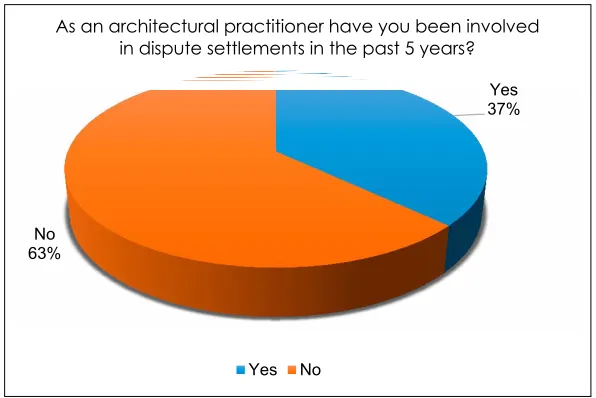
been involved with dispute resolution. Figure 2 is a graphical summary indicating the
percentage of architectural practitioners who have been involved in dispute
settlements between 2012 and 2016.
Yes 37%
No 63%
As an architectural practitioner have you been involved in dispute settlements in the past 5 years?
Yes No
As an architectural practitioner have you been involved in dispute settlements in the past 5 years?
Figure 2: Graphical summary of practitioners who have been involved in dispute resolution
The study revealed that the majority (63%) of the respondents have not been involved with dispute resolution. Only 37% of the respondents have been involved in some form of dispute resolution between 2012 and 2016. The researcher is of the opinion that a large number of architectural practitioners have not been involved with dispute resolution, due to their lack of knowledge on appropriate ADR methods and the benefits it could have. This statement is supported by a previous study conducted by Wilcocks (2016: 93), indicating that there is a strong link between the respondents’ level of knowledge and their involvement in dispute resolution. The study proved that 70.9% of the respondents, who have hardly any or no knowledge regarding ADR, have not been involved with dispute resolution between 2012 and 2016.
[image:12.421.55.353.55.254.2]4.3 Preference of ADR methods
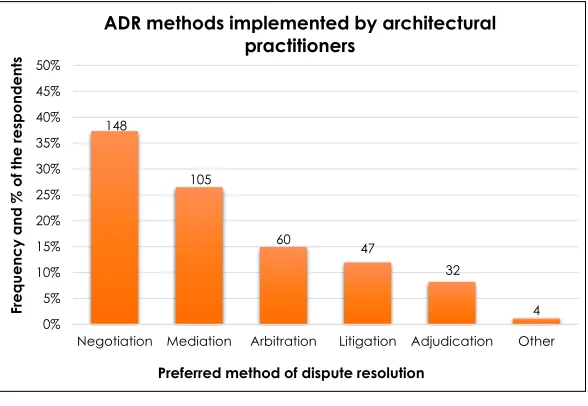
The second part of the questionnaire asked which method(s) were preferred by architectural practitioners who have implemented ADR in an attempt to resolve a dispute. Figure 3 is a graphical summary of the ADR methods implemented by architectural practitioners between 2012 and 2016.
Figure 3: Graphical summary of ADR methods implemented by architectural practitioners between 2012 and 2016
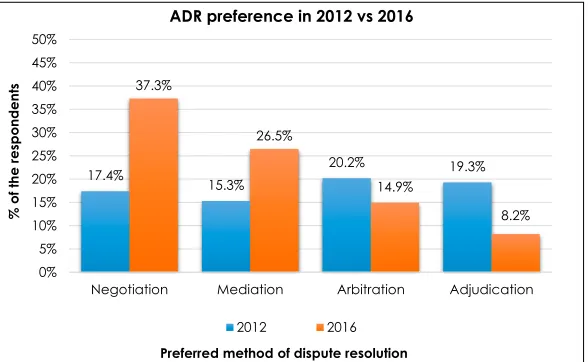
The majority of the participating architectural practitioners preferred negotiation (37.3%) and mediation (26.5%) as the means of resolving disputes in the South African built environment. Only 14.9% of the respondents prefer arbitration and 8.2% prefer adjudication. The data revealed that, although litigation does not form part of ADR procedures, it is still implemented by 11.9% of the practitioners.
Negotiation is one of the most commonly used ADR methods for resolving disputes, because it is an informal method that is used as a preventative measure to avoid fully fledged disputes between parties (Chong & Zin, 2012: 430). Research also indicates that parties, who have been involved with disputes, favour mediation or negotiation as a method of ADR (Brand, Steadman & Todd, 2012; Rao, 2009: 320).
Using a population size of 45 participants, a similar study for the built environment done in 2012 by du Preez and Verster (2013: 5) lists the preferred ADR methods as arbitration, adjudication, negotiation, and mediation. A comparison between the preferences of ADR methods in 2012 with the results of this study shows a change from arbitration (20.2%) and adjudication (19.3%) to negotiation (37.3%) and
148
105
60 47
32 4 0% 5% 10% 15% 20% 25% 30% 35% 40% 45% 50%
Negotiation Mediation Arbitration Litigation Adjudication Other
Fr eq uen cy and % of the res ponde nts
Preferred method of dispute resolution
ADR methods implemented by architectural practitioners
Figure 3: Graphical summary of ADR methods implemented by architectural practitioners between 2012 and 2016
[image:13.421.72.366.132.335.2]110
preferred ADR methods as arbitration, adjudication, negotiation, and mediation. A comparison between the preferences of ADR methods in 2012 with the results of this study shows a change from arbitration (20.2%) and adjudication (19.3%) to negotiation (37.3%) and mediation (26.5%). Figure 4 shows a graphic representation comparing the current preference of ADR methods implemented by architectural practitioners to those in the built environment noted in the 2012 study by Du Preez and Verster.
Figure 4: Graphical comparison of the most preferred method of ADR between 2012 and 2016
This comparison displays the ever-changing nature and implementation of various ADR methods within the built environment of South Africa. Although Du Preez and Verster (2013: 5) argue that the construction industry is changing towards the implementation of adjudication as a preferred method for resolving disputes, the comparative data covering the five years from 2012 to 2016 indicated a different scenario. In 2012, Figure 4 shows negotiation, also known as agent resolution, ranking as the third preferred method of ADR in the built environment, while it became the most preferred ADR method implemented between 2012 and 2016 by architectural practitioners. In 2012, mediation was the least preferred ADR method in the built environment, but between 2012 and 2016, it has been the second most preferred ADR method implemented by architectural practitioners.
Negotiation is a private, voluntary and consensual process whereby parties attempt to resolve their differences personally by agreement without the intervention of an independent third party (Havenga & Havenga, 2010: 286; Ramsden, 2009: 2), while mediation is an ADR method in which a neutral third party, known as the mediator, seeks to resolve a dispute between the parties in conflict (Chong & Zin, 2012: 430). The benefits of using negotiation is that both the discussion and the outcome can remain confidential (Havenga & Havenga, 2010: 286). The benefit of using mediation is that the parties are in agreement and willing to assist the mediator and mediation proceedings in reaching a settlement (Ramsden, 2009: 3; Chong & Zin, 2012: 430).
17.4% 15.3% 20.2% 19.3%
37.3% 26.5% 14.9% 8.2% 0% 5% 10% 15% 20% 25% 30% 35% 40% 45% 50%
Negotiation Mediation Arbitration Adjudication
% of th e res pon den ts
Preferred method of dispute resolution ADR preference in 2012 vs 2016
2012 2016
Figure 4: Graphical comparison of the most preferred method of ADR between 2012 and 2016
[image:14.421.59.353.148.329.2]Negotiation is a private, voluntary and consensual process whereby parties attempt to resolve their differences personally by agreement without the intervention of an independent third party (Havenga & Havenga, 2010: 286; Ramsden, 2009: 2), while mediation is an ADR method in which a neutral third party, known as the mediator, seeks to resolve a dispute between the parties in conflict (Chong & Zin, 2012: 430).
The benefits of using negotiation is that both the discussion and the outcome can remain confidential (Havenga & Havenga, 2010: 286). The benefit of using mediation is that the parties are in agreement and willing to assist the mediator and mediation proceedings in reaching a settlement (Ramsden, 2009: 3; Chong & Zin, 2012: 430). Despite its confidential benefit, negotiation is the simplest way of settling disputes, because the parties control the process and the outcome; the parties themselves are in the best position to know the strengths and weaknesses of their own cases (Wang, 2000: 191). The outcome of a case through mediation can result in the immediate resolution of the dispute, if the parties agree based on their interests and needs (LawTeacher, 2013: online). Because arbitration takes decision-making power away from the parties, parties do not learn how to resolve their own conflicts more effectively in the future, as does mediation (LawTeacher, 2013: online). Adjudication procedures have a 28-day timetable, which means that parties involved can lose considerable sums of money in a very short timescale (Expert Evidence, 2017: online).
This might be the reason for the change in ADR preferences, as more architectural practitioners are familiarising themselves with the process of ADR, and trying to avoid any formal court litigation.
5.
Discussion and conclusion
Although arbitration and adjudication were known in 2012 as the most preferred ADR methods to resolve construction disputes, architectural practitioners preferred negotiation and mediation in 2016. This points to the evolutionary challenges of ADR in the South African built environment. A study by Du Preez and Verster (2013: 5) suggests that arbitration and adjudication will remain profound as a support system to ADR.
6.
Recommendations
It is recommended that architectural practitioners keep track of the continuous development of ADR methods. Depending on the circumstances of specific construction disputes, architectural practitioners should study the different types of ADR processes, methods and procedures, as ADR has a variety of attributes. These include, among others, avoiding formal court litigation, flexibility, cost effectiveness, time-saving, confidentiality, privacy, and the preservation of business relationships.
To limit the current lack of ADR knowledge, architectural practitioners should develop ADR implementation guidelines for their firms that focus on choice, procedure and methods best dealing with the interest of the parties involved in the dispute. These implementation guidelines should specifically focus on serving as a mechanism for avoiding formal court litigation.
References
AOA (Association of Arbitrators). 2014. Becoming an arbitrator. [Online]. Available at: <http://www.arbitrators.co.za/membership/> [Accessed: 24 October 2018].
Balogun, O.A., Anzari, N. & Thwala, W.D. 2017. Adjudication and arbitration as a technique in resolving construction industry disputes: A literature review. In: Proceedings of the Sixth International Conference on Advances in Civil, Structural and Environmental Engineering - ACSEE 2017.
Bhattacharyya, G.K. & Johnson, R.A. 2014. Statistics: Principles and methods, 7th edition. Hoboken, NJ: John Wiley & Sons.
Boubala, H.G.O. 2010. Risk management of SMMEs. Unpublished MTech thesis. Cape Town: Cape Peninsula University of Technology. Brand, J., Steadman, F. & Todd, C. 2012. Commercial mediation. A user’s guide. Cape Town: Juta.
Brown, J.D. 2011. Quantitative research in second language studies. In Hinkel, E. (Ed.). Handbook of research in second language teaching andlLearning. (Vol. 2). New York: Routledge.
Bunni, N.G. 2000. Recent developments in construction disputology.
Journal of International Arbitration, 17(4), pp. 105-115.
Butler, D. & Finsen, E. 1993. Arbitration in South Africa: Law and practice. Cape Town: Juta.
Bvumbwe, C. & Thwala, D.W. 2011. An exploratory study of dispute resolution methods in the South African construction industry, IPEDR, Vol. 21. Singapore: LACSIT Press.
Chong, H. & Zin, R.M. 2012. Selection of dispute resolution methods: Factor analysis approach. Engineering, Construction and Architectural Management, 19(4), pp. 428-443. https://doi. org/10.1108/09699981211237120
Courtright, C. 2007. Context in information behavior research. Annual Review of Information Science and Technology, 41(1), pp. 273-306. https://doi.org/10.1002/aris.2007.1440410113
Creswell, J.W. 2014. Research design: Qualitative, quantitative and mixed-methods approaches. 4th edition. Thousand Oaks, CA: Sage.
De Oliveira, M. 2012. Dispute resolution under the general conditions of contract 2010. Potchefstroom: North-West University.
Du Preez, O., Berrry, F.H. & Oosthuizen, P. 2010. Mediation and conciliation as methods of Alternate Dispute Resolution (ADR) in the construction industry. In: Proceedings of the 5th Built Environment
Conference, 18-20 July, Durban, South Africa, pp. 162-177.
Du Preez, O. & Verster, J.J.P. 2012. Alternate dispute resolution preferences: Conflict, claims and confusion. In: Michell, K., Bowen, P.A. & Cattell, K. (Eds). Proceedings of the joint CIB W070, W092 & TG72 international Conference, Cape Town, 23-25 January. Cape Town, UCT: Department of Construction Economics and Management, pp. 73-80.
Du Preez, O. & Verster, J.J.P. 2013. ADR practice in the construction industry: A futuristic perspective. In: Proceedings of the CIB World Building Congress, Brisbane, Australia, 5-9 May 2013, under the responsibility of Working Commission W113 - Law and Dispute Resolution, pp. 19-30 [Online]. Available at: <http://site.cibworld.nl/ dl/publications/pub_390.pdf> [Accessed: 19 September 2018]. Edwards, D.J. & Holt, G.D. 2010. The case for ‘3D triangulation’ when applied to construction management research. Construction Innovation, 10(1), pp. 25-41. https://doi.org/10.1108/14714171011018292 Ehrlich, D. 2012. A guide to using Dispute Adjudication Board. Johannesburg. Sonnenbergs. [online]. Available at: <https:// www.ensafrica.com/news/a-guide-to-using-a-dispute-adjudication-board?Id=577&STitle=construction%20ENSight> [Accessed: 27 August 2018].
El-Adaway, I.H. & Kandil, A.A. 2009. Contractors’ claims insurance: A risk retention approach. Journal of Construction Engineering and Management, 135(9), pp. 819-825. https://doi.org/10.1061/(ASCE) CO.1943-7862.0000033
Expert Evidence. 2017. Adjudication advantages and disadvantages. [online]. Available at: <http://expert-evidence.com/adjudication-advantages-and-disadvantages/Adjudication disadvantages> [Accessed: 4 March 2019].
Fenn, P., Lowe, D. & Speck, C. 1997. Conflict and dispute in construction.
FIDIC (International Federation of Consulting Engineers). 2017.
General conditions of contract for construction. 2nd edition (Red
Book). Geneva: SAICE.
Finsen, E. 2005. The building contract: A commentary on the JBCC Agreements. 2nd edition. Cape Town: Juta.
Gebken, R.J. & Gibson, G.E. 2006. Quantification of costs for dispute resolution procedures in the construction industry. Journal of Professional Issues in Engineering Education and Practice, 132(3). pp. 264-271. https://doi.org/10.1061/(ASCE)1052-3928(2006)132:3(264) Goldsmith, J., Pointon G. & Ingen-Housz, A. 2006. ADR in business: Practice and issues across countries and cultures. The Netherlands: Kluwer Law International, p. 7.
Group Five. 2013. Integrated Annual Report-2013, Johannesburg: Group Five. [Online]. Available at: <http://www.g5.co.za/reports/ ar_2013/pdf/Group-Five-2013-supplementary-information.pdf> [Accessed: 19 September 2018].
Hallowell, M. 2010. Cost-effectiveness of construction safety programme elements. Construction Management and Economics, 28(1), pp. 25-34. https://doi.org/10.1080/01446190903460706
Havenga, P. & Havenga, M. 2010. General principles of commercial law. 7th edition. South Africa: Juta.
Iwamatsu, J., Akiyama, T. & Endo, K. 2008. Construction claims and disputes and the business culture of construction in Japan. Journal of Professional Issues inEngineering Education and Practice, 134(1), pp. 119-127. https://doi.org/10.1061/(ASCE)1052-3928(2008)134:1(119) JBCC (Joint Building Contracts Committee). 2018. Principal Building Agreement: JBCC, Ed 6.2, May 2018. Johannesburg: JBCC.
Kheni, N.A., Gibb, A.G.F. & Dainty, A.R.J. 2010. Health and safety management within small and medium-sized enterprises (SMEs) in developing countries: Study of contextual influences. Journal of Construction Engineering and Management, 136(10), pp. 1104-1115. https://doi.org/10.1061/(ASCE)CO.1943-7862.0000218
LawTeacher. November 2013. Advantages and disadvantages of mediation ADR. [online]. Available at: <https://www.lawteacher.net/free-law-essays/contract-law/ advantages-and-disadvantages-of-mediation-adr-contract-law-essay.php?vref=1> [Accessed: 4 March 2019].
Loosemore, D.J. 2009. Briefing: Challenges to ADR in the UK and internationally – A personal view. Proceedings of the Institution of Civil Engineers – Management,Procurement and Law, 162(3), pp. 95-96. https://doi.org/10.1680/mpal.2009.162.3.95
Maiketso, N.C. & Maritz, M.J. 2012. Adjudication as an alternative dispute resolution method in the South African construction industry.
Journal of the South African Institution of Civil Engineering, 54(2), pp. 65-70.
Maritz, M.J. 2007. An investigation into the adjudication of disputes in the South African construction industry. In: Proceedings of the Royal Institute of Chartered Surveyors Conference, 6-7 September 2007, Atlanta, Georgia. Atlanta, GA: Institute of Technology, pp. 419-426. Maritz, M.J. 2009. Adjudication of disputes in the construction industry.
Essays Innovate, 3(1), pp. 78-79.
Mathers, N., Fox, N. & Hunn, A. 2009. Surveys and questionnaires. The NIHR RDS for the East Midlands/Yorkshire & the Humber.
McCreary, S.T., Gamman, J.K. & Brooks, B. 2001. Refining and testing joint fact finding for environmental dispute resolution: Ten years of success. Mediation Quarterly, 18(4), pp. 329-348. https://doi. org/10.1002/crq.3890180403
Murdoch, J. & Hughes, W. 2008. Construction contracts: Law and management. 4th edition. New York: Taylor and Francis.
Murray & Roberts. 2013. Annual Integrated Report 2013. Murray & Roberts. [Online]. Available at: <http://www.murrob. com/ pdflannual_reportslar_2013/2013-integrated-report. Pdf> [Accessed: 16 September 2018].
Povey, A.L. 2005. An investigation into the mediation of disputes in the South African construction industry. Journal of the South African Institute of Civil Engineering, 47(1), pp. 2-7.
Powell, M.R. & Nielsen, K.R. 2013. Special section on alternative dispute resolution for the engineering and construction industry – Part 1. Journal of Legal Affairsand Dispute Resolution in Engineering and Construction, 5(1), p.1. https://doi.org/10.1061/(ASCE)LA.1943-4170.0000108
Pretorius, P. 1993. Dispute resolution. Cape Town: Juta.
PROCSA (Professional Consultants Services Agreement Committee). 2017. Professional Client/Consultant Service Agreement, Ed. 4.0, October 2017. Pretoria: PROCSA.
Quail, G.P. 1978. The building contract. Pretoria: Building Publications. Ramsden, P. 2009. Law of arbitration. Cape Town: Juta.
Rao, P.C. 2009. Alternative to litigation in India. Edited by P.C. Rao and W. Seffield. New Delhi: Universal Law Publishing.
Reid, A. & Ellis, R.C. 2007. Common sense applied to the definition of a dispute. Structural Survey, 25(3/4), pp. 239-252.
Reynolds, M.P. 2010. Crossing the Rubicon. Construction Law Journal, 2. Oxford Brookes University: Keating Chambers.
SACAP (South African Council for the Architectural Profession). 2015.
Annual report 2014/2015. Johannesburg: SAIA.
SAIA (The South African Institute of Architects). 2008. Client Architect Agreement 2008. Pretoria: SAIA.
SAICE (South African Institution of Civil Engineering). 2015. General Conditions of Contract for Construction Works (GCC) (Simplified form). 3rd edition. Halfway House: SAICE.
Seifert, B.M. 2005. International construction dispute adjudication under international federation of consulting engineers: Conditions of contract and the dispute adjudication board. Journal of Professional Issues in Engineering Education and Practice, 131(2), pp. 149-157. https://doi.org/10.1061/(ASCE)1052-3928(2005)131:2(149)
Sorsa, K. 2011. Proactive management and proactive business law: A handbook. Turker University of Applied Sciences Tampereen Yliopistopaino Oy. Tampere: Juvenes Print.
Statistics South Africa. 2018. Economy disappoints in Q1 2018, contracting by 2.2%. Statistical Release P0441. 5 June. [Online]. Available at: <http://www.statssa.gov.za/?p=11202> [Accessed: 28 August 2018].
Steen, J. 1994. Five steps to resolving construction disputes – without litigation. Journal of Management in Engineering, 10(4), pp. 19-21. https://doi.org/10.1061/(ASCE)9742-597X(1994)10:4(19)
Steffens, F. 2017. (Retired Professor and statistician at the University of Pretoria). Personal communication on response rates. Pretoria. [8 November 2016].
Stewart, W.J. 2006. Collins Dictionary of Law. [Online]. Available at: <http://legaldictionary.thefreedictionary.com/ alternative+dispute+resolution> [Accessed: 22 August 2016].
Surveymonkey. 2016. About us. [Online]. Available at: <https://www. surveymonkey.com/mp/aboutus/> [Accessed: 28 August 2018]. Thumbiran, I. 2015 Summary: Prompt payment. Unpublished paper presented to adjudication delegates at the University of Pretoria. Van Stade, B. & Chiunda, M. 2016. (Chief operations managers at SACAP). Personal communication on the number of architectural professionals in South Africa. Pretoria. [3 November 2016].
Van Zyl, C.H., Verster, J.J.P. & Ramabodu, M.S. 2010. Dispute resolution alternatives: Problems, preference and process. Paper delivered at the Construction, Building and Real Estate Research Conference (COBRA) of the Royal Institution of Chartered Surveyors (RICS), 2-3 September, Université Paris-Dauphine.
Verster, J.J.P. 2006. Managing cost, contracts, communication and claims: A quantity surveying perspective on future opportunities. In: Proceedings of the 1stICEC & IPMA Global Congress on Project Management, 5th World Congress on Cost Engineering, Project
Management and Quantity Surveying, 23-26 April 2006, Ljubljana, Slovenia, CD ROM.
Verster, J.J.P. & Van Zyl, C.H. 2007. Managing differences and disputes: A search for an effective and efficient construction dispute resolution method. In: Proceedings of Pacific Association of Quantity Surveyors (PAQS) 2007 Congress: Construction from a different perspective. Auckland, New Zealand, 9-13 June.
Vicente, P. & Reis, E. 2010. Using questionnaire design to fight nonresponse bias in web surveys. Social Science Computer Review, 28(2), pp. 251-267. DOI: 10.1177/0894439309340751.
Victorian Law Reform Commission. 2008. Civil Justice Review, Report No. 14. Australia: VLRC.
Wang, M. 2000. Are alternative dispute methods superior to litigation in resolving disputes in international commerce? No. 2. Arbitration International. Chartered Institute of Arbitrators, p. 189.
WBHO. 2013. Operational review: Building and civil engineering WBHO. [Online]. Available at: <http://wbho. investoreports.com/wbho_ ar_2013/reviews/operational-review/> [Accessed: 16 September 2018]. Wiese, T. 2016. Alternative dispute resolution in South Africa: Negotiation, mediation, arbitration and ombudsmen. Cape Town: Juta.
Wilcocks, T. 2016. Investigating the use of alternative dispute resolution methods in the architectural profession of South Africa. Unpublished M.Tech. dissertation. Pretoria: Tshwane University of Technology. https://doi.org/10.18820/24150487/as24i2.6
Williams, C. 2007. Research methods. Journal of Business and Economic Research, 5(3), pp. 65-72.