Web Marketing
FOR
Web Marketing
FOR
DUMmIES
‰Wiley Publishing, Inc.
111 River Street Hoboken, NJ 07030-5774
www.wiley.com
Copyright © 2007 by Wiley Publishing, Inc., Indianapolis, Indiana
Published by Wiley Publishing, Inc., Indianapolis, Indiana
Published simultaneously in Canada
No part of this publication may be reproduced, stored in a retrieval system or transmitted in any form or by any means, electronic, mechanical, photocopying, recording, scanning or otherwise, except as permit-ted under Sections 107 or 108 of the 1976 Unipermit-ted States Copyright Act, without either the prior written permission of the Publisher, or authorization through payment of the appropriate per-copy fee to the Copyright Clearance Center, 222 Rosewood Drive, Danvers, MA 01923, (978) 750-8400, fax (978) 646-8600. Requests to the Publisher for permission should be addressed to the Legal Department, Wiley Publishing, Inc., 10475 Crosspoint Blvd., Indianapolis, IN 46256, (317) 572-3447, fax (317) 572-4355, or online at
http://www.wiley.com/go/permissions.
Trademarks:Wiley, the Wiley Publishing logo, For Dummies, the Dummies Man logo, A Reference for the Rest of Us!, The Dummies Way, Dummies Daily, The Fun and Easy Way, Dummies.com, and related trade dress are trademarks or registered trademarks of John Wiley & Sons, Inc. and/or its affiliates in the United States and other countries, and may not be used without written permission. All other trademarks are the property of their respective owners. Wiley Publishing, Inc., is not associated with any product or vendor mentioned in this book.
LIMIT OF LIABILITY/DISCLAIMER OF WARRANTY: THE PUBLISHER AND THE AUTHOR MAKE NO REP-RESENTATIONS OR WARRANTIES WITH RESPECT TO THE ACCURACY OR COMPLETENESS OF THE CONTENTS OF THIS WORK AND SPECIFICALLY DISCLAIM ALL WARRANTIES, INCLUDING WITHOUT LIMITATION WARRANTIES OF FITNESS FOR A PARTICULAR PURPOSE. NO WARRANTY MAY BE CRE-ATED OR EXTENDED BY SALES OR PROMOTIONAL MATERIALS. THE ADVICE AND STRATEGIES CON-TAINED HEREIN MAY NOT BE SUITABLE FOR EVERY SITUATION. THIS WORK IS SOLD WITH THE UNDERSTANDING THAT THE PUBLISHER IS NOT ENGAGED IN RENDERING LEGAL, ACCOUNTING, OR OTHER PROFESSIONAL SERVICES. IF PROFESSIONAL ASSISTANCE IS REQUIRED, THE SERVICES OF A COMPETENT PROFESSIONAL PERSON SHOULD BE SOUGHT. NEITHER THE PUBLISHER NOR THE AUTHOR SHALL BE LIABLE FOR DAMAGES ARISING HEREFROM. THE FACT THAT AN ORGANIZATION OR WEBSITE IS REFERRED TO IN THIS WORK AS A CITATION AND/OR A POTENTIAL SOURCE OF FUR-THER INFORMATION DOES NOT MEAN THAT THE AUTHOR OR THE PUBLISHER ENDORSES THE INFOR-MATION THE ORGANIZATION OR WEBSITE MAY PROVIDE OR RECOMMENDATIONS IT MAY MAKE. FURTHER, READERS SHOULD BE AWARE THAT INTERNET WEBSITES LISTED IN THIS WORK MAY HAVE CHANGED OR DISAPPEARED BETWEEN WHEN THIS WORK WAS WRITTEN AND WHEN IT IS READ.
For general information on our other products and services, please contact our Customer Care Department within the U.S. at 800-762-2974, outside the U.S. at 317-572-3993, or fax 317-572-4002.
For technical support, please visit www.wiley.com/techsupport.
Wiley also publishes its books in a variety of electronic formats. Some content that appears in print may not be available in electronic books.
Library of Congress Control Number: 2006936827
ISBN: 978-0-470-04982-2
Manufactured in the United States of America
10 9 8 7 6 5 4 3 2 1
About the Author
Jan Zimmermanhas found marketing to be the most creative challenge of owning a business for the nearly 30 years she has spent as an entrepreneur.
Since 1994, she has owned Sandia Consulting Group and Watermelon
Mountain Web Marketing in Albuquerque, New Mexico. (Sandiais Spanish for
watermelon.) Her previous companies provided a range of services including video production, grant writing, and linguistic engineering R&D.
Jan’s Web marketing clients at Watermelon Mountain are a living laboratory for experimenting with the best techniques for Web success in site design, content development, word-of-Web marketing, search engine optimization, and offline integration.
Ranging from hospitality and tourism to retail stores, B2B suppliers, trade associations, and service companies, her clients have unique marketing needs but share similar business concerns and online challenges. Her consulting practice keeps Jan aware of the real-world issues facing small-business owners and provides the basis for her pragmatic marketing advice.
Throughout her business career, Jan has been a prolific writer. She has written four editions of another book about marketing on the Internet, as well as the books Doing Business with Government Using EDIand Mainstreaming Sustainable Architecture. Her concern about the impact of technological development on women’s needs led to her book Once Upon the Future and an anthology, The Technological Woman.
The writer of numerous articles and a frequent speaker on Web marketing topics, Jan has long been fascinated by the intersection of business, technol-ogy, and human beings. In her spare time, she crews for a hot air balloon as a way to get her feet off the ground.
Jan can be reached at [email protected] www. watermelonweb.com.
Dedication
In Loving Memory
Aunt Ceil
Author’s Acknowledgments
The idea of a writer, locked in a cell alone with her computer and literary agony, is a myth –– at least for nonfiction. This book could not have been written without a cast of dozens, especially researcher Diane Martin, who did a mammoth job of organizing information.
She provided background files, compiled sites for the many tables in this book, and rooted out arcane online facts, often at the last minute. Working on my truly crazy schedule, Diane checked thousands of links and reviewed hun-dreds of sites for screen shots. Not many people are asked to search the Web for a good site index. Diane interviewed companies for the Real World stories with genuine interest and skill. Finding those companies –– and clearing copyrights for them –– required endless calls and e-mail.
The staff at Watermelon Mountain Web Marketing supplemented her efforts, drawing on their extensive knowledge of the Internet to suggest sites or ways to locate information. My particular thanks to Tenley Zumwalt, Sandy Flowers, and Shawna Araiza, for helping with research, Photoshop, and those endless copyright clearances. I owe my staff a great debt for taking on extra work to allow me to write –– not to mention their patience and computer support and ignoring my frustration with PCs. I promise to buy myself a new Mac, guys.
As always, my family, friends, and pets earn extra hugs for their constant support and encouragement. I’m lucky to have friends who accept that I could not always be there for them. The garden, alas, is not so forgiving.
Special thanks to all my clients, who have taught me so much and given me the opportunity to put into practice what I preach.
I’d also like to thank Kim Darosett, project editor at Wiley, for her flexibility and patience with an author who sometimes can’t remember an answer from one chapter to the next, and copy editor Heidi Unger. Together, they have made this book much better than it started out. My thanks also to technical editor Paul Chaney for his careful checking of links and knowledge of Web details, and to all the other staff at Wiley –– from the art department to legal –– who have provided support. If errors remain, I am certain they are all mine. My apprecia-tion goes to senior acquisiapprecia-tions editor Steve Hayes, for making this project pos-sible, and to my agent, Margot Hutchison of Waterside.
Publisher’s Acknowledgments
We’re proud of this book; please send us your comments through our online registration form
located at www.dummies.com/register/.
Some of the people who helped bring this book to market include the following:
Acquisitions, Editorial, and Media Development
Project Editor:Kim Darosett
Senior Acquisitions Editor:Steve Hayes
Copy Editor:Heidi Unger
Technical Editor:Paul Chaney
Editorial Manager:Leah Cameron
Media Development Specialists:Angela Denny, Kate Jenkins, Steven Kudirka, Kit Malone
Media Development Coordinator:
Laura Atkinson
Media Project Supervisor:Laura Moss
Media Development Manager:
Laura VanWinkle
Editorial Assistant:Amanda Foxworth
Sr. Editorial Assistant:Cherie Case
Cartoons:Rich Tennant (www.the5thwave.com)
Composition Services
Project Coordinator: Jennifer Theriot
Layout and Graphics: Lavonne Cook, Denny Hager, Barbara Moore, Laura Pence
Proofreaders:John Greenough, Jessica Kramer, Techbooks
Indexer:Techbooks
Anniversary Logo Design:Richard Pacifico
Publishing and Editorial for Technology Dummies
Richard Swadley,Vice President and Executive Group Publisher
Andy Cummings,Vice President and Publisher
Mary Bednarek,Executive Acquisitions Director
Mary C. Corder,Editorial Director
Publishing for Consumer Dummies
Diane Graves Steele,Vice President and Publisher
Joyce Pepple,Acquisitions Director
Composition Services
Gerry Fahey,Vice President of Production Services
Contents at a Glance
Introduction ...1
Part I: Getting Going with Online Marketing...7
Chapter 1: Taking Your Marketing to the Web ...9
Chapter 2: Planning for Web Marketing...17
Chapter 3: Taking the First Steps to Your Online Presence ...41
Part II: Building a Marketing-Effective Web Site ...61
Chapter 4: Producing a Successful Business Web Site ...63
Chapter 5: Creating a Marketing-Effective Storefront ...91
Chapter 6: Pulling Repeat Visitors with Onsite Marketing Techniques ...121
Part III: Exploring Online Marketing Basics ...149
Chapter 7: Marketing with Online Buzz ...151
Chapter 8: The Art of E-Mail Marketing ...177
Chapter 9: Staying Ahead of the Online Marketing Wave...203
Chapter 10: Mastering the Secrets of Search Engines ...223
Part IV: Spending Online Marketing Dollars...253
Chapter 11: Marketing with Pay Per Click Ads ...255
Chapter 12: Marketing with Paid Online Advertising ...281
Chapter 13: Capturing Customers with New Technology ...297
Part V: Maximizing Your Web Success ...317
Chapter 14: Improving Results with Web Analytics ...319
Chapter 15: Staying Out of Legal Trouble ...335
Chapter 16: The Keys to Maintaining Your Web Presence ...349
Part VI: The Part of Tens ...357
Chapter 17: Ten Free Ways to Market Your Web Site...359
Chapter 18: Ten Most Common Mistakes of Web Marketing ...363
Chapter 19: Ten Tips for Tired Sites ...367
Table of Contents
Introduction...1
About This Book...1
Conventions Used in This Book ...2
What You Don’t Have to Read ...2
Foolish Assumptions ...3
How This Book Is Organized...3
Part I: Getting Going with Online Marketing ...4
Part II: Building a Marketing-Effective Web Site ...4
Part III: Exploring Online Marketing Basics ...4
Part IV: Spending Online Marketing Dollars...4
Part V: Maximizing Your Web Success...5
Part VI: The Part of Tens ...5
Icons Used in This Book...5
Where to Go from Here...6
Part I: Getting Going with Online Marketing ...7
Chapter 1: Taking Your Marketing to the Web . . . .9
Rearranging Your Marketing Mix ...10
Reaching your current audience online ...10
Finding new customers...11
Discovering the long tail of opportunity ...11
Understanding Web Marketing Essentials ...12
Adjusting the Numbers for a New Medium...12
Estimating the cost of customer acquisition ...13
Computing your break-even point ...14
Figuring out whether you’ll make money online...15
Chapter 2: Planning for Web Marketing . . . .17
Preparing an Online Business Plan ...17
Planning to Fit Your Business Goals ...19
Setting Goals for Your Web Site...22
Providing customer service through information ...23
Branding your company or product ...24
Generating leads or qualifying prospects ...24
Generating revenue through sales ...25
Achieving internal needs ...25
Transforming your business through process innovation or creative techniques ...25
Specifying Objectives for Your Web Site ...26
Defining Your Target Market ...27
Understanding market segmentation ...28
Researching your market online ...29
Writing Your Online Marketing Plan ...29
Examining the four Ps of marketing ...30
Understanding why people buy: Maslow’s Triangle ...32
Fishing where the fish are ...35
Marketing online is part of overall marketing ...36
Chapter 3: Taking the First Steps to Your Online Presence . . . .41
Deciding Who Will Design Your Site ...41
Understanding why it’s not practical to do it all yourself...42
Using a professionally designed template to create your site ...43
Opting for professional Web design services ...45
Creating a Site Index ...48
Writing a Request for Proposal (RFP)...50
Elements of a good RFP ...50
Establishing a development timeline...51
Knowing what to expect from the developer ...51
Finding the Right Domain Name for Your Site ...53
Understanding what makes a good domain name ...53
Renaming your site: Pros and cons...54
Playing Games with Page Names...55
Understanding What Your Site Must Accomplish...56
Catching the visitor’s attention ...56
Getting visitors to stick around ...57
Bringing ’em back for more...58
Gearing the Site to Your Visitors’ Interests...59
Part II: Building a Marketing-Effective Web Site ...61
Chapter 4: Producing a Successful Business Web Site . . . .63
Thinking About the Structure of Your Web Site ...64
Using AIDA to guide visitors toward specific actions...64
Assessing your Web site or others...65
Creating a Concept...67
Applying marketing communications principles to your design ...67
Developing Content ...70
Writing effective marketing copy ...71
Choosing fonts ...74
Telling stories with pictures ...74
Using rich media...76
Choosing a way to update your content ...78
Ensuring Easy Navigation: A Human-Friendly Site...81
Mastering usability issues...82
Taking human factors into consideration ...83
Making your site accessible...85
Decorating Your Site ...85
Improving Marketing Efficacy...87
The conversion funnel ...88
Calls to action ...88
The four-letter word that starts with F...90
Chapter 5: Creating a Marketing-Effective Storefront . . . .91
Examining the Key Components of an Online Store ...92
Selling B2B (Business to Business) with an Online Store ...93
Merchandising Your Online Store ...94
Selecting and pricing products...95
Displaying products ...97
Informing users of product options ...97
Enhancing revenue with upsales, impulse buys, and more ...99
Including product detail ...102
Making It Easy for Your Customers to Buy ...104
Providing a product search engine ...104
Implementing 2 clicks to buy ...105
Offering multiple payment options ...107
Supporting customers ...108
Fulfilling orders...110
Shipping Is a Marketing Issue ...111
Deciding what to charge for shipping...111
Communicating your shipping policies...112
Specifying Storefront Requirements ...112
Selecting the right type of storefront...113
Narrowing the options ...115
Watching Out for Storefront Do’s and Don’ts ...119
What users hate about online shopping ...119
Chapter 6: Pulling Repeat Visitors
with Onsite Marketing Techniques . . . .121
Deciding Which Onsite Marketing Techniques to Use ...122
Freshening Your Content...123
Establishing an update schedule...123
Determining what content to update...124
Using content that updates automatically ...126
Building an Online Community ...128
Communication styles used in online communities ...129
Message boards and chat rooms...130
Blogs and wikis ...132
Other community builders...135
Tooting Your Own Horn...137
Displaying internal banners ...137
Collecting testimonials ...138
Soliciting product reviews...140
Submitting to award and hot sites ...140
Incorporating Freebies and Fun ...141
Coupons and discounts ...142
Free offers...142
Games and contests ...143
Providing a Tell a Friend Option on Your Site ...143
Doing Viral Marketing without Catching a Cold...144
Part III: Exploring Online Marketing Basics...149
Chapter 7: Marketing with Online Buzz . . . .151
Becoming an Online Gorilla with Guerrilla Marketing...152
Keys to success ...152
Niche marketing ...153
B2B guerrillas...153
Buzzing with Chat Rooms and Message Boards ...154
Talkie-talk on other sites ...155
Netiquette...156
Buzzing in the Blogosphere ...156
Deciding whether blogs will work for you ...156
Selecting the right blogs ...157
Getting the most out of blogs ...158
Buzzing with Social Networks ...159
Personal social networks ...160
Business social networks ...161
Buzzing with Press Releases...164
Writing an effective release ...165
Distributing your release...166
Buzzing with Inbound Link Campaigns ...168
Evaluating your link popularity ...169
Implementing a link campaign ...170
Understanding the difference between nice links and naughty ones ...173
Following external and reciprocal link protocol ...174
Chapter 8: The Art of E-Mail Marketing . . . .177
Using What You Already Have: Free E-Mail Tools ...178
Branding with signature blocks...178
Letting autoresponders do the work ...179
Speeding response time with packaged blurbs...180
Getting the Most Out of E-Mail Messages ...182
E-mailing like a pro ...182
Sending bulk or group e-mail ...183
Rolling Out E-Mail Newsletters...184
Improving the efficacy of your newsletter ...185
Creating an effective newsletter ...188
Selecting a method of distribution...190
Choosing HTML or text...192
Following best practices...192
Deciding on timing and frequency ...193
Finding Subscribers for Your Newsletter ...195
Mailing to customers and prospects ...196
Keeping your address list up-to-date...196
Collecting new names ...197
Renting e-mail subscribers...198
Working with a list rental house ...200
Chapter 9: Staying Ahead of the Online Marketing Wave . . . .203
Marketing Your Online Business Offline...203
Stamping your URL on everything ...204
Giving swag, bling, and freebies ...205
Getting your name out at offline community events ...206
Including your Web address in offline advertising ...207
Going Live: Coordinating a Site Launch ...208
Producing Online Events...209
Marketing Internationally Online ...210
Selling internationally ...210
Generating Leads with an Affiliate Program ...215
Considering your options...216
Starting your affiliate program ...218
Establishing Loyalty Programs Online ...219
Rewarding customers and keeping their business ...219
Setting up a loyalty program...220
Chapter 10: Mastering the Secrets of Search Engines . . . .223
Which Search Engines Do You Need? ...224
Building a Search-Engine-Friendly Site ...225
Site structure...226
Splash pages ...227
URL construction ...228
Footers ...229
Site index and sitemaps...229
Optimizing for Google...231
Dealing with the Google sandbox...231
Improving your Google PageRank ...233
Finding Google-qualified inbound links ...235
Making adjustments for Google dances ...236
Optimizing for Yahoo!, MSN, and Other Engines with Meta Tags ...236
Using meta tags ...237
Choosing good keywords ...241
Page optimization...243
Using the Open Directory (dmoz)...244
Drawbacks to dmoz...245
Submission process ...245
Submitting to Specialty Search Engines and Directories ...246
Maintaining Your Ranking ...250
Checking your ranking...251
Resubmitting your site ...251
Part IV: Spending Online Marketing Dollars ...253
Chapter 11: Marketing with Pay Per Click Ads . . . .255
Devising a Pay Per Click (PPC) Strategy ...257
Comparing PPC to other online advertising ...257
Using content ad partners...258
Carrying Out Your PPC Plan ...261
Bidding within your budget ...263
Selecting search terms...265
Writing a good PPC ad ...267
Reviewing reports ...269
Yahoo! Search Marketing Specifics ...271
Google AdWords Specifics ...272
Working with Shopping Search Engines ...276
Considering Other Paid Directories and Search Engines...277
Chapter 12: Marketing with Paid Online Advertising . . . .281
Understanding Banner Advertising ...282
Making Banner Ad Decisions ...286
Estimating costs ...286
Doing it yourself or using an agency...287
Deciding where to advertise ...288
Choosing banner types, sizes, and position ...289
Evaluating results ...291
Considering multimedia banners, blogs, and RSS feeds ...292
Sponsoring Newsletters and Sites...293
Advertising with Online Classifieds...294
Chapter 13: Capturing Customers with New Technology . . . .297
Adding Video Blogging to Your Campaign ...298
What are vlogs?...298
Vlogging considerations ...299
Feeding Updates to Your Fans with Real Simple Syndication (RSS)...301
Understanding how RSS works...301
Knowing when to use RSS ...303
Developing sales prospects ...303
Delivering Useful Content: Webcasts, Web Conferences, and Webinars ...304
Comparing options...304
Deciding how to go about it ...305
Delivering Content and Generating Leads with Podcasts...307
Understanding how podcasts work ...308
Getting the best results from podcasts ...310
Entering the Wireless World ...311
Searching + text messaging ...311
Initiating a text messaging campaign...312
Marketing with picture messaging (MMS) ...314
Part V: Maximizing Your Web Success...317
Chapter 14: Improving Results with Web Analytics . . . .319
Tracking Web Site Activity ...320
Identifying What Parameters to Measure ...322
Which statistics to fret over ...322
Which statistics to scan casually ...324
Special statistical needs ...326
Interpreting Sales Statistics ...329
Diagnosing Conversion Rate Troubles ...331
Is the conversion problem with the audience? ...331
Is the conversion problem with the Web site itself?...331
Is the conversion problem with business fundamentals?...332
Chapter 15: Staying Out of Legal Trouble . . . .335
Protecting Copyright on the Web...336
Reserving Trademarks on the Web...340
Avoiding Litigation: From Disclaimers to Terms of Use ...340
Linking Legally...342
Reviewing Privacy Policies ...343
Establishing Kid-Safe Zones ...344
Safeguarding Your Business...347
Chapter 16: The Keys to Maintaining Your Web Presence . . . .349
Marketing Begins with ABC...349
Reaching Out to Your Customers...350
Rewriting Your Marketing Plan for the Future...352
Two-stepping with the competition ...353
Adapting to new technology ...353
Adjusting to new rules ...354
Having Fun ...356
Part VI: The Part of Tens ...357
Chapter 17: Ten Free Ways to Market Your Web Site . . . .359
Put Your URL on All Stationery and Packaging ...359
Include Your URL in Your E-Mail Signature Block ...360
Use Calls to Action in Your Text...360
Collect Customer Testimonials ...360
Submit to Four, Top Search Engines ...360
Conduct a Link Campaign ...361
Take Advantage of Free Google and Yahoo!
Local Services and Coupons ...361
Submit Your Shopping Site to Froogle...362
Deliver a Newsletter through Yahoo! Groups ...362
Chapter 18: Ten Most Common Mistakes of Web Marketing . . . .363
Not Setting Business Goals ...363
Not Planning ...364
Underestimating the Time and Money It Will Take...364
Not Building a Search-Engine-Friendly Web Site ...364
Thinking About “Me” Rather than “You”...365
Not Updating Your Site ...365
Waiting for Traffic to Click in the Door...365
Ignoring Statistics ...366
Avoiding Problems with the Back Office...366
Being Unwilling to Change ...366
Chapter 19: Ten Tips for Tired Sites . . . .367
Diagnose the Problem Correctly ...367
Check Traffic Statistics for User Appeal ...368
Review Your Design for User Appeal ...368
Make Site Operation Easy for Users ...369
Check Page Statistics...370
Use Multiple Techniques to Build Traffic...370
Check Statistics for Leads, Sales, and Conversions ...371
Optimize Your Site for Sales ...371
Embrace the Worms...372
Never Stop Working on Your Site ...372
Introduction
I
t looks so simple on TV. Launch Web site, count money. If only real life were that easy! Alas, with billions of Web sites competing for attention, it’s not simple at all.On the other hand, marketing online isn’t rocket science. This book charts a practical course of action to put your business Web site to work, adding profits to your bottom line. Whether you’re just beginning to develop an online pres-ence or you’ve been online for years and are anxious to build traffic, this book will help you drive prospects to your site and convert them into customers.
Web Marketing For Dummiesleverages your offline knowledge of marketing into mastery of the Web. Because I’ve written this for owners of small busi-nesses, where cash is king, I suggest dozens of free to low-cost guerrilla mar-keting ideas that you can try online.
There is no simple formula that says shoe companies should use this Web marketing method and architects should use that one. I urge you to keep a picture of your customers or clients in mind as you read this book. If you always ask yourself whether a particular method would appeal to your target market, you’ll make the right decisions. Answer your customers’ question, “What’s in it for me?” and your Web marketing plan will work magic for you.
About This Book
This book is a reference guide to Web marketing. It’s written like good Web copy: short sentences, short paragraphs, short chapters, with lots of bullets and tables so you can find information quickly.
Please look at the pretty pictures. Not only do they save you 1,000 words of reading, they’re good examples of what you’re trying to accomplish.
This book is intended for business people, not techies. Where there is techni-cal information, I suggest you share that tip with your Web developer. Let him or her worry about Apache Mod Rewrites for search-engine-friendly URLs. You worry about your business.
Conventions Used in This Book
Doing something the same way over and over again can be boring, but consistency makes stuff easier to understand. In this book, those consistent elements are conventions.There are only a few:
When URLs (Web addresses) appear within a paragraph, caption, or table, they look like this: www.dummies.com.
New terms appear in italicsthe first time they’re used, courtesy of the copy editor.
Anything you have to type is in bold, but frankly, I don’t think you have to type a single thing in this book. Mostly, you just have to think.
Fortunately, Web marketing is platform- and operating-system-independent. It doesn’t matter whether you’re on a Mac with OS X or a PC running Windows XP, but I do recommend a high-speed Internet connection. You can no longer realistically monitor your Web site, upload content, review statistics, or research your market at turtle speed (dialup).
What You Don’t Have to Read
You don’t have to read anything that seems irrelevant to your business! You can scoot past the text following a Technical Stuff icon because that’s really for your developer. You can bypass the Real World stories in sidebars, though you might enjoy reading the experiences of actual business owners who tried the marketing techniques under discussion. Sometimes, they divulge a help-ful insider secret or two.
Foolish Assumptions
In my head, I’ve constructed a picture of you, the reader. I assume you (or your designated staff member) already
Have a computer with high-speed Internet access.
Are (or soon will be) an owner or a department manager in a small-to-mid-size business.
Have or plan to write a business plan.
Frequently use standard applications such as Word and Excel, e-mail, and browsers.
Are comfortable searching the Web by using keywords and search engines.
Can write and do basic arithmetic, especially when dollar signs are involved.
Know your business and target markets.
Have a passion for your business and a commitment to providing excellent customer service.
If my assumptions are incorrect, you’ll probably find this book either too easy or too hard to read. On the other hand, if my description is accurate, this book is just right for you.
How This Book Is Organized
I divided this book into parts that follow a chronological development process, from business planning and market research, through the design of a marketing-effective Web site and online store, to online promotion that pushes qualified traffic.
For information on a specific topic, check the headings in the Table of Contents or look at the Index.
Part I: Getting Going with
Online Marketing
Unless you have endless wealth and infinite time, you need some idea of what you’re trying to accomplish online before you start. This section stresses the importance of Web planning as it intersects with all aspects of your business, including the financial ones. Stocked with useful planning forms and check-lists, this part shows how to plan for success from the beginning.
Part II: Building a Marketing-Effective
Web Site
Profitable business Web sites don’t happen by accident. From a marketing perspective, a successful site attracts visitors, keeps them on the site, and brings them back for repeat visits. This section addresses building a marketing-effective Web site and online store, as well as implementing marketing ideas right on your site. Onsite marketing methods, including viral techniques, are usually either free or inexpensive, making them especially attractive for busi-nesses getting started online.
Part III: Exploring Online
Marketing Basics
The core of this book, Part III covers the absolutely essential components of online marketing: word-of-Web techniques, link campaigns, e-mail marketing, natural search engine optimization, and integration with offline techniques. While some of the methods in this section are time consuming, they don’t require deep pockets.
Part IV: Spending Online
Marketing Dollars
Part V: Maximizing Your Web Success
A book about Web marketing would be incomplete without discussing Web analytics and sketching the overall environment in which Web marketing occurs. From legal and tax issues to a review of basic business concerns, this part will help you maximize the return on your Web investment.Part VI: The Part of Tens
Like all For Dummiesbooks, this one has a Part of Tens. These chapters list ten free ways to kick off your Web marketing campaign, ten of the most common Web marketing mistakes, and ten tips to rejuvenate a tired site. Turn to the Part of Tens for good ideas again and again.
Icons Used in This Book
To make your experience easier, I use various icons in the margins to indicate particular points of interest.
Whenever I provide a hint that makes an aspect of Web marketing easier, I mark it with the Tip icon — it’s my way of sharing what I’ve figured out the hard way — so that you don’t have to. Of course, if you prefer to get your education through the school of hard knocks, be my guest.
This icon is simply a friendly reminder. There are more details in this book than any normal person can remember. Use this icon to help you remember basic principles of Web marketing. Look up all the rest when you need it!
Ouch! This icon is the equivalent of an exclamation point. Heed these warnings to avoid potential pitfalls.
No one can do a Web site alone. It helps to know who can provide assistance. This icon suggests what type of professional to call. No names, but at least you have a search term to use! For a business Web site, I don’t recommend using amateurs or helpful friends and relatives, unless they’re already profes-sionals in the field.
This icon designates a real-world story about a company that’s tried the tech-nique under discussion. Real-world stories are fun to read and contain useful tips from actual business people.
Where to Go from Here
You’ll find helpful features on the companion Web site for this book at www. dummies.com/go/webmarketing.
From the site, you can download copies of the planning forms and checklists that appear throughout the book — and a few extra ones. Use them to develop your own Web marketing plans, or to track and analyze what you’ve done. For convenience, you can use the live links to key resource sites to stay up-to-date, subscribe to blogs or newsletters, or simply find out more than fits between any two covers.
Part I
In this part . . .
U
nless you’re Mr. or Ms. Moneybags, know what you’re doing before you start spending money and time with online marketing. This section stresses the importance of Web planning as it intersects with all aspects of your business, including the financial ones.Chapter 1 puts Web marketing in the context of overall marketing. You discover that what you already know about marketing is true, such as the importance of return on investment (ROI). At the same time, Web marketing confronts you with new techniques and terms, such as the
conversion funnel,which measures what percent of site browsers convert to buyers.
It’s easy to get so enthralled by Web technology that you lose site of your business goals. Take advantage of basic planning tools in Chapter 2 to maintain a focus on your bottom line, even as your marketing world grows more complex. A quick review of basic business and marketing principles demystifies Web marketing and positions you at the starting line.
Chapter 1
Taking Your Marketing to the Web
In This Chapter
Absorbing the Web into your overall business plans Rethinking your marketing
Running the Web numbers for your business
I
s it hypnosis? Seduction? Simple amnesia? Don’t let dot-com technobabble dazzle you into forgetting every business lesson you learned the hard way. You know there are no magic marketing bullets offline; there aren’t any online either. You know that you build a customer list slowly, experimenting with a variety of techniques until word-of-mouth marketing kicks in. You want to be successful online? Then approach the Web the same way you approach your offline business — with an awareness of business fundamentals, a combina-tion of marketing techniques, and an indelible focus on your customers:You must have the business fundamentals right before you can have a truly successful Web site.Many sites flounder on straightforward busi-ness issues of cost, merchandising, back-office support, and customer service. Too many confuse revenues with profits, only to discover in quarterly financials that their sites are sinking into the Red Sea.
Successful Web marketing requires a combination of methods.
Nowhere in this book do you read that the solution to all your Web woes lies in content, search engine optimization, link campaigns, pay per click ads, banners, e-mail newsletters, or any one online or offline marketing technique. Many are necessary, but none alone is sufficient to bring in all the traffic you need. Instead, you must select judiciously from an extensive marketing menu: a little appetizer, a nice side dish, maybe an entree that takes the most of your Web marketing dollars and efforts. Oh, don’t forget dessert.
From those principles, you can see that Web marketing fits within the defini-tion of marketing you’re already familiar with. When they’re well imple-mented, online techniques might offer a more cost-effective marketing mix, greater flexibility, or easier expansion to new markets than offline techniques. With this book as your reference guide, you can master these new tools, adding a sense of adventure, as well as profits, to your bottom line.
Rearranging Your Marketing Mix
If you’re already in business, you know you have to spend money to make money. You may need to redistribute your marketing budget to free up funds for marketing online. Here’s a method to elevate your marketing analysis from guesswork to grand plan. First, make a four-column list organized as follows:
The first column lists all the marketing techniques you currently use. The second column lists the target market you reach with that technique. The third column lists how many new customers you think that
technique brings in.
The fourth column lists how much you spend per year on that technique.
If you’ve been in business for a while, you might have forgotten some of your recurring marketing investments. Here are a few examples to spark your memory: a Yellow Pages listing, signs, business cards and letterhead, logo design, a listing in a local business club directory, T-shirts for the girls’ soccer team, newspapers or other print ads, direct mail, local fliers, word of mouth, radio spots, billboards, and so on.
If you don’t have extra money to invest in developing and promoting a Web presence, decide which existing methods you can cut in favor of more cost-effective online marketing. If you duplicate your reach at lower cost online, you can put the difference into your Web site.
What you already know about marketing is true. Profit from your own success. Unless you’re starting a new business online, your new customers are going to look an awful lot like your old ones. You already know how to sell to them, what they need, and what appeals to their emotions.
When you design your site and implement your Web marketing campaign, use these profiles to decide what to do and where to spend.
Finding new customers
If you intend to use the Web to find new customers, decide whether you’re simply expanding your geographical reach; going after a new consumer demographic or vertical industry segment for existing products, or selling new products and services to completely new audiences.
All the guerrilla marketing aphorisms apply online. Rifles, not shotguns! Target one narrow market at a time, make money, and reinvest it by going after another market. Don’t spread your marketing money around like bees spread pollen — a little here, a little there. That will dilute your marketing dollars and reduce the likelihood of gaining new customers.
Write up the same type of profile for your new target audience(s) that you write up for your existing ones. As you read through the marketing chapters of this book, match the profiles of your target markets to a given technique to find a good fit.
Discovering the long tail of opportunity
You might hear the phrase the long tail to describe the market model used by successful Web sites. The long tail, shown in the graph in Figure 1-1,describes a situation in which a lot of low-frequency events (think sales for various products) add up to more than a few, high-frequency events. The low-frequency events tail off, but added together they make up more than half the total.
Products Sales
Figure 1-1: A graph of the long tail
This theory suggests that the reach of the Web is so vast that you can have a profitable business selling many items to a few people rather than spending a humongous marketing budget to sell a few items to many people. It works for Amazon.com, Netflix, iTunes, and eBay. Why not for you? The trick is that those few people need to find your products in the vastness of cyberspace, or you have to find them.
Of course, that’s Web marketing, which is what this book is all about. If you’re curious, read more about the long tail at http://en.wikipedia.org/ wiki/Long_tail, or in Chris Anderson’s book The Long Tail: Why the Future of Business is Selling Less of More(Hyperion).
Understanding Web Marketing Essentials
While this book is full of the endless details that make up a successful Web marketing campaign, you need to keep only three, overarching points in mind. If you measure everything you do against these criteria, you’ll come out fine:
Do your plans fit with the needs and interests of your target audience? Do your plans make financial sense?
Are your plans within your capabilities to execute?
Right this very minute, create two new folders in your bookmarks, one for sites you love and another for sites you hate. Better yet, set up an account at del.icio.us (http://del.icio.us), which allows you to gather all your bookmarks in one, convenient, online account, accessible anywhere. With one click, you can tag(bookmark) any site you see for future reference. Whatever your online activities, make a habit of tagging or bookmarking the sites that appeal to you and the ones you can’t stand. Don’t worry if you don’t yet have the vocabulary to explain your reactions. By the time you’re ready to talk to a developer about designing a new site or upgrading an exist-ing one, your library of saved sites can provide essential information about where you want to go.
Adjusting the Numbers
for a New Medium
The Web offers an unprecedented opportunity to reach very narrow, niche markets with customized, sometimes individualized, products and services. Think imaginatively about the big picture. What are your long-term strategies for growing your business? Can you take advantage of Web technology to help your company prosper by
Supporting your current customers more cost-effectively Expanding to new markets
Expanding your list of products or services
Rid yourself of one myth right now. The truth is that marketing on the Web is not free. You can spend a lot of money, a lot of time, or some combination of the two, but you can’t get away without an investment of some sort. Before you go online, think hard about the numbers. As a good businessperson, con-sider these key benchmarks, which are described in the sections that follow:
The cost of customer acquisition The break-even point
Return on investment (ROI)
Don’t call a Web developer about money! If you’re not sure how to compute these numbers, ask your bookkeeper or CPA for help. Or go to one of the many Small Business Development Centers around the country for free assistance. (Go to http://sba.gov/sbdc/sbdcnear.htmlto find a center in your area.)
Estimating the cost of
customer acquisition
Can you acquire customers for less than the average $20–$30 cost of finding a new retail customer offline? Maybe, but it depends on what you’re selling. Generally, the more expensive your product or service, the more you must spend to acquire a new customer.
The cost of lead acquisition equals your marketing cost divided by the number of customer leads that the activity generates:
If you spend $100 for pay per click ads on Google to get 20 people to your site, your cost is $100 divided by 20, or $5 per lead. If only two of those 20 people buy, your cost of customer acquisition is actually $50. That’s fine if they each spend $250 on your site, but what if they spend only $25? You can compute acquisition cost for any single marketing campaign or technique or across an entire year’s worth of marketing expenditures.
The average cost of acquiring a new customer approximately equals the profit derived from an average customer’s purchases in the first year. In other words, you might not make a profit on your customers unless they spend more than the average or you retain them for more than a year. Yes, indeed, it’s a cold, cruel world. However, if you take advantage of the many free and low-cost techniques in this book, you can reduce your dollar cost of customer acquisition and stand a better chance of making a profit.
It takes three times as much money to acquire a new customer as it does to keep an existing one.
Computing your break-even point
Break-evenis the number of sales at which revenues equal total costs. After you reach break-even, sales start to contribute to profits. To calculate the break-even point for your Web site, subtract your cost of goods(or cost of delivering services) from your revenues, which yields the gross margin:
revenues – cost of goods = gross margin
Now, total the fixed costs(charges that are the same each month, regardless of how much business you do) for your Web site, such as monthly devel-oper’s fees, hosting, charges for your Internet service provider (ISP), over-head, and in-house labor. Finally, divide your fixed costsby your gross margin. That tells you how many sales you must make to pay for your basic Web expenses.
fixed costs ÷ gross margin = break-even point
Figuring out whether you’ll
make money online
Return on investment(ROI) looks at the rate at which you recover your invest-ment in site developinvest-ment or marketing. Often you calculate ROI for a period of a year. To calculate ROI, simply divide profits (not revenue) by the amount of money invested to get a percentage rate of return:
profits ÷ investment = rate of return
You can also express ROI by how long it will take to earn back your invest-ment. An annual 50 percent ROI means it will take two years to recover your investment. As with acquisition costs, you can compute ROI for your original investment in site development, for any single marketing campaign or tech-nique, or across an entire year’s worth of Web expenses.
Don’t spend more on marketing than you can make back. Losing money on every sale is not a good business plan.
Chapter 2
Planning for Web Marketing
In This Chapter
Getting ahead of the game Establishing goals for your site Finding out about target markets Applying the four Ps of marketing Understanding why people buy
Putting it all together in an online marketing plan
I
t’s easy to get so involved with the Web that you lose sight of your busi-ness goals. In this chapter, I show you how a few, simple, planning tools can help you track the big picture while maximizing the contribution of your Web site to your bottom line.If you mastered marketing principles in business school long ago, this chap-ter connects cybermarketing to your memories of business plans, the four Ps of marketing (product, price, placement, and promotion), and Maslow’s Triangle. If your marketing knowledge comes from the school of hard knocks or if you’re new to business, these conceptual marketing tools enable you to allocate marketing dollars in a new environment.
As you go through the planning process, I suggest that you summarize your decisions on the forms in this chapter. Refer to them whenever you’re uncertain about a Web marketing decision. These forms also make it easier to convey your site goals and objectives consistently to developers, graphic designers, other service providers, and employees. For your convenience, you can download full-page versions of these forms from the book’s compan-ion Web site at www.dummies.com/go/webmarketing.
Preparing an Online Business Plan
opening a new storefront in another city; it requires just as much planning. Even if you’re only launching or revamping a Web site, I suggest writing a shortened version of the business plan outlined in the following list.
Most business plans include some variation of the following sections:
Summary
Description of Business (type of business and goals) Description of Product or Service
Competition (online and offline)
Marketing (target market, need, objectives, methods, promotion) Sales Plan (pricing, distribution channels, order fulfillment) Operations (facilities, staffing, inventory)
Management (key players and board)
Financial Data (financing, financial projections, legal issues)
The SBA (Small Business Administration) site includes free online business advice for start-ups at www.sba.gov/starting_business/index.html, or search the Web for sample business plans at sites like Bplans.com (www. bplans.com/sp/businessplans.cfm).
Going into detail about the process of writing a business plan is beyond the scope of this book. If you need assistance, business attorneys or accountants can help you get started and are familiar with local business organizations. For free help, check out the business program at the closest community col-lege or university or locate a nearby small business support office at one of the following sites:
Small Business Development Center (SBDC) www.sba.gov/sbdc/ sbdcnear.html
Small Business Administration (SBA) http://sba.gov
Service Corps of Retired Executives (SCORE) www.score.org/ findscore/index.html
To get a good handle on the basics, you might want to read Starting an Online Business For Dummies,4th Edition, by Greg Holden (Wiley Publishing) or
Web sites don’t solve business problems; they create new challenges. If your business is experiencing any problems, fix them first! Any difficulties with computer infrastructure, record-keeping, manufacturing, supply chains, customer service, order fulfillment, staffing, cost controls, training, or pricing are only magnified when you go online.
Planning to Fit Your Business Goals
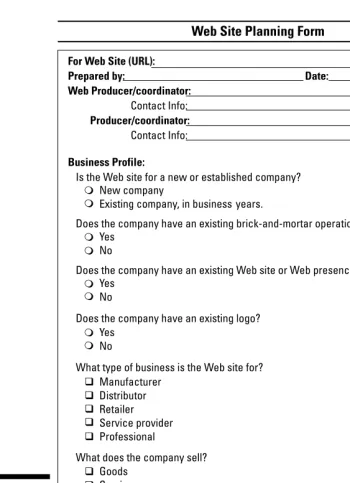
Before you state the goals for your Web site, you must be clear about the goals for your business. Your answers to a few basic questions establish the marketing framework for your site. Answer the questions in the Business Profile section of the Web Site Planning Form in Figure 2-1. These questions apply equally to businesses of any size and to not-for-profit organizations, educational institutions, and governments.
Here are a few examples of business profile questions:
Are you a new company or an existing one with an established customer/client base?
Do you have an existing brick-and-mortar store or office? Do you have an existing Web site and Web presence? Do you sell goods or services?
Do you market to individuals (which is called B2Cfor business-to-consumer) or to other businesses (which is called B2Bfor business-to-business)?
Who are your customers or clients (generally referred to as your
target markets)?
Do you sell — or want to sell — locally, regionally, nationally, or internationally?
Answer the other questions of the Business Profile section of the form to get an overall idea of what your business looks like.
© 2006 Watermelon Mountain Web Marketing www.watermelonweb.com
Is the Web site for a new or established company?
Web Site Planning Form
For Web Site (URL):
Prepared by: Date:
Web Producer/coordinator: Contact Info: Producer/coordinator:
Business Profile:
Contact Info:
New company
Existing company, in business years.
Does the company have an existing brick-and-mortar operation? Yes
No
Yes No
Yes No
Does the company have an existing Web site or Web presence?
Does the company have an existing logo?
What type of business is the Web site for? Manufacturer
Distributor Retailer Service provider Professional
What does the company sell? Goods
Services
What type of range does the company have? Local
Regional National International
Describe your goods or services: Figure 2-1:
Web Site Planning Form (download
at www.
dummies.
com/ go/web
© 2006 Watermelon Mountain Web Marketing www.watermelonweb.com
Web Site Goals
Rank the applicable purposes of your site, with 1 being the most important.
Information Branding
Lead generation/qualifying prospects Sales revenue Ad revenue Internal needs Transformation Financial Profile Break-even point: Return on investment:
Outside development:
Special elements (such as video): Marketing:
Inhouse Labor: Other materials: Web Site Budget for First Year
Sample Objectives
Traffic objective (# viewers per month): Conversion objective:
Sales objectives (# sales per month):
Other objectives specific to your site:
Repeat for each goal within timeframe specified (for instance, 1 year).
Within: Within: Within: Within: Within: Within:
Average $ per sale: $ revenue per month:
Within: Within: $ $ $ % $ % $ Total: $ $ $ $ $ Within: Within: Local Regional National International
© 2006 Watermelon Mountain Web Marketing www.watermelonweb.com
Setting Goals for Your Web Site
After you’ve outlined your business goals, you need to decide what your Web site must accomplish from a marketing perspective. The goals you set for your site plus the definition of your target market should drive both your Web design and marketing campaigns.
Business Web sites generally have one of the seven goals in the following sections as a primary goal, although large, sophisticated sites now address
Marketing Profile
Describe your target markets. Give specific demographic or segment information. For B2B, segment by industry or job title.
What is your marketing tag?
Name at least six competitors and their Web sites.
several categories. Rank the functions that apply to your site on the Web Site Goals section of the Web Site Planning Form (refer to Figure 2-1), with 1 being the primary purpose of your site.
Unless you have a large enough budget and staff to handle the demands of mar-keting to multiple audiences, select only one or two of these goals. You can add others later after benefits from your site start flowing to your bottom line.
Providing customer service
through information
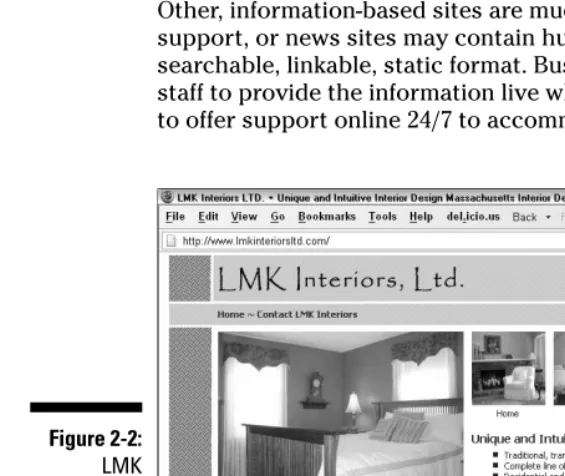
Brochurewareor business card sites are an inexpensive solution. These sites, which contain no more than the minimal information included in a small tri-fold brochure, might provide a small business with an adequate Web presence. For example, the two-page interior design site at www. lmkinteriorsltd.com(shown in Figure 2-2) briefly describes services, linking to a second page with contact information and a project inquiry form. Other, information-based sites are much more extensive. Medical, technical support, or news sites may contain hundreds or thousands of pages in a searchable, linkable, static format. Businesses save money by hiring fewer staff to provide the information live while taking advantage of the Internet to offer support online 24/7 to accommodate customers worldwide.
Courtesy Cheryl K. Perkins & Assoc. (Website Designer)
Branding your company or product
Sites like Coke.com primarily serve a branding function. Branding sites may include games, coupons, entertainment, feedback sections, interactive func-tions, and corporate information, but they generally don’t sell the product online. They generate leads or sales only indirectly. For instance, consumers can buy a key chain or other branded paraphernalia on the Coca-Cola site (www.coke.com) but cannot buy a bottle of Diet Coke.
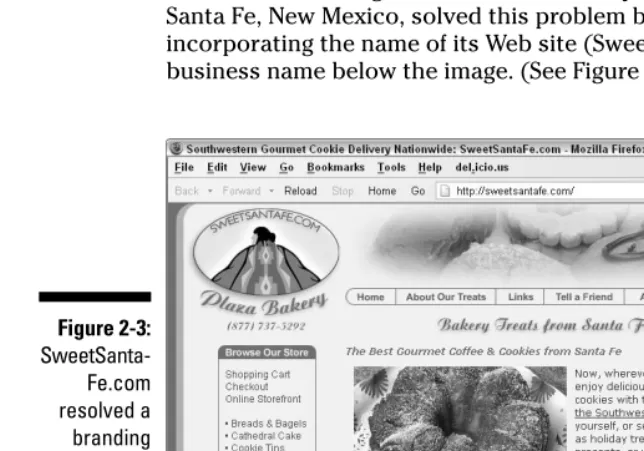
Branding can be tricky, even on a sales site, when the name of a site is not the same as the existing business. Plaza Bakery, located on the central plaza in Santa Fe, New Mexico, solved this problem by modifying its former logo, incorporating the name of its Web site (SweetSantaFe.com), and moving its business name below the image. (See Figure 2-3.)
Courtesy Plaza Bakery
Generating leads or qualifying prospects
Some sites, especially those for services and expensive products such as cars and homes, allow potential customers to research offerings, but cus-tomers must call, e-mail, or visit the brick-and-mortar establishment to close a sale. Interactive techniques, such as the Live Chat feature used by staffing agency Aerotek (www.aerotek.com/default.aspx) build relationships that turn prospects into customers. (Chapters 4 and 6 describe many interac-tive techniques you can use on your site for this purpose.)Figure 2-3: SweetSanta-Fe.com resolved a branding problem on its new Web site by revising
If you’re clever, you can qualify your leads online. For instance, SantaFe Wedding.com, a destination wedding site, asks for the groom’s name on its form inquiry page (http://santafewedding.com/request.html). That question alone reduces the number of false leads by more than 60 percent.
Generating revenue through sales
Transaction sites, which are, perhaps, the most familiar type of site, are used to sell goods or services online. Travel reservations, magazine subscriptions, organizational memberships, B2B (business to business) sales, and even donations fall into this category, as do retail sites from Amazon.com to the smallest, home-based micro-store. Good transaction sites take advantage of the Web to gather information about customer demographics, needs, and preferences and to test response to special offers.
Generating revenue through advertising
A business model that calls for generating revenue by selling ads operates in a fundamentally different marketing mode. When you sell advertising, the pri-mary product is the audience you deliver — either the number of eyeballs that view an ad or the number of click-throughs to an advertiser’s site.Achieving internal needs
Sites in this category attract investors, identify strategic business partners, locate suppliers, recruit dealers, or solicit franchisees. The audience for these sites is quite different from the audience for a site targeted at cus-tomers or clients. This distinction is critical because elements of your marketing plan are derived from the definition of your target market.
Transforming your business through
Surprisingly, innovation doesn’t have to cost much. Pablo’s Mechanical (www.pablosmechanical.com), a plumbing and heating contractor, cap-tured the second-home market in the rural tourist area near Angel Fire, New Mexico. Pablo’s Mechanical realized that second-home owners are usually well off, are frequent Internet users, and often live out of state, perhaps in a different time zone. His simple, inexpensive site directs his customers to click onto large plumbing manufacturers’ sites to select fixtures and then send him an e-mail with what they want installed.
Specifying Objectives for Your Web Site
What can convince you that your site is successful? After you establish goals, you need to specify the criteria that satisfy them. That means establishing measurable objectives. First, enter your calculations from Chapter 1 for break-even point, return on investment (ROI ), and budget onto the Financial Profile section of the Web Planning Form in Figure 2-1. Your budget and ROI expecta-tions might constrain how much you can spend on marketing and, therefore, on how much traffic your site will receive. Take this into consideration as you specify numerical targets for your objectives and the dates you expect to accomplish them. There’s no point in setting unrealistic objectives that doom your site to failure before you start.
Table 2-1 suggests some possible measurements for different Web site goals, but you have to determine the actual quantities and time frames for achieve-ment. Define other objectives as appropriate. Enter the numbers and time frames for the criteria you’ll use on the Sample Objectives section of the Web Site Planning Form. These numbers are specific to each business.
Table 2-1
Site Goals and Objectives
Site Goal Possible Objectives to Measure
Managing customer Number of phone calls and e-mails, amount of traffic to
service various pages, hours of site use, cost savings, time savings
Branding Onsite traffic, time onsite, activities performed, coupons
downloaded, gross revenues
Generating Number of phone calls and e-mails, conversion rate of visits
qualified leads to leads, conversion rate of leads to sales as compared to
Site Goal Possible Objectives to Measure
Generating Conversion rate of buyers to visitors, sales revenue,
online sales average dollar value of sale, number of repeat buyers, profit
from online sales, cost of customer acquisition, promo code use, sales closed offline that are generated from Web, if possible (that is, enter phone orders into the system)
Generating Ad revenue, click-through rate, page views per ad, traffic to
ad revenue various pages, visitor demographics
Measuring Conversion rates for various actions, site traffic, other
internal goals measurements (depending on specific goals)
Transforming Site revenues, costs, profit, time savings, costs savings,
the business other measurements (depending on specific goals)
If you don’t have objectives, you won’t know when you’ve reached or exceeded them. Setting objectives ahead of time also ensures that you establish a method for measurement.
For instance, you can obtain site traffic numbers from your Web statistics, as I discuss in Chapter 14, but you can’t count leads that come in over the phone that way. Your receptionist must ask how a caller heard about you and tally results. Or you can display a separate number, e-mail address, person, or extension for Web visitors to use, just as you would establish a separate department number for a direct mail campaign.
Try to track data for a 13-month period so you can compare same-date results. Almost all businesses experience some cyclical variation tied to the calendar.
Defining Your Target Market
In the Marketing Profile section of the Web Site Planning Form (refer to Figure 2-1), you need to define your target market(s). For each goal you select on your Planning Form, decide who your audience is. Phrases such as “everyone who eats chocolate” or “all airplane passengers” are way too broad. Unless you are Toyota or General Mills, you won’t have the funds to reach everyone, so you need to segment and prioritize your markets.
Understanding market segmentation
Market segmentation(dividing your market into smaller sets of prospects who share certain characteristics) takes many different forms. You need to select the one that’s the best fit for your business. For your online marketing plan, you need to locate the various sites on the Web where your target audiences hang out, so you need to know who they are. Think about it for a moment. The sites that appeal to opera lovers might not appeal to teenagers, and vice versa.
One caveat: Your online target audience might differ slightly from your offline audience. It might be more geographically diverse, wealthier, older, younger, more educated, more motivated by price than features, or vice versa. You discover these variations only from experience.
Here are a few forms of market segmentation:
Demographic segmentation:Sorts by age, gender, socioeconomic status, or education for B2C companies
Lifecycle segmentation:Acknowledges that consumers need different products at different stages of life (teens, young singles, married cou-ples, families with kids, empty nesters, active retirees, frail elderly)
Geographic segmentation:Targets areas as small as a neighborhood or zip code or as broad as a country or continent
Vertical industry segmentation:Targets all elements within a defined industry as a B2B strategy
Job segmentation:Identifies different decision makers (such as engineers, purchasing agents, and managers) at specific points of the B2B sales cycle Specialty segmentation:Targets a narrowly defined market (such as
45- to 65-year olds, female caregivers of people with Alzheimer’s, or 16-to 35-year-old male owners of classic Mustangs)
Researching your market online
If you aren’t sure how to define your market segments, check some of the online market research sites in Table 2-2. These sites offer a wealth of statisti-cal data about the demographics of online users, what types of products sell well, and the growth of Internet use by demographic segments.
Table 2-2
Online Market Research Sites
Name URL Content
ClickZ www.clickz.com Marketing stats, resources,
articles, and more
Internet Systems www.isc.org/index. Internet domain survey
Consortium pl?/ops/ds host count
internet.com www.internet.com Online marketing newsletters
and resource-providers lists
MarketingSherpa www.marketingsherpa. Free articles and case
com studies, fee-based online
marketing library
Web Marketing www.wilsonweb.com Resource links with online
Today and e-commerce marketing
information
If your target audience isn’t online, the Web should not be part of your marketing mix for end user sales! It can still fulfill other functions, of course. Check the Harris Interactive report at http://harrisinteractive.com/harris_ poll/index.asp?PID=668for details about who’s online. As of May 2006, Harris found that 77 percent of U.S. adults — 172 million — were online at work, school, or home and that Internet access now looks a lot more like the nation as a whole than it did several years ago. More seniors, minorities, and low-income users now have Internet access, shrinking the digital divide.
Writing Your Online Marketing Plan
Marketing tag: Enter your marketing tag,which is the five- to seven-word phrase that describes what your business offers or who you are. This phrase probably appears (or should) on almost all your stationery, busi-ness cards, advertising, and packaging. Like your logo, your marketing tag helps define your public image. Your marketing tag should appear on your Web site as well! Many companies include it in their header graphic to reinforce branding. You can see examples in Figure 2-2 and the figure in the “Planning for success at a museum Web site” sidebar near the end of the chapter.
Value proposition:Why should someone buy from your company rather than from a competitor?
Competitors: Enter the names of at least six competitors and their Web addresses.
After you go online, your universe of competitors expands phenome-nally. If you’ve been selling locally but plan to expand your market size, you’ll find lots of other competitors online. You’ll find competitors for your type of business in search engines, online Yellow Pages, or online business directories. This effort can be a bit sobering, but it’s better to be prepared than surprised.
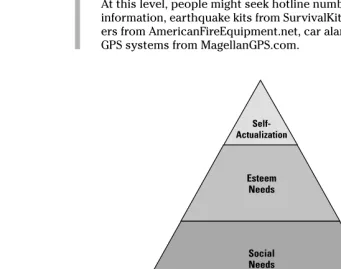
Before writing an online marketing plan, consider how three other traditional marketing concepts apply in cyberspace: the classic four Ps of marketing, Maslow’s Triangle (which I discuss in further detail in the “Understanding why people buy: Maslow’s Triangle” section later in this chapter), and the obvious but often-forgotten need to fish where the fish are. Use these tools as part of your planning process to resolve problems before they impede your online success.
Examining the four Ps of marketing
Marketers name product, price, placement (distribution), and promotion as the traditional elements of marketing. These terms apply to the Web as well.
If you plan to update an existing site, it’s particularly important to review the four Ps. For instance, you might think you need a site update because you receive too little traffic from search engines, but after a review of the four Ps, you find out that the real issue is pricing. Chapter 14 explains how to diag-nose problems with the four Ps by using your Web statistics.
Product
benefits, or services they offer. (To find your competitors, look up your prod-uct in Google or another search engine.) Prodprod-uct also includes such elements as performance, warranties, support, variety, and size. If you have an online store, look at your entire product mix and merchandising, not just individual products. Ask yourself the following questions:
Do you have enough products in your online catalog to compete successfully?
Are you selling what people want to buy?
Are you updating your product catalog regularly, quickly removing items that are out of stock and promoting new items?
Price
The expanding presence of discount stores online puts significant price
pressure on small businesses. Price comparison sites like Shopping.com, which cost-conscious shoppers check frequently, also compel lower prices. Use those sites to assess your prices against your online competition. Are you signifi-cantly higher, lower, or price competitive? What about your shipping prices?
I talk more about shipping in Chapter 5, but for now, remember that high shipping costs account for 75 percent of abandoned shopping carts. If necessary, bury some of the handling and shipping costs in the basic product price and reduce the visible price for shipping.
It’s very hard for your small business to compete in the market for standard goods like baby clothes or DVDs unless you have really good wholesale deals from manufacturers or distributors. But you can compete pricewise on cus-tomized goods or services or by offering unique benefits for buying from your company. If you must charge higher prices than your online competi-tors, review your value proposition so that people perceive an extra benefit. That could be a $5 promotional code for a discount on another purchase, a no-questions-asked return policy, exclusivity, or your reputation for quality service.
You don’t need to compete with offline prices because people value the con-venience of, and time saved by, shopping online. It’s perfectly okay to pr