Volume 2007, Article ID 39575,8pages doi:10.1155/2007/39575
Research Article
Application of the HLSVD Technique to the Filtering of
X-Ray Diffraction Data
M. Ladisa,1A. Lamura,2T. Laudadio,3and G. Nico2
1Istituto di Cristallografia (IC), Consiglio Nazionale delle Ricerche (CNR), Via Amendola 122/O, 70126 Bari, Italy 2Istituto Applicazioni del Calcolo Mauro Picone (IAC), Consiglio Nazionale delle Ricerche (CNR), Via Amendola 122/D,
70126 Bari, Italy
3SISTA, SCD Division, Department of Electrical Engineering (ESAT), Katholieke Universiteit Leuven, Kasteelpark Arenberg 10, 3001 Leuven-Heverlee, Belgium
Received 6 February 2006; Revised 21 December 2006; Accepted 2 February 2007
Recommended by Jacques G. Verly
A filter based on the Hankel-Lanczos singular value decomposition (HLSVD) technique is presented and applied for the first time to X-ray diffraction (XRD) data. Synthetic and real powder XRD intensity profiles of nanocrystals are used to study the filter performances with different noise levels. Results show the robustness of the HLSVD filter and its capability to extract easily and effciently the useful crystallographic information. These characteristics make the filter an interesting and user-friendly tool for processing of XRD data.
Copyright © 2007 M. Ladisa et al. This is an open access article distributed under the Creative Commons Attribution License, which permits unrestricted use, distribution, and reproduction in any medium, provided the original work is properly cited.
1. INTRODUCTION
In many applications of X-ray diffraction (XRD) techniques
to the study of crystal properties, a key step in the data
pro-cessing chain is an effective and adaptive noise filtering [1–
4]. A correct noise removal can facilitate the separation of the useful crystallographic information from the background signal, and the estimation of crystal structure and domain size. Important issues of XRD data filtering are performances in noise suppression, capability to preserve the peak position, computational cost, and finally, the possibility of being used
as a blackbox tool. Different digital filters have been applied
to XRD data, in spatial and frequency domains. Simple pro-cedures are based on polynomial filtering (and fitting) in the spatial domain [1]. A standard practice when working in fre-quency domain is to use Fourier smoothing. It consists in removing the high-frequency components of the spectrum [5]. Since the truncation of high-frequency components can
be problematic in the case of high-level noise, a different
ap-proach based on the Wiener-Fourier (WF) filter has been
proposed to clean XRD data [6]. A different approach, which
makes use of the singular value decomposition (SVD), has been successfully applied to time-resolved XRD data to
re-duce noise level [3,4].
In this work, we describe an application of the Hankel-Lanczos singular value decomposition (HLSVD) algorithm
to filter XRD intensity data. The proposed filter is based on a subspace-based parameter estimation method, called Hankel singular value decomposition (HSVD) [7], which is currently applied to nuclear magnetic resonance spectroscopy data for solvent suppression [8]. The HSVD method computes a “sig-nal” subspace and a “noise” subspace by means of the SVD
of the Hankel matrixH, whose entries are the noisy signal
data points. Its computationally most intensive part consists
of the computation of the SVD of the matrix H. Recently,
several improved versions of the algorithm have been devel-oped in order to reduce the needed computational time [8]. In this paper, we choose to apply the HSVD method based on the Lanczos algorithm with partial reorthogonalization (HLSVD-PRO), which is proved to be the most accurate and
efficient version available in the literature. A comparison in
terms of numerical reliability and computational efficiency
of HSVD with its Lanczos-based variants can be found in [8]. A criterion is presented to facilitate the separation of noise from the useful crystallographic signal. It is completely user-independent since it is based on a numerical method.
It will be described in more detail in Section 4. It enables
the design of a blackbox filter to be used in the process-ing of XRD data. Here, the filter is applied to nanocrys-talline XRD data. Nanocrystals are characterized by chemical
At a scale of a few nanometers, metals can crystallize in a
structure different from that of bulk. Nowadays, different
branches of science and engineering are benefiting from the properties of nanocrystalline materials [10]. In particular, recent XRD experiments have shown that intensities, mea-sured as a function of the scattering angle, could be use-ful to extract structural and domain size information about nanocrystalline materials. Experimental XRD data were col-lected on the XRD beam line at the Brazilian Synchrotron Light Facility (LNLS-Campinas, Brazil) using 8.040 keV pho-tons at room temperature (for further details, see [11]). In
this case, samples with different diameters of powder of gold
nanoparticles underwent diffraction measurements in the
X-ray domain. The diffracted intensity was recorded varying
the diffraction angle, namely, the angle between the
inci-dent beam and the scattered one. Synthetic XRD datasets are generated by computing the X-ray scattered intensity from
nanocrystalline samples of different sizes and properties by
using an analytic expression (see (6)). Synthetic datasets are processed and filter performance is studied when considering
different levels of noise. Numerical tests on real XRD data of
Au nanocrystalline samples of different sizes and properties
show the robustness of the proposed filter and its
capabil-ity to extract easily and efficiently the useful crystallographic
information. These characteristics make this filter an inter-esting and user-friendly tool for the interactive processing of XRD data.
The paper has the following structure.Section 2is
de-voted to the theoretical aspects of the proposed approach. The dataset used to study the filter properties is described
inSection 3. Numerical results are reported inSection 4.
Fi-nally, some conclusions are drawn inSection 5.
2. THE SUBSPACE-BASED PARAMETER ESTIMATION METHOD HSVD
Let us denote withInthe samples of the diffracted intensity
signal collected at anglesϑn,n=0,. . .,N−1. They are
mod-elled as the sum ofKexponentially damped complex
sinu-soids
In=In0+en= K
k=1
akexp
iϕk
exp−dk+i2π fk
ϑn
+en,
(1)
where In and In0, respectively, represent the measured and
modelled intensities at thenth scattering angleϑn=nΔϑ+ϑ0,
withΔϑthe sampling angular interval andϑ0the initial
scat-tering angular position,akis the amplitude,ϕkthe phase,dk
the damping factor, and fkthe frequency of thekth sinusoid,
k=1,. . .,K, withKthe number of damped sinusoids, anden is complex white noise with a circular Gaussian distribution.
It is worth noting that the value ofK increases or decreases
by 2 in order to guarantee that the modelled intensity is real. This constraint is enforced in the filtering process. The
algo-rithm is described in detail inAppendix A.
It allows to estimate the parametersdkand fkappearing
in (1). These are inserted into the model (1), which yields the
set of equations
In K
k=1
akexp
iϕk
exp−dk+i2πfk
ϑn
+en, (2)
with n = 0, 1,. . .,N −1. The least-squares solutionck =
akexpiϕkof (2) provides the amplitudeakand phaseϕk
es-timates of the model sinusoids. The computationally most intensive part of this method is the computation of the SVD
of the Hankel matrixH. Various algorithms are available for
computing the SVD of a matrix. The most reliable algorithm for dense matrices is due to Golub and Reinsch [12] and is available in LAPACK [13]. The Golub-Reinsch method com-putes the full SVD in a reliable way and takes approximately
2LM2+ 4M3complex multiplications for anL×Mmatrix.
However, when only the computation of a few largest singu-lar values and corresponding singusingu-lar vectors is needed, the method is computationally too expensive. More suitable al-gorithms exist which are based on the Lanczos method. The proposed approach relies on the latter.
A key step in the filtering procedure is the selection of
the numberKof damped sinusoids characterizing the model
function of the HLSVD-PRO filter. Here, a possible approach is presented, which is based on the following frequency
selec-tion criterion: the singular valuesλk,k = 1,. . .,r, are
plot-ted versus the corresponding frequencies fkof the sinusoids
in (1). This choice facilitates a direct comparison of the re-sults of the proposed filter with those obtained by other filters based on a frequency approach. It was observed that, gener-ally, crystallographic XRD intensity signals show a clear tran-sition from a low-frequency region, characterized by high
singular valuesλk, to a high-frequency region with small
sin-gular values whose variability is below 10% with respect to
the asymptotic valueλr, namely (λK−λr)/λK <0.1. We
ex-ploit this feature in order to automatically find a threshold.
The indexKof the frequencyfKcorresponding to the
transi-tion provides the number of damped sinusoids to be used in the HLSVD-PRO filter. The filter performance was evaluated using the measure
E =Iexp−Ith
Ifil−Ith
, (3)
where Iexp/th/fil are the experimental/theoretical/filtered
in-tensities, respectively.
3. DATASET
The HLSVD-PRO filter was applied to synthetic as well as real XRD data. In this section, the generation of XRD inten-sity profiles and the experimental setup for the acquisition of real data are described. Both synthetic and real XRD data refer to Au nanocrystalline samples. Nanocrystals are made
of clusters of three different structure types: cuboctahedral
C, icosahedralI, and decahedralD. For each fixed structure
typeX(X =C,I,D), the sizenof clusters follows a
log-normal distribution
fX(n)=exp
−sX/2
2πξXsX
exp
−
logn−logξX2
2s2X
with modeξXand logarithmic widthsX. Structural distances
for the different structure typesXare generally studied
in-dependently of the actual nanomaterial. The nearest distance between atoms in the crystals is chosen as a reference length
and is arbitrarily set to 1/√2, a constant in various structures
Xand for all sizesnof the clusters. Actual distances in
nan-oclusters are then recovered by applying a correction factor
aX(n) for strain, supposed to be uniform and isotropic. A
convenient description of the strain factor as a function of the structure type and cluster size is
aX(n)=ΩX+ΞX−ΩX×π+ 2 atan
n0 X−n
/wX
π+ 2 atann0
X−1/wX,
(5)
given in terms of the four parameters [n0X,ΩX,ΞX,wX].
In-tensities scattered by nanoclusters with sizenand structure
typeXare computed by using the diffractional model based
on the Debye function method [14,15]:
IX,n(q)=A
NX(n) + NX(n)
i /=j
sin2πquXi,j,naX(n)
2πquXi,j,naX(n)
, (6)
where I0 is the incident X-ray intensity, T(q) is the
Debye-Waller factor, f(q) is the atomic form factor, A =
I0[T(q)f(q)]2,q = 2af.c.c.sinϑ/λandq = q/af.c.c. are, re-spectively, the dimensionless and the usual scattering vector
lengths withaf.c.c.being the face-centered cubic (f.c.c.) bulk
lattice constant;NX(n) is the number of atoms in the cluster,
uXi,j,nthe distance between theith and jth atom,aX(n) the
strain factor. The total scattered intensity is computed as
I(q)= X xX
SX
n=1
fX(n)IX,n(q), (7)
whereSXdenotes the size of the largest cluster of typeX,xX
is the number fraction of each structure type (XxX=1),
and fX(n) is the value of log-normal size distribution (4).
It is worth noting that both intensities in (6) and (7) are
actually functions of the scattering angle ϑ being q =
2af.c.c.λ−1sinϑ. Experimental XRD intensity profiles are
col-lected by counting, at each scattering angle ϑn, the
num-ber of scattered photons giving the diffracted intensity
sig-nal In. For such events, data are affected by Poisson noise.
Since the number of photons scattered at each angle ϑn is
large, the Poisson-distributed noise can be approximated by a Gaussian-distributed noise as required in Section 2 [16].
Noisy synthetic XRD intensity profiles were built by
gen-erating Poisson-distributed random profiles with intensityI
(7) taken as the mean value of the Poisson process. As a mea-sure of the noise level, the noise-to-signal ratio (NSR) was defined as follows:
NSR= PP(F×I)
(F×I) , (8)
where P(I) denotes a Poisson process with mean value I.
Different NSR values were obtained by scaling the scattered
intensity (7) by a factorF.Figure 1displays XRD intensity
Table1: Values of parameters used in (6) to compute synthetic XRD intensity profiles. The wavelength and the f.c.c. bulk lattice constant were set toλ=0.15418 nm andaf.c.c.=0.40786 nm, re-spectively.
Parameter X=C X=I X=D
ξX 5.0 5.0 5.0
sX 0.3 0.3 0.3
n0
X 4.0 4.0 6.0
ΩX 1.0 1.0 1.0
ΞX 1.0 1.0 1.0
wX 0.5 0.5 0.5
0 1000 2000 3000 4000 5000 6000
0.2 0.3 0.4 0.5 0.6 0.7 0.8 0.9 1
ϑ(rad)
XRD
int
ensit
y
(A
U)
Figure1: Synthetic XRD intensity profiles as a function of the scat-tering angle. From the upper to the lower profile, the NSR increases from 2% to 5% (seeFigure 2and text for details).
profiles with increasing NSRs. They were obtained by setting
λ = 0.15418 nm andaf.c.c. = 0.40786 nm in (6). The set of
parameters used to compute the synthetic profiles are
sum-marized inTable 1.Figure 2shows the NSR of the synthetic
profiles as a function of the scaling factorF ranging from 0
to 2. This range contains the NSR values usually measured in experimental profiles.
We also considered real data in order to validate our
method. Three different samples were prepared with
resul-tant mean diameters of 2.0, 3.2, and 4.1 nm, respectively (as measured by transmission electron microscope). The size distributions were approximately characterized by the same
full width at half-maximum (≈1 nm) for all three systems.
4. NUMERICAL RESULTS
Table2: MeasureE(see (3)) of the filter performance as a function of the orderKof the filter. The synthetic XRD intensity data refer to different sample sizes and NSRs. The best performance corresponds to the orderKreported in the middle row of each NSR value.
2 nm 3 nm 4 nm
NSR=10%
K−2 1.86±0.16 1.25±0.09 1.67±0.10
K=9 2.49±0.16 2.34±0.20 1.89±0.19
K+ 2 2.43±0.42 2.28±0.21 1.73±0.18
NSR=5%
K−2 2.17±0.18 1.81±0.16 1.52±0.11
K=11 2.34±0.18 1.87±0.16 1.56±0.12
K+ 2 2.22±0.28 1.87±0.16 1.48±0.09
NSR=2%
K−2 1.80±0.21 1.37±0.32 1.13±0.14
K=15 1.89±0.28 1.54±0.39 1.25±0.06
K+ 2 1.86±0.18 1.46±0.38 1.18±0.09
0 0.05 0.1 0.15 0.2 0.25
0 0.2 0.4 0.6 0.8 1 1.2 1.4 1.6 1.8 2 Scaling factorF
NSR
Figure2: NSR as a function of the factorF, see text for details. The horizontal line separates the NSR values above and belowF=1.
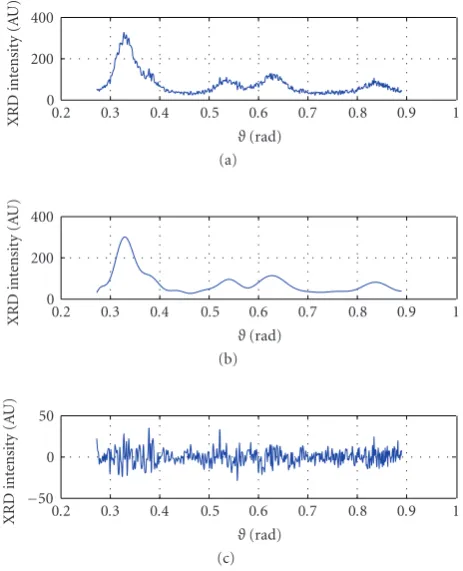
properties under controlled conditions.Figure 3displays an
example of application of the HLSVD-PRO filter. A noisy synthetic XRD intensity profile is shown at the top of the figure. It corresponds to X-ray scattering from an Au
sam-ple having a 3 nm size with a Poisson-like noise with NSR=
10%. The filtered signal shown in the middle of the figure was
obtained by settingK =9 in the HLSVD-PRO filter. In the
following (seeTable 2for results), we discuss in more detail
the performance of the method when the valuesK =7 and
K =11 are used. This value was estimated according to the
criterion illustrated inSection 2. The values ofλkwere
plot-ted by first sorting frequencies fkin ascendant order.
Specif-ically, a transition from high to smallλkwas observed at
fre-quency fK =35 rad−1, which represents theKth frequency
in the set of the sorted frequencies starting from the smallest one. For a comparison, the discrete Fourier transform (DFT) of the noisy synthetic XRD signal is reported at the bottom
ofFigure 4. Again, a phenomenon of transition from high to
small singular values occurs in the same region of the spec-trum, as observed at the top of the figure. However, the
tran-0 200 400
0.2 0.3 0.4 0.5 0.6 0.7 0.8 0.9 1
ϑ(rad)
XRD
int
ensit
y
(A
U)
(a)
0 200 400
0.2 0.3 0.4 0.5 0.6 0.7 0.8 0.9 1
ϑ(rad)
XRD
int
ensit
y
(A
U)
(b)
−50 0 50
0.2 0.3 0.4 0.5 0.6 0.7 0.8 0.9 1
ϑ(rad)
XRD
int
ensit
y
(A
U)
(c)
Figure3: Three nm Au synthetic sample: (a) noisy (NSR=10%) synthetic XRD intensity profile as a function of the scattering angle
ϑ; (b) filtered XRD intensity profile; (c) difference between
mea-sured and filtered profiles.
sition frequency is much more difficult to localize than in
the HLSVD-PRO filter case. The same behavior is observed when using the WF filter. This makes troublesome the appli-cation of DFT and WF filters to clean noisy XRD data. It is
worth noting that this difference between the HLSVD-PRO
and Fourier-frequency-based filters is relevant when the fil-ter is intended to be used during infil-teractive XRD data anal-ysis. In this case, the successful application of an easy-to-use blackbox filter becomes crucial.
Coming back toFigure 3, the difference between the
val-ues of noisy and filtered profiles is shown at the bottom. To quantify the performance of the filter, the filtered signal was compared with the noiseless synthetic XRD signal (see Figure 5). For the sake of completeness, we also report in
Figure 5 the residue between the noiseless and the filtered
signals. This can be done only with synthetic signals as ex-perimental XRD data without noise are not available. To give a statistical significance to these measures a Monte Carlo experiment was carried out. More precisely, the HLSVD-PRO was applied to 1000 noisy synthetic profiles generated
by considering samples of the same size undergoing diff
er-ent NSRs. For each filtered profile, the filter performance
measureE, defined in (3), was estimated by calculating the
mean value and the standard deviation. For each sample size and NSR, the mean and standard deviation are obtained
2 2.5 3 3.5 4 4.5 5
0 50 100 150 200 250
f (rad−1)
log
|
λi
|
(a)
0 1 2 3 4 5
0 50 100 150 200 250
f(rad−1)
|
DFT
{
I
(
ϑ
)
}|
(b)
Figure4: Three nm Au synthetic sample with NSR = 10%: (a) amplitude of eigenvaluesλkversus frequency fk,k = 1,. . .,r; (b) portion of the DFT amplitude spectrum of the noisy synthetic XRD intensity profile. Both plots refer to the XRD intensity profile shown at the top ofFigure 3.
noise realizations having the same NSR. The sensitivity to the
numberK of sinusoids of the HLSVD-PRO filter was also
studied. This number was slightly varied around the
opti-malK value selected by using the threshold criterion. The
performance results were compared in order to validate the
choice of the optimalKvalue. In particular,Kwas increased
and decreased by 2, as discussed inSection 1. The results of
such a comparison are summarized inTable 2and they show
that the proposed threshold criterion provides the value ofK
corresponding to the best performance of the HLSVD-PRO filter.
The filter was also applied to real XRD intensity profiles
of Au samples of sizes 2, 3.2, and 4.1 nm.Figure 6shows at
top the profile of a 3.2 nm Au sample with NSR = 2.3%.
The latter is computed asσ/I, whereσ andI are
vec-tors with the measured error and the intensity values, re-spectively. Since in the case of XRD signals, the noise
fol-lows the Poisson distribution, σ is given by √I. The result
obtained by HLSVD-PRO is displayed in the middle of the figure. At bottom, the plot of singular values is depicted ver-sus the frequency. Components with a frequency higher than
fK=34 rad−1, due to noise, were removed. Denoising a real
XRD profile of 500 intensity data samples, as typical ones used in the present study, requires about 11 seconds, using Matlab 7 on a machine with an Intel Xeon 2.80 GHz proces-sor and a 512 KB cache size.
Finally, as a matter of comparison, we applied two well-known parametric algorithms that are commonly used for spectral analysis: MUSIC and ESPRIT [17]. Such methods
are generally expected to be more effective spectral tools
compared to DFT since they rely on the use of a model
func-0 100 200 300 400
0.2 0.3 0.4 0.5 0.6 0.7 0.8 0.9 1
ϑ(rad)
XRD
int
ensit
y
(A
U)
(a)
−50 0 50
0.2 0.3 0.4 0.5 0.6 0.7 0.8 0.9 1
ϑ(rad)
XRD
int
ensit
y
re
sidue
(A
U
)
(b)
Figure5: Three nm Au synthetic sample with NSR = 10%: (a) noiseless synthetic XRD intensity profile as a function of the scatter-ing angleϑ; (b) difference between noiseless and filtered (see middle
plot ofFigure 3) profiles.
tion. However, in the present case where the signal is better modelled with damped sinusoids, the aforementioned meth-ods are not able to correctly filter the signal. This limitation comes from the use of prescribed model functions that do not account for damping. Extensive simulation studies by us-ing synthetic as well as real data show that MUSIC and ES-PRIT fail. For instance, for the real XRD intensity reported
inFigure 6, we computed the residue-to-signal ratio (RSR).
We obtain the following results: RSR=54% (ESPRIT), 51%
(MUSIC), 2% (HLSVD).
5. CONCLUSIONS
A filter based on the HLSVD-PRO method has been pre-sented. It has been applied to filter XRD patterns of nan-ocluster powders. The filter performance has been studied
on synthetic and real XRD patterns with different NSRs.
Re-sults show that the proposed filter is robust and
computa-tionally efficient. A further advantage is its user-friendliness
that makes it a useful blackbox tool for the processing of XRD data.
APPENDICES
HSVD is a subspace-based parameter estimation method in
which the noisy signal is arranged in a Hankel matrixH. Its
SVD allows to compute a “signal” subspace and a “noise”
subspace. In fact, if H is constructed from a noiseless
sig-nal, the data matrixHhas exactly rank equal toK, the
num-ber of exponentials that models the underlying signal. Due
0 2 4 6
×103
0.2 0.3 0.4 0.5 0.6 0.7 0.8 0.9 1
ϑ(rad)
XRD
int
ensit
y
(A
U)
(a)
0 2 4 6
×103
0.2 0.3 0.4 0.5 0.6 0.7 0.8 0.9 1
ϑ(rad)
XRD
int
ensit
y
(A
U)
(b)
3 4 5 6
0 50 100 150 200 250
f(rad−1)
log
|
λi
|
(c)
Figure6: Au real sample of 3.2 nm: (a) noisy (NSR=2.3%) XRD intensity profile as a function of the scattering angleϑ; (b) filtered XRD intensity profile; (c) amplitudes of eigenvaluesλk versus fre-quencyfk,k=1,. . .,q.
However, as long as the SNR of the signal is not too low, one can still define the “numerical” rank being approximately
equal toK. Then, the “signal” subspace is found by
truncat-ing the SVD of the matrixHto rankK.
In the following subsections, the method will be derived in the context of linear algebra.
A. HSVD: THE ALGORITHM
TheNdata points defined in (1) are arranged into a Hankel
matrixH of dimensionsL×M, withL+M = N+ 1 and
LN/2,
HL×M=
⎡ ⎢ ⎢ ⎢ ⎢ ⎢ ⎣
I0 I1 · · · · · · IM−1
I1 I2 · · · · · · IM ..
. ... ... ... ...
IL−1 IL−2 · · · · · · IN−1
⎤ ⎥ ⎥ ⎥ ⎥ ⎥ ⎦
L×M
. (A.1)
The SVD of the Hankel matrix is computed as
HL×M=UL×LΣL×MVM×MH , (A.2)
whereΣ = diag{λ1,λ2,. . .,λr},λ1 ≥ λ2 ≥ · · · ≥ λr ≥ 0,
r =min(L,M),UandV are orthogonal matrices, and the
superscriptHdenotes the Hermitian conjugate. The SVD is
computed by using the Lanczos bidiagonalization algorithm with partial reorthogonalization [18]. This algorithm com-putes two matrix-vector products at each step. Exploiting the
structure of the matrix (A.1) by using the FFT, the latter
com-putation requiresO((L+M) log2(L+M)) rather thanO(LM).
In order to obtain the “signal” subspace, the matrixHis
truncated to a matrixHKof rankK,
HK=UKΣKVKH, (A.3)
where UK, VK, and ΣK are defined by taking the first K
columns ofU andV, and the K ×K upper-left matrix of
Σ, respectively. The way of choosingKis described at the
be-ginning ofSection 4. As a subsequent step, the least-squares
solutionEof the following overdetermined set of equations
is computed as
UK(top)UK(bottom)E, (A.4)
whereUK(bottom)andU
(top)
K are derived fromUKby deleting its
last and first rows, respectively. Equation (A.4) follows from the shift-invariance property holding for the Vandermonde
decomposition of the Hankel matrixH[7]. TheK
eigenval-ueszkof the matrixEare used to estimate the frequenciesfk
and the damping factorsdkof the model damped sinusoids
from the relationship
zk=exp
−dk+i2πfk
Δϑ, (A.5)
as
dk= −
logzk
Δϑ ,
fk=
logzk
(2πΔϑ) ,
(A.6)
withk=1,. . .,K.
B. HSVD: NOISELESS DATA
Arrange theN noiseless data points I0
n defined in (1) in a
Hankel matrixHof dimensionsL×M, withLandMgreater
thanKandN=L+M−1,
H=
⎡ ⎢ ⎢ ⎢ ⎢ ⎢ ⎣
I0
0 I10 · · · IM−0 1
I0
1 I20 · · · IM0 ..
. ... ... ...
I0
L−1 IL−0 2 · · · IN−0 1
⎤ ⎥ ⎥ ⎥ ⎥ ⎥
⎦. (B.1)
The model of (1) can be rewritten in terms of complex
am-plitudesckand signal poleszkas follows:
I0 n=
K
k=1
ckznk, n=0,. . .,N−1, (B.2)
where ck = ak exp (iϕk) exp (−dk +i2πfk)ϑ0 andzk =
matrixHcan be factorized as follows:
H=
⎡ ⎢ ⎢ ⎢ ⎢ ⎢ ⎣
1 1 · · · 1
z1 z2 · · · zK ..
. ... . .. ...
zL−1 1 zL−2 1 · · · zL−K 1
⎤ ⎥ ⎥ ⎥ ⎥ ⎥ ⎦ ⎡ ⎢ ⎢ ⎢ ⎢ ⎢ ⎣
c1 0 · · · 0 0 c2 · · · 0
..
. ... . .. ...
0 0 · · · cK
⎤ ⎥ ⎥ ⎥ ⎥ ⎥ ⎦
×
⎡ ⎢ ⎢ ⎢ ⎢ ⎢ ⎣
1 1 · · · 1
z1 z2 · · · zK ..
. ... . .. ...
zM−1
1 zM−2 1 · · · zM−K 1
⎤ ⎥ ⎥ ⎥ ⎥ ⎥ ⎦
T
=SCTT.
(B.3)
This factorization is called Vandermonde decomposition and from it the signal parameters can immediately be derived. A well-known algorithm to directly compute the Vandermonde decomposition is available in the literature and is called Prony’s method [19–22]. Here, a more reliable approach, based on an indirect computation of the parameters, is adopted. This approach is described below. From (B.3), it can
be easily proved that the matrixSsatisfies the so-called
shift-invariance property, that is,
S↑=S↓Z, (B.4)
whereS↑andS↓are derived fromSby deleting its first and last
rows, respectively, andZis aK×Kcomplex diagonal matrix
with entries equal to theKsignal poleszk,k=1,. . .,K. The
rank of the matrixHis equal toK, and thus, its SVD has the
following form:
H=UΣVH=U
K U2 ΣK 0
0 0 VK V2
H
=UKΣKVKH, (B.5)
whereUK∈CL×K,U2∈CL×(L−K),ΣK∈CK×K,VK ∈CM×K,
V2∈CM×(M−K). From the comparison of (B.3) and (B.5), it
follows thatSandUKspan the same column space, and hence
are equal up to a multiplication by a nonsingular matrixQ∈
CK×K, that is,
UK =SQ. (B.6)
Using (B.6), the shift-invariance property of (B.4) becomes
UK↑ =UK↓Q−1ZQ. (B.7)
The matrixQ−1ZQ can be determined as the least-squares
solution of (B.7). Several reliable and efficient algorithms are
available in the literature and they exploit well-known alge-braic tools such as the QR decomposition, the SVD
decom-position, and so forth. The reader is referred to [12, 23],
where an exhaustive overview on the computation of the least-squares solution of a system of equations is provided.
Since the eigenvalues ofQ−1ZQandZare equal, the signal
poles are easily derived as
zk
K k=1=eig
Q−1ZQ=eig(Z), (B.8)
where the function eig(·) determines the eigenvalues of the
matrix between brackets.
From the signal poles, frequency and damping factors are estimated. By filling in these estimates into the model function (B.2), a new system of equations is obtained with
unknowns equal to the complex variablesck. Its solution
pro-vides estimates for the amplitudes and the phases.
C. HSVD: NOISY DATA
When noise affects the data, as in real MRS signals,
rela-tion (B.5) no longer holds. Although no exact solurela-tion of the shift-invariance property exists, if the noise is small
com-pared to the signal,Hcan be approximated by the truncated
SVD, that is,
H=UΣVH≈UKΣKVKH=HK, (C.1)
whereUK andVK are the firstK columns ofU andV,
re-spectively, andΣKis theK×Kupper-left submatrix ofΣ.
The matrixHK has rankKbut its Hankel structure has
been destroyed by the truncation of the SVD. Therefore, there exists no exact solution of the system in (C.1). However, estimates of the signal poles can still be obtained by solving the aforementioned system in an LS sense and the signal pa-rameters can be derived from such estimates as in the noise-less case. Further details about the derivation of HSVD can
be found in [7,24].
ACKNOWLEDGMENTS
The authors thank A. Cervellino, C. Giannini, and A. Guagl-iardi for kindly providing us with experimental XRD data.
REFERENCES
[1] B. Mierzwa and J. Pielaszek, “Smoothing of low-intensity noisy X-ray diffraction data by Fourier filtering: application to sup-ported metal catalyst studies,”Journal of Applied Crystallogra-phy, vol. 30, no. 5, pp. 544–546, 1997.
[2] A. Hieke and H.-D. D¨orfler, “Methodical developments for X-ray diffraction measurements and data analysis on lyotropic liquid crystals applied to K-soap/glycerol systems,”Colloid and Polymer Science, vol. 277, no. 8, pp. 762–776, 1999.
[3] M. Schmidt, S. Rajagopal, Z. Ren, and K. Moffat, “Appli-cation of singular value decomposition to the analysis of time-resolved macromolecular X-ray data,”Biophysical Jour-nal, vol. 84, no. 3, pp. 2112–2129, 2003.
[4] S. Rajagopal, M. Schmidt, S. Anderson, H. Ihee, and K. Mof-fat, “Analysis of experimental time-resolved crystallographic data by singular value decomposition,”Acta Crystallographica Section D, vol. 60, no. 5, pp. 860–871, 2004.
[5] E. E. Aubanel and K. B. Oldham, “Fourier smoothing without the fast Fourier transform,”Byte, vol. 10, no. 2, pp. 207–222, 1985.
[6] C. Wooff, “Smoothing of data by least squares fitting,” Com-puter Physics Communications, vol. 42, no. 2, pp. 249–251, 1986.
[8] T. Laudadio, N. Mastronardi, L. Vanhamme, P. van Hecke, and S. van Huffel, “Improved Lanczos algorithms for black-box MRS data quantitation,”Journal of Magnetic Resonance, vol. 157, no. 2, pp. 292–297, 2002.
[9] D. J. Wales, “Structure, dynamics, and thermodynamics of clusters: tales from topographic potential surfaces,” Science, vol. 271, no. 5251, pp. 925–929, 1996.
[10] R. W. Siegel, E. Hu, D. M. Cox, et al., “Nanostructure Sci-ence and Technolgy. A Worldwide Study,” The Interagency Working Group on NanoScience, Engineering and Technolgy,
http://www.wtec.org/loyola/nano/.
[11] D. Zanchet, M. B. D. Hall, and D. Ugarte, “Structure popula-tion in thioi-passivated gold nanoparticles,”Journal of Physical Chemistry B, vol. 104, no. 47, pp. 11013–11018, 2000. [12] G. H. Golub and C. Reinsch, “Singular value decomposition
and least squares solutions,”Numerische Mathematik, vol. 14, no. 5, pp. 403–420, 1970.
[13] E. Anderson, Z. Bai, C. Bischof, et al.,LAPACK Users’ Guide, SIAM, Philadelphia, Pa, USA, 1995.
[14] R. A. Young,The Rietvel Method, Oxford University Press, New York, NY, USA, 1993.
[15] A. Cervellino, C. Giannini, and A. Guagliardi, “Determina-tion of nanoparticle structure type, size and strain distri-bution from X-ray data for monatomic f.c.c.-derived non-crystallographic nanoclusters,”Journal of Applied Crystallog-raphy, vol. 36, no. 5, pp. 1148–1158, 2003.
[16] J. R. Taylor, An Introduction to Error Analysis: The Study of Uncertainties in Physical Measurements, University Scientific Books, Sausalito, Calif, USA, 1997.
[17] P. Stoica and R. Moses, Introduction to Spectral Analysis, Prentice-Hall, Upper Saddle River, NJ, USA, 1997.
[18] H. D. Simon, “The Lanczos algorithm with partial reorthogo-nalization,”Mathematics of Computation, vol. 42, no. 165, pp. 115–142, 1984.
[19] S. L. Marple, Digital Spectral Analysis with Applications, Prentice-Hall, Englewood Cliffs, NJ, USA, 1987.
[20] G. Golub and V. Pereyra, “Separable nonlinear least squares: the variable projection method and its applications,”Inverse Problems, vol. 19, no. 2, pp. R1–R26, 2003.
[21] B. J. C. Baxter and A. Iserles, “On approximation by expo-nentials,”Annals of Numerical Mathematics, vol. 4, pp. 39–54, 1997, The heritage of P. L. Chebyshev: a Festschrift in honor of the 70th birthday of T. J. Rivlin, hskip 1em plus 0.5em minus 0.4em.
[22] G. Beylkin and L. Monzon, “On approximation of functions by exponential sums,”Applied and Computational Harmonic Analysis, vol. 19, no. 1, pp. 17–48, 2005.
[23] A. Bjoirck, Numerical Methods for Least Squares Problems, SIAM, Philadelphia, Pa, USA, 1996.
[24] S. Y. Kung, K. S. Arun, and D. V. Bhaskar Rao, “State-space and singular-value decomposition-based approximation methods for the harmonic retrieval problem,”Journal of the Optical So-ciety of America, vol. 73, no. 12, pp. 1799–1811, 1983.
M. Ladisareceived the Laurea and Ph.D. degrees in physics from the University of Bari, Bari, Italy, in 1997 and 2001, respectively. He is currently a Researcher with the Istituto di Cristallografia (IC), National Research Council (CNR), Bari, Italy.
A. Lamurareceived the Laurea and Ph.D. degrees in physics from the University of Bari, Bari, Italy, in 1994 and 2000, respec-tively. He is currently a Researcher with the Istituto per le Applicaizoni del Calcolo (IAC), National Research Council (CNR), Bari, Italy.
T. Laudadioreceived the Laurea degree in mathematics from the University of Bari, Bari, Italy, in 1992, and the Ph.D. degree in electrical engineering from the Katholieke Universiteit Leuven, Leuven, Belgium, in 2005. She is currently a Research Fellow with the Istituto di Studi sui Sistemi Intel-ligenti per l’Automazione (ISSIA), National Research Council (CNR), Bari, Italy.