Volume 2008, Article ID 657081,8pages doi:10.1155/2008/657081
Research Article
Nonlinear Frequency Scaling Algorithm for
High Squint Spotlight SAR Data Processing
Lihua Jin and Xingzhao Liu
Department of Electronic Engineering, School of Electronic, Information, and Electrical Engineering, Shanghai Jiao Tong University, 1-411 SEIEE Buildings, 800 Dongchuan Road, Shanghai 200240, China
Correspondence should be addressed to Xingzhao Liu,[email protected]
Received 1 August 2007; Revised 27 December 2007; Accepted 12 February 2008
Recommended by A. Enis C¸etin
This paper presents a new approach for the squint-mode spotlight SAR imaging. Like the frequency scaling algorithm, this method starts with the received signal dechirped in range. According to the geometry for the squint mode, the reference range of the dechirping function is defined as the range between the scene center and the synthetic aperture center. In our work, the residual video phase is compensated firstly to facilitate the following processing. Then the cell migration with a high-order range-azimuth coupling form is processed by a nonlinear frequency scaling operation, which is different from the original frequency scaling one. Due to these improvements, the algorithm can be used to process high squint SAR data with a wide swath and a high resolution. In addition, some simulation results are given at the end of this paper to demonstrate the validity of the proposed method.
Copyright © 2008 L. Jin and X. Liu. This is an open access article distributed under the Creative Commons Attribution License, which permits unrestricted use, distribution, and reproduction in any medium, provided the original work is properly cited.
1. INTRODUCTION
Spotlight synthetic aperture radar (SAR) often operates in the squint mode. Several algorithms can be used for the squint mode spotlight SAR processing, that is, the polar format algorithm (PFA) [1], the range migration algorithm (RMA) [2], the chirp scaling (CS) algorithm [3], and the frequency scaling (FS) algorithm [4], the former three of which have been comprehensively discussed in [5]. The PFA limits the quality of the final image because of polar-to-rectangular interpolation and has a higher computational burden due to two interpolations compared to the RMA technique with one interpolation [5]. The RMA is supposed to be squint angle independent. However, the interpolation degrades the image at the edges for high squint angle. Moreover, the spectrum in the range wave number direction after the Stolt mapping requires expansion and thus increases the computational load. Modified Stolt mapping methods [6,7] introduced a change of the variable range wave number to overcome these problems.
The algorithms of CS and FS are more attractive because they avoid interpolation and the computing burden is reduced greatly. In the former algorithm, the range cell
migration is approximately written as a polynomial, and is accurately corrected except the range-dependent secondary range correction (SRC) error. However, with increasing the squint angle, the error becomes significant and degrades the image. In the latter algorithm, which is presented specially for spotlight SAR data processing, the dechirped signal has been applied to reduce the sampling frequency in range. When processing high squint spotlight SAR data, the FS algorithm also suffers the trouble caused by the SRC error. Based on the CS algorithm, a nonlinear chirp scaling (NCS) algorithm [8] has been proposed to deal with the squint mode strip-map SAR imaging, in which the CS technique is extended to the cubic order to achieve the effect of the range-dependent filtering required in the SRC.
ta,start L ta,end l ta=0
ϕ Rc
Δθ r0
rc
θ h
ta
rmax
rmin
p(r0, 0)
Wa
Wr
Figure1: Squint-mode spotlight SAR geometry.
algorithm. The detailed description of the algorithm is given
inSection 2, the simulation results are presented inSection 3,
and the conclusion appears inSection 4.
2. ALGORITHM DESCRIPTION
2.1. Dechirping function and signal model
A simple geometry of airborne squint mode spotlight SAR is shown in Figure 1, where h is the flight altitude, θ is the angle of view,rc is the distance from the center of the
scene to the flight line,rmin andrmaxare the minimum and maximum distance from the scene to the flight line, andRc
is the distance between the scene center and the synthetic aperture center. The platform moves with velocity valong a straight line, and the radar beam is steered to spotlight the scene center. The squint angleϕis defined as the angle between the view axis of the radar at the synthetic aperture center and the broadside direction.
At a certain azimuth time ta, the slant range R(ta;r0)
between the radar sensor and a point target at position (r0, 0) can be expressed as
Rta;r0
=r2 0+
vta
21/2
. (1)
For short,R(ta;r0) is written asR(ta) in the following text.
The received chirp signal from the target is
sta,te;r0
=C·rect
te−2R
ta
/c Tp
×rect t
a−
ta,start+ta,end
/2
Tspot
×exp
−j4πR
ta
λ
×exp
jπke
te−2R
ta
c
2 ,
(2)
where C is constant term, te is fast time, λ is the radar
wavelength,ke is the chirp rate, andcis the speed of light.
TpandTspotare the pulse width and the synthetic aperture time, respectively,ta,startandta,endare the start and the end of
ta, respectively.
In this paper, a dechirping operation is performed at the receiver. The dechirping function is defined as
HDechirp=exp
−jπke
te−2Rc
c
2
, (3)
where the reference range is chosen asRcwhich is presented
by the solid line in Figure 1. The dechirped signal can be described as
sdechirp
ta,te;r0
=C·rect
te−2R
ta
/c Tp
×rect t
a−
ta,start+ta,end
/2
Tspot
×exp
−j4π
λ R
ta
×exp
−j4πke c
Rta
−Rc
te−2Rc
c
×exp
j4πke c2
Rta
−Rc
2
.
(4)
According to the appendix of [4], the range Doppler domain signal after the dechirping and the azimuth Fourier transform (FT) is described as
S0
fa,te;r0
=C·
rect
te−2Rc/c
Tp
exp
j4πke
c Rc
te−2Rc
c
×exp
−j4πr0 λ
1+λke
c
te−
2Rc
c
2 −
λ fa
2v
2
∗exp−jπk
et2e
,
(5)
where fa denotes the azimuth frequency, and∗is the
con-volution operation. For the squint mode in Figure 1, the center of fast timetebecomes 2Rc/c, and thus
λke
c
te−
2Rc
c
≤λke
c Tp
2 = B
2fc 1, (6)
where B is the bandwidth of the transmitted signal, and
fc is the carrier frequency. Therefore, the definition of the
dechirping function makes the phase error small enough when the phase of the signal is expanded into the Taylor series in the range-Doppler domain.
2.2. Preprocessing residual video phase compensation
First, the dechirped signal is transformed into the range frequency domain, according to (C.8) and (C.9) in the appendix of [5], where the constant termCis omitted:
S1
ta,fe;r0
=exp
−j4π
λ R ta ×exp
−j4πke c2
Rta
−Rc
2
×exp
−j4πR
ta
c fe
×Tpsinc
πTp
fe+2ke
c
Rta
−Rc
,
(7)
wherefeis the range frequency. SinceF=fe+(2ke/c)[R(ta)−
Rc] and exp(−jπ/ke ·F2) ≈ 1 when −1/Tp < F < 1/Tp,
therefore (7) can be simplified as
S2
ta,fe;r0
=Tpsinc
πTpF
exp
−j4π
λ R ta ×exp
−j4πRc
c fe
exp
jπ ke f
2
e
.
(8)
The last exponential term exp(jπ/ke· fe2) in the frequency
domain expression of (8) corresponds to the RVP term in the time domain expression of (5). Multiplied by a phase compensation function, the RVP term can be removed in the range frequency domain. In the domain of fast time and slow time, the output is
S3
ta,te;r0
=rect
te−2Rc/c
Tp
exp
−j4π
λ R ta ×exp
−j4πke c
Rta
−Rc
te−2Rc
c
.
(9)
2.3. Nonlinear frequency scaling algorithm
Transforming (9) by the principle of stationary phase [9] for the azimuth Fourier transformation, we can obtain the range-Doppler domain expression similar to (5), that is,
S4
fa,te;r0
=rect
te−2Rc/c
Tp
exp
j4πke
c Rc
te−
2Rc
c
×exp
−j4πr0 λ
1 +λke
c
te−
2Rc
c 2 − λ f a 2v 2 . (10)
After a Taylor series expansion of the square root expression in (10), the signal is written as
S4
fa,te;r0
=rect[·] exp
−j4πr0β λ
×exp
−j4πke c
r0
β −Rc
te−2Rc
c
×exp
−j π
Km
te−
2Rc
c 2 ×exp jφ3
te−2Rc
c
3
.
(11)
Generally, the quartic and the higher-order errors can be neglected even in the case of a large squint angle. In (11),
βfa
=
1−λfa+ fdc
2v
2 ,
Km= c
2β3
2λk2
e
β2−1r
0 =Kmref
+Ks·Δf,
Kmref=
c2β3 2λk2
e
β2−1r
c
,
Ks=
c3β4 4λk3
e
β2−1r2
c
,
Δf = −2ke
cβ
r0−rc
,
φ3=2πλ
2k3
er0
c3
β2−1
β5 .
(12)
In (12), fdc is Doppler centroid,Km is written as the sum
of a constant term and a linear term. In [4], the original FS operation scales the range frequency by 1/β, that is, the main part of the phase in (11) is scaled as
−4πke
cβ
r0−Rcβ
teβ−2Rc
c
− π
Km
teβ−2Rc
c
2 +· · ·.
(13)
The secondary range compression and the bulk range shift are performed by
+4πke
cβ
rc−Rcβ
teβ−
2Rc
c
+ π
Kmref
teβ−
2Rc
c
2 − · · ·.
(14)
Obviously, the phase compensation of the FS algorithm is completed only for the second exponential term in (11). The quadratic and the cubic exponential terms in (11) are defined to be src(fa,te;r0) which is referred to as the secondary range
compression term in [4], and are compensated by src(rref)∗ in the FS algorithm, wherercis chosen as the reference range
rref. However, in the case of a large squint angle and a large scene, the error from approximationr0 ≈rref(Km ≈Kmref)
cannot be neglected any longer, and the phase error caused by the incompletely matched src(rref)∗ distorts the image severely.
The quadratic and cubic phases ϕ2 = −(π/Km)(te −
2Rc/c)2,ϕ3 = φ3(te−2Rc/c)3 are the function of azimuth
4096 Range time (sample) −300
−200 −100 0 100 200 300
Quadr
atic
p
hase
er
ro
r(r
ad)
(a)
4096 Range time (sample) −300
−200 −100 0 100 200 300
Quadr
atic
p
hase
er
ro
r(r
ad)
(b)
4096 Range time (sample) −300
−200 −100 0 100 200 300
Quadr
atic
p
hase
er
ro
r(r
ad)
(c)
4096 0
Range time (sample)
rc
rmin
rmax
−20 −10 0 10 20
C
u
bic
p
hase
er
ro
r(r
ad)
(d)
4096 0
Range time (sample)
rc
rmin
rmax
−20 −10 0 10 20
C
u
bic
p
hase
er
ro
r(r
ad)
(e)
4096 0
Range time (sample)
rc
rmin
rmax
−20 −10 0 10 20
C
u
bic
p
hase
er
ro
r(r
ad)
(f)
Figure2: (a), (b), and (c) present the quadratic phase errorϕ2−ϕ2(rc) in the case ofβ(−PRF/2)=0.5394,β(0)=0.5, andβ(PRF/2)= 0.4559, respectively. (d), (e), and (f) present the cubic phase errorϕ3−ϕ3(rc) at three differentβvalues 0.5394, 0.5, and 0.4559.
following simulation result presents the quadratic and cubic phase error for 60 degree squint angle with particular parameters listed inSection 3.
The quadratic phase error shown inFigure 2is too large to make the image focused. Therefore, the quadratic phase error has to be compensated. However, the cubic phase error is acceptable if compared with the quadratic phase error.
A nonlinear method [8] has been used to solve this problem caused by the approximation error, where the coefficient of the quadratic term is also scaled to be range independent. In the proposed algorithm, the main part of phase in (11) after the nonlinear FS can be written as
−4πke
cβ
r0−Rcβ
teβ−
2Rc
c
− π
Kmrefβ
teβ−
2Rc
c
2 +· · ·.
(15)
Though (11) is not a strict chirp signal, if the cubic term is small enough, it is possible to apply the principle of
stationary phase to obtain its FT. The fundamental FT pair in the nonlinear operation can be described as
exp
−jπ kt
2
exp
−j2π
3 yt 3
⇐⇒expjπk f2exp
j2π
3 yk 3f3
,
(16)
where the coefficient yshould satisfy|y| 1/|4k2f|. The derivation is given inAppendix A.
2.4. Phase compensation functions
The block diagram of the nonlinear FS algorithm is shown
in Figure 3. The signal at the stage of the dashed line box
Dechirped SAR signal
Range FFT Preprocessing
Range IFFT
Azimuth FFT
Range FFT
Range IFFT
Range FFT
Azimuth IFFT
Processed image
S1 exp(−jπ
kef
2
e)
S3
S4
S5
S6
S7
S8
S9
Cubic phase functionHcubic
Frequency scaling functionHFS
Matched filter functionHMF
Azimuth filter functionHAF
Figure 3: Block diagram of the nonlinear frequency scaling algorithm.
from higher-order terms, a small-phase filter function is multiplied before the FS operation, that is,
Hcubic=exp
−j2π
3
Ym+ 3
2πφ
rref
te−2Rc
c
3 ,
(17)
whereYm=Ks(1/β−0.5)/Km3ref(1/β−1). The derivation of
Ym is given inAppendix B. The output of the cubic filter is
approximately written as
S5
fa,te;r0
=S4
fa,te;r0
·Hcubic
=rect[·] exp
−j4πr0β λ
×exp
−j4πke c
r0
β −Rc
te−2Rc
c
×exp
−j π
Km
te−2Rc
c
2
×exp
−j2π
3 Ym
te−2Rc
c
3
.
(18)
According to (16), we can write the expression after the range FT as
S6
fa,fe;r0
=exp
−j4πr0
λ β
×exp
−j4πRc c
fe−fd
×expjπKm
fe−fd
2
×exp
j2π
3 YmK 3
m
fe−fd
3 ,
(19)
where
fd= −2ke
c
r0
β −Rc
=2ke
c
Rc−rc
β
+2ke
cβ
rc−r0
= fref+Δf, fref=2ke
c
Rc−rc
β
,
(20)
where fd is the counterpart of the scatterer trajectory τd
mentioned in the NCS algorithm [8]. The frequency fd is
moved to the desired trajectory fs = fref+β·Δf after the nonlinear FS operation, and thus the range migration can be corrected.
The frequency scaling function is extended to the cubic order such that the coefficient of the quadratic term is scaled as a range-independent one, that is,
HFS=exp
j4πRc c
1−1
β
fe−fref
×expjπq2
fe−fref 2
×exp
j2π
3 q3
fe−fref 3
,
(21)
whereq2=Kmref(1/β−1),q3=Ks(1/β−1)/2.
Multiplied byHFS, the signal becomes as follows:
S7
fa,fe;r0
=S6
fa,fe;r0
·HFS
=exp
−j4πr0
λ β
exp
−j4πRc cβ
fe−fs
×exp
jπKref β
fe−fs
2
×exp
j2π
3
Ks
2β(1−β)
fe−fs
3
expjφΔ
.
(22)
The derivation of (22) and the definition ofφΔare also given
inAppendix B. According to (16), the signal after the inverse
FT in range can be expressed as
S8
fa,te;r0
=exp
−j4πr0
λ β
exp
j2π fs
te−2Rc
cβ
×exp
−j πβ Kmref
te−
2Rc
cβ
2
×exp
−jπ
3
Ksβ2
Km3ref(1−β)
te−2Rc
cβ
3
×expjφΔ
.
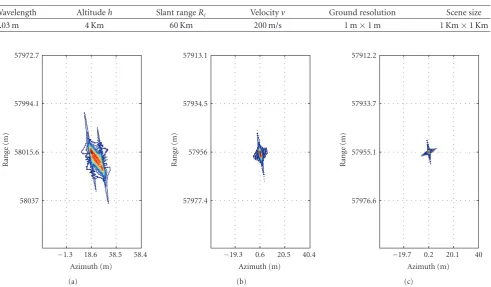
Table1: System parameters for an airborne X-band SAR.
Wavelength Altitudeh Slant rangeRc Velocityv Ground resolution Scene size
0.03 m 4 Km 60 Km 200 m/s 1 m×1 m 1 Km×1 Km
58.4 38.5 18.6 −1.3
Azimuth (m) 58037
58015.6 57994.1 57972.7
Range
(m)
(a)
40.4 20.5 0.6 −19.3
Azimuth (m) 57977.4
57956 57934.5 57913.1
Range
(m)
(b)
40 20.1 0.2 −19.7
Azimuth (m) 57976.6
57955.1 57933.7 57912.2
Range
(m)
(c)
Figure4: Contour plots of point target by different algorithms (squint angleϕ=15◦). (a) Processed by the FS algorithm [4]. (b) Processed by the FS algorithm with the dechirping function given in this paper. (c) Processed by the nonlinear FS algorithm.
After the multiplication by the frequency scaling function
HFS and the inverse FT in range, the secondary range compression and the bulk range cell migration correction (RCMC) can be performed using the range-matched filter function. The range-matched filter function is given by
HMF=exp
−j2π fref
te−
2Rc
cβ
×exp
j πβ
Kmref
te−2Rc
cβ
2
×exp
j πKsβ
2
3K3
mref(1−β)
te−2Rc
cβ
3
.
(24)
After the range-matched filtering and the range FT, the signal is focused in range, that is,
S9
fa,fe;r0
=exp
−j4πr0
λ β
sinc
fe+2ke
c
r0−rc
×exp
−j2π2Rc cβ fe
expjφΔ
.
(25)
Finally, a focused image can be obtained by the azimuth filtering and the azimuth inverse FT. The azimuth filter function is given as follows:
HAF=exp
−j4πr0
λ (1−β)
exp−jφΔ
exp
j2π2Rc cβ fe
.
(26)
Shifting the range spectrum to make fref =0 before the frequency scaling operation will simplify the expressions of
HFS,HMF, andHAF.
3. SIMULATION RESULTS
In order to evaluate the proposed algorithm, some simula-tions for an airborne spotlight SAR in the squint mode have been performed. The system parameters are given inTable 1. First, the results obtained by using the FS algorithm [4], the FS algorithm with the dechirping function given in this paper and the proposed algorithm, have been compared. The squint angle is defined as 15 degree. The echo of a point target at the center of the scene is simulated and the contour plots by the three algorithms are shown in
Figure 4. From Figure 4, the contour of point target by
the FS algorithm [4] is defocused so severe that the target cannot be identified; the image by the FS algorithm with the dechirping function given in this paper is acceptable, however, its main lobe is broadened and represents a small position shift; as expectation the image processed by the proposed algorithm shows excellent focus performance and the range and azimuth peak position all agree with the theoretical values.
Another simulation under the same system parameters with the squint angleϕ=60◦is implemented. The distance from the center of the scene to the flight pathrc is 30 km,
500 0
−500
Azimuth (m) 30495.61
30000 29504.54
Range
(m)
Figure5: Contour plot of targets (squint angleϕ=60◦), where the image of each target has been zoomed and then pasted back into original figure according to its location.
151.35 MHz, the pulse width is 20 microseconds, and the PRF is 640 Hz. Nine typical point targets are arranged in the scene. Their range coordinates arermax,rc, andrmin, and their
azimuth coordinates are−500 m, 0, and 500 m, respectively. The Doppler centroid is not zero, and thus the azimuth spectrum should be shifted before being transformed into the range-Doppler domain. The contour plot of the nine targets is shown inFigure 5. The simulation results show that the nonlinear frequency scaling method is also effective even in the squint angle up to 60 degree, which can obtain images with high quality even at the edges of a large scene.
4. CONCLUSION
In this paper, we present a squint mode spotlight SAR processing scheme. With the phase error correction, a complete processing flow for the squint mode spotlight SAR is proposed. First, a dechirping function for the squint mode is given. Then a preprocessing step is introduced to remove the RVP. Finally, the nonlinear approach and the frequency scaling operation are combined to minimize the approximation error of the SRC. The simulation results show that the proposed algorithm is quite effective in the case of high squint angle and large scene. In addition, only the FT and multiplication operations are required in this algorithm.
APPENDICES
A. DERIVATION OF FOURIER TRANSFORMS PAIR FOR A NONLINEAR CHIRP SIGNAL
Consider a signal
x(t)=exp
−jπ kt
2
exp
−j2π
3 yt 3
, (A.1)
we can use the principle of stationary phase to obtain its FT. The integral phase can be written as follows:
φ(t)= −π
kt
2−2π 3 yt
3−2π f t. (A.2)
According to the principle, the stationary points that make the most contributions satisfy the following:
d
dtφ(t)= −
2π
k t−2π yt
2−2π f =0. (A.3)
The solution to this equation is
t=−1±
1−4f k2y
2k y , when|y|
1
4k2f, t≈ −k f . (A.4)
Substituting the solution into the integral phase expression, we can obtain the phase of the FT, that is,
φ(f)=πk f2+2π 3 yk
3f3. (A.5)
As a result, we can obtain the FT pair in (16).
B. DERIVATION OF THE NONLINEAR FREQUENCY SCALING FUNCTION
In this section, the derivation of variablesq2,q3,Ym,φΔis
presented. Here, (19) and (21) are rewritten as (B.1) and (B.2) as follows:
S6
fa,fe;r0
=exp
−j4πr0
λ β
exp
−j4πRc c
fe−fd
×expjπKm
fe−fd
2
×exp
j2π
3 YmK 3
m
fe−fd
3 ,
(B.1)
HFS=exp
j4πRc c
1−1
β
fe−fref
×expjπq2
fe− fref 2
×exp
j2π
3 q3
fe−fref 3
.
(B.2)
Multiplied (B.1) by (B.2), that is,S6∗HFS, the quadratic and the cubic terms of the phase expression can be written as a polynomial of fe−fs, where constantπis neglected:
Km
fe−fd
2 +2
3YmK 3
m
fe−fd
3 +q2
fe−fref 2
+2 3q3
fe−fref 3
=C3
fe−fs
3 +C2
fe−fs
2 +C1
fe−fs
+C0,
(B.3)
where the relationships fd= fref+Δf,fs= fref+β·Δf have been applied and the polynomial coefficients offe−fscan be
calculated as
C3=2
3
YmKm3 +q3
,
C2=2
YmKm3+q3
βΔf +Km+q2−2YmKm3Δf
,
C1=2
YmKm3+q3
β2Δf2+ 2K
m+q2−2YmKm3Δf
βΔf
+2YmKm3Δf2−2KmΔf
.
In (B.4), unknown variablesq2,q3, andYmare used to make
thatC1,C2, andC3 are independent ofΔf. ExpandingC1,
C2, andC3into polynomials ofΔf =(2ke/cβ)(rc−r0) and
substituting the expression ofKm=Kmref+Ks·Δf, therefore,
the coefficient of the cubic term is as follows:
C3=
2 3
YmKm3ref+q3
+ 2YmKm2refKsΔf
+ 2YmKmrefKs2Δf2+
2 3YmK
3
sΔf3,
(B.5)
and the coefficient of the quadratic term
C2=Kmref+q2+
Ks+ 2q3β+ 2YmKm3ref(β−1)
Δf
+ 6YmKm2refKs(β−1)Δf2+· · ·,
(B.6)
and the coefficient of the linear term
C1=
2Kmref(β−1) + 2q2β
Δf
+2YmKm3ref(β−1) 2
+ 2q3β2+ 2Ks(β−1)
Δf2
+ 6YmKm2refKs(β−1)2Δf3+· · ·.
(B.7)
In order to compensate src term exactly, the coefficients of Δf in (B.5), (B.6), and (B.7) are preferred to be zero. However, the case of Ym = 0 is meaningless, thus, the
following equations hold:
Ks+ 2q3β+ 2YmKm3ref(β−1)=0,
2Kmref(β−1) + 2q2β=0,
2YmKm3ref(β−1)2+ 2q3β2+ 2Ks(β−1)=0.
(B.8)
Solving the linear equations, we obtain
q2=Kmref
1
β−1
, q3=
Ks(1/β−1)
2 ,
Ym=
Ks(1/β−0.5)
Km3ref(1/β−1)
.
(B.9)
By ignoring higher-order terms ofΔf in the coefficients of fe−fs, (B.3) is approximated as follows:
2 3
YmKm3ref +q3
fe−fs
3
+Kmref+q2
fe−fs
2 +· · ·
=Afe−fs
2 +2
3BA 3f
e−fs
3 +φΔ,
(B.10)
where
A=1
βKmref,
BA3= Ks
2β(1−β),
φΔ=
−2
3YmK 3
s
Δf6+−2Y
mKmrefKs2−2YmKs3fref
Δf5
+−2YmKm2refKs2−6YmKmrefKs2fref−2YmKs3fref2
Δf4
+
Ks
3 (1−β)−6YmK 2
mrefKsfref
−6YmKmrefKs2fref2 − 2 3YmK
3
sfref3
Δf3
+Kmref(1−β)−6YmKm2refKsfref2 −2YmKmrefKs2fr3ef
Δf2+−2Y
mKm2refKsfref
Δf .
(B.11)
REFERENCES
[1] M. Soumekh,Synthetic Aperture Radar Signal Processing with MATLAB Algorithms, John Wiley & Sons, New York, NY, USA, 1999.
[2] C. Cafforio, C. Prati, and F. Rocca, “SAR data focusing using seismic migration techniques,”IEEE Transactions on Aerospace and Electronic Systems, vol. 27, no. 2, pp. 194–207, 1991. [3] R. K. Raney, H. Runge, R. Bamler, I. G. Cumming, and F. H.
Wong, “Precision SAR processing using chirp scaling,”IEEE Transactions on Geoscience and Remote Sensing, vol. 32, no. 4, pp. 786–799, 1994.
[4] J. Mittermayer, A. Moreira, and O. Loffeld, “Spotlight SAR data processing using the frequency scaling algorithm,”IEEE Transactions on Geoscience and Remote Sensing, vol. 37, no. 5, part 1, pp. 2198–2214, 1999.
[5] G. Carrara, R. S. Goodman, and R. M. Majewski, Spotlight Synthetic Aperture Radar, Artech House, Norwood, Mass, USA, 1995.
[6] A. Reigber, E. Alivizatos, A. Potsis, and A. Moreira, “Extended wavenumber-domain synthetic aperture radar focusing with integrated motion compensation,” IEE Proceedings: Radar, Sonar and Navigation, vol. 153, no. 3, pp. 301–310, 2006. [7] M. Vandewal, R. Speck, and H. S¨uß, “Efficient and precise
processing for squinted spotlight SAR through a modified stolt mapping,”EURASIP Journal on Advances in Signal Processing, vol. 2007, Article ID 59704, 7 pages, 2007.
[8] G. W. Davidson, I. G. Cumming, and M. R. Ito, “A chirp scaling approach for processing squint mode SAR data,”IEEE Transactions on Aerospace and Electronic Systems, vol. 32, no. 1, pp. 121–133, 1996.