Volume 2007, Article ID 38916,10pages doi:10.1155/2007/38916
Research Article
Wavelet-Based Algorithm for Signal Analysis
Norman C. F. Tse1and L. L. Lai2
1Division of Building Science and Technology, City University of Hong Kong, Tat Chee Avenue, Kowloon, Hong Kong
2School of Engineering and Mathematical Sciences, City University, Northampton Square, London EC1V0HB, UK
Received 6 August 2006; Revised 12 October 2006; Accepted 24 November 2006
Recommended by Irene Y. H. Gu
This paper presents a computational algorithm for identifying power frequency variations and integer harmonics by using wavelet-based transform. The continuous wavelet transform (CWT) using the complex Morlet wavelet (CMW) is adopted to detect the harmonics presented in a power signal. A frequency detection algorithm is developed from the wavelet scalogram and ridges. A necessary condition is established to discriminate adjacent frequencies. The instantaneous frequency identification approach is applied to determine the frequencies components. An algorithm based on the discrete stationary wavelet transform (DSWT) is adopted to denoise the wavelet ridges. Experimental work has been used to demonstrate the superiority of this approach as compared to the more conventional one such as the fast Fourier transform.
Copyright © 2007 N. C. F. Tse and L. L. Lai. This is an open access article distributed under the Creative Commons Attribution License, which permits unrestricted use, distribution, and reproduction in any medium, provided the original work is properly cited.
1. INTRODUCTION
Power quality has become a major concern for utility, facility, and consulting engineers in recent years. International as well as local standards have been formulated to address the power quality issues [1]. To the facility managers and end users, fre-quent complaints by tenants/customers on occasional power failures of computer and communication equipment and the energy inefficiency of the LV electrical distribution system are on the management’s agenda. Harmonic currents produced by nonlinear loads would cause extra copper loss in the dis-tribution network, which on one hand will increase the en-ergy cost and on the other hand would increase the elec-tricity tariffcharge. The benefits of using power electronic devices in the LV distribution system in buildings, such as switch mode power supplies, variable speed drive units, to save energy are sometimes offset by the increased energy loss in the distribution cables by current harmonics and the cost of remedial measures required. Voltage harmonics caused by harmonic voltage drops in the distribution cables are aff ect-ing the normal operation of voltage-sensitive equipment as well.
In order to improve electric power quality and energy efficiency, the sources and causes of such disturbance must be known on demand sides before appropriate corrective or mitigating actions can be taken [2,3].
A traditional approach is to use discrete Fourier trans-form (DFT) to analyze harmonics contents of a power sig-nal. The DFT which is implemented by FFT has many attrac-tive features. That theory of FFT has been fully developed and well known; scientists and engineers are familiar with the computation procedures and find it convenient to use as many standard computation tools as readily available. It is however easily forgotten that Fourier transform is basically a steady-state analysis approach. Transient signal variations are regarded by FFT as a global phenomenon.
Nowadays power quality issues, such as subharmonics, integer harmonics, interharmonics, transients, voltage sag and swell, waveform distortion, power frequency variations, are experienced by electricity users. This paper attempts to develop an algorithm based on continuous wavelet trans-form to identify harmonics in a power signal [4].
2. WAVELET TRANSFORM AND ANALYZING WAVELET
The wavelet transform of a continuous signal,f(t), is de-fined as [5],
W f(u,s)=f,ψu,s
=
+∞
−∞ f(t) 1
√
sΨ
∗t−u s
dt, (1)
whereψ∗(t) is the complex conjugate of the wavelet function ψ(t);sis the dilation parameter (scale) of the wavelet; andu is the translation parameter (location) of the wavelet.
The wavelet function must satisfy certain mathematical criteria [7]. These are the following:
(i) a wavelet function must have finite energy; and (ii) a wavelet function must have a zero mean, that is, has
no zero frequency component.
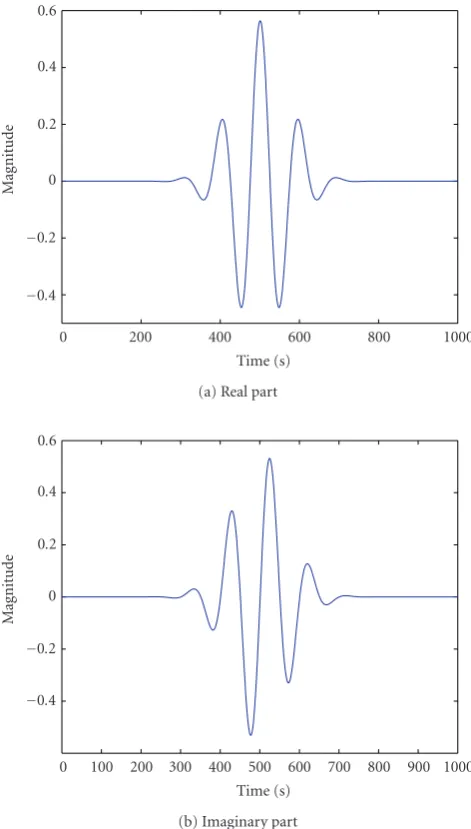
The simplified complex Morlet wavelet (CMW) [8,9] is adopted in the algorithm for harmonic analysis as shown in Figure 1, defined as
Ψ(t)= 1 π fb
e−t2/ fb
ej2π fct, (2)
where fbis the bandwidth parameter and fcis the center
fre-quency of the wavelet.
The CMW is essentially a modulated Gaussian func-tion. It is particularly useful for harmonic analysis due to its smoothness and harmonic-like waveform. Because of the an-alytic nature, CMW is able to separate amplitude and phase information.
Strictly speaking, the mean of the simplified CMW in (2) is not equal to zero as illustrated in (3),
+∞
−∞Ψ(t)dt= 1
π fb
+∞
−∞e
j2π fcte−t2/ fbdt=e(−fb/4)(2π fc)2.
(3)
However the mean of the CMW can be made arbitrarily small by picking the fband fcparameters large enough [9].
For example, the mean of the CMW in (3) with fb =2 and fc=1 is 2.6753×10⁻⁹which is practically equal to zero. The
frequency support of the CMW in (2) is not a compact sup-port but the entire frequency axis. The effective time support of the CMW in (2) is from−8 to 8 [10] provided that fbis
not larger than 9.
From the classical uncertainty principle, it is well known that there is a fundamental trade-offbetween the time and frequency localization of a signal. In other words, localization in one domain necessarily comes at the cost of localization in the other. The time-frequency localization is measured in the mean squares sense and is represented as a Heisenberg box. The area of the Heisenberg box is limited by
δωδt≥1
2, (4)
whereδωis the frequency resolution, andδtis the time res-olution.
For a dilated complex Morlet wavelet,
δω= 1
sfb
, δt=s
fb
2 . (5)
0 200 400 600 800 1000
0.4 0.2 0 0.2 0.4 0.6
Time (s)
M
ag
nitude
(a) Real part
0 100 200 300 400 500 600 700 800 900 1000 0.4
0.2 0 0.2 0.4 0.6
Time (s)
M
ag
nitude
(b) Imaginary part
Figure1: The real part and imaginary part of the complex Morlet wavelet.
Complex Morlet Wavelet achieves a desirable compromise between time resolution and frequency resolution, with the area of the Heisenberg box equal to 0.5. From (5), it is seen that the frequency resolution is dependent on the selection of fband the dilation. As will be discussed inSection 4, the
dilation is dependent on the selection of fcand the sampling
frequency.
3. HARMONICS FREQUENCY DETECTION
Given a signal f(t) represented as
f(t)=a(t) cosφ(t), (6)
the wavelet function in (2) can be represented as [11],
The dilated and translated wavelet families [11] are rep-resented as
Ψu,s(t)=√1
sΨ
t−u
s
=e−jξug
s,u,ξ(t), (8)
wheregs,u,ξ(t)=√sg((t−u)/s)ejξt; andξ=ω/s.
The wavelet transform of the signal function f(t) in (6) is given as [11],
W f(u,s)= √
s 2 a(u)e
jφ(u)gsξ−φ(u)+ε(u,ξ), (9)
whereg(ω) represents the Fourier transform of the function g(t).
The corrective termε(u,ξ) in (9) is negligible ifa(t) and φ(t) in (6) have small variations over the support ofψu,sin
(8) and ifφ(u)≥Δω/s[11]. If a power signal contains only a single frequency, the corrective term can be neglected safely. However for a power signal containing harmonics from low frequency to high frequency, the corrective term will con-tribute to the wavelet coefficients, making the frequency de-tection not straightforward.
The instantaneous frequency is measured from wavelet ridges defined over the wavelet transform. The normalised scalogram defined by [11,12]
ξ
ηPwf(u,ξ)=
W f(u,s)2
s (10)
is calculated with
ξ
ηPwf(u,ξ)= 1 4a
2(u)g
η
1−φ(u)
ξ
+ε(u,ξ) 2
.
(11)
Since|g(ω)|in (11) is maximum atω=0, if one neglects ε(u,ξ), (11) shows that the scalogram is maximum at
η
s(u)=ξ(u)=φ
(u). (12)
The corresponding points (u,ξ(u)) calculated by (12) are called wavelet ridges [13]. For the complex Morlet wavelet, g(t) in (7) is a Gaussian function. Since the Fourier trans-form of a Gaussian function is also a Gaussian function, the wavelet ridge plot exhibits a Gaussian shape.
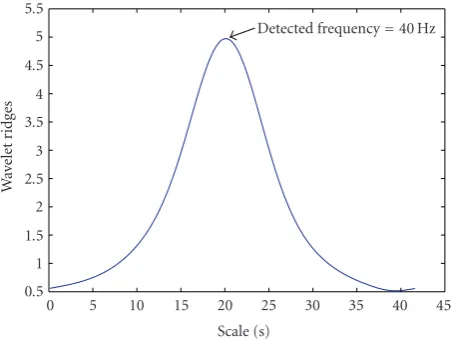
Figure 2shows the wavelet ridges plot for a 40 Hz signal. It can be seen that the wavelet ridges can accurately detect the frequency of the signal.
Figure 3shows the wavelet ridges plot for the detection of a 40 Hz signal component in a signal containing frequen-cies at 40 Hz and 240 Hz, respectively. There are some fluc-tuations at the peak of the wavelet ridges, introducing small errors in the frequency detection. The fluctuations are due to imperfection of the filters produced by the dilated CMWs and the corrective term in (9).
Discrete stationary Wavelet transform (DSWT) [14] is adopted to remove the fluctuations of the wavelet ridges. In view of the shape of the wavelet ridges, the Symlet2 wavelet
0 5 10 15 20 25 30 35 40 45
0.5 1 1.5 2 2.5 3 3.5 4 4.5 5 5.5
Scale (s)
W
av
elet
ridges
Detected frequency=40 Hz
Figure2: Wavelet ridges plot for a 40 Hz signal.
0 5 10 15 20 25 30 35 40 45
0 1 2 3 4 5 6
Scale (s)
W
av
elet
ridges
Some fluctuations at the peak of the ridges plot to be removed by denoising techniques
Figure3: Wavelet ridges plot for a 40 Hz signal component in signal containing 40 Hz and 240 Hz.
developed by Daubechies is used. It is found that a decom-position level of 5 is sufficient to remove the fluctuations. Figure 4shows the denoised wavelet ridges plot of the sig-nal containing frequencies at 40 Hz and 240 Hz, respectively. The 40 Hz frequency component of the signal is accurately detected by the wavelet ridges after denoising.
4. DISCRIMINATION OF ADJACENT FREQUENCIES
The Fourier transform of a dilated CMW in (8) is represented as [11]
Ψ(s f)=√se−π2fb(s f−fc)2. (13)
The functionΨ(s f) can be regarded as a bandpass filter centered at the frequency fc. The bandwidth of the bandpass
filter can be adjusted by adjusting fb. The CWT of a signal is
0 5 10 15 20 25 30 35 40 45 0.5
1 1.5 2 2.5 3 3.5 4 4.5 5 5.5
Scale (s)
W
av
elet
ridges
Detected frequency=40 Hz
Figure4: Denoised wavelet ridges plot of the wavelet ridges plot in Figure 3.
0.05 0.1 0.15 0.2 0.25 0.3 0.35 0.4 f/s 0 1 2 3 4 5 6 7 8
fc/s2 ( s2)
(s1) fc/s1
x Bandwidth
atfc/s2
Bandwidth atfc/s1
F o ur ier tr ansfor m of co mple x M orlet w av elet
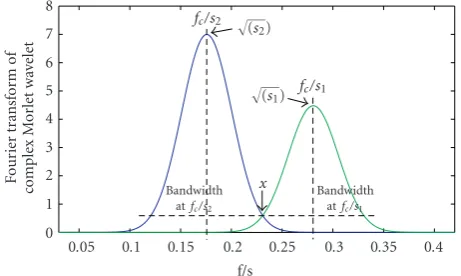
Figure5: Frequency plot of (15) for two CMWs at scalesS1andS2, respectively.
Suppose that (13) is represented as
Ψ(s f)=x, (14) where x represents an arbitrary magnitude to be defined later.
Combining (13) and (14) gives
f = fc
s ±
1
sπfb
ln x √ s , (15)
where fc/sis the center frequency of the dilated bandpass
fil-ter; and the bandwidth is (2/sπfb)
|ln(x/√s)|.
Figure 5shows the plot of the frequency support of two dilated CMWs at scalesS1andS2, respectively.
If the two dilated CMWs are used to detect two adjacent frequencies in a signal, with their frequencies represented as [10]
f1= fsfc
S1
, f2= fsfc
S2
, (16)
where fsrepresents the sampling frequency, then
fc
S1−
fc
S2 =
1 S1π
fb ln x S1 + 1
S2π fb ln x S2 . (17)
Assume thatS2> S1, (17) is simplified to
fc
fb> 1
π ln x S1
xf2+ f1 f2−f1.
(18)
ForS1=200 andx=0.5,
1 π ln x S1
=0.58. (19)
Substituting (19) into (18) gives
fc
fb>0.58xf2
+f1 f2−f1
, S1≤200, x≤0.5. (20)
It is estimated that the magnitude of x should not be larger than 0.5. Equation (20) is used to determine the val-ues of fband fcin (2) for the continuous wavelet transform
with complex Morlet wavelet which is a necessary condition to discriminate adjacent frequencies contained in the power signal.
5. HARMONICS AMPLITUDE DETECTION
Theoretically, once the algorithms developed in Sections3 and4detect the harmonics contained in the power signal, the corresponding harmonics amplitudes would be determined readily by
a(u)=2
(ξ/η)Pwf(u,ξ)
g(0) =
2W f(u,s)2s 1
=2W f√(u,s)
s .
(21)
The values of 2|W f(u,s)|2/sin (21) are produced in the process of generating the scalogram.
0 1000 2000 3000 4000 5000 Data point
20 0 20 40 60 80 100 120 140 160 180
Ab
so
lu
te
w
ave
le
t
co
e
ffi
cient
991.5 Hzfb fc=9 7 step 0.5
Figure6: Absolute wavelet coefficients plot generated by CWT (us-ing complex Morlet wavelet,fb=9,fc=7) for harmonic frequency at 991.5 Hz.
0 1000 2000 3000 4000 5000
Data point 0
20 40 60 80 100 120 140 160 180
Denoised
absol
ut
e
w
av
elet
co
e
ffi
cient
991.5 Hzfb fc=9 7 step 0.5 DSWT output
Figure 7: Coefficients generated by discrete stationary wavelet transform (Haar wavelet, level 5 decomposition) of the absolute wavelet coefficients plot inFigure 6.
Discrete stationary wavelet transform (DSWT) [14] is adopted to remove the fluctuations. Since the absolute wa-velet coefficients plot should exhibit a constant magnitude for a harmonic frequency of constant amplitudes, the Haar wavelet is used for the DSWT to denoise the absolute wavelet coefficients. It is found that a decomposition level of 5 is suf-ficient for harmonics up to 1000 Hz.
Figure 7shows the output of the DSWT of the absolute wavelet coefficients shown inFigure 6. The fluctuations are removed resulting in an accurate detection of the amplitude of the harmonics frequency.
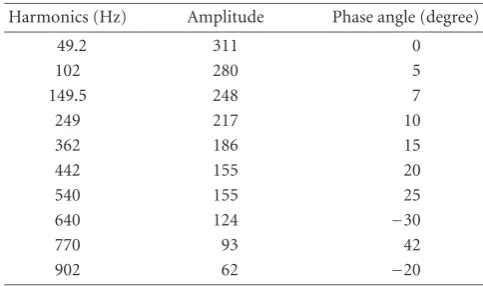
Table1: Harmonics in the simulated signal.
Harmonics (Hz) Amplitude Phase angle (degree)
49.2 311 0
102 280 5
149.5 248 7
249 217 10
362 186 15
442 155 20
540 155 25
640 124 −30
770 93 42
902 62 −20
Table2: Settings of the proposed detection algorithm.
Frequency range (Hz)
Sampling frequency (Hz)
Data length/time
period (seconds) fb-fc
40–75 5000 3000/0.6 s 6-2
75–275 7500 3000/0.4 s 6-2
275–575 15 000 3000/0.2 s 6-3
575–925 25 000 4000/0.16 s 6-3
6. THE PROPOSED HARMONICS DETECTION ALGORITHM
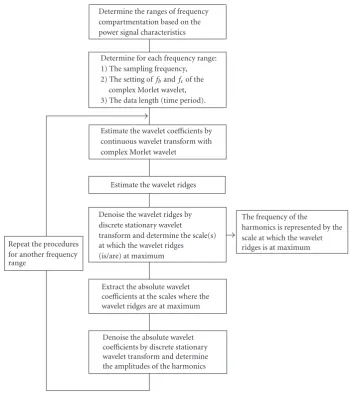
The proposed harmonics detection algorithm is presented in Figure 8.
The proposed algorithm is implemented with Matlab software.
7. SIMULATION SETTINGS
A simulated signal is used to test the proposed harmonics de-tection algorithm. The simulated signal contains signal fre-quency components as shown inTable 1. The simulated sig-nal does not contain 50 Hz frequency component.
The simulated signal is sampled at 25 kHz. The number of data points per cycle of the highest harmonics of 890 Hz in the simulated signal is approximately 28. In any case, a min-imum of 25 data points per cycle of any harmonics should be maintained for accurate amplitude detection. A higher sampling frequency would give a better detection of the am-plitudes of the harmonics frequencies, but more data points are required resulting in slow computation. For faster CWT computation, the simulated signal will be down-sampled for the detection of lower harmonics. The down-sampling set-tings are as shown inTable 2. In accordance with the classical uncertainty principle, a larger time window is required at low frequencies, and a smaller time window is sufficient at high frequencies.
The necessary condition discussed inSection 4for dis-crimination of adjacent frequencies requires that the com-plex Morlet wavelet should be set at fb =6 and fc =2 to 3
Determine the ranges of frequency compartmentation based on the power signal characteristics
Determine for each frequency range: 1) The sampling frequency, 2) The setting offbandfcof the
complex Morlet wavelet, 3) The data length (time period).
Estimate the wavelet coefficients by continuous wavelet transform with complex Morlet wavelet
Estimate the wavelet ridges
Denoise the wavelet ridges by discrete stationary wavelet
transform and determine the scale(s) at which the wavelet ridges (is/are) at maximum
Extract the absolute wavelet coefficients at the scales where the wavelet ridges are at maximum
Denoise the absolute wavelet coefficients by discrete stationary wavelet transform and determine the amplitudes of the harmonics Repeat the procedures
for another frequency range
The frequency of the
harmonics is represented by the scale at which the wavelet ridges is at maximum
Figure8: The flow chart of the proposed harmonics detection algorithm.
From (5) and (16), the frequency resolution is dependent on the bandwidth parameter fband the center frequency fc
of the dilated complex Morlet wavelet, and the sampling fre-quency fs. For detection of higher harmonics, frequency
res-olution would be improved by using higher sampling fre-quency and larger fband fcas shown inTable 2.
8. SIMULATION RESULTS
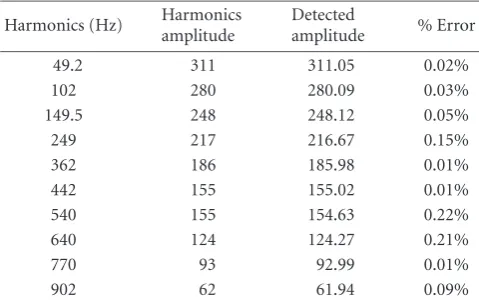
The simulation results for harmonics detection are shown in Table 3. It can be seen that the accuracy of the proposed al-gorithm is very promising. The small errors in the frequency detection are mainly due to the computation errors of the conversion from frequency to scale and vice versa. The scale increment size in the dilation of the wavelet, that is, the step size of the scales used in decomposition, is deterministic in the frequency detection accuracy. Higher resolution can be used if needed with a sacrifice in computation speed. It is proved that the necessary condition established inSection 4 is sufficient in distinguishing adjacent frequencies.
Table3: Harmonics detection results.
Harmonics (Hz) Detected
harmonics (Hz) % Error
49.2 49.19 0.02%
102 102.04 0.04%
149.5 149.55 0.03%
249 248.76 0.09%
362 362.1 0.03%
442 442.15 0.03%
540 539.57 0.08%
640 640.04 0.01%
770 770.18 0.02%
902 902.53 0.06%
Table4: Amplitudes detection results.
Harmonics (Hz) Harmonics
amplitude
Detected
amplitude % Error
49.2 311 311.05 0.02%
102 280 280.09 0.03%
149.5 248 248.12 0.05%
249 217 216.67 0.15%
362 186 185.98 0.01%
442 155 155.02 0.01%
540 155 154.63 0.22%
640 124 124.27 0.21%
770 93 92.99 0.01%
902 62 61.94 0.09%
Table 5shows the FFT of the simulated signal for com-parison. The sampling frequencies are set at 2 kHz and 25 kHz, respectively. A hamming window was applied to the data.
Table 6shows the comparison of the detection errors of the proposed harmonic detection algorithm and the FFT. It can be seen that FFT has very good frequency detection capability, except for harmonic frequencies with decimal place. In the simulation test by FFT, the frequency detec-tion errors are quite significant at harmonics of 49.2 Hz and 149.5 Hz. On amplitude detection, the proposed harmonics detection algorithm is more accurate than FFT for harmonic frequencies with decimal place.
9. EXPERIMENTAL RESULTS
Figure 9(a)shows a waveform captured from the red phase input current of a 3-phase 6-pulse variable speed drive (VSD) with the VSD output voltage set at 20 Hz. The sampling fre-quency is 10 kHz. The rated frefre-quency of the low voltage elec-trical power supply source to the VSD is 50 Hz.
Figure 9(b)shows two cycles of the waveform in Figure 9(a). The shape of the waveform is a typical input current waveform of a 3-phase 6-pulse VSD. It is expected that the current would contain integer harmonics at 5th, 7th, 11th, 13th, 17th, 19th, and so forth harmonics of the fundamen-tal frequency. Since the waveform is not exactly symmetrical, there are some even harmonics present in the waveform.
The proposed harmonics detection algorithm is used to analyze the waveform in Figure 9(a).Table 7 shows the ranges of frequency compartmentation, fbandfcsettings of
the complex Morlet wavelet, the sampling frequencies, data lengths, and time period used.
Table 8shows the detection results, together with the re-sults produced by FFT for comparison.
FromTable 8, the fundamental frequency estimated by the proposed harmonics detection algorithm is 49.95 Hz. While FFT estimates that the fundamental frequency is 50 Hz , Table 9 compares the estimated harmonics by FFT and the proposed harmonics detection algorithm, respec-tively, to the integer multiples of respective fundamental fre-quencies.
0 500 1000 1500 2000 2500 3000 3500 4000 4500 5000 Data point
6 4 2 0 2 4 6
Si
gn
al
m
agn
it
u
d
e
(a) Waveform of the red phase input current of a 3-phase 6-pulse variable speed drive (sampling frequency=10 kHz).
0 50 100 150 200 250 300 350 400
Data point 6
4 2 0 2 4 6
Si
gn
al
m
agn
it
u
d
e
(b) Two cycles of the waveform inFigure 9(a). Figure9
For the proposed harmonics detection algorithm, the harmonics estimated conform to the integer multiples of the fundamental frequency at 49.95 Hz. Some deviations from the integer multiples of the fundamental frequency are how-ever found only at even harmonics which have very small magnitudes.
The harmonics estimated by FFT do not conform to the integer multiples of the fundamental frequency estimated at 50 Hz. The errors are possibly due to the comparatively fine frequency resolution of 0.05 Hz. As a result, there are some frequency leakages in the FFT decomposition. The am-plitudes of the harmonics estimated by FFT are therefore smaller than the amplitudes estimated by the proposed har-monic detection algorithm.
Table5: FFT of the simulated signal.
Harmonics (Hz) Amp.
Sampling rate=2 kHz Sampling rate=25 kHz
Data length=2000 Data length=25000
Time period=1 s Time period=1 s
Detected freq. (Hz) Detected amp. Detected freq. (Hz) Detected amp.
49.2 311 49 301.2 49 301.3
102 280 102 279.8 102 279.9
149.5 248 150 202.8 150 202.8
249 217 249 216.9 249 217
362 186 362 185.9 362 186
442 155 442 155 442 155
540 155 540 155 540 155
640 124 640 124 640 124
770 93 770 92.98 770 92.97
902 62 902 62.03 902 62.01
Table6: Comparison of simulation results by the proposed detection algorithm and FFT.
Proposed detection algorithm
FFT
Sampling rate=2 kHz Sampling rate=25 kHz
Data length=2000 Data length=25000
Time period=1 s Time period=1 s
Freq. error Amp. error Freq. error Amp. error Freq. error Amp. error
0.02% 0.02% 0.41% 3.15% 0.41% 3.12%
0.04% 0.03% 0% 0.07% 0% 0.04%
0.03% 0.05% 0.33% 18.23% 0.33% 18.23%
0.09% 0.15% 0% 0.05% 0% 0%
0.03% 0.01% 0% 0.05% 0% 0%
0.03% 0.01% 0% 0% 0% 0%
0.08% 0.22% 0% 0% 0% 0%
0.01% 0.21% 0% 0% 0% 0%
0.02% 0.01% 0% 0.02% 0% 0.03%
0.06% 0.09% 0% 0.05% 0% 0.02%
Table7: Settings of the proposed detection algorithm.
Frequency
range (Hz) fb-fc
Sampling frequency (Hz)
Data length/time period (seconds)
40–75 6-1 5000 5000/1 s
75–125 6-3 5000 5000/1 s
125–225 6-3 10 000 5000/0.5 s
225–375 6-3 10 000 5000/0.5 s
375–975 6-6 10 000 5000/0.5 s
49.95 Hz. This serves to confirm that the fundamental fre-quency estimated by the proposed harmonics detection al-gorithm is very accurate.
10. CONCLUSIONS
The proposed harmonics detection algorithm is able to iden-tify the frequency and amplitude of harmonics in a power signal to a very high accuracy. The accuracy of the proposed harmonic detection algorithm has been verified by tests con-ducted to a computer-simulated signal and a field signal. Two techniques are adopted to achieve accurate frequency identi-fication.
Table8: Experimental results.
Harmonic no.
FFT with hamming window
Proposed detection algorithm Sampling rate=10 kHz
Data length=10000 Time period=1 s
Frequency Amplitude Frequency Amplitude
1 50 1.521 49.95 1.547
2 100 0.06 99.93 0.069
3 150 0.284 149.85 0.303
4 200 0.051 199.6 0.066
5 250 1.209 249.79 1.351
7 350 0.861 349.65 1.014
8 400 0.029 398.94 0.038
9 450 0.117 449.78 0.137
10 500 0.016 500.83 0.024
11 550 0.451 549.45 0.564
12 Not detected Not detected 597.61 0.015
13 649 0.256 649.35 0.307
15 749 0.04 748.13 0.048
17 849 0.118 848.66 0.131
19 949 0.043 949.37 0.054
Table9: Comparison of accuracy in harmonics estimation.
Harmonic no.
FFT Proposed detection
algorithm
Expected frequency
Detected frequency
Expected frequency
Detected frequency
1 50 50 49.95 49.95
2 100 100 99.9 99.93
3 150 150 149.85 149.85
4 200 200 199.8 199.6
5 250 250 249.75 249.79
7 350 349.5 349.65 349.65
8 400 399.5 399.6 398.94
9 450 449.5 449.55 449.78
10 500 499.5 499.5 500.83
11 550 549.5 549.45 549.45
12 600 Not detected 599.4 597.61
13 650 649.5 649.35 649.35
15 750 749.5 749.25 748.13
17 850 849.5 849.15 848.66
19 950 949 949.05 949.37
parameter fb and the dilation factor. The dilation factor in
turn can be adjusted by the wavelet center frequency fcand
the sampling frequency. A narrow bandwidth is therefore achieved at the expense of time resolution. For an extremely narrow bandwidth, the time window would be large.
A second technique based on discrete stationary wavelet transform is adopted such that harmonic frequency can be
determined accurately without the need of a large time win-dow. It is seen that the wavelet ridges plot is a Gaussian; the scale at which the wavelet ridges plot is maximal represents the frequency of the harmonics in the signal. Discrete sta-tionary wavelet transform is used to remove small fluctua-tions near the peak of the wavelet ridges plot so that a smooth Gaussian-like wavelet ridges plot is revealed, the peak of the wavelet ridges plot can then by identified.
Discrete stationary wavelet transform is proved to be use-ful in denoising the absolute wavelet coefficients of the con-tinuous wavelet transform for amplitudes detection.
The disadvantage of the proposed algorithm is that the accuracy of both frequency and amplitude detections is de-pendent on the data points taken per cycle of the highest har-monics in the signal. In other words, a higher sampling fre-quency than twice the Nyquist frefre-quency is required.
11. FURTHER WORKS
A future paper will show simulation results that the proposed harmonic detection algorithm could be used to detect non-integer harmonics. Further experimental tests would need to be conducted for noninteger harmonics detection as well as subharmonics detection.
REFERENCES
[1] “IEEE recommended practice for monitoring electric power quality,” IEEE Standards Board, June 1995.
[3] W. L. Chan, A. T. P. So, and L. L. Lai, “Harmonics load signa-ture recognition by wavelets transforms,” inProceedings of In-ternational Conference on Electric Utility Deregulation and
Re-structuring and Power Technologies (DRPT ’00), pp. 666–671,
London, UK, April 2000, IEEE Catalog no. 00EX382. [4] N. C. F. Tse, “Practical application of wavelet to power
qual-ity analysis,” inProceedings of IEEE Power Engineering Society
General Meeting, p. 5, Montreal, Quebec, Canada, June 2006,
IEEE Catalogue no. 06CH37818C, CD ROM.
[5] P. S. Addison,The Illustrated Wavelet Transform Handbook, In-stitute of Physics, Bristol, UK, 2002.
[6] V. L. Pham and K. P. Wong, “Wavelet-transform-based al-gorithm for harmonic analysis of power system waveforms,”
IEE Proceedings: Generation, Transmission and Distribution,
vol. 146, no. 3, pp. 249–254, 1999.
[7] G. Strang and T. Nguyen,Wavelets and Filter Banks, Wellesley-Cambridge, Wellesley, Mass, USA, 1996.
[8] S.-J. Huang, C.-T. Hsieh, and C.-L. Huang, “Application of Morlet wavelets to supervise power system disturbances,”IEEE
Transactions on Power Delivery, vol. 14, no. 1, pp. 235–241,
1999.
[9] A. Teolis, Computational Signal Processing with Wavelets, Birkh¨auser, Boston, Mass, USA, 1998.
[10] M. Misiti, Y. Misiti, and G. Oppenheim,Wavelet Toolbox for
Use with Matlab, The Mathworks, Natick, Mass, USA, 1996.
[11] S. Mallet,A Wavelet Tour of Signal Processing, Academic Press, San Diego, Calif, USA, 1998.
[12] R. A. Carmona, W. L. Hwang, and B. Torr´esani, “Multiridge detection and time-frequency reconstruction,”IEEE
Transac-tions on Signal Processing, vol. 47, no. 2, pp. 480–492, 1999.
[13] R. A. Carmona, W. L. Hwang, and B. Torresani, “Characteriza-tion of signals by the ridges of their wavelet transforms,”IEEE
Transactions on Signal Processing, vol. 45, no. 10, pp. 2586–
2590, 1997.
[14] A. Antoniadis and G. Oppenheim, Eds.,Wavelets and Statis-tics, Lecture Notes in Statistics, Springer, New York, NY, USA, 1995.
Norman C. F. Tsewas born in Hong Kong SAR, China, on 7 February, 1961. He gradu-ated from the Hong Kong Polytechnic Uni-versity (then Hong Kong Polytechnic) in 1985 holding an Associateship in electrical engineering. He obtained M.S. degree from the University of Warwick in 1994. He is a Chartered Engineer, a Corporate Member of the IET, UK (formerly IEE, UK) and the Hong Kong Institution of Engineers. He is
now working with the City University of Hong Kong as a Senior Lecturer majoring in building LV electrical power distribution sys-tems. His research interest is in power quality measurement, web-based power quality monitoring, and harmonics mitigation for low-voltage electrical power distribution system in buildings.
L. L. Lai received B.S. (first-class honors) and Ph.D. degrees from Aston University, UK, in 1980 and 1984, respectively. He was awarded D.S. by City University Lon-don in 2005 and he is its honorary grad-uate. Currently he is Head of Energy Sys-tems Group at City University, London. He is also a Visiting Professor at South-east University, Nanjing, China, and Guest
Professor at Fudan University, Shanghai, China. He has authored/ coauthored over 200 technical papers. With Wiley, he wrote a book entitledIntelligent System Applications in Power Engineering -
Evo-lutionary Programming and Neural Networksand edited one
enti-tledPower System Restructuring and Deregulation - Trading,
Per-formance and Information Technology.In 1995, he received a