Volume 2008, Article ID 736818,9pages doi:10.1155/2008/736818
Research Article
Delay Optimization in Cooperative Relaying with
Cyclic Delay Diversity
Slimane Ben Slimane, Bo Zhou, and Xuesong Li
Radio Communication Systems, Department of Communication Systems, The Royal Institute of Technology (KTH), Electrum 418, 164 40 KISTA, Sweden
Correspondence should be addressed to Slimane Ben Slimane,[email protected]
Received 1 November 2007; Accepted 5 March 2008
Recommended by J. Wang
Cooperative relaying has recently been recognized as an alternative to MIMO in a typical multicellular environment. Inserting random delays at the nonregenerative fixed relays further improve the system performance. However, random delays result in limited performance gain from multipath diversity. In this paper, two promising delay optimization schemes are introduced for a multicellular OFDM system with cooperative relaying with stationary multiple users and fixed relays. Both of the schemes basically aim to take the most advantages of the potential frequency selectivity by inserting predetermined delays at the relays, in order to further improve the system performance (coverage and throughput). Evaluation results for different multipath fading environments show that the system performance with delay optimization increases tremendously compared with the case of random delay.
Copyright © 2008 Slimane Ben Slimane et al. This is an open access article distributed under the Creative Commons Attribution License, which permits unrestricted use, distribution, and reproduction in any medium, provided the original work is properly cited.
1. INTRODUCTION
A practical method called cooperative communications has been proposed recently in order to approach the theoretical limits of MIMO technology [1]. Mobile units or relays cooperate by sharing their antennas, so as to create avirtual MIMO system [2], thus enabling to exploit diversity and reducing end-to-end path loss [3].
To achieve greater coverage and capacity, relaying has been proved to be a valuable alternative [4–7] for future generations of wireless networks. There are fundamentally two kinds of relays depending upon whether the received signal is only amplified and forwarded or is processed before forwarding, the former is called a nonregenerative relay (amplify-and-forward relay) and the later is called a regenerative relay (decode-and-forward relay). A relay can also be mobile or stationary.
Inserting delays at the relays can make the channel more frequency selective and enhances system performance [8]. These delays can be totally random or can be predetermined. In order to take advantage of the obtained frequency selectivity of the channel, we can either use coded OFDM signalling or single-carrier system with frequency domain
equalization [3]. However, the equivalent relay channel will still experience fading dips that may not be resolved by channel coding or equalization. With channel feedback from the mobile unit to the relays, optimal coherent combining of the relayed signals can be obtained and considerable performance improvement can be achieved [6]. However, such an improvement is obtained at the expense of huge feedback information as full channel state information is needed at the different relays.
The aim of this paper is to optimize the cyclic delays in a cooperative OFDM relaying scheme with cyclic delay diversity. Our objective is to improve the coverage and throughput of the system while minimizing the feedback information from the mobile unit to the relay stations. For this purpose, two algorithms are proposed and studied, one is based on the strongest path and the other is based on linear approximation of the channel phase. The obtained results show that both algorithms provide very good performance which make them very promising for future wireless com-munications.
Figure1: System layout of cooperative relaying communication.
delay optimization procedure used in this paper where two different algorithms are given.Section 4gives a mathematical model of the received signal-to-interference+noise-ratio (SINR) as a function of the number of relays and the different radio channels. Section 5 gives some numerical results to illustrate the behaviour of the algorithms and their performance. Section 6 summarizes the work and provide some suggestions for further studies.
2. SYSTEM MODEL
Figure 1 shows the cellular/relay system where each cell consists of a base-station at the center of the cell with omnidirectional antenna and M relays (placed at half the distance from the boundary of the cell). Mobile users are uniformly distributed over the service area. We limit our study to the downlink and assume an OFDM access scheme where the same frequency is used in all the cells (reuse 1).
To better illustrate the system, the communication link within one cell is shown in Figure 2. We assume that the relays operate in a duplex mode where the first time slot is used to receive the OFDM signal from the base station and the second time slot is used to forward a cyclic delayed version (blockwise) of the signal to the mobile unit while the base station is silent. We assume nonregenerative relays where each relay introduces a predetermined cyclic delay, amplifies the signal, and then forwards it. Hence the mobile unit receives two versions of the useful signal that can be combined using maximum ratio combining (MRC) before decoding.
The cyclic delay is usually assumed predetermined or totally arbitrary [2,3]. In this paper, we try to identify the delays that can be used at the different relays such that the system throughput is improved.
Source Destination
RN-1
RN-i
RN-M . . . . . . h1
h0 hi
hM
g1
gi
gM
Figure2: Cooperative relaying communication in a single cell.
3. DELAY OPTIMIZATION ALGORITHM
Random cyclic delays at the relays do not make the full use of the multipath channel’s feature since it increases the frequency selectivity of the radio channel, but does not remove the fading dips. To optimize the delays at a given relay, some information about the channel state between the relay and the mobile unit is needed at the relay. Perfect knowledge of the channel state will provide the best performance, but at the expense of a huge overhead where the channel transfer function at each OFDM subcarrier needs to be sent to the relay [6]. In this paper, we try to reduce this overhead by considering the dominant part of the channel only.
3.1. Delay optimization based on the strongest path
Inserting random delay does not make the full use of the multipath channel’s feature. An optimal delay allocation approach using coherent combining in large-scale coop-erative relaying networks was introduced in [6], but it is well suited for unlimited feedback communications with perfect knowledge of the channel, which is hard to achieve in the practical case. Besides, what we gain from the delay optimization will be lost on the feedback concerning the spectrum efficiency. Although we obtain an optimal delay through this scheme, it comes at expense of the feedback information required.
×10−5 6 4 2 0
|
h
|
0 10 20 30 40 50 60
Tap [Ts/100] (a) ×10−5
6 4 2 0
|
h
|
0 10 20 30 40 50 60
Tap [Ts/100] (b) ×10−5
1.5 1 0.5 0
|
h
|
0 10 20 30 40 50 60
Tap [Ts/100] (c)
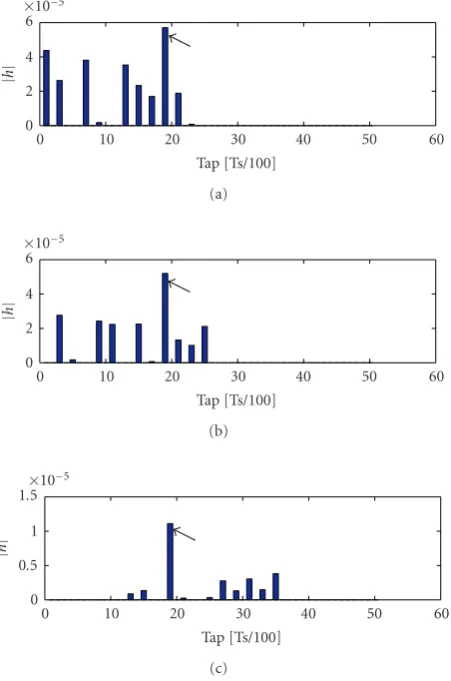
Figure3: Impulse responses of the initial relay channeli,i=1, 2, 3
in a typical urban environment.
channel appears as Rician fading. Hence each relay requires information about the time delay of the strongest path and its phase only. The benefit of this is a good diversity gain with very limited feedback information.
In order to give a basic introduction to this scheme, let us consider the case of three relay stations with the channel impulse responses shown inFigure 3. The strongest path of each channel is indicated with an arrow.
With the received signals from the relays, the algorithm operates in the following way.
(i) The receiver (MS) locates the strongest path from the three different relays, generates an index of their locations
{l1,l2,l3}and phases as{θ1,θ2,θ3}, and feed them back to
the relays;
(ii) Based on the feedback information about the posi-tion of the strongest path and its phase, each relay introduces the proper cyclic shift (optimized delay) to the signal so as the peaks of all signals are aligned at the receiver.
Figure 4shows how the different channels appear at the receiver side after delay optimization where it is observed that the strongest paths of the different channels are now aligned in time.
×10−5 6 4 2 0
|
h
|
0 10 20 30 40 50 60
Tap [Ts/100] (a) ×10−5
6 4 2 0
|
h
|
0 10 20 30 40 50 60
Tap [Ts/100] (b) ×10−5
1.5 1 0.5 0
|
h
|
0 10 20 30 40 50 60
Tap [Ts/100] (c)
Figure4: Impulse responses of the three relay channels after delay
optimization in a typical urban environment.
(iii) Each relay compensates for the phase of the strongest path such that when the different signals are multiplexed in the air, they will add coherently at the receiver. Hence the total received power of the useful signal will be enhanced. Figure 5 shows the resulting equivalent low pass of the fading multipath relay channel where it is observed that the strongest paths have been added coherently while the secondary paths have been averaged out and kept low values.
3.2. Linear approximation of the channel phase
The method discussed inSection 3.1requires channel state information in the time domain which requires an extra IFFT operation at the mobil unit since channel estimation for OFDM is usually done in the frequency domain. One way to avoid this is by investigating and approximating the channel transfer function phase directly.
Based on the multipath fading channel model, the frequency selective channel can be written as
h(t)=
K−1
k=0 hkδ
t−τk
×10−4 1.4 1.2 1 0.8 0.6 0.4 0.2 0
|
h
|
0 10 20 30 40 50 60
Tap [Ts/100]
Figure5: Ultimate channel impulse response of the equivalent relay
channel.
10 0 −10 −20 −30 −40 −50 −60 −70 −80
θ
(
f
)
0 20 40 60 80 100
Number of sub-carrier
Figure6: Phase variation of multipath fading channel in a typical
urban environment with respect to OFDM spectrum.
Assuming hk is slowly varying, the channel transfer function between relay i and the mobile unit can be approximated as
Hi(f)= K−1
k=0
hke−j2π f τk=Hi(f)e−jθi(f). (2)
Figure 6 shows how the θi(f) varies with respect to the frequency f. FromFigure 6, we notice that the phaseθi(f) can be approximated as a linear function:
θi(f)=θi−2πτif, (3)
where−2πτiis the slope of the phase and θi is a constant phase. Thus the corresponding channel in frequency domain is given by
Hi(f)=Hi(f)ejθi(f)
≈Hi(f)ej(−2π f τi+θi).
(4)
15
10
5
0
−5
−10
|
H
|
0 20 40 60 80 100
Number of sub-carrier Channel response for user 1 Channel response for user 2 Channel response for user 3 Channel response for user 4 Channel response for user 5
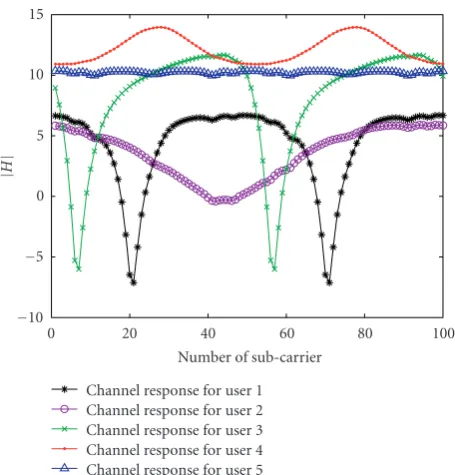
Figure 7: Channel responses in a typical urban environment
experienced by 5 different users.
Based on the above formulas, the optimized delayτifor relayican be approximated as
τi(f)= − 1 2π
dθi(f)
df ≈τi. (5)
Having the estimated delay and the initial phase, each relay channel will make the necessary cophasing and cyclic shifting before signal forwarding. The cyclic delayed signals from the different relays multiplex in the air providing an overall received signal with higher signal amplitude as compared to the case of no delay optimization.
3.3. Scheduling
Multiaccess scheme is required to arrange the multiple users sharing the limited resource. In the interest of maximizing the spectrum efficiency thus to limit the cost of the system, which is the main issue from the operators’ standpoint [9], an OFDMA scheme with frequency scheduling is considered here.
It should be noted that this scheduling scheme is imple-mented with priority: one has to give the first priority to the user suffering the most frequency selective channel (with the highest standard deviation) and give second priority to the user having the second highest standard deviation, and so on. This is not the optimal channel allocation algorithm with respect to system throughput, but a fair system from the user’s point of view and at the same time the spectrum efficiency remains at a high level.
By means of the scheduling scheme presented above, we give higher priority to those users who are not more sensitive to the channel, so as to allocate the subcarriers in a more efficient way.
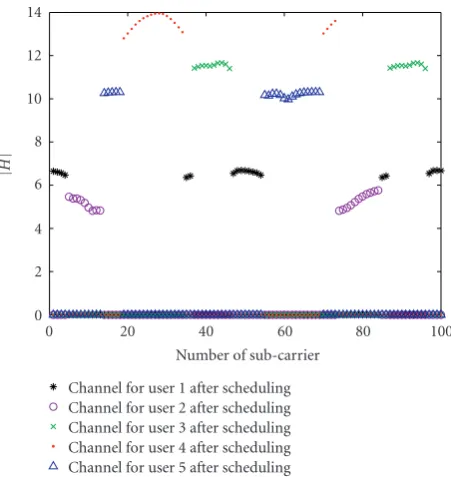
Applying the scheduling algorithm, we notice from Figure 8that the users are related well with each other on the spectrum with the help of scheduling.
4. MATHEMATICAL MODEL
To model the system, we consider one communication link between the base station and the mobile unit within a given cell. As indicated earlier, the communication is done in two steps: in the first step (first-time slot), the base station transmits information to both mobile unit and the relays and in the second step (second-time slot), the relays forward the information to the mobile unit while the base station is silent. Considering cell 0, the received signal at the mobile unit directly from base stations (BS) during the first time slot can be written as
r0(t)=
Nc−1
i=0
P−1
p=0 h(0,i)psi
t−υ(0,i)p
+z0(t), (6)
wheresi(t) is the signal coming from base stationi,h(0,i)pand
υ0,(i)p are the channel attenuation and time delay of path p between base stationiand the mobile unit, respectively,Nc is the total number of base stations, and z0(t) represents
thermal noise.
Assuming that the base stations are synchronized, the demodulated output sample at subcarrierncan be written as
R0,n=H0(0)(n)s0,n+ Nc−1
i=1
H0(i)(n)si,n+Z0,n, (7)
where
H0(i)(n)=
P−1
p=0
h(0,i)pe−j2πυ (i)
0,pn/T (8)
is the channel transfer function at subcarrier n, si,n is the received symbol from base stationiat subcarriern, andZ0,nis zero-mean complex Gaussian random variable with variance
N0.
The received signals at the different relays from the base station within cell 0 are given by
y0,m(t)= Nc−1
i=0
P−1
p=0 cm(i),psi
t−ν(i)
m,p
+zm(t),
m=0, 1,. . .,M−1.
(9)
Each relay amplifies and retransmits its received signal with the appropriate cyclic delay while the base stations are silent. Hence the received signal at the mobile unit from the different relays during the second time slot can be written as
r1(t)=
Nc−1
i=0
M−1
m=0 βi,m
P−1
p=0 gm(i),pyi,m
t−τm(i),p
+z1(t), (10)
14 12 10 8 6 4 2 0
|
H
|
0 20 40 60 80 100
Number of sub-carrier Channel for user 1 after scheduling Channel for user 2 after scheduling Channel for user 3 after scheduling Channel for user 4 after scheduling Channel for user 5 after scheduling
Figure8: Channel allocation to the 5 users after scheduling in a
typical urban environment.
wherey(t) is the cyclic delay version (blockwise) ofy(t) and
βi,m is the amplification factor used at relay nodemwithin celliwith
βi,m=P 1
−1
p=0c(mi),p2+N0/Ei
, (11)
andEi=piTis the average energy per transmitted symbol of celli.
Assuming that the relays are synchronized, the demodu-lated signal sample at subcarrierncan be written as
R1,n=H1,e(n)s0,n+ Nc−1
i=1
Hi,e(n)si,n+ Nc−1
i=1
Gi,e(n)si,n+Z1,n,
(12)
where
H1,e(n)= M−1
m=0
β0,mG(0)m (n)Cm(0)(n)e−j(θ0,m+2πnl0,m/N),
Hi,e(n)= M−1
m=0
β0,mG(0)m (n)Cm(i)(n)e−j(θ0,m+2πnl0,m/N),
Gi,e(n)= M−1
m=0
βi,mG(mi)(n) Nc−1
k=0 C(k)
m (n)e−j(θi,m+2πnli,m/N).
(13)
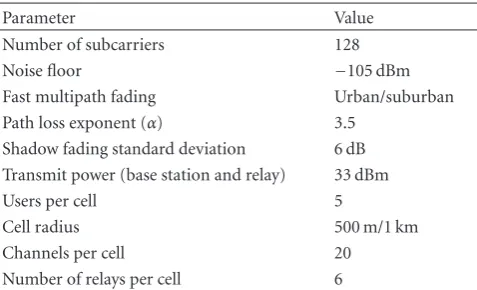
Table1: Simulation parameters.
Parameter Value
Number of subcarriers 128
Noise floor −105 dBm
Fast multipath fading Urban/suburban
Path loss exponent (α) 3.5
Shadow fading standard deviation 6 dB Transmit power (base station and relay) 33 dBm
Users per cell 5
Cell radius 500 m/1 km
Channels per cell 20
Number of relays per cell 6
shift and the phase employed at relaymwithin celli, andZ1,n is zero-mean complex Gaussian with varianceN0.
Combining the direct received signal in (7) and that from the relays in (12), the signal-to-interference+noise-ratio (SINR) can be written as
Γ= H
(0) 0
2 p0
Nc−1 i=1 H0(i)
2
pi+N0W
+ H1,e
2 p0
Nc−1
i=1 Hi,e2+Gi,e2
pi+N0W
,
(14)
where without loss of generality, we have dropped the subcarrier indexn, pi is the average transmitted power of signalsi(t), andWis the signal bandwidth.
The throughput is derived from the received SINR using the following expression:
R=CBWlog2
1 +Γ
2 , (15)
where CB = 1/2 to account for the half duplex operation of the relay node and the factor 2 is to account for practical implementation of channel coding and modulation.
5. NUMERICAL RESULTS
Numerical evaluation is performed by system simulation of a two-tier (19 cells) hexagonal cellular system with omnidi-rectional antenna and 6 relay nodes per cell as illustrated in Figure 1. The proposed algorithms are evaluated by snapshot simulation for the OFDMA system. We assume that users are uniformly distributed over the whole cells. The number of active relays for each user is set toM =3. Mobile units are uniformly distributed within the area. The multipath fading channel is modelled as a tapped delay line and based on the models proposed in [10]. A more detailed list of the simulation parameters is given inTable 1.
With fractional feedback, delay optimization based on strongest path further enhances the channel response com-pared to inserting random delays at relays. Two different types of channel are considered here: (1) flat fading channel
1
0 ×10−4
|
H
|
0 10 20 30 40 50 60 70 80 90 100 Number of sub-carrier
With random delay Without relay With optimized delay
Figure9: A snapshot of a frequency selective channel before and
after adding cyclic delays for the case of three active relays.
and (2) frequency selective fading channel. By adding pre-determined delays and retransmitting the signal with proper amplification at relay nodes, this delay diversity scheme leads a substantial improvement to the system performance.
By properly selecting the cyclic delay for each relay node, we expect to get a good relay channel that can improve the communication link of the mobile unit.Figure 9 illustrates the channel transfer function of the relay channel with and without cyclic delay diversity for a typical urban environment. It is observed that the initial channel has been improved and the optimized delays have improved the channel gains of the different OFDM subcarriers which make the channel more robust as compared to the case with random delays.
A performance improvement of the OFDMA scheme with frequency scheduling is then expected. As our objective is to assess the performance of the optimized delay scheme, we limit our study to the case of having the same statistical channels between the source and relays, as well as between the relays and the mobile unit. We have investigated the performance of our system in a typical urban and rural area environments [10].
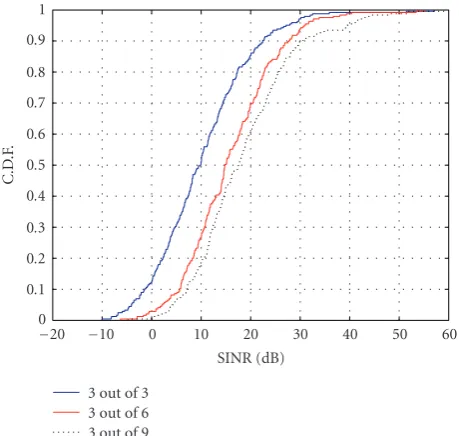
The number of active relays within the cell will affect the received SINR experienced by the user.Figure 10shows the received SINR at 5 percentile for a given user and with different number of active relays. We notice that having 3 active relays is a good compromise between increased received power and experienced interference.
3 2.5 2 1.5 1 0.5 0 −0.5
SINR
(dB)
2 2.5 3 3.5 4 4.5 5 5.5 6 Number of active relays
Figure 10: The received SINR at 5 percentile with the different
number of active relays on an urban environment with a cell radius of 500 m.
1 0.9 0.8 0.7 0.6 0.5 0.4 0.3 0.2 0.1 0
C.D
.F
.
−20 −10 0 10 20 30 40 50 60
SINR (dB) 3 out of 3
3 out of 6 3 out of 9
Figure11: Cumulative distribution function of the received SINR
with the different number of total relays on an urban environment with a cell radius of 500 m.
the infrastructure cost issue, we considered six relays per cell and we assumed that only three are active at a time. The following simulations are based on this relay selectivity scheme.
Figure 12 shows the cumulative distribution function (CDF) of the combined received SINR with and without delay diversity over an urban environment when the opti-mized delay is based on the strongest path and with three active relays out of 6 relays. Clearly, the optimized delay algorithm improves the system performance considerably.
1 0.9 0.8 0.7 0.6 0.5 0.4 0.3 0.2 0.1 0
C.D
.F
.
−20 −10 0 10 20 30 40 50 60
SINR (dB) Without cyclic delay
With random cyclic delay With optimized cyclic delay
Figure12: Cumulative distribution function of the received SINR
on an urban environment with a cell radius of 500 m.
1 0.9 0.8 0.7 0.6 0.5 0.4 0.3 0.2 0.1 0
C.D
.F
.
−20 −10 0 10 20 30 40 50 60
SINR (dB) Without cyclic delay
With random cyclic delay With optimized cyclic delay
Figure13: Cumulative distribution function of the received SINR
on a rural environment with a cell radius of 1000 m.
An improvement of about 3 dB at 5 percentile of the CDF compared to random delay is obtained.
In a rural environment, we can see that (Figure 13) the system has also been greatly improved by about 3 dB at 5 percentile of the CDF when introducing optimized delay as compared to the random delay scheme.
1 0.9 0.8 0.7 0.6 0.5 0.4 0.3 0.2 0.1 0
C.D
.F
.
0 2 4 6 8 10 12 14 16 18
Throughput (bits/symbol/Hz) Without cyclic delay
With random cyclic delay With optimized cyclic delay
Figure14: Normalized system throughput on an urban
environ-ment with a cell radius of 500 m.
1 0.9 0.8 0.7 0.6 0.5 0.4 0.3 0.2 0.1 0
C.D
.F
.
0 2 4 6 8 10 12 14
Throughput (bits/symbol/Hz) Without cyclic delay
With random cyclic delay With optimized cyclic delay
Figure15: Normalized system throughput on a rural environment
with a cell radius of 1000 m.
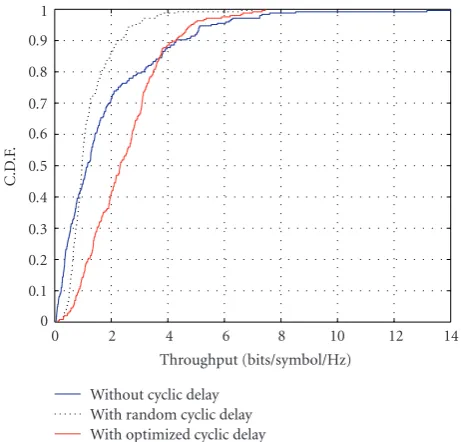
service quality in large coverage case and can reduce the infrastructure cost and at the same time improve the system performance. The system performance is further evaluated in terms of system throughput to support our theoretical derivation. The corresponding normalized throughput for an urban environment has been evaluated and is illustrated in Figure 14and that on a rural environment is shown in Figure 15. From these simulation results, it is clear that the system throughput increases when using the optimized cyclic delay algorithm on different environments. It is interesting to note that for both environments, relays with random
1 0.9 0.8 0.7 0.6 0.5 0.4 0.3 0.2 0.1 0
C.D
.F
.
−10 0 10 20 30 40 50 60
SINR (dB) Based on strongest path Based on channel phase
Figure16: Cumulative distribution function of the received SINR
for the two optimized algorithms on an urban environment with a cell radius of 500 m.
1 0.9 0.8 0.7 0.6 0.5 0.4 0.3 0.2 0.1 0
C.D
.F
.
0 1 2 3 4 5 6 7 8 9
Throughput (bits/symbol/Hz) Based on the strongest path
Based on the channel phase
Figure17: Normalized system throughput for the two optimized
algorithms on an urban environment with a cell radius of 500 m.
delay do not improve the system throughput in comparison to the case without relay. The crossover in the two curves for random delay and no relay situation occurs due to the interference behaviour. At high coverage, the SINR decreases for random delay compared to the case without relay.
that the two algorithms perform almost in the same way with respect to received SINR as well as throughput. The algorithm based on strongest path performs a little better than the second algorithm. For the linear approximation algorithm, we take an approximate of the slope phase curve (which contains variations) which does not give that accurate optimum delay but gives us a rough idea of how to estimate it. On the other hand, the method based on strongest path tends to give a better approximation of the delay as it adds the paths coherently.
6. CONCLUSIONS
In this paper, two promising delay optimization schemes have been proposed based on linear approximation of the channel phase and the strongest path, for a multicellular OFDM system with cooperative relays, in order to take the most advantages of the multipath fading channel by means of exploiting the potential frequency selectivity. The obtained results show that the system performance with delay optimization increases tremendously compared with random delay diversity. Evaluations in different environ-ments further shows that the delay of these optimization schemes is well suited for diverse environments and supports a large coverage. It should be noted that the relays work in a distributed manner and no coordination is needed; besides, both of the delay optimization schemes only require a fractional feedback to substantially improve the system performance. It is quite attractive to the operators who hope to improve the service as well as reduce the system complexity and cost.
We focused in this paper on the delay optimization with limited feedback only relying on the strongest path. One of the interesting points is to investigate how the feedback affects the system performance and what is the optimum degree of feedback with respect to the performance/cost ratio. Implementation of sector antennas will also affect the results by reducing the interference. In addition, the introduction of different scheduling algorithms, for example, always assigning the channel to the user holding the best SINR, could improve the system performance as well. These are some points that can be further explored and studied in the future.
REFERENCES
[1] F. H. P. Fitzek and M. D. Katz, Cooperation in Wireless Networks: Principles and Applications, Springer, New York, NY, USA, 2006.
[2] A. Nosratinia, T. E. Hunter, and A. Hedayat, “Cooperative communication in wireless networks,”IEEE Communications Magazine, vol. 42, no. 10, pp. 74–80, 2004.
[3] S. B. Slimane and A. Osseiran, “Relay communication with delay diversity for future communication systems,” in Pro-ceedings of the 64th IEEE Vehicular Technology Conference (VTC ’06), pp. 321–325, Montreal, Canada, September 2006. [4] N. Ahmed, M. A. Khojastepour, and B. Aazhang, “Outage
minimization and optimal power control for the fading relay channel,” inProceedings of the IEEE Information Theory
Workshop (ITW ’04), pp. 458–462, San Antonio, Tex, USA, October 2004.
[5] J. N. Laneman, D. N. C. Tse, and G. W. Wornell, “Cooperative diversity in wireless networks: efficient protocols and outage behaviour,” IEEE Transactions on Information Theory, vol. 50, no. 12, pp. 2062–3080, 2004.
[6] P. Larsson, “Large-scale cooperative relay network with opti-mal coherent combining under aggregate relay constraints,” in
Proceedings of the Future Telecommunications Conference, pp. 166–170, Beijing, China, December 2003.
[7] A. Sendonaris, E. Erkip, and B. Aazhang, “User cooperation diversity—part I: system description,”IEEE Transactions on Communications, vol. 51, no. 11, pp. 1927–1938, 2003. [8] A. Yaver, A. Anto, M. U. Khattak, and P. Nagarajan,
“Coop-erative relaying with cyclic delay diversity,” Wireless Networks Course Project, 2006.
[9] J. Zander and S.-L. Kim, Radio Resource Management for Wireless Networks, Artech House, Norwood, Mass, USA, 2001. [10] GPP TR 25.943 V5.1.0 Technical Report—Release 5, 3rd