Association Schemes, Codes, and Difference Sets
Thesis by
Carlos H. Salazar-Lazaro
In Partial Fulfillment of the Requirements for the Degree of
Doctor of Philosophy
California Institute of Technology Pasadena, California
2007
c
° 2007
Acknowledgments
I cannot thank enough my advisor Professor Richard Wilson for his guidance and support throughout my years as a graduate student. I am grateful for his suggestions on the different topics that I have pursued while working on my thesis. I am even more grateful for his patience and kindness.
I thank Cheng-Yeaw Ku, Dinakar Ramakrishnan, and David Wales, the other members of my committee, for their time and patience. I also thank the graduate students who have listened, who have helped me with technical questions, and who have provided invaluable friendships. Specifically, I would like to thank Daniel Katz, Kimball Martin, Jay Bartroff, David Whitehouse, Chris Lee, David Grynkiewicz, Jennifer Johnson, Matthew Gealy, Antonio Hernandez, Rupert Venzke, and many others.
I thank the Caltech mathematics department for supporting me through graduate school. I also thank the math department staff for their invaluable assistance. Specif-ically, I thank Elizabeth Woods, Kathy Carreon, Stacey Croomes, Cherry Galvez, and Seraj Muhammed. I give my special gratitude to Pamela Fong and Sara Mena for being good friends and colleagues. I thank the postdocs whom I befriended, and who helped me in one way or another. Specifically, I thank Vladimir Baranovsky, Cheng-Yeaw Ku, Peter Keevash, Ada Chan, Monica Varizani, Eric Wambach, Eric Rains, David Damanik, and many others.
Abstract
Adviser: Richard Wilson.
This thesis consists of an introductory chapter and three independent chapters. In the first chapter, we give a brief description of the three independent chapters: abelian
n-adic codes; generalized skew hadamard difference sets; and equivariant incidence structures.
In the second chapter, we introduce n-adic codes, a generalization of the Duadic Codes studied by Pless and Rushanan, and we solve the corresponding existence problem. We introduce n-adic groups, canonical pplitters, and Margarita Codes to generalize the “self-dual” codes of Rushanan and Pless, and we solve the correspond-ing existence problem.
In the third chapter, we consider the generalized skew hadamard difference set (GSHDS) existence problem. We introduce the combinatorial matricesAG,G1, where
G1 = (Z/exp(G)Z)∗ and Gis a group, to reduce the existence problem to an integral
equation. Using a special finite-dimensional algebra or Association Scheme, we show
A2
G,G1 = |G|
p Ifor generalG. With the aid ofAG,G1, we show some necessary conditions for the existence of a GSHDS D in the group (Z/pZ)×(Z/p2Z)2α+1, we provide a
proof of Johnsen’s exponent bound, we provide a proof of Xiang’s exponent bound, and we show a necessary existence condition for general G.
In the fourth chapter, we study the incidence matrices Wt,k(v) of t-subsets of
{1, . . . , v} vs. k-subsets of {1, . . . , v}. Also, given a group G acting on {1, . . . , v}, we define analogous incidence matrices Mt,k and M0
t,k of k-subsets’ orbits vs. t
-subsets’ orbits. For general G, we show that Mt,k and Mt,k0 have full rank over Q, we give a bound on the exponent of the Smith Group of Mt,k and M0
t,k, and we give
the Equivariant Sign Conjecture for the matrices Wt,k(v) using a special basis of the column module ofWt,k consisting of columns ofWt,k; we verify the Equivariant Sign Conjecture for small cases; and we reduce this conjecture to the case v = 2k+t. For the caseG= (Z/nZ), we conjecture thatMt,k0 has a basis of the column module ofMt,k0
that consists of columns of M0
t,k. We prove this conjecture for (t, k) = (2,3),(2,4),
and we use these results to calculate the Smith Group of M2,4, M20,4, M2,3, and M20,3
Contents
Acknowledgments iv
Abstract vi
List of Figures xiii
1 Introduction 1
1.1 Abelian n-adic Codes . . . 1
1.2 Generalized Skew Hadamard Difference Sets . . . 5
1.3 Equivariant Incidence Structures . . . 10
1.3.1 GeneralG . . . 11
1.3.2 Case G=Stab(Ω) . . . 11
1.3.3 Case G= (Z/nZ) . . . 13
2 Abelian n-adic Codes 15 2.1 Preliminaries . . . 15
2.2 Abelian n-adic Codes . . . 19
2.2.1 Existence Criteria . . . 21
2.2.2 Existence in n-groups . . . 28
2.2.3 Existence in s-groups with (s, n) = 1 . . . 29
2.2.3.1 Existence in s-groups, (s,2) = 1 . . . 29
2.2.3.2 Existence in 2-groups with (2, n) = 1 . . . 37
2.3 Duadic Code Generalizations andn-adic Codes . . . 39
2.4 Abelian n-adic Groups . . . 47
2.4.2 Margarita Codes . . . 51
2.5 Conclusion . . . 56
3 Generalized Skew Hadamard Difference Sets 59 3.1 Quadratic Residue Slices (QRS) . . . 66
3.1.1 The Aut(G) Action . . . 67
3.1.2 Character Values of QRS . . . 71
3.1.3 The QRS Incidence Structure AG,G1 . . . 80
3.2 Difference Coefficients . . . 85
3.3 The G2 Association Scheme . . . 93
3.4 Results for Special Groups . . . 105
3.4.1 Examples of θ:G→Gb . . . 109
3.4.2 Results forθs Induced by Invariant Factor Inner Products . . 112
3.4.3 Results forθs Induced by Galois Group Structures . . . 119
3.5 Results for General G. . . 134
3.5.1 Johnsen’s Exponent Bound . . . 134
3.5.2 A Special Condition . . . 135
3.5.2.1 The Algebra Induced by D . . . 136
3.5.2.2 The Result . . . 138
4 Equivariant Incidence Structures 140 4.1 Preliminaries . . . 141
4.1.1 G-maps and G-spaces . . . 141
4.1.2 General Results for Smith Groups . . . 162
4.1.2.1 Short Exact Sequences of Z-Modules . . . 163
4.1.2.2 The Results . . . 171
4.1.3 The Johnson SchemeJ(v, k) . . . 177
4.1.3.1 The Matrices W0t,k, Wmin(t,k t0,k0) . . . 185
4.2 General Equivariant Results . . . 190
4.3 The Mt,k and M0 t,k Incidence Structures . . . 202
4.3.2 The Smith Group ofMt,k and M0
t,k . . . 213
4.3.2.1 Bounds on|Mt,k||Mt,k|0 . . . 214
4.3.3 The Integral Preimage Problem . . . 221
4.3.4 Integral (t, k)-Bases . . . 227
4.3.5 The Kernel ofM0 t,k and Mt,k . . . 240
4.4 Positive Equivariant G-Signings . . . 244
4.5 The Case G=Stab(Ω) . . . 248
4.5.1 Reduction Results . . . 257
4.5.2 Monotone Families {Ω}∞ v=1 Induced by (t, k)-Bases . . . 262
4.5.3 The Equivariant Sign Conjecture . . . 267
4.6 The Case G= (Z/nZ) . . . 274
4.6.1 The Orbits of (Z/nZ) On the k-subsets . . . 275
4.6.2 A Partition of the k-subsets’ Orbits of (Z/nZ) . . . 282
4.6.3 The Ker(Mt,k0 ) . . . 286
4.6.4 The (2,3) Case . . . 289
4.6.4.1 The Space (C3(X))0 . . . 290
4.6.4.2 Projected Relative (2,3)-Pods . . . 290
4.6.4.3 Finding a (2,3)-Basis . . . 291
4.6.4.4 The Smith Group ofM0 2,3 and M2,3 . . . 297
4.6.5 The (2,4) Case . . . 306
4.6.5.1 The Space (C4(X))0 . . . 306
4.6.5.2 Projected Relative (2,4)-Pods . . . 306
4.6.5.3 Finding a (2,4)-Basis . . . 310
4.6.5.4 The Smith Group ofM0 2,4 and M2,4 . . . 323
4.6.6 The (3,4) Case . . . 339
4.6.6.1 Projected Relative (3,4)-Pods . . . 339
4.6.6.2 Partial Reduction for a (3,4)-Basis . . . 342
4.6.6.3 Partial Results for S(M0 3,4) . . . 345
List of Figures
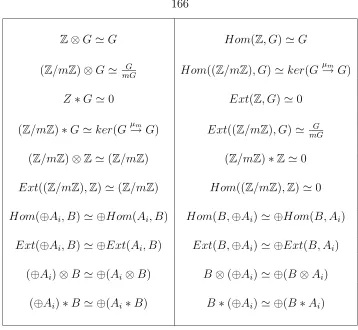
4.1 Algebraic isomorphisms. . . 166
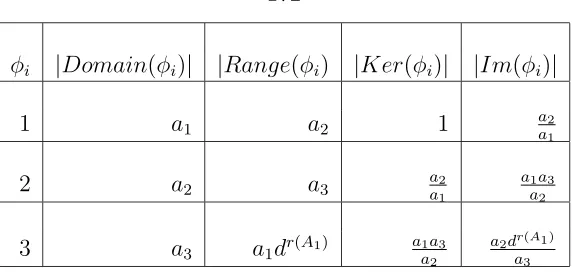
4.2 Exact sequence integral conditions. . . 171
4.3 Exact sequence integral conditions. . . 172
4.4 Calculating the Frankl rank for the 3-subset {1,3,4} ⊂ {1, . . . ,7}. . . . 263
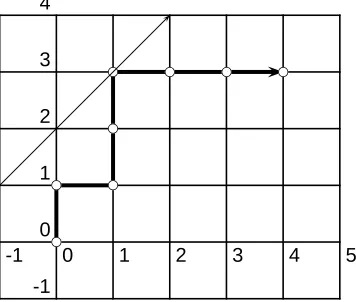
4.5 The orbits of {1,3,7} under the action of (Z/7Z). . . 276
4.6 Correspondence between the 3-subsets’ orbits of (Z/7Z) and the parti-tions of 3. . . 284
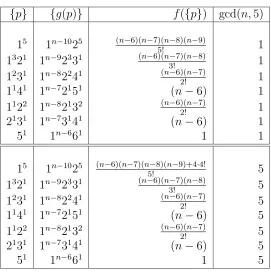
4.7 f({p}) for k= 4. . . 285
4.8 f({p}) for k= 5. . . 285
4.9 f({p}) for k= 2. . . 286
4.10 f({p}) for k= 3. . . 286
4.11 Relative (2,3)-pod. . . 288
4.12 Projected relative (2,3)-pod. . . 289
4.13 Classes of 3-subsets’ orbits. . . 290
4.14 Relative (2,3)-pod. . . 291
4.15 Projected relative (2,3)-pod. . . 292
4.16 The Smith Group of M2,3(n). . . 300
4.17 The Smith Group of M2,3(n). . . 301
4.18 Classes of 4-subsets’ orbits. . . 306
4.19 Relative (2,4)-pod. . . 307
4.20 Projected relative (2,4)-pod. . . 307
4.21 Relative (2,4)-pod. . . 308
4.22 Projected relative (2,4)-pod. . . 309
4.24 Projected relative (2,4)-pod. . . 310
4.25 The Smith Group of M2,4(n). . . 331
4.26 Relative (3,4)-pod. . . 340
4.27 Projected relative (3,4)-pod. . . 341
4.28 Relative (3,4)-pod. . . 342
Chapter 1
Introduction
1.1
Abelian n-adic Codes
In [21], Pless and Rushanan introduced a family of cyclic binary codes called the Duadic Codes to generalize the cyclic binary Quadratic Residue Codes. Using the language of primitive idempotents1 inF
q[G], where Fq is the finite field of q elements
and G is an abelian group, Duadic Codes were introduced as in definition 1.1.1. Definition 1.1.1. Let µ∈Aut(G), and let e=Pg∈Geg[g]be a primitive idempotent in Fq[G]. Define µ·e as Pg∈Geg[σ(g)]. Let e1 =e and e2 =µ·e. If
e1+e2 = 1−
1
|G|
X
g∈G
[g],
then we say thate1, e2, µforms aDuadic Codeand we call µthesplitting of the code.
Duadic Codes were of special importance since they provided a construction for Finite Projective Planes. This link is sumarized in the following result that is found in [23] in its most general form.
Theorem 1.1.2. LetCbe a duadic code with splitting given byµ−1 then the minimum
distance for oddlike2 code words, d
0, satisfies
d20−d0+ 1≥v.
1
An idempotent is primitive, if for every other idempotentf,ef =f e=f 6= 0⇒e=f.
2
If equality holds then the supports of the minimum-weight oddlike codewords of weight
d0 are the blocks of a projective plane of order (d0−1). Furthermore, d0 is the
mini-mum distance ofC, and the minimum weight codewords are precisely those codewords that are constant on the supports of the blocks of the finite projective plane.
Originally, Duadic Codes were introduced in the cyclic binary case. Since their introduction, there has been various generalizations with respect to:
1. Parity of the characteristic of the field, 2. Number of idempotents used, and 3. The cyclic and noncyclic abelian case.
The following is a history of these generalizations:
1. The family of Duadics in even characteristic, by Rushanan in [22]. These are codes in Fq[G] where G is an arbitrary abelian group, q is even, and 2
idempotents are used in its definition. The existence problem is solved.
2. The family of Duadics in odd characteristic, by Smid in [25]. These are codes in Fq[Z/nZ] where q is odd and 2 idempotents are used in its definition. The existence problem is solved.
3. The family of Triadic Codes, by Pless and Rushanan in [21]. These are codes inFq[Z/nZ] where q is even and 3 idempotents are used in its definition.
The existence problem is solved.
4. The family of Polyadic Codes, by Brualdi and Pless in [4]. These are codes inFq[Z/nZ] andmidempotents are used in its definition. The existence problem
is solved.
5. The family of m-adic Polyadic Codes, by Ling and Xing in [18]. These are codes in Fq[G] whereGis a general abelian group, andm idempotents are used
We will provide for a different generalization of Duadic Codes that will parallel the family ofm-adic Polyadic Codes of San Ling, and the Duadic Codes of Rushanan. This will be the family of n-adic codes defined by:
Definition 1.1.3. Let n be a prime and G be an abelian group. An n-adic code is a paire, µwheree is an idempotent andµ∈Aut(G)satisfyingStabhµi(e) ={µk|µk·e=
e}=hµni, under the action of Aut(G) on the primitive idempotents of F
q[G], and
he1, . . . , eni = Fq[G], he1i ∩ he2i ∩ · · · ∩ heni = hdg0i
= h 1
|G|
X
g∈G
[g]i,
where ei =µi−1·e.
Remark: The termn-adic, introduced in definition 1.1.3, is not related top-adic numbers.
We will solve the existence problem for n-adic codes as it is given by the next theorem.
Theorem 1.1.4. Let n be a prime, then the following are true:
1. There is an n-adic code inFq[G] if and only if there is an n-adic code in Fq[S]
for every sylow subgroup S of G.
2. There are no n-adic codes in Fq[G] whenG is an n-group.
3. Let G be an s-group where (s, n) = 1. Let ts(k) = |µk| in Aut(Z/sZ). Then,
(a) Let s be an odd prime and assume n divides ts−1
q(s), then there is an n-adic
code in Fq[G].
(b) Let s be an odd prime, assumen does not divide s−1
tq(s), andG= (Z/sZ) π1×
(Z/s2Z)π2× · · · ×(Z/srZ)πr. Then,
i. Ifs= 1 modulon there is ann-adic code inFq[G]if and only ifπi = 0
ii. If s6= 1 modulo n there is an n-adic code in Fq[G]if and only if ts(n)
divides πi for all i.
(c) Let s = 2 be such that (2, n) = 1. Let G= (Z/sZ)π1 ×(Z/s2Z)π2 × · · · × (Z/srZ)πr. There is an n-adic code in F
q[G] if and only if tn(2) divides πi
for all i.
We will continue our study ofn-adic codes by providing conditions under whichn -adic codes become Tri-adic Codes, Poly-adic Codes, andm-adic Polyadic Codes. This will put the concept of n-adic codes into perspective with the current generalizations of duadic codes.
We will also provide a generalization of proposition 1.1.2, given as proposition 1.1.5 below, by introducing the concept of n-adic groups for which there will always be a canonical splitter of order n, and by calling the analogous “self-dual” codes Margarita codes.
Theorem 1.1.5. Let e, µl give a Margarita code inFq[G] whereG is ann-adic group
and µl a canonical splitter of order n. Let d0 be the minimum weight of all oddlike
vectors of hei. Let w ∈ hei be an oddlike vector of weight d0. Let w = Pg∈Bβg[g]
where B ⊂G is the support of w. Let Be =Pg∈B[g] be the characteristic function of the support of w. Define rn,µl,G :G→Z as,
rn,µl,G(g) = |Hg∩(B×. . .×B)|,
where
Hg = {(g1, . . . , gn)∈G× · · · ×G|g1+µl(g2) +· · ·+µln−1(gn) =g}.
Then,
1. The constant d0 satisfies dn0 −rn,µl,G(1) + 1≥ |G|,
2. If dn
0 −rn,µl,G(1) + 1 = |G|, then:
(b) The characteristic function of the support of w satisfies,
e
B ∗(µl·Be)∗ · · · ∗(µln−1·Be) = (rn,µl,G(1)−1)[1] + X
g∈G
[g].
3. The constant rn,µl,G(1) satisfies rn,µl,G(1) =d0 modulo n.
1.2
Generalized Skew Hadamard Difference Sets
We will assume that the reader is familiar with the theory of Difference Sets as it can be found in Jungnickel’s book in [12], and in Lander’s book in [17]. Also, we will assume thatGis an abelian group, and we will use the additive notation for its group operation.
Skew Hadamard Difference Sets (SHDS) are subsetsDof an abelian groupGsuch that in the group algebra Z[G]:
D(x)D(x−1) = (k−λ)[0] +λG(x), D(x) +D(x−1) = G(x)−1.
The following is what is known about the existence problem for SHDSs. This can be found in Chen, Sehgal, and Xiang’s paper in [6].
Theorem 1.2.1. A SHDS has parameters (v, k, λ) = (v,v−1 2 ,
v−3
4 ). Also, if D ⊂ G
is a SHDS, and G is abelian, then:
1. The order of the group v has the form v =p2α+1, where p= 3 mod 4,
2. If χ is any nonprincipal character, then:
χ(D) = −1 +²χ
√ −v
2 ,
3. If G=Z/pa1Z×Z/pa2Z× · · · ×Z/parZ where: a
1 ≥a2 ≥ · · · ≥ar and a1 ≥2,
then:
(a) The exponents a1 and a2 are the same, i.e. , a1 =a2,
(b) The exponents ais satisfy,
a1 ≤
a1+· · ·+ar+ 1
4 .
This is Xiang’s exponent bound.
We introduce the concept of a Generalized Skew Hadamard Difference Set (GSHDS), given by:
Definition 1.2.2. A generalized skew hadamard difference set (GSHDS) is an ele-ment of the group algebra D(x)∈Z[G] such that:
D(x)D(xno) = (ko
−λ)[1] +λG(x), D(x) +D(xno) = G(x)−[1],
where [1] =x0 is the multiplicative unit of Z[G], ko =|D(x)∩D(x−no)|, and no is a
Non-Quadratic Residue of (Z/exp(G)Z)∗.
In our study of GSHDSs, we introduce the concept of Quadratic Residue Slices (QRS) defined by:
Definition 1.2.3. Let G be an abelian p-group, and G1 = (Z/exp(G)Z)∗ be the
numerical multipliers of G. Let Ωg1, . . . ,Ωgr be the distinct orbits of the action of G1
on Ge=G\{0}. A Quadratic Residue Slice (QRS) is any formal sum of the form:
r
X
i=1
²ΩgiΩgi,
where ²Ωgi ∈ {±1}.
Conjecture 1.2.4. If G is an abelian group that affords a GSHDS, then G is ele-mentary abelian.
We prove the analog of proposition 1.2.1 for GSHDS using a unified framework in the language of Quadratic Residue Slices (QRS).
We introduce a combinatorial matrix AG,G1 that is well defined in any abelian
p-group and depends on the choice of a set of representatives of the action of G1 on
G\{0}.
Definition 1.2.5. Let G be an abelian p-group with exponent pa1. Let θ : G → Gb
be an noncanonical isomorphism such that θ(g)(g0) = θ(g0)(g). Let Ω
g be an orbit
of G1 = (Z/exp(G)Z)∗ on Ge = G\{0} and Ωχ an orbit of G1 = (Z/exp(G)Z)∗ on
eb
G =Gb\{χ0}. Then, AG,G1 is defined on the set of orbits of G1 on Ge versus the set
of orbits of G1 on Geb using θ by:
AG,G1(Ωθ(g0),Ωg) =
(np)o(p·g) if θ(g0)(g) =ηn p,
0 else,
where (np) is the quadratic residue symbol, o(g) is the order of g in the group G, χ0
is the principal character, ηp is a fixed primitive pth root of unity, and p · g =p·g =
g + g + · · · + g is g added to itself p times.
Using the matrix AG,G1, we introduce the concept of difference coefficients as: Definition 1.2.6. Let d be the vector representation of a QRS D⊂G, i.e., a vector of ±1. The difference coefficients of D are given by the vector AG,G1d.
We show the following properties of AG,G1: Theorem 1.2.7. The following hold:
1. The incidence matrix AG,G1 satisfies,
A2G,G1 = |G|
p Ir,r,
2. There is a GSHDS D in G if and only if there is a vector d of ±1s such that
AG,G1d=
q
|G|
p d¯for some integral vector d¯.
We proceed to study difference coefficients, and we show integral formulas involv-ing them. In our study of difference coefficients, we prove Xiang’s exponent bound for GSHDS, and we introduce the concept of difference intersection numbers.
Definition 1.2.8. Let D be a QRS in G, and let L ⊂ G be a subgroup with GL =
{g0
1L, . . . , gs0L}. The difference intersection numbers of D with respect to L inG are
defined as:
νG,L(D, gi0) = |D∩gi0L| − |D(n0)∩g0
iL|.
Using part 1 of theorem 1.2.7 and the structure of Galois Rings, we find necessary conditions for the existence of a GSHDS in the family of groups (Z/pZ)×(Z/p2Z)2α+1.
We achieve this by first using the multiplicative structure of the Galois RingGR(p2, α)
to deduce a “Canonical Form” forAH,H1, whereH = (Z/p
2Z)2α. Using the “Canonical
Form” of AH,H1, we deduce the following existence conditions:
Theorem 1.2.9. Let G = (Z/pZ) ×(Z/p2Z)3, and D ⊂ G a GSHDS. Let H =
{0} ×(Z/p2Z)3 ⊂ G and L =p·H '(Z/pZ)3. Let D0 =H∩D, and D00 =L∩D.
Let,
1. The vector of ±1s representing D0 be d0.
2. Decompose d0 by d0 = (d0T
0 , d01T, . . . , d0pT2) where d0i is a (p2+p+ 1)×1 vector of
±1s representing disjoint H1 classes of D0.
3. The vector of difference coefficients of the H1 classes of d0i be die
0
.
Then, there is a ordering of the H1 classes of H and a set of H1-orbit representatives
such that:
2. The image ofd0 underAL,L1 has formAL,L1d0 =pd¯0 where d¯0 is ap
2+p+ 1×1
vector of ±1s. Define d¯0 the ”dual” of D00.
3. The image of de0 under AL,L1 has form AL,L1de0 =p ¯
e
d0, for some integral de¯0.
4. The vector d¯e0 of the previous part satisfies de¯0 =Pp
2
i=1di.
5. The vector of ±1s of part 2 satifies pd¯0 =Pp
2
i=1die.
Theorem 1.2.10. Let D be a GSHDS in G= (Z/pZ)×(Z/p2Z)2β+1, and let K = (Z/pZ)2β. Then, there are elements A, B ∈Z[K] that depend on D, and there is an
element L0 ∈Z[K] that depends on the structure of G such that:
1. The elementsA andB satisfy p2βA=χ
0(A)K(x) +L0∗B(−1), whereχ0 is the
principal character of K.
2. The elements A and B satisfy p2βB = χ
0(B)K(x) +pL0 ∗A(−1), where χ0 is
the principal character of K.
3. All the coefficients of A are odd, and χ0(A) is odd.
4. All the coefficients of B are odd, and χ0(B) is odd.
5. The principal character of A has value χ0(A) = pβ−1²0b0; where ²0 is ±1, and
b0 is an odd integer.
6. The principal character of B has value χ0(B) = pβ²0a0; where ²0 is ±1 and
equal to the ²0 of part 5, and a0 is an odd integer.
We close the chapter with a proof of Johnsen’s exponent bound using the matrix
AG,G1, and with a necessary existence condition between the Difference Coefficients and the difference intersection numbers of a GSHDS D in a general abelian p-group
1.3
Equivariant Incidence Structures
We consider the incidence matrices Wt,k defined on the t-subsets vs. k-subsets of {1, . . . , v} by:
Wt,k(eT, eK) =
1 if T ⊂K,
0 else.
The following problems concerning the matrices Wt,k have been solved in the literature:
1. What is the rank of Wt,k? When is Wt,k onto? When is Wt,k injective?
2. How can the kernel of Wt,k be characterized? Do we know a canonical basis for the kernel?
3. Does Wt,k allow for a column Z-basis? That is, is there a subset of the columns of Wt,k that is a basis for the column space of Wt,k overZ? This is the concept of a (t, k)-basis.
4. What is the Smith Normal Form of Wt,k?
5. What is a left inverse of Wt,k whenWt,k is injective? 6. What is a right inverse of Wt,k when Wt,k is surjective?
7. When does an integral vector have an integral preimage under Wt,k?
Questions 1, 5, and 6 have been answered by Kramer in [13, 14, 15]. Questions 3, 4, and 7 have been answered by Wilson in [26]. Question 2 has been answered by Ajoodani-Namini and Khosrovshahi in [1], and by Bier in [3].
We consider these questions when there is an action of a group G. That is, we ask the same questions for Mt,k = (Wt,k)0, and for Mt,k0 = ((Wt,kT )0)T; where Mt,k is
defined by
Mt,k(eΩT, eΩK) = |{K
0 ∈Ω
and M0
t,k is defined by
Mt,k0 (eΩT, eΩK) = |{T
0 ∈Ω
T|T0 ⊂K}|,
where ΩT is an orbit ofG on the t-subsets, and ΩK is an orbit ofG on thek-subsets.
1.3.1
General G
For general G:
1. We show Mt,k and M0
t,k have full rank.
2. We provide a partial answer to the integral preimage problem of Mt,k for
arbi-trary G.
3. We provide some bounds on the exponent of the Smith Group of Mt,k andMt,k0
for arbitrary G.
4. We provide a left inverse of Mt,k when Mt,k is injective.
5. We provide a right inverse of Mt,k when Mt,k is surjective. 6. We provide a left inverse of M0
t,k when Mt,k0 is injective.
7. We provide a right inverse of Mt,k0 when Mt,k0 is surjective. 8. We solve for the Smith Group of M0
t,k provided that for t < k:
(a) The matrix Mt,t0 +1(n) affords a (t, t+ 1)-basis.
(b) A vector z has an integral preimage under Mt,t0 +1 if and only if
¡t+1−i t−i
¢
divides M0
i,tz fori= 1, . . . , t.
1.3.2
Case G
=
Stab
(
Ω
)
Definition 1.3.1. Let β be a (t, k)-basis of L0
t,k. We say that ² is a trivial positive
equivariant signing for (Lt,k, β), if for every K0 ∈∼β,
Lt,keK0 =
X
K∈β
C(K0, K)²(K)Lt,keK,
we have ²∈ {−1,0,1} and C(K0, K)≥0.
We say the signing ² is G-invariant, where G⊂Sv, whenever²(σ·K) =²(K) for all σ ∈G and K ∈βt,k.
We consider the action of the group G = Stab(Ω), where Ω is a partition of
{1, . . . , v}. By introducing the concepts of: monotone families, compatible sets, equiv-ariant compatible sets, and inclusion maps; we give reduction criteria to show for a given G-invariant family βt,k of columns of Wt,k(v):
1. When βt,k is a (t, k)-basis ofWt,k(v). 2. When the set of G-orbits in β, i.e., βG
t,k, is a (t, k)-basis for Mt,k0 .
3. When the set βt,k admits a trivial positive equivariant signing for Wt,k that is
G-invariant. 4. When the set βG
t,k admits a trivial positive equivariant signing for Mt,k0 .
We show the Bier-Frankl (B-F) basis and the Khosorovshahi-Ajoodani (KAj) basis allow a stabilizer group Gof the form Stab(Ωt,k) where
Ωt,k = {1, . . . , v−k−t} ∪ {v−k−t+ 1, v−k−t+ 2} ∪ · · · ∪ {v−k+t−1, v−k+t} ∪ {v−k+t+ 1, . . . , v},
for the KAj basis, and
for the B-F basis. We also show that these bases are equivalent.
Using the reduction results, we prove that these bases admit a trivial positive equivariant signing that is G-invariant for the cases: (1,2),(2,3), by providing a proof; (3,4),(5,6), via a computer program. We also show:
Proposition 1.3.2. Let βt,k be the KAj (t, k)-basis or the B-F (t, k)-basis, then: βt,k(v)admits a trivial positive equivariant signing that isG=Stab(Ωt,k(v))-invariant
for allv ≥k+t+ 1 if and only if βt,k(v) admits a trivially positive equivariant signing
that is G=Stab(Ωt,k(2k+t))-invariant for v = 2k+t.
We propose the following conjecture that we call the “Equivariant Sign Conjec-ture.”
Conjecture 1.3.3. Let βt,k be the KAj (t, k)-basis or the B-F (t, k)-basis, then βt,k
admits a trivial positive equivariant signing that is G=Stab(Ωt,k)-invariant.
1.3.3
Case G
= (
Z
/
nZ
)
For the groupG= (Z/nZ):1. We solve the integral preimage problem for Mt,k when G = Z/nZ and n is a prime.
2. We calculate the Smith Group of M0
2,3 and of M2,3 for arbitrary n by solving
for a (2,3)-basis.
3. We calculate the Smith Group of M0
2,4 and of M2,4 for arbitrary n by solving
for a (2,4)-basis.
4. We give some partial results for a generating set of the column space of M0
3,4.
We also propose the following conjectures that we call the “(t, k)-basis Conjec-tures.”
Conjecture 1.3.4. (Weak version) Let gcd(tk, n) = 1, and let t < k ≤ n−k. Then, M0
Conjecture 1.3.5. (Strong version) Let t < k ≤ n− k. Then, M0
t,k admits a
(t, k)-basis.
We close the chapter by showing how the (t, k)-basis conjectures can be used to calculate the Smith Group of Mt,k0 .
Proposition 1.3.6. Let gcd(n,(2(k−1))!) = 1, and 1 ≤ t < k ≤ n −k ≤ n−t. Assume the(t, k)-basis conjecture holds forn, and for all (i−1, i) where i= 1, . . . , k. Then, M0
t,k(n) has Smith Group given by:
(Z/
µ
k t

Z)×(Z/
µ
k−2
t−2

Z)r2(n)−1
×(Z/
µ
k−3
t−3

Z)r3(n)−r2(n)
× · · ·
×(Z/
µ
k−(t−1)
t−(t−1)

Z)rt−1(n)−rt−2(n),
where ri(n) = ( n i)
Chapter 2
Abelian n-adic Codes
2.1
Preliminaries
We will consider abelian group codes that are given by ideals in Fq[G] and are also
known as G-codes. We will assume that (q,|G|) = 1, where q is a prime power, and that G is abelian. This will make Fq[G] a semisimple algebra and all ideals in Fq[G]
principal (generated by idempotents, unique up to units).
We will assume the natural action of Aut(G) on the idempotents e of G defined for any σ ∈Aut(G) as:
µ·e = X
g∈G
eg[σ(g)],
where e=Pg∈Geg[g].
We will also assume the natural action ofAut(G) onGbdefined for anyσ ∈Aut(G) and χ∈Gb asσ·χ=χ◦σ−1.
As Fq[G] is semisimple, every G-invariant subspace I1 splits. That is, there is a
G-invariant subspace I2 such that Fq[G] = I1 ⊕I2. In particular, if I1 = hei, then
I2 = h1−ei and Fq[G] = hei ⊕ h1−ei. Hence, Fq[G] = he1i ⊕ · · · ⊕ heri; where
heii are ideals that cannot be written as the sum of 2 proper ideals, i.e., irreducible. The idempotents e1, . . . , er are called primitive idempotents. We note that it can be
shown that any idempotent ofFq[G] is the sum of some irreducible idempotents, that
By considering a splitting field for G, i.e., Fqr where F∗qr has all exp(G)th roots
of unity, one can show that in Fqr[G]⊇ Fq[G] there are |G| irreducible idempotents
given by the irreducible characters ofGintoF∗
qr; where the idempotent corresponding
to the character χ is given by:
eχ = 1
|G|
X
g∈G
χ(g−1)[g].
One can show that the Galois group ofFqr overFq is generated by the Frobenious
Mapx7→xq. We will denote the Frobenious Map byσq. We note that, one can show
that ifχ(g) is an irreducible character, thenσq(χ(g)) is another irreducible character. Thus, σq induces an action on the irreducible characters of G.
The following is a well-known result in Character Theory, and it can be found in Isaacs’ book in [10], chapter 9.
Theorem 2.1.1. Lete be the an irreducible idempotent inFq[G], let Fqr be a splitting
field of G. Then, in Fqr[G], e=eχ
1 +· · ·+eχl where χ1, . . . , χl forms an orbit of σq
acting on the irreducible characters of G.
By using theorem 2.1.1, we will proceed to calculate the irreducible idempotents of Fq[G] by introducing the concept of cyclotomic cosets.
Note that σq(χ(g)) = (χ(g))q =χq(g). Hence, in Gb, σq acts like raising to the qth
power. This mapg 7→gq, a numerical multiplier, is clearly in Aut(Gb) as (q,|G|) = 1.
By using any noncanonical isomorphism η : G 7→ Gb, where Gb is the group of characters, we can identify anyχ=χg ∈Gb with aη(g). By using this identification,
we can identify the orbit ofχ=χg1 underσq inGb with the orbit of g1 under µq inG. Thus, by theorem 2.1.1, if e is an irreducible idempotent in Fq[G], then there is some orbit of µq acting on G, say Cgo, such that
e = X
g∈Cgo eχg,
cyclotomic cosets of G.
We will call the irreducible idempotentdg0 =
P
g0∈C
1eχ1 =
1
|G|
P
g∈G[g] which
cor-responds to the trivial cyclotomic coset C1 ={1} the trivial irreducible idempotent,
clearly a primitive idempotent in Fq[G].
It can be shown that if X = {Cgo, . . . , Cgr} are all the distinct µq orbits of G,
then X forms an Association Scheme. That is, if inZ[G] we let Cg0i =Pg∈C
gig, then
there are pk
i,j ∈Z such that:
Cg0i ∗Cg0j =
r
X
k=0
pki,jCg0k.
Thus, the algebra generated by X0 ={C0
go, . . . , C
0
gr}inFq[G] is finite dimensional
of dimension r+ 1. One can show that this subalgebra is also semisimple and has as idempotents the primitive idempotents of Fq[G]. In particular, this shows that
primitive idempotents, and for that matter any idempotent, are constant on the qth cyclotomic cosets of G. However, there is an easy way of seeing this. Let e be an idempotent, then:
e = eq
= (X
g∈G cg[g])q
= X
g∈G
(cg)q[gq]
= X
g∈G cg[gq] = µq·e,
which says thatµq is a multiplier ofe. Thus, the coefficients ofeareµqinvariant; that is, they are constant on the qth cyclotomic classes. Note also that Aut(G) induces an action on the primitive idempotents of Fq[G]. We can show this by considering
a primitive idempotent dgi = P
g∈Cgi eχg of Fq[G] ⊆ Fqr[G], where Fqr is a splitting
µ·dgi = ( X
g∈Cgi
µ·eχg)
= X
g∈Cgi
(µ·eχg),
where, eχg =
1
|G|
P
g0∈Gχg((g0)−1)[g0]. Thus,
µ·eχg =
1
|G|
X
g0∈G
χg((g0)−1)[µ(g0)]
= 1
|G|
X
g0∈G
χg((µ−1(g0))−1)[g0]
= 1
|G|
X
g0∈G
χg(µ−1((g0)−1))[g0]
= 1
|G|
X
g0∈G
(µ·χg)((g0)−1)[g0].
Define µ∗(χ)(g0) = (µ·χ)(g0). Note that µ∗(χ) is again an irreducible character since µ ∈ Aut(G). One can show that µ∗ is an automorphism of the group of irre-ducible characters, i.e.,µ∗ ∈Aut(Gb), and that the mapµ→µ∗is an anti-isomorphism fromAut(G) to Aut(Gb).
Clearly, µ·eχg =eµ∗(χg), and
µ·dgi = X
g∈Cgi eµ∗(χ
g)
= X
g∈µ∗(C gi)
eχg,
where µ∗(Cg
i) is defined in the following way: since µ∗ ∈ Aut(Gb), and {χg|g ∈ Cgi}
form a cyclotomic coset inGb,µ∗(Cg
i) denotes the cyclotomic coset inGcorresponding
to the cyclotomic coset {µ∗(χg)|g ∈Cg
i}in Gb.
We can be more precise on the definition of µ∗(Cg
η : G → Gb. Define ¯µ : G → G such that µ∗(χg) = χ
¯
µ(g).1 More precisely, ¯µ is
defined such that µ∗(η(g)) =η(¯µ(g)). Hence, ¯µ(g) =η−1(µ∗(η(g))). Clearly, µ∗(Cg
i)
is ¯µ(Cgi) = Cµ¯(gi) by definition, therefore, µ·dgi =dµ¯(gi).
Thus, µ·dgi = dµ¯(gi) is a primitive idempotent and this shows that µ acts on
the primitive idempotents the same way ¯µ acts on the cyclotomic cosets. One can show that the map µ → µ¯ is an isomorphism of Aut(G) of order two. So, given
σ ∈Aut(G), there is a unique τ ∈Aut(G) such that σ= ¯τ. Also, the action ofµ on the primitive idempotents is the same as the action of ¯µon the cyclotomic cosets via the correspondence established by η.
We will define X ={dg0, dg1, . . . , dgr} as the set of all the primitive idempotents
of Fq[G]. Also, for given Y ⊂ X, we will define eY = Pdg∈Y dg as the idempotent
of Fq[G] that corresponds to Y. We note that the previous definition is exhaustive.
That is, given an idempotent e of Fq[G] there is Y ⊂X such thate =eY.
Using the previous notation, one can show:
eX = 1, e∅ = 0,
eX1 ∗eX2 = eX1∩X2, (2.1)
heX1, eX2i = heX1∪X2i, (2.2)
µ·eX1 = eµ(X1), (2.3)
where X1 ⊂X, X2 ⊂X, andµ(X1) ={µ·dg =dµ¯(g)|dg ∈X1}.
2.2
Abelian n-adic Codes
Definition 2.2.1. We will assume that n is a prime. An n-adic code is a pair e, µ
where e is an idempotent and µ ∈ Aut(G) satisfying Stabhµi(e) = {µk|µk·e = e} =
1
hµni and
he1, . . . , eni = Fq[G], (2.4)
he1i ∩ he2i ∩ · · · ∩ heni = hdg0i (2.5) = h 1
|G|
X
g∈G
[g]i,
where ei =µi−1·e. We will call µ the splitter of the code.
Definition 2.2.2. We will say that ann-adic codeµ, eis“reduced”ifheii∩heji=dg0
for all i, j.
Examples of n-adic codes are given by the Q-codes of Rushanan in [22], which are
n-adic codes where n = 2.
The main objective of this section is to solve the existence problem for abelian
n-adic codes in Fq[G]. This is is summarized by theorem 2.2.3. Theorem 2.2.3. The following are true:
1. There is an n-adic code inFq[G] if and only if there is an n-adic code in Fq[S]
for every sylow subgroup S of G.
2. There are no n-adic codes in Fq[G] whenG is an n-group,
3. Let G be an s-group where (s, n) = 1. Let ts(k) = |µk| in Aut(Z/sZ). Then, (a) Let s be an odd prime. Assumen divides s−1
tq(s), then there is ann-adic code
in Fq[G].
(b) Lets be an odd prime. Assumendoes not divide tsq−(s1), and G= (Z/sZ)π1× (Z/s2Z)π2× · · · ×(Z/srZ)πr. Then,
i. Ifs= 1 modulon there is ann-adic code inFq[G]if and only ifπi = 0
modulo n for all i.
ii. If s6= 1 modulo n there is an n-adic code in Fq[G]if and only if ts(n)
(c) Let s = 2 be such that (2, n) = 1. Let G= (Z/sZ)π1 ×(Z/s2Z)π2 × · · · × (Z/srZ)πr. There is an n-adic code in F
q[G] if and only if tn(2) divides πi
for all i.
We proceed to show existence conditions for n-adic codes. The next subsections will take care of the individual cases of theorem 2.2.3.
2.2.1
Existence Criteria
We will show criteria for existence of n-adic codes that will be used in the proof of theorem 2.2.3.
A direct consequence of then-adic code definition is that the order of the splitter
|µ|inAut(G) is divisible by n. We can show this by contradiction. If |µ|=n∗n0+l where l∈ {1, . . . , n−1}, then
e = µ|µ|·e
= µn∗n0+l·e
= µl·e,
which contradicts the choice of n as the smallest power of µ such thatµk·e=e.
Using equations (2.1) and (2.3), and the n-adic code definition, we can force set conditions. Let e = eY for some Y ⊂ X where e, µ give an n-adic code, then ei =µi−1·e=e
µi−1(Y). Equations (2.1), (2.3), and (2.5) give the following:
dg0 = e1∗ · · · ∗en
= eY ∗eµ(Y)∗ · · · ∗eµn−1(Y) = eY∩µ(Y)∩···∩µn−1(Y).
Thus,
Similarly, equations (2.2) and (2.4) give:
Y ∪µ(Y)∪ · · · ∪µn−1(Y) = X. (2.7)
We can use the previous set conditions to deduce properties of the splitter µ. Corollary 2.2.4. Let, e, µ give an n-adic code in Fq[G], then:
1. If there is a primitive idempotent d such that d ∗ µ = d then d = dg0 =
1
|G|
P
g∈G[g].
2. If there is a cyclotomic coset such that µ¯(Cg) = Cg then Cg ={1}.
Proof. Both conclusions are equivalent, as the action of µ on the primitive idempo-tents is the same as the action of ¯µ on the cyclotomic cosets and dg0 corresponds to
C1 ={1}. Only the first statement will be shown.
Let d be a primitive idempotent; then Equation (2.7) says that d ∈ µk(Y) for
some k. That is, d = µk · d0 for some d0 ∈ Y. Suppose µ· d = d. Note that
µk+l·d0 =µl·(µk·d0) = µl·d =d which shows that d ∈ µk+l(Y) for all l. That is, d∈µl(Y) for all l. Equation (2.6) forcesd=d
g0.
We define mq(G) as the number of cyclotomic q cosets of Ge =G\{1}. Theorem 2.2.5. Let e, µ give an n-adic code in Fq[G] then:
1. The orbits of the action of µ¯ on the cyclotomic cosets of Ge have length divisible by n.
2. The number of cyclotomic q-cosets of Ge is divisible by n. That is, mq(G) = 0
modulo n.
Proof. Clearly, part 2 is a consequence of part 1. Let e, µ give an n-adic code in
Fq[G]. Let Ω be an orbit of ¯µ on the cyclotomic cosets of Ge. Let |µ|=nl∗n
1 where
(n, n1) = 1.2 Note that µ0 = µn1 has order nl. Clearly, ¯(.) is an isomorphism of
2
Aut(G), and |µ¯0| =|µ0| =nl. Since |µ¯0|= nl, all orbits of µ0 on Ω have size a power of n.
It suffices to show thatµ0 has no fixed points in Ω because then all orbits ofµ0 on Ω have size nl”, where l ≥ 1; that is, their length is divisible by n. Hence, Ω must
have size divisible by n.
Suppose µ0 has a fixed point in Ω, that is ¯µ0(Cg) = Cg. We will show that e, µ0 gives another n-adic code. Clearly, (n, n1) = 1 implies
{0,1, . . . , n−1} = {0, n1,2∗n1, . . . ,(n−1)∗n1},
where the above equation is modulo n. Therefore,
{e, µ·e, . . . , µn−1·e} = {e, µn1 ·e, . . . , µn1∗(n−1)·e}. (2.8)
By using an arithmetic argument, we can show thatnis the smallest power ofµ0 such that (µ0)n·e=e. Therefore,
Stabhµ0
i(e) = h(µ0)ni.
Equation (2.8) shows that
Fq[G] = he, µ·e, . . . , µn−1·ei
= he, µ0·e, . . . ,(µ0)n−1·ei, hdg0i = hei ∩ hµ·ei ∩ · · · ∩ hµ
n−1
·ei
= hei ∩ hµ0·ei ∩ · · · ∩ h(µ0)n−1·ei.
Hence, e, µ0 gives ann-adic code.
By corollary 2.2.4,Cg =C1 ={1}; however, this contradicts our choice of Ω which
is made of cyclotomic cosets of Ge and 1∈/ Ge.
Theorem 2.2.6. There is an n-adic code in Fq[G]if and only if there is σ ∈Aut(G)
Proof. Suppose there is ann-adic code inFq[G] given bye, µ. By the proof of theorem
2.2.5,σ= ¯µ0has ordernland the orbits ofσon the cyclotomic cosets ofGehave length
divisible by n.
Conversely, let σ be such that the orbits of σ on the cyclotomic cosets of Ge have length divisible by n. Let Ω1, . . . ,ΩN be the orbits of σ on the cyclotomic cosets of
e
G. Let Ωi = {Cgji,1, . . . , Cgji,N
i} where Ni is divisible by n and σ(Cgji,k) = Cgji,k+1
where k is taken modulo Ni. Let
Ωj,k = {Cj,k, Cj,k+n, . . . , Cj,k+l∗n, . . . , Cj,k+(Nj n−1)∗n}
where k +l∗n is taken modulo Nj and k ∈ {1, . . . , n}. Note that σ(Ωj,k) = Ωj,k+1
by construction, wherek is taken modulo n. Letdgi =
P
g∈Cgi eχg be the primitive idempotent corresponding to the cyclotomic
coset Cgi. Choose µ ∈ Aut(G) such that ¯µ = σ. Define dj,k = P
Cg∈Ωj,kdg. Since
the action of µ on the primitive idempotents is the same as the action of σ on the cyclotomic cosets, and σ(Ωj,k) = Ωj,k+1, we have µ· dj,k = dj,k+1. Define ek =
dg0 +d1,k +d2,k,+· · ·+dN,k, then µ·ek = ek+1 and all {e1, . . . , en} are distinct by construction.
Note that dj,k ∗dj0,k0 = 0, unless j = j0 and k = k0. Also, dj,k ∗dg
0 = 0. Hence,
e1∗e2∗ · · · ∗en =dg0.
Also note thate1+· · ·+en−(n−1)e1∗· · ·∗en= 1. Thus,he1, . . . , eni=h1i=Fq[G],
and he1i ∩ · · · ∩ heni=hdg0i; therefore, e1, µ gives ann-adic code. We observe that the constructed n-adic code e1, µ is also “reduced.”
As a corollary, we deduce that the “reduced” condition does not modify the solu-tion to the existence problem forn-adic codes.
Corollary 2.2.7. Fq[G] allows ann-adic code if and only ifFq[G]allows a “reduced” n-adic code.
divisible by n. Applying theorem 2.2.6, once again, we can construct ann-adic code inFq[G] that is reduced.
(⇐) This is clear.
Theorem 2.2.8. There is an n-adic code in Fq[G]if and only if there is σ ∈Aut(G)
such that |σ|=nl and σ fixes no cyclotomic coset of Ge.
Proof. Suppose there is an n-adic code in Fq[G] given by e, µ. Then by the proof of
theorem 2.2.5, σ = ¯µ0 has order nl and σ fixes no cyclotomic coset of Ge.
Conversely, suppose σ ∈ Aut(G) such that |σ| = nl and σ fixes no cyclotomic
coset of Ge. Then, the orbits ofσ on the cyclotomic cosets of Ge have length divisible by n. Using the same construction of the second part of the proof of theorem 2.2.6, one can construct an n-adic code in Fq[G].
For the next sections,tk0(k) = |µk|inAut((Z/k0Z)), will denote the multiplicative
order of k modulo k0.
Corollary 2.2.9. Let G= (Z/sZ)× · · · ×(Z/sZ) '(Z/sZ)r. If there is an n-adic
code in Fq[G], then mq(G) = s r
−1
ts(q) = 0 modulo n.
Proof. By theorem 2.2.5, it suffices to show thatmq(G) = str−1
s(q). This will be done by
using the fundamental counting principle.
Define Ni =|{g ∈Ge|µqi(g) = µiq(g) =g}|. Let t =ts(q), then
mq(G) = 1
t t−1
X
i=0
Ni.
Clearly, N0 =sr−1. Note thatNi = 0 fori∈ {1, . . . , t−1}; because, ifµqi(g) = g
then (qi −1)∗g = 0 in G. Thus qi −1 = 0 modulo |g| = s. This contradicts the
choice of i. Thus, nog exists such that µqi(g) =g. Therefore,
mq(G) = 1
t{(s r
Theorem 2.2.10. If there is an n-adic code in Fq[K] and in Fq[L] then there is an n-adic code in Fq[K×L].
Proof. By theorem 2.2.8, it suffices to show that there is γ ∈ Aut(K×L) of order
|γ|= nl, and γ fixes no cyclotomic coset of K^×L. By theorem 2.2.8, there are σ ∈ Aut(K) and τ ∈Aut(L) of orders|σ|=nl1 and|τ|=nl2, whereσfixes no cyclotomic coset of Ke and τ fixes no cyclotomic coset of Le. Consider γ(k, l) = (σ(k), τ(l)). Clearly, |γ|=lcm(|σ|,|τ|) =lcm(nl1, nl2) =nl. LetC
(k,l)denote the cyclotomic coset
ofK×L containing (k, l). Now, supposeγ(C(k,l)) =C(k,l) whereC(k,l) is a cyclotomic
coset of K^×L; then, (σ(k), τ(l)) = γ(k, l) = µi
q(k, l) = µqi(k, l) = (µqi(k), µqi(l)).
Thus, σ(k) = µqi(k) and τ(l) = µqi(l). Therefore, σ(Ck) = Ck and τ(Cl) = Cl. By
the choice ofσandτ,Ck=C1 andCl =C1. Thus,C(k,l) =C(1,1) and this contradicts
the choice of C(k,l) since C(1,1) is not a cyclotomic coset of K^×L. Therefore, γ fixes
no cyclotomic coset of K^×L.
Theorem 2.2.11. Lete, µgive ann-adic code inFq[G]. SupposeK ⊂Gis a subgroup
such that µ(K) = K. Then, there is an n-adic code in Fq[K] and Fq[G/K].
Proof. By theorem 2.2.5, the orbits of σ = ¯µ on the cyclotomic cosets of Ge have length divisible by n. Consider the restriction of σ to K. Since µ(K) = K, it can be shown that ¯µ(K) = K. Thus, σ ∈ Aut(K). Since σ(K) = K, the orbit of a cyclotomic coset Ck ofK is made up of cyclotomic cosets of K. By assumption of σ, all orbits of σ on the cyclotomic cosets of Ke have length divisible byn. By theorem 2.2.6, there is an n-adic code in Fq[K].
To show the other result, consider the epimorphism ρ : G→ G/K which can be extended to an algebra epimorphism ρ :Fq[G]→Fq[G/K]. As µ(K) =K, µ factors
clearly an idempotent. Since ρ(µi·e) = φi·ρ(e),
Fq[G/K] = h1i
= hρ(e), ρ(µ·e), . . . , ρ(µn−1·e)i = he0, φ·e0, . . . , φn−1 ·e0i.
Also, note that:
e0∗(φ·e0)∗ · · · ∗(φn−1·e0) = ρ(e)∗(ρ(µ·e))∗ · · · ∗(ρ(µn−1·e)) = ρ(e∗(µ·e)∗ · · · ∗(µn−1·e)) = ρ(dg0)
= dg0.
Thus, he0i ∩ hφ·e0i ∩ · · · ∩ hφn−1·e0i=hdg 0i.
It suffices to show that the smallest power ofφthat fixese0 isn. Clearly,µn·e=e,
sinceφn·e0 =φn·ρ(e) =ρ(µn·e) =ρ(e) =e0. Suppose that there is 1≤k ≤n−1 such thatφk·e0 =e0. Note that, sincen is prime, (k, n) = 1; thus by choosingk0 such that
k∗k0 =n∗n1+ 1, we have thate0 =φk∗k
0
·e0 =φn∗n1+1·e0 =φ·e0. In particularhe0i=
he0, φ·e0, . . . , φn−1·e0i = h1i = F
q[G/K]. By uniqueness of idempotents generating
ideals in Fq[G/K], we have that e0 = 1 in Fq[G/K]. Thus, ρ(e) = 1 in Fq[G/K]
which forces e to be an idempotent of Fq[K] alone. Note that since µ(K) = K, {e, µ·e, . . . , µn−1·e} are idempotents of F
q[K]. Thus Fq[G] = he, µ·e, . . . , µn−1·ei
is a subideal ofFq[K]. This is a contradiction; therefore,φ·e0 cannot equal e0. Thus,
no such k exists. Therefore,n is the smallest power of φ that fixes e0.
Theorem 2.2.11 can be applied to any characteristic subgroup. In particular, it can be applied to the sylow subgroups of G, since these are characteristic as G is abelian. Thus, theorems 2.2.10 and 2.2.11 yield the following corollary.
Corollary 2.2.12. There is an n-adic code in Fq[G] if and only if there is an n-adic
And also,
Corollary 2.2.13. Let s be a prime and let (s, q) = 1. If there is an n-adic code in
Fq[Z/srZ], then there is an n-adic code in F
q[Z/sZ].
Proof. LetG(1) =hsi ⊂(Z/srZ). Clearly, G(1) is a characteristic subgroup ofZ/srZ.
By applying theorem 2.2.10 toL= (Z/srZ)/G
(1) 'Z/sZ, the conclusion follows.
Corollary 2.2.12 reduces the existence problem to s-groups, where s is a prime. We will see that the existence problem in s-groups has different answers depending ons.
2.2.2
Existence in n-groups
For this section, we will let G= (Z/nZ)π1 × · · · ×(Z/nrZ)πr be an n-group. We will
show that there are no n-adic codes in Fq[G].
Lemma 2.2.14. If G= (Z/nZ)π1, then there are no n-adic codes in F
q[G].
Proof. By corollary 2.2.9, mq(G) = nπ1−1
tn(q) = 0 modulo n. Note that modulo n we
have:
nπ1 −1
tn(q) =
n−1
tn(q){1 +n+· · ·+n
π1−1}
= n−1
tn(q)
6
= 0.
This is a contradiction. Thus, there cannot be an n-adic code in Fq[G].
Theorem 2.2.15. Let G= (Z/nZ)π1 × · · · ×(Z/nrZ)πr be an abelian n-group, then
there are no n-adic codes in Fq[G].
Proof. Define G(i) = {g ∈ G | |g| divides ni}. Clearly, G(i) is a characteristic
sub-group of G. Suppose there is an n-adic code in Fq[G]. Consider L = G/G(r−1) '
(Z/nZ)πr. By theorem 2.2.11, there is an n-adic code in F
q[L]. This contradicts
2.2.3
Existence in s-groups with
(
s
,
n
) =
1
The existence problem depends on the value of s modulo n and on the parity of s
modulo 2. The parity of s modulo 2 is important, since (Z/srZ)∗ is not cyclic when
s = 2, whereas it is when s is an odd prime. Because of this, the proofs have to be modified. We note that by the previous section, we can assume that s6=n.
2.2.3.1 Existence in s-groups, (s,2) =1 First, we will consider G=Z/sZ. Let t =ts(q).
Theorem 2.2.16. There is ann-adic code inFq[Z/sZ]if and only if s−1
t =mq(Z/sZ) =
0 modulo n.
Proof. Suppose there is an n-adic code in Fq[Z/sZ], then by theorem 2.2.5 we have mq(Z/sZ) = 0 modulo n. Note that by corollary 2.2.9 we have s−t1 =mq(Z/sZ).
Conversely, suppose N = s−t1 = n∗n1 is divisible by n. Let {Cg1, . . . , CgN} be
all the cyclotomic cosets of Ge. By theorem 2.2.6, it suffices to find σ ∈Aut(G) such that the orbits of σ on the cyclotomic cosets of Ge have length divisible by n. It will be shown that σ =µl, whereAut(Z/sZ) = (Z/sZ)∗ =hµli will do the job.
Consider, H = hµli
hµqi =
(Z/sZ)∗
hqi = hli
hqi. Note that every coset of H is a cyclotomic coset. This can be seen by considering,3
Cg = {[g],[g∗q], . . . ,[g∗qt−1]}
= µg({[1],[q], . . . ,[qt−1]})
= µg(hµqi).
Since H is cyclic and generated by µl, this shows that µl acts transitively on the cosets of H. Thus, µl acts transitively on the cyclotomic cosets ofGe. Therefore, the action of µl on the cyclotomic cosets of Ge is one orbit of length N. Since N = 0 modulo n, the conclusion follows.
Now, we consider G=Z/srZ.
3
Theorem 2.2.17. There is an n-adic code in Fq[Z/srZ] if and only if there is an n-adic code in Fq[Z/sZ].
Proof. Suppose there is an n-adic code in Fq[Z/srZ], then by corollary 2.2.13 there
is an n-adic code in Fq[Z/sZ].
Conversely, suppose there is an n-adic code in Fq[Z/sZ]. Let G = Z/srZ. Since s 6= 2, Aut(G) = hµli is cyclic. Following the same construction as in the proof of theorem 2.2.16, we will show that the action of µl on the cyclotomic cosets of Ge has orbits of length divisible by n.
Define Si = {g ∈ Ge | g = sr−i ∗g
1,(g1, s) = 1}. Clearly, Si is a characteristic
subset ofG. Thus,Si is the union of cyclotomic cosets of Ge. Also, Ge=S1∪ · · · ∪Sr.
Define Ni to be the number of cyclotomic cosets of Si. First, we will calculate
Ni = si−t1(s−1)
si(q) . Second, we will show thatµl acts transitively on the cyclotomic cosets
of Si and that Ni is divisible by n if and only if N1 is divisible by n. By theorem
2.2.16,N1 = tss−(q1) is divisible by n. Hence, this will show that the action of µl on the
cyclotomic cosets Ge is made up of r orbits, each orbit of lengthNi where all Nis are divisible by n. By theorem 2.2.6, the conclusion will follow.
Let Aut(Zsi) = (Z/siZ)∗ be the units of the ring Z/siZ. Define Hi = (Z/s iZ)∗
hµqi and Ki = (Z/siZ)∗. Consider Cg a cyclotomic coset of Si. Then, g = sr−i ∗g
1, where
(g1, s) = 1. Note that we think of g1 as a unit in Z/siZ. Consider,
Cg = {[sr−i∗g1],[sr−i∗g1∗q], . . . ,[sr−i∗g1∗qtsi(q)−1]}
= µsr−i(µg
1({[1],[q], . . . ,[q
tsi(q)−1]
})) = µsr−i(µg
1hµqi).
The above implies that Cg is the image under µsr−i of a coset of Hi. This shows
calculated directly as:
|Hi| = |(Z/s
iZ)∗|
|hµqi|
= s
i−1(s−1)
tsi(q) .
Since µl generates (Z/srZ)∗, it also generates (Z/siZ)∗ for every 1 ≤ i ≤ r.4 Thus,
µl acts transitively on the cosets of Hi and therefore on the cyclotomic cosets ofSi.
Now we show that |Hi|is divisible by n if and only if |H1|is divisible by n. This
will show that Ni is divisible by n if and only if N1 is divisible by n, and the proof
will be finished.
Lemma 2.2.18. q is an n-adic residue modulo s if and only if q is an n-adic residue modulo si for every i.5
Proof. This is a result from Number Theory and can be shown in the following way. Clearly, if q is an n-adic residue modulo si, then it is an n-adic residue modulo s.
Conversely, suppose q is an n-adic residue modulo s. Consider the equation:
Xn−q = 0, (2.9)
in the s-adic numbers Qs, where s is a prime. Since q is an n-adic residue modulo s, Equation (2.9) has a solution in the residue field Zs/(sZs) =Fs of Qs.6 Note that f(x) = xn−q has no double roots in F
s as f0(x) = n∗xn−1 and (f(x), f0(x)) = 1
in Fs[x]. Thus, f(x) = (x − xo)g(x), where xo ∈ Fs; and g(x) ∈ Fs[x], where
(g(x), x−xo) = 1 in Fs[x]. By Hensel’s lemma, this factorization can be lifted to
a factorization in Zs[x]. That is, there is Xo ∈ Zs and h(x) ∈ Zs[x] such that: f(x) = (x−X0)h(x),x−Xo =x−xo modsZs[x]; where, h(x) = g(x) mod sZs[x].
Thus,Xn =qhas a solution in thes-adic integers, namelyXo. Through the canonical
projection from Zs → Zs/(siZs) = Z/siZ, we find a solution of Xn = q in Z/siZ.
4
µlwhen viewed as an element of (Z/siZ)∗is basicallyµlowherel=lomodulosi(1≤lo≤si−1).
5
qis ann-adic residue modulosi if and only if there isx
∈Z/siZsuch thatxn=qmodsi.
6
Thus, q is an n-adic residue modulo si.
Let Ki = (Z/siZ)∗. Suppose that |Hi| = si−1(s−1)
tsi(q) is divisible by n. Note that,
since (s, n) = 1 and n divides |Hi| = si−t1(s−1)
si(q) , we have that n divides s−1
tsi(q). In
particular, n divides s−1; therefore, n divides |Kj|=sj−1(s−1) for all j.
Since Kj is cyclic andn divides |Kj|, we have that Kj Kn
j =
Z/nZ, where Kn
j ={g ∈ Kj |xn =g,for some x∈Kj}.7 Therefore, we have the following lemma.
Lemma 2.2.19. If n divides |Hi| for some i, then n divides |Kj| for all j and Ki Kn
i = Z/nZ.
Now we are ready to prove our final claim.
Lemma 2.2.20. The order of Hi is divisible by n if and only if the order of H1 is
divisible by n.
Proof. Suppose|Hi|is divisible byn. By lemma 2.2.19,ndivides|Kj|and Kj Kn
j = Z/nZ
for all j.
Since Ki is cyclic, we can apply the following claim toKi that we include without proof.
Claim 2.2.21. Suppose H, K are subgroups of a cyclic group G. If |H| divides |K|
then H ⊂K.
Consider,
|hµqi| ∗ |Hi| = |Ki|
=
¯ ¯ ¯ ¯KKin
i
¯ ¯ ¯
¯∗ |Kin|
= n∗ |Kin|.
Since n divides |Hi|, this forces |hµqi| to divide |Kn
i |. By claim 2.2.21, we have that hµqi ⊂Kn
i . In particular, q is an n-adic residue modulo si.
7
By lemma 2.2.18, q is an n-adic residue modulo s. Thus µq ∈Kn
1. Consider:
|H1| =
¯ ¯ ¯ ¯
K1
hµqi
¯ ¯ ¯ ¯ = ¯ ¯ ¯ ¯KK1n
1 ¯ ¯ ¯ ¯∗ ¯ ¯ ¯ ¯K n 1
hµqi
¯ ¯ ¯ ¯
= n∗
¯ ¯ ¯ ¯ K n 1
hµqi
¯ ¯ ¯ ¯.
Thus, n divides |H1|.
Conversely, suppose n divides |H1|. By lemma 2.2.19, we have that n divides Kj
and Kj Kn
j = (
Z/nZ) for all j. By considering,
|hµqi| ∗ |H1| = |K1|
=
¯ ¯ ¯ ¯KK1n
1
¯ ¯ ¯
¯∗ |K1n|
= n∗ |K1n|,
one can conclude that |hµqi| divides |Kn
1| since n divides |H1|. Thus, q is an n-adic
residue modulosby claim 2.2.21 about cyclic groups. By lemma 2.2.18,qis ann-adic residue modulosi. Using the same argument as above, by considering the equation:
|Hi| =
¯ ¯ ¯ ¯hKiµqi
¯ ¯ ¯ ¯ = ¯ ¯ ¯ ¯KKin
i ¯ ¯ ¯ ¯∗ ¯ ¯ ¯ ¯K n i hµqi
¯ ¯ ¯ ¯
= n∗
¯ ¯ ¯ ¯ K n i hµqi
¯ ¯ ¯ ¯,
we conclude that n divides Hi.
Now we consider general s-groups. Let G = (Z/sZ)π1 × · · · ×(Z/srZ)πr. Note
that if mq(Z/sZ) = s−1
ts(q) = 0 modulo n, then by theorem 2.2.16 there is an n-adic
code in Fq[Z/sZ]. By theorem 2.2.17, there is an n-adic code in Fq[Z/srZ], for all r.
Corollary 2.2.22. If mq(Z/sZ) = 0 modulo n and G= (Z/sZ)π1 × · · · ×(Z/srZ)πr
is an s-group with (s, n) = 1, s odd, then there is an n-adic code in Fq[G].
However, what happens whenmq(Z/sZ)6= 0 modulon? This is answered partially by the following theorem.
Theorem 2.2.23. Suppose mq(Z/sZ)= 06 modulon, (s, n) = 1, ands an odd prime. If there is an n-adic code in G= (Z/sZ)π1 × · · · ×(Z/srZ)πr, then either:
1. If s = 1 modulo n, then πk = 0 modulo n for all k, 2. If s 6= 1 modulo n, then tn(s) divides πk for all k.
Proof. Consider the case G = (Z/sZ)π1. Suppose there is an n-adic code in F
q[G].
By theorem 2.2.5, sπ1
−1
ts(q) = mq(G) = 0 modulo n. Thus, s−1
ts(q){1 +s+· · ·+s
π1−1}=
sπ1−1
ts(q) = 0 modulo n. Since s−1
ts(q) 6= 0 modulo n and n is a prime, we can divide by s−1
ts(q) in the previous equation to get 1 +s+· · ·+s
π1−1 = 0 modulo n. Thus, if s= 1
modulo n, this implies π1 = 0 modulo n. If s 6= 1 modulo n, this implies s
π1−1 s−1 = 0
modulo n forcing sπ1 = 1 modulo n. That is, t
n(s) divides π1.
Now consider the general case G= (Z/sZ)π1× · · · ×(Z/srZ)πr, and suppose there
is an n-adic code in Fq[G]. Define the following groups:
G(i) = {g ∈G| | |g| divides si},
G(i) = {si∗g | |g ∈