Cost-effectiveness of strategies to
improve delivery of brief interventions
for heavy drinking in primary care: results
from the ODHIN trial
Colin Angus1, Jinshuo Li2, Esperanza Romero-Rodriguez3, Peter Anderson4,5, Steve Parrott2, Alan Brennan1
1School of Health and Related Research, University of Sheffield, Sheffield, UK
2Department of Health Sciences, University of York, York, UK
3 Maimonides Biomedical Research Institute of Cordoba (IMIBIC), Reina Sofia University Hospital,
University of Cordoba, Cordoba, Spain
4Institute of Health and Society, Newcastle University, Newcastle upon Tyne, UK
5Faculty of Health, Medicine and Life Sciences, Maastricht University, Netherlands
Correspondence: Colin Angus, School of Health and Related Research, University of Sheffield,
Sheffield, UK, Tel: 0114 2220686, Fax: 0114 2720749, email: [email protected]
Running Head: Cost-effectiveness of improving SBI delivery
Abstract
Background
Screening and Brief Interventions (SBIs) for heavy drinking are an effective and cost-effective
approach to reducing alcohol-related harm, yet delivery rates remain low. This study uses trial data
to estimate the cost effectiveness of alternative strategies to increase SBI delivery.
Methods
Data from a large cluster-randomised trial were combined with the Sheffield Alcohol Policy Model, a
policy appraisal tool, to estimate the cost effectiveness of eight strategies to increase SBI delivery in
primary care in England, Poland and the Netherlands: care as usual (control), training and support
(TS), financial reimbursement (FR), referral of patients to an online intervention (eBI) and all
combinations of TS, FR and eBI. Cost-effectiveness was assessed from a healthcare perspective by
comparing health benefits (measured in Quality-Adjusted Life Years (QALYs)) with total
implementation costs and downstream healthcare savings for each strategy over a 30-year horizon
and calculating Incremental Cost-Effectiveness Ratios (ICERs).
Results
All trialled strategies were cost-effective compared to control. TS combined with FR was the most
cost-effective approach in England (more effective and less costly than control) and Poland (ICER
€4,632 vs. next best strategy). This combination is not cost-effective in the Netherlands, where TS
alone is the most cost-effective approach (ICER €3,386 vs. next best strategy).
Conclusions
Structured training and support, financial incentives and access to online interventions are all
FR together may be the most cost-effective approach, however this is sensitive to country
characteristics and alternative BI effect assumptions.
Trial registration
ClinicalTrials.gov trial identifier: NCT01501552
Key Words
Introduction
The harmful use of alcohol is one of the most important risk factors for disease, disability and death
worldwide, with 4.2% of the global burden of disease and injury in 2016 estimated to be attributable
to alcohol consumption (1). Besides these health consequences, alcohol-related harm is associated
with significant negative economic and other impacts on society (2) and, as a result, there is an
increasing awareness of negative effects of alcohol in public health policy (3).
Screening and Brief Interventions (SBI), delivered in primary care, have been shown to be an
effective (4,5) and cost-effective, or even cost-saving (6), policy option for the reduction of
alcohol-related harm, although there are significant variations in the potential impacts of SBI programmes
between countries (7). In spite of this promise, delivery rates by primary health care practitioners
have been found to be consistently low, with only around 1 in 20 eligible patients being screened (8).
These rates compare extremely unfavourably to those for Brief Interventions for smoking, which are
supported by a similarly robust evidence base, with a recent UK study finding an eightfold difference
in Brief Intervention delivery rates for smoking and drinking (9).
A wide range of approaches, including the provision of training, support and financial
reimbursement, have been identified as potentially effective levers to improve the uptake of SBIs
among primary care practitioners (10). Online Brief Interventions (often referred to as eBI) have also
emerged as a potentially effective alternative to face-to-face interventions which may reduce the
burden on healthcare providers’ time (11). The recent Optimising Delivery of Health care
Interventions (ODHIN) trial tested the effects of several of these strategies on SBI delivery rates and
demonstrated that training and support and financial reimbursement are effective, particularly in
combination, at increasing uptake in primary care (12). These strategies, however, have costs
between countries. Previous cost-effectiveness studies in this area have focussed only on online
interventions in settings outside primary care (e.g. (13–15)).
This study aims to address this gap by using the Sheffield Alcohol Policy Model, a widely-used alcohol
policy appraisal tool which has previously been applied to assess the potential cost-effectiveness of
SBIs across Europe (7,16,17), to evaluate the long-term cost-effectiveness in England, the
Netherlands and Poland of training and support, financial incentives and referral to online
interventions at improving SBI delivery and the resulting effects on population health outcomes. The
findings will enable policy makers to understand the potential costs and benefits of engaging in such
programmes and make more informed health policy decisions when allocating potentially scarce
Methods
ODHIN Trial design
The ODHIN trial took place in 120 primary health care units (PHCUs) equally distributed across five
countries (England, Netherlands, Poland, Catalonia and Sweden). The trial examined the impact of
three alternative strategies for improving the uptake of Screening and Brief Intervention (SBI)
delivery in primary care:
Training and Support (TS) in which providers were offered two 1-2 hour face-to-face
educational training sessions on SBI and follow-up telephone support
Financial Reimbursement (FR) in which providers were offered financial incentives for
screening and intervention delivery
Referral to an Online Brief Intervention (eBI) in which providers were able to refer patients
identified as risky drinkers to an online-based intervention.
Practices were randomised to either control or any combination of the three strategies (e.g. TS alone
or FR together with eBI) to give eight arms in total. See the trial protocol or outcomes report for
further details on the trial design (12,18).
Trial outcomes
The trial collected data on three key performance measures of SBI delivery:
1) The screening proportion – the proportion of eligible patients who were screened for heavy
drinking using the AUDIT-C screening tool1
1 A small number of patients in Catalonia were screened using an alternative screening tool, ALRIS, although
2) The screen positive proportion – the proportion of screened patients who were identified as
heavy drinkers by the screening test2.
3) The Brief Intervention proportion – the proportion of patients who screened positive on
AUDIT-C who subsequently received a Brief Intervention
Trial data was collected at three time points – baseline (i.e. pre-intervention), during a 12-week
implementation period at which time the strategies were being implemented, and during a 4-week
follow-up period 6-months later (i.e. post-intervention). The baseline values of each measure were
derived for each country, and the effect of each strategy on each measure during the
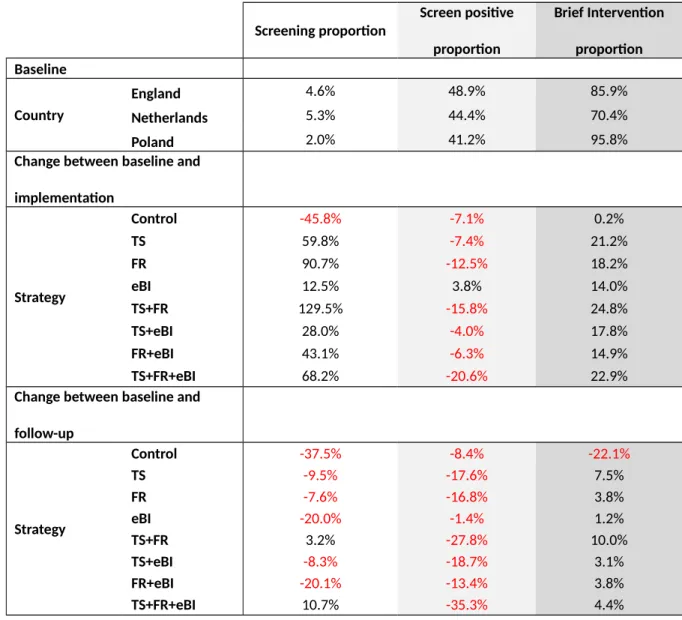
implementation period and at follow-up, as presented in Table 1. See Appendix A for further details
of this analysis. Whilst the trial took place across five countries, versions of the Sheffield Alcohol
Policy Model, used to estimate the long-term costs and effects of the trialled strategies, were only
available for three of these countries: England, Netherlands and Poland. Full details of these models
have previously been published (16,19). The analysis presented here therefore focusses on these
three countries.
TABLE 1 ABOUT HERE
For each country data was also collected on the costs associated with implementing each strategy,
as summarised in Appendix B. Costs specific to organising the trial itself were excluded (e.g. the cost
of printing the tally sheets used to record practitioners’ SBI activity). Finally, full details of the
structure of the financial incentives offered to providers in FR arms of the trial were collected (as
each country set their own incentive structure using the budget allocated within the trial). This data
was used to estimate, for each strategy in each country, the long-term costs of implementation in
primary care at a national level using data on the total number of practitioners, practices and
patients in each country. See Appendix B for full details.
2 Screen positives were defined in Catalonia and England as men and women who scored ≥5 on AUDIT-C and in
Modelling health outcomes
The SBI delivery outcomes collected in the trial were converted into long-term health outcomes, in
terms of Quality-Adjusted Life Years (QALYs) and healthcare costs associated with the treatment of
alcohol-related health conditions, using the Sheffield Alcohol Policy Model (SAPM). SAPM is a causal
epidemiological model which has previously been used to appraise pricing and SBI policies in
England, the Netherlands and Poland (16,19,20) and whose findings have informed the development
of primary care guidelines for the treatment of alcohol problems in the UK and the Netherlands
(21,22). The model synthesises published evidence and country-specific data on current alcohol
consumption, mortality and hospitalisation rates for 48 different alcohol-related health conditions,
primary care usage, healthcare service utilisation costs and health-related quality of life data in order
to estimate the proportion of the total adult population (18+ years) who would receive a brief
intervention over a 10-year time horizon. The model then estimates the resulting changes in alcohol
consumption and subsequent changes in mortality, hospitalisations and healthcare costs. Health
outcomes are reported at a 30-year time horizon in order to account for the time lags which exist
between changes in alcohol consumption and changes in risk of alcohol-related harm (23). Full
methodological details of SAPM have previously been published elsewhere (24,25).
A key challenge in estimating the impact of the trial strategies on SBI delivery over a 10-year period
is that, whilst Training & Support and eBI strategies are essentially ‘one-off’ policies, in the sense
that practitioners are trained or introduced to the eBI tool at the outset and not subsequently
re-trained, Financial Reimbursement requires continuous investment. The follow-up measures are
therefore not directly comparable across all strategies as practices allocated to TS and eBI strategies
were essentially still under implementation conditions (e.g. practitioners could still refer patients to
the eBI tool), whilst those allocated to FR strategies were not under implementation conditions, as
no further payments were made after the 12-week implementation period. In order to overcome
exactly what was implemented in the trial (i.e. FR withdrawn after 12 weeks) and assumes that the
effects observed at follow-up would be sustained in the long term. Second, a ‘full implementation’
analysis models FR payments continuing for the full 10 years and assumes, as observed in previous
SBI studies (e.g. (26)), that the effect of these on provider behaviour is maintained in the long term.
As a sensitivity analysis within the full implementation analysis, we also examine the impact of
assuming that training must be re-delivered every five, or every two, years in order to achieve this
persistence of effect.
In order to incorporate the three SBI delivery measures recorded in the trial into SAPM, two
modifications are required to the country-specific models. First, the probability that any individual
who receives a screen, screens positive is estimated from their alcohol consumption and
demographic characteristics using a logistic regression whose parameters are calibrated to ensure
that the modelled screen positive proportion matches that estimated from the trial data –see
Appendix C for full details. Second, the model was adapted to account for the fact that not all
patients who screen positive actually receive an intervention in practice using data from the trial as
reported in Table 1. Receipt of an intervention is assumed to lead to a 12.3% reduction in mean
alcohol consumption in line with evidence from a Cochrane review on the effectiveness of BIs in
primary care (4). This reduction is assumed to decay linearly back to age-adjusted pre-intervention
consumption levels over the following 7 years as suggested by long-term follow up evidence from a
previous trial (27). Due to the uncertainty in this persistence of effect, we test a more conservative
assumption of 3 years in a sensitivity analysis. It is assumed that no individuals are screened more
than once over the 10-year SBI implementation period.
Health Economic analysis
For each of the three countries (England, Netherlands and Poland), for each of the eight strategies
(control, TS, FR, eBI, TS+FR, TS+eBI, FR+eBI, TS+FR+eBI), we conducted three primary analyses.
over the 9 month trial period. This produces a ‘within-trial’ estimate of the cost per additional BI
delivered over control. Subsequently we present a full long-term cost-utility analysis for each of the
two scenarios (‘trial only’ and ‘full implementation’) from the perspective of the health care system.
Total QALYs accrued in each scenario are estimated from SAPM alongside estimates of the
healthcare costs associated with alcohol. These are combined with the estimated costs of
implementing the eight strategies and the costs associated with actual SBI delivery for each country
to estimate the net cost of each strategy over 30 years. Within each country and scenario, these net
costs and QALY gains are compared to give Incremental Cost-Effectiveness Ratios (ICERs) for every
strategy. These are compared to national effectiveness thresholds to determine the most
cost-effective strategy for each country under each scenario. All costs are converted to 2016 Euros using
OECD Purchasing Power Parities (28) and all costs and health benefits are discounted using
Results
Within-trial analysis
Results from the within-trial analysis in Table 2 show that all strategies are estimated to increase the
numbers of BIs delivered across the population in all countries. TS+FR is the most effective strategy
at increasing BI delivery, although it has one of the highest marginal costs for each additional BI
delivered across all three countries. In contrast, eBI appears to offer the cheapest way to achieve
delivery of additional BIs, although it is among the least effective strategies overall.
TABLE 2 ABOUT HERE
Trial only cost-effectiveness analysis
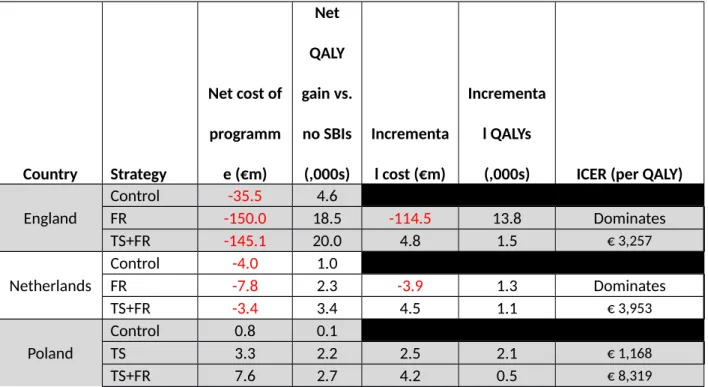
Results from the trial only analysis in Table 3 show that TS+FR is the strategy which produces the
largest health benefits while remaining cost-effective across all three countries. The ICERS of €3,257,
€3,953 and €8,319 in England, the Netherlands and Poland respectively compared to the next-best
alternative are all substantially lower than the respective thresholds of €22,918, €20,000 and
€14,666 below which interventions are generally considered cost-effective. In both England and the
Netherlands the FR strategy dominates control (i.e. it produces greater health benefits while costing
less), although the scale of savings is very different between the two countries (€150m and €7.8m
respectively). Both TS and TS+FR strategies incur a net cost to the healthcare system in Poland, with
the most effective strategy, TS+FR, costing €6.8m over 30 years compared to control. Estimated
health gains under TS+FR are also larger in England, at 15,400 QALYs over 30 years compared to
2,400 in the Netherlands and 2,600 in Poland. Full results for all strategies can be found in Appendix
E.
Full implementation analysis
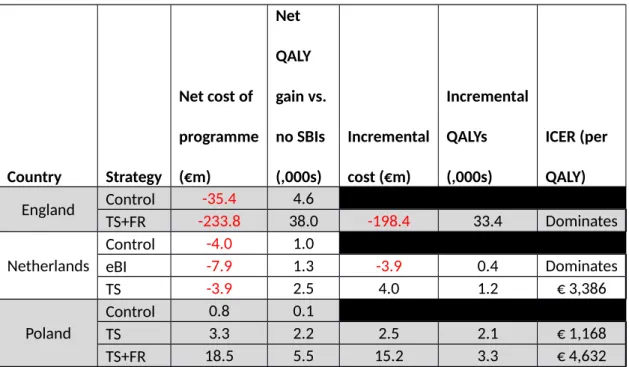
Assuming that the costs and impacts of FR are maintained at implementation levels across the
modelled 10-year implementation period leads to broadly similar results, shown in Table 4. TS+FR is
still the optimal strategy in England and Poland, but the incremental analysis shows that it is no
longer cost-effective in the Netherlands compared to TS alone (ICER €29,952). As for the within-trial
analysis, the optimal strategies are estimated to be cost saving in England and the Netherlands, but
not Poland, and the health gains in England are significantly larger than in the other countries. Full
results for all strategies can be found in Appendix F.
TABLE 4 ABOUT HERE
Sensitivity analyses
In order to investigate the uncertainty in our assumptions of continued effectiveness for strategies
other than FR in the longer-term in the full implementation analysis, we tested the assumption that
training had to be re-delivered every 5 or every 2 years in order to achieve this persistence of effect
(at the same cost as the original training, before discounting). Full results for these alternative
assumptions can be found in Appendix G.
These alternative assumptions lead to significant increases in the costs associated with
implementing all strategies involving Training & Support. For example, the cost over 10 years of
delivering TS in the Netherlands increased from €8.6m to €15.9m with retraining every 5 years and
€36.9m with retraining every 2 years. However, these increased costs made little difference to the
overall cost-effectiveness results and the overall conclusions of the analysis. The only significant
change is that TS ceases to be cost-effective in the Netherlands if re-training is required every 2
Finally, we tested the impact on the trial only analysis of assuming a shorter persistence of effect of
BI receipt on alcohol consumption. Full results for this can be found in Appendix H. As may be
expected the overall cost-effectiveness is reduced for all strategies, however TS+FR remains the
most cost-effective option for both England and the Netherlands, with ICERS of €21,668 and €13,413
respectively. In contrast, this alternative assumption means that TS+FR is no longer estimated to be
cost-effective in Poland, with TS alone offering the most cost-effective strategy with an ICER of
Discussion
The findings of this study highlight that current SBI delivery rates in primary care are extremely low,
while demonstrating that several cost-effective strategies exist to increase these rates. This analysis,
which presents the first available estimates of the cost-effectiveness of strategies to increase these
proportions, consistently shows that Training and Support or Training and Support in combination
with Financial Reimbursement are effective and cost-effective strategies for increasing these delivery
proportions. Modelling using only the trial data suggests that TS+FR is the most cost-effective
strategy in all countries, whilst assuming that increased screening proportions in practices receiving
FR would be maintained if incentives continued to be paid makes TS+FR the optimal strategy in two
of the three modelled countries, with TS alone the best option in the Netherlands. Sensitivity
analyses show that these results are generally robust to more pessimistic assumptions of long-term
effectiveness, although TS+FR may not to be cost-effective in Poland if the duration of effect of BIs is
shorter than we have assumed in our base case. Whilst eBI alone is the least costly way of increasing
BI delivery, and is estimated to be cost-effective versus control, as suggested by studies in other
settings (13,15), this analysis shows that it is dominated by other strategies (i.e. it is less effective
and costs more).
There are a number of limitations to the methods used in this study, including those limitations
inherent to SAPM which have been widely discussed previously (16,17,19,24), for example we do not
model individuals who do not engage with primary care services, or explicitly model individual
trajectories of alcohol consumption across the life course. There are also a number of assumptions
relating to the trial data that should be considered alongside the results of this analysis. These
include assumptions around the ongoing effect on provider behaviour of the eight strategies after
the 6-month follow-up in the trial. We have examined some of these assumptions in sensitivity
analyses and it should be noted that other more pessimistic assumptions of long-term effects would
analyses presented here. As both of these produce similar results, it is unlikely that reduced
long-term effects would alter our conclusions. A further consideration is that the trial did not collect data
on the demographics (or alcohol consumption) of those patients who consulted with, but were not
screened by, participating practitioners. It is therefore difficult to determine whether the increased
proportion of patients screening positive were a consequence of practitioners screening patients
from different population groups which have a higher prevalence of risky drinking behaviour, or
practitioners screening the same number of patients in each population group but with more
successful identification of risky drinkers within each group. We have assumed the latter, but the
impact of this assumption on the model results is unclear, as it will depend on the distribution of
alcohol consumption and alcohol-related harms across the population in each country. We have
used scenario analysis to explore key uncertainties in the model, however we have not been able to
consider joint uncertainty across multiple input parameters, or attempt a full probabilistic analysis of
uncertainty. Finally, as the focus of BI delivery in Europe is generally on early identification of
potentially harmful drinking we have not explicitly modelled referral of patients identified as having
some form of Alcohol Use Disorder to specialist treatment. As treatment itself is highly likely to be
saving (29,30) this exclusion means our estimates are likely to underestimate the true
cost-effectiveness of each strategy.
The finding that SBI programmes themselves are cost-effective has been widely replicated in many
studies across many countries (e.g. (31,32)), however the costs and health benefits of such
programmes between countries are likely to vary significantly (33). This is due to variation in
underlying factors such as alcohol consumption, primary care usage, alcohol-related health and
healthcare system costs as well as population (7). It is therefore perhaps unsurprising that the
findings of this study suggest considerably variation in both costs and benefits of each strategy
between countries, particularly since the trial results have shown there is additional variation
between countries in terms of current screening. In spite of this heterogeneity, several clear patterns
with different healthcare systems and drinking cultures. Across all countries, TS is a relatively
low-cost but effective policy option, while the addition of FR roughly doubles the health benefits at
substantial additional cost. Across all countries, in spite of the relatively low cost of implementation
and delivery of eBI programmes, these were consistently found to be less cost-effective than other
strategies, perhaps related to a lack of familiarity or trust among practitioners of its efficacy (12,34).
Whilst these results provide strong support for training programmes and the introduction of
financial incentives, further research should address the questions of how to design training and
support programmes and financial incentive structures to achieve maximum engagement with
practitioners. One possibility, which could also potentially reduce training costs in the longer term,
may be to embed an SBI component into routine training for primary care practitioners.
Consideration for variation in provider response to different strategies, e.g. if training is more
effective at encouraging practitioners who have not previously been delivering SBIs to start, or
whether the effect is achieved through increasing delivery levels among practitioners who were
already active, would also help in designing more effective, tailored approaches to increasing the
delivery of Brief Interventions. Finally, relatively little is understood about the ways in which
different subgroups of the population may respond to Brief Interventions and whether, as a result,
greater effects on population health can be achieved through targeting interventions at certain
patient groups.
The findings of this study show that providing primary care providers with tailored training and
support, financial incentives and the option to refer patients to an online intervention, either alone
or in combination, are likely to be cost-effective options compared to providing no support or
incentives to practitioners. Policy makers may, however, be mindful of the potential ethical issues
associated with offering financial incentives to healthcare practitioners (35,36). Training and support
and financial incentives together may offer the most cost-effective strategy for increasing delivery of
society, although this finding is sensitive to both the characteristics of the country and also
assumptions around the long-term effects of BIs.
Conflict of Interest
CA has received funding related to commissioned research from Systembolaget and Alko, the
Swedish and Finnish government-owned alcohol retail monopolies. PA has received fees from AB
InBev for public health comment on its goals to reduce the harmful use of alcohol, outside the
submitted work. JL, ER, SP and AB have no interests to declare.
Funding
This work was supported by European Union’s Seventh Framework Program for research,
technological development and demonstration [grant agreement no. 259268]. The views expressed
here reflect only the authors’ and the European Union is not liable for any use that may be made of
the information contained therein.
Key Points
Current provision of Screening and Brief Advice in primary care is low across Europe
Training and Support, Financial Reimbursement and the opportunity to refer patients to an
online tool, and all combinations of these strategies are likely to be cost-effective compared
to current practice
Training and Support in combination with Financial Reimbursement is the most effective
strategy at increasing SBI delivery, but also the most costly and as a result may not be
cost-effective in all countries
Referring patients to an online Brief Intervention is a low-cost way of increasing SBI delivery,
although the scale of increase may be modest and other, more costly options are likely to be
References
1. GBD 2016 Risk Factors Collaborators. Global, regional, and national comparative risk
assessment of 84 behavioural, environmental and occupational, and metabolic risks or
clusters of risks, 1990-2016: a systematic analysis for the Global Burden of Disease Study
2016. Lancet [Internet]. Elsevier; 2017;390(10100):1345–422. Available from:
http://www.ncbi.nlm.nih.gov/pubmed/28919119
2. Miguez-Burbano MJ, Jackson J, Room R, Babor T, Rehm J, Organization WH, et al. Alcohol and
public health. Lancet (London, England) [Internet]. Elsevier; 2005;365(9468):1386–7.
Available from: http://www.ncbi.nlm.nih.gov/pubmed/15836882
3. World Health Organization. Global Strategy to reduce the harmful use of alcohol [Internet].
Geneva; 2010. Available from:
http://www.who.int/substance_abuse/publications/global_strategy_reduce_harmful_use_al
cohol/en/
4. Kaner EFS, Beyer F, Dickinson HO, Pienaar E, Campbell F, Schlesinger C, et al. Effectiveness of
brief alcohol interventions in primary care populations. Cochrane database Syst Rev Online.
Wiley Online Library; 2007;4(2):CD004148.
5. O’Donnell A, Anderson P, Newbury-Birch D, Schulte B, Schmidt C, Reimer J, et al. The impact
of brief alcohol interventions in primary healthcare: a systematic review of reviews. Alcohol
Alcohol. 2013 Nov 13;49(1):66–78.
6. Angus C, Latimer N, Preston L, Li J, Purshouse R. What are the Implications for Policy Makers?
A Systematic Review of the Cost-Effectiveness of Screening and Brief Interventions for
Alcohol Misuse in Primary Care. Front psychiatry [Internet]. 2014 Jan;5(AUG):114. Available
from: http://www.pubmedcentral.nih.gov/articlerender.fcgi?
7. Angus C, Thomas C, Anderson P, Meier PS, Brennan A. Estimating the cost-effectiveness of
brief interventions for heavy drinking in primary health care across Europe. Eur J Public
Health. 2016;
8. Bendtsen P, Anderson P, Wojnar M, Newbury-Birch D, Müssener U, Colom J, et al.
Professional’s Attitudes Do Not Influence Screening and Brief Interventions Rates for
Hazardous and Harmful Drinkers: Results from ODHIN Study. Alcohol Alcohol [Internet].
2015;50(4):agv020-. Available from: http://www.ncbi.nlm.nih.gov/pubmed/25787012
9. Brown J, West R, Angus C, Beard E, Brennan A, Drummond C, et al. Comparison of brief
interventions in primary care on smoking and excessive alcohol consumption: A population
survey in England. Br J Gen Pract [Internet]. British Journal of General Practice; 2016
Jan;66(642):e1–9. Available from: http://www.ncbi.nlm.nih.gov/pubmed/26719481
10. Keurhorst M, van de Glind I, Bitarello do Amaral-Sabadini M, Anderson P, Kaner E,
Newbury-Birch D, et al. Implementation strategies to enhance management of heavy alcohol
consumption in primary health care: a meta-analysis. Addiction [Internet]. 2015
Dec;110(12):1877–900. Available from: http://www.ncbi.nlm.nih.gov/pubmed/26234486
11. Donoghue K, Patton R, Phillips T, Deluca P, Drummond C. The effectiveness of electronic
screening and brief intervention for reducing levels of alcohol consumption: a systematic
review and meta-analysis. J Med Internet Res [Internet]. 2014;16(6):e142. Available from:
http://www.ncbi.nlm.nih.gov/pubmed/24892426
12. Anderson P, Bendtsen P, Spak F, Reynolds J, Drummond C, Segura L, et al. Improving the
delivery of brief interventions for heavy drinking in primary health care: outcome results of
the ODHIN five country cluster randomized factorial trial. Addiction [Internet]. 2016;
Available from: http://doi.wiley.com/10.1111/add.13476
Randomized Controlled Trial of an Internet Based Psychologically Enhanced Intervention for
People with Hazardous Alcohol Consumption. Myer L, editor. PLoS One [Internet]. Public
Library of Science; 2011 Mar 9;6(3):e14740. Available from:
http://dx.plos.org/10.1371/journal.pone.0014740
14. Smit F, Lokkerbol J, Riper H, Majo MC, Boon B, Blankers M. Modeling the cost-effectiveness of
health care systems for alcohol use disorders: How implementation of ehealth interventions
improves cost-effectiveness. J Med Internet Res [Internet]. 2011;13(3):e56. Available from:
http://www.ncbi.nlm.nih.gov/pubmed/21840836
15. Blankers M, Nabitz U, Smit F, Koeter MWJ, Schippers GM. Economic evaluation of
internet-based interventions for harmful alcohol use alongside a pragmatic randomized controlled
trial. J Med Internet Res [Internet]. 2012 Oct 29;14(5):e134. Available from:
http://www.ncbi.nlm.nih.gov/pubmed/23103771
16. Purshouse R, Brennan A, Rafia R, Latimer NR, Archer RJ, Angus CR, et al. Modelling the
cost-effectiveness of alcohol screening and brief interventions in primary care in England. Alcohol
Alcohol. 2013 Sep 25;48(2):180–8.
17. Angus C, Scafato E, Ghirini S, Torbica A, Ferre F, Struzzo P, et al. Cost-effectiveness of a
programme of screening and brief interventions for alcohol in primary care in Italy. BMC Fam
Pract [Internet]. 2014 Jan;15(1):26. Available from:
http://www.biomedcentral.com/1471-2296/15/26
18. Keurhorst MN, Anderson P, Spak F, Bendtsen P, Segura L, Colom J, et al. Implementing
training and support, financial reimbursement, and referral to an internet-based brief advice
program to improve the early identification of hazardous and harmful alcohol consumption in
primary care (ODHIN): study protocol for a cluster rando. Implement Sci. 2013 Jan;8:11.
care interventions (ODHIN): Cost-effectiveness - model report [Internet]. Sheffield; 2013.
Available from:
http://www.odhinproject.eu/resources/documents/doc_download/66-deliverable-3-1-cost-effectiveness-model-report.html
20. Meier PS, Holmes J, Angus C, Ally AK, Meng Y, Brennan A. Estimated Effects of Different
Alcohol Taxation and Price Policies on Health Inequalities: A Mathematical Modelling Study.
Basu S, editor. PLOS Med [Internet]. Public Library of Science; 2016 Feb 23;13(2):e1001963.
Available from:
http://journals.plos.org/plosmedicine/article?id=10.1371/journal.pmed.1001963
21. National Institute of Health and Clinical Excellence (NICE). PH24 Alcohol-use disorders:
preventing harmful drinking [Internet]. 2010. Available from:
www.nice.org.uk/guidance/ph24
22. Nederlands Huisartsen Genoodschap. Problematisch alcoholgebruik [Internet]. 2014.
Available from:
https://www.nhg.org/standaarden/volledig/nhg-standaard-problematisch-alcoholgebruik
23. Holmes J, Meier PS, Booth A, Guo Y, Brennan A. The temporal relationship between per
capita alcohol consumption and harm: a systematic review of time lag specifications in
aggregate time series analyses. Drug Alcohol Depend. 2012 Jun 1;123(1–3):7–14.
24. Purshouse R, Brennan A, Latimer N, Meng Y, Rafia R, Jackson R, et al. Modelling to assess the
effectiveness and cost-effectiveness of public health related strategies and interventions to
reduce alcohol attributable harm in England using the Sheffield Alcohol Policy Model version
2.0. Report to the NICE Public Health Programme Development Group. Sheffield; 2009.
25. Brennan A, Meier P, Purshouse R, Rafia R, Meng Y, Hill-Macmanus D, et al. The Sheffield
26. Hamilton FL, Laverty AA, Gluvajic D, Huckvale K, Car J, Majeed A, et al. Effect of financial
incentives on delivery of alcohol screening and brief intervention (ASBI) in primary care:
longitudinal study. J Public Health (Oxf) [Internet]. 2014 Sep 26;36(3):450–9. Available from:
http://jpubhealth.oxfordjournals.org/content/early/2013/12/26/pubmed.fdt121.full
27. Fleming M, Mundt M, French M, Manwell L, Stauffacher E, Barry K. Brief Physician Advice for
Problem Drinkers: Long-Term Efficacy and Benefit-Cost Analysis. Alcohol Clin Exp Res. 2002
Jan;26(1):36–43.
28. OECD. Purchasing Power Parities (PPPs) Data [Internet]. 2013 [cited 2013 Jul 8]. Available
from: http://www.oecd.org/std/prices-ppp/purchasingpowerparitiespppsdata.htm
29. UKATT Research Team UR. Cost effectiveness of treatment for alcohol problems: findings of
the randomised UK alcohol treatment trial (UKATT). BMJ [Internet]. British Medical Journal
Publishing Group; 2005 Sep 10;331(7516):544. Available from: http://www.ncbi.nlm.nih.gov/
pubmed/16150765
30. Fox C. Final reports from the Drug Treatment Outcomes Research Study (DTORS). Probat J
[Internet]. SAGE PublicationsSage UK: London, England; 2010 Sep 24;57(3):333–6. Available
from: http://journals.sagepub.com/doi/10.1177/02645505100570030908
31. Zur RM, Zaric GS. A Microsimulation Cost-Utility Analysis of Alcohol Screening and Brief
Intervention to Reduce Heavy Alcohol Consumption in Canada. Addiction [Internet]. 2015 Oct
19; Available from: http://www.ncbi.nlm.nih.gov/pubmed/26477518
32. OECD. Tackling Harmful Alcohol Use: Economics and Public Health Policy [Internet]. Sassi F,
editor. OECD Publishing; 2015. Available from:
http://www.oecd-ilibrary.org/social-issues-migration-health/tackling-harmful-alcohol-use_9789264181069-en
alcohol use: a comparative cost-effectiveness analysis. J Stud Alcohol. 2004;65:782–93.
34. Bendtsen P, Müssener U, Karlsson N, López-Pelayo H, Palacio-Vieira J, Colom J, et al.
Implementing referral to an electronic alcohol brief advice website in primary healthcare:
results from the ODHIN implementation trial. BMJ Open [Internet]. British Medical Journal
Publishing Group; 2016 Jun 16;6(6):e010271. Available from:
http://www.ncbi.nlm.nih.gov/pubmed/27311902
35. Kramer G. Payment for performance and the QOF: are we doing the right thing? Br J Gen
Pract [Internet]. Royal College of General Practitioners; 2012 Mar;62(596):e217-9. Available
from: http://www.ncbi.nlm.nih.gov/pubmed/22429440
36. Gravelle H, Sutton M, Ma A. Doctor behaviour under a pay for performance contract: Further
evidence from the Qaulity and Outcomes Framework [Internet]. 2008. Report No.: 034.
Table 1 - Baseline Screening and Brief Intervention rates and the impact on these as estimated from the ODHIN trial
Screening proportion Screen positive proportion Brief Intervention proportion Baseline Country
England 4.6% 48.9% 85.9%
Netherlands 5.3% 44.4% 70.4%
Poland 2.0% 41.2% 95.8%
Change between baseline and
implementation
Strategy
Control -45.8% -7.1% 0.2%
TS 59.8% -7.4% 21.2%
FR 90.7% -12.5% 18.2%
eBI 12.5% 3.8% 14.0%
TS+FR 129.5% -15.8% 24.8%
TS+eBI 28.0% -4.0% 17.8%
FR+eBI 43.1% -6.3% 14.9%
TS+FR+eBI 68.2% -20.6% 22.9%
Change between baseline and
follow-up
Strategy
Control -37.5% -8.4% -22.1%
TS -9.5% -17.6% 7.5%
FR -7.6% -16.8% 3.8%
eBI -20.0% -1.4% 1.2%
TS+FR 3.2% -27.8% 10.0%
TS+eBI -8.3% -18.7% 3.1%
FR+eBI -20.1% -13.4% 3.8%
Table 2 – Estimated additional Brief Interventions delivered and associated costs compared
to control over trial period
Additional BIs delivered Cost per additional BI
England Netherlands Poland England Netherlands Poland
TS 399,247 209,344 72,615 € 38 € 33 € 18
FR 433,430 302,798 103,166 € 40 € 29 € 16
eBI 290,112 202,927 96,203 € 25 € 17 € 5
TS+FR 517,849 451,470 116,390 € 41 € 24 € 19
TS+eBI 266,193 180,936 29,294 € 31 € 21 € 7
FR+eBI 315,354 206,759 12,411 € 27 € 22 € 15
Table 3 – Trial-only analysis results for cost-effective strategies
Country Strategy
Net cost of
programm
e (€m)
Net
QALY
gain vs.
no SBIs
(,000s)
Incrementa
l cost (€m)
Incrementa
l QALYs
(,000s) ICER (per QALY)
England
Control -35.5 4.6
FR -150.0 18.5 -114.5 13.8 Dominates
TS+FR -145.1 20.0 4.8 1.5 € 3,257
Netherlands
Control -4.0 1.0
FR -7.8 2.3 -3.9 1.3 Dominates
TS+FR -3.4 3.4 4.5 1.1 € 3,953
Poland
Control 0.8 0.1
TS 3.3 2.2 2.5 2.1 € 1,168
Table 4 – Full implementation analysis results for cost-effective strategies
Country
Strateg
y
Net cost of
programme
(€m)
Net
QALY
gain vs.
no SBIs
(,000s)
Incremental
cost (€m)
Incremental
QALYs
(,000s)
ICER (per
QALY)
England
Control -35.4 4.6
TS+FR -233.8 38.0 -198.4 33.4 Dominates
Netherland
s
Control -4.0 1.0
eBI -7.9 1.3 -3.9 0.4 Dominates
TS -3.9 2.5 4.0 1.2 € 3,386
Poland
Control 0.8 0.1
TS 3.3 2.2 2.5 2.1 € 1,168