~--~--I-~
""Rand
INTRODUCTION
This is a description of the solving of a payroll problem by the Univac System. Its purpose is to aid the student of electronic data-processing equipment in bridging the gap between his study of the B A C's of a computer code and the visualization of the com-puter's solving a realistic problem. The payroll problem offers an ideal bridge across this gap. The basic problem is familiar to everyone, and includes operations found in most other applications. Although the payroll described was adapted from an actual survey, no attempt has been made to include everything found in the survey in this payroll anatysis. Only those operations basic to the problem itself, or which need description, are included. To re-peat, this is not a description of how a payroll should be done on a
computer, but is a description of how a simplified payroll could
be done.
The unmeasured day-work payroll, one of the many different payroll systems used by industry today, is used as an example. In this system, the employee is paid on the basis of hours in attendance rather than on performance. It is commonly used by heavy indus-tries where the establishment of individual performance standards is not considered feasible. Such standards are essential to in-centive systems. Furthermore, the payroll described here is handled in isolation from individual job-cost accounting. However, summa-ries of payroll data may be produced for selected clock-number groups (departments) as a by-product of the payroll operations. Most payroll departments handle both salaried employees and em-ployees paid by hourly wage. Salaried and hourly rolls would be prepared separately though in similar manner. This discussion is confined to the hourly roll.
In order that some practical orientation may be achieved, equip-ment time estimate~ are in~luded. These figures relate to an
hourly roll of 50,000 employees who are paid weekly.
MASTER EMPLOYEE FILE
The master employee file tape is the basic functional record for all payroll operations. A one-block item is assigned to each employee. It includes the following fields:
FIELD
Badge number Name
Address
Social Security number Hourly rate
Days I absence allowed per year
Number of income-tax exemptions Termination-of-employment key Union dues key (indicates amount) Blue Cross key (indicates amount) Bond account number
Size-of-bond key (indicates amount) Weekly bond deduction amount
Cumulative total of bond deductions Number of days classified absence
Weeks 1-13 (of a quarter)
Number of days personal absence Weeks 1-13 (of a quarter)
Number of days medical absence Weeks 1-13 (of a quarter) ,
Number of hours laid off Weeks 1-13 (of a quarter)
Total hours worked by week Weeks 1-13
Gross wages earned by week Weeks 1-13
Quarter-to-date total FICA-taxable earnings
Quarter-to-date total FICA tax Year-to-date total
FICA-DIGITS ALLOWED
8 20 9 3 2 1 1 1 6 1 4 .) 39 78 78 6
taxable earnings 6
Year-to-date total FICA tax 4
Year-to-date gross earnings 8
Year-to-date income tax withheld 8
Available for modification of procedure 318
Total Digits 720
Note that the master file item includes basic information and certain subtotals which are maintained for quarterly and annual reports.
The master file items appear in order of the employees' eight-digit badge numbers. All items of input data pertaining to individual employees are identified and ordered by badge numbers. The first three digits of the badge number constitute the employee's clock or department number, and are changed when he is transferred from one department to another. The remaining five digits are
permanent-ly assigned to the individual employee.
The various payroll operations are performed in daily, weekly, quarterly and annual cycles. These are discussed separately, and additional details of the payroll system itself are supplied.
[, _ _ RU_N..---I_-.I
,-[
RUN III
L _ _ _ _ _ _ _ _
4
---,
I
I
TO SALARIED
ROLL
COMP-UTATION.
I
I
I
THE DAILY CYCLE
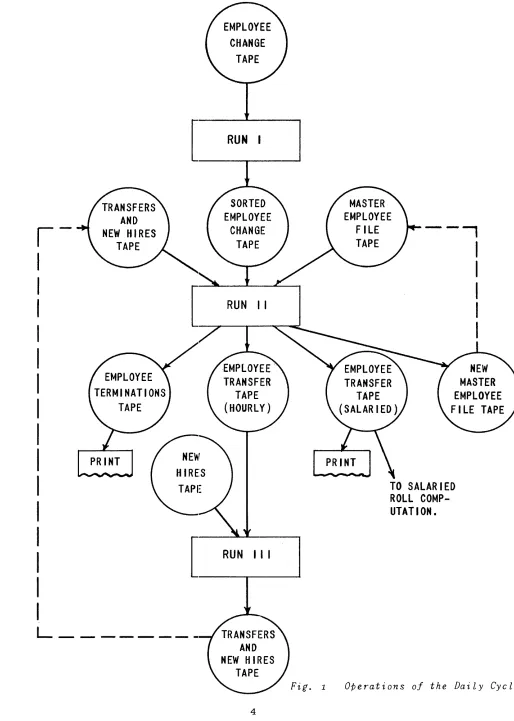
The Daily Cycle, Fig. 1, is designed to effect changes in the master
file. Changes fall into five categories:
1. Transfers from one department to another, the employee
remaining on the hourly roll.
2. Transfers that place the employee on the salaried roll. 3. New hires.
4. Termination of employment.
5. Substitutions of new information (e.g., a wage raise, change of address, etc.)
Each change, except new hires, is represented by a two-word item, shown in Fig. 2. The first word contains the employee's
eight-'D
efPt
+:$,I
L '" i /-. ,,:! ...,--I I I I I I I I
BADGE NUMBER
CHANGE KEY
NEW INFORMATION
I I I I I I I I I I I
Fi~. 2 Layout of Chan~e Items
digit badge number and a four-digit key indicating the type of change (the field within the master-file item). The second word contains whatever new information is required (e.g., a new three-digit clock number in the case of a transfer). Most changes can
be effected by a single change item on the employee change tape, but a change of address would require three (of the 48 digits allotted, 20 are for employee name and 28 for his address), since
each change item can affect at most 12 digits.
Run I is a conventional two-word sort of the items recorded on the employee change tape, ordering them by the entire first word (badge number and type-of-change key). The sorted employee change tape is the output of Run I.
>
=
"cxt<
ERROR
the ith item of the master employee fi le
M~: the badge number of Mi
the jth item of the transfers and new hires tape
the badge number of Hj the pth item of the sorted
employee change tape
the badge number of Cp
the type of change key of Cp the new master file
the employee transfer tape (hourly)
the employee transfer tape (salaried)
TF: the employee termination tape
W: a master file item in working storage
Q1;}-@-1_C_H_A_NG_E_WB ____
H
W~TT ~
G)-5}0J---'~~
CHANGE WBH
W - Ts
~
f:::\ _
D----'~ ~I
EFFECT SUBSTITUTIONI
~
~'<Y---1L...-
___
ON_W _ _ _--,~
Fi~. 3 Daily Cycle:
Flow Chart for Run II
master file item must be repositioned in the master file. Run II changes the badge number of the selected master item and writes it on the employee transfer tape (hourly) at the same time deleting
it from the new master file tape.
Run III merges and sorts these items with the master file items of newly hired employees. The output of Run III is the transfers and new hires tape which will be merged with the master file during Run lIon the succeeding day.
File maintenance is the basic operation of Run II and is worth a close inspection. Fig. 3 is an abbreviated flow chart of this run. It omits most of the procedure concerned with input and output. End-of-tape sentinels and end-of-block considerations are not shown. The counter operations:
II
+
I--+. iare meant to imply the input and output operations needed to make the next item available.
The first portion of Run II (operations between
<D
and®
accom-plishes an item-by-item merge of the previous day's transfers andnew hires tape with the master file tape. As each item is se-lected by the merge, its badge number, WB, is compared with the badge number of the current sorted employee change tape item, C~.' If they are the same, the change is effected through the setting of the index k of the variable connector
a:
al. If the chang-e is a transfer wi thin the hourly roll, k is set to 1. This leads to the setting of the index of
variable connector
e
to 1, and thence to®.
®
to®
changes the badge number of the master file i tern in working storage, WB, and writes the item on the employee transfer tape (hourly), TT.a2. If the change is a transfer to the salaried roll, k is set to 2. This also sets the index of ~ to 1, and
pro-ceeds to
®. ®
to®
changes the badge number of the master file item and writes the item on the employee change tape (salaried), T8• This tape is used in the daily cycle of the salaried roll operations in a run analogous to Run III.a3. If the change is a termination of employment, k is set to
3. This results in the setting of the index of S to 2,
and then leads to
®. ®
to®
inserts a one-digi t termination key in the master file item, and writes the master file item on both the new master file tape, TM, and the employee termination tape, TFo The termination tape is later printed, providing information that permits paying the employee within twenty-four hours ofa~. Any other changes are simple substitutions. In these cases, k is set to 4, setting
S
to 2 and proceeding to(j). (j)
to®
effects the substi tution on the recorded file item.The sequence from
®
to f3 permi ts making more than one change, where required, according to the setting of the index ofS.
Notice that termination and substitutions lead, through S, to@ ,
in order that the master file item may be written on the new master file tape. Transfers lead directly through f3 to@ ,
th us de-leting the item from the new master file. From@,
the vari-able connector y selects either a new master file item or a new i tern from the transfers and new hires tape (depending on the opera-tions inQ)) ,and recommences the run with the new item.If more than one change i tern applies to an employee, a sequencing of change items may be necessary. For example, if an employee's hourly rate is to be changed at the same time that he is trans-ferred, the pay change must be effected before his master file item is written on the employee transfer tape. The first digit of the type-of-change key is the key to this sequence. Since Run I sorts the change items according to both badge number and type-of-change key, these items are sequenced in the required order.
The box labeled "error" is entered when there is a mismatch of input items. This would result from some incorrect manual opera-tion, either in the recording on tape of change or new hire items, or an operator's error.
The equipment time estimates for the daily cycle are:
Uni typer: Verifier: Univac:
High-Speed Printer:
Run I 3 hours 3 hours
4 minntes
Run II
1 2/3 hrs. 6 minutes
Run III 8 hours 8 hours 5 minutes
Assumptions: 150 new hires, 150 terminations, 200 transfers, and 600 other changes daily.
THE WEEKLY CYCLE
The weekly cycle, Fig. 4, is designed to compute the payroll, to produce related weekly reports, and to bring up to date the sub-totals in the master file i tern that are used in the quarterly and annual cycles. Three types of input data are used:
1. Payroll adjustment tape 2. Clock card tape
3. Master employee file
RUN IV
RUN V
RUN VI
RUN VII
FROM
DAI LY
CYCLE
TO
DAILY
CYCLE
Payroll adjustments include bonuses, deductions for merchandise, pay advances, etc. Payroll adjustments are typed onto the payroll
adjustment tape, in the form of two-word items. Fig. 5 illustrates
I I I I I I I I I r
BADGE
~lUMBERADJUSTMENT KEY
.
.
.
.
.
AMOUNT OF ADJUSTMENT
I I I I I I I I I I I
Fi~. 5 Layout of Payroll Adjustment Items
the layout of these payroll adjustment items. The first word con-tains the employee' s bad~~e number and a four-digi t key indicating the type of adjustment. The second word contains the amount of the adjustment.
Run IV is a conventional two-word sort that orders the payroll ad-justment tape items by badge number. The sorted items form the sorted payroll adjustment tape.
The clock-card items contain weekly time totals which are supplied by the timekeepin'4 department. There is at least one clock-card item for each emJ>'toyee. Every clock-card item consists of two words, with the employeells badge number occupying the first eight digit-positions of the Jirst word. Clock-card items may be of two types:
1. If the employee has worked a standard forty-hour week on
straight time, a one-digit, non-zero key 'in the ninth digit-position of the first word indicates his shift. No further information is needed.
2. If the employee has not worked a standard forty-hour week,
time totals in several categories may be necessary. These include four possible categories of absence, and the total of hours worked on straight time and on overtime for each of three shifts. All totals for absences appear in assigned locations in the employee's first clock-card item, shown in Fig. 6a. The ninth digit in the first word of the first item is zero, to indicate a non-standard work week.
There may be as many as six totals repr'esenting hours worked. Each total will appear in a six-digit field. The first digit in each field will indicate the shift worked, and whether straight time or overtime is involved. One such field will occupy the first six
I I I I I I I
,
,
BADGE NUMBER
S*
HOURS LAID OFF
.
I II
K
HOURS WORKED, kth SHIFT
MEDICAL ABSENCE PERSONAL ABS~NCE CLASSIFIED ABSEN CEI I I I- I I
S (standard-work-week key) can be 0 for non-standard work-week, or
1, 2, or 3 for 4o-hour week on shift 1 , 2 , or 3*
K (pay-category key) can be 1, 2, 3, 4, 5, or 6 (three shifts, three
overtime categories). Absences l~sted to the tenth of a day.
K
Fi~. 6a Clock-card: Layout of First Item
digit-positions of the second word of the first clock-card item. Two such fields will occupy the second word of each trailer item, as shown in Fig. 6b.
I I I I I
,
I I IBADGE NUMBER
ZI
.
HOURS WORKED, kth SHIFT
KHOURS WORKED, kth SHIFT
I I I I I I I I
Z in 9th digit-position ensures that Run V will place the trailer item following the first clock-card item.
Fi~. 6b Clock-card: Layout of Trailer Item
Run V is a conventional two-word sort that orders the items on the clock-card tape by the entire first word. The output of this run is the ,sorted clock-card tape.
Run VI uses the sorted payroll adjustment tape, the sorted clock-card tape, and the master file to produce the weekly payroll tape and a new master file. The weekly payroll tape contains all the information required on paychecks and the related weekly reports. It consists of a series of ten-word items. The new master file contains the up-to-date summaries.
*
The principal purpose of the standard-work-week key is to eliminate unneces-sary typing in preparing the clock-card tape. But it also permits Run VI to by-pass lengthier computations when overtime and absences are not involved.DEFINITION OF SYMBOLS USED IN DIAGRAMS OF RUN VI
Mi Represents the ith master file item. To refer to a particular unit of information within that item, superscripts are used. For example, the symbol M~ stands for the badge number of ith master file item. The superscripts are interpreted as follows:
Personal Information -B Badge number N Name and address
o
Number of income tax exemptions T Termination-of-employment key A Days absence allowedY Bond account number.
Computational -R
U
X
YO
YB ¥S.
Hourly rate of pay Union dues key Blue Cross key
Weekly bond deduction Bond size key
Quarterly Summaries
-we
Number of days classified absence by weekWP Number of days personal absence by week WM Number of days medical absence by week
WL
Number of hours laid off absence by weekWW
Total hours worked by weekWG
Total gross wages earned by weekQF
Quarterly total of FICA-taxable earningsQS
Quarterly total of FICA tax paidAnnual Summaries
-YF Year-to-date FICA earnings
YS Year-to-date FICA tax
YG
Year-to-date gross earningsYI Year-to-date income tax Other Summaries
-YA Cumu la t i ve total of bond deductions
CLOCK-CARD ITEN
c .
J Stands for the jth clock-card item. The superscripts referring
to fields within Cj are: Badge number
Standard work week key B S K L WK M P C
Pay category of time worked Hours laid off
Hours worked on Kth shift (Note: since prOVISIon is made to represent two shifts on each trailer clock-card item, their pay category is Kl or K2 and hours WKl or WK 2 respectively.) Hours medical absence
Hours personal absence Days' classified absence
Pay Adjustment Item
Am Represents the mth payroll adjustment item. The following superscripts are defined:
B
Badge numberTA
Type-of-adjustment (on net or gross pay) key. 2 Amount of adjustmentPayroll I tern
Represents the kth payroll item. The fields making up this item are defined in the flow charts of computer Run VI, but are listed here for convenience:
B Badge number
N
Name and address G Gross payMP Medical pay
NA
Adjustment on net pay~ This variable superscript stands for storage of pay adjustment information
in Pk
SS
FICA taxIT Income tax
YO
Bond deductionU
Union dues deductionX
Blue Cross deductionNP Net pay
Y Bond account number
YB Bond size key
13
Use: 1, 1, 1 1 1 1 1 1 1 1 2 2,
1, 3
2 2
Since Run VI is the most important of all the payroll runs, it deserves close inspection. The normal path of computation is from connector
Q)
to connector@ ..
STANDARD WEEK
The first two operations serve to match the master file item with its appropriate clock-card item, and then to determine whether a standard work-week applies. The al ternati ves labelled "error" occur whenever a master-file item of a non-terminated employee has
no clock-card item, or vice-versa.
@
to@
calculates gross pay, and brings to date the weekly work summary in the master file, for standard-work-week employees.@
to(j])
calculates gross pay for one shift of non-standard work.MEDICAL
PAY
PER SON AL LEAVE PAY
~ leads to the calculation of medical and personal absences~ and summarizes this and the gross pay data in the master file. Before pay is authorized for either absence, a check is made against the amount of absence allowed for the employee. Medical pay is kept separate from gross at this time, since it is not FICA-taxable.
PAY ADJUSTMENTS
5
®
to@)
checks whether ~ddi tional clock-card items pert ain to the employee.®
to®
determines whether or not an adj ustment item is present for this employee, and, if so, makes this adjust-ment on net or gross as indicated by the type-of-adjustadjust-ment key.The adjustment information is stored in the payroll item so as to provide the employee with a visible record.
FICA
COMPUTATION
@
to®
determines the necessi ty for FICA computations. If the year-to-date FICA-taxable earnings are less than $4200, a FICA tax is computed, and the appropriate quarterly and annual summaries are recorded. The calculation of the tax is designed to tax no more than $84, irrespective of multiplication roundoffs.TAXABLE
GRO SS P'AY
INCOME TAX CALCULATION
®
to®
adds medical pay if any, to gross pay, determines withholding tax, and records the appropriate summaries.WEEKLY BOND DEDUCTION
DERIVE BOND SIZE E FROM
M rB
I
UNION DUES DEDUCTIONS
BLUE CROSS DEDUCTION
FROM M~ pX
k
QD
to {} makes deductions for bonds, union dues, and Blue Cross. If the accumulated bond deductions exceed the bond size, the employee is credited with the purchase of abond; the bond-size key and account number are entered into the payroll item.DETERM I H AT I ON OF NET PAY
WR I TE ADJUSTED MASTER FILE ITEM
q)
to ~ obtains the net pay by subtracting the various deduc-tions from the gross pay and adding the net pay adj ustment, if any.IT
K+
I~K
I
implies that the payroll item just computed is written in the weekly payroll tape.
@
toCD
wri tes the complete adj usted file item on the new master file tape, and selects the next master file item.Run VII uses the weekly payroll tape to prepare four output tapes for printing. Referring to the column labeled "use" in the defini-tion of symbols for the payroll item, (see pageI3), those fields marked
CD
are reproduced in the paycheck and payroll register tapes, those fields marked®
appear in the bond listing tape, and those marked®
are in the check register tape. Two type-ins are necessary at the start of Run V1I: the date and the initial paycheck serial number. The run supplies the date to each paycheck, and generates successive serial numbers to appear on checks and on the check register. If desired, weekly summary reports may be prepared showing totals by department and by shift. Run V may produce time totals and Run VII may produce pay totals. Equipment time estimates for the weekly cycle are:Unityper: Verifier: Univac:
High-Speed Printer:
Run IV 10 hours 10 hours 9 minutes
Run V 70 hours 70 hours
2~ hours
Run VI
Lt hours
(Assumpt ions: 3,000 payroll adj ustmen ts weekly. )
THE QUARTERLY AND ANNUAL CYCLES
Run VII
1 2/3 hrs. 17 hours
The quarterly cycle, illustrated in Fig. 8, is required to prepare the FICA report for the Federal government. One line on this re--port is devoted to each employee, listing his name, his Social Security number, his quarterly taxable earnings, and the FICA tax withheld. The master file is the sole input for Run VIII, the only run needed for the quarterly cycle. In addition to the FICA re-port, an earnings record and an attendance record are produced. The earnings record lists for each employee h is name, badge number, total hours worked and total wages earned for each of the thirteen weeks in the quarter. The attendance record lists for each em-ployee his name, badge number, total days worked and total time
absent (in each of the four categories) for each of the thirteen weeks in the quarter.
Equipment time estimates for the quarterly cycle are: Univac:
High-Speed Printer:
RUN VIII
1 2/3 hours
30 hours
Fig'. 7 OPerations of the Quarterly Cycle
The annual cycle, shown in Fig. 8, is required to prepare the individual employee's
W-2
forms. The only in-1)ut is the master file from which RunIX derives the employee's name, ad-dress, badge number, social security number, exemvtions, total gross pay, total FICA earnings, total income tax and FICA tax wi thheld for the year. Equipment time estimates for the annual cycle are:
Univac:
High-Speed Printer:
1 2/3 hours
16 hours
Fi~. 8
19