Abstract
Over the last fifteen years we have seen green infrastructure planning develop and refine its focus. The observable shift is from a focus on
what
, towhy
and more recently,how
we deliver green infrastructure.
In the urban context, there is often an emphasis on the capacity ofstrategic
level projects to deliver the plurality of functions and benefits we have come to expect from our towns and cities. However, PhD research conducted at the University of Liverpool brings focus to the potential for small-scale green infrastructure sites to respond to green infrastructure needs. As such a new concept ofcommunity
-scale green infrastructure is introduced to describe activity at the local-level. With reference to examples from research in The Mersey Forest Community Forest area of the Northwest of England, community-scale green infrastructure is understood as a network of groups and projects who aim to deliver locally relevant functions and benefits to respond effectively to changing social and environmental needs.Keywords
Green infrastructure, community engagement, social capital, civic engagement, urban environmental stewardship.
1 2
3
4 5 6 7 8 9 10 11 12 13 14 15
16
17
18
19 20
Introduction
Broadly speaking current academic thinking allows analysis of small-scale voluntary activity within green infrastructure through two main lenses. Firstly, small-scale green infrastructure sites may be analysed in terms of social outcomes. For example, the dynamics between people and place, and the recent popularity of community gardens as a site of social capacity building (Firth
et al.
, 2011; Johnson, 2012; Zoellner et al, 2012). These studies primarily measure outcomes utilising qualitative social indicators such as personal wellbeing, confidence and self-esteem; and collective pride and cohesion at the local level. This approach is typified by Firthet al.’
s study which found that access to a community garden encouraged ‘a greater sense of pride and motivation to make aesthetic changes’ to small-scale sites of green infrastructure (2011: 557). Secondly, relating to the physical and ecological attributes of green infrastructure, small-scale voluntary activity may be analysed in terms of the contribution it makes to ecological networks, and specifically how it improves instances of ‘interconnectivity’ between sites of green infrastructure (Benedict and McMahon, 2006) and ‘continuity’ across ‘hubs’ (larger areas) and ‘sites’ (smaller areas) (Ahern, 2007: 241). As such, small-scale green infrastructure becomes a significant mechanism for delivering multi-functional benefits attributed to green infrastructure more generally, and supports Natural England’s understanding of a ‘multi-scale’ approach to delivery (2009: 9). This paper is principally concerned with the first focus and presents new insights into the role of small-scale green infrastructure plays in contributing social outcomes.Defining community-scale green infrastructure
In order to define the specifics of community-scale green infrastructure, it is first necessary to establish the parameters by which green infrastructure in general is understood. It may be reasoned that, over the past fifteen years, the advocacy argument for delivering multi-functional green and blue spaces through the framework of green infrastructure planning has largely been won (Benedict & McMahon, 2006; National Research Council, 2004; Mazza
et al.,
2011). Attention has consequently turned to the effectiveness of existing and emergent mechanisms which successfully deliverfunction
/s in response to an area of identified green infrastructureneed,
with the aim of deliveringbenefit/s
to human or non-human actors (The Mersey Forest, 2014: 8). In the context of implementation, particularly 2223
24 25 26 27 28 29 30 31 32 33 34 35 36 37 38 39 40 41 42 43
44 45
at the European level of green infrastructure guidance,
function
andservice
are used interchangeably. Examples of function within the environmental service vernacular include carbon storage and sequestration, water purification, air quality, and production of food, fibre and fuel (EC Green Infrastructure Studies, 2012). In simple terms,function
refers to the questions of ‘how’
in green infrastructure.In contrast,
benefit
refers to the question of‘what’
and ‘why’;
and details the quality and quantity of value transferred to a range of beneficiaries, for example ‘increased yield attributable to soil quality’, ‘perception of the attractiveness of an area for workers/investors’, or ‘number of visitors per year’ (EC, 2012; The Mersey Forest, 2012, 2014). Green infrastructureneed
relates to both function and benefit, such as density of tree cover in a neighbourhood in need of urban cooling due to high seasonal temperatures; and describes the ‘quality, distance and quantity’ of a site of green infrastructure (CABE Space, 2009). In addition,need
may also refer to addressing the exclusion of a certain social group/s to these benefits, and therefore highlights the role green infrastructure provision can play in enhancing quality of life through sustainable land management approaches (The Mersey Forest, 2013: 29). As a consequence, when analysing the contribution of green infrastructure elements within a specific geo-spatial context, it is possible to measurefunction, benefit
orneed
or a combination of all three.Beyond the variables of
function, benefit
andneed,
green infrastructure can be defined by itsscale.
The Landscape Institute (2013) emphasises the importance of the landscape-scale when considering how to integrate green infrastructure within urban developments. Similarly, Natural England and Land Use Consultants (2009) iterate the role of green infrastructure in creating a framework for delivering large scale environmental improvements across urban and rural contexts, highlighting the role of ‘ecological networks’ and ‘green corridors’ which intersect local authority boundaries necessitating joined up approaches to management (2009: 8). Within the same guidance document, Natural England references green infrastructure as a ‘strategic, multi-scale’ approach to ‘land conservation and land use planning’ (2009: 9). Furthermore, the strategic role of green infrastructure in creating both a conceptual and practical framework for sustainable land management is evidenced in the emergent number of green infrastructure frameworks for both urban and rural areas (e.g. Liverpool City Region and Warrington, 2013 and 2014; North East Wales, Cheshire and Wirral, 2010; Greater Manchester, 2008; South East, 2009). As such, it would be feasible to interpret coalescence of different stakeholder groups around a shared understanding that for maximal function/s and benefit/s, the preferred scale of 5556 57 58 59
60 61 62 63 64 65 66 67 68 69 70 71 72
green infrastructure delivery and enhancement is the landscape-scale or the
strategic
scale.
Working at such astrategic-
scale has recently been typified by large scale projects with a landscape scale or technology focus, exemplified by projects such as ‘Wirral Waters’ (Peel Land & Property, 2015) in Merseyside which utilises green infrastructure as the context for attracting investment to redevelop an assemblage of brownfield sites. This type of green infrastructure delivery may be thought of as exemplifying the ‘business case for green infrastructure’ (Alker, 2015), reflecting the potential to converge green infrastructure development with significant capital investment. However, the last five years has also seen a rise in academic literature on the multi-functionality and associated benefits within small-scale projects, such as community gardens (Firth et al, 2011; Johnson, 2012; Zoellner et al, 2012).One key function that is often highlighted in the context of small-scale projects is the capacity they hold to satisfy the planning system’s statutory requirements for community participation and engagement by providing opportunities for co-production (Bovaird, 2007). Another socioeconomic function of small-scale projects highlighted within the academic literature is the impact of community gardens and allotments when conceptualised as a network or ‘system’ (Feenstra, 1997: 28) or an ‘agrifood landscape’ (Allen
et al.
, 2003: 61). Thus, the small-scale has the potential to complement the social and economic functions attributed to strategic-scale projects, and as such this paper seeks to define the role of thesmall
-scale orcommunity-scale
in green infrastructure planning as a complementary scale of green infrastructure delivery, management and maintenance.Exploring the community-scale in green infrastructure planning
Aim
Building on a previous study by Jerome (2012) that indicates there are different categories of groups who are engaged in the voluntary activity of the creation, management and maintenance of small-scale green spaces at the local level, the aim of this study is to define in more detail the characteristics of community-scale green infrastructure activity. To this end, the following two main research questions will be addressed in this paper:
What role do voluntary groups play in creating, managing and maintaining green space at the local level?
What types of voluntary group are involved in creating, managing and maintaining green space at the local level?
89 90 91 92 93 94 95 96 97 98 99
100 101 102 103 104 105 106 107 108 109
110
111 112
113 114 115 116 117
Theoretical background
It is significant to bring focus to the capacity of the
community
scale to deliverstrategic
value and respond to need as for many years investment in green infrastructure has been defined by the contribution of public sector agencies including: local authorities, The Environment Agency, British Waterways, The Forestry Commission and Natural England (Leeds City Region Green Infrastructure Strategy, 2010). Furthermore, by contributing a richer understanding of activity at the community-scale, we can extend the current academic literature which has tended towards a narrower picture of activity at the local level: one further minimised because of an assumption towards homogeneity of practice, with a predominant focus on community gardens and food-growing initiatives (Firth et al, 2011; Johnson, 2012; Kingsley and Townsend, 2006; Wakefield et al, 2007; Zoellner et al, 2012).Methods
Case description and sampling
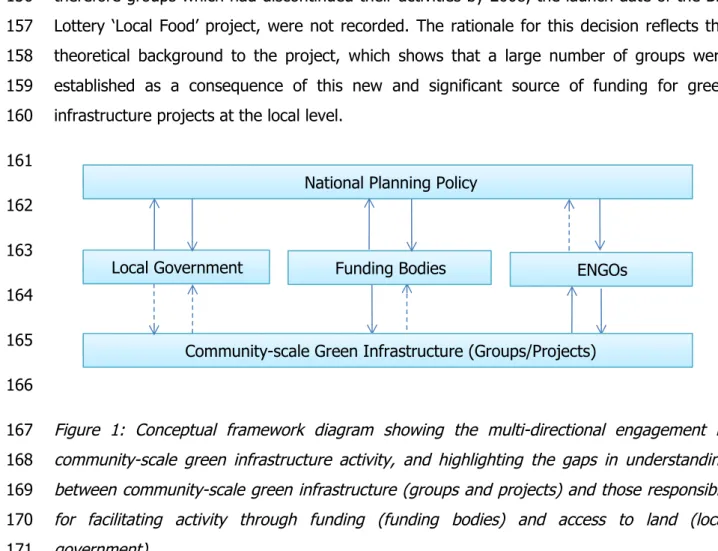
This paper draws on PhD research conducted at the University of Liverpool (2011-2015) to contribute to understanding of green infrastructure activity at the community-scale. The broader thesis is concerned with understanding the key factors and forces at play in the longevity and resilience of community-scale green infrastructure activity. This paper is reporting on one aspect of the research study, which is defining community-scale green infrastructure, both in terms of its activity focus and observable approaches to governance (Figure 1). For this aspect, an initial desk-based search of green infrastructure activity was conducted, recording both current and historical groups and projects. This involved drawing on data available from formal sources including project websites and funder websites such as the Big Lottery ‘Local Food’ archives, plus various online social networks, including ‘Project Dirt’ and Facebook. The sample area for data collection was the geographical boundary of The Mersey Forest, an official partner of the research study. The Mersey Forest covers a 500 square mile area in the Northwest of England. It spans urban, urban fringe and rural land use (The Mersey Forest Plan, 2014); hence it was possible to explore activity being led by individuals and community groups working in a variety of settings such as street-scale plots, local parks and woodlands. Groups and projects who currently or historically had taken an active role in designing, delivering, managing and maintaining green infrastructure were recorded. It was necessary to limit the sample size however; 122
123
124 125 126 127 128 129 130 131 132 133 134
135
136 137
therefore groups which had discontinued their activities by 2008, the launch date of the Big Lottery ‘Local Food’ project, were not recorded. The rationale for this decision reflects the theoretical background to the project, which shows that a large number of groups were established as a consequence of this new and significant source of funding for green infrastructure projects at the local level.
Figure 1:
Conceptual framework diagram showing the multi-directional engagement in
community-scale green infrastructure activity, and highlighting the gaps in understanding
between community-scale green infrastructure (groups and projects) and those responsible
for facilitating activity through funding (funding bodies) and access to land (local
government).
Exploring the community-scale green infrastructure in planning
Results and Discussion
The desk-search returned a population of 300 groups and projects, which were active beyond 2008, or were still currently active in The Mersey forest area. By organising the groups and projects thematically, it was possible to create a typology of four distinct types:
formal group (active), formal group (inactive), informal group
andproject.
Across the four types it was possible to identify a range of commonbenefits
, including conservation and education, health and wellbeing, food growing, social cohesion, and regeneration. These benefits were observable in varying degrees across the types; and there was often a noticeable correlation between activity focus and benefit/s. This finding builds on Firthet
al.
’s (2011) typology of small-scale green infrastructure which prioritises discussion of variations across groups and projects primarily byactivity
. In contrast to,
the typologyNational Planning Policy
Local Government ENGOs
Community-scale Green Infrastructure (Groups/Projects) Funding Bodies
156 157 158 159 160
161
162
163
164
165
166
167 168 169 170 171
172 173
174 175
presented here broadens the thematic variation to include categories of
constitutional
difference
andorganisational understanding
. The typology therefore describes groups and projects according to activity focus and associated benefits: plus adopted approaches to governance as a key characteristic affecting experiences and outcomes of voluntary groups at the local level.The theme of governance was primarily utilised to create the four distinct types of community-scale green infrastructure. Firstly,
Groups
distinguish green infrastructure activities which are wholly managed by community volunteers. There are two main types of group:Formal groups
describe groups who have a formal constitution, such as Friends groups; andInformal groups
comprise groups who manage and maintain sites of green infrastructure without formal governance structures and systems in place. Secondly, the typology recordsProjects
which define green infrastructure activity which is supported by volunteer involvement, but is ultimately managed by employees within an organisation whose aims and objectives are not directly related to green infrastructure. An example of aproject
is a community garden facility developed by a public health organisation to promote wellbeing benefits associated with access to green space.By defining voluntary green infrastructure activity at the local level within The Mersey Forest area this study contributes to the research literature by extending a picture of diversity at the community-scale. The typology created shows that many different green infrastructure
functions
andbenefits
are being delivered in response to perceivedneed
at the local level. Further, community-scale green infrastructure activity shows a picture of community engagement which is multi-directional:
encompassing engagement with a piece of land (over a sustained period of time); engagement with other members of a (placed-based/interest-based) community; and engagement between an organisation and its participants. In this context, engagement is understood in terms ofactive
engagement, notpassive
, drawing on the work of planning theorists Healey (1992) and Campbell (2000), and in particular Arnstein’s conceptual framework of active ‘participation’ (1969). As such, further analysis of community-scale green infrastructure activity, in particular the role of group governance, may also contribute to discussions of citizenship, social responsibility and ‘delegated power’ (Arnstein, 1969).Another area of planning theory which community-scale green infrastructure may contribute understanding is the literature which focuses on discussions of place. In the context of this study, ‘place’ may refer to ‘a sense of place’ (Carter, 2001); ‘place attachment’ (Green and 186
187 188 189 190
191 192 193 194 195 196 197 198 199 200 201
202 203 204 205 206 207 208 209 210 211 212 213 214 215
White, 2007); or a feeling of
connection, belonging,
orownership
for/with a physical space outside of home and work (Oldenburg, 2000). As such, community-scale
can also describe a green infrastructure group or project which has formed around a community with shared or common interests, where a site is created or adopted in response to a green infrastructure need relating to a specific cultural, ethnic, religious or ‘other’ person-centred need. In this sense, motivational factors (Measham and Barnett, 2008; Seamanet al.
, 2010) may beenvironmental
- to improve the functionality of their own local area; orsocial
– in response to physical or mental health needs, social exclusion or isolation, or other social needs.By observing activity within The Mersey Forest, it was possible to create an understanding of small-scale green infrastructure which draws on both these perspectives, highlighting the dual function of social dynamics and place-based factors. One way in which ‘connectivity’ (Benedict and McMahon, 2006) and ‘continuity’ (Ahern, 2007: 241) across sites of activity was observed was through the creation of ‘informal networks’ (Littlewood and Thomas, 2010) between individual groups and projects. These networks, which are both spatial and social in character, facilitate opportunities for informal knowledge sharing and resource distribution. As such,
community-scale
green infrastructure describes activity which is both socioeconomic and physical (spatial) in its focus and it is precisely the opportunities created for ‘larger than site’ influence through informal networks of activity which provides the underpinning for the creation of an evolving definition of community-scale green infrastructure activity.For example, the Friends of Everton Park group in North Liverpool averted a significant impact on their capacity after an arson incident in 2014 by being able to draw on an informal network of green infrastructure focused community groups in Liverpool to organise a donation of plants and tools. This may be understood conceptually as an example of
bonding
social capital (Putnam, 2000; Firthet al.
, 2011), describing peer-to-peer partnership across place-based or common-interest networks, or ‘collective action’ (Bovaird, 2007) which in this case proved to be a key influence on their green infrastructure objectives and retention of volunteers. In another example, The Friends of Furey Wood in Cheshire had a track record of ten years providing volunteering opportunities. However, after the departure of two key volunteers, their activities discontinued. There were two other volunteer-led woodland groups within 2 km of the Furey Wood site, and although the three groups shared common-interests including approaches to working and support from the same local authority Countryside Ranger, for the Friends of Furey Wood the role of informal networks 219220 221 222 223 224 225 226
227 228 229 230 231 232 233 234 235 236 237 238
on capacity to adapt to change proved less influential then the role of individuals within the group.
The experience of these two groups helps to advance a theoretical understanding of community-scale green infrastructure activity within a local and place-based or relationship-centred context. Moreover, although there is extensive literature highlighting the importance and challenges associated with community engagement in planning for the built environment in both academic (Arnstein, 1969; Healey, 1992; Campbell, 2000) and practitioner (CABE Space, 2009) literature: less attention is shown to the role of community management and maintenance of green infrastructure, with research focusing on participation (Mayer
et al.
, 2012), volunteer motivation (Measham and Barnett, 2008; Seamanet al.,
2010) and ‘use and enjoyment of the outdoors’ (Natural England, 2015). Therefore, by exploring the ways in which individuals and communities organise themselves and create opportunities for the co-production (Bovaird, 2007) of green infrastructure function/s and benefit/s at the community-scale: we can strengthen the conceptual argument that small-scale green infrastructure sites provide opportunities foractive
engagement in creation or enhancement of the local environment.Conclusion
Community-scale green infrastructure describes a complementary scale of green infrastructure planning and delivery: an ‘informal network’ of
micro
activity to supplement the strategic level interventions which characterise activity at the landscape scale. Community-scale green infrastructure activity is delivered through the efforts of voluntary groups and volunteers. Its green infrastructurefunction/s
andbenefit/s
relate to particular communities of place or interest, and can therefore be understood as responding equally to geographicneed
and socialneed
. The research being conducted in The Mersey Forest area of Northwest England indicates a plurality of actors and activities delivering green infrastructure at the local level; challenging the picture of homogeneity in the recent academic literature evaluating the social impact of community gardening and food-growing initiatives (Firthet al.,
2011).The overall picture of the community scale is thus one of vibrancy and creativity, characterised by groups and projects of various size, membership, and activity focus. In addition, groups and projects are shown to differ in their governance structures, ranging 252
253
254 255 256 257 258 259 260 261 262 263 264 265 266 267
268 269
270 271 272 273 274 275 276 277 278 279 280
281
from legally constituted groups to ad hoc informal groups. Through the utilisation of ‘informal networks’ and social capital, groups and projects develop a more responsive strategy to adapt outputs and outcomes, multi-functionality and associated green infrastructure benefits, to changing local needs, both social and environmental. A more detailed analysis of the factors and forces affecting resilience at a group or project level would be beneficial to substantiate this argument and establish whether the
community
scale
at which these voluntary enterprises are engaged in green infrastructure planning may in fact be the source of their strength.Bibliography
Ahern, J. (2007) Green infrastructure for cities: The spatial dimension. In
Cities of the
future: Towards integrated sustainable water and landscape management
, edited by V. Novotny and P. Brown. London: IWA Publishing.Alker, J. (2015) ‘We need to shout louder about the business case for green infrastructure. In
Business Green
[online] Available at http://www.businessgreen.com/bg/opinion/2397381/ we-need-to-shout-louder-about-the-business-case-for-green-infrastructure. Accessed 19 October 2015.Allen, P., FitzSimmons, M., Goodman, M., and Warner, K. (2003). Shifting plates in the agrifood landscape: the tectonics of alternative agrifood initiatives in California,
Journal of
Rural Studies,
Vol 19, January 2003, pp.61-75.Arnstein, S. R
., (1969) A Ladder of Citizen Participation,JAIP
, Vol. 35, No. 4, July1969
, pp. 216-224.Benedict, M.A. and McMahon, E. (2006)
Green infrastructure [electronic book]: linking
landscapes and communities / Mark A. Benedict, Edward T. McMahon.
Washington, DC: Island Press.Bovaird, T. (2007) Beyond Engagement and Participation: User and Community Coproduction of Public Services.
Public administration review,
67(5), pp. 846-860.CABE Space (2009)
Open Space Strategies: Best practice guidance.
[online] Available at:https://www.designcouncil.org.uk/sites/default/files/asset/document/open-space-strategies.pdf . Accessed 22 July 2015.
Campbell, H. and Marshall, R. (2000) Public Involvement and Planning: Looking beyond the One to the Many.
International Planning Studies ,
5(3), pp321-344.285 286 287 288 289 290 291 292
293
294 295
296 297 298
299
300 301 302 303
304
305 306 307
308 309
310 311 312
313 314
315 316 317
EC European Commission (2012) Green Infrastructure Studies,
Green Infrastructure
Implementation and Efficiency
[online] Available at:http://ec.europa.eu/environment/nature/ecosystems/studies.htm#implementation. Accessed 22 March 2015.
Feenstra, G.W. (1997) Local food systems and sustainable communities.
American Journal of
Alternative Agriculture,
Vol 12, pp. 28-36).Firth, C., Maye, D. and Pearson, D., (2011). Developing 'community' in community gardens.
Local Environment,
16(6), pp. 555-568.Green, A.E. and White, R.J. (2007)
Attachment to Place – Social networks, mobility and the
prospects of young people.
York, York Publishing Services Ltd.Healey, P., (1992) A Planner's Day: Knowledge and Action in Communicative Practice.
Journal of the American Planning Association,
58(1), pp. 9-20.Jerome (2012) MRes Dissertation:
Common Ground: Enabling Social Capital through
Community Gardening. An Exploratory Case Study for Liverpool’s Green Infrastructure
Professionals.
Liverpool: Department of Geography and Planning, University of Liverpool.Johnson, S., 2012. Reconceptualising gardening to promote inclusive education for
sustainable development.
International Journal of Inclusive Education,
16(5), pp. 581-596.Kingsley, J. and Townsend, M., (2006) ‘Dig In’ to Social Capital: Community Gardens as Mechanisms for Growing Urban Social Connectedness.
Urban Policy & Research,
24(4), pp. 525-537.Leeds City Region Partnership (2010)
Leeds City Region Green Infrastructure Strategy.
Oxford: LDA Design. Accessed 21 July 2015.Mazza, L.et al.
2011.Green Infrastructure
Implementation and Efficiency
. Final report for the European Commission, DG Environment on Contract ENV.B.2/SER/2010/0059. Institute for European Environmental Policy, Brussels and London.Littlewood, S. and Thomas, K. (2010) A European programme for skills to deliver sustainable communities: Recent steps towards developing a discourse.
European Planning Studies
, 18(3) 467-484.Measham T.G. and Barnett, G.B. (2008) Environmental volunteering: motivations, modes and outcomes
Australian Geographer
39(4) pp. 537-552. [online] Available at:http://dx.doi.org/10.1080/00049180802419237 Accessed 23 July 2015.
The Mersey Forest (2012)
Liverpool Green Infrastructure Strategy.
[online] Available at: http://www.ginw.co.uk/liverpool/Technical_Document.pdf. Accessed 22 July 2015.The Mersey Forest (2013)
Liverpool City Region and Warrington Green Infrastructure
Framework.
[online] Available at:http://www.merseyforest.org.uk/our-work/green-infrastructure/liverpool-city-region-green-infrastructure-framework/. Accessed 19 September 2014.
320 321 322 323
324 325
326 327
328 329
330 331
332 333 334
335 336
337 338 339
340 341 342 343 344
345 346 347
348 349 350
351 352
The Mersey Forest (2014)
The Mersey Forest Plan
[online] Available at:http://www.merseyforest.org.uk/about-the-mersey-forest/plan/ Accessed 28 October 2015.
National Research Council (2004) Valuing ecosystem services: toward better environmental decision-making. Washington, D.C.: National Academies Press.
Natural England and Land Use Consultants (2009)
Experiencing Landscapes: capturing the
cultural services and experiential qualities of landscape.
Available athttp://www.naturalengland.co.uk Accessed 19 October 2015.
Oldenburg, R. (2000)
Celebrating the third place: Inspiring stories about the “Great Good
Places” at the heart of our communities.
New York: Marlowe & Company.Peel Land and Holdings [online] (2015) Webiste for
Wirral Waters
Available at: http://www.wirralwaters.co.uk/. Acecssed 19 October 2015.Putnam, R., 2000
Bowling alone: the collapse and revival of American community.
New York: Simon Shuster.Seaman, P.J., Jones, R. and Ellaway, A., (2010). It's not just about the park, it's about integration too: why people choose to use or not use urban greenspaces.
International
Journal of Behavioral Nutrition & Physical Activity,
7, pp. 78-86.Wakefield, S., Yeudall, F., Taron, C., Reynolds, J. and Skinner, A., (2007) Growing urban health: Community gardening in South-East Toronto.
Health promotion international,
22(2), pp. 92-101.Zoellner, J., Zanko, A., Price, B., Bonner, J. and Hill, J.L., (2012) Exploring community gardens in a health disparate population: findings from a mixed methods pilot study.
Progress in Community Health Partnerships: Research, Education and Action,
6(2), pp. 153-165.357 358
359 360
361 362 363
364 365
366 367
368 369
370 371 372
373 374 375
376 377 378 379