Volume 2007, Article ID 51269,8pages doi:10.1155/2007/51269
Research Article
Iterative Reconfigurable Tree Search Detection
of MIMO Systems
Wu Zheng, Wentao Song, Hanwen Luo, and Xingzhao Liu
Department of Electronic Engineering, Shanghai Jiaotong University, Shanghai 200030, China
Received 30 May 2005; Revised 5 January 2006; Accepted 30 April 2006
Recommended by Xiadong Wang
This paper is concerned with reduced-complexity detection, referred to as iterative reconfigurable tree search (IRTS) detection, with application in iterative receivers for multiple-input multiple-output (MIMO) systems. Instead of the optimum maximum a posteriori probability detector, which performs brute force search over all possible transmitted symbol vectors, the new scheme evaluates only the symbol vectors that contribute significantly to the soft output of the detector. The IRTS algorithm is facilitated by carrying out the search on a reconfigurable tree, constructed by computing the reliabilities of symbols based on minimum mean-square error (MMSE) criterion and reordering the symbols according to their reliabilities. Results from computer simula-tions are presented, which proves the good performance of IRTS algorithm over a quasistatic Rayleigh channel even for relatively small list sizes.
Copyright © 2007 Wu Zheng et al. This is an open access article distributed under the Creative Commons Attribution License, which permits unrestricted use, distribution, and reproduction in any medium, provided the original work is properly cited.
1. INTRODUCTION
A multiple-input multiple-output (MIMO) technology, de-ploying multiple transmit and receive antennas, is most likely to be the dominant solution to meet the requirement of rapid data flow in future wireless communication systems [1,2]. It makes full use of random fade and multipath prop-agation to improve transmit rate greatly without increasing bandwidth and transmit power. To approach MIMO chan-nel capacity, chanchan-nel code is usually required to provide re-dundancy to guard against burst fading, interference, and noise.
It is advantageous to apply iterative receivers with space-time bit interleaved coded modulation (ST-BICM) tech-niques in view of performance and computational complex-ity [3–6]. By applying “turbo processing” principle, the it-erative receiver is divided into two stages: MIMO detec-tor and channel decoder. These two stages iteratively ex-change extrinsic information learned from one to the other until the receiver converges. The design of low-complexity MIMO detector to eliminate interference between layers to-tally is the main challenge. Maximum a posteriori (MAP) algorithm is the optimal in a sense of the least bit error rate (BER) from the detector output, which performs an exhaustive search over the complete set of all the possible
Constellation mapper
s H w
y
MIMO detector
LD(x) LE(x) +
x
Π
Interleaver
v Channel
encoder
u
Binary source
Π 1
Deinterleaver
LA(x)
Π
Interleaver
LA(v) Channel decoder
LA(u)
LE(v)
+ LD(v)
LD(u) Hard decision
Binary sink
+ +
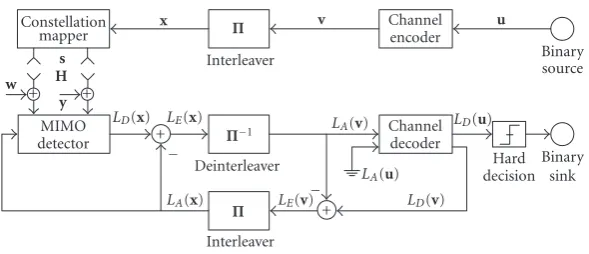
Figure1: Block diagram of the coded MIMO system with iterative receiver.
a reduced search space to be selected by means of the M -algorithm [12].
This paper presents an iterative reconfigurable tree search (IRTS) algorithm based on the ITS scheme. By reconfiguring the tree structure according to the symbol reliability infor-mation, the new algorithm can further decrease the number of sequences in the search space and attain the better bit error performance with lower complexity.
2. SYSTEM MODEL AND ITERATIVE RECEIVER
Consider the MIMO system withNttransmit andNrreceive antennas. AQ×1 vector of symbols,s=[s1,s2,. . .,sQ]∈SQ,
is encoded by ST encoder into theNt×TST blockC, where the superscriptTindicates transpose,Sdenotes the constella-tion with 2Mc(Mc≥1) possible signal points,Tis the num-ber of symbol periods in each block. The symbol transmit rate of the ST code isQ/T symbols per channel use (pcu). LetYbeNr×Treceived signal matrix, then it can be written as
Y=HC+W, (1)
whereHisNr×Nt channel matrix, known perfectly to the
receiver, whose entries are assumed to be independent and identically distributed zero-mean complex Gaussian random variables with a common variance 0.5 per real dimension, to remain constant within each block and to change indepdently from one block to the next (i.e., quasistatic). The en-tries ofNr×Tnoise matrixWare assumed to be independent samples of zero-mean complex Gaussian random variables with a common varianceσ2per real dimension.
To describe the decoding problem conveniently, lety = vec(Y),w = vec(W), where vec(·) denotes stacking all the columns of matrix into one column, (1) can be rewritten as
y=IT⊗HcT1,cT2,. . .,cTTT+w, (2)
where ⊗ denotes the Kronecker matrix product, cn (n = 1, 2,. . .,T) is thenth column ofC. In this paper we only con-sider vertical Bell labs layered ST (V-BLAST) multiplexer [7];
other ST block codes can be easily extended. In the case of V-BLASTQ=NtandT=1, (2) can be represented compactly as
y=Hs+w. (3)
Figure 1illustrates a block diagram of the coded MIMO system employing ST-BICM and iterative receiver. The re-ceiver follows the structure that was first proposed in [13] for code division multiple access (CDMA) systems and later applied to MIMO systems [3–6]. At the transmitter, binary information bit sequenceu is encoded into the sequencev by the predetermined error correction code; coded sequence vis bit-interleaved by a pseudorandom permuterΠto gen-eratex; based on constellationS, the interleaved sequencex is mapped to symbol vectorss, and then sent by multiple an-tennas. At the receiver, the transmitted signals are received on Nrreceive antennas, and the received signal vectorsyare fed
to the MIMO detector. The optimum decoder is maximum-likelihood (ML) decoder, which has an exponential compu-tational complexity increasing with the length of information bit sequence and does not lend itself to a feasible decoding method.
Channel encoder and ST constellation mapper are sepa-rated by an interleaver, which forms a structure of a serially concatenated code: channel code as outer code and ST map-per as inner code [3–6]. Based on iterative “turbo processing” principle, the concatenated code can be decoded using a low-complexity iterative method. The optimal decoding problem is divided into two stages: MIMO detector (inner module) and channel decoder (outer module). Soft-input soft-output (SISO) algorithm is adopted at each stage and soft infor-mation is exchanged between the two stages. AssumeLD(·), LA(·), andLE(·) denote log-likelihood ratio (LLR) of the a
posteriori information, the priori information and the ex-trinsic information, respectively, the decoding process can be generalized as follows.
(1) Inner module computesLE(x), conditional ony and LA(x).LE(x) is deinterleaved to yield
which is fed into outer module as the a priori informa-tion ofv.
(2) Outer module processes LA(v) based on the con-straints imposed by channel code to yieldLE(v) and LD(u).LE(v) is interleaved to generate
LA(x)=ΠLE(v), (5)
which is passed to inner module as a priori informa-tion.
The above operations (1) and (2) are repeated until pre-defined terminal condition is satisfied. At the end of itera-tive process the estimation ofuis obtained by hard-deciding LD(u), thus
u=sgnLD(u). (6)
3. ST MAP DETECTOR AND ITS ALGORITHM
At the transmitter, the use of interleaver makes the bits within x statistically independent. Based on MAP detector the ex-trinsic information of the coded bits, expressed as a log-likelihood ratio [6], can be computed by
LExqk|y=ln x∈X
+1 qkp
y|x·exp1/2·xT·LA(x)
x∈X−1 qk p
y|x·exp1/2·xT·LA(x)
LD(xqk|y)
−ln p
xqk=+1
pxqk= −1
LA(xqk)
,
(7)
wherexqk denotes thekth bit mapped onto the symbolsq,
X±1
qk = x | xqk = ±1},X+1qk andX−qk1are sets of all possible
bit sequencexwithxqk=+1 andxqk= −1, respectively. The likelihood function p(y | x) can be deduced from (3), we have
py|x=py|s=map(x)=exp
−1/2σ2y−Hs2
2πσ2Nr , (8)
y−Hs2=(s−s)HHHH(s−s)+yHI−HHHH−1
HHy, (9)
wheres = [s1,s2,. . .,sNt]T = (HHH)−1HHy is the uncon-strained ML solution, and the superscriptHdenotes Hermi-tian transpose. The second term of the right-hand side of (9) is independent ofsand can be omitted from the metric. For
HHHis nonnegative definite matrix, it can produceLHLby Cholesky factorization, whereLisNt×Nt lower triangular
matrix. The first term of the right-hand side of (9) can be written as
(s−s)HHHH(s−s)=Nt
q=1
lqqsq−sq+ q−1
p=1
lqpsp−sp 2 . (10) By defining
μ(s)= −σ12
Nt
q=1
lqqsq−sq+ q−1
p=1
lqpsp−sp 2 + Nt
q=1
Mc
k=1
xqkLAxqk,
(11)
the metric can be computed in a symbol-by-symbol fashion, starting with the first symbols1and proceeding tosNt, by ex-ploiting the following relations:
μ1= −
1 σ2l11
s1−s1 2
+
Mc
k=1
x1kLA
x1k
,
μq=μq−1−σ12
lqqsq−sq+ q−1
p=1
lqpsp−sp 2 + Mc
k=1
xqkLAxqk, 2≤q≤Nt,
μ(s)=μNt.
(12)
A symbol vector s consists of Nt symbols and can uniquely be represented by a path through tree structure with depthNt, having a single symbol on each branch and 2Mc branches out of each node. A sequence of symbols s1,s2,. . .,sqand a metricμq is associated with each path of
the tree, where q ≤ Nt denotes the symbol depth of path.
Each symbol vector scorresponds to a path with depth Nt and has a metricμ(s)=μNt. The computational complexity of such an optimum detector is exponential withNtMc.
After having obtained the M candidate symbol se-quences, denoted by the set L, and also using max-log ap-proximation [6], (7) can be written as
LExqk|y=12
max
x∈L∩X+1 qk,s=map(x)
μ(s)− max
x∈L∩X−1 qk,s=map(x)
μ(s)
−LAxqk.
(13)
M-algorithm only considers a fraction of all possible paths and the setLis not guaranteed to contain the bestM candidates, but the probability that it does increases with sig-nal noise ratio. Moreover, all bit sequences inLmight end up having the same binary value at some positions especially whenMis small. In such a case, (13) cannot be evaluated be-cause eitherL∩X+1qk orL∩Xqk−1is empty andLE(xqk |y) is assigned a positive or negative clipping value. The optimized value in [11],±3, is used in the simulations ofSection 5.
4. IRTS ALGORITHM
The reconfigurable trellis (tree) search algorithm has been employed in channel decoders [14,15]. It achieves near-ML performance with low complexity. The key idea is to arrange symbol positions according to different reliabilities of sym-bols. During the search process in the previously mentioned ITS algorithm, the number of branches is decreased by ex-ploring paths that are most likely to be part of the maximum-likelihood path (MLP), while discarding those paths that are unlikely to belong to the MLP as early in the search as pos-sible. Few branches are needed to be explored and a reduced search algorithm can stop any further exploration of a path relatively early in the search without losing the MLP, if the influence of unexplored branch metrics on the rank order of the path metrics are insignificant. The order is only deter-mined at the first iteration and a reconfigurable tree structure is constructed according to the order; during the following it-erations, the detection process is based on the reconfigurable tree structure.
Letsk(k =1, 2,. . .,Nt) be the desired signal, (3) can be denoted as [3]
y=hksk+Hksk+w, (14)
where hk is thekth column of H, Hk = [h1,h2,. . .,hk−1,
hk+1,. . .,hNt], andsk=[s1,s2,. . .,sk−1,sk+1,. . .,sNt]T. By us-ing a linear filter zk, anNr×1 column vector, the decision statistic of thekth substream is
rk=zHky. (15)
According to (14), (15) can be rewritten as
rk=zHkhksk+zHkHksk+zHkw, (16)
where the three terms on the right-hand side of (16) are de-sired response obtained by the linear filter, coantenna inter-ference and phase-rotated noise, respectively. The weights of the linear filter should be optimized. Based on MMSE crite-ria,zkis the vector such that the mean-squared error between rkandskis the minimum:
zk=arg min
(zk)
Esk−zHky2
, (17)
whereE denotes the expectation andzkcan be computed as [3,16]
zHk =hHkHHH+ 2σ2I
Nr −1
. (18)
The estimation of transmitted symbol at thekth antenna,sk, can be achieved by quantizingrk. The reliability of symbol can be computed and denoted by log-likelihood ratio
Lsk=ln p
rk|sk sk=skp
rk|sk, (19)
wherep{rk |skis the conditional probability density
func-tion ofrkgivensk. Here we assume that each element ofzHkw still obeys the Gaussian distribution and has the same vari-anceσ2, and we have [17]
prk|sk∝exp
−
distrk,sk2 2·σ2
, (20)
where dist(rk,sk) denotes the Euclidean distance betweenrk
andsk. Using max-log approximation, (19) can be simplified as
Lsk=ln exp
−distrk,sk2
sk=skexp
−distrk,sk2
≈−distrk,sk−max sk=sk
−distrk,sk. (21)
Example 1. The following example with the Nt = Nr =
4QPSK-modulated MIMO system illustrates the procedure.
The system is given by
H= ⎡ ⎢ ⎢ ⎢ ⎣
0.0910 +j0.8047 −0.1856−j0.2338 0.0080−j0.3864 −0.6999−j0.6040 0.4642−j0.4838 −0.8578−j0.5965 −0.4562−j0.5987 0.9472−j0.8495 0.8258−j0.9135 −0.9330 +j0.3520 0.5697−j0.1742 0.2047−j0.0848 −0.3257−j0.0516 0.6585 +j1.0525 0.1638 +j0.4688 1.0458−j0.0462
⎤ ⎥ ⎥ ⎥
⎦. (22)
Table1: Results of reliability metrics based on MMSE criterion.
k rk sk Lsk
1 0.6924−j0.2594 1−j 1.0376 2 0.2722 +j0.2224 1 +j 0.8896 3 −0.3132−j0.4420 −1−j 1.2528 4 −0.1043−j0.5477 −1−j 0.1899
Assume that the noise varianceσ2 =2.0047, and the
re-ceived symbol vector is
y=[−0.0672 +j0.6564,−1.1688−j0.9705,
−3.8602−j2.2125, 0.0822−j1.6471]T.
(23)
According to (15) and (18),rk (k = 1, 2, 3, 4) can be com-puted and written as a column vector
r=[0.6924−j0.2594, 0.2722 +j0.2224,
−0.3132−j0.4420,−0.1043−j0.5477]T. (24)
By quantizing rk and using (21),sk andL(sk) can be
com-puted and are listed inTable 1.
According to the computed reliability metrics, the search sequence can be arranged ask = 3, 1, 2, and 4. Observing (21), we can find that if real and imaginary components ofrk
are separated, the reliability metric by the exact computation is the tradeoffbetween the two components; while the reli-ability metric by the max-log approximation computation is mainly decided by the unreliable one between real and imagi-nary components. In both cases the higher reliability compo-nent is influenced by the lower one. The example also proves such a result.
For QPSK or QAM modulations because of the inde-pendence between real and imaginary components of each constellation symbol, the real and imaginary components can be processed separately. By defining y=[y1R,y2R,. . .,yNrR,y1I,y2I,. . .,yNrI]T,s=[s1R,s2R,. . .,
sNtR,s1I,s2I,. . .,sNtI]T,w=[w1R,w2R,. . .,wNrR,w1I,w2I,. . .,
wNrI]T, and H =
real(H) −imag(H) imag(H) real(H)
, where real(·) and
imag(·) indicate the real and imaginary components of a complex matrix, respectively, (3) can be written as
y=Hs+w. (25)
Using (25) in IRTS algorithm, since the real and imag-inary components can be separated, the order for the de-tection of the real and imaginary components can be deter-mined separately. Based on their respective reliability met-rics, the performance of the algorithm can be further im-proved.
5. COMPLEXITY ANALYSIS AND SIMULATION RESULTS
In the section of complexity analyses, complexity orders es-timation of MMSE detection, LSD, exact MAP detection is provided, and then the number of basic operations for ex-act MAP detection, ITS detection, and IRTS detection is counted. Complexity analysis of the detectors is based on an iteration of the detection/decoding loops. The matrix in-version performed by the MMSE-based detector constructs the bulk of the total complexity, whose complexity isO(N3
r)
[4]. The complexity of the LSD scheme is dependent on the noise. There exist different viewpoints for the complexity of sphere decoder. References [10,18] indicate that the expected complexity of sphere decoder is subjected to polynomial de-pendence onNt, that is,O(Nt3) when SNR is high, and the complexity is predicted as exponential when SNR is low. Ref-erence [19] indicates that the complexity of sphere decoder is exponential and the rate of the exponential function de-pends on the SNR. It is quite small for high SNR. As to the exact MAP detection, the total number of symbol vectors needed to be processed is 2Nt·Mcand has the complexity order ofO(2Nt·Mc).
Table2: Operation counts for ITS, IRTS, and exact MAP detection, per symbol period (NtMcbits).
1st iteration Each of the following iterations ITS, additions M·2Mc2N2
t + 4Nt+NtMc−1 M·2Mc2Nt2+ 4Nt+NtMc−1 ITS, multiplications M·2Mc2N2
t + 5Nt M·2Mc2Nt2+ 5Nt
IRTS, additions 8N 2
rNt+ 4Nr3−6Nr2+ 2NrNt+ 2Nr−2Nt M·2Mc2N2
t + 4Nt+NtMc−1 +4Nt2Mc+M·2Mc2Nt2+ 4Nt+NtMc−1
IRTS, multiplications 8Nr2Nt+ 4Nr3+ 4NrNt+ 4Nt M·2Mc2N2 t + 5Nt +2Nt2Mc+M·2Mc2Nt2+ 5Nt
Exact MAP, additions 2NtMc4NrNt+ 2Nr+NtMc−1 2NtMc4NrNt+ 2Nr+NtMc−1
Exact MAP, multiplications 2NtMc4NrNt+ 2Nr 2NtMc4NrNt+ 2Nr
100 10 1 10 2 10 3 10 4 10 5 10 6
BER
1 1.5 2 2.5 3 3.5
Eb/N0(dB) MMSE
LSDL=64 ITSM=16
IRTSM=16 complex IRTSM=16 real Exact MAP
Figure2: Bit error performance of the 4×4 ST-BICM MIMO sys-tem.
The numbers of floating-point additions and multiplications involved in ITS detection, IRTS detection, and exact MAP detection of theNtMccode bits transmitted during a single symbol period are listed inTable 2.
Table 2shows that the complexity of the ITS detection is O(M2McNt2), and IRTS detection only introduces the addi-tional complexity ofO(N3
r) for the first iteration, which may
be ignored.
In the simulations, the channel code is a parallel concate-nated (turbo) code with rateR=1/2, whose constituent con-volutional codes both have memory 2, with feedback poly-nomial Gr(D) = 1 +D+D2 and feedforward polynomial
Gf(D)=1 +D2. Frames of 1024 information bits are fed to
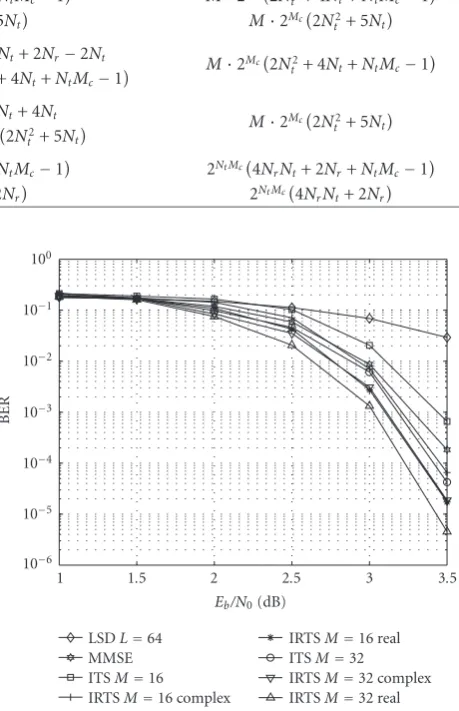
the channel encoder and interleaver, QPSK modulated and subsequently transmitted over a quasistatic fading channel. There are eight iterations over MIMO detector/turbo de-coder loop, and four iterations within turbo dede-coder. All the interleavers are pseudorandom, and no attempt was made to optimize their design. Figures2 and3 show the perfor-mance of iterative detection and decoding forNt =Nr =4
100 10 1 10 2 10 3 10 4 10 5 10 6
BER
1 1.5 2 2.5 3 3.5
Eb/N0(dB) LSDL=64
MMSE ITSM=16
IRTSM=16 complex
IRTSM=16 real ITSM=32
IRTSM=32 complex IRTSM=32 real
Figure3: Bit error performance of the 8×8 ST-BICM MIMO sys-tem.
andNt = Nr = 8 transmit/receive antennas, respectively. For IRTS detection discussed inSection 5, the performance of the following two cases are given: the case with separating real and imaginary components, denoted as “IRTS Real,” and the case without separating real and imaginary components, denoted as “IRTS Complex.”
For the 4×4 MIMO system, exact MAP detection is performed, which computes soft a posteriori value based on all the 256 symbol vectors. Performance of IRTS detection withM =16, which is better than that of MMSE detection, LSD and ITS detection, is shown to have achieved near exact MAP performance. At BER = 10−4, “IRTS Real” detection
has achieved more than 0.3 dB coding gains over ITS detec-tion. For the 8×8 MIMO system, the exhaustive search space is composed of 216symbol vectors. Because of the relatively
detection withM=16 even performs better than ITS detec-tion withM=32.
The simulation results have also demonstrated the per-formance improvement by separating real and imaginary components. For the 4×4 MIMO system,Figure 2shows that about 0.2 dB gain has been achieved at BER=10−5. For the
8×8 MIMO system,Figure 3shows that the performance of “IRTS Real” detection withM=16 even equals that of “IRTS Complex” detection withM=32.
6. CONCLUSIONS
This paper has proposed a novel reduced-complexity detec-tion scheme for iterative ST-BICM MIMO receivers, named iterative reconfigurable tree search detection. An important improvement of this scheme is using the reliability metrics computed by MMSE criterion to order the transmitted sym-bols, constructing a reconfigurable tree structure and apply-ingM-algorithm to the reconfigurable tree. The IRTS detec-tion scheme, whose complexity per bit is almost linear in the number of transmit antennas, offers the possibility of trad-ing offlower complexity for improved performance. And it has been demonstrated that such a scheme is capable of ap-proaching MAP performance at considerably reduced com-plexity.
We have focused primarily on the reduced-complexity detection schemes. Some possible ways that we have not con-sidered to improve performance include optimizing the de-sign of interleaver to have a good minimum distance and im-proving constellation shaping [6], and so forth.
ACKNOWLEDGMENTS
The work was supported by the National Natural Science Foundation of China (No. 60332030, 60572157) and the Na-tional High Technology Research & Development of China (No. 2003AA123310).
REFERENCES
[1] G. J. Foschini and M. J. Gans, “On limits of wireless commu-nications in a fading environment when using multiple an-tennas,”Wireless Personal Communications, vol. 6, no. 3, pp. 311–335, 1998.
[2] E. Telatar, “Capacity of multi-antenna Gaussian channels,” Eu-ropean Transactions on Telecommunications, vol. 10, no. 6, pp. 585–595, 1999.
[3] M. Sellathurai and S. Haykin, “TURBO-BLAST for wireless communications: theory and experiments,”IEEE Transactions on Signal Processing, vol. 50, no. 10, pp. 2538–2546, 2002. [4] S. Haykin, M. Sellathurai, Y. L. C. De Jong, and T. J. Willink,
“Turbo-MIMO for wireless communications,”IEEE Commu-nications Magazine, vol. 42, no. 10, pp. 48–53, 2004.
[5] A. Stefanov and T. M. Duman, “Turbo-coded modulation for systems with transmit and receive antenna diversity over block fading channels: system model, decoding approaches,
and practical considerations,”IEEE Journal on Selected Areas in Communications, vol. 19, no. 5, pp. 958–968, 2001. [6] B. M. Hochwald and S. Ten Brink, “Achieving near-capacity on
a multiple-antenna channel,”IEEE Transactions on Communi-cations, vol. 51, no. 3, pp. 389–399, 2003.
[7] G. J. Foschini, “Layered space-time architecture for wireless communication in a fading environment when using multi-element antennas,”Bell Labs Technical Journal, vol. 1, no. 2, pp. 41–59, 1996.
[8] H. Zhu, Z. Shi, and B. Farhang-Boroujeny, “MIMO detection using Markov chain Monte Carlo techniques for near-capacity performance,” inProceedings of IEEE International Conference on Acoustics, Speech, and Signal Processing (ICASSP ’05), vol. 3, pp. 1017–1020, Philadelphia, Pa, USA, March 2005.
[9] H. Zhu, B. Farhang-Boroujeny, and R.-R. Chen, “On perfor-mance of sphere decoding and Markov chain Monte Carlo detection methods,” IEEE Signal Processing Letters, vol. 12, no. 10, pp. 669–672, 2005.
[10] J. Luo, K. R. Pattipati, P. Willett, and G. M. Levchuk, “Fast op-timal and subopop-timal any-time algorithms for CDMA mul-tiuser detection based on branch and bound,”IEEE Transac-tions on CommunicaTransac-tions, vol. 52, no. 4, pp. 632–642, 2004. [11] Y. L. C. De Jong and T. J. Willink, “Iterative tree search
detec-tion for MIMO wireless systems,”IEEE Transactions on Com-munications, vol. 53, no. 6, pp. 930–935, 2005.
[12] J. B. Anderson and S. Mohan, “Sequential coding algorithms: a survey and cost analysis,”IEEE Transactions on Communica-tions, vol. 32, no. 2, pp. 169–176, 1984.
[13] X. Wang and H. V. Poor, “Iterative (Turbo) soft interference cancellation and decoding for coded CDMA,”IEEE Transac-tions on CommunicaTransac-tions, vol. 47, no. 7, pp. 1046–1061, 1999. [14] A. D. Kot and C. Leung, “Reconfigurable trellis decoding of linear block codes,” inProceedings of IEEE International Sym-posium on Information Theory, p. 128, Whistler, BC, Canada, September 1995.
[15] Y. S. Han, C. R. P. Hartmann, and C.-C. Chen, “Efficient priority-first search maximum-likelihood soft-decision de-coding of linear block codes,”IEEE Transactions on Informa-tion Theory, vol. 39, no. 5, pp. 1514–1523, 1993.
[16] B. Vucetic and J. H. Yuan,Space-Time Coding, John Wiley & Sons, New York, NY, USA, 2003.
[17] J. G. Proakis, Digital Communications, McGraw-Hill, New York, NY, USA, 3rd edition, 1995.
[18] B. Steingrimsson, Z.-Q. Luo, and K. M. Wong, “Soft quasi-maximum-likelihood detection for multiple-antenna wireless channels,” IEEE Transactions on Signal Processing, vol. 51, no. 11, pp. 2710–2719, 2003.
[19] J. Jald´en and B. Ottersten, “On the complexity of sphere de-coding in digital communications,”IEEE Transactions on Sig-nal Processing, vol. 53, no. 4, pp. 1474–1484, 2005.
Wentao Song received the B.S. degree in electronic engineering from Shanghai Jiao-tong University in 1957. He is the Honorary Chairman of the Institute of Wireless Com-munication in Shanghai Jiaotong Univer-sity, where he is a Professor. He is also the Honorary Director of Shanghai Institute of Electronics and Fellow of China Institute of Communication. His research interests in-clude mobile communications and satellite communications.
Hanwen Luo received his B.S. degree in electronic engineering from Shanghai Jiao-tong University in 1977. He is the Vice Chairman of the Institute of Wireless Com-munication of Shanghai Jiaotong Univer-sity, where he is currently a Professor. He is also the Fellow of the Wireless Communica-tion Specialist Group of the NaCommunica-tional Basic Research Program of China (973). His re-search interests include mobile and personal communications.