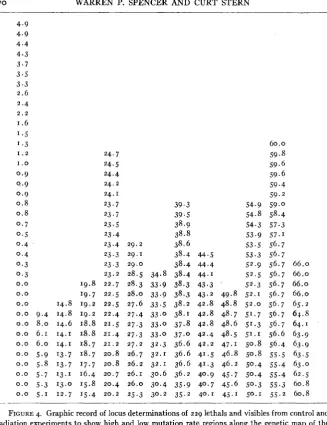
E X P E R I M E N T S TO TEST T H E VALIDITY OF T H E LINEAR DROSOPHILA AT LOW DOSAGE'
WARREN P. SPENCER AND CURT STERN2 Universdy of Rochester, Rochester, N . Y.
Received November z 5 , 1947
R-DOSE/MUTATION FREQUENCY RELATION I N
I N C E the discovery of MULLER (1927) and STADLER (1928) that X-rays induce mutations in organisms, a very large body of data has been ac- cumulated by many workers dealing with the relationship of mutation fre- quency t o dosage intensity. X-rays of various wave-lengths, radiations of radium, neutrons and ultra-violet light have all been employed as causative agents. It is not the intention here to review the voluminous literature which has grown up in this field. The reader may refer t o the general reviews of SCHULTZ (1936), STUBBE (1937), and TIMOF~EFP-RESSOVSKY (1937).
On the basis of the accumulated data on Drosophila melanogaster, on which most experiments have been conducted, and with allowance for variables not easily controlled from experiment t o experiment, radiation geneticists are generally agreed that the r-dose/mutation frequency relation seems t o be a linear one. Furthermore, experiments on fractionation of dosage and variation in time-intensity relationships would seem to indicate that this linear rela- tionship should hold a t very low dosages. While the extrapolation of the curve into the region of low dosages is a reasonable hypothesis, the experimental in- vestigation of this part of the curve is of interest. From a theoretical point of view the validity of the extrapolation needs t o be checked by observation. From the practical aspect of the effect of low dosage radiation on man this part of the curve is of special significance.
The lowest dosages thus far used have been 385 r for X-rays by OLIVER (1932) and 400 r for radium by RAYCHAUDURI (1941, 1944). The accumulation of sufficient data to be statistically significant for lower dosages than the ones reported is a considerable task. Here will be reported data on controls, 25 r,
50 r, 150 r, 500 r, 1000 r, 2 0 0 0 r, 3000 r, and 4000 r. The collection of the data
occupied the full time of three workers in the laboratory from October, 1943 to July, 1945. I n addition to the main problem of induced mutation frequency a t low dosages, some data are presented on the ratio of pure lethals to visibles, This paper is based on work performed under Contract No. W-7401-eng-49 for the MANHAT- TAN PROJECT and the information covered therein will appear in Division VI of the Manhattan Project Technical Series, as part of the contribution of the UNIVERSITY OF ROCHESTER. Apart from minor changes this report is printed in the form in which it was written originally (1945- 1946), that is, before the results of the experiments of CASPARI and STERN had accumulated. Their report is published simultaneously (CASPARI and STERN 1948). Both papers should be consulted together.
e Now Department of Biology, COLLEGE OF WOOSTER, Wooster, Ohio, and Department of zoology, UNIVERSITY OF CALIFORNIA, Berkeley, California, respectively.
44 WARREN P. SPENCER AND CURT STERN
semilethals with visible effects, and semilethals without visible effects, the occurrence of lethal clusters in controls and such clusters a t low dosages, the association of lethals with crossover modifiers a t different dosages, and the distribution of lethals and visibles on the genetic map of the X chromosome in Drosophila melanogaster.
DESCRIPTION O F TECHNICAL METHODS EMPLOYED
T h e genetic procedure
Through the courtesy of DR. H. J. MULLER, now of INDIANA UNIVERSITY, whose cooperation and advice have been invaluable, a tool stock was secured for use in making tests of lethals and visibles in the X chromosome of control and irradiated flies. This stock, the fifth in a series of stocks, will be designated as “Muller-5.” The complete formula for the stock is scSrB In-S wa sc8. MULLER (written communication) explains the genetic content of the stock as follows: “The expression scsr
.
. .
sc8 refers to a chromosome whose left end is derived from the scuteS1 inverted X chromosome and whose right end is from a scute8 chromosome. Such a chromosome is easily obtained by single crossing over between the two scutes. Since these inversions are sensibly identical except for the fact that the left break of scuteS1 is just t o the left of it, this chromosome has two scute genes, scutes1 near the left end and scutes near the right end, b u t is otherwise sensibly identical with either a scuteS1 or a scute* chromosome. “In-S” designates Inversion-S (S = SINITSKAYA), an inversion slightly smaller than and in very nearly the same position as “delta 49,” which arose in the scutes1 chromosome by irradiation a t the same time as the scutes1 itself arose. I made up this particular chromosome for the purpose of studying mutations in the female, because there is needed for this object a chromosome having (I) very little crossing over throughout its length, (2) suitable markers, both dominant and recessive, and (3) comparatively high viability and fertility. Condition (I) is here fulfilled by the two inversions, one included within the other, though rarely (less often, I believe, than in the case of C1B) double crossing over does occur: this usually separates the Bar from the rest, so if both Bar and apricot loci are followed, one can be virtually certain of what one has. Condition ( 2 ) has been provided by Bar and apricot. Condition (3) holds because the duplication of the scute locus largely prevents the lowering of fer- tility and viability that scute* or scuteS1 alone would give.”MUTATION AND LOW X-RAY DOSAGE 45
homozygous form, and this gives it a distinct advantage over any CIB balanced stock in procuring large numbers of virgin females for initial crosses. Homo- zygous Muller-5 females have a lower viability and fecundity than females heterozygous for Muller-5 and any sex-linked mutant either lethal or visible, except a few weak dominants such as “Minutes.” This makes possible the re- tention of any new lethal or weak recessive visible indefinitely in stock in a pseudo-balanced condition with Muller-5, provided the stocks are cultured in half-pint bottles and enough parents are used in each generation t o eliminate the chance selection o€ only Muller-5 females when flies are shaken into a fresh stock bottle. Such stocks could, of course, be carried in sm’aller culture bottles if heterozygous females were selected as parents each generation.
The use of this stock in testing for either lethals or visibles which have arisen in the X chromosome of control or treated males is illustrated in figure I.
m-i
M L L h J
FIGURE I. The Muller-5 technique for the detection of lethals and visibles in the X chromosome of Drosophila mdanogaster. See text for full explanation.
46
crossing over. The occurrence of non disjunction males among the FP flies will never obscure the presence of a new lethal as such males will be Muller-5 and not wild type. The genetic set-up is particularly convenient because only a t one stage in the entire procedure is it necessary to use virgin females, the I’ Muller-5 females (B). Even here the inclusion of an occasional non-virgin Muller-5 female has no serious consequences as her homozygous apricot Bar daughters are easily separated from the red heterozygous Bar F1 females used for the test matings. This is an important item in a large scale experiment.
About one fourth of the lethals and visibles found were tested for linkage relations. F1 females (G) or F3 heterozygous Bar females were mated to the multiple recessive males, scute (0.0)-crossveinless (13.7) vermilion (33.0)-
forked (56.7)-carnation ( 6 2 . 5 ) . Their non-Bar daughters, carrying the new mutant in one X chromosome and the recessive tester genes covering the genetic map in the other X chromosome, were mated t o their Muller-5 sons. From five to seven such pair matings were made for each gene tested, and a lower limit of zoo males to be classified was set. The use of Muller-5 fathers in these tests again eliminated errors which might have arisen from non disjunc- tion males.
Choice of stock for testing mutation rate
For irradiation work a t low dosages, it was desirable t o use a stock of flies with a low control mutation rate and one which would not prove highly vari- able. Canton-Special was tentatively chosen as the stock to be used, provided it showed on test a low control mutation rate suspected from previous experi. ence. The following description is taken from BRIDGES and BREHME (1944). “A standard wild type phenotype, obtained from a stock collected in Canton, Ohio. Selected by BRIDGES. The salivary chromosomes were found by BRIDGES t o be normal. The stock contains a recessive for multiple thoracic and scutellar bristles, which overlaps wild type in most of the flies but appears sporadically in strains in which Canton-S has been used in crosses.” The stock had originally been made isogenic by BRIDGES, and about four years before these experiments were started, the process had been repeated by one of the present authors
During the autumn and winter of 1943, preliminary tests on control muta- tion rates in Canton-S and seven other stocks were run. As data accumulated, it became evident that Canton-S had a low natural mutation rate, consider- ably lower than the average of the other seven stocks and possibly as low or lower than any of the others. (For a discussion of the variability of spontaneous mutation rates, compare MULLER 1928b, DEMEREC 1937b.) The results of these tests are given in table I . The figures for the seven stocks include about
3000 tests run during the spring and summer of 1944. As Canton-S is a wild type stock, it has the advantage over any stock homozygous for visible muta- tions which might mask new visibles; for instance, a stock containing white would eliminate work on all other eye colors a t the white and other loci. During the course of these tests, a routine was gradually evolved whereby large num- bers of test cultures could be run through on a uniform schedule. The detailed
WARREN P. SPENCER AND CURT STERN
MUTATION AND LOW X-RAY DOSAGE
TABLE I
47
Preliminary tests on natural mutation rate in eight stocks of Drosophila melanogaster. Lethals and visibles arising in male germ cells.
_ _ _ _ ~
CHROMOSOmS TESTED
STOCK LETHALS VISIBLES % LETHALS
Pittsford, N. Y. 2,218 5 I
Webster, N. Y. 1 9 9’3 3 I
Oregon-R 1,923 2 I
Muller-5 1,366 I 0
white 1,080 3 0
yellow-white-forked 764 2 0
New Wilmington, Pa. 7 2 7 0 I
Total of seven Stocks 9,991 16 4 .16
Canton Special 20,324 ’7 2 .os
account of this routine given in the following section appears justified both as a guide for other workers and as a source of intrinsically important informa- tion on the details of the present experiments.
Culture of Mulier-5 and Canton special stocks
Each week on Friday ten or eleven half-pint cultures of Muller-5 were started. The usual molasses-cornmeal medium, enriched with dry brewer’s yeast was used for these and all other cultures. Moldex was added t o keep down mold growth. Carragar, a specially prepared extraction of the marine seaweed, Chondrus crispus, was substituted for agar because of the difficulties in securing adequate supplies of the latter. About fifty pairs of parent flies were used in each half-pint culture. On the following Tuesday, two double sheets of “Kleenex” tissue paper soaked in a suspension of about IOO g of baker’s yeast in 600 cc of water were added t o each half-pint culture. The stocks were kept in an incubator at 24-25OC and flies were emerging at this temperature 11-12
48 WARREN P. SPENCER AND CURT STERN
the old ones discarded. Generally these flies were simply shaken into the new stock bottles, but about once a month the parents were selected under the binocular microscope t o eliminate any round eyed males or heterozygous Bar females due t o Bar reversion in the MULLER-5 stock.
Stock of Canton-S was started each week on Wednesday by shaking newly emerged Canton-S flies into six half-pint culture bottles. These flies were all shaken on Friday into one half-pint etherizer and etherized together. The bottles from which they had been shaken were set back as fresh stock and yeasted on Monday. The flies which had been shaken out and etherized were two t o four days old, and from them 400 or 440 males were selected under the binocular microscope and placed in gelatin capsules, 2 0 flies per capsule, for ir-
radiation or as controls. These males were examined to make certain that they showed no new visible mutations a t the time they were isolated. After irradia- tion, the flies were immediately placed with the virgin MULLER-5 females, 40 males per half-pint bottle, and each bottle marked with the dosage received. The Canton-S stock was thus carried in six lines and the flies from the six lines thoroughly mixed and sampled for each week’s lot of parent males t o be irradiated or t o serve as controls. The Canton-S stocks were purposely raised under somewhat crowded conditions in order t o eliminate semilethals which might arise in the stocks. Such semilethal flies are generally weaker than wild- type, and by some larval and adult crowding, it was hoped that they would largely be killed off. It may be argued that crowding the Canton-S stock might have affected in some way the natural mutation rate. This might be true, but this possible objection seemed to be outweighed by the necessity of eliminating as far as possible any semilethal males which might otherwise be used as parents for the experimental cultures.
On Tuesday, the parent flies from the ten or eleven crosses of
MULL ER-^
females t o Canton-S males started the previous Friday were shaken into a fresh set of marked half-pint culture bottles and the first set provided with Kleenex soaked in yeast suspension. On Thursday, the parent flies from the second set of cultures made up on Tuesday were discarded and these cultures yeasted.As the F1 flies (C) and (D) of figure I began emerging, they were shaken
MUTATION AND LOW X-RAY DOSAGE
The test cultures
49
During the period from December I, 1944, through June, 1945, approxi- mately 127,000 test cultures were made up; of these, 121,353 (an average of
17,336 per month) developed and were examined for lethals without etheriza- tion (see below). I n the earlier part of the work, fewer test cultures were reared as they were all etherized and examined both for lethals and visibles. The following routine was followed for the period mentioned above. Test cultures were reared in one ounce culture bottles (“creamers”). The medium was the same as that used for half-pint cultures. Creamers were arranged in rows on tin trays; three fourths of these trays held 95 creamers each and one fourth held 1 2 0 creamers. Hot medium was poured into four trays of creamers each morning and afternoon, a total of 810 creamers per day. On cooling, the culture bottles were inoculated with a drop of heavy yeast suspension and the four trays placed in the refrigerator without capping the bottles. The lot made u p in the morning was used that afternoon and the lot made in the afternoon was used the following morning. On Saturday only one lot of culture bottles was prepared and these bottles were used the following Monday morning.
When a tray of creamers was removed from the refrigerator, it was covered with cheese-cloth. Flies from the aging bottles were etherized and males and females separated and placed in dry vials where they could easily be re- etherized. One female and one or more males were placed in each creamer which was immediately covered with a paste-board creamer cap in which three short cuts were made with a dental scalpel for ventilation. As soon as creamers were removed from the refrigerator, the air within them began t o warm u p with consequent drop in relative humidity and evaporation of moisture from the food surface. Few flies became stuck in the medium and there was less con- tamination with mold than if paper or other materials had been added. Failure of a culture t o develop was, Lowever, generally due t o the parent fe- male becoming mired in the food medium, often in the spot of yeast. I n order t o avoid this as much as possible, the yeast was placed a t one side of the creamer. Actually, many trays came through with no failures, and the per- centage of failures was definitely correlated with atmospheric humidity. A library card was placed on each tray with date and X-ray dosage marked in two ways to avoid errors in recording. The trays were then placed in order on shelves in open cabinets in the laboratory and not disturbed until the cultures were examined for lethals exactly two weeks after they were made up. Parent flies were not removed, for their phenotypes were such that they did not inter- fere with the identification of the lethals. Thus a t all times there were 88 trays and 8,910 test cultures arranged in sequence on the cabinet shelves.
Examination of test cultures for lethals
50 WARREN P. SPENCER AND CURT STERN
placing the creamer on its side under the low power of the binocular microscope, magnification 7X, and checking for wi!d type males which could readily be identified at this magnification. The 810 cultures could be examined accurately in this manner in less than two hours. Each culture without offspring was set out of the tray and also each culture with no wild type males, a potential lethal bearing culture. The total number of fertile cultures and of failures was recorded on the card, and this card set in a small tray with any potential lethal cultures or filed if therewere none of these present. Potential lethal cultures were set back for two more days and then the flies etherized and each class of flies re- corded on a lethal card together with the date on which the lethal was found. At this time two new cultures of three heterozygous apricot Bar females and five
MULL ER-^
males were made up t o test the lethal through another genera- tion. A later count of the original lethal culture and counts of the two F3 generation tests were made and recorded on the lethal card. I n case of linkage tests, heterozygous apricot Bar females from the Fa cultures were mated t o the multiple recessive males mentioned above. The few cultures coming through with less than a dozen flies were scored as failures and were not included in the total. With the food medium enriched with brewer’s yeast, the number of such cultures was extremely low and could not have introduced any large error. However, to be sure that such low yielding cultures were not due to some domi- nant effect of a lethal carrier, many cultures of a few flies containing no wild type males were tested through another generation using the heterozygous Bar females present. The results of such tests indicated that there was no selection against lethal bearing chromosomes by the discard of the small group of cul- tures with only a few flies per culture. I n such cultures, generally one or both parents were found dead, thus explaining the low yield. The procedure out- lined above was specifically designed for the discovery of pure lethals, which experience had shown was by far the largest class of mutants th at could be recovered rapidly and with little subjective error. No attempt was made t o save semilethals and a culture was discarded as soon as one wild type male was seen. As such a male could not be due to nondisjunction and as cross- overs were practically eliminated, no pure lethals would be discarded on this criterion. All of the checking for lethals without etherization of flies was done by the senior author.MUTATION AND LOW X-RAY DOSAGE 51
radiation of 150 r or more for visibles after they had first been checked for lethals. These cultures were etherized in checking for visibles. Problems in- volved in scoring both lethals and visibles will be discussed below.
The X-ray treatments
I n an ideal radiation experiment, all lots of flies receiving different dosages would be irradiated on the same apparatus on the same day and the output of the apparatus checked during the radiation with a dosimeter which had it- self been standardized immediately before the radiation. Obviously, these conditions could not be adhered to in a large scale experiment involving eight different dosages and hundreds of thousands of test cultures. It was impossible to predict a t the beginning of the experiment how many points on the dosage curve could be profitably investigated. It has been the present aim to spread the low dosages over as many lots of flies and as much time as practicable and to spread the control lots over the entire period of the experiment.
A lot refers to control or irradiated flies used for one week's test cultures. These may therefore be referred t o as weekly lots Table z gives the number
TABLE 2
Dosages and other conditions of radiation and numbers of lots of inales irradiated al dijerent dosages.
- ~ _ _ _ __-
_. -
___
~ _ _ _ _ _ _ _ _ _ _ _ _ ~ ________WEEKLY
LOTS
DOSAGE K . V .
Control 70
25-r 43
So-r I 1
50-r 4 5
I go-r I 2 I So-r 3'
500-r 14
Iooo-r 5
2000-r 2
3000-r 2
4000-r I
1000-r 2 0
T.S.D. IN INCHES
M.A. r/MIN.
1 8 . 5 1 8 . 5 1 8 . 5 1 8 . 5 7 . 2 5 7 . 2 5 7 . 2 5 7 . 2 5
15-22 15-22 15-22 15-22 91-100 91-100
IO
1 0
IO
96 96
of weekly lots for each dosage. The weekly lots a t 50 r, 150 r, and 1000 r given a t IO r per minutes were irradiated on a machine whose output was checked
5 2 WARREN P. SPENCER AND CURT STERN
secured a t dosages above 1000 r had relatively little bearing on the main prob- lem being investigated.-At the beginning of the experiment and before any flies were irradiated, some zo,ooo Canton-S control cultures were reared but not recorded in weekly lots.
T h e mutational category chosen f o r quantitative study
It seems pertinent a t this point to consider briefly the kinds of mutations occurring in Drosophila and their adaptability t o a quantitative study of the type undertaken, and to define carefully the category of mutation chosen.
Mutations occur in both autosomes and sex chromosomes, and there is abundant evidence that more of them are occurring in the autosome complex than in the X chromosome. However, there is no breeding procedure by which newly arisen autosomal mutants can be found as easily and effectively as can sex-linked mutants by the method outlined in figure I. Although the data are
as yet fragmentary, it would seem that comparative studies on sex-linked and autosomal mutation should make possible a transfer of findings on X chromo- some mutation rate t o the mutation picture in the autosomes.
Mutations are known to occur a t different stages in the development of the organism. The study of mutation rate in mature sperm has certain technical advantages when it comes to securing large quantities of valid data. I n ex- tensive experiments on natural mutation rate,
MULLER
(1945,1946) has shown th a t “overall mutation frequency is two or three times higher in the first crop of spermatozoa, accumulated during a male’s pre-imaginal life, than in those of a week later derived from a non-virgin male,” (MULLER 1945). It should be noted that all of the Canton-S spermatozoa used in our control and radiation experiments were from males a week or less old.Mutations may be somewhat arbitrarily grouped into the following over- lapping categories: dominant lethals, recessive lethals, recessive lethals with visible dominant defects, sterility mutants, recessive semilethals without visible effects, recessive semilethals with visible effects, deleterious or lowered viability mutants without visible effects, deleterious or lowered viability mutants with visible effects, recessive visibles, dominant visibles, and iso- alleles (mutants whose presence can only be detected by special genetic or environmental tools).
CATCHESIDE and LEA (1945) review the data on dominant lethals in Droso- phila melanogaster and present new data. While these can be shown by statisti- cal means, using relatively high X-ray dosages, to have a higher incidence than any of the other categories quantitatively studied, their use in experiments a t low dosages is out of the question because of relatively high control variables. Furthermore, while they are well adapted to the study of certain theoretical problems, their significance can hardly be compared with that of certain of the other categories.
MUTATION AND LOW X-RAY DOSAGE 53
ity. Their occurrence was first noted by MULLER (1928a) and their abundance proven by MULLER (1934), KERKIS (1935, 1938) and TIMOF~EFF-RESSOVSKY
(1934). These authors came t o the conclusion that the class of viability mu- tants is from two t o three times as numerous as the lethals. More recently, IVES (1945) and DOBZHANSKY and SPASSKY (1944) have reported similar results. This heterogeneous group of genetic changes, readily influenced in expression by genetic and environmental modifiers, is not amenable t o quick detection and objective classification and is therefore not favorable for the kind of quantitative study here undertaken.
Visibles, both dominant and recessive, occur in much smaller numbers than any of the previously discussed categories or than pure lethals. Furthermore they are subject t o the traditional objection that their discovery depends upon the training of the investigator and is less objective than the discovery of pure lethals where the proper genetic tools are used. I n any case, the time involved in finding them is very much greater than that in finding pure lethals.
This leaves lethals and semilethals with and without visible effects. Un- fortunately for a purely objective study, there is a sizeable borderline group between the pure lethals and semilethals. I n this group are found mutants which may in one generation or culture appear t o be pure lethals while in another generation or culture either by the vagaries of statistical sampling or through changed culture conditions a few flies may come through and they must then be scored as semi-lethals. About half or a little over half of these extreme semilethals which we have found show visible effects. This visible effect forms an objective criterion for classification. The other semilethal group grades into the lowered viability class and an arbitrary criterion of classification needs to be set up to separate them. Such criteria are either not accurate because of varying numbers of flies per culture or if accurate, are laborious and time consuming, an important factor to be considered.
Second generation tests of all lethals found were also made. In spite of the fact that 65 of them appeared as pure lethals in the first generation count but as semi-lethals in the second generation count, they have been included with the 914 lethals which behaved as pure lethals in both generations and the cal- culations based on the total number of 989 lethals of which a small number behaved as semi-lethals in the second generation. This has been done because the criterion of selection in the first genkation has been a purely objective one, the total absence of all wild type males. For reasons stated in a later section, we have not included those semi-lethals with visible effects in which a few flies came through in the first generation.
54 WARREN P. SPENCER AND CURT STERN
Furthermore, certain mutants behave as semi-lethals a t one temperature and as lethals a t another temperature (see DOBZHANSKY and SPASSKY 1944). Many examples of mutants were found which behaved as lethals in the first genera- tion and as semi-lethals in the second generation. Some which appeared as lethals in the two test generations acted as semi-lethals in later linkage tests. As explained above, all mutants which were scored as pure lethals in the first generation were included in calculations of mutation rate. However, had the cultures been reared a t constant temperature, a rather large group of semi- lethals and delayed emergence mutants with visible effects, discovered through the total absence of the semi-lethal or delayed emergence class when the cul- tures were first examined, could have been included in the totals. 'Our experi- ence with such mutants would indicate t h a t the inclusion of these classes would increase by ten percent or more the total mutations discovered, a considerable figure when low mutation rates constitute a limiting factor in these studies. I n any case, test cultures should be reared a t constant temperature to cut to a minimum inaccuracy in objective scoring of that class of mutants which is semi-lethal a t one temperature and lethal a t another.
LETHAL MUTATION R A T E I N CONTROL AND IRRADIATED MALES
MUTATION AND LOW X-RAY DOSAGE 55 ten percent of normal, the number of flies of this class expected would be 0.5;
and with two lowered viability mutants, one with 30 percent and the other with
2 0 percent of normal viability, the expected number of flies coming through
would be three. Obviously, in some individual cases with this expectation, none would actually emerge. Since semi-lethal and lowered viability mutants to- gether make up a group of considerable size, the observed mutation rate a t high dosages will thus tend to be increased. As the above factors act in oppo- site directions, though not necessarily cancelling one another out, i t has been
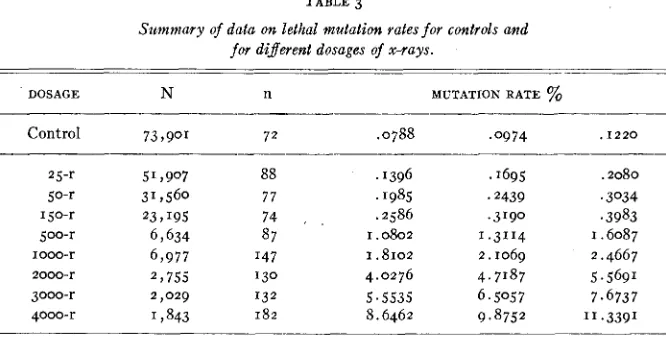
TABLE 3
Summary of data on lethal mutation rates for controls and
for dijerent dosages of x-rays.
DOSAGE N n MUTATION RATE %
Control 73,901 72 .0788 .0974 . I 2 2 0
25-r 51,907 88 . '396 1695 .2080
jo-r 31,560 77 ' 1985 .2439 .3034
150-r 23 7 195 74 r .2 586 .3190 .3983
2000-r 2 t 755 130 4.0276 4.7'87 5.5691
3000-r 2,029 132 5.5535 6.5057 7.6737
4000-r 1,843 182 8.6462 9.8752 11.3391
500-r 6,634 87 I . 0802 I .SI14 I . 6087
1000-r 6,977 I47 I .8102 2.1069 2.4667
-_____ N=Total number of chromosomes tested.
n=Total number of chromosomes in which lethals were found. Column 5 gives the lethal mutation rate observed in percent.
Columns 4 and 6 give the percentage values of which the observed mutation rates would be the upper and lower five percent fiducial limits (five percent in both tails jointly).
deemed unprofitable to attempt to introduce a correction factor where the highest dosage used is 4000 r. It is of interest to note in the paper of GOWEN and GAY (1933) that of the six points on each of two curves for the percent of chromosomes without recessive lethals, the last two points (highest radia- tion) fall below the fitted curve. Such a result is not surprising when a correc- tion was made for chromosomes bearing two lethals and no counter correction for double semi-lethals and double lowered viability mutants.
Column 5 gives the lethal mutation rates expressed in percent of lethal bear- ing chromosomes found in the tests for controls and a t different dosages. It was intended to proportion the test cultures a t different dosages in such a way that the standard error would be about the same percent of the mutation rate for such dosage and for the controls. Actually on this criterion about twice as many data have been secured a t dosages from 1000 r up as a t the lower
56 WARREN P. SPENCER AND CURT STERN
Columns 4 and 6 give percentage values of which the observed lethal muta- tion rated would be the upper and lower five percent fiducial limits (five per- cent in both tails jointly). Thus, if 0.0974 percent represents the observed con- trol mutation rate, then a true rate of 0.0788 would be expected once in forty times to result in an observed value as large as, or larger than 0.0974. Sim- ilarly, a true rate of 0.1220 would be expected once in forty times to result in an observed value as low as, or lower than 0.0974. The calculated values were obtained by the following method suggested by DR. DONALD R. CHARLES:
“Let n’/N represent a “universe” mutation rate and n /N the mutation rate in a sample of N. The standard error of n’ is
By ordinary theory, the upper five percent fiducial limit of n‘ is n‘
+
1.96~But from STEVENS (1942) this limit is actually n’
+
1.96~+
c c being a correction. We want to find an n’ such thatn‘
+
1.96~+
c = nFor any particular sample n and c are known; the equation can thus be solved for n’.”
On the basis of the experimental evidence, it would seem that a n X-ray dosage even as low as 2 5 r produces a significant rise in mutation rate over that found in the controls.
Figure 2 shows the fit of a straight line curve to the data secured. The verti-
cal lines represent the statistical limits a t the five percent level of significance. The curve is based on all the data reported in table 3 , which give a control mutation rate of 0.1004 percent per chromosome tested, and an induced muta- tion rate of 0.00~15 percent per r-unit of radiation per chromosome tested. Only the control, 2 5 r, 50 r, and 150 r points are plotted on this curve. On the
basis of this figure, it is not unreasonable to conclude that the lethal mutation rate in mature sperm of the Canton-S stock is directly proportional to the X-ray dosage for values as low as 2 5 r. The low value a t 150 r must be con-
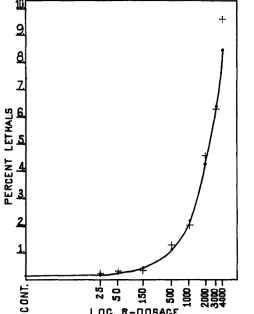
sidered in connection with the entire experiment. As eight dosages and control values have been studied, it is not surprising to find one point on the curve considerably out of line. Figure 3 is a log dose-mutation rate plot made up from data in table 3.
CONTROL VALUES AND LETHAL CLUSTERS
MUTATION AND LOW X-RAY DOSAGE 57
It is therefore important to collect a large body of control data and to collect these data in so far as possible a t the same time and under the same environ- mental and genetic conditions as the radiation data in order to reduce errors from control fluctuations to a minimum.
The data on both controls and each dosage group were collected and filed in weekly lots as explained above. These lots were in turn made u p of sub-lots consisting of the test cultures on each tray, an average of a little less than IOO cultures per tray. The filing of the data in this way made it possible t o observe and test cases in which the lethal distribution among control and low dosage cultures appeared t o be non-random. This procedure led to the discovery of several cases of what we shall designate as “lethal clusters” among the controls and the low dosage tests. As this matter has an important bearing on the col- lection of data in low dosage experiments, some specific cases will be presented in detail.
Among 1,726 test cultures examined in the forty-second lot of controls, there were seven lethals found where, on the basis of the control rate established, about 1.7 lethals were expected. Four of the lethals were found in two trays, two per tray, and all were late pupal lethals. As not more than 2 0 percent of all lethals are pupal, $his made their chance association even less likely. It was thought that these might have come from a Canton-S male carrying a semi- lethal X chromosome, but subsequent tests showed that this was not the case. I n table 4 the data are presented. It will be noted that the linkage tests placed
TABLE 4
Lethal cluster: qznd lot of controls.
CULTURES NO. NO. NO. FLIES PER
MADE UP CULTURES LETHALS LINKAGE TEST LOCUS
____
12-14-44 (Tray 8) 91 2 (4 340 2 2 . 7
(b) 335 2 5 . 3
12-14-44 (Tray 9) 9 0 2 (4 332 2 3 . 2
(b) 248 2 3 . 4
Counts demonstrating that these are pure lethals ( I F I , z FZ cultures).
-
LETHAL APRICOT APRICOT +/APRICOT.
BAR $3 f ” BAR P P BAR P P TOTAL
8a. 12-30 79 0 78 162 319
8b. 12-30 76 0 7 7 191 344
ga. 12-30 6 8 0 68 185 321
9b. 12-30 9 4 0 105 150 349
Totals 317 0 328 688 1,333
58 WARREN P. SPENCER AND CURT STERN
(late pupal) clearly indicates that they are one and the same lethal. As there were three creamer cultures of each lethal reared, this really amounted to 1 2 test cultures and 1,333 flies reared with not a single wildtype male coming through. I n addition a half-pint mass culture of each of the four lethals was reared and several hundred flies from each culture examined with no wild type males appearing. It seems well established that this was a pure lethal and not a semilethal and that the four lethals found actually came from four sperm cells derived from the same Canton-S male and all carrying the same lethal which must have arisen in the germ tract of this male. The male might possibly have been a gonosomic mutant (SIDKY 1940), the germ cells all lethal bearing and the body cells non-lethal bearing. Such an explanation is in principle the same as that suggested, the lethal mutation having arisen a t an earlier stage in the ontogeny of male.
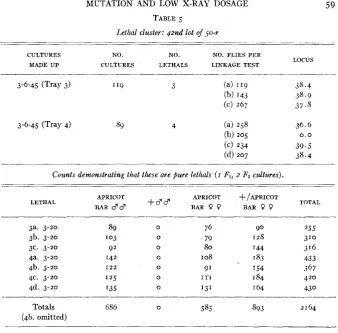
Among 804 test cultures examined in the forty-second lot a t 50 r, twelve lethals were found. At the mutation rate established for this dosage, about two lethals were expected in the 804 cultures. Three of these lethals were found in one tray of 119 cultures and four in a tray of 89 cultures. These seven were run through linkage tests and three cultures of each were raised. All proved t o be pure lethals and the linkage tests showed that six of the seven were probably identical. The data on this case are given in table 5 . The other five lethals in this lot were not tested for linkage relations. Some or all of them may have been identical with the six shown to be the same. Such a cluster of pure lethals can best be accounted for by assuming that a lethal arose early in the germ tract of one of the 80 Canton-S males used as grandparents of the flies in the 804 test cultures. These lethals would then be control lethals and not due t o the radiation. although they appeared in the 50 r tests.
I n the forty-sixth lot a t 50 r, three lethals appeared in one tray of 89 test cultures. Linkage tests placed their loci a t 0.0, 28.0 and 30.4. Apparently two were identical and the third a t a different locus. Two lethals appeared in a tray of 94 cultures in control lot 67. They proved to be identical, the linkage tests placing their loci a t 29.1 and 29.2. I n the third lot a t 50 r two lethals were found in a tray of 89 cultures; the locus of both by linkage tests proved t o be a t 5 2 . 0 .
I n the fifth lot a t 1 5 0 r in a tray of 94 cultures two mutants were found; one gave no wild type males in the test culture and the other gave one The linkage tests placed these a t 23.7 and 24.4 respectively. During the linkage tests, a few flies came through showing extreme rough eyes, coarse and irregular bristles, and coarse textured wings sometimes nicked, This is apparently an extreme semi-lethal allele of goggle, locus 2 5 in the X chromosome (BRIDGES and
BREHME 1944). It is unlikely in the latter case that one of the Canton-S males irradiated a t 150 r was goggle as these flies were examined for mutants, and such an extreme phenotype would not seem likely to be overlooked. I t seems more probable in the light of evidence from the other cases that this repre- sented a visible cluster.
The following case, however, illustrates the fact that a visible might be overlooked in selecting Canton-S males for irradiation. I n lot 54 a t 1 5 0 r out of
lLlUTATION AND LOW X-RAY DOSAGE
TABLE 5
Lethal cluster: qrnd lol of 50-r
59
~ ~- - ~ - . _.
CULTURES NO. NO. NO. FLIES PER
MADE U P CULTURES LETHALS LINKAGE TEST LOCUS
3-6-45 (Tray 3) 1'9 3 (a) 119 3 8 . 4
(b) 143 3 8 . 9
(cl 267 3 7 . 5
Counts demonstrating that t h e are pure lethals ( I Fl, 2 F2 cdtures).
~
~-
LETHAL APRICOT APRICOT +/APRICOT TOTAL
8 A R 8 3 +" BAR
o o
BARo o
3". 3-20 89 0 76 90 255
3b. 3-20 '03 0 79 I 2 8 3'0
3c. 3-20 92 0 80 144 316
4b. 3-20 I 2 2 0 91 I54 367
4c. 3-20 '2.5 0 I 1 1 I 84 420
4d. 3-20 '35 0 131 164 430
Totals 686 0 5% 893 2164
4a. 3-20 '42 0 I08
.
183 433_--
(4b. omitted)
were found in four trays out of the nine 150 r trays for t h a t week. There were 354 cultures in these four trays. On the average about ten test cultures should come from one male fly. I n this case it seems probable that all fourteen female parents of these test cultures showing wavy wings had obtained their wavy- bearing X chromosome from the same male. As some wavy males approach the normal in phenotype it could easily have been overlooked when the Canton- S males were selected for raying. This case, however, may represent another visible cluster. The linkage test of the mutant placed it a t locus 40.7. The mutant fits the description of wavy, locus 41.9 (BRIDGES and BREHME).
60
25,000 Canton-S males were used to secure the sample of sperm cells for the
200,801 test cultures. If the experiment were to be repeated on the same scale, about four times this many males would probably be used. Ideally, one male should be used for each FB test culture. However, this would practically double the work so that half as many data could be collected in the same time. A rea- sonable balance should be struck between the work involved in the sampling method and that applied to the collection of test data so that the sampling errors may be kept small and the data secured may be as extensive as possible. It seems clear in the present experiment that each lethal test culture found in a demonstrated lethal cluster must be scored as a separate lethal as each test culture from a non-lethal cluster of germ cells is scored as a separate non- lethal. Obviously there is no method of demonstrating the test cultures forming non-lethal clusters, but by implication they must be there.
We believe that the body of data presented in this report is sufficiently large so t h at the sampling error from control lethal clusters does not seriously in- validate the conclusions drawn. It is not unlikely, however, that some of the variations in control mutation rate in different stocks and in the same stock a t different times as reported by various workers can be accounted for on the basis of insufficient or faulty sampling. Even where linkage tests did not demonstrate any lethal cluster, the inclusion of a disproportionately high number of germ cells from non-lethal clusters in one experiment might give a mutation rate lower than normal. It seems clear that where control data are needed, the method of sampling the germ cells must be given careful consideration. LURIA and DELBRUCK (1943) discuss the sampling problem involved in determining mutation rate in bacteria, and AUERBACH and FANO (1943) consider the same problem in dealing with the scoring of mutations arising from chemical treat- ment of Drosophila larvae.
WARREN P. SPENCER AND CURT STERN
T h e mutation rate at low dosages
As will be seen from table 2, only two weekly lots of flies were irradiated a t 2000 r and 3000 r and only one at 4000 r. As much work has already been done a t these dosages, the present purpose was only to secure some additional data at these dosages as a general check on the low dosage experiment. From all of our data, assuming a linear r-dose/mutation rate relation, the control mutation rate value has been calculated as 0.1004 per cent and the mutation rate per r-unit as o 0 0 2 1 5 percent From these data, it appears that the control or nat- ural mutation rate is doubled by a dosage of 46.7 r.
Owing to the possibility of errors a t the high dosages due to the small num- ber of irradiated lots a t these dosages and consequent chance of errors in dosi- meter readings and t o the inaccuracies introduced by multiple lethals and semilethals in some chromosomes, it was decided to calculate the control and radiation mutation rate on the basis of the data collected a t o through 1000 r radiation. These data were less likely to be subject to errors in dosimeter read- ings as all radiations a t 1000 r and lower were carried out on many weekly lots of flies (see table 2 ) . They were relatively free from errors due to multiple
MUTATION AND LOW X-RAY DOSAGE 61
Calculations on the basis of these data gave a control mutation rate of 0.1039 percent and a mutation rate per r-unit of 0.00197 percent. These figures indi- cate a doubling of the control mutation rate a t a dosage of 52.7 r. The two sets of values check closely, the low induced mutation rate a t 150 r and the high rate a t 4000 r, accounting largely for the minor differences in the figures.
I n figure z the solid line represents the curve based on the assumption of a linear r-dose/mutation frequency relation and calculated from all the data, while the broken line represents the curve calculated from the data for controls through 1000 r radiation. On the basis of this curve, the 150 r mutation value shows a-deviation from the expected a t about the five percent level of signifi-
-
Z
25R
50R
150
R
DOSAGE
FIGURE 2 . The linear relation between r-dose and lethal mutation rate. The solid line is based on all data in table 3; the broken line is based on the control through 1000 r data, omitting the
2000, 3000, and 4000 r data. The data points for control, 2 5 , 50, and 150 r are shown as small central horizontal marks. The ends of the vertical lines represent values of which the observed would be the upper and lower five percent fiducial limits.
Calculated mutation rates (maximum likelihood) from all data: control, 0.1004q/o; induced, o.oozr5ofo per r.
62 WARREN P. SPENCER AND CURT STERN
cance, and the 50 r value shows a deviation in the opposite direction and almost as great. If the control lethal clusters reported for the 50 r material had been present in the 1 5 0 r cultures the deviation of these two points from the fitted curve would have about the same values. The deviation of the mutation rates at the different dosages from the expected values may well be explained as due t o chance, particularly with the factor of control lethal clusters taken into consideration. An examination of figure 3 and of published curves on the
FIGURE 3 . A log dose mutation rate plot constructed from all the data in table 3. The crosses above or below the theoretical points on the curve mark the actual mutation rates observcd at the different dosages.
linear r-dose/mutation relation a t high dosages will show that here, also, chance and unknown variables cause considerable fluctuations from the theoretical values to be expected. On the basis of control through 1000 r data the facts are consistent with the interpretation that the linear r-dose/mutation frequency relation holds a t low dosages.
MUTATION AND LOW X-RAY DOSAGE 63
the genetic background in C a n t o n 3 is such that certain mutations which would act as lethals in some stocks behave as semilethals here because of the general vigor of the stock. Many of the experiments on the lethal mutation rate have been done on multiple mutant stocks less vigorous than Canton-S. Furthermore, in our experiments the use of yeast-enriched medium tended to bring through some flies, which, on a poorer medium, would all have died before the adult stage. I n this connection a survey of the earlier literature on the induction of mutations by X-rays shows that in individual radiation ex- periments almost invariably inadequate data were secured to establish con- trol mutation rates within reasonably narrow limits. This is no reflection on early workers as the high dosages employed showed a tremendous increase in the induced mutation rates even if the control rates were in error by a factor of ten or more. However, when the small lots of control data from separate experiments are combined into larger lots representing control data collected a t about the same time in the radiation work, an interesting comparison may be made. The earliest control data, those reported by MULLER and ALTENBURG (1919) give a very high mutation rate. The summary of control data(ScHuLTz, 1936) excluding the early data of MULLER and ALTENBURG, and based on 15 different experiments totaling 26,145 X chromosomes tested gives a control rate of 0.18 percent. DUBININ (1946) published a table on control mutation rates in which two sets of data are on a scale sufficiently large t o be of some validity. I n this table, data of TIMOF~EFF-RESSOVSKY published in 1940 on eight lines of flies and 68,221 chromosomes tested give a mutation rate of 0.14 percent and data of DEMEREC (1937) on 1 2 lines and 13,612 chromosomes tested give a mutation rate of 0.10 percent. It is quite possible that improve- ment in culture conditions, particularly by the addition of brewer’s yeast t o the culture medium, have resulted in the apparent lowering of control mutation rates by bringing through a sizeable group of semilethals, which would be scored as lethals under poorer culture conditions. The criteria used in scoring lethal mutations will also have a bearing on the apparent lethal mutation rate, and these criteria should be carefully stated for comparative purposes.
64 WARREN P. SPENCER AND CURT STERN
present data come exclusively from flies of one week or less in age. As the figure for the doubling of natural mutation rate a t 35 r was based exclusively on rela- tively high radiation data, the control mutations occurring in the irradiated material would have a negligible effect on the results. MULLER’S experiments carried on a t the same time and on about the same scale as the present ones, make possible an explanation of the apparent discrepancy between t he present findings and those previously reported.
I n any case the present data clearly indicate that, for radiation with X-rays, dosages as low as 2 5 r produce mutations as drastlc in their effects and in the same proportion t o the dosage as do exposures to high dosages. If an extra- polation is permissible, one may assume that there exists no tolerance dose below which mutations are not induced. The total effect of X-rays on the in- duction of point mutations in a fruit-fly population would depend, then, on the mean value of r-units to which the individuals of the population are ex- posed. I n other words, the total effect on the germ-plasm of a population of
IOO,OOO individuals would be as great if each individual received I r a t the
beginning of the reproductive period as it would be if 1,000 individuals each received IOO r and the others none. If the data on flies can be shown to have transfer value t o mant then widespread exposure of large numbers of the human race during the reproductive period even t o low dosages of X-rays must be looked upon as a serious hazard. It should also be kept in mind that for all practical considerations mutation of the germ-plasm is an irreversible process. The new mutation, once it occurs, cannot be cured or alleviated. As most transmitted mutations, however deleterious their effects, are recessive, the importance of the induction of a mutation is not to be reckoned in terms of its effect on one individual, but rather in respect t o its possible effect through transmission t o many individuals over a large time scale. A final evaluation of these problems will have to take into account the data published simultane- ously by CASPARI and STERN (1948) and will have t o await still further in- vestigations.
APPENDIX A. VISIBLES AND VISIBLE-LETHAL RATIOS
MUTATION AND LOW X-RAY DOSAGE
TAEUE 6
65
Lethal-visible ratio at different dosages.
COR RECTED
SEMI VALUE RATIO
SEMI-
LETHALS LETHAL FOR VISI- LETHALS
LETHAL VISIBLES
(PURE) NON- BLESAND TO
VISIBLES
VISIBLES SEMI- VISIBLES
LETHAL VISIBLES DOS-
AGE
4000 r # cultures examined I , 843 # mutants found 163
3000 r # cultures examined 2,029
#mutants found 125
2000 r # cultures examined 2,755 # mutants found 119
1 ,843
2 0
1 7 843 I 1
I ,627 2 2 33.3
24. 1 20.9 2,029 8 2,029 8
2 f 75s
I 5
2,755 I 2
1,472 5
1000 r # cultures examined 6,977 # mutants found I37
# mutants found 81 500 r # cultures examined 6,634
6,977 10
6,977 I 4
1,206 3 31.0
6 9 634 5
6,634
5 14.3
150 r # cultures examined 23,195 # mutants found 67
23, I95 9
23, '95
6.
17,099 6 14. I
7.2
16.1 50 r # cultures examined 31,560
# mutants found 74
# mutants found 70 Control #cultures examined 73,901
31,560 4
31,560 3
7 > 535
I
73,901 7
73,901 IO
Totals 83 6 78 69 63 159.0 5 . 2 : I
Note: Figures in column 6 derived from the expression
N=total cultures examined for lethals; "=total cultures examined for visibles; L = total cultures in which lethals or semi-lethals of either kind were found; v=visibles found; slv=semi- lethal visibles found.
+slv. N
66 WARREN P. SPENCER AND CURT STERN
gence. Several interesting types of this sort have been seen. I n the 40th lot at
2 5 r, two semilethal visibles of particular interest have been found. I n one,
the tarsal joints were absent from all legs. I n another, the flies on emergence showed complete lack of muscular coordination and soon died.
Since during the second year of work most of the cultures were not etherized and examined for visibles, it has been necessary to estimate the number of visibles occurring from the sample of cultures which were examined. I n all, 73,457 cultures have been etherized and examined for visibles in addition t o those cultures etherized as potential lethals and found to contain semilethal visibles. As may be seen from the table, the estimates of visible-lethal ratios a t the different dosages are not based on samples of equal significance. However, the total data on visibles seem sufficiently extensive to justify their inclusion. Based on a total of 836 pure lethals and 159 visibles (of the latter 132 were discovered and the others calculated from the samples of cultures actually examined), the over-all lethal-visible mutation ratio is 5.2:1. Furthermore, the
recorded ratios are quite similar for controls and the different dosages. This result is subject to a considerable statistical error so that the ratios m a y be intrinsically somewhat different. Such a difference would be expected since it is known that X-ray induced lethals consist of two classes, namely, cytologi- cally visible small deficiencies and cytologically unrecognizable changes, while spontaneous lethals are composed nearly exclusively of the latter group. It will be noted that the ratio of 10.3: I in the case of the 50 r dosage is based on a
relatively small number of cultures examined considering the low rate of ex- pected mutation. SCHULTZ (1936) tabulates the lethals and visibles found in radiation experiments by five different workers. They found 1,189 lethals t o 161 visibles, a ratio of 7.4: I . The somewhat lower ratio obtained in the present
experiment may be due to a difference in criteria of classification or it may arise from an inherent difference in stocks. I n any case, the order of magnitude is the same.
As the total mutation rate is composed of the sum of the mutation rates a t the different loci, a comparative study of mutation a t different loci is of in- terest. Obviously, sex-linked lethals are not adapted for such a study as there is no general way by which two such lethals can be tested for allelism although ALIKHANIAN (1937) and SHAPIRO (1937) were able to make such tests for loci which could be “covered” by the presence of a deleted X chromosome in addi- tion t o the undeleted X chromosome of lethal-bearing males. A comparative study of visible mutation rate could best be made by using an attached-X chromosome stock and examining individual males for new sex-linked visibles. However, it seems worthwhile to include the data we have secured from over
70,000 test cultures examined. While new sex-linked mutants have been found
MUTATION AND LOW X-RAY DOSAGE 67
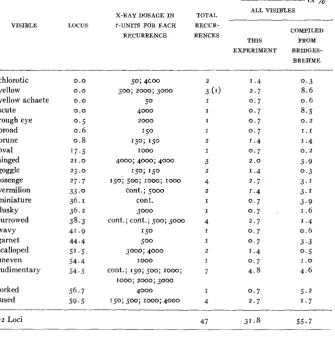
were identified by their distinctive phenotypic appearance and by linkage tests as representing mutations a t known loci in the X chromosome. Most of the others were probably also mutations a t known loci, but in the absence of an easily identified and distinctive phenotype, no attempt has been made t o associate them with known loci. Thus many recessive minute bristle types have been found, but as this phenotype is found a t several X chromosome loci it is difficult to identify them. Table 7 presents the data on the mutants identified,
TABLE 7
Record of visible mitations found at idenlijied loci.
_ _ _ _
_. ~. _.
VISIBLE LOCUS
X-RAY DOSAGE I N r-UNITS FOR EACH RECURRENCE .- chlorotic yellow yellow achaete scute rough eye broad prune oval singed goggle lozenge vermilion miniature dusky furrowed wavy garnet scalloped uneven rudimentary 0.0 0.0 0.0 0.0
0 . 5 0 . 6 0.8 '7.5
2 5 . 0
27.7 33 .o
36.1 36.2 41.9 44.4 51.5 54.4 54.5
21 .O
38.3
forked 56.7
fused 5 9 . 5 22 Loci
50; 4coo
500; 2000; 3000
50
4000
1 5 0
150; 150
4000; 4000; 4000
150; I50
150; 500; 1 0 0 0 ; I o 0 0
cont.; 5000
cont. 3000 cont.; cont.; 500; 3000
150
500
3000; 4000
cont.; 150; 500; 1000; row; 2000; 3000
4000 150; 500; 1000; 4000
2 0 0 0
1 0 0 0
1000
-____
LOCUS MUTATIONS %
___
ALL VISIB'LES
_ _ _ _ _ _ _ _ _ ~ TOTAL
RECUR-
RENCES COMPILED
THIS FROM
EXPERIMENT BRIDGES- BREHME
2 I .4 0.3
3 (1) 2.7 8.6
I 0 . 7 0.6
I 0 . 7 8.5 I 0 . 7 0 . 2
I 0 . 7 1.1
2 1.4 I .4
I 0 . 7 0 . 2 2.0
1.4
2.7
1 . 4
0 . 7
0 . 7
2 . 7
0 . 7
3.9 0.3 3.' 3.' 3.9 1.6
I .4
0 . 6
I 0 . 7 3.3
2 1.4 0 . 5
I 0 . 7 1 . 0
7 4.8 4.6
68 WARREN P. SPENCER AND CURT STERN
tions t o the Notch deficiency have been found but are not listed in the table. The table includes a column showing the percentage of the total number of visibles which has occurred at each locus, and another column for comparison compiled from data on visibles in the report of BRIDGES and BREHME (1944)
based on over 600 visible mutations a t sex-linked loci. (The Bar and white loci were omitted in making this tabulation.) I n general, the visible mutation pic- ture in the two sets of data seems rather consistent. Visibles have beenfound recurring repeatedly a t certain loci known from previous work t o have a rela- tively high mutation rate. Possibly a more accurate comparison could be made if the percentages were doubled for each locus for about half of the visibles which have been included were semilethal visibles, which are not so likely t o have been seen, or, if seen, may have remained unanalyzed in previous work. It would appear that the present mutation rates a t the yellow, scute, miniature, garnet and forked loci are lower than those reported before, but higher a t the furrowed, rudimentary, and fused loci. However, the numbers are too small to be significant. Of the 47 mutants listed in the table, five occurred in the con- trols. This is the same proportion of control visibles to radiation visibles as th a t found among all the visibles recorded in table 6. On the basis of the rela- tively constant visible-lethal ratio at different dosages as indicated by data in table 6, it may be inferred that approximately five more of the visibles listed in table 7 from the radiation lots are actually control visibles. It would seem that most of the visibles listed in table 7 were induced by the radiation. There is no way of knowing which of the specific visible mutations occurring in the radiation experiments were really spontaneous control visibles. Without this knowledge and with consideration of the relatively low number of visibles, it is premature t o speculate whether or not relatively highly mutable loci, pro- ducing visibles even under control conditions, have a high induced visible mutation rate following irradiation. This is a problem worthy of iuture inves- tigation. Extensive experiments on specific loci may show that some react differently from others in the relative numbers of contiol and induced visibles occurring. This, however, would be no proof that the total dosage mutation curve for induced visibles differs from that for induced lethals. Loci yielding lethals may also react differentially from others t o radiation. The latter point would be more difficult to establish owing t o the difficulty of identifying lethal loci. However, the problem might be attacked by studying lethal mutation rates at loci in which visible alleles occur. I n this connection, it is of interest t o note that in the present material, among those lethals tested by linkage tests and not found to be associated with crossover inhibitors, eleven lethals were found so close to the scute locus as to give no crossing over among about zoo
flies per test. Two such lethals were found near the crossveinless locus, three near the vermilion locus, eight near the forked locus, and none near the carna- tion locus. Thus, of 194 lethals not associated with crossover inhibitors and tested for linkage, 24 occurred in the regions of the five marker loci. Of the 148
visibles found, 1 1 were located a t these five loci or gave no crossing over with