Hospital Waste Management Practises in
Dhaka City: A Case Study
Farjana Akter1, Farhana Chowdhury2, Musfira Rahman 3
M. Sc. Student, Department of Water Resources Engineering, Bangladesh University of Engineering and Technology,
Dhaka, Bangladesh1
Assistant Professor, Department of Civil Engineering, Stamford University, Dhaka, Bangladesh2
M. Sc Student, Department of Civil Engineering, Bangladesh University of Engineering and Technology,
Dhaka, Bangladesh 3
ABSTRACT: Wastes generated from hospitals, clinics and places where treatment and diagnosis are done tend to cause the fatal diseases. Although understanding the techniques of medical waste management and existing practises is important, the field of environmental and civil engineering place less importance for this area of study. The study was therefore undertaken to investigate the medical waste categories and management practises followed by two prominent hospitals situated at Dhaka city in Bangladesh which are Dhaka Medical College Hospital and Holy Family Red Crescent Medical College Hospital. The daily average waste generated in Dhaka Medical College Hospital is 4028.33 kg among which Hazardous waste are 871.84 kg (21.64%) and Non-Hazardous waste are 3156.5 kg (78.36%), The daily average waste generated in Holy Family Red Crescent Medical College Hospital is 761.33 kg among which Hazardous waste are 216.83 kg (28.48%) and Non-Hazardous waste are 544.5 kg (71.52%).In case of the disposal of wastes, it was found that disposal at open dumpsites is preferred to other disposal techniques. The study also shows that the existing medical waste management practises are not satisfactory. So, the knowledge and awareness among the individuals carrying out this task should be risen up to a standard level.
KEYWORDS: Medical Waste, Improper Disposal, PRISM, Waste Management
I. INTRODUCTION
II. RELATEDWORK
Medical wastes include non- hazardous and hazardous wastes (infectious, pathological, Pharmaceutical, genotoxics). Hazardous wastes can make the whole waste stream toxic if they are not properly segregated from the non-hazardous portion. Poorly managed health care waste (HCW) expose health care workers, waste handlers, and the community to diseases like hepatitis and AIDS (HIV) infections and may damage the environment (Waste Concern,2005).
Many reports in the literatures have been shown that infection with human immunodeficiency virus (HIV) and hepatitis virus B and C can present a mechanism for transmission of diseases through medical waste (Mulish et. al., 2003).These micro-organisms are mainly transmitted through occupational injuries from infectious sharps by human blood and fluid (Hagen et. al., 2001).
Micro-organism resistant to antibiotics and chemical disinfectants can also add to the hazards formed by improper managed medical waste in healthcare establishment (Muhlichet. al., 2003).Concerted cultures of pathogens and infected sharps such as hypodermic needles are most likely the waste items, which can most sensitive potential hazards to health(Muhlichet. at., 2003).
Chemical waste discharge into the sewerage system is caused for adverse effects on the operation of biological wastewater treatment plans (PRISM, 2004).
Project Oriented Research
In 1999, The Bangladesh Legal Aid Service Trust (BLAST) carried out a study particularly in Sir Salimullah Medical College Hospital, Holy Family Hospital, and Bangabandhu Sheikh Mujib Medical University. The survey assessed the existing medical waste management system. JICA (Japan International Cooperation Agency), working on “Clean Dhaka Master Plan” for solid waste management (JICA, 2004). PRISM Bangladesh a non-governmental environment oriented organization working on different type of waste management such as wastewater treatment by duckweed, solid waste management with safe and final management by compost and eco-friendly hospital waste management in Dhaka, Khulna, Jessore and Tangail district of Bangladesh (PRISM, 2004). They have started their project on hospital waste management since 2002 in Khulna. Now their project is running in Dhaka, Khulna and Jessore district.
III.METHOLOGY
Table 4.1: Capacity of DMCH and HFMCH
Medical College and Hospital DMCH HFMCH
No of departments 28 20
No of wards 45 10
No of operation theatre 11 7
No of beds 1700 528
No of cabins 93 93
No of inpatients 2000 350 No of outpatients 3500 280
Waste generation rate in DMCH and HFMCH
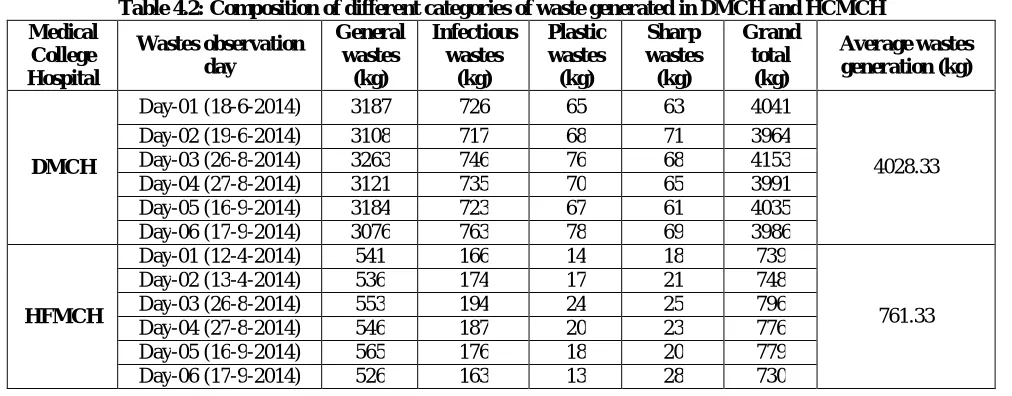
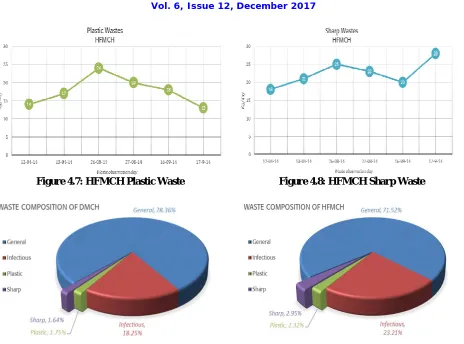
Composition of different categories of waste generated in DMCH and HCMCH is presented in Table 4.2& Figure 4.9 & 4.10.
Table 4.2: Composition of different categories of waste generated in DMCH and HCMCH Medical College Hospital Wastes observation day General wastes (kg) Infectious wastes (kg) Plastic wastes (kg) Sharp wastes (kg) Grand total (kg) Average wastes generation (kg) DMCH
Day-01 (18-6-2014) 3187 726 65 63 4041
4028.33 Day-02 (19-6-2014) 3108 717 68 71 3964
Day-03 (26-8-2014) 3263 746 76 68 4153 Day-04 (27-8-2014) 3121 735 70 65 3991 Day-05 (16-9-2014) 3184 723 67 61 4035 Day-06 (17-9-2014) 3076 763 78 69 3986
HFMCH
Day-01 (12-4-2014) 541 166 14 18 739
761.33 Day-02 (13-4-2014) 536 174 17 21 748
Figure 4.1: DMCH Infectious Waste Generation Figure 4.2: DMCH Hazardous Waste Generation
Figure 4.7: HFMCH Plastic Waste Figure 4.8: HFMCH Sharp Waste
Figure 4.9: Waste Composition of DMCH Figure 4.10: Waste Composition of HFMC
Waste management systems inDhaka Medical College Hospital:
Collection:In DMCH there is a bowl with capacity 2-3 kg kept below the bed of various wards for collecting general waste. This general waste includes plastic, packaging, paper, food, vomit, pharmaceutical waste both liquids and tablets etc.
Separation and segregation:Syringes, needles and saline bags are claimed to be separated for the interchange with the new products from the suppliers by the ward masters and cleaner. But at present some swindle cleaners mishandle the bags and syringes for further selling to the dishonest recycling vendors who are then responsible to supply the improperly treated syringes and bags to the market again.
Disinfection and treatment:Chemical disinfection such as chlorination is also performed in this hospital to disinfect surgical instruments.There was an onside incinerator for treatment of pathological and infectious waste which has been out of order for the last several years. Basically infectious wastes are now disposed off to the DCC bin without any prior treatment.
Internal temporal storage bin:Waste collected from different wards, cabins, departments and operation theatres are then stored in a temporal storage bin until they are finally disposed off to the nearest DCC bin outside the hospital boundary.
thus disposed off to the open DCC bin causes serious health hazard to the scavengers, tokais, waste handling personnel and the public as well as to the environment also.
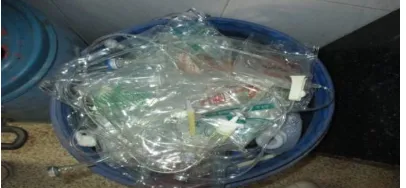
Figure 4.11: DMCH Waste Collection Bin Figure 4.12: DMCH Container Fill with Waste in Storage Room
Figure 4.13: DMCH Incinerator Machine Figure 4.14: DMCH Sharp Wastes on Ground
Waste management system in Holy Family Red Crescent Medical college Hospital
Collection: In Holy family Red Crescent Medical College Hospital there is a bowl with capacity 2-2.5 kg kept below the bed of various wards for collecting general waste which is collected by cleaners and maids to the internal dustbin for temporal storage.
Separation and Segregation:Syringes, needles, saline bags, blood bags and other hazardous pathological and infectious wastes are separated and stored in place within the hospital premises.
Disinfection and treatment: Surgical instruments, patients’ cloths, gloves etc. are autoclaved regularly for sterilization. There are three autoclaved in total. Two of them are computerized vertical type autoclaves and one is non-digital manually driven autoclave.
Internal temporal storage bin: General waste collected from different wards, cabins, departments and operation theatres are thrown away from each floor through and opening into a hollow duct. The duct extends from ground floor to the top of the buildings and is connected to each floor through an opening. The waste thus thrown away are dropped and gathered at the bottom of the duct.
Figure 4.17: Sharp Wastes of Holy Family Figure 4.18: Holy Family Internal Zone for Used Syringes
Lacking of existing waste management system in surveyed hospitals: From the conducted survey the following drawbacks of the existing health care waste management system were discovered.
Segregation at source: Very poor segregation at the point of origination, e.g. at beside bowls pharmaceuticals are thrown off together with general waste, no particular separation for needles and sharps are performed except for DMCH where the needles and syringes are collected in boxes for returning to the suppliers.
Sharps management: Used needles and syringes are not always destroyed or disposed of property in a standard method specified by any guideline.
Waste collection and containerization: No puncture proof container is used for sharp wastes collection. Colour coding is practiced in some hospitals but not in a standardized way.
Internal transport: Trolleys are hardly used for internal transportation of waste.
Occupational health and safety measures for workers: Not safety gowns, masks, gloves or protective clothing are worn by the cleaners.
Recycling and reuse: Some cleaners and scavengers are involved in separating plastics and papers in the temporal storage or DCC bin for recycling.
Treatment: Treatment of plastics for recycling under PRISM is performed in the open place in Matuail land fill site which is not healthier enough for such act as flies roam around the site.
Transportation and ultimate disposal of HCW: Hospital wastes are dumped in the outside DCC bin without much segregation of infectious and anatomical wastes. Wastes are transported by open DCC collector vehicle without any cover at irregular time period during day at pick hour causing health hazard to city people.
V. CONCLUSION
The hospitals in Dhaka city are increasing day by day due to the increase of private entrepreneur ship. The daily average waste generated in Dhaka Medical College Hospital is 4028.33 kg and Hazardous waste are 871.84 kg (21.64%) and Non-Hazardous waste are 3156.5 kg (78.36%), The daily average waste generated in Holy Family Red Crescent Medical College Hospital is 761.33 kg and Hazardous waste are 216.83 kg (28.48%) and Non-Hazardous waste are 544.5 kg (71.52%).The staff education particularly for the workers involved in collection, segregation and in house management in HCW canminimize the quantity in hazardous portion in many situations. The management of HCW in Internal and External management is required by a systematic approach to the handling, storage, transport treatment and disposal of waste by methods that all stages minimize the risk to public and the environment.
REFERENCES
[1] Hagen D.L., Al-Hurnaidi F. and Blake M.A., Infectious waste surveys in a Saudi Arabian hospital: An important qualityimprovement tool, American Journal of Infectious Control, Vol. 29, pp. 198-202, 2004.
[2] JICA, 2004. Clean Dhaka Master Plan, Progress report, JICA: Dhaka.
[3] Lawson, A., UN tackles Dhaka’s medical waste (BBC correspondent in Dhaka), 2004.
[4] Muhlich M., Scherrer M., Daschner F.D., Comparison of infectious waste management in European hospitals, No 55, pp. 260-268, 2003. [5] PRISM Bangladesh, 2004. Survey Report on Hospital Waste Management in Dhaka City, (Ward no. 49 and 57).