Cloud Storage Security Based on Trusted
Third Party Auditing
Priyanka S. Nangare1, Prof. Varsha Dange2
M.E. Student, Dept. of Computer Engineering, DPCOE, Pune, India1
Assistant Professor, Dept. of Computer Engineering, DPCOE, Pune, India2
ABSTRACT: In disseminated processing, data proprietors have their data on cloud servers and customers (data purchasers) can get to the data from cloud servers. Due to the data outsourcing, regardless, this new perspective of data encouraging advantage furthermore displays new security challenges, which requires a self-governing inspecting organization to check the data trustworthiness in the cloud. Guarantee untouchable data set away in the cloud against distortion, adding adjustment to non-basic inability to dispersed stockpiling together with data precision and consistency checking and frustration redesign gets the opportunity to be essential. Starting late, recouping codes have grabbed reputation as an aftereffect of their lower repair information transmission while working honestly if there ought to an ascent an event of disappointment. Thus new structure is proposing an open inspecting arrangement for the recuperating code-based appropriated stockpiling. To deal with the proliferation issue of failed authenticators when the data proprietor is not present, propose structure display middle person authorities, which are endorsed to reproduce the authenticators, into the ordinary open inspecting system model. Likewise, the proposed system plots an innovative open variable authenticator, which is delivered by a couple key. In this way, the arrangement cans out and out release data proprietors from keeping focused web. Expansive security examination shows that the arrangement is secure moreover test evaluation exhibits that the arrangement is exceedingly beneficial.
KEYWORDS: Cloud storage, regenerating codes, public audit, privacy preserving, authenticator regeneration, proxy,
privileged, provable secure.
I. INTRODUCTION
Conveyed capacity is without further ado grabbing reputation since it offers a flexible on-interest data outsourcing organization with connecting with benefits: lightening of the weight for limit organization, comprehensive data access
with range self-governance, and evading of capital utilization on gear, programming, and individual systems of support, etc.,[2]. Regardless, this new perspective of data encouraging advantage moreover brings new security perils toward customers data, thusly making individuals or enter priers still feel hesitant. It is seen that data proprietors lose great control over the fate of their outsourced data; in this way, the exactness, openness and uprightness of the data are being put at peril. From one viewpoint, the cloud organization is regularly stood up to with a wide extent of inside/external enemies, who may malevolently delete or decline customers' data; on the other hand, the cloud administration suppliers may act deceitfully, trying to hide data hardship or degradation and attesting that the files are still precisely secured in
method [9]. To totally ensure the data uprightness and recuperation the customers' estimation resources furthermore online weight, we propose an open assessing arrangement for the recouping code-based circulated stockpiling, in which the respectability checking and recuperation are executed by a pariah evaluator and a semi-trusted delegate autonomously for the advantage of the data proprietor.
II. RELATED WORK
In [3] this paper shows consider the issue of remotely checking the uprightness of recuperating coded data against debasements under a bona fide circulated capacity setting. We arrange and complete a convenient data genuineness protection (DIP) plan for a specific recouping code, while sparing its trademark properties of adjustment to non-basic disappointment and repair-movement saving. Our DIP arrangement is made under an adaptable Byzantine not well arranged model, and enables a client to for all intents and purposes check the reliability of unpredictable subsets of outsourced data against general or malicious corruptions. It works under the essential supposition of unstable appropriated stockpiling and allows differing parameters to be changed for an execution security trade off. It completes and evaluate the overhead of our DIP arrangement in a certified appropriated stockpiling test bed under different parameter choices. It further separate the security characteristics of our DIP arrangement by method for numerical models. Structure arrangement FMSR-DIP codes, which enable reliability affirmation, adjustment to inside disappointment, and profitable recovery for disseminated stockpiling.
In [4] this paper first arranges an examining structure for conveyed stockpiling systems and propose a beneficial and assurance shielding assessing tradition. By then, It extend our surveying tradition to reinforce the data dynamic operations, which is profitable and provably secure in the sporadic prophet model. It further extend reviewing tradition to reinforce bunch looking at for both different proprietors and various fogs, without using any trusted organizer. The structure proposes a viable and secure component inspecting tradition, which can meet the above recorded necessities. To deal with the data security issue, our methodology is to make an encoded check with the test stamp by using the Linearity property of the bilinear coordinating, such that the inspector can't unscramble it however can affirm the rightness of the affirmation. Without using the cloak methodology, strategy does not require any trusted organizer in the midst of the bunch inspecting for different fogs.
In [5] this paper, structure propose a versatile scattered stockpiling respectability reviewing framework, utilizing the homomorphic token and spread destruction coded data. The proposed plot grants customers to audit the circulated stockpiling with incredibly lightweight correspondence and figuring cost. The assessing result ensures strong dispersed stockpiling rightness guarantee, and also at the same time fulfills speedy data screw up repression, i.e., the recognizing evidence of raising hell server. Considering the cloud data are capable in nature, the proposed arrange further sponsorships secure and capable component operations on outsourced data, including square modification, deletion, and addition. In this paper, maker propose an intense and versatile spread stockpiling check arrangement with express component data support to ensure the precision and openness of customers data in the cloud. It rely on upon destruction modifying code in the record dispersal status to give redundancies and surety the data consistency against Byzantine servers, where a limit server may fall level in optional ways. This advancement drastically diminishes the correspondence and limit overhead when stood out from the routine replication-based archive dispersal frameworks. By utilizing the homomorphic token with flowed affirmation of cancellation coded data, plan finishes the limit rightness security and data botch constraint: at whatever point data contamination has been recognized in the midst of the limit precision check, our arrangement can basically guarantee the simultaneous imprisonment of data bungles, i.e., the unmistakable evidence of the getting boisterous server(s).
III. MOTIVATION
direct authenticator and irregular veiling to ensure that the TPA would not realize any learning about the information content put away on the cloud server amid the productive examining process, which not onlyeliminates the weight of cloud client from the repetitive and potentially costly inspecting undertaking, additionally eases the clients apprehension of their outsourced information spillage. Considering TPA might simultaneously handle numerous review sessions from various clients for their outsourced information records. The proposed framework outlines a novel homomorphic authenticator, which can be produced by a few mystery keys and confirmed openly. Using the straight subspace of the recovering codes, the authenticators can be registered proficiently. The plan is first to permit protection safeguarding open evaluating for recovering code-based distributed storage. The proposed plot totally discharges information proprietors from online weight for the recovery of squares and authenticators at broken servers and it gives the benefit to an intermediary for the reparation.
IV. EXISTING APPROACH
Existing framework outlined and actualized an information trustworthiness assurance (DIP) plan for FMSR [6]-based distributed storage and the plan is adjusted to the meager cloud setting. Be that as it may, the two are intended for private review, just the information owner is permitted to check the trustworthiness and repair the faultyservers. Considering the expansive size of the outsourced information and the client's obliged asset ability, the undertakings of examining and reparation in the cloud can be impressive and costly for the clients [7]. The overhead of utilizing distributed storage ought to be reduced however much as could reasonably be expected such that a client does not have to perform an excess of operations to their outsourced information. [8] Specifically, clients might not have any desire to experience the unpredictability in checking and reparation. The reviewing plans in [9] and [1] suggest the issue that clients need to continuously stay on the web, which might hinder its selection by and by, particularly for long haul authentic capacity.
V. PROPOSED APPROACH
Proposed framework use Elliptic bends to build people in general key cryptography framework. The key size for this calculation is little henceforth information transmission required less data transfer capacity and time .Public-key cryptography depends on the obstinacy of certain numerical issues. Early open key frameworks, for example, the RSA calculation, are secure expecting that it is hard to figure a huge whole number made out of two or all the more substantial prime elements. For elliptic-bend based conventions, it is expected that finding the discrete logarithm of an arbitrary elliptic bend component concerning an openly known base point is infeasible. The measure of the elliptic bend decides the trouble of the issue. It is trusted that the same level of security managed by a RSA-based framework with an extensive modulus can be accomplished with a much littler elliptic bend bunch. Utilizing a little gathering lessens capacity and transmission necessities. For current cryptographic purposes, an elliptic bend is a plane bend which comprises of the focuses fulfilling the mathematical statement.
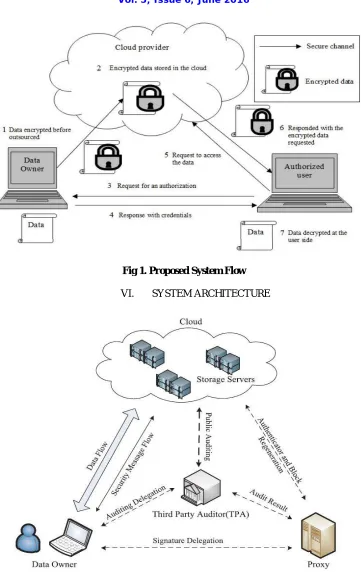
Fig 1. Proposed System Flow
VI. SYSTEM ARCHITECTURE
1. Data owner encrypt the data which he want to store in the cloud. 2. At the same time data owner generate public key and private key.
3. Next step is data owner store his encrypted file on the cloud at the same time that file will be stored on the proxy agent.
4. Data owner send the secret key to the Third Party Auditor and Proxy.
5. Third Party Auditor contains the hash code of the file of data owner as well as file stored on the cloud.
6. Third Party Auditor continuously auditing the hash code for the original file and hash code of the cloud file. If Third Party Auditor found change in the hash code it immediately inform or send acknowledgement to the proxy agent.
7. Then proxy agent replaces the changed file in the cloud.
VII. MODULEINFORMATION
1. Cloud Server:
Which are managed by the cloud service provider, provide storage service and have significant computational resources.
Responsibility:
1. Dealing with receive data from Data Owner. 2. Store the Data in encrypted form.
3. Give the Data read permissions to authorized User. 4. Accept and Replacement of Data through Proxy Agent.
2. Data Owner / Cloud Client:
Data Owner owns large amounts of data files to be stored in the cloud.Data owner refers to both the possession of and responsibility for information. Data Owner implies power as well as control. The control of information includes not just the ability to access, create, modify, package, derive benefit from, sell or remove data, but also the right to assign these access privileges to others.
Responsibility:
1. Use or Data Owner able to Outsource their Data. 2. Encrypt the Data while Outsourcing of it.
3. Delegation between Data Owner and Proxy Agent.
4.Generate ask secrete key and Assign to the corresponding Authenticators present in PA. 5. Data User able see data Stored on cloud Server and can make request to the Data or file.
3. Third Party Auditor:
TPA has expertise and capabilities to conduct public audits on the coded data in the cloud, the TPA is trusted and its audit result is unbiased for both data owners and cloud servers.
Responsibility:
1. Examining the outsourced data and data owner Data to ensure the Data Integrity. 2. Public Auditing by checking h(.) code.
3. Send Acknowledgement to the Proxy for decision making.
VIII. MATHEMATICAL MODELING APPROACH
Let us consider S as system for regenerating code based cloud storage using public auditing scheme,
Where,
s = Start of the web Server. 1. Log in with Server.
2. Deploy the web application on web Server. e = End of the web Application.
To retrieve the useful traveling package pattern form dataset and provide recommendation to the Tourist.
X = Input of the program.
X={F,m,ɸ,Ψ}
F be the File.
Mbe the Number of file block. ɸ be the Authenticators.
Ψ be the Block of code.
Y = Output of the program.
Y = {┴}
┴ be the new coded block.
Responses and outputs a new coded block set by authenticator i.e. ┴
X,YƐ U
Let, U be the Set of System.
U = {F,┴,A,R}
Where F, ┴, A, R are the elements of the set.
F=File
┴= new Block of Code.
A= public Auditing. R= File Replacement.
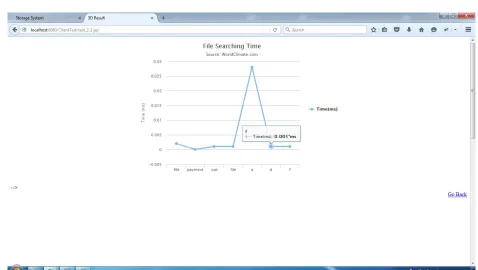
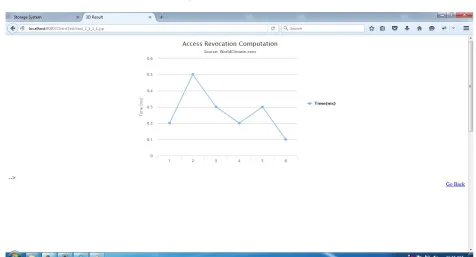
IX. EXPERIMENTALSETUPANDRESULT
Fig 3: File Upload Time
Fig 5: File Download Time
X.CONCLUSION
Subsequently the system propose an open assessing arrangement for the recuperating code-based dispersed stockpiling structure, where the data proprietors are advantaged to allot TPA for their data authenticity checking. To secure the primary data assurance against the TPA, I will randomize the coefficients in any case as opposed to applying the outwardly impeded framework in the midst of the assessing procedure. Considering that the data proprietor can't by and large stay online for all intents and purposes, with a particular finished objective to keep the limit open and variable after a malignant corruption, I bring a semi-trusted middle person into the system exhibit and give an advantage to the delegate to handle the reparation of the coded pieces and authenticators. Wide examination exhibits that these proposed arrangement is provable secure, and the execution evaluation will show that propose arrangement is exceedingly compelling and can be consolidated into a recouping code-based circulated stockpiling structure.
REFERENCES
[1] Jian Liu, Kun Huang, Hong Rong, HuimeiWang, and Ming XianPrivacy-Preserving Public Auditing for Regenerating-Code-Based Cloud Storage IEEE TRANSACTIONS On Information Forensics And Security, VOL. 10, NO. 7, JULY 2015.
[2] M. Armbrustet al., “Above the clouds: A Berkeley view of cloud computing,” Dept. Elect. Eng. Comput.Sci., Univ. California, Berkeley, CA, USA, Tech. Rep. UCB/EECS-2009-28, 2009.
[2]H. C. H. Chen and P. P. C. Lee, Enabling data integrity protection in regeneratingcoding- based cloud storage: Theory and implementation, IEEE Trans. Parallel Distrib. Syst., vol. 25, no. 2, pp. 407416, Feb. 2014.
[3] K. Yang and X. Jia, An efficient and secure dynamic auditing protocol for data storage in cloud computing, IEEE Trans. Parallel Distrib. Syst., vol. 24, no. 9, pp. 17171726, Sep. 2013.
[4] C. Wang, Q. Wang, K. Ren, N. Cao, and W. Lou, Toward secure and dependable storage services in cloud computing, IEEE Trans. Service Comput., vol. 5, no. 2, pp. 220232, Apr./Jun. 2012.
[5] Y. Hu, H. C. H. Chen, P. P. C. Lee, and Y. Tang, “NCCloud: Applying network coding for the storage repair in a cloud-of-clouds,” in Proc.USENIX FAST, 2012, p. 21.
[6] C. Wang, Q. Wang, K. Ren, and W. Lou, “Privacy-preserving public auditing for data storage security in cloud computing,” in Proc. IEEEINFOCOM, Mar. 2010, pp. 1–9.
[7] C. Wang, S. S. M. Chow, Q. Wang, K. Ren, and W. Lou,“Privacy-preserving public auditing for secure cloud storage,” IEEE Trans. Comput., vol. 62, no. 2, pp. 362–375, Feb. 2013.
[8] B. Chen, R. Curtmola, G. Ateniese, and R. Burns, “Remote data checking for network coding-based distributed storage systems,” in Proc ACM Workshop Cloud Comput. Secur. Workshop, 2010, pp. 31–42.
[9 ]A. G. Dimakis, K. Ramchandran, Y.Wu, and C. Suh, A survey on network codes for distributed storage, Proc. IEEE, vol. 99, no. 3, pp. 476489, Mar. 2011.
[10]Y. Hu, H. C. H. Chen, P. P. C. Lee, and Y. Tang, NCCloud: Applying network coding for the storage repair in a cloud-of-clouds, in Proc. USENIX FAST, 2012, p. 21.
[11] G. Atenieseet al., “Provable data possession at untrusted stores,” in Proc. 14th ACM Conf. Comput.Commun.Secur.(CCS), New York, NY, USA, 2007, pp. 598–609.