Identification of
Cis-regulatory Elements in the Mouse
Pax9/Nkx2-9
Genomic
Region: Implication for Evolutionary Conserved Synteny
Fabio Santagati,*
,1Kuniya Abe,
†Volker Schmidt,
‡Thomas Schmitt-John,
‡Misao Suzuki,
§Ken-ichi Yamamura** and Kenji Imai
†,2*GSF-National Research Center for Environment and Health, Institute of Developmental Genetics, D-85764 Neuherberg, Germany,
†Technology and Development Team for Mammalian Cellular Dynamics, RIKEN Tsukuba Institute, BioResource Center,
Ibaraki 305-0074, Japan,‡Developmental Biology and Molecular Pathology, University of Bielefeld, 33501 Bielefeld,
Germany and§Center for Animal Resources and Development and**Institute of Molecular Embryology and
Genetics, Kumamoto University, Kumamoto 862-0976, Japan Manuscript received January 23, 2003
Accepted for publication April 28, 2003
ABSTRACT
We previously reported close physical linkage betweenPax9andNkx2-9 in the human, mouse, and pufferfish (Fugu rubripes) genomes. In this study, we analyzedcis-regulatory elements of the two genes by comparative sequencing in the three species and by transgenesis in the mouse. We identified two regions including conserved noncoding sequences that possessed specific enhancer activities for expression ofPax9in the medial nasal process and of Nkx2-9in the ventral neural tube. Remarkably, the latter contained the consensus Gli-binding motif. Interestingly, the identifiedPax9 cis-regulatory sequences were located in an intron of the neighboring geneSlc25a21. Close examination of an extended genomic interval around Pax9revealed the presence of strong synteny conservation in the human, mouse, and Fugu genomes. We propose such an intersecting organization ofcis-regulatory sequences in multigenic regions as a possible mechanism that maintains evolutionary conserved synteny.
T
HE sequencing of genomes has opened new re- four paralogous subgroups. The products of the Pax genes have major roles during embryonic development search perspectives for the full interpretation ofin the processes of tissue patterning and organogenesis genomic codes, not only by allowing the comprehensive
(Dahlet al.1997). One subgroup consists ofPax9and recognition of protein coding and noncoding
tran-its paralogPax1. The two genes share a high sequence scribed sequences, but also by facilitating the
identifica-homology and show a very widely overlapping expres-tion of regulatory sequences responsible for the control
sion pattern.Pax9is expressed mainly in the sclerotome of correct gene expression in time and space. The
identi-of the somites, in the pharyngeal pouch endoderm and fication of evolutionarily conserved noncoding
se-its derivatives, in the developing limb buds, and in the quences (CNSs) among orthologous genomic regions
facial mesenchyme of neural-crest cell origin, including of different species has been proven to be a powerful
nasal and jaw processes and tooth buds (Neubu¨ seret
guide for the localization of cis-acting transcriptional
al.1995). A targeted mutagenesis approach has shown regulatory elements (KoopandNadeau1996;
Hardi-thatPax9exerts a fundamental function for the normal
son2000;Wassermanet al.2000). The elucidation of
development of several facial structures, such as the
cis-regulatory elements in a genome is an important
secondary palate, teeth, and laryngeal cartilage, of the starting point for the identification of the specific
bind-third and fourth pharyngeal pouch derivatives like para-ing factors and therefore for the subsequent discovery
thyroid glands, ultimobranchial bodies, and the thymus, of the molecular pathways that control the mechanisms
and of the limbs (Peterset al. 1998). A role of Pax9
of cellular differentiation and physiology.
in vertebral column development was observed only in
Pax9 belongs to the paired-box (Pax) transcription
Pax1;Pax9 double-mutant mice, which show a much factor gene family. The Pax family in vertebrates
in-more severe phenotype than that of single Pax1 mu-cludes nine members that are further subdivided into
tants, while single Pax9 null mutants do not exhibit vertebral column defects (Peterset al.1999).
No cis-regulatory mechanism that controls specific
Sequence data from this article have been deposited with the
expression of Pax9 in time and space has been
de-EMBL/GenBank Data Libraries under accession no. AF267536.
scribed. In the framework of the search forcis-regulatory
1Present address:Institut de Ge´ne´tique et de Biologie Mole´culaire et
Cellulaire, CNRS/INSERM/ULP, Colle`ge de France, 67404 Illkirch, elements of Pax9, we previously described the exon-Strasbourg, France.
intron structure ofPax9inHomo sapiens,Mus musculus,
2Corresponding author:GSF-National Research Center for
Environ-andFugu rubripes(Santagatiet al.2001). The analysis
ment and Health, Institute of Developmental Genetics, Ingolsta¨dter
Landstrasse 1, D-85764 Neuherberg, Germany. E-mail: [email protected] of thePax9genomic region in the three species
mouse embryos was performed according to the protocol
de-transcription factor gene, Nkx2-9. Nkx2-9 codes for a
scribed bySpo¨ rleandSchughart(1998). After rehydration
member of the Nk2 transcription factor family, charac- of paraformaldehide-fixed embryos in methanol/PBS, all in-terized by the Nk2 homeobox. Nkx2-9 is initially ex- cubation and washing steps were automatically processed by
InsituPro (INTAVIS Bioanalytical Instruments AG, Ko¨ln,
Ger-pressed in the ventral half of the developing neural
many).
tube of the mouse embryo in the entire axis and, as development progresses, its expression becomes re-stricted to the brain region (Pabst et al. 1998). Pax9
RESULTS
andNkx2-9lieⵑ80 kb apart from each other in a
head-to-head orientation on human chromosome (HSA) Identification of candidates forcis-regulatory elements by comparative sequencing:The human sequence (Gen-14q13 and on mouse chromosome (MMU) 12, while
they are only 10 kb apart in Fugu. Bank accession no. AL079303) consisted of a nearly 200-kb genomic region from 18 200-kb downstream ofNKX2-9
In this work, we investigatedNkx2-9andPax9
tissue-specific enhancers by interspecies sequence comparison to 84 kb downstream ofPAX9(note their head-to-head organization as shown in Figure 1). The mouse se-and by transgenesis. Through an extended genomic
analysis and the identification of more associated genes quence was derived from the combination of two over-lappingPax9-positive BAC clones, 136M3 (GenBank ac-that enlarged the region of the conserved synteny, we
propose a model for the regulatory sequence organiza- cession no. AC040982) and 327I21 (GenBank accession no. AC079959) from the RPCI-23 mouse BAC library. tion of this region and suggest a possible interpretation
for the strong synteny conservation with evolutionary The 24.4-kb Fugu sequence (GenBank accession no. AF267536) was determined by sequencing a cosmid considerations.
clone including Nkx2-9andPax9. This Fugu sequence ranges from 1.9 kb downstream of Nkx2-9 to 6.5 kb
MATERIALS AND METHODS downstream ofPax9. Consistent with the fact that the
Fugu genome is eight times more compact than the
Genomic sequence comparison:Alignment and search for
human genome (Elgaret al. 1996;KoopandNadeau
homologous regions between large genomic sequences of
dif-ferent species were carried out with the PipMaker program 1996), this Fugu genomic interval largely overlaps with
(Schwartzet al.2000) available on the web site at Pennsylva- the 200-kb human reference interval. A comparison
be-nia State University (http://bio.cse.psu.edu/pipmaker). The tween the human and mouse sequences by PipMaker reference human sequence was masked against repetitive DNA
analysis revealed that the entire genomic interval
dis-with RepeatMasker (http://ftp.genome.washington.edu/RM/
played a significant degree of homology, indicating a
RepeatMasker.html).
Construction of transgenic constructs with CNSs: A 1-kb remarkable conservation even outside of the coding
fragment containing the CNS-6 segment was amplified from sequences (Figure 1). The BLASTZ alignment of Pip-bacterial artificial chromosome (BAC) DNA by PCR with prim- Maker analysis found numerous (ⵑ2000) ungapped se-ers 5⬘-CATTTTGCCAGAGGCAGAGG-3⬘ and 5⬘-AAGGGAC
quence segments that were similar between humans and
AGTGAGCGGTCTG-3⬘ and was cloned in SmaI-linearized
mice (depicted as dots or bars in Figure 1). Of these
pASShsp68lacZpA (provided by H. Sasaki). Its original
orienta-tion with respect to the mouse Nkx2-9promoter was main- conserved sequence segments, we focused on segments
tained in the construct. A 2.5-kb fragment containing the that were at least 100 bp long and at least 70% identical, CNS⫹2 segment was amplified with primers 5⬘-GGACCAGG according to the criteria suggested by Loots et al. CCTTTGTATAAGGC-3⬘ and 5⬘-TGATTGTGACCCCTGGTT
(2000). In this way, we found 100 of the conserved
TAGC-3⬘and cloned as above. The integrity of all constructs
segments as putative CNSs. Of these, 4 and 8 segments
was verified by sequencing, and their inserts were excised from
the vector sequence bySalI digestion. were found to correspond to exons ofNkx2-9andPax9,
Generation of transgenic mice:Transgenic mice were gener- respectively, and were excluded from further analyses. ated by pronucleus injection of linearized transgene con- A BLAST search was performed for each of the re-structs into fertilized eggs that were subsequently transferred
maining 88 putative CNSs to verify whether they really
into the oviducts of pseudopregnant foster females. X-gal
stain-represented noncoding sequences. Surprisingly, 7 of
ing was performed as described (Peters et al. 1998) on
founder transgenic embryos. To obtain sectioned views, X-gal- them lying downstream of PAX9 matched the cDNA
stained embryos were cut by scalpel at levels as indicated (Fig- sequence ofSLC25A21.SLC25A21codes for a mitochon-ure 3, A–D). Yolk sacs were used for DNA preparation for drial oxodicarboxylate carrier protein, which is ubiqui-PCR genotyping (primer pairs 5⬘-AGGTGACACTATAGAAG
tously present in the inner mitochondrial membrane
GATCCG-3⬘, 5⬘-GGTGCTAGCTCAACTGGTGG-3⬘and 5⬘-TCT
and plays a central role in amino acid metabolism (
Fier-CATGCTGGAGTTCTTCG-3⬘, 5⬘-AGCATTTGTATTTCTGAT
GCCAAC-3⬘). monteet al.2001). The mouse counterpart ofSLC25A21
Whole-mount RNAin situ hybridization: A mouse Nkx2-9 (hereafter referred to asSlc25a21) liesⵑ2 kb from the probe was amplified by RT-PCR from total RNA of embryonic 3⬘end of Pax9in a tail-to-tail orientation. SLC25A21/ day 11.5 mouse embryos and cloned in pCRII-TOPO
(In-Slc25a21consists of 10 exons that are distributed over
vitrogen, San Diego). An antisense probe was transcribed with
a large genomic region ofⵑ500 kb. These 7 conserved
SP6 RNA polymerase on XhoI-linearized template. A sense
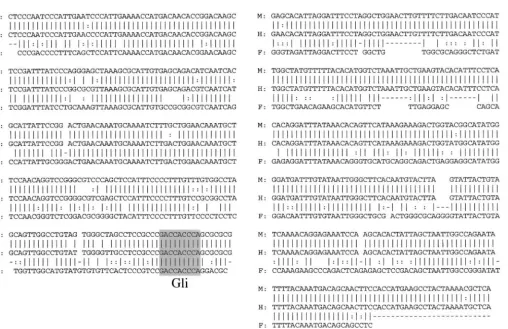
Figure2.—Sequence alignment of CNS-6 (A) and CNS⫹2 (B). Within the 200-kb interval analyzed by PipMaker, these regions are the only two segments of noncoding sequences that show a significant degree of homology among humans, mice, and Fugu. Vertical bars, double dots, and dashes indicate perfect matches, transitions, and gaps, respectively. In CNS-6, the potential Gli-binding sites with the complete consensus motif are shaded. M, mouse; H, human; and F, Fugu.
were excluded from further investigations. Thus, the al.2001), to include an additional gene,Slc25a21. The fourth hit was detected insideSlc25a21intron 7 in the rest of 81 sequence segments were regarded as true
CNSs. These CNSs often appeared in clusters, and we close vicinity of exon 8 (Figure 2B). This region coin-cided with the mouse-human CNS⫹2.
found 15ⵑ1-kb genome segments that contained
multi-ple CNSs, including very long ones, which were distrib- Transient transgenesis with CNS constructs: To test the potential regulatory activity of the selected CNS uted over the whole region examined (CNS-8–CNS⫹7;
Figure 1). segments, we performed a transient transgenic assay in founder embryos. The general design of the experiment In contrast, in the alignment of the Fugu and human
sequences, only a small number of homologous seg- was to place a test genomic fragment upstream of alacZ
reporter cassette with a minimal promoter from mouse ments were detected by PipMaker analysis (Figure 1).
In the intergenic region betweenPax9 andNkx2-9, se- Hsp68. (Kotharyet al.1989;SasakiandHogan1996).
CNS-6 segment drives Nkx2-9 expression in the ventral
neu-quences within the CNS-6 region also were found
con-served in Fugu (Figures 1 and 2A). Downstream ofPax9, ral tube:CNS-6 and CNS⫹2, which are conserved in all three species, were tested by this enhancer assay. CNS-6 four distinct hits were identified by PipMaker analysis.
Interestingly, three of these conserved segments fell into is onlyⵑ1.5 kb from the 5⬘end ofNkx2-9and consists of a 422-bp sequence with an overall 85% identity between three exons of SLC25A21 (exons 7, 8, and 10) in the
corresponding human sequence. AlthoughSlc25a21in humans and mice. Within this sequence a 244-bp seg-ment had 80% conservation with the Fugu DNA (Figure the mouse and in Fugu has not been described, this
result provides evidence for the presence of the ortholo- 2A). Five independent mouse embryos at E10.5 carried the CNS-6 transgene, and all of them showed lacZ ex-gous gene ofSLC25A21in the two species. This finding
was very intriguing, because it extended the region of pression upon X-gal staining. As compared to endoge-nousNkx2-9expression (Figure 3, D and H), expression conserved synteny among the three vertebrate species,
Figure3.—X-gal staining of CNS-6 transgenic embryos. (A–C) Whole-mount overview of transgenic founder embryos at E10.5-E11. lacZ expres-sion is clearly visible along the whole neural tube. (D) RNAin situ hybrid-ization ofNkx2-9at E10.5 as control. E–H show transversal dissections of the whole embryos depicted in A–D, respectively. The section level is indi-cated in A–D with a line. Note that X-gal staining is consistently seen in the ventral part of the neural tube (yellow arrowheads in E–G). The lo-cation of the notochord is indicated (nc in E–H).
in both levels and tissue-specific patterns, including irre- Pax9expression can also be detected in the more inter-nal medial nasal processes as well as in the lateral nasal producible ectopic staining in diverse structures (Figure
3, A–C and E–G). Nevertheless, all of the samples shared process (Figure 4D). Thus the CNS⫹2 segment does not appear to contain all the elements required for the a common positive domain in the ventral neural tube
(Figure 3, E–G). This lacZ expression in the ventral complete expression ofPax9in the nasal processes. neural tube corresponds well to that of endogenous
Nkx2-9 (Figure 3, D and H). Thus, our data strongly
DISCUSSION
suggest that the CNS-6 segment includes cis-acting
se-quences that regulateNkx2-9expression in the ventral Identification of enhancers for expression ofNkx2-9
andPax9:This work provides the first evidence for the neural tube. This Nkx2-9expression pattern has been
shown to be dependent on Sonic hedgehog (Shh) sig- elucidation of cis-regulatory elements that control ex-pression of the physically linked but distinctly regulated naling from the floor plate (Pabst et al.2000), which
is mediated by Gli transcription factors as the final ef- genes Pax9 and Nkx2-9. The CNS-6 segment directed the transcription of the reporter gene in the ventral part fectors. Consistent with this model, a fully conserved
consensus sequence of nine bases for the Gli-binding of the neural tube. The analysis of the CNS-6 sequence revealed not only a high degree of sequence conserva-site (GACCACCCA), originally found inFoxa2(Sasaki
et al.1997), was recognized within the CNS-6 sequence tion among the three species, but also a putative binding site for Gli proteins with a complete match to the con-in all three species (Figure 2A).
CNS⫹2 segment possessed the enhancer activity of Pax9 sensus sequence identified inFoxa2(Sasakiet al.1997). In the 200-kb Nkx2-9/Pax9 genome interval of the
expression in the medial nasal process:The second fragment
tested was CNS⫹2. This segment was located very close mouse, we found three of the nine-base Gli-binding motif, but the one included in CNS-6 is the only one to exon 8 ofSlc25a21inside the preceding intron. The
human/mouse homologous region was 594 bp long that is conserved in humans, mice, and Fugu. Whether the identified sequence in CNS-6 functions as a Gli-with an overall identity of 95%, 300 bp of which were
homologous to the Fugu sequence with 64% identity binding site remains to be confirmed in future studies. Our finding that CNS⫹2 is able to direct transgene (Figure 2B). A 2.2-kb segment of the mouse sequence,
including CNS⫹2 and part ofSlc25a21exon 8, was used expression selectively in the oral edge of the medial nasal processes but not in the remaining mesenchymal for the transgenic construct. Three transgenic founder
embryos at E11.5 were produced with this construct. tissues suggests that each of thePax9-expressing struc-tures is independently regulated. Thus, the regulatory Besides inconsistent X-gal staining in several domains
that did not match with the endogenousPax9expres- mechanisms that control the whole cranio-facial devel-opment may be very complex and diverse, consistent sion pattern, a very specific expression was observed in
all of the embryos in the ventromedial region of the with the composite distribution of signaling molecules and transcription factors involved in facial development medial nasal processes (Figure 4, A–C). This domain
overlapped with the two stripes of endogenousPax9ex- (Francis-Westet al.1998). CNS⫹2 is located only 8 kb downstream of the last exon of Pax9, but remarkably pression in the same structures (Figure 4D), suggesting
that CNS⫹2 includescis-regulatory elements that drive this region is in the seventh intron of the neighboring gene Slc25a21. The entire genomic interval that
and, within the introns of a neighboring gene, localize the protein tyrosine phosphatase-RQ gene. Recently, an-other remarkable example of a complex organization of genes in mammals has been reported forShh( Let-tice et al. 2002). The genomic region containing the limb-specific control elements of Shhwas identified to beⵑ800 kb away from the gene itself inside the introns of theLmbr1gene in humans and mice. Moreover, at least one more gene has been located betweenShhandLmbr1, suggesting that these elements can exert their specific function on the target gene despite large genomic dis-tances and the presence of other intervening genes.
Conserved synteny around Pax9: Our finding that
Slc25a21physically links toPax9in the human, mouse, and Fugu genomes has extended the region of con-served synteny in the three species that we described earlier (Santagatiet al.2001). Moreover, close exami-nation of the mouse and human genome sequences from GenBank (mouse, NW_000053; human, NT_025892) has revealed that this region of conserved synteny extends even further with at least four additional genes included. In the mouse and human genomes,Nkx2-1(orTitf1) and
Mbip(Fukuyamaet al.2000) are found on the centro-meric side ofNkx2-9, and Mipol1(Kondohet al. 2002)
Figure4.—X-gal staining of CNS⫹2 transgenic embryos.
andFoxa1are located on the telomeric side ofSlc25a21.
A–D show reporter (lacZ) expression in the ventral part of the
Thus, the order of the genes in the synteny group is:
facial structures from three independent transgenic founder
Mbip—Nkx2-1—Nkx2-9—Pax9—Slc25a21—Mipol1—Foxa1.
embryos at E11.5 (A–C) in comparison to endogenousPax9
expression detected by RNAin situhybridization at E11.0 (D). In the Fugu genome (http://www.ensembl.org), five of
(A–C) The reporter expression is consistently observed in the the seven genes also physically link together: Mbip, oral edge of the medial nasal processes (MNP) as indicated
Nkx2-1,Nkx2-9,Pax9, andSlc25a21. Whether Fugu
coun-by black arrowheads. (D)Pax9 is very strongly expressed in
terparts of Mipol1 and Foxa1 are also associated with
the corresponding part of the MNP. Note that Pax9 is also
these linked genes cannot be determined on the basis
expressed in the dorsal part of the MNP (red arrowhead) and
in the lateral nasal processes (LNP). of the currently available Fugu sequence data.
Interestingly, a similar physical linkage is encoun-tered for mouse and human paralogs of many of these tains all cis-regulatory elements of Pax9 has not been genes. The paralogous genes ofPax9,Nkx2-9, andNkx2-1
determined. By BAC transgenesis we tested whether a arePax1,Nkx2-2, andNkx2-4, respectively, and they are 195-kb BAC clone, including 130 kb upstream and 50 known to physically link in MMU2 and in HSA20p11 kb downstream of Pax9, contained all cis-regulatory (Wanget al.2000;Santagatiet al.2001). By close exami-elements of Pax9. Our preliminary result showed that nation of genome sequence data (mouse, NW_000178; thePax9-BAC transgene could only partially reproduce human, NT_011387), we found thatFoxa2, the paralog endogenous expression of Pax9 (see the supplemen- ofFoxa1, also fell into this synteny group. Furthermore, tal figures available online at http://www.genetics.org/ within the human genome sequence betweenPAX1and supplemental). This observation suggests that additional FOXA2, a computer-predicted gene with homology toSLC cis-regulatory elements ofPax9 are located outside this 25A21 (named LOC200259 or SLC21A5L) was present. BAC interval. It should be noted that this BAC clone Thus, the locus order in this synteny group is:Nkx2-4— contained not only Pax9 but also its flanking genes, Nkx2-2—Pax1—Slc25a5l—Foxa2. Similarly, in Fugu, we
Nkx2-9and part of Slc25a21, on either side. Taken to- could confirm the physical association ofNkx2-4,Nkx2-2, gether, our results suggest thatcis-regulatory elements andPax1in the genome annotation data (http://www. of Pax9 are interspersed in a wide genomic interval, ensembl.org). Together, gene order in the two paralo-even in the regions of neighboring genes. The correct gous genome segments includingPax9orPax1is highly expression ofPax9in a particular domain may be deter- conserved in the human, mouse, and Fugu genomes. mined by the concomitant function of separate control In lower chordates, only one member for each paralo-elements, even at a long genomic distance from each gous gene pair is present, strongly suggesting that the other, as exemplified in the case of mouse Myf5 and genomic regions evolved through duplication of a com-mon ancestral genome (Figure 5). This genomic region
Figure5.—A model of the origin and conserva-tion of the syntenic regions including Nkx2-2/9 andPax1/9paralogous gene pairs. From the con-served synteny of thePax1/Pax9genomic regions and the genetic information about lower chordates such as amphioxus, it can be assumed that in the ancestral genome of chordate progeni-tors a set of at least five genes (ancesprogeni-tors of Nkx2-1/4,Nkx2-2/9,Pax1/9,Slc25a21/5l, andFoxa1/2) were tightly associated. A series of genome dupli-cation events brought about the evolutionary burst that caused the origin of vertebrates. The Pax1/9 syntenic region also underwent duplica-tion, originating two sets of paralogous genes that afterward independently diversified, acquiring distinct functions up to the present time. The presence of interspersed regulatory cis-elements throughout this genomic region may have been working as the driving force that has kept these genes tightly associated through evolution.
surrounding thePax1/9gene may include at least four that the plasticity of the genome in the events of shuf-other linked genes that have maintained their physical fling and reorganization during evolution has been inev-association from the primitive situation predating the itably limited to some extent. The rearrangement units locus duplication up to the present time. Following this may not have been single genes but the blocks of physi-duplication event, these paralogous gene pairs diversi- cally linked genes. Hence, in the future, the search for fied their roles, contributing to the variety of functional- cis-regulatory elements not only will lead to a better ities in vertebrates (Figure 5). To our best knowledge, understanding of the molecular mechanisms that con-such a synteny conservation between mammals and fish trol gene expression, but also will provide insights into involving five to seven genes maintaining the same gene genome evolution.
order has never been described in detail before. More- We acknowledge H. Sasaki, P. A. Iannou, K. Araki, and F. Stewart over, the comparison between two paralogous genomic for providing plasmid constructs as indicated in the text. We thank
segments includingPax9orPax1allowed us to speculate B. Rey, A. Krause, and G. Michel for their contribution to the genera-tion of transgenic mice; M. Wahl for providing informatics tools for
on the organization of a putative ancestral genome. This
genomic sequence analyses; and R. Balling, L. Bally-Cuif, and J. Favor
physical association might reflect a fixed multigenic
for critical reading of the manuscript and helpful comments. This
transcriptional domain whose members (at least the
work was supported in part by the Deutsche Forschungsgemeinschaft
five genes in Figure 5) cannot be separated without and the GSF-Forschungszentrum and in part by the Ministry of Educa-compromising their normal function. The nature of tion, Culture, Sports, Science and Technology of Japan, with Special Coordinating Funds for Promoting Science and Technology (K.A.).
this functional bond has still to be investigated, but the strong indication from our study that at least some of thePax9regulatory elements are interspersed or inter-digitated over a widespread multigenic region can already
LITERATURE CITED
account for a decisive factor to maintain their physical
Carvajal, J. J., D. Cox, D. SummerbellandP. W. Rigby, 2001 A
linkage. As mentioned above, the tight physical linkage
BAC transgenic analysis of theMrf4/Myf 5locus reveals
interdig-betweenMyf 5andMrf4is likewise conserved in all the itated elements that control activation and maintenance of gene vertebrate species so far analyzed (Carvajalet al.2001). expression during muscle development. Development128:1857–
1868.
It is logical to deduce that this kind of genomic
organiza-Dahl, E., H. KosekiandR. Balling, 1997 Pax genes and
organo-tion of genes and their regulatory elements represents genesis. Bioessays19:755–765.
an irresolvable constraint for neighboring genes. Elgar, G., R. Sandford, S. Aparicio, A. Macrae, B. Venkatesh
et al., 1996 Small is beautiful: comparative genomics with the
In conclusion, interpretation of our results in light
pufferfish (Fugu rubripes). Trends Genet.12:145–150.
of similar examples in the literature leads to some new Fiermonte, G., V. Dolce, L. Palmieri, M. Ventura, M. J. Runswick general considerations. The presence of intersecting et al., 2001 Identification of the human mitochondrial oxodicar-boxylate carrier. Bacterial expression, reconstitution, functional
regulatory sequences in multigenic genomic regions
characterization, tissue distribution, and chromosomal location.
conceivably represents a key point in genome evolution.
J. Biol. Chem.276:8225–8230.
The onset and fixation of regulatory elements inside the Francis-West, P., R. Ladher, A. Barlow andA. Graveson, 1998
Signalling interactions during facial development. Mech. Dev.
territory of neighboring genes constitutes a functional
75:3–28.
bond resulting in the physical association between the
Fukuyama, K., M. Yoshida, A. Yamashita, T. Deyama, M. Baba
genes. These associations in time might have extended, et al., 2000 MAPK upstream kinase (MUK)-binding inhibitory
protein, a negative regulator of MUK/dual leucine
Hardison, R. C., 2000 Conserved noncoding sequences are reliable Peters, H., B. Wilm, N. Sakai, K. Imai, R. Maaset al., 1999 Pax1 and Pax9 synergistically regulate vertebral column development. guides to regulatory elements. Trends Genet.16:369–372.
Kondoh, S., H. Sugawara, N. Harada, N. Matsumoto, H. Ohashi Development126:5399–5408.
Santagati, F., J. K. Gerber, J. H. Blusch, C. Kokubu, H. Peterset et al., 2002 A novel gene is disrupted at a 14q13 breakpoint of
t(2;14) in a patient with mirror-image polydactyly of hands and al., 2001 Comparative analysis of the genomic organization of Pax9and its conserved physical association withNkx2–9in the feet. J. Hum. Genet.47:136–139.
Koop, B. F., andJ. H. Nadeau, 1996 Pufferfish and new paradigm human, mouse, and pufferfish genomes. Mamm. Genome12: 232–237.
for comparative genome analysis. Proc. Natl. Acad. Sci. USA93:
1363–1365. Sasaki, H., andB. L. Hogan, 1996 Enhancer analysis of the mouse
HNF-3 beta gene: regulatory elements for node/notochord and
Kothary, R., S. Clapoff, S. Darling, M. D. Perry, L. A. Moranet
al., 1989 Inducible expression of an hsp68-lacZ hybrid gene in floor plate are independent and consist of multiple sub-elements. Genes Cells1:59–72.
transgenic mice. Development105:707–714.
Lettice, L. A., T. Horikoshi, S. J. Heaney, M. J. Van Baren, H. C. Sasaki, H., C. Hui, M. NakafukuandH. Kondoh, 1997 A binding site for Gli proteins is essential for HNF-3beta floor plate
en-Van Der Lindeet al., 2002 Disruption of a long-range cis-acting
regulator for Shh causes preaxial polydactyly. Proc. Natl. Acad. hancer activity in transgenics and can respond to Shh in vitro. Development124:1313–1322.
Sci. USA99:7548–7553.
Loots, G. G., R. M. Locksley, C. M. Blankespoor, Z. E. Wang, W. Schwartz, S., Z. Zhang, K. A. Frazer, A. Smit, C. Riemeret al., 2000 PipMaker—a web server for aligning two genomic DNA
Milleret al., 2000 Identification of a coordinate regulator of
interleukins 4, 13, and 5 by cross-species sequence comparisons. sequences. Genome Res.10:577–586.
Spo¨ rle, R., andK. Schughart, 1998 Paradox segmentation along Science288:136–140.
Neubu¨ ser, A., H. KosekiandR. Balling, 1995 Characterization inter- and intrasomitic borderlines is followed by dysmorphology and developmental expression of Pax9, a paired-box-containing of the axial skeleton in theopen brain(opb) mouse mutant. Dev. gene related to Pax1. Dev. Biol.170:701–716. Genet.22:359–373.
Pabst, O., H. Herbrand andH. H. Arnold, 1998 Nkx2–9 is a Wang, C., C. T. Brodnicki, N. G. Copeland, N. A. JenkinsandR. P.
novel homeobox transcription factor which demarcates ventral Harvey, 2000 Conserved linkage of NK-2 homeobox gene pairs domains in the developing mouse CNS. Mech. Dev.73:85–93. Nkx2–2/2–4 and Nkx2–1/2–9 in mammals. Mamm. Genome11:
Pabst, O., H. Herbrand, N. Takuma and H. H. Arnold, 466–468.
2000 NKX2 gene expression in neuroectoderm but not in mes- Wasserman, W. W., M. Palumbo, W. Thompson, J. W. Fickettand endodermally derived structures depends on sonic hedgehog in C. E. Lawrence, 2000 Human-mouse genome comparisons to mouse embryos. Dev. Genes Evol.210:47–50. locate regulatory sites. Nat. Genet.26:225–228.
Peters, H., A. Neubu¨ ser, K. KratochwilandR. Balling, 1998