Access Point Handover for Network Coverage
based Wi-Fi Advisory System
Akhila V 1, Jalaja G 2
P.G. Student, Department of Computer Science & Engineering, BNMIT, Bengaluru, Karnataka, India1
Associate Professor, Department of Computer Science & Engineering, BNMIT, Bengaluru, Karnataka, India2
ABSTRACT: Wi-Fi sensing automatically connects to nearby Wi-Fi networks, and provides greater Internet
connectivity options. Conventional techniques for Wi-Fi sensing are Participatory Sensing and Opportunistic Sensing [1]. Activity Diary refers to an aggregation of data based on human activity. Smart-city applications use this Activity Diary to comprehend City Dynamics in order to make way for urban planning with respect to wireless network distribution, coverage, connectivity and location. Public Wi-Fi advisory system [2] extracts data using Opportunistic Sensing and Data Aggregation Algorithm. To provide uninterrupted connection to users’ devices, a novel method called AP Handover [3] is been proposed. The results indicate that this Method significantly reduces data communication overhead on the AP side, thereby facilitating efficient utilization of bandwidth, while simultaneously saving time and energy at the user and AP side.
KEYWORDS: Wi-Fi Sensing, Participatory Sensing, Opportunistic Sensing, Activity Diary, Data Aggregation
Algorithm, AP Handover.
I. INTRODUCTION
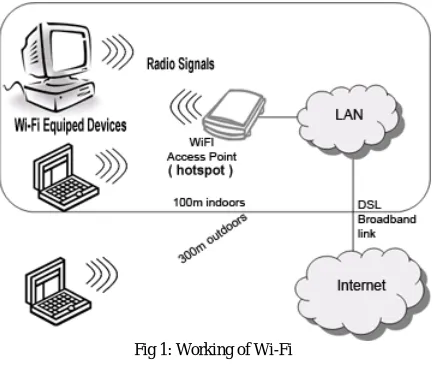
Wireless LAN (WLANs) is broadly used for communication networks for a considerable long time. As convenient gadgets get to be Predominant, an interest to get access to internet without any requirement on area has been developing. The wireless connectivity is more vital, particularly used for cell phones, tablets, as other social media activities. As the internet traffic increases, the history of WLANs is not long. Wi-Fi technology [4] is a wireless LAN. Local area network (LAN) [5] is a PC framework that interfaces PCs through wires in a little area. It offers data rates around 80 to 90 Mbps. To interface contraptions in a LAN, unprecedented endeavors to set up security are required to keep customers from using tasks and data. Frameworks are difficult to set up and ought to be kept up by gifted pros. Exhausting holes in dividers, running connections in lofts makes it all the more expensive and dreary. In light of these hindrances, Wireless Local Area Networks (WLAN) [6] has been introduced. WLAN is an area framework without wires. Convenient customers can get information and framework resources through WLANs as they go to social affairs, group up with various customers, or move to various ranges in the premises. WLAN is not an exchange for wired establishment. It is an extension to wired LAN. WLAN is industrially known as Wi-Fi. Fig 1 demonstrates the working of LAN and WLAN.
COMPONENTS OF WLAN
WLANs comprises of the beneath parts.
Wi-Fi Access Point: It is networking equipment that permits remote gadgets to associate with a wired system utilizing Wi-Fi.
Wi-Fi Access Gateway: It routes bundles of packets from a remote LAN to another system. It might be executed as programming, equipment, or mix of both. It also consolidates the elements of a remote access point, a router, and regularly gives firewall capacities.
Authentication, Authorization and Accounting (AAA): The AAA server is an Internet server program
that handles client demands for access to Internet PC assets and, for a versatile administration supplier, gives validation, approval, and accounting administrations. The AAA server collaborates with system access and gateway servers and with databases and catalogs containing client data.
Internet: The Internet is a worldwide arrangement of interconnected PC that organizes utilization of the
standard Internet protocol suite (TCP/IP) to connect a few gadgets around the world. It is a worldwide system of systems that comprises of private, open, scholarly, business, and government parcel exchanged systems, connected by a wide cluster of electronic, remote, and optical systems administration advancements.
Fig 1: Working of Wi-Fi
II. RELATED WORK
Sensor-enabled devices have helped numerous application that consolidate either Participatory sensing and Opportunistic sensing [1] to sense data in daily life. Such sensing innovations are abused to study human exercises [7], Transportation action derivation [8], System quality [9][10]. The participatory detecting includes human engagement to Settle on choice on the timing of detecting, gathering information, while the opportunistic sensing gathers information Without human choice just when the required information is accessible. In any case, applications utilizing participatory Detecting approaches exceptionally depend on independent bootstrapping information to pull in more information Commitments from people. In this manner, it considers detecting approaches for gathering independent bootstrapping information. The wireless coverage, connectivity, and locations based on crowd sourcing data collected by devices for a Wi-Fi advisory system. We exploit opportunistic sensing technology to collect Wi-Fi network information in the daily life and implement a Wi-Fi network monitoring system for understanding wireless network better in a city area.
III.SYSTEM REQUIREMENTS
To be efficiently used, computer software needs hardware components or other software resources to be present on a computer. These prerequisites are known as system requirements and are often used as a guideline. Most software defines two sets of system requirements:
minimum
With increasing demand for higher processing power and resources in newer versions of software, system requirements tend to increase over time.
SOFTWARE REQUIREMENTS
Operating system: Windows XP/7.
Coding Language: JAVA, J2ee
Tool: NETBEANS 8.1
Database: ORACLE 10G
HARDWARE REQUIREMENTS
System: Pentium IV 2.4 GHz.
Hard Disk: 40 GB.
Floppy Drive: 1.44 Mb.
Monitor: 15 VGA Colour.
Mouse : Logitech.
Ram: 512 Mb.
IV.MODULES DESCRIPTION
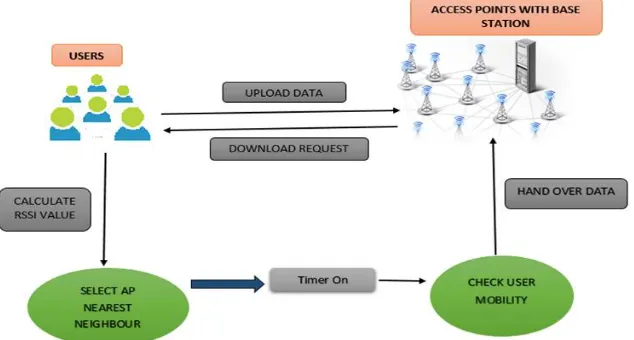
The system proposed follows a 2-way functional architecture where primarily the user raises a request to the Access Point (AP) for data connectivity. While the request is shared, the trigger performs two actions. The Base Station is a body, which contains information about all Access Points and controls them. Firstly, the Access Points communicate to the Base Station about the incoming request from the user, registers this information and passes an authorization parameter.
Secondly, the request triggers an instruction to enquire about the RSSI Value of the user. The request helps in inspecting the User Coordinates, Coverage (Threshold) details and Mobility details. The Fig 2 shows the system architecture. An algorithm is followed to monitor user mobility and the nearest Access Point to communicate to the user’s device continuously in order to provide a seamless data connectivity.
The modules are:
User and Base station
This module creates user and base stations by using basic attributes such as Username, Coordinates, System Name and Port Number and provides authentication for both user and base station modules.
AP Discovery
This module links the User to the Access Point. Access Point coordinates are determined, and the covered mobility region in which users are present is fixed.
Neighbours AP Discovery
This module discovers the neighbour AP using node and AP coordinates. By comparing the distance between AP and node, then checking user position, it helps locating the AP closest to the user by collecting RSSI Value.
Content Downloading
When a search request is received from a user, the server determines user coordinates and processes the query. Meanwhile, a timer at the AP is triggered to check the user position. Access point has a threshold value, which iscompared with user position. Therequest iseasily processed if the user is within AP coverage area.
AP Handover
In this module, AP Handover is explained. If user position is beyond AP coverage, there is relay of user data along with hash code from AP in question to the neighbour AP. The new AP then sends a notification to the user, which is to be responded using the hash code. Following this authentication, the user request can be processed.
V. DATA AGGREGATION ALGORITHM
Data Aggregation Algorithm is used to infer the locations of Wi-Fi Access Points
Firstly based on Wi-Fi BSSIDs, we figure subset of samples S = {PI, P2… Pn} for each Wi-Fi access point so that Pi and Pj have the same BSSID, for Pi, Pj € S.
Based on the coordinates of locations, we group samples S into several clusters, denote by {C1, C2... Cm}. for two samples Pi and Pj, if |li –lj| < §, Pi and Pj belong to the same cluster, where § is pre-defined threshold.
For each cluster Ci c S, we compute average positioning accuracy by A(Ci) =
Based on average positioning accuracy, we sort clusters {C1, C2... Cm} in increasing order. Finally choose the top-k clusters, denoted by {C1, C2, ... , Ck}, to infer the location of the Wi-Fi access point byVI.SEQUENCE DIAGRAM
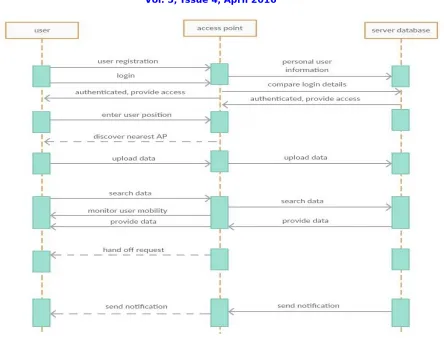
Fig 3: Sequence Diagram
VII. EXPERIMENTAL RESULTS
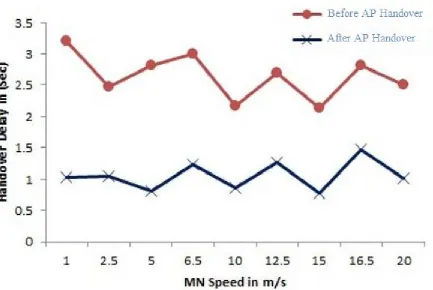
Fig 4: Comparison of AP Handover Delay and speed
Fig 5: Comparison w.r.t Bandwidth
VIII. CONCLUSION
new Access Points. Access Points relay user data to succeeding Access Points resulting in uninterrupted connectivity, efficient utilization of bandwidth, saves time and energy.
REFERENCES
[1] N. D. Lane, S. B. Eisenman, M. Musolesi, E. Miluzzo. And A. T. Campbell, "Urban sensing systems: Opportunistic or participatory?"in Proceedings of the Workshop on Mobile Computing Systems and Applications (HotMobile), 2008.
[2] Fang-Jing Wu and Wen-Ching Lin “Understanding Wireless Network Coverage,Connectivity, and Locations using Opportunistic Sensing for
a WiFi Advisory System” in 2015 IEEE Tenth International Conference on Intelligent Sensors, Sensor Networks and Information Processing (ISSNIP) Singapore, 7-9 April 2015.
[3] “Survey on Access Point Handover Decision Algorithm” in 2014.
[4] “An Introduction to Wireless Technologies” by F. Ricci in 2010/2011.
[5] “An Introduction to Local Area Networks” by david d. clark, kenneth t.pogran, david p. wed in November 1978.
[6] “An Overview of Wireless Local Area Networks” by Ibrahim Al Shourbaj
[7] Y. Wang, 1. Liu, Y. Chen, M. Gruteser, 1. Yang, and H. Liu, "E-eyes:device-free location-oriented activity identification using fine-grained
wifi signatures," in ACM Int'l Con! Mobile Computing and Networking, 2014, pp. 617-628.
[8] F.-J. Wu and H. B. Lim, "Urban Mobility Sense: A user-centric participatory sensing system for transportation activity surveys," IEEE Sensors
Journal, vol. 14, no. 12, pp. 4165-4174, 2014.
[9] "OpenSignal: 3G and 4G LTE Cell Coverage Map," http://opensignal.coml.
[10] A. Faggiani, E. Gregori, L. Lenzini, V. Luconi, and A. Vecchio, "Smartphone-based crowdsourcing for network monitoring: Opportunities,