Determination and Study of Mechanical
Properties for the Metal-Metal Matrix as
Functional Graded Material (Al-SiC)
M.Vadivel1 , M.Pradeep2, R.Pradeep Kumar3, M.Prakash4, B.Rajavel5
Assistant Professor, Dept. of Mechanical Engineering Angel College of Engineering and Technology,
Tirupur, India. 1
Students, Dept. of Mechanical Engineering Angel College of Engineering and Technology, Tirupur, India. 2345
ABSTRACT: Materials science FGM may be characterized by the variation in composition and structure gradually over volume, resulting in corresponding changes in the properties of the material. Various approaches based on the bulk (particulate processing), perform processing, layer processing and melt processing are used to fabricate the functionally graded materials. FGM are very important in engineering and other applications but cost of producing these materials makes it prohibitive in some applications.
I.INTRODUCTION
Functionally Graded Material (FGM) belongs to a class of advanced material characterized by variation in properties as the dimension varies. The overall properties of FMG are unique and different from any of the individual material that forms it. There is a wide range of applications for FGM and it is expected to increase as the cost of material processing and fabrication processes are reduced by improving these processes. In this study, an overview of fabrication processes, area of application, some recent research studies and the need to focus more research effort on improving the most promising FGM fabrication method (solid freeform SFF) is presented. Improving the performance of SFF processes and extensive studies on material characterization on components produced will go a long way in bringing down the manufacturing cost of FGM and increase productivity in this regard.
There is limit to which a material can be dissolved in a solution of another material because of thermodynamic equilibrium limit [2]. When more quantity of the alloying material is desired, then the traditional alloying cannot be used. Another limitation of conventional alloying is when alloying two dissimilar materials with wide apart melting temperatures; it becomes prohibitive to combine these materials through this process. Powdered Metallurgy (PM) is another method of producing part that cannot be produced through the conventional alloying, as alloys are produced in powdered form and some of the problems associated with the conventional alloying are overcome. Despite the excellent characteristics of powdered Metallurgy, there exist some limitations, which include intricate shapes and features that cannot be produced using PM; the parts are porous and have poor strength. Although these limitations are of advantage to some applications (e.g. filter and non structural applications) but are detrimental to others. Another method of producing materials with combination of properties is by combining materials in solid state, which is referred to as composite material.
II. RAW MATERIALS
A. Aluminium
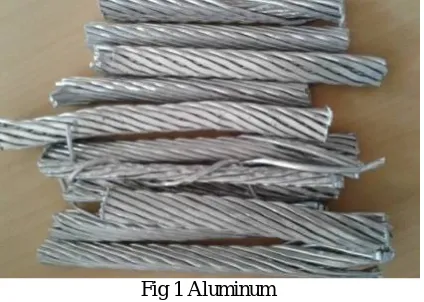
attack by fuels and solvents, and the ability to be formed and treated on conventional equipment. It possesses excellent casting properties and reasonable strength. Aluminium is a chemical element in the boron group with symbol AL and atomic number 13 and it is silvery-white, soft, non magnetic, ductile material by mass aluminium makes up about 8% of earth crust. Aluminium is remarkable for metals low density and it’s ability to resist corrosion through the phenomenon of passivation. aluminium and it’s alloy are vital to the aerospace industry and impotant in transportation and structures , such as building facades and window frame. The oxides and sulfates are the most usefull compound of aluminium.This alloy is best suited for mass production of lightweight metal castings. Fig. 1 shows Aluminium.
Fig 1 Aluminum
B. Silicon Carbide
Fig 2 Silicon Carbide
III. SPECIMEN PREPARATION
Two specimens were prepared by using stir casting. Table I shows composition of different reinforcements which were added in functional graded material Aluminium.
Sample no. Aluminum (Al)in Wt%
Silicon Carbide(SiC)
in Wt%
1 90 10
TABLE I COMPOSITION OF RAW MATERIALS USED
A. Stir Casting Procedure
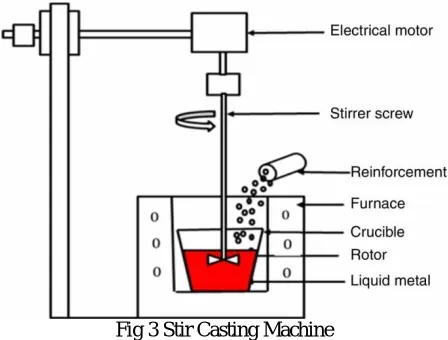
Among the variety of manufacturing processes available for functional graded material (FGM), stir casting process is generally accepted as a particularly promising route, currently practiced commercially. Its advantage lies in its simplicity, flexibility and applicability to large quantity production. First of all stirring system has been developed by coupling motor with gear box and a mild steel stirrer. All the melting was carried out in graphite crucible in a oil-fired furnace. Bars of aluminium were preheated at 1000°C for 3 to 4 hours before melting and mixing the SiC particles were preheated at 800c for 1 to 3 hours to make surface oxidized.
The furnace temperature was first raised above the liquids to melt the scraps completely and was then cool down just below the liquids to keep the slurry in semi solid state. At this stage the preheated SiC particles were added and mixed by means of stir casting setup. After sufficient manual mixing was done, the composites slurry was reheated to fully liquid state and then automatic mechanical mixing was carried out for above 10 minutes at a normal stirring rate of 600rpm. In the final mixing process, the furnace temperature was controlled with in 760°C. pouring of composites slurry has been carried out in the die mould prepared according to pin dimensions. Fig. 3 shows the Stir Casting Machine.
Fig 3 Stir Casting Machine
IV. RESULTS AND DISCUSSION
A. Hardness Test
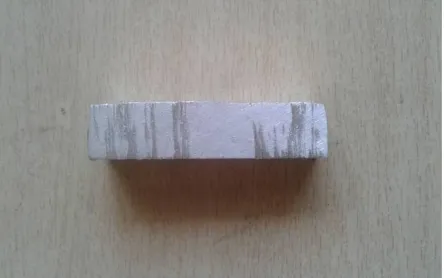
using a specified force. The ball is then removed and the diameter of the resulting indentation is measured using a microscope. The Specimen used is of IS 1500 standard. Readings on 3 locations were taken and average reading of each sample was considered. Fig. 4 shows the specimens of hardness test.
Table I shows the hardness of the composites. Among the different specimen, Al6063 reinforced with 10% Boron and 5% Graphite has the highest hardness of 38 BHN. But for Al6063 5% Boron carbide, 5% Graphite Hardness value decreases to 34 BHN.
Fig 4 specimens of hardness test
TABLE I HARDNESS OF THE COMPOSITES Aluminum Silicon
Carbide HARDNESS
(BHN) 34
B. Impact Test
In an impact test a notched bar of material, arranged either as a cantilever or as a simply supported beam, is broken by a single blow in such a way that the total energy required to fracture it may be determined. The energy required to fracture a material is of importance in cases of -shock loading when a component or structure may be required to absorb the K.E of a moving object. Energy absorbed is the energy which isabsorbed by the material. The
energy is calculated in joules.The energy absorbed is calculated the energy available at theend. The energy absorbed
can be found with the help of Charpy impact tests. The standard specimen size for Charpy impact testing is
10mm×10mm×55mm. Fig.5 shows the specimens of Impact testing.
Table II shows the energy absorbed by the composites. For Al7075, Al7075 + 3% Zircon, Al7075 + 6% Fly Ash and Al7075 + 3% Zircon + 6% Fly Ash energy absorbed are 2J. It is clear that energy absorbed is same for all
compositions. Fig. 10 shows energy absorbed by the Composites. TABLE II ENERGY ABSORBED BY THE COMPOSITES
Aluminum Silicon Carbide
IMPACT
(JOULS) 2.1
C. Wear Test
The dry sliding wear tests were performed on pin-on-disc apparatus. Wear test samples were made of size ø7×50mm. The rotating disc material is made of EN-31 steel with the hardness of 63 HRC. Sliding wear tests were conducted on track diameter 15mm with load 10N, sliding speed 0.314 m/s and sliding distance 113.097 m. The dry sliding wear was observed by measuring weight loss. Weight loss of pins was converted into volume loss using density of specimens. Fig.6 shows the specimens used for wear tests. Table III shows Wear rate, Specific Wear rate and Coefficient of Friction.
Fig 6 Specimens of Wear Test
TABLE III WEAR RATE AND FRICTION FORCE
S N O SP EE D L O A D W E A R T I M E BEFO RE WEIG HT AFTE R WEIG HT AFTE R WEIG HT FRICTIO N FORCE
1 750 20 14 7
2
0 12.883 12.871 12.871 11.1
2 100 20 35 2
2
0 12.088 12.049 12.049 7.2
3 125 0 20
40 7
2
V.CONCLUSION
Thus by this project we concluding by saying that the increase in percentage of silicon carbide will results in better hardness as compared to those aluminium pieces which are tested in hardness testing machine.
REFERENCES
1. H.Riedel, T.Kraft, in: W.A.Kaysser (Ed.), Functionally Graded Materials 1998, Proceedings of the 5th International Symposium on FGM 1998, Trans Tech Publications, Switzerland, 1999, pp. 1035–1040.
2. H.Ehbing, W.Michaeli, in: W.A.Kaysser(Ed.), Functionally Graded Materials 1998, Proceedings of the 5th International Symposium on FGM 1998, Trans Tech Publications, Switzerland, 1999,pp. 107–112.
3. C.Uhlig, E.Fliedner-Dimke, H.Goering, J.Bauer, M.Bauer, H.Queck, in: W.A. Kaysser (Ed.), Functionally Graded Materials 1998, Proceedings of the 5th International Symposium on FGM 1998, Trans Tech Publications, Switzerland, 1999, pp. 113–120.
4. E.I.Elghandour, F.A. Kokailah, S.A.Khalil, S.R. Naga, in: B. Ilschner,N. Cherradi (Eds.), FGM’94, Proceedings of the 3rd International Symposium on Structural and Functional Gradient Materials 1994, Presses Polytechniques et Universitaires Romandes, Lausanne, 1995, pp. 673–678.
5. M.Sasaki, T.Hiratani, T.Hirai, in: J.B. Holt, M. Koizumi, T.Hirai, Z.A. Munir (Eds.), Ceram. Trans. 34, Functionally Gradient Materials, American Ceramic Society, Westerville, OH, 1993, pp. 369–376.
6. S.Sato, T. Nose, S. Masuda, S. Yanase, in: W.A. Kaysser (Ed.), Functionally Graded Materials 1998, Proceedings of the 5th International Symposium on FGM 1998, Trans Tech Publications, Switzerland, 1999, pp. 567–572.
7. J.L.Hilden, K.P.Trumble, in: W.A.Kaysser (Ed.), Functionally Graded Materials 1998, Proceedings of the 5th International Symposium on FGM 1998, Trans Tech Publications, Switzerland, 1999, pp. 157–162.
8. G.Zimmermann, A.Schievenbusch, in: W.A.Kaysser (Ed.), Functionally Graded Materials 1998, Proceedings of the 5th International Symposium on FGM 1998, Trans Tech Publications, Switzerland, 1999, pp. 533–538.
9. Güntner, P.R. Sahm, in: W.A. Kaysser (Ed.), Functionally Graded Materials 1998, Proceedings of the 5th International Symposium on FGM 1998, Trans Tech Publications, Switzerland, 1999, pp. 187–192.
10. Q.Wang, Z. Huang, S. Ramakrishna, in: K. Trumble, K. Bowman, I. Reimanis, S. Sampath (Eds.), Functionally Graded Materials 2000, Proceedings of the 6th International Symposium on Functionally Graded Materials 2000, Ceramic Transactions 114, American Ceramic Society, Westerville, OH, 2001, pp. 89–96.
11. T. Seefeld, C. Theiler, E. Schubert, G. Sepold, in: W.A. Kaysser (Ed.), Functionally Graded Materials 1998, Proceedings of the 5th International Symposium on FGM 1998, Trans Tech Publications, Switzerland, 1999, pp.459–466.
12. Neubrand, A. Kawasaki, in: K. Trumble, K. Bowman, I. Reimanis, S. Sampath (Eds.), Functionally Graded Materials 2000, Proceedings of the 6th International Symposium on Functionally Graded Materials 2000, Ceramic Transactions 114, American Ceramic Society, Westerville, OH, 2001, pp. 705–712.