Improvement of Subgrade Characteristics by
using Lime & Rice Husk Ash
Ashutosh Pathak 1, Yogesh Pathak 2
Assistant Professor, Department of Civil Engineering, Rajkiya Engineering College, Ambedkar Nagar, U.P, India1 Assistant Professor, Department of Civil Engineering, Rajkiya Engineering College, Ambedkar Nagar, U.P, India2
ABSTRACT: Procurement of conventional materials in huge quantity required for construction of Subgrade of road is becoming very difficult in many locations due to various problems. On the other hand due to increasing economic growth & industrialization, a huge quantity of waste materials generated needs land for disposal & from that generally creates problems for public health & ecology. So need has arisen for proper disposal of the waste materials. Study brings out the effect of siliceous compound available in amorphous form in burnt Rice Husk Ash, when different doses are mixed with weak soil increases the subgrade strength characterstics. Geotechnical engineering properties like Liquid limit, Plastic limit, Compaction characteristics, CBR values of soil have been studied in this work. On addition of Rice Husk ash the diffused double layer thickness of mixture increases and hence water holding capacity of soil mixtures increases. Specific gravity decreases on addition of ash. On addition of Rice Husk ash the gradation of mixture is adversely affected which leads in reduction of dry density. Rice Husk ash can be used as a good stabilizer along with lime.
KEYWORDS:Rice Husk Ash, Lime, CBR, Compaction Characteristics, Subgrade.
I. INTRODUCTION
In the present scenario, India is the third largest in the world after U.S.A. having a road network of 3.3 million kms. This network has been intensified upon adoption of prestigious projects like Pradhan Mantri Gram Sadak Yojana (PMGSY), Golden Quadlateral, as well as National Highway Development Project by the Government of India. In recent times the demand for subgrade material has increased due to increased constructional activities in the road sector & due to paucity of available nearby land to allow excavate fill materials for making subgrade. In this situation a means to overcome this problem is to utilize the different alternative generated waste materials which cause not only environmental hazards & also the disposal problems. Utilizing these materials in the area of road construction, after improving their characteristics properly can provide useful solution to this problem.
II. RELATEDWORK
III. MECHANISMINVOLVEDINSTABILIZATION
Lime reacts with any other fine pozzolanic component (such as hydrous silica and RHA minerals) to form calcium-silicate hydrate with soil particles. This reaction is also water insoluble. The cementing agents are exactly the same for ordinary Portland cement. The difference is that the calcium silicate gel is formed from the hydration of anhydrous
calcium silicate (cement), whereas with the lime, the gel is formed only by the removal of silica from the clay minerals of the soil. The pozzolanic process may be written as
Ca(OH)2 + SiO2= C-S-H Ca(OH)2 + Al2O3 =C-S-H
Note: C-S-H is cemented material).
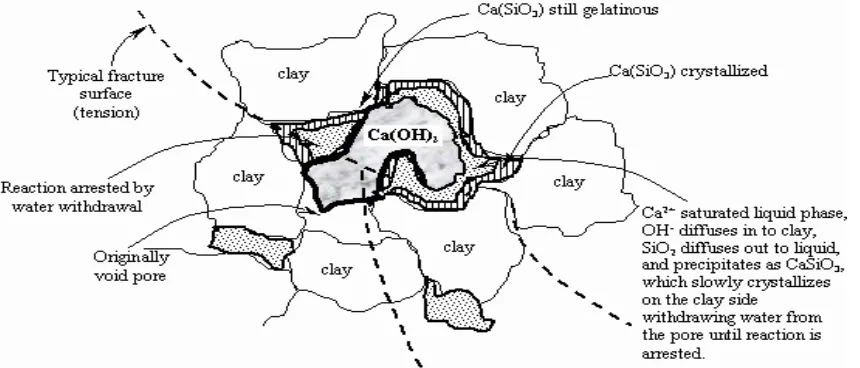
The silicate gel proceeds immediately to coat and bind clay lumps in the soil and to block off the soil voids in the manner shown by Figure. In time, this gel gradually crystallizes into well-defined calcium silicate hydrates such as
tobermorite and hillebrandite. The micro-crystals can also mechanically interlock. The reaction ceases on drying, and very dry soils will not react with lime or cement. The mechanism of the reaction can be represented as
NAS4H + CH ® NH + CAS4H ® NS + degradation product*
< NH + C2SH* 8 (2CH)
Where: S = SiO2, H = H2O, A = Al2O3, C = CaO, N = Na2O
Figure 1:- Reaction mechanism of stabilization on clay soils (Ingles, 1972)
Rice Husk ash containing cementitious material called pozzolana, interact with soils to attain stabilized status. Use of Rice Husk ash for soil stabilization attributes to the chemical composition and physical characteristics of ash, which favour pozzolanic reactions.
IV.MATERIALSUSED
Soil: In these study three types of materials namely clayey soil, rice husk ash and lime have been used. Soil has been collected from the shallow depth of the nearby field in the Lambua near Sultanpur District. Table -1 shows properties of virgin soil.
Table 1-Properties of Soil
Sl.No Properties Soil
1 Light Compaction MDD 1.876 gm/cc OMC 16.28% 2 Specific Gravity 2.67
3 CBR Unsoaked 6.95 %
Soaked 3.86 % 4 Atterberg Limit Liquid Limit 27
Plastic Limit 21 Plasticity Index 6
Rice Husk Ash: Rice husk ash, a predominantly siliceous material is collected from a rice mill which is situated at Lucknow in Uttar Pradesh. Table-2 shows properties of Rice Husk Ash.
Table 2-Chemical Composition of RHA
Fe2O3 0.54
K2O 0.1-2.54
Sio2 62.5-97.6
CaO 0.1-1.31
MgO 0.01-1.96
Na2O 0.01-1.58
P2O5 0.01-2.69
SiO3 0.1-2.3
Carbon 2.71-6.42
The average particle size and Specific gravity of RHA are 63.8 μm and 2.11 respectively
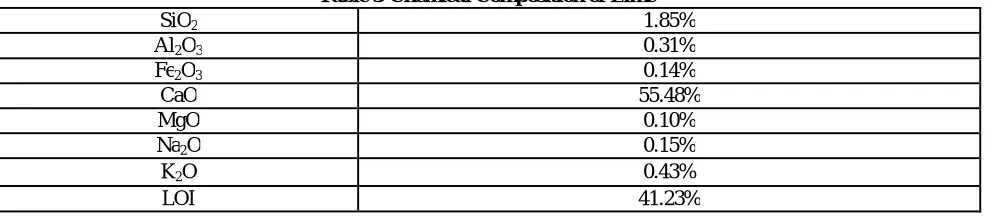
Lime: Lime has been collected from the nearby market at Lucknow, Uttar Pradesh. Table 3 shows the constituents of lime by weight .
Table 3-Chemical Composition of Lime
SiO2 1.85%
Al2O3 0.31%
Fe2O3 0.14%
CaO 55.48%
MgO 0.10%
Na2O 0.15%
K2O 0.43%
V. SCOPEANDOBJECTIVES
In the present study, an attempt is made to identify how Rice Husk ash (RHA) may be effectively utilized in combination with clayey soils to get an improved soil material which may be utilized in various soil structures. Following are the objectives of the present work:-
1. Determine physical property such as LL,PL,PI ,Grain size distribution, determine the MDD and OMC,CBR for the virgin soil sample.
2. Lime content is varied from 0 to 3% in steps of 1% to optimize its value on maximum dry density and CBR value of suitable Soil-Lime mixes.
3. RHA content is varied from 0 to 30% in steps of 10% to optimize its value on maximum dry density and CBR value of suitable Soil-RHA mixes.
4. Lime and RHA were added in virgin soil sample in varied percentage 0 to 3% & 0 to 30% respectively to optimize its value on maximum dry density and CBR value of suitable Soil+Lime+RHA Mixes.
5. Relationship have been developed showing the variation of MDD, OMC & CBR (unsoaked & soaked) at various percentage of lime, MDD , OMC & CBR (unsoaked & soaked) at various percentage of RHA, variation of OMC, MDD & CBR at various percentage of Soil+RHA+Lime.
6. To study the influence of mixing on subgrade strength.
VI.EXPERIMENTALINVESTIGATIONS
For determining the quantitative information about the mixed soil, RHA was mixed with the soil sample in increasing proportion of 0%, 10%, 20%, and 30% by weight of soil sample. Further for knowing the effect of lime, 0% to 3% lime in dry condition by weight of soil has been added with the soil mixed with RHA varying from 0% to 30%.
Total mixing proportions are shown in the Table-4 as series 1, 2, 3 and 4. Now for determining the various characteristics of the soil mixed with rice husk ash and lime, Standard Proctor’s compaction tests and CBR tests at OMC both in unsoaked and soaked have been performed in the laboratory.
Table-4 Mix Proportion of Soil, RHA and Lime
Series Sl. No. Soil (%) RHA (%) Lime (%)
1 100 0 0
2 100 10 0
1 3 100 20 0
4 100 30 0
1 100 0 1
2 100 10 1
2 3 100 20 1
4 100 30 1
1 100 10 2
2 100 10 2
3 3 100 20 2
4 100 30 2
1 100 0 3
2 100 10 3
4 3 100 20 3
VII. ANALYSISOFTESTRESULT
Effect on Compaction Characteristics
Series of compaction test have been carried out with virgin soil as well as Rice Husk ash and mix of soil, RHA-Soil, Lime-Soil & RHA-Lime-Soil.Table-5 shows series of compaction test at various % of Lime.
Table-5 Series of Compaction test at various % of Lime SOIL+LIME
SOIL (%) LIME (%) OMC (%) MDD(gm/cc)
100 0 16.28 1.876
100 1 15.20 1.906
100 2 12.50 2.000
100 3 10.90 2.020
But adding RHA to virgin soil increased the OMC of the mix and decreased MDD value.Table-6 shows series of compaction test at various % of RHA
Table-6 Series of Compaction test at various % of RHA SOIL+RHA
SOIL (%) RHA (%) OMC (%) MDD(gm/cc)
100 0 16.28 1.876
100 10 17.00 1.832
100 20 18.50 1.815
100 30 19.25 1.689
In Figure-2 shows variation of OMC & MDD at various % of Lime & RHA (a) Variation of OMC & MDD with increase in lime content (b) Variation of OMC & MDD with increase in RHA content.
(a) (b)
Table-7 shows variation of subgrade characteristics with increase in Lime & RHA content
1.85 1.90 1.95 2.00 2.05 8.00 9.00 10.00 11.00 12.00 13.00 14.00 15.00 16.00 17.00 18.00
0 0.5 1 1.5 2 2.5 3
M D D (gm /c c ) O M C %
LIME CONTENT %
OMC MDD 1.7 1.7 1.8 1.8 1.9 1.9 16.0 16.5 17.0 17.5 18.0 18.5 19.0 19.5
0 10 20 30
M D D (gm /c c ) O M C %
RHA CONTENT %
SOIL+LIME+RHA
Series Sl. No. Soil (%) RHA (%) Lime (%) OMC (%) MDD(gm/cc) CBR
Unsoaked(%) Soaked(%)
1
1 100 0 0 16.28 1.876 6.95 3.86 2 100 10 0 17.00 1.832 7.38 4.23 3 100 20 0 18.50 1.815 7.73 4.72 4 100 30 0 19.25 1.689 6.78 4.46
2
1 100 0 1 15.20 1.906 7.15 5.92 2 100 10 1 17.18 1.823 7.90 6.78 3 100 20 1 19.06 1.715 8.93 7.47 4 100 30 1 22.15 1.649 10.13 8.24
3
1 100 0 2 12.50 2.000 7.21 6.27 2 100 10 2 15.24 1.834 7.38 6.52 3 100 20 2 21.50 1.620 8.76 7.30 4 100 30 2 23.32 1.600 9.53 7.81
4
1 100 0 3 10.90 2.020 7.98 7.12 2 100 10 3 15.50 1.910 9.10 8.15 3 100 20 3 20.34 1.862 9.53 8.67 4 100 30 3 23.10 1.791 10.73 9.18 Figure-3 shows variation of OMC & MDD of Soil+Lime+RHA mix (a) Variation of MDD with increase in Lime & RHA content (b) Variation of OMC with increase in Lime & RHA content.
(a) (b) Effect on Strength Characteristics
CBR tests were performed to evaluate the strength properties of the mix. It has been seen that with increase in RHA content in soil reduce its strength. But adding a very little amount of lime has increased the strength substantially
1.5 1.6 1.7 1.8 1.9 2.0 2.1
0 10 20 30
M
D
D
(gm
/c
c
)
RHA CONTENT %
0 % Lime 1 % Lime
2 % Lime 3 % Lime
10.0 12.0 14.0 16.0 18.0 20.0 22.0 24.0
0 10 20 30
O
M
C
%
RHA CONTENT %
0 % Lime 1 % lime
both soaked and un-soaked conditions. When lime is mixed with the soil- RHA mix, the strength has been increased considerably. The RHA has good pozolonic characteristics which with hydrated lime improves the strength of the mix.
Figure-4 shows variation of CBR of Soil with various % of Lime, RHA & Lime + RHA (a) Variation of CBR with increase in Lime content (b) Variation of CBR with increase in RHA content (c)Variation of Unsoaked CBR with increase in Lime + RHA content (d) Variation of soaked CBR with increase in Lime + RHA content
(a) (b)
(C ) (D)
3.00 4.00 5.00 6.00 7.00 8.00 9.00
0 1 2 3
C
B
R
Lime Content %
Unsoaked CBR Soaked CBR
2.00 3.00 4.00 5.00 6.00 7.00 8.00 9.00
0 10 20 30
C
B
R
%
RHA Content %
Unsoaked CBR Soaked CBR
6.0 7.0 8.0 9.0 10.0 11.0
0 10 20 30
U N S O A K ED C B R
RHA CONTENT %
0 % Lime 1 % Lime
2 % lime 3 % Lime
3.0 4.0 5.0 6.0 7.0 8.0 9.0 10.0
0 10 20 30
S O A K ED C B R
RHA CONTENT %
0 % Lime 1 % Lime
VIII.CONCLUSION
From the experimental study the following conclusions may be drawn:
1.RHA can be used to r educe the burden of waste material which can be very effectively done by use it as a soil stabilizer by partially replacing the soil with lime.
2.RHA can be used very effectively in the backfilling with soil as well as making the subgrade of the roads as it is being lighter in weight and if lime can be added, it will have a water proofing property as well.
3.The Soaked C B R i n c r e a s e s b y 2 . 3 7 t i m e s a t 3 % l i m e & 3 0 % R H A c o n t e n t . 4.The Unsoaked C B R i n c r e a s e s b y 1 . 5 4 t i m e s a t 3 % l i m e & 3 0 % R H A c o n t e n t . 5.The MDD of RHA – soil mix decreases as the RHA content increases in soil.
6.The OMC of RHA-Soil mix increases as the RHA content increases in soil.
7.The curing period of the mix may be a governing parameter as the hydration of lime depends on it. So it is expected that as the curing period increases, the strength will increase.
REFERENCES
[1] Petry, T.M., and Little, D.N., “Review of Stabilization of Clays and Expansive soils in Pavement and Lightly Loaded Structures-History, Practice, and future”, ASCE J. of Materials in Civil Engineering, Vol. 14, Issue. 6, pp. 447-460.,2002.
[2] Sivapulliah P.V., Subba Rao K.S., and Gurumurthy, J.V., “Stabilization of rice husk ash as cushion below foundations on expansive soils”, Ground Improvement, Vol. 8, Issue. 4, pp 137-149, 2004.
[3] F O Okafor and U N Okonkwo, “Effects of rice husk ash on some geotechnical properties of laterite soil”, Leonardo Electronic Journal of Practices and Technologies, Vol.15, pp. 67-74,2009.
[4] Ali F Haji, A Adnan and Chew K C ,“Geotechnical properties of a chemically stabilized soil from Malaysia with rice husk ash as an additive”, Journal of Geotechnical and Geological Engineering, Vol. 10, Issue. 2, pp. 117-134,1992.
[5] Basha E A, Hashim R, Mahmud H B and Muntohar A S, “Stabilization of residual soil with rice husk ash and cement”, Construction and Building Material, Vol. 19, Issue 6, P 448-453,2005.
[6] Brooks R M, “Soil stabilization with fly ash and rice husk ash”, International Journal of Research and Reviews on Applied Science, Vol. 1, Issue 3,pp. 209-217,2009.
[7] Jha, J.N., and Gill, K.S., “Effect of rice husk ash on lime stabilization”. Journal of the Institution of Engineers (India), Volume 87, page 33-39, 2006.
[8] Alhassan, M, “Potentials of rice husk ash for soil stabilization”. AU J. T. Vol. 11, Issue 4, pp. 246-250, 2008.
[9] Muntohar, A.S., “ Utilization of uncontrolled burnt rice husk ash in soil improvement”, Dimensi Teknik Sipil, Vol. 4, Issue. 2, pp.100 – 105, 2002.