DOI: 10.1534/genetics.107.072637
A Validated Whole-Genome Association Study of Efficient Food
Conversion in Cattle
W. Barendse,
1A. Reverter, R. J. Bunch, B. E. Harrison,
W. Barris and M. B. Thomas
CSIRO Livestock Industries, Queensland Bioscience Precinct, St. Lucia 4067, Australia Manuscript received February 26, 2007
Accepted for publication April 17, 2007
ABSTRACT
The genetic factors that contribute to efficient food conversion are largely unknown. Several physiological systems are likely to be important, including basal metabolic rate, the generation of ATP, the regulation of growth and development, and the homeostatic control of body mass. Using whole-genome association, we found that DNA variants in or near proteins contributing to the background use of energy of the cell were 10 times as common as those affecting appetite and body-mass homeostasis. In addition, there was a genic contribution from the extracellular matrix and tissue structure, suggesting a trade-off between efficiency and tissue construction. Nevertheless, the largest group consisted of those involved in gene regulation or control of the phenotype. We found that the distribution of micro-RNA motifs was significantly different for the genetic variants associated with residual feed intake than for the genetic variants in total, although the distribution of promoter sequence motifs was not different. This suggests that certain subsets of micro-RNA are more important for the regulation of this trait. Successful validation depended on the sign of the allelic association in different populations rather than on the strength of the initial association or its size of effect.
F
OOD use and food conversion efficiency are important for the survival and selective advantage of an animal and underpin its ability to compete. Food is a limiting resource and as such competition for its use is a fundamental driver of selection, both natural and artificial (Darwin1859; Byers2000). Food conversion efficiency is a critical aspect of animal systems due to its impact on the flow of nutrients (Cahaner and Leenstra 1992; Kohn et al. 1997; Veerkamp 1998; Bjornssonet al.2001; Robinsonand Oddy2004) and it has a major role in the overall efficiency of the en-terprise. Food consumption is under physiological control (Leibowitzand Alexander1998; Cummings et al.2001) and there is genetic variability within popu-lations for food conversion efficiency (Robinson and Oddy 2004), with a clear trade-off between such efficiency and other traits of an individual (Veerkamp 1998). In humans, food intake above metabolic needs is linked to obesity, and the homeostasis of body weight appears to be under partial genetic control (Neelet al. 1998).Most of the studies performed in this area to date have addressed the homeostatic control of body mass, due to the difficulty of accurately measuring food intake in populations. Most studies are of the genes that code
for hormones and their receptors that regulate these systems (Leibowitz and Alexander 1998; Sakurai et al. 1998; Walderet al. 1998; Cummingset al. 2001; Tanakaet al. 2003), such as leptin, serotonin, orexin, ghrelin, and insulin. Disruption of some of these genes leads to large changes in levels of obesity in several spe-cies. Measuring food intake with any degree of accuracy is highly complex and requires automated measure-ment of individual food intake, and this is difficult to do for extended periods except in some experimental ani-mals and in livestock.
In the absence of information on overall distribution of genetic effects, one may speculate that there should be a role for many DNA variants in genes that affect processes that use energy constantly. These processes include basal metabolic rate, the control of appetite, the generation of ATP, the regulation of growth and de-velopment, and the homeostatic control of body mass. Nevertheless, the relative frequency of DNA variants in each of these systems is unknown.
Furthermore, the ideas about the kinds of genetic variation that will be responsible for quantitative trait loci (QTL) are changing rapidly so that not all the DNA variants will be of genic origin. There is debate about the proportion of the DNA variants affecting the phenotype that would come from genes (Holliday 1990; Kashi et al. 1997; Mattick 2001; Bejerano et al. 2004) compared to that from nongenic DNA. In genes, these are not only likely to be changes in the coding sequence
1Corresponding author:CSIRO Livestock Industries, Queensland
Bio-science Precinct 306 Carmody Rd., St. Lucia 4067, Australia. E-mail: [email protected]
but also likely to be due to differences in regulatory sequences (Xieet al.2005; Clopet al.2006). More than half of the ultra-conserved DNA in a mammalian species is not associated with genes, suggesting that a large proportion of the DNA elements that affect the pheno-type will be nongenic; here, genic refers not only to coding sequences but also to DNA close to coding sequences that may affect the function or regulation of that coding sequence.
To identify some of the DNA variation associated with residual food intake (RFI), a measure of food conversion efficiency that includes metabolic weight, we scanned the bovine genome for associations using the whole-genome association (WGA) methodology and then con-firmed a subset of the associations. Food intake can be measured accurately and conveniently in cattle for an extended time and more genetically diverse samples can be obtained for livestock than for rodent models. RFI is considered to be the preferred method of measuring food conversion efficiency since it takes into consider-ation the daily weight gain of the animal as well as adjusts for the metabolic weight of the individual. WGA may be applied speculatively in livestock with panels of DNA variants in the tens of thousands due to high levels of linkage disequilibrium (LD) within breeds.
MATERIALS AND METHODS
Cattle samples:The cattle DNA sample and the methods of measurement of phenotypes, including RFI, have been reported previously (Uptonet al.2001; Robinsonand Oddy
2004). DNA and feed intake and daily gain and body-weight measurements were available for 1472 animals of seven breeds: Angus, Brahman, Belmont Red, Hereford, Murray Grey, Santa Gertrudis, and Shorthorn, representing 308 sires, 32 herds of origin across the seven breeds, and 42 feed groups. The Angus, Hereford, Murray Grey, and Shorthorn are European taurine breeds adapted to temperate environments while the Brah-man, Belmont Red, and Santa Gertrudis are breeds adapted to tropical environments; the Brahman was used in the forma-tion of the Santa Gertrudis. A subset of this sample was used for the WGA, and the subset was selected to improve the power to detect associations in a small sample. Animals were selected within the systematic or fixed effects of the experiment, so pairs of animals were matched within sex, within feed group, within herd of origin, and within market destination (domes-tic, Korea, and Japan); sex, feed group, herd of origin, and market destination form the contemporary group. Common sires were avoided to ensure a diversity of sires. Pairs were chosen to be discordant on phenotype, so that one member of the pair fell within the top 200 while the other member fell within the bottom 200; the pairs are not merely members of the top 200vs.those of the bottom 200. This yielded a final sample for WGA of 189, consisting of 41 Angus, 21 Brahman, 24 Belmont Red, 28 Hereford, 20 Murray Grey, 28 Santa Gertrudis, and 27 Shorthorn animals: the odd numbers are due to the constraint of a 2396-well format; three animals were unmatched, and three animals were genotyped twice, anonymously, to assess the genotyping error rate, which had a 99.92% accuracy. The sample represents 142 sires with a range of one to four offspring/sire and a median of one offspring/
sire, 32 herds with a median of five steers/herd, and 37 feed groups with a median of four offspring/feed group.
The feed intake trait was RFI (Robinsonand Oddy2004)
measured in kilograms per day of feed; it is the deviation between the actual feed intake and the predicted feed intake of the animal, given its average daily weight gain and metabolic weight. The heritability of RFI was estimated using the five-generation pedigree data for all the animals. The RFI values for the sample range from3.40 to 3.81 with a mean of 0.07 and standard deviation of 1.32. The total sample from which the extremes were drawn had a mean of 0.00 and a standard deviation of 0.75.
Single nucleotide polymorphisms:Very high LD has been reported for livestock species in general (Farniret al.2000;
McRaeet al.2002; Tenesaet al.2003; Nsengimanaet al.2004),
and high levels of LD have been reported to extend out for .1 Mbp in dairy cattle breeds (Farniret al.2000; Khatkar
et al.2006). As few as 3000 evenly spaced single nucleotide polymorphisms (SNPs) could therefore be sufficient for WGA to cover the genome. However, estimates of LD calculated across breeds in beef cattle show much lower LD (Barendse
et al.2007); to reduce LD and therefore improve the precision of gene mapping, seven breeds were used in this study.
The WGA was performed using the MegAllele Genotyping Bovine 10K SNP Panel (Hardenbol et al. 2005), a fully
described set of SNP, by ParAllele, on an Affymetrix GeneChip Scanner 3000, yielding an average spacing of 325 kbp between SNP. The Baylor College of Medicine (BCM) SNP or the Single Nucleotide Polymorphism database (dbSNP) identifiers for the top 161 SNP are given in supplemental Table 1 at http:// www.genetics.org/supplemental/. The SNP sequences can be downloaded from the Baylor College of Medicine web-site at ftp://ftp.hgsc.bcm.tmc.edu/pub/data/Btaurus/snp/ Btau20050310/, and the BCM identifiers can be used in dbSNP. One of the overall objectives of validation is to obtain estimates of size of effect and genetic variation due to QTL that are as accurate and as unbiased as possible (e.g., Utzet al.
2000). In this study, the initial associations were made on animals of extreme phenotype so that a small sample will have a large power to detect associations, but using regression methods, albeit with permutation tests, will cause the allele effects to be overestimated (Landerand Botstein1989), and
so it would be important to validate the significance and size of effects in the full sample. We validated 44 of the SNPs from the WGA on the whole sample, using the SNPlex method (ABI 3130XL, ABI, Foster City, CA) in our laboratories or the Taqman assay as reported previously (Barendseet al.2006,
2007) to determine whether the WGA had identified valid associations, whether the effects were similar in different breeds, and to more accurately measure the size of effect associated with each SNP. The estimates of the allele effects obtained in the WGA were compared to those in the validation sample using linear regression to determine the amount of deflation in the estimates of the additive effects. The 34 significant loci for RFI had a range of significances fromP, 0.01 toP,0.0001, partly to determine whether the level of significance was important in selecting SNPs for further validation, and so these 34 SNPs are not a panel of the most significant SNPs generated by the WGA that might be used for selecting RFI. Due to technical reasons associated with genotyping, not all the animals with genotypes in the WGA had genotypes in the validation experiment. We estimated the additive effects for these SNPs in the non-WGA residue (validation sample minus the WGA) to determine the degree of variability left over once the WGA sample was removed.
but C is allele 0 when G is allele 1. A negative value forameans that allele 0 causes a decrease in RFI, while a positive value means that allele 1 decreases RFI. The WGA and validation genotyping use consistent allele codes.
Differences between breed genotype frequencies were tested in contingency tables (Weir 1996) using the log-likelihood
G-test with the Williams correction (Sokaland Rohlf1981).
Due to the relatively small breed samples (Nrange of 21–41), significance was called atP,0.01. The genotype frequencies were tested for Hardy–Weinberg equilibrium (HWE) using the x2test. In the HWE test, observed genotype frequencies were compared only to the expected frequencies if all expected classes were.5.
Analysis: To be able to compare the WGA and validation samples, the model RFI¼N(m1contemporary group1sire, se) was fitted to the RFI values of all animals using ASReml (Gilmouret al.1995, 2002). While the selecting of samples for
the WGA tried to remove the effect of contemporary group and sire, the validation sample would need adjustment for these effects, and therefore comparing the two would require that both were adjusted in the same way. Contemporary group was treated as a fixed effect; it includes herd of origin, which then accounts for the breed effect. The sire was treated as a random effect. The inclusion of sire and breed controls for the average differences between breeds and sires, which controls the genetic stratification in the sample. The residual trait values were obtained once for the entire experiment. The residual trait value for each individual was then matched to its SNP genotypes for both the WGA experiment of 9260 SNPs and the validation experiment of 44 SNPs. The mean trait values for each genotype at each SNP were calculated and then these were compared one SNP at a time using t-tests with significance determined by 100,000 permutations of the data. In the validation experiment, statistics were calculated for the combined sample as well as for each breed separately. The t-value between the most significant comparison of genotype means is reported astmax. The differences between all three genotype means and the allele frequencies were used to calculate a, the average effect of allele substitution of the polymorphism (Lynch and Walsh1998). The significance
threshold was determined empirically (Churchill and
Doerge1994). The false discovery rate (FDR) was determined
by exploring the empirical distribution ofP-values to estimate the proportion of observed P-values that follow a uniform distribution on the (0,1) interval, that is, the distribution of P-values corresponding to tests with true null hypotheses (Mosiget al.2001; Nettletonet al.2006). The proportion
of the variance explained by the significant SNP was estimated using regression, where sums of squares where compared between the model without SNP to the model with SNP.
To estimate the distance over which SNPs will show sig-nificant associations in this population, the detection distance (DD) was calculated. The DD represents the distance at which a SNP can be expected to detect a DNA variant affecting the phenotype through linkage disequilibrium in the particular study. The DD was estimated from the distribution of sig-nificant associations between SNP and the trait of interest in the following way. Each SNP withP,0.01 to the trait was used as an index SNP and was used once, ensuring that the observa-tions were independent. The distance between the index SNP and the closest SNP in the same scaffold was calculated in base pairs by counting. We calculated the distances within a scaffold only, due to the uncertainty of the orientation of some scaf-folds, the unknown distances between scafscaf-folds, and in some cases the order of scaffolds in the draft bovine sequence. Therefore, some index SNPs were not included because there were no other SNPs within the scaffold that were genotyped. We did not calculate distances between SNP where there
appeared to be likely mis-assembly of the scaffold, but in no case where this occurred was the adjacent SNP associated with RFI, so this exclusion did not exclude any data that might have increased the DD. The log(1/P) was calculated and the dif-ference obtained for each pair of index and adjacent SNPs. The difference in log(1/P) or DLP and the distance between each pair of SNPs was plotted. A curve was fitted to the points and the inflection point was taken to be the maximum DD for the data.
The LD was estimated for each pair of SNPs used to estimate the DD, usingr2calculated according to the published formula (Hilland Robertson1968). The haplotype frequencies in
each pairwise SNP comparison were estimated from two-locus genotypes of unknown phase using the EM algorithm (Weir
1996). The r2 estimates were calculated within and across breeds. The difference in log(1/P) was plotted against ther2 esti-mated across breeds for each pair of SNPs.
The promoter sequence and micro-RNA (mi-RNA) se-quence motifs (Xie et al. 2005) were downloaded and any
redundancy was fully expanded. The occurrence of each motif was counted in the 250-bp sequence flanking each SNP, and each SNP was tested to determine whether it was a poly-morphism for a motif; 250 bp was chosen arbitrarily to represent the close vicinity of the SNP so it is unlikely to represent artifacts due to assembly. In addition, the number of SNPs associated with RFI with 0, 1, 2, and so on copies of a motif in the surrounding sequence were compared to the rest of the SNPs in the SNP panel in a contingency table using the log-likelihoodG-test with the Williams adjustment (Sokaland
Rohlf 1981). Furthermore, each motif was counted in the
sequences surrounding the SNPs associated with RFI and compared to the number of each motif in the sequences surrounding the SNP in the rest of the panel. Since several of the classes were 0, the contingency tables were compared with a generalized linear model using the Poisson distribution implemented by S-Plus (Venablesand Ripley2000).
RESULTS
We plotted the SNP data and examined them for several characteristics (Figure 1) as a check on the performance of the panel. Of the 9260 SNPs in total, 8786 were polymorphic in this sample, showing a flat distribution of allele frequencies (Figure 1A); 76% of these SNPs showed significant differences (P,0.01) in genotype frequencies when all breeds were considered, 56% of the SNPs showed differences in temperate breeds, and 31% of the SNPs showed differences in the tropically adapted breeds. The genotype frequen-cies were consistent with Hardy–Weinberg expectations in 94% of breed comparisons. All the X-linked loci would have been out of HWE, because the analyzed DNA samples were all from steers.
QTL with differences between means of 0.5 of a phenotypic standard deviation (sp) or less,P-values will
not reachP¼0.001 in the sample size used for WGA in this study unless the effects are overestimated. There-fore, one should not focus only on effects with P # 0.001; otherwise, one would reject too many of the real associations to RFI. This suggests that a threshold ofP# 0.01 would be useful in identifying QTL regions for further study of RFI, corresponding to a real feature in the data.
There were 161 SNPs with P # 0.01, representing 141 genetic regions, which were annotated in detail (supplemental Table S1 at http://www.genetics.org/ supplemental/). Twenty of the SNPs explain 76% of the genetic variance for RFI, which has a heritability of 0.2660.07 when measured in all available animals. The amount of variance explained reached a plateau after 20 SNPs. However, when these 20 are removed, another panel of 20 SNPs explain 71% of the genetic variance, and subsequent panels of 20 explain progressively less variance. The panel of 34 SNPs used in the validation experiment (see below) explained 12% of the genetic
variance in that larger sample, showing that real genetic variance is explained by some of the SNPs, but that the size of the WGA sample is not large enough to give accurate estimates of the amount of genetic variance explained by the significant SNPs.
To estimate the DD between SNPs and the QTL that they mark, we calculated the DLP between adjacent SNPs, at least one of which hadP,0.01 to RFI. The DLP dropped by 1 unit over a distance of much ,10 kbp (Figure 2A), and the inflection point occurred at30 kbp. The curve fitted to this data set had anR2of 0.82. This is also the maximum distance found for both ad-jacent SNPs to be significantly associated with RFI. The shape of the curve is determined by the large number of adjacent SNPs that are,5 kbp apart where the DLP is
.1. After 30 kbp, the curve is relatively flat and gradually increases from a DLP of 1.5 to that of 2.0.
The plot of the across-breedr2against distance shows four comparisons withr2.0.4 but none withr2$0.8 for SNPs separated by.30 kbp (Figure 2B), indicating that LD is low beyond 30 kbp for the SNPs in these breeds. The estimates of linkage disequilibrium for the pairs of Figure1.—(A) Histogram of allele frequencies in the whole genome association study. (B) The relationship betweent-test and
allele frequency in the whole genome association study, showing a density threshold att¼2.5. (C) The relationship between t-test and the average effect of allele substitution in the whole genome association study, showing largea-values fort.2.5.
Figure2.—(A) The reduction in significance of adjacent loci compared to the distance between adjacent loci as an estimator of
index and adjacent SNPs showed a higher mean for the within-breed comparison (r2¼0.3560.01 SE) than for the across-breed comparison (r2 ¼ 0.29 6 0.03 SE). Adjacent SNPs that showed an LD ofr2$0.8, the tag SNP threshold (Chapmanet al.2003), had a mean DLP of 0.66 (60.18 SE) while SNPs withr2,0.8 had a mean DLP of 1.64 (60.06 SE) in the difference inP-value for their associations to RFI; a DLP of 0.66 is equivalent to the difference between 0.01 and 0.048. There is a trend of increasing DLP with decreasingr2(Figure 2C).
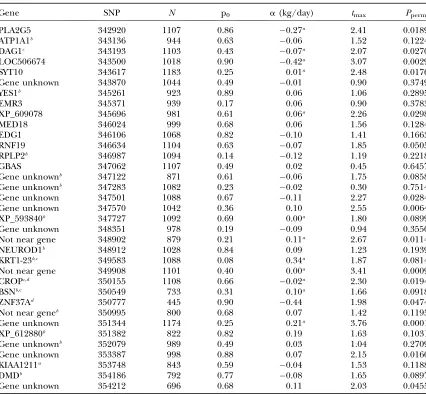
At least 76% of the SNP withP#0.01 in the WGA were found to have some significance in the larger sample or in at least one of the breeds of that larger sample. We tested 34 significant SNPs (Figure 3A; Table 1) in the whole sample of 1200 animals to determine how many would remain significant and to obtain more accurate estimates of the sizes of effect. The average number of WGA samples in this sample was 156 (SD¼20.41, range 90–171). Of the 189 animals in the WGA experiment, the average number of genotypes for these 34 loci was 166 (SD ¼ 7.9, range 137–171). Animals used in the WGA represent on average 16% of the genotypes in the validation sample. Of the 34, 13 hadP,0.05 when all the breeds were combined, 2 of which were significant only in the total sample but not in any of the individual breeds, and a further 13 showed a significant association in at least one of the breeds; these are 76% of the total. We also tested 10 nonsignificant SNPs as a control (Figure 3A). One of those 10 (342920, Table 1) had a P,0.05 in the combined sample, andP,0.01 in two of the breeds. It is 20 kbp away from 342650, which had a P¼0.023 in the WGA.
The most significant SNPs (e.g., 349908 and 351344) in the validation sample were those that had anaof the same sign in all breeds. There was no relationship be-tween the strength of the significance or the size of the allele effect of the SNPs in the WGA on the significance of the SNPs in the validation experiment, once the sig-nificance threshold had been crossed (Figure 3, B and C). The direction of the allele substitutions were similar, in general, between the WGA and validation experi-ment (Figure 3B) with a significant trend line (R2¼ 0.52), which is consistent with most of the SNPs in the validation experiment being associated with RFI. The sizes of effects were smaller in the larger sample (Figure 3B), with a slope in the regression of 4.1. Using additive effects instead of average effects of allele substitution results in a slope of 3.9 and an R2 ¼0.62, indicating that the relationship is mainly due to the additive effects rather than to the dominant effects.
Removing the WGA samples from the total results in a collapse of the additive effects for most of the SNPs. The range of additive effects in the WGA sample for the 34 loci is from 0.95 to 10.91. In the whole sample the range of additive effects is from 0.29 to 10.23, but once the WGA samples are removed the range of additive effects is from0.10 to10.11, with 17 of the 34 additive effects ranging from0.01 to10.01. Removing the WGA sample results in the variance for the RFI trait dropping to 0.62 of its value in the full sample. Most of the infor-mation for the associations appears to be contained in the samples of extreme phenotype, as predicted.
The significant SNPs with a-values of the opposite sign in different breeds will lead to other SNPs that Figure3.—(A) A comparison of thet-test value of significant SNPs of the WGA with their tests in the validation experiment.
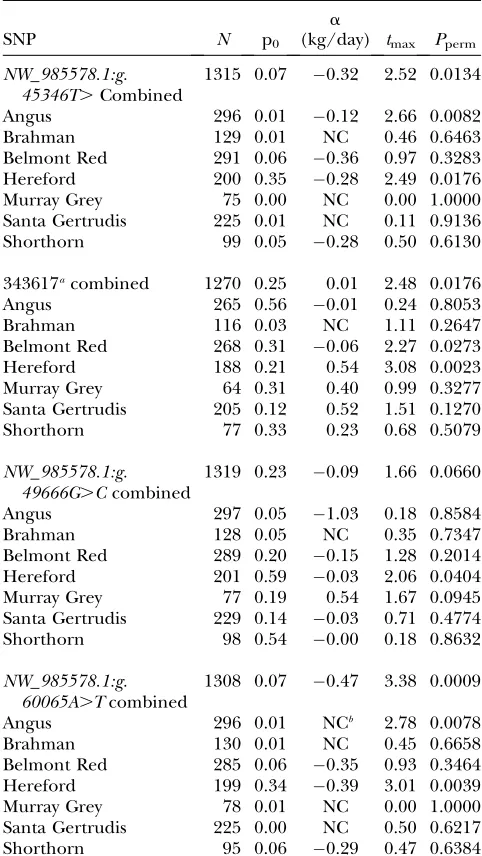
should show consistent allele effects in all breeds. For example, the SNP 343617 (NW_985578.1:g.47639A.G) was very strongly associated to RFI in the WGA but was of moderate significance in the combined validation sample (Table 2), with two significant breed a-values of opposite sign tending to cancel each other out. Two of three new SNPs flanking 343617—i.e., not part of the WGA but taken from genome sequencing traces in the surrounding 20 kbp and so within the DD—showed largea-values of the same sign in different breeds and
one of these, NW_985578.1:g.60065A.T, was highly significant.
There were 5 SNPs that affected mi-RNA motifs, 16 that affected promoter sequence motifs, and 9 that were in mRNA in the 161 sequences. These represent similar proportions of the total SNPs; that is, the 5 mi-RNA SNPs represent 1.4% of the mi-RNA SNPs, the 16 pro-moter sequences represent 1.0% of the propro-moter SNPs, and the 9 mRNA SNPs represent 1.0% of the mRNA SNPs in the panel.
TABLE 1
The results of validation of a set of SNPs from the WGA
Gene SNP N p0 a(kg/day) tmax Pperm
PLA2G5 342920 1107 0.86 0.27a 2.41 0.0189
ATP1A1b 343136 944 0.63 0.06 1.52 0.1224
DAG1c 343193 1103 0.43 0.07a 2.07 0.0270
LOC506674 343500 1018 0.90 0.42a 3.07 0.0029
SYT10 343617 1183 0.25 0.01a 2.48 0.0176
Gene unknown 343870 1044 0.49 0.01 0.90 0.3749
YES1b 345261 923 0.89 0.06 1.06 0.2895
EMR3 345371 939 0.17 0.06 0.90 0.3783
XP_609078 345696 981 0.61 0.06a 2.26 0.0298
MED18 346024 999 0.68 0.06 1.56 0.1284
EDG1 346106 1068 0.82 0.10 1.41 0.1663
RNF19 346634 1104 0.63 0.07 1.85 0.0505
RPLP2b 346987 1094 0.14 0.12 1.19 0.2218
GBAS 347062 1107 0.49 0.02 0.45 0.6457
Gene unknownb 347122 871 0.61 0.06 1.75 0.0858
Gene unknownb 347283 1082 0.23 0.02 0.30 0.7514
Gene unknown 347501 1088 0.67 0.11 2.27 0.0284
Gene unknown 347570 1042 0.36 0.10 2.55 0.0064
XP_593840b 347727 1092 0.69 0.00a 1.80 0.0899
Gene unknown 348351 978 0.19 0.09 0.94 0.3550
Not near gene 348902 879 0.21 0.11a 2.67 0.0114
NEUROD1b 348912 1028 0.84 0.09 1.23 0.1939
KRT1-23b,c 349583 1088 0.08 0.34a 1.87 0.0814
Not near gene 349908 1101 0.40 0.00a 3.41 0.0009
CROPc,d 350155 1108 0.66 0.02a 2.30 0.0194
BSNb,c 350549 733 0.31 0.10a 1.66 0.0918
ZNF37Ad 350777 445 0.90 0.44 1.98 0.0474
Not near geneb 350995 800 0.68 0.07 1.42 0.1195
Gene unknown 351344 1174 0.25 0.21a 3.76 0.0001
XP_612880b 351382 822 0.82 0.19 1.63 0.1031
Gene unknownb 352079 989 0.49 0.03 1.04 0.2709
Gene unknown 353387 998 0.88 0.07 2.15 0.0160
KIAA1211a 353748 843 0.59 0.04 1.53 0.1188
DMDb 354186 792 0.77 0.08 1.65 0.0897
Gene unknown 354212 696 0.68 0.11 2.03 0.0455
‘‘Not near gene’’ indicates that there is no gene within 150 kbp of either side; ‘‘gene unknown’’ means that the scaffold end is,150 kbp from one side; ‘‘SNP’’ is the ParAllele SNP identifier;Nis the sample size; p0is the frequency of the 0 allele; anda(kg/day) is the average effect of allele substitution. Allele 0 is the allele higher up the alphabet. A negative value forameans that allele 0 causes a decrease in RFI, while a positive value means that allele 1 decreases RFI.Ppermis theP-value derived from 100,000 permutations.
aDominance deviationj
kj$1.0;i.e., showing dominance or overdominance, the large numbers are consis-tent with the low heritability of RFI.
bSignificant in at least one of the component breeds. cWithin the genomic DNA of the gene.
To determine whether there were any characteristic motifs among the 161 SNPs associated with RFI, the pres-ence and identity of each promoter or mi-RNA motif was counted within 250 bp of each SNP. Of the 161 signif-icant SNPs, 90 contained one or more mi-RNA motifs. There was no difference in the distribution of numbers of promoter or mi-RNA motifs in the sequences sur-rounding the SNPs; that is, the numbers of sequences with 0, 1, 2, 3, and more motifs was not statistically
dif-ferent when the 161 SNPs for RFI were compared to the rest of the SNP set, for both promoter sequences (Gadj¼
18.90, d.f.¼12,N¼12,060,P¼0.091) and for mi-RNA sequences (Gadj¼1.48, d.f.¼5,N¼12,060,P¼0.916).
There were 86 promoter motifs in the 161 SNP se-quences and these were not different in distribution from the 150 promoter motifs found in the rest of the SNPs (D¼169.8, d.f.¼149,P ¼0.116). However, the number of each mi-RNA motif was highly significantly different between the RFI SNPs compared to the rest (D¼97.7, d.f.¼49,P¼4.453105). The proportion of each of the 50 mi-RNA motifs in the total is shown in Figure 4, with several clear examples of motifs that are relatively more or less common than in the full data set. Thirty-four of the genes with significant SNPs code for protein that either control or are part of cellular processes that are continuous and are part of the back-ground use and generation of energy (Figure 5; supple-mental Table S1 at http://www.genetics.org/supplesupple-mental/). Nine genes are associated with apoptosis and protein turnover, including UBE2I, which is involved in ubiq-uitination, the targeting of proteins for degradation, and may have a role in blocking cell cycle progression in eukaryotes. Six either are ion channels or are associated with ion flux with a further three associated with neu-rotransmitter flux, includingATP1A1, the pump main-taining the Na1
/K1
gradient on plasma membranes. Ten are associated with growth and development, including FGF2, which is involved in a wide range of growth processes. Five are associated with translation or tran-scription, includingRPLP2, which is a component of the 60S ribosome subunit and plays a role in protein elongation. One of these five is a structural protein, KRT32, which is a hair-and-nail keratin, and hair and hoof growth is clearly a continual process.
There were only three significant SNPs affecting known pathways for leptin, insulin, and serotonin. These are NEUROD1, which binds to the insulin promoterPDE3B, which is part of thePI3K-PDE3B-cAMP pathway, critical in leptin signaling, andMPDZ, which has probable protein– protein interactions with the C-terminal domain of the serotonin 5-HT-2C receptor (supplemental Table S1 at http://www.genetics.org/supplemental/).
Thirty-seven of the genes point to new genetic path-ways in the control of food conversion efficiency (supplemental Table S1 at http://www.genetics.org/ supplemental/). Six of these are DNA-binding proteins, which points to regulation of expression. Three genes are involved in signal transduction, and since the orexins influence food intake through signal transduction (Sakuraiet al.1998), these SNPs may point to such con-trol. But by far the largest group are 28 of the significant SNPs that are in either hypothetical coding sequences or coding sequences without an assigned function. These are an important new source of genes with effects on RFI. Eleven of the genes affect proteins in the extracellu-lar matrix, cell adhesion, and tissue strength, including TABLE 2
The association between RFI and SNP near SYT10 coding sequences, with SNPs in the order in which they occur
on the chromosome
SNP N p0
a
(kg/day) tmax Pperm
NW_985578.1:g. 45346T.Combined
1315 0.07 0.32 2.52 0.0134
Angus 296 0.01 0.12 2.66 0.0082 Brahman 129 0.01 NC 0.46 0.6463 Belmont Red 291 0.06 0.36 0.97 0.3283 Hereford 200 0.35 0.28 2.49 0.0176 Murray Grey 75 0.00 NC 0.00 1.0000 Santa Gertrudis 225 0.01 NC 0.11 0.9136 Shorthorn 99 0.05 0.28 0.50 0.6130
343617acombined 1270 0.25 0.01 2.48 0.0176
Angus 265 0.56 0.01 0.24 0.8053 Brahman 116 0.03 NC 1.11 0.2647 Belmont Red 268 0.31 0.06 2.27 0.0273 Hereford 188 0.21 0.54 3.08 0.0023 Murray Grey 64 0.31 0.40 0.99 0.3277 Santa Gertrudis 205 0.12 0.52 1.51 0.1270 Shorthorn 77 0.33 0.23 0.68 0.5079
NW_985578.1:g. 49666G.Ccombined
1319 0.23 0.09 1.66 0.0660
Angus 297 0.05 1.03 0.18 0.8584 Brahman 128 0.05 NC 0.35 0.7347 Belmont Red 289 0.20 0.15 1.28 0.2014 Hereford 201 0.59 0.03 2.06 0.0404 Murray Grey 77 0.19 0.54 1.67 0.0945 Santa Gertrudis 229 0.14 0.03 0.71 0.4774 Shorthorn 98 0.54 0.00 0.18 0.8632
NW_985578.1:g. 60065A.Tcombined
1308 0.07 0.47 3.38 0.0009
Angus 296 0.01 NCb 2.78 0.0078
Brahman 130 0.01 NC 0.45 0.6658 Belmont Red 285 0.06 0.35 0.93 0.3464 Hereford 199 0.34 0.39 3.01 0.0039 Murray Grey 78 0.01 NC 0.00 1.0000 Santa Gertrudis 225 0.00 NC 0.50 0.6217 Shorthorn 95 0.06 0.29 0.47 0.6384
NC, not calculated because it needs all genotypes and enough in each genotype so that each mean can have a stan-dard error.
a343617 is
NW_985578.1:g.47639A.G.
bThe heterozygotes have lower RFI values than the
three involved in muscular and myotonic dystrophy in humans (supplemental Table S1 at http://www.genetics. org/supplemental/). There are two laminin genes (LAMA2andLAMC1),KRT1-23(a marker of terminal differentiation in epithelia), three genes involved with muscular and myotonic dystrophy (DAG1, DMD, MBNL1), and five genes involved in cell adhesion (EDG1,FAT3,GPIAP1,SDK1, andSPA17).
Fourteen of the significant SNPs (Figure 5; supplemen-tal Table S1 at http://www.genetics.org/supplemensupplemen-tal/) are unambiguously separated from any gene, and with the DD in this experiment, they are unlikely to be sig-nificant due to LD to allelic variants in nearby genes. Al-though 50 of the regions with significant SNPs are not close to genic sequences, 36 of these are within 150 kbp
of the end of the scaffold. We set a threshold of five times the 30-kbp DD to be completely sure that the SNP was not genic. These 14 significant SNPs represent a low es-timate of the proportion of the nongenic DNA that is likely to affect the phenotype and, by relaxing the 150-kbp threshold, other likely candidate regions can be obtained from supplemental Table S1 at http://www. genetics.org/supplemental/.
DISCUSSION
These results show that a panel of9000 SNPs can provide useful data on livestock and other species to locate and identify genes affecting a quantitative trait. Livestock species are reported to have high levels of LD Figure4.—The distribution of mi-RNA motifs
due to domestication and, more recently, breed forma-tion (Farniret al.2000; McRaeet al.2002; Tenesaet al. 2003; Nsengimana et al. 2004; Khatkar et al. 2006). Increased LD is detectable within dairy breeds of cattle at a distance of 1 Mbp, which would suggest that 3000 evenly spaced SNPs could be sufficient to cover the genome. However, estimates of LD are lower across the seven beef breeds in this study, with few elevated values ofr2for pairs of SNPs separated by.30 kbp. By using the offspring of .100 sires over several breeds, in-cluding representatives of the taurine group of Euro-pean cattle, the zebu group of Indian cattle, and the sanga group of African cattle, we appear to have de-creased the amount of LD in the sample. In accordance with this, the DD found between SNPs was only 30 kbp in this study. Tag SNP pairs (Chapmanet al.2003) did show associations to RFI of a similar level of significance, but no tag SNP pairs were found at distances.30 kbp, for the SNP associated with RFI. This lower level of LD across breeds is consistent with previous studies of livestock that show that when highly diverse groups of animals are used, involving several breeds, that the estimates of LD are low even at very small genetic distances (Barendseet al.2007). Similar results of the effect of estimating LD within and across breeds have been reported for a sample of 224 dogs (Lindblad-Toh et al.2005). The low levels of LD mean that many of the QTL for RFI will be missed due to incomplete coverage of the genome, but this tool allows us to find many potential genes with greater precision than by using only one breed or a small number of sires within a breed. The use of a sample with high LD might have meant that the QTL would not have been resolved to,1 Mbp, with detection distances that might have spread out to several centimorgans. The corollary of this also applies to WGA in human or other wild species, where the detection distance between a SNP and a DNA variant causing the trait will be short. That is, even a panel of tens of thousands of SNPs should identify a useful number of genetic regions associated with the trait, and comprehensive coverage will of course require hun-dreds of thousands to millions of SNPs, depending
upon the species and the sample structure. Our results indicate that hundreds of thousands of SNPs will be required for comprehensive coverage for cattle as well. The distribution of SNP effects showed that concerns that QTL might not be detected unless minor allele frequencies were substantial are unfounded. Although minor allele frequencies below a certain point would result in few genotypes for some homozygotes, by using thet-test to determine significance, we avoid this issue since a substantial number of heterozygote individuals will still be available even when the allele frequencies are as low as 5%. By using permutation tests, which is the recommended approach (Churchill and Doerge 1994; Carlson et al.2004), any non-normality in the distribution of the phenotype will not affect the perfor-mance of the significance test.
This permutation approach allows us to be more conservative, to account for multiple testing of SNPs, and to set realistic thresholds for significance in the experiment. While some of the SNPs do show signifi-cance at extremeP-values, such asP,0.0001, if one did not consider the nature or makeup of the population, such a threshold will yield distorted results. Most QTL will have small effects, defined as polygenic variation whena,0.5sp(Mortonand Lio1997), and some of them will be undetected by such a stringent threshold. Such polygenic effects have been mapped, diagnostic DNA tests have been identified (Barendse2002; Page et al. 2002), and their existence confirmed indepen-dently by using much lower significance thresholds (Morris et al. 2006), so it is the replication of the as-sociations that is important, not the use of highly ex-treme significance thresholds. By setting a too-stringent threshold, such polygenic variation would be ignored, or its effects would have to be overestimated to be sig-nificant, and then the attempt to predict phenotype on the basis of genotype would be restricted to only those genes with large effects. For most quantitative traits, this would mean that there would be inaccuracies in the prediction of phenotype using SNPs, because most quan-titative traits have zero or one major gene segregat-ing with many QTL of smaller effect and with epistatic Figure5.—The frequency of genes of
interactions between them (Mayo 2004; Barendse 2005; Carlborg et al.2006). A FDR of 17.4% for the WGA at a threshold ofP¼0.01, and the finding that 76% of the significant associations at that threshold were found in the validation experiment, suggest that
.107 of the 141 genetic regions affect the trait. This does not support a model of a quantitative trait largely determined by a small number of oligogenic loci, al-though the genetic variance in some traits may well be largely affected by a small number of polymorphisms.
Comparing either the allele substitution or the additive effects of the same SNP in two samples may be a useful way to determine the degree of support for a set of SNPs; however, as the WGA sample forms a part of the whole sample, the results will be correlated to some extent. Validation of the SNP association by genotyping all the animals is important because using animals of extreme phenotype will result in allelic affects that are too large, and methods that do not involve correction for missing data may result in spurious associations (Lander and Botstein1989); we have used permuta-tion methods to ensure that we make no assumppermuta-tions of normality in the underlying extreme phenotypic data. The allelic effects in the whole sample are 25% of those found in the WGA and the regression between WGA and the validation sample is consistent with the QTL being real, but does not prove that the QTL are real. Comparing the additive effects in the WGA sample to those in the non-WGA sample would not provide much information in this experiment due to the large reduction of the additive effects once the WGA samples are removed, as is predicted in theory (Lander and Botstein1989); most of the effects are essentially zero in the non-WGA sample. Had the WGA sample been a random selection of the whole, then correlation be-tween the additive effects in the WGA with the additive effects in the non-WGA sample would be a test of the 34 SNPs, but in this case it is consistent only with the SNP being associated with RFI. Independent validation of a trait like RFI will be difficult, partly because generating a sufficiently large sample would be costly and therefore correspondingly rare and partly because RFI may vary at different times in the animal’s life ( Johnston2007) and so may require that the same breeds are used and that the animals are measured at the same time of life.
The validation of the SNPs in this study through the analysis of a large group of animals suggests that many of the SNPs identified in the WGA are real and shows that rankings of SNPs on level of significance or size of effect are not good predictors of performance in fur-ther studies. WGA is an important tool for identifying DNA variants that affect phenotypes (Kruglyak1999; Carlsonet al.2003, 2004; Fanet al.2006) with studies in humans and in mice (Ozakiet al.2002; Kleinet al.2005; Maraganoreet al.2005; Valdaret al.2006). Neverthe-less, it is necessary to confirm these results as there have been WGA validation failures (Goriset al.2006; Myers
2006), that is, failures to find the most statistically sig-nificant associations in other studies, even when the original studies included independent validation. Here we show that some of the most significant associations are not found when a large sample is subsequently genotyped, but many are, and some of those with less extremeP-values in the WGA were found to be highly significant in the validation experiment. This confirms the notion that the highly significant effects to come out of WGA may be overestimated, and a concentration on them when validating SNPs may lead to failure of validation. The key factor is whether the same genotype or genotypes cause a change of the same direction in the phenotype in all population groups, which is a func-tion of the LD between the marker SNP and the caus-ative SNP. In hindsight, this seems obvious, but the proportion ofa-values with the same sign in different populations is not currently a statistic that is collected in these studies, and the LD found among SNPs in the study is not always reported.
These SNPs seem to be embedded among a specific subset of mi-RNA motifs compared to the SNPs in general in the panel, which would implicate only a part of the regulatory machinery of the cell and would imply a degree of modularity in the regulation of traits. There does not appear to be an enrichment of mi-RNA SNPs over other kinds of SNPs, which would be consistent with the idea that many different kinds of DNA variants will play a role in QTL variation, not one kind over another kind. Moreover, only one of the significant mi-RNA SNPs was near a gene; the other four were distant from any coding sequence. This suggests that enrich-ment of WGA panels for SNPs that are associated with genes are likely to miss functional SNPs. Nevertheless, the mi-RNA motifs that are present on the sequences flanking the significant SNPs are not a random sample of the motifs in the SNP set. Each mi-RNA motif is as-sociated with a small number of mi-RNAs, so a differ-ence in the distribution means that a specific set of mi-RNAs are important for RFI, and one may generalize to say that the sum of the mi-RNAs for the entire phe-notype is a combination of specific sets of mi-RNAs for different traits. This implies a modularity in regulation via mi-RNA that is not evident for the promoter motifs. The promoter motifs showed no difference in the sequence surrounding the significant SNPs for RFI compared to the rest of the SNPs, suggesting that the mechanisms for promoter regulation are more generic and clearly showing that the differences in mi-RNA are not due to the DNA composition of the DNA sequence in which these SNPs occur.
effect on some aspect of a hormone affecting food con-sumption, with one each affecting insulin, leptin, and serotonin.
The behavioral and homeostatic systems that affect hunger, feeding, and satiety thus act above the actual food conversion efficiency of the animal. Some of the genes identified in this way seem obvious candidates, such asATP1A1,UBE2I, andRPLP2. These genes would be expected to play a part in the basal metabolic rate of an animal, as they use ATP or other forms of energy to shunt ions around, to recycle proteins, and to syn-thesize proteins. The rate and efficiency of these systems clearly must have a role to play in this trait, and their identification in this study is confirmation that the ap-proach used here has provided valid data (Carlson et al.2004).
By extension, the more interesting genes are those that are DNA sequences for hypothetical genes or genes with unknown function. Some of these have hints at func-tionality that are relevant for RFI, such asXP_602409, which is similar toCyclin M1, while others are targets for further analysis, considering that they have a strong likelihood of being involved in food conversion or met-abolic efficiency. The large number of these genes implies that the study of other difficult traits should help in the annotation of the genes that are known only as hypothetical DNA sequences or genes of unknown function. How these may influence food conversion is not known and will require substantial further research. One class of genes of great interest is that affecting the extracellular matrix with an effect on RFI. Mutations in one of these,DMD, are known to have effects on mus-cle regeneration and muscular hypertrophy (Doriguzzi et al.1993; Harperet al.2002), so some of their roles may be pleiotropic and will be different from that of stitching together the phenotype. Nevertheless, it is possible that they point to something more substantive than genes with pleiotropic effects on the phenotype. That several of these genes in the extracellular matrix and cell adhesion have effects on RFI shows a possible trade-off between RFI and tissue strength. This would imply that RFI would be correlated to some extent with other aspects of the musculature of the phenotype; in this population, there is a positive genetic correlation between RFI and fatness in several depots of the animal while there is a negative genetic correlation between RFI and muscle area of the m. longissimus lumborum (Robinson and Oddy 2004). While this is not a direct measure of tissue strength, it says that such correlations are to be expected.
The final group of SNPs point to a significant number of nongenic DNA variants as having an impact on the phenotype. The 14 genetic regions are a conservative estimate, given the DD found in this study. Further-more, the distance from a gene does not mean that they must necessarily be either spurious or in LD with genic variation. The variation causing the Callipyge mutation is in the intergenic space (Frekinget al.2002), three of
three of these nongenic SNPs were validated in this study, 53% of the ultra-conserved DNA elements are not translated or immediately adjacent to coding sequences (Bejeranoet al.2004), and there are several hypotheses linking QTL variability to repetitive DNA (Kashiet al. 1997). If one assumes that the border for genic variation would be no .4 kbp at either end of the coding se-quence (Xieet al.2005), then the nongenic group is the largest group of SNPs in this study with effects on the phenotype.
These results have implications in general for WGA for QTL. First, the validation study shows that the SNPs that are most likely to be validated are those with con-sistenta-values in different populations, not those that have either the biggest a-values or the most extreme P-values in the WGA, and they are likely to be those that are in high LD to the causal mutations. Second, the difference in distribution of mi-RNA motifs suggests that each trait will have its signature that will correspond to how they may be regulated. Third, while the identity of many of the genes affecting the trait will change in different species, this analysis shows the likely propor-tion of those to come from housekeeping genes, from regulation by genes, and from regulation of the pheno-type from nongenic DNA variation. This last pheno-type of DNA variant is likely to be important for all quantitative traits. Finally, due to the large number of genes affecting the extracellular matrix, this study shows a possible off between RFI and tissue strength. This trade-off could be a common response of many species to selection for food use and metabolic efficiency. This kind of trade-off is at the heart of the response of the organism to its environment, since trade-offs between the soma and energy are central to some of the theories of aging and senescence and of early advantage in spread-ing genes vs.maintenance of a body well into old age (Kirkwood and Rose 1991). Our results show that there is a trade-off of food conversion efficiency, per-haps allowing more energy for reproduction or other evolutionarily important behaviors, with some of the genes that are directly involved in tissue strength and integrity. This begs the question, is the efficiency in-crease due to better tissue construction leading to savings in energy or to lower quality of construction requiring less energy?
LITERATURE CITED
Barendse, W. J., 2002 DNA markers for meat tenderness. Patent
ap-plication WO02064820.
Barendse, W., 2005 The transition from quantitative trait loci to
diagnostic test in cattle and other livestock. Aust. J. Exp. Agric.
45:831–836.
Barendse, W., R. J. Bunch, B. E. Harrison and M. B. Thomas,
2006 The growth hormone 1 GH1:c.457C.G mutation is asso-ciated with relative fat distribution in intra-muscular and rump fat in a large sample of Australian feedlot cattle. Anim. Genet.
37:211–214.
Barendse, W., R. J. Bunch, J. W. Kijasand M. B. Thomas, 2007 The
effect of genetic variation of the retinoic acid receptor-related orphan receptor C gene on fatness in cattle. Genetics 175:
843–853.
Bejerano, G., M. Pheasant, I. Makunin, S. Stephen, W. J. Kentet al.,
2004 Ultraconserved elements in the human genome. Science
304:1321–1325.
Bjornsson, B., A. Steinarssonand M. Oddgeirsson, 2001
Op-timal temperature for growth and feed conversion of immature cod (Gadus morhuaL.). ICES J. Mar. Sci.58:29–38.
Byers, J. E., 2000 Competition between two estuarine snails:
impli-cations for invasions of exotic species. Ecology81:1225–1239. Cahaner, A., and F. Leenstra, 1992 Effects of high temperature on
growth and efficiency of male and female broilers from lines selected for high weight-gain, favorable feed conversion, and high or low fat-content. Poult. Sci.71:1237–1250.
Carlborg,O¨., L. Jacobsson, P. Ahgren, P. Siegeland L. Andersson,
2006 Epistasis and the release of genetic variation during long-term selection. Nat. Genet.38:418–420.
Carlson, C. S., M. A. Eberle, M. J. Rieder, J. D. Smith, L. Kruglyak
et al., 2003 Additional SNPs and linkage-disequilibrium analy-ses are necessary for whole-genome association studies in hu-mans. Nat. Genet.33:518–521.
Carlson, C. S., M. A. Eberle, L. Kruglyakand D. A. Nickerson,
2004 Mapping complex disease loci in whole-genome associa-tion studies. Nature429:446–452.
Chapman, J. M., J. D. Cooper, J. A. Toddand D. G. Clayton,
2003 Detecting disease associations due to linkage disequilib-rium using haplotype tags: a class of tests and the determinants of statistical power. Hum. Hered.56:18–31.
Churchill, G. A., and R. W. Doerge, 1994 Empirical threshold
val-ues for quantitative trait mapping. Genetics138:963–971. Clop, A., F. Marcq, H. Takeda, D. Pirottin, X. Tordoiret al.,
2006 A mutation creating a potential illegitimate microRNA target site in the myostatin gene affects muscularity in sheep. Nat. Genet.38:813–818.
Cummings, D. E., J. Q. Purnell, R. S. Frayo, K. Schmidova, B. E.
Wisseet al., 2001 A preprandial rise in plasma ghrelin levels
suggests a role in meal initiation in humans. Diabetes50:1714– 1719.
Darwin, C., 1859 On the Origin of Species by Means of Natural Selection,
or the Preservation of Favoured Races in the Struggle for Life.James Murray, London.
Doriguzzi, C., L. Palmucci, T. Mongini, L. Chiadopiat, G. Restagno
et al., 1993 Exercise intolerance and recurrent myoglobinuria as the only expression of Xp21 Becker type muscular-dystrophy. J. Neurol.240:269–271.
Fan, J. B., M. S. Cheeand K. L. Gunderson, 2006 Highly parallel
genomic assays. Nat. Rev. Genet.7:632–644.
Farnir, F., W. Coppieters, J. J. Arranz, P. Berzi, N. Cambisanoet al.,
2000 Extensive genome-wide linkage disequilibrium in cattle. Genome Res.10:220–227.
Freking, B. A., S. K. Murphy, A. A. Wylie, S. J. Rhodes, J. W. Keele
et al., 2002 Identification of the single base change causing the callipyge muscle hypertrophy phenotype, the only known example of polar overdominance in mammals. Genome Res.
12:1496–1506.
Gilmour, A. R., R. Thompsonand B. R. Cullis, 1995 Average
information REML: an efficient algorithm for variance parame-ter estimation in linear mixed models. Biometrics 51: 1440– 1450.
Gilmour, A. R., B. J. Gogel, B. R. Cullis, S. J. Welhamand R.
Thompson, 2002 ASReml User Guide Release 1.0.VSN
Interna-tional, Hemel Hempstead, UK.
Goris, A., C. H. Williams-Gray, T. Foltynie, D. A. S. Compston,
R. A. Barkeret al., 2006 No evidence for association with
Par-kinson disease for 13 single-nucleotide polymorphisms identified by whole-genome association screening. Am. J. Hum. Genet.78:
1088–1090.
Hardenbol, P., F. L. Yu, J. Belmont, J. MacKenzie, C. Bruckner
et al., 2005 Highly multiplexed molecular inversion probe gen-otyping: over 10,000 targeted SNPs genotyped in a single tube assay. Genome Res.15:269–275.
Harper, S. Q., M. A. Hauser, C. DelloRusso, D. Duan, R. W. Crawford
et al., 2002 Modular flexibility of dystrophin: implications for gene therapy of Duchenne muscular dystrophy. Nat. Med.8:253–261. Hill, W. G., and A. Robertson, 1968 Linkage disequilibrium in
finite populations. Theor. Appl. Genet.38:226–231.
Holliday, R., 1990 Mechanisms for the control of gene activity
dur-ing development. Biol. Rev.65:431–471.
Johnston, D. J., 2007 Technical update NFI & IGF-I, pp. 1–2 inAGBU
Technical Notes(http://agbu.une.edu.au/cattle/beef9.pdf). Kashi, Y., D. Kingand M. Soller, 1997 Simple sequence repeats as
a source of quantitative genetic variation. Trends Genet.13:74–78. Khatkar, M. S., A. Collins, J. A. L. Cavanagh, R. J. Hawken, M.
Hobbset al., 2006 A first-generation metric linkage
disequilib-rium map of bovine chromosome 6. Genetics174:79–85. Kirkwood, T. B. L., and M. R. Rose, 1991 Evolution of senescence:
late survival sacrificed for reproduction. Philos. Trans. R. Soc. Lond. B Biol. Sci.332:15–24.
Klein, R. J., C. Zeiss, E. Y. Chew, J. Y. Tsai, R. S. Sackleret al.,
2005 Complement factor H polymorphism in age-related mac-ular degeneration. Science308:385–389.
Kohn, R. A., Z. Dou, J. D. Fergusonand R. C. Boston, 1997 A
sen-sitivity analysis of nitrogen losses from dairy farms. J. Environ. Manage.50:417–428.
Kruglyak, L., 1999 Prospects for whole-genome linkage
disequilib-rium mapping of common disease genes. Nat. Genet.22:139–144. Lander, E. S., and D. Botstein, 1989 Mapping Mendelian factors
underlying quantitative traits using RFLP maps. Genetics121:
185–199.
Leibowitz, S. F., and J. T. Alexander, 1998 Hypothalamic
seroto-nin in control of eating behavior, meal size, and body weight. Biol. Psychol.44:851–864.
Lindblad-Toh, K., C. M. Wade, T. S. Mikkelsen, E. K. Karlsson, D.
B. Jaffe et al., 2005 Genome sequence, comparative analysis
and haplotype structure of the domestic dog. Nature438:803– 819.
Lynch, M., and J. B. Walsh, 1998 Genetics and Analysis of Quantitative
Traits.Sinauer Associates, Sunderland, MA.
Maraganore, D. M., M.deAndrade, T. G. Lesnick, K. J. Strain,
M. J. Farreret al., 2005 High-resolution whole-genome
associ-ation study of Parkinson disease. Am. J. Hum. Genet.77:685–693. Mattick, J. S., 2001 Non-coding RNAs: the architects of eukaryotic
complexity. EMBO Rep.2:986–991.
Mayo, O., 2004 Interaction and quantitative trait loci. Aust. J. Exp.
Agric.44:1135–1140.
McRae, A. F., J. C. McEwan, K. G. Dodds, T. Wilson, A. M. Crawford
et al., 2002 Linkage disequilibrium in domestic sheep. Genetics
160:1113–1122.
Morris, C. A., N. G. Cullen, S. M. Hickey, P. M. Dobbie, B. A.
Veenvlietet al., 2006 Genotypic effects of calpain 1 and
calpas-tatin on the tenderness of cookedm. longissimus dorsisteaks from Jersey x Limousin, Angus and Hereford-cross cattle. Anim. Genet.37:411–414.
Morton, N. E., and P. Lio, 1997 Oligogenic linkage and map
inte-gration, pp. 17–21 inGenetic Mapping of Disease Genes, edited by I.-H. Pawlowitski, J. H. Edwardsand E. A. Thompson.
Aca-demic Press, San Diego.
Mosig, M. O., E. Lipkin, G. Khutoreskaya, E. Tchourzyna, M.
Solleret al., 2001 A whole genome scan for quantitative trait
loci affecting milk protein percentage in Israeli-Holstein cattle, by means of selective milk DNA pooling in a daughter design, using an adjusted false discovery rate criterion. Genetics 157:
1683–1698.
Myers, R. H., 2006 Considerations for genomewide association
studies in Parkinson disease. Am. J. Hum. Genet.78:1081–1082. Neel, J. V., A. B. Wederand S. Julius, 1998 Type II diabetes,
homeostasis’’: the ‘‘thrifty genotype’’ hypothesis enters the 21st century. Perspect. Biol. Med.42:44–74.
Nettleton, D., J. T. G. Hwang, R. A. Caldo and R. P. Wise,
2006 Estimating the number of true null hypotheses from a his-togram of p values. J. Agric. Biol. Environ. Stat.11:337–356. Nsengimana, J., P. Baret, C. S. Haleyand P. M. Visscher, 2004
Link-age disequilibrium in the domesticated pig. Genetics166:1395– 1404.
Ozaki, K., Y. Ohnishi, A. Iida, A. Sekine, R. Yamada et al.,
2002 Functional SNPs in the lymphotoxin-[alpha] gene that are associated with susceptibility to myocardial infarction. Nat. Genet.32:650–654.
Page, B. T., E. Casas, M. P. Heaton, N. G. Cullen, D. L. Hyndman
et al., 2002 Evaluation of single-nucleotide polymorphisms in CAPN1 for association with meat tenderness in cattle. J. Anim. Sci.80:3077–3085.
Robinson, D. L., and V. H. Oddy, 2004 Genetic parameters for feed
efficiency, fatness, muscle area and feeding behaviour of feedlot finished beef cattle. Livest. Prod. Sci.90:255–270.
Sakurai, T., A. Amemiya, M. Ishii, I. Matsuzaki, R. M. Chemelli
et al., 1998 Orexins and orexin receptors: a family of hypotha-lamic neuropeptides and G protein-coupled receptors that regu-late feeding behavior. Cell92:573–585.
Sokal, R. R., and F. J. Rohlf, 1981 Biometry.W. H. Freeman, San
Francisco.
Tanaka, T., J. Yamamoto, S. Iwasaki, H. Asaba, H. Hamuraet al.,
2003 Activation of peroxisome proliferator-activated receptor delta induces fatty acid beta-oxidation in skeletal muscle and at-tenuates metabolic syndrome. Proc. Natl. Acad. Sci. USA100:
15924–15929.
Tenesa, A., S. A. Knott, D. Ward, D. Smith, J. L. Williamset al.,
2003 Estimation of linkage disequilibrium in a sample of the
United Kingdom dairy cattle population using unphased geno-types. J. Anim. Sci.81:617–623.
Upton, W., H. M. Burrow, A. Dundon, D. L. Robinsonand E. B.
Farrell, 2001 CRC breeding program design, measurements
and database: methods that underpin CRC research results. Aust. J. Exp. Agric.41:943–952.
Utz, H. F., A. E. Melchingerand C. C. Schon, 2000 Bias and
sampling error of the estimated proportion of genotypic variance explained by quantitative trait loci determined from experimental data in maize using cross validation and vali-dation with independent samples. Genetics154:1839–1849. Valdar, W., L. C. Solberg, D. Gauguier, S. Burnett, P. Klenerman
et al., 2006 Genome-wide genetic association of complex traits in heterogeneous stock mice. Nat. Genet.38:879–887. Veerkamp, R. F., 1998 Selection for economic efficiency of dairy
cat-tle using information on live weight and feed intake: a review. J. Dairy Sci.81:1109–1119.
Venables, W. N., and B. D. Ripley, 2000 Modern Applied Statistics
With S-PLUS.Springer-Verlag, New York.
Walder, K., R. A. Norman, R. L. Hanson, P. Schrauwen, M. Neverova
et al., 1998 Association between uncoupling protein poly-morphisms (UCP2–UCP3) and energy metabolism obesity in Pima Indians. Hum. Mol. Genet.7:1431–1435.
Weir, B. S., 1996 Genetic Data Analysis II. Sinauer Associates,
Sunderland, MA.
Xie, X., J. Lu, E. J. Kulbokas, T. R. Golub, V. Mootha et al.,
2005 Systematic discovery of regulatory motifs in human pro-moters and 39UTRs by comparison of several mammals. Nature
434:338–345.