ISSN(Online): 2319-8753 ISSN (Print): 2347-6710
I
nternational
J
ournal of
I
nnovative
R
esearch in
S
cience,
E
ngineering and
T
echnology
(An ISO 3297: 2007 Certified Organization)
Website: www.ijirset.com
Vol. 6, Issue 6, June 2017
Throughput Maximization using Spatial
Reusability in Multi-Hop Wireless Networks
Abhilash S. Bhise1, Dr. Sachin D. Babar2 M. E, Department of Computer, SIT, Lonavala, India 1
Professor, Department of Computer Engineering, SIT, Lonavala, India 2
ABSTRACT: In multi-hop wireless networks it is very important to find best path from source node to destination node to achieve high end-to-end throughput. For delivering a single packet and to find path with less transmission count or time today’s large number of routing protocols have been developed but such transmission count or time minimizing protocols cannot guaranteed to achieve maximum end-to-end throughput. For improve the end-to-end throughput in multi-hop wireless networks in this paper we consider the spatial reusability technique. We propose two algorithms first is for single path namely spatial reusability-aware single path routing (SASR) and second for any path routing namely spatial reusability any path routing (SAAR) and for finding shortest path we propose Euclidean Distance algorithm.
KEYWORDS: Routing, wireless network, Hop to Hop to communication.
I. INTRODUCTION
It is extremely important to select route carefully which can maximize the end-to-end throughput especially in multi-hop wireless network this is because there is limited capacity of wireless communication media are available. Recently there large number of routing protocols has been developed for multi-hop wireless networks. [4],[14],[15]. The problem with existing protocols is that it minimizing the overall number of transmissions and does not maximize the end-to-end throughput for deliver a single packet from source node to destination node.
In this paper we work on two routing algorithm including path routing and anypath routing. In single-path routing protocols the task is to select single-path which is cost minimizing single-path with packets are delivered from source to destination node. Most of existing routing protocols like single path or anypath routing protocols working on link-quality aware routing metrics as link transmission count-based metrics (e.g., ETX[16] and EATX[17]) and link transmission time-based metrics (e.g., ETT[5] and EATT[8]). For minimizing the overall transmission count or time for delivering a packet they select any path.
This remainder of this paper is organized as follows. Section 2 discusses the related works. Section 3 include system architecture section 4 presents the System analysis. Finally, we conclude the paper and discuss or future work.
II.RELATEDWORK
1. A Multi-Radio Unification Protocol for IEEE 802.11Wireless Networks [1]. Algorithm:
Striping Algorithm
Round Robin Algorithm Advantages:
Multiple radios are assigning a flow to a particular channel based on the load across all channels and to maintain this assignment for the duration of the flow.
Disadvantages:
The neighbouring nodes are not able to communicate with each other when that neighbours chosen by orthogonal to the channel and this chooses by wireless node.
ISSN(Online): 2319-8753 ISSN (Print): 2347-6710
I
nternational
J
ournal of
I
nnovative
R
esearch in
S
cience,
E
ngineering and
T
echnology
(An ISO 3297: 2007 Certified Organization)
Website: www.ijirset.com
Vol. 6, Issue 6, June 2017
Algorithm:
Shortest-path algorithm
Distributed Bellman-Ford (DBF) algorithm dist ante-vector routing algorithm
Advantage and Disadvantage:
The problems arising with large populations of mobile hosts, which can cause route updates to be received in an order delaying the best metrics until after poorer metric routes are received, we have separated the route tables into two distinct structures.
3. A performance comparison of multi-hop wireless ad hoc network routing protocols [3].
Algorithm:
Temporally-Ordered Routing Advantage
The DSDV over traditional distance vector protocols have advantages that it guarantees loop freedom. Disadvantage:
These missing pieces greatly simplify the problem faced by the routing protocol, capture effects, propagation delay, MAC-layer collisions, and the effects of congestion due to large packet sizes are unaccounted for. Furthermore, broadcast and unicast packets were delivered with the same probability, and, as noted in this is not a realistic assumption.
III. SYSTEM ARCHITECTURE / SYSTEM OVERVIEW
1. System Model
For SAAR algorithm spatial reusability any path routing we have to define novel approach in spatial reusability aware routing scheme for participating node selection, cost calculation, and forwarding list determination.
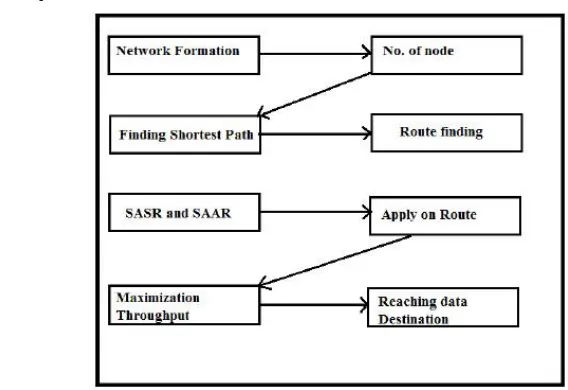
With different data rates in network simulator we design SASR algorithm and SAAR algorithm. The evaluation results show that our algorithms works improvement to end-toend throughput compared with existing ones. Specifically, for path routing, a throughput gain up to 5.3 with a median of more than 60 percent is achieved in the case of single-flow, and an average gain of more than 20 percent is achieved with multiple flows; for any path routing, a median gain of 13.2 percent and the maximum gain up to 71.6 percent can be realized. Proposed work presents the results of a detailed packet level simulation comparing four multi-hop wirelesses ad hoc network routing protocols that cover a range.
2. System Architecture
ISSN(Online): 2319-8753 ISSN (Print): 2347-6710
I
nternational
J
ournal of
I
nnovative
R
esearch in
S
cience,
E
ngineering and
T
echnology
(An ISO 3297: 2007 Certified Organization)
Website: www.ijirset.com
Vol. 6, Issue 6, June 2017
3. Spatial reusability-aware anypath routing
The single-path routing, which restricts the packets to be forwarded through apredetermined path from the source to the destination, anypath routing enables anyintermediate node who overhears the packet to participate in packet forwarding.Therefore, in the case of any path routing, our objective is to pick a set of participatingnodes Q (including the source), and the corresponding profile of distance/cost.
C = (Ci)i ∈ Q (1) and forwarder lists F = (Fi)i ∈ Q to minimize the spatial reusability aware any path cost Csrc. Here, having a smaller Ci means that node i is closer to the destination.
Algorithm 1. SASR-MIN Algorithm
This algorithm used for finding minimal path. C=Path delivery time
Q=Covered link
∗= Maximal non-interfering sets
I=non-interfering sets P=Path
1. C←0
Initially cost mean delivery time is zero. 2. Q←
Covered Set initially empty 3. while Q≠P
In this Step loop for Q is not equal to select path then it executed. Enter in loop. 4. foreach I ∗ do
In above step for loop executed up to I is an element of set ∗. 5. I←I \ Q
In that Store link in I when set that contains all those link of I that are not in Q. 6.if I ≠ &&c(I) / |I|< Threshold
If I is not equals to Empty and also we check value of cost of I up to threshold i.e. particular link. 7. ∝← c(I) / |I|
Store the value of cost in ∝. 8. Temp ←I
And also non-interfering link are stored in Temp Variable.
In that continuously execute the loop up covered all links are possible . 9. End //End if loop
10. End //End Foreach loop 11. C← C+ c(Temp)
Store total cost in C. 12. I←I ∪ {Temp}
Store the non-interfering link in I. 13. Q ← Q ∪ {Temp}
Stored covered link in Q 14. End // End while loop 15. Return C and I
Algorithm 2. SASR-FF Algorithm
This algorithm used for minimal cost of path selection from set of paths. P=Path
ISSN(Online): 2319-8753 ISSN (Print): 2347-6710
I
nternational
J
ournal of
I
nnovative
R
esearch in
S
cience,
E
ngineering and
T
echnology
(An ISO 3297: 2007 Certified Organization)
Website: www.ijirset.com
Vol. 6, Issue 6, June 2017
I= non-interfering sets
1. Sort the links in P by cost in non-increasing order L
2. Initially we give one variable K ←0
3. Cost of path initially zero and I is empty C ←0; I← ∅
4. Execute the for loop for all links are sorted in L and (i, j) are the values are particular node
foreach (i, j) L do
5. fused← FALSE;
In this step fused is false then go to for loop 6. for l ← 1 to k do
In this step variable l is equals to one up to k 7. reusable ←TRUE;
If route will be reusable then it assign to TRUE
8. foreach ( , ) do
9. if [ (i, j) , ( , ) ] E then
10. reusable ←FALSE;
If route is not reusable then assign to FALSE i.e. if node not sending more packet for different route . 11. break;
12. end // end if loop
13. end // end foreach loop 14. if reusable then
If reusable is TRUE
Then find max cost of path add to non-interfering set 15. ← ∪ {(i, j) }; ←max{( , ) }; 16. fused ← TRUE;
17. end
18. end
19. if not fused then
20. k ← k+1
21. I ← I ∪ {{(i, j) }}; ←
22. end
23. end
24. forl ← 1 to k do
25. C ← C+ 26. end
27. return C and I
Algorithm 3. SAAR Algorithm
Input- G= (N, E)
A network graph, a source node Src, a destination node Dst.
Output- A set of participating nodes Q, and the corresponding profile of cost C and forwarder lists F. 1. foreachi N do
i node belong to N
2. ← +∞ ; ← ∅; Ω(i, i)←1
ISSN(Online): 2319-8753 ISSN (Print): 2347-6710
I
nternational
J
ournal of
I
nnovative
R
esearch in
S
cience,
E
ngineering and
T
echnology
(An ISO 3297: 2007 Certified Organization)
Website: www.ijirset.com
Vol. 6, Issue 6, June 2017
3. end // end foreach loop
4. ←0; q←Dst; Q ←{ };I ← {{Dst}}; q= last picked min-cost node 5. while q≠ do
Q is not equals to Dst then
6. foreach (i, q) ∧i∉ do
node I and q belongs to E And i is not belongs to Q
7. ← ∪{ };Ω ←Ω
Add last picked min-cost node into forwarder list and probability matrix add node i.
8. foreach j Q do
j is belongs to Q
9. Ω( , )←0
Then set probability matrix set Zero.
10. foreach k ∧ < do
k is belongs to and is less than
11. Ω( , )←Ω( , ) + x Ω( , ); Add node link in probability matrix.
12. end //end foreach loop
13. end //end foreach loop
14. ( , ) ← CalculateCost (i, I,Ω, F);
Calculate minimum cost with node I and interfering set, probability matrix and forwarder list.
15. end //end foreach loop
16. q←argmin( ); Q ← ∪{q}; //last picked min-cost node add cost and participating node set Q into add q.
i N\Q
17. Ω ←Ω ;I← ;
Set probability matrix into add last min-cost node and Interfering set also add q.
18. end //end while loop
19. return Q, C, and F;
Output is participating node and min-cost and forwarding list. Algorithm 4. Function CalculateCost ()
i= node
I= non-interfering sets
Ω= a profile of relay probabilities
F= a profile of forwarding sets
Output- The fused anypath cost from node i to the destination node, and updated non- interfering sets I.
1. fused←FALSE; ←0;
Initially fused node is false and Cost set also set zero.
2. foreach I I do
3. reusable← TRUE
If node is reusable then Sst reusable node is true .
4. foreach (j, ) Ido
Node j and forwarder node belongs to interfering set
ISSN(Online): 2319-8753 ISSN (Print): 2347-6710
I
nternational
J
ournal of
I
nnovative
R
esearch in
S
cience,
E
ngineering and
T
echnology
(An ISO 3297: 2007 Certified Organization)
Website: www.ijirset.com
Vol. 6, Issue 6, June 2017
6. reusable← FALSE; break; if nodes are not reusable then false.
7. end //end if loop
8. end //end foreach loop
9. if reusable then
10. I ← I ∪{(i, )}; fused←FALSE ; break;
Add into non-interfering set node i and forwarding list of node i. and fused set false.
11. end //end if loop
12. end // end foreach loop
13. if not fused then 14. I ← I ∪{{(i, )}};
Add into non-interfering set node i and forwarding list of node i.
15. end// end if loop
16. foreach I I do
17. ← +c(I)
Add min-cost with non-interfering set.
18. end// end foreach loop
19. return and I.
Returncost of set and non-interfering set node Algorithm 5. . Euclidean Distance Algorithm
distance= distance
p and q are Euclidean Vectors
f p = (p1, p2,..., pn) and q = (q1, q2,..., qn) are two points in Euclidean n-space, then the distance (d) from p to q,
or from q to p is given by the Pythagorean formula: 1. n=number of nodes
2. for i ←1 to n do
3. for j ← 1 to n do
4. node[i]=[p, q]; 5. node[j]=[p, q];
6. distance[i, j]= (( 1− 1) ) + (( 2− 2) ) +⋯… … . . +(( − ) )
7. end
8. end
9. return distance;
IV.EXPERIMENTAL RESULTS
ISSN(Online): 2319-8753 ISSN (Print): 2347-6710
I
nternational
J
ournal of
I
nnovative
R
esearch in
S
cience,
E
ngineering and
T
echnology
(An ISO 3297: 2007 Certified Organization)
Website: www.ijirset.com
Vol. 6, Issue 6, June 2017
TABLE I
SIMULATION PARAMETERS SETUP Parameter Value
Number of Nodes 10
Terrain Area 2,000m× 2,000m RTS/CTS OFF
Packet Size 1,500 Bytes Traffic Generator CBR
CBR Rate 5 Mbps / 20 Mbps 802.11 Data Rate 11 Mbps / 54 Mbps
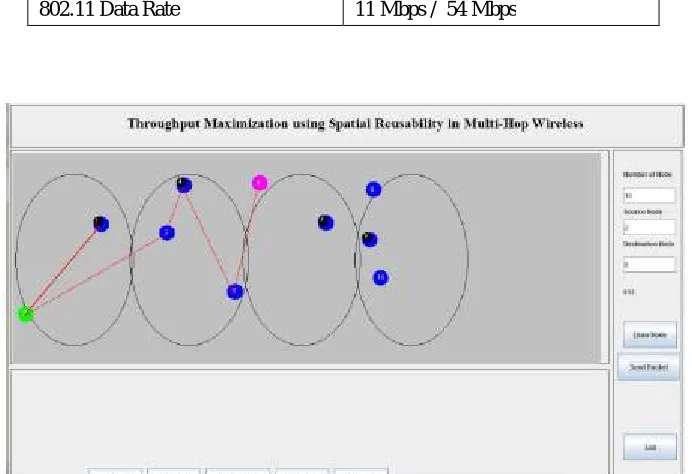
Fig 4 Implementation of SASR and Sending Packet
ISSN(Online): 2319-8753 ISSN (Print): 2347-6710
I
nternational
J
ournal of
I
nnovative
R
esearch in
S
cience,
E
ngineering and
T
echnology
(An ISO 3297: 2007 Certified Organization)
Website: www.ijirset.com
Vol. 6, Issue 6, June 2017
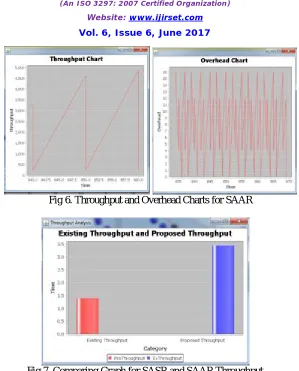
Fig 6. Throughput and Overhead Charts for SAAR
Fig 7. Comparing Graph for SASR and SAAR Throughput
V. CONCLUSION
Spatial reusability aware routing can efficiently improve the source to destination communication with high end throughput in multi-hop wireless networks, by carefully considering spatial reusability of the wireless communication media. This is done by the protocols, SASR and SAAR, for spatial reusability-aware single-path routing and any path routing, respectively. To contribute more for better energy efficiency system implement opportunistic routing to reduce energy consumption. Resource allocation algorithm is inquired to maximize the energy efficiency (EE) in multiuser decode-and forward (DF) relay interference networks.
REFERENCES
[1] Atul Adya, Paramvir Bahl, Jitendra Padhye, Alec Wolman, Lidong Zhou, ”A Multi-Radio Unification Protocol for IEEE 802.11Wireless Networks”, in Proc. 1st Int. Conf. Broadband Netw, 2004, pp. 344354.
[2] C. E. Perkins and P. Bhagwat,”Highly dynamic destination sequenced distance-vector routing (DSDV) for mobile computers,” in Proc. 4th Annu. ACM/IEEE Int. Conf. Mobile Comput. Netw., 1998, pp. 8597.
[3] J. Broch, D. A. Maltz, D. B. Johnson, Y.-C. Hu, J. G. Jetcheva, ”A performance comparison of multi-hop wireless ad hoc network routing protocols”, in Proc. 4th Annu. ACM/IEEE Int. Conf. Mobile Comput. Netw. 1998, pp. 8597.
[4] S. Chachulski, M. Jennings, S. Katti, and D. Katabi, ”Trading structure for randomness in wireless opportunistic routing”, in Proc. SIGCOMM Conf. Appl., Technol., Archit. Protocols Comput. Commun., 2007, pp. 169180.
[5] R. Draves, J. Padhye, and B. Zill, ”Routing in multi-radio, multihop wireless mesh networks”, in Proc. 10th Annu. Int. Conf. Mobile Comput. Netw., 2004, pp. 114128.
[6] D. B. Johnson and D. A. Maltz, ”Dynamic source routing in ad hoc wireless networks”, in , Mobile Comput, vol. 353, 1996 pp. 153181. [7] T.S. Kim, J. C. Hou, and H. Lim, ”Improving spatial reuse through tuning transmits power, carrier sense threshold, and data rate in multihop wireless networks”, in Proc. 12th Annu. Int. Conf. Mobile Comput. Netw., 2006, pp. 366377.
ISSN(Online): 2319-8753 ISSN (Print): 2347-6710
I
nternational
J
ournal of
I
nnovative
R
esearch in
S
cience,
E
ngineering and
T
echnology
(An ISO 3297: 2007 Certified Organization)
Website: www.ijirset.com
Vol. 6, Issue 6, June 2017
[9] Y. Lin, B. Li, and B. Liang, ”Codeor Opportunistic routing in wireless mesh networks with segmented network coding”, in Proc. IEEE Int. Conf. Netw. Protocols, 2008, pp. 1322.
[10] J. Padhye, S. Agarwal, V. N. Padmanabhan, L. Qiu, A. Rao, and B. Zill, ”Estimation of link interference in static multi-hop wireless networks”, in Proc. Internet Meas. Conf., 2005, p. 28.
[11] Y. Liu, M. Dong, K. Ota and A. Liu, ”ActiveTrust: Secure and Trustable Routing in Wireless Sensor Networks,” in IEEE Transactions on Information Forensics and Security, vol. 11, no. 9, Sept. 2016, pp. 2013-2027.
[12] S. Zhao, L. Fu, X. Wang, and Q. Zhang, Fundamental relationship between node density and delay in wireless ad hoc networks with unreliable links, in Proc. 17th Annu. Int. Conf. Mobile Comput. Netw., 2011, pp. 337348.