Summary We investigated the influence of cutting water po-tential (Ψcut) on rooting of juvenile hardwood (dormant) and softwood (succulent) stem cuttings of loblolly pine (Pinus taedaL.) propagated under varying substrate water potentials (Ψsub) and volumes of mist application. Mist treatment andΨsub contributed to theΨcutof unrooted stem cuttings. WhenΨsub was held constant across mist treatments, mist treatment con-tributed strongly to Ψcut. Substrate water potential affected rooting percentage when mist treatment was sub-optimal or ex-cessive, otherwise mist treatment had a stronger effect than Ψsubon rooting percentage. Cuttings rooted best when sub-jected to moderate cutting water potentials (–0.5 to –1.2 MPa) during the initial 4 or 5 weeks of the rooting period. Cuttings experiencing either severe water deficit or no water deficit rooted poorly. We conclude that the rooting environment should impose a moderate water stress on loblolly pine stem cuttings to achieve optimum rooting.
Keywords: adventitious rooting, clonal forestry, Pinus taeda, vegetative propagation, soil water deficit, water relations, wa-ter stress.
Introduction
Propagation of loblolly pine (Pinus taedaL.) by juvenile stem cuttings, produced on recurrently sheared stock plants (hedges), can be used to multiply superior full-sib families and elite clones within superior families for reforestation (Zobel and Talbert 1984, Goldfarb et al. 1997, Frampton et al. 1999, 2000). Production of high-quality rooted stem cuttings on a large scale, however, requires maintenance of a suitable root-ing environment over large areas. Rootroot-ing environments can vary from polyethylene-covered greenhouses to semi-shaded structures and direct field-setting of stem cuttings. Thus, spe-cific irrigation protocols may not be applicable in all rooting environments (Frampton and Hodges 1989, Rowe et al. 1999, Gocke et al. 2001). Therefore, a more physiological approach to understanding water relations of stem cuttings during the
rooting period may aid in the design and control of suitable propagation environments.
In most commercial systems for rooting of stem cuttings, in-termittent mist application minimizes plant water stress by lowering leaf temperature and transpiration, thereby increas-ing the humidity surroundincreas-ing the cuttincreas-ings (Tukey 1978). It has been shown that the volume of water applied during intermit-tent mist application can affect rooting percentage (Green-wood et al. 1980, Loach 1988). The water content of the substrate (rooting medium) is also important during rooting of woody ornamental species (Rein et al. 1991), especially when mist is not applied (Graves and Zhang 1996) or applied infre-quently to softwood cuttings (Giroux et al. 1999).
The water potential of a stem cutting(Ψcut) is a physiologi-cal indicator of the water deficit (Kramer and Kozlowski 1979) that results when transpiration rate exceeds water uptake (Grange and Loach 1983, Bray 1997). Although available wa-ter is not usually limiting during rooting, high negative Ψcut values may arise, presumably because of the absence of a root system for water uptake. ForΨcutto increase, stem cuttings must either absorb applied mist through foliage or absorb wa-ter through the basal portion of the cutting, which is inserted into the substrate. Although both modes of uptake have been reported to occur in stem cuttings of radiata pine (Pinus radiataD. Don.) (Cameron and Rook 1974, Cremer and Sven-sson 1979), the modes of uptake that contribute to Ψcut of loblolly pine under different environmental conditions have not been reported.
It has been suggested that rooting percentage is related lin-early toΨcutduring the rooting period (Loach 1977, Loach and Whalley 1978, Hartmann et al. 2002). This relationship im-plies that stem cuttings with a highΨcut, will have an increased likelihood of root initiation and development. On the other hand, supra-optimal mist application, which decreases water stress, can decrease rooting (Greenwood et al. 1980, Harri-son-Murray and Howard 1998). Decreased rooting under con-ditions of minimal water stress has also been observed and is usually attributed to reduced oxygen concentrations near root
© 2004 Heron Publishing—Victoria, Canada
Mist, substrate water potential and cutting water potential influence
rooting of stem cuttings of loblolly pine
ANTHONY V. LEBUDE,
1,2BARRY GOLDFARB,
2,3FRANK A. BLAZICH,
1FARRELL C.
WISE
4and JOHN FRAMPTON
21Department of Horticultural Science, North Carolina State University, Raleigh, NC 27695-7609, USA 2Department of Forestry, North Carolina State University, Raleigh, NC 27695-8002, USA
3Corresponding author ([email protected]) 4
MeadWestvaco Corp., P.O. Box 1950, Summerville, SC 29484, USA
root formation to occur. Murthy and Goldfarb (2001) observed that moderate to severe short-term water stress in stem cuttings of loblolly pine, before transfer to optimal conditions, de-creased percent rooting only slightly. The degree of water stress that stem cuttings can experience without serious inhibi-tion of rooting percentage is poorly defined.
In previous studies, the effects of gradients in mist and sub-strate water content on rooting percentage were investigated by positioning stem cuttings at various distances from a fixed mist nozzle placed above the rooting bed (Harrison-Murray and Howard 1998, Loach 1988). Although indicative of the ef-fect of the overall amount of water applied, this experimental design precludes differentiation between the effects of the mist treatment and those of substrate water content, because the factors are confounded. However, a more detailed understand-ing of the effects of aerial mist and substrate water content and their interactions onΨcutand rooting would facilitate imple-mentation of irrigation systems that would be applicable ac-ross rooting environments.
We studied the relationship between rooting percentage and Ψcutin juvenile hardwood (dormant) and softwood (succulent) loblolly pine stem cuttings and determined how this relation-ship is affected by aerial mist and substrate water potential (Ψsub). Specifically, we examined the effects of the volume of mist delivered per application (mist treatment) and Ψsubon Ψcutand root formation. We also tested the effects of various mist treatments onΨcutand root formation, withΨsubheld con-stant. In the analysis of all experiments,Ψcutwas treated as an independent variable to determine its relationship with rooting percentage.
Materials and methods
Plant material
In June 1996, 200 seeds from two unrelated full-sib families (100 seeds per family) of a Florida provenance of loblolly pine were germinated. In May 1997, individual seedlings were transplanted to 12-l containers filled with a substrate of com-posted, shredded pine bark:sand (4:1 v/v). All stock plants were grown outdoors at the North Carolina State University Horticultural Field Laboratory (35°47′N, 78°39′W). At the beginning of March and August of each year, seedlings were sheared to a height of about 15 cm and maintained as hedged stock plants (hedges) by removing all remaining terminal buds of lateral stems in accordance with protocols of Cooney and Goldfarb (1999). Irrigation was provided, as needed, by an overhead sprinkler system. About 51 g of commercial slow-re-lease fertilizer (18:6:12 N,P,K; Osmocote, 8–9-month, Grace-Sierra, Milpitas, CA) was applied twice per year to each hedge after pruning to maintain tissue nitrogen concentrations at the target values recommended by Rowe et al. (2002). Other macro- and micronutrients were applied as indicated by
peri-eral pesticides were applied throughout the growing season to control tip moth (Rhyacionia frustranaComst.) and fusiform rust (Cronartium quercuum (Berk.) Miyabe ex Shirai f. sp.
fusiforme).
In February 1999, ramets were produced from the original seedling ortets by rooting stem cuttings from each of about 60 ortets of each full-sib family that had shown a high rooting ability in previous experiments. In May 1999, rooted cuttings from the 60 ortets per family were moved outdoors and grown for about 12 months in 164-ml containers (Ray-Leach Super-Cells, Steuwe and Sons, Corvallis, OR) before transplanting two ramets per ortet into 12-l containers in May 2000. Hedges were pruned to a height of 15 cm in July 2000. Nutrient treat-ments were as described previously.
For all experiments, terminal stem cuttings were collected from the hedged ramets of both full-sib families before 1200 h, wrapped in moist paper towels and stored in insulated coolers. Coolers were placed in a cold room maintained at 4° C for Ex-periments 1 and 3 (winter). For ExEx-periments 2 and 4 (spring), coolers were placed under the propagation bench overnight at ambient greenhouse temperatures. Before setting them in the rooting medium to a depth of 1 cm, cuttings were recut from the proximal portions to a final length of 9 cm, and the basal 1 cm was dipped for 3 s in either 10 mM 1-naphthaleneacetic acid (NAA; 1.86 g l–1in 30% ethanol v/v) for Experiments 1 and 3, or 2.5 mM NAA (0.46 g l–1in 20% ethanol v/v) for Ex-periments 2 and 4. Needles were not removed from the basal portions of the cuttings that were inserted into the rooting me-dium.
Propagation environment
altered to create different mist application treatments. For each boom speed, mist application (ml m–2per boom pass) was cal-culated by dividing the total output for all nozzles (258 ml min–1 per nozzle × 26 nozzles) (TeeJet nozzle #800067, Spraying Systems, Neuvo, CA) by the area covered by the boom in 1 min. Main plots were surrounded by either white porous cloth (Experiments 1 and 2) or clear polyethylene plas-tic (Experiments 3 and 4) to minimize environmental gradients within the greenhouse and to separate treatments. Individual plots were surrounded by two rows of border cuttings.
Effects of mist treatment andΨsubonΨcutand rooting percentage (Year 1)
Experiments 1 and 2 investigated the effects of two mist treat-ments and fourΨsubtreatments onΨcutand rooting of stem cut-tings. The design for each experiment was a split-plot with two mist treatments as the main plots and two replications of each mist treatment. Cuttings in the high-mist treatment (HM) re-ceived about 40% more mist than cuttings in the low-mist treatment (LM) during each boom pass. FourΨsubtreatments: wet, intermediate, dry and a control were the subplots. Each Ψsubtreatment in a replication of mist was represented as two separate rooting tubs (subsamples within subplots). TheΨsub treatments were created by using rooting tubs of various heights for each treatment (wet = 15.2 cm, intermediate = 30.5 cm and dry = 43.2 cm) filled with fine silica sand (BX-30, Foster Dixiana, Columbia, SC). After watering each rooting tub to container capacity, the different distances between the perched water tables at the bases of the containers and the root-ing zones at the tops of the sand columns in each container cre-ated the threeΨsubtreatments. To maintainΨsubat the desired treatment threshold values, tensiometers (Irrometer, Santa Monica, CA) monitoredΨsuband then triggered supplemental irrigation delivered through drip irrigation emitters (360° shrub-bubblers, Antelco, Sydney, Australia) placed at the sand surface in the rooting containers. One tensiometer was placed in each of the wet, intermediate and dryΨsubtreatments (six tensiometers total) in one replication of each mist treatment. Tensiometers were inserted so that the top of the porous ce-ramic tip was at the surface of the sand and the base was 3.8 cm below the surface. This allowed measurement ofΨsubnear the basal portion of the stem cuttings. WhenΨsubfor each treat-ment decreased below the set critical values (described in next section), supplemental irrigation was applied to both replica-tions for thatΨsubtreatment within a mist treatment. To serve as a control, a commonly used medium, peat:perlite (2:3 v/v), was placed in a container with a height equal to the intermedi-ateΨsubtreatment with no supplemental irrigation provided.
Twenty-one hundred cuttings, bulked from the two families, were collected for each experiment and about 120 stem cut-tings were placed in each subplot (60 cutcut-tings per subsample × 2 subsamples × 4Ψsubtreatments × 2 mist treatments × 2 repli-cations = 1920 total stem cuttings set). We used a pressure chamber (Scholander et al. 1965) (SoilMoisture Equipment, Santa Barbara, CA) to measureΨcutdestructively at 0500 and 1400 h on one cutting per subsample 7, 14, 21, 28 and 35 days
after setting (DAS). Cuttings selected randomly forΨcut mea-surements were replaced to maintain canopy dynamics. We also measured Ψsubin each subsample at these times. The means ofΨcutandΨsubfor the two subsamples at two measure-ment times each day for the 35-day measuremeasure-ment period provided subplot water potential values. The percentage of cuttings that had not been sampled and produced at least one root≥1 mm was recorded for each subplot 70 DAS.
Experiment 1 Juvenile hardwood stem cuttings were
col-lected on January 5, 2001 and stored until set on January 11, 2002. Chronologically, stem cutting material was 4.5 years old from seed, although cuttings were collected from hedges that had been propagated vegetatively 18 months previously. Cut-tings in the HM treatment received 121 ml m–2of mist, whereas cuttings in LM received 72 ml m–2, about 40% less during each boom pass. Mist treatments remained constant for 36 DAS, then HM was reduced to 102 ml m–2until 50 DAS and finally reduced to 72 ml m–2for the remainder of the experiment. The LM treatment remained unchanged during the experiment.
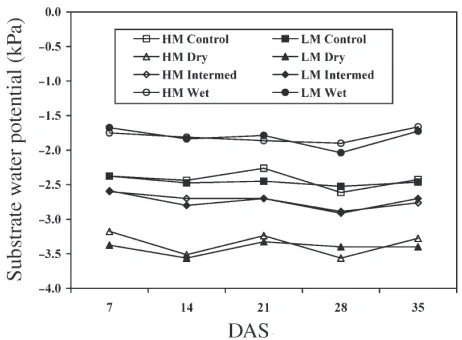
The Ψsub treatments were calibrated to –1.6 kPa (wet), –2.8 kPa (intermediate) and –3.8 kPa (dry) corresponding to sand column heights in the rooting containers of 10.2, 25.4 and 38.1 cm, respectively. TheΨsubtreatments were relatively sta-ble over the 35-day measurement period (Figure 1).
Experiment 2 Softwood stem cuttings were collected on
June 22, 2001, stored overnight, and set the following day. Stem cutting material was 5 years from seed, although cuttings were collected from hedges that had been propagated vegeta-tively 2 years previously. Because HM stem cuttings in Experi-ment 1 remained continuously wet, modifications were made to the mist andΨsubtreatments in Experiment 2. During the first 35 DAS in the HM treatment, boom speed was varied manually to apply 68–121 ml m–2of mist per boom pass so that the
tions in both HM and LM were adjusted to 45 ml m for the remainder of the experiment. TheΨsubtreatments were cali-brated to –1.8 kPa (wet), –2.5 kPa (intermediate) and –3.5 kPa (dry) by altering the heights of the sand columns, and irrigated to maintainΨsubwithin the desired range as described above. TheΨsubtreatments remained constant during the measure-ment period, except for the control treatmeasure-ment whereΨsub fluc-tuated depending on mist treatment. BecauseΨsubin the control treatment was not maintained by supplemental irrigation, it av-eraged –2.6 kPa in HM, and –3.1 kPa in LM. The remaining Ψsubtreatments were significantly different from one another, yet similar between mist treatments for eachΨsubtreatment as in Experiment 1 (data not shown).
Effect of mist treatment onΨcutand rooting percentage
(Year 2)
Experiments 3 and 4 tested the effects of mist treatment onΨcut and rooting percentage. Each experiment was a randomized complete block design with two replications of six mist treat-ments. The mist treatments were45, 61, 75, 102, 147 and 310 ml m–2of mist application per boom pass and remained constant for the duration of the experiment. The value ofΨsub was set at –2.2 kPa for all mist treatments and maintained as described for Experiments 1 and 2. AΨsubof –2.2 kPa was cre-ated by placing 12.5 cm offine silica sandin 91 (length) × 61 (width) × 20 cm (height) black plastic super tubs (Rosti OS, Irving, TX).
About 100 stem cuttings were set in each plot.A pressure chamber was used to measureΨcutdestructively every 3 h be-tween 0500 and 2300 h (seven measurements) on two cuttings per plot 7, 14, 21, 28 and 35 DAS (the 35-DAS measurements were made only in Experiment 4). Data forΨcutwere averaged over the seven measurement times each day and then over the 28- (Experiment 3) or 35-day (Experiment 4) measurement period. We measured Ψsubat 0500 and 1400 h on the same DAS and values remained at –2.4±0.2 kPa among plots dur-ing these periods.The percentage of cuttings that had not been sampled and produced at least one root > 1 mm was recorded for each plot 70 DAS.
Experiment 3 Hardwood stem cuttings were collected on
February 15, 2002, stored and then set on April 5, 2002 (1200 total stem cuttings). Stem cutting material was 5.5 years old from seed, although stem cuttings were collected from hedges that had been propagated vegetatively 2.5 years previously.
Experiment 4 Three thousandsoftwood stem cuttings were
collected onJune 25, 2002 and set the following day. Stem cut-ting material was6 years old from seed, although cuttings were collected from hedges that had been propagated vegetatively 3 years previously. One hundred stem cuttings were placed in each of two rooting tubs (subsamples) per plot for a total of 2400 cuttings. There were two rooting tubs per replication to provide enough cuttings for simultaneous measurements of
Statistical analyses
Data were tested for normality and homogeneity of variances by univariate procedures (Steel et al. 1997) in SAS (SAS Insti-tute, Cary, NC). In all experiments, data forΨcutwere not dis-tributed normally, but had equal variances among treatments. Despite numerous transformations, normality was not proved significantly. However, the transformation that im-proved distribution according to visual examination of plots was used in a parallel analysis with the untransformed data. No differences were found between the two analyses for any ex-periment. Data for rooting percentage were distributed nor-mally and had homogeneous variances among treatments; however, the arcsine square-root-transformed values were used in a parallel analysis. The outcomes of both analyses were similar. Therefore, all test statistics and means presented are based on the untransformed data ofΨcutand rooting per-centage.
For Experiments 1 and 2, the main effects and interactions of mist andΨsubonΨcutand percent rooting were determined by analysis of variance. The relationship betweenΨcutandΨsub was determined by regression analysis. For Experiments 3 and 4, the relationship betweenΨcutand mist application, and the relationship between percent rooting and mist application were determined by regression analysis. For all experiments, we examined the relationship ofΨcutas the independent vari-able with rooting percentage.
Results
Effects of mist treatment and subonΨcutand rooting
percentage (Experiments 1 and 2)
In Experiments 1 and 2,Ψcutwas significantly affected by both mist andΨsubtreatments (P= 0.10) (Table 1). Values ofΨcut in-creased (became less negative) across allΨsubtreatments when mist application increased 40% from LM to HM (Figure 2). In Experiment 1, but not Experiment 2,Ψcutwas significantly af-fected by the mist × Ψsub treatment interaction (Table 1). Therefore, the effect ofΨsubonΨcutis shown by mist treatment for Experiment 1, whereas the main effect ofΨsubis shown for Experiment 2 (Figure 2). As Ψsubincreased, the rate of in-crease in Ψcutwas similar for cuttings in the combined mist treatments in Experiment 2 and for LM cuttings in Experi-ment 1, as indicated by similar regression slopes (b= 0.20 for Experiment 2 andb= 0.21 for LM in Experiment 1) (Figure 2). For HM cuttings in Experiment 1, however, the rate of increase inΨcutwith increasingΨsubwas significantly less (b= 0.09).
re-spectively. In Experiment 2, mist treatment, but notΨsub, sig-nificantly affected rooting percentage (Table 1). In this experi-ment, rooting percentage was higher for HM cuttings (60%) than for LM cuttings (35%), regardless ofΨsubtreatment.
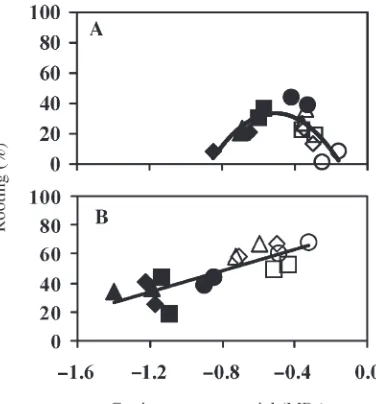
In Experiment 1, rooting percentage was related moderately with both the linear and quadratic terms ofΨcut(P= 0.01,r2= 0.56, for the equation containing both terms) (Figure 3A). Rooting percentage increased to about 35% asΨcutincreased from –0.8 to –0.5 MPa. However, percent rooting then de-creased asΨcutcontinued to increase to –0.2 MPa (Figure 3A). For cuttings in Experiment 2, rooting increased linearly asΨcut increased (Figure 3B). Although overall rooting was higher for Experiment 2 than for Experiment 1, the highest rooting percentages were found in cuttings of several treatment
com-binations, with meanΨcutbetween –0.4 and –0.6 MPa, similar to Experiment 1.
Effects of mist treatment on cutand rooting percentage
(Experiments 3 and 4)
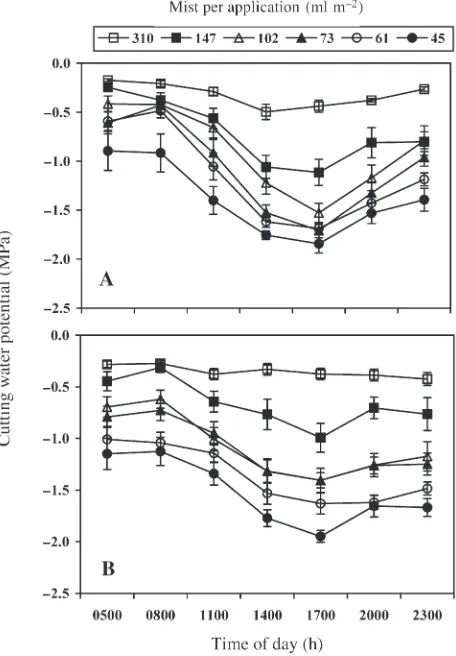
Over the 28- and 35-day measurement periods in Experiments 3 and 4, respectively,Ψcuttended to follow a similar diurnal pattern for each mist treatment (Figure 4): it decreased be-tween 0800 and 1700 h and increased bebe-tween 1700 and Table 1. Values ofPfor the analysis of variance for cutting water potential (Ψcut)and percent rooting of juvenile hardwood (Experiment 1) and softwood (Experiment 2) stem cuttings of loblolly pine rooted in two mist treatments and four substrate water potential (Ψsub) treatments. Bold values are statistically significant (P< 0.1). Error A was used as the error term to test the main effect of replication and mist treatment, and Error B was used as the error term to test the main effect ofΨsuband the mist ×Ψsubinteraction.
Source df Experiment 1 Experiment 2
Ψcut Rooting (%) Ψcut Rooting (%)
Replication 1 0.53 0.28 0.46 0.12
Mist treatment 1 0.08 0.17 0.02 0.02
Error A 1 0.14 0.32 0.68 0.85
Ψsub 3 0.01 0.04 0.01 0.40
Mist treatment×Ψsub 3 0.09 0.01 0.50 0.88
Error B 6
Figure 2. Effect of mist treatment and substrate water potential (Ψsub) on mean cutting water potential (Ψcut) of juvenile hardwood (Experi-ment 1, conducted in January 2001) and softwood (Experi(Experi-ment 2, conducted in June 2001) stem cuttings of loblolly pine. Solid regres-sion lines represent Experiment 1. The open symbols in Experiment 1 represent the high mist (HM) and solid symbols the low mist (LM) treatments. The dashed regression line represents Experiment 2, and the open symbols represent the means of HM and LM. Symbols are means (n= 20 for Experiment 1, andn= 40 for Experiment 2) ofΨcut andΨsubmeasured at 0500 and 1400 h 7, 14, 21, 28 and 35 days after setting in each plot. Regression equations areΨcut(HM) = –0.07 + 0.09Ψsub(P= 0.03,r2= 0.58) andΨcut(LM) = –0.07 + 0.21Ψsub,P= 0.02,r2= 0.61, for Experiment 1 andΨcut(combined HM and LM) = –0.30 + 0.20Ψsub,P= 0.04,r2= 0.61, for Experiment 2.
Figure 3. Relationship between rooting percentage and cutting water potential (Ψcut) of juvenile (A) hardwood (Experiment 1, conducted in January 2001) and (B) softwood (Experiment 2, conducted in June 2001) stem cuttings of loblolly pine rooted under high mist (HM = open symbols) and low mist (LM = solid symbols) and four substrate water potential treatments (control =䊏,䊐; dry =䉱,䉭; intermedi-ate =䉬,䉫; and wet =䊉,䊊). Symbols are means (n= 20) ofΨcut mea-sured at 0500 and 1400 h 7, 14, 21, 28, or 35 days after setting in each plot. Values for the quadratic term,Ψcut
2
, in Experiment 1 were gener-ated forΨcutin each plot initially, and then averaged similarly to the linear term. The regression equations are (A) Rooting (%) = –32.80 – 261.66Ψcut– 257.47Ψcut
2
ure 4). In both experiments, meanΨcut(across all times and measurement dates) was strongly related to the log of mist ap-plication (Experiment 3,R2= 0.97 and Experiment 4,r2= 0.96) (Figure 5). The sharpest increase inΨcutwas between 45 and 102 ml m–2of mist per application, whereas above 147 ml m–2, the increase was more gradual.
Mean rooting was 73 and 63% for Experiments 3 and 4, re-spectively. Rooting percentage was significantly affected by both the linear and quadratic terms of mist treatment in Experi-ment 3 (P= 0.03,R2= 0.54, for the equation containing both terms), but neither the linear nor the quadratic terms affected rooting percentage in Experiment 4 (Figure 6). In Experi-ment 3, rooting increased to 94% in a mist treatExperi-ment of 147 ml m–2per boom pass, and then declined as mist application in-creased (Figure 6).
Rooting percentage was related moderately with both the linear and quadratic terms ofΨcutin both experiments (P = 0.01,R2= 0.70, for equations containing both terms in both ex-periments) (Figure 7). In Experiment 3, the highest rooting percentage (90%) occurred for cuttings with a meanΨcut be-tween –0.5 and –1.0 MPa. In Experiment 4, the highest rooting
Figure 4. Cutting water potential by time of day for juvenile (A) hard-wood (Experiment 3, conducted in April 2002) and (B) softhard-wood (Ex-periment 4, conducted in June 2002) stem cuttings of loblolly pine receiving 45, 61, 73, 102, 147, or 310 ml m–2of mist per application. Symbols are means (n= 8 for Experiment 3, andn= 10 for Experi-ment 4) of two replications per mist treatExperi-ment averaged over 7, 14, 21, 28, or 35 (day 35 measurement for Experiment 4 only) days after set-ting. Vertical bars = ± 1 SE (n= 4 for Experiment 3 andn= 5 for Ex-periment 4).
Figure 5. Relationship between cutting water potential (Ψcut) and 45, 61, 73, 102, 147, or 310 ml m–2of mist per application for juvenile (A) hardwood stem cuttings in April 2002 (Experiment 3) and (B) softwood stem cuttings of loblolly pine in June 2002 (Experiment 4). Symbols are mean (n= 56 for Experiment 3, andn= 70 for Experi-ment 4)Ψcutfor each replication recorded seven times per day, 7, 14, 21, 28, or 35 (day 35 measured for Experiment 4 only) days after set-ting cutset-tings in each plot. The regression equations are (A)Ψcut= –3.39 + 0.54ln(ml m–2),P= 0.01,r2= 0.97, and (B)Ψcut= –3.84 + 0.62ln(ml m–2),P= 0.01,r2= 0.96. Vertical bars = ± 1 SE (n= 4 for Experiment 3, andn= 5 for Experiment 4).
percentage (80%) occurred for cuttings with a meanΨcut be-tween –0.7 and –1.2 MPa.
Minimum (most negative) and maximum dailyΨcutwere se-lected from the weekly measurements for each plot, regardless of the time of day, and averaged over the 28- (n= 4) or 35-day (n= 5) measurement period. In Experiment 3, rooting percent-age was moderately to highly correlated with minimumΨcut (R2= 0.78,P= 0.01) (Figure 8A). The regression equation predicted that 80% or more cuttings rooted when mean daily minimumΨcutwas between –0.7 and –1.65 MPa (Figure 8A). In Experiment 4, rooting percentage was related closely to minimumΨcut(R2= 0.45,P= 0.07) (Figure 8B). The regres-sion equation did not predict 80% rooting from the observed data, so 70% rooting was used as a benchmark. At 70% rooting or higher,Ψcutranged from –0.95 to –1.60 MPa (Figure 8B), however, variation in rooting was considerable.
The relationship between rooting percentage and maximum Ψcut was moderate for both Experiments 3 (R2= 0.61,P= 0.02) and 4 (R2= 0.61,P= 0.01) (Figure 8). When cuttings in Experiment 3 experienced a mean maximum Ψcut between –0.2 and –0.4 MPa, rooting was 80%. In Experiment 4, when
cuttings experienced a mean maximumΨcutbetween –0.35 and –0.75 MPa, rooting was 70% or higher.
Discussion
Mist andΨsubcontributed to theΨcutof unrooted, juvenile stem cuttings of loblolly pine. For all cuttings in Experiments 1 and 2,Ψcutincreased asΨsubincreased (Figure 2). Cuttings in indi-vidual mist treatments received equal mist application, so in-creases inΨcutwere a result of water uptake from the substrate. Increasing mist treatment also increasedΨcutfor all cuttings in all experiments (Figures 2 and 5). It has been suggested that water uptake can occur through both the aerial portion of the foliage exposed to intermittent mist application and the basal portion of the shoot inserted in the rooting substrate (Cameron and Rook 1974, Cremer and Svensson 1979, Peer and Green-Figure 7. Relationship between rooting percentage and mean cutting
water potential (Ψcut) of juvenile (A) hardwood (Experiment 3, April 2002) and (B) softwood (Experiment 4, June 2002) stem cuttings of loblolly pine rooted under six mist treatments. Symbols are means (n= 56 for Experiment 3, andn= 70 for Experiment 4) ofΨcut re-corded seven times per day 7, 14, 21, 28, or 35 days after setting cut-tings (Day 35 measurement for Experiment 4 only) in each plot. Values for the quadratic term,Ψcut
2,
were generated forΨcutin each plot initially, and then averaged similarly to the linear term. The re-gression equation for (A) is Rooting (%) = 9.26 – 261.94Ψcut– 152.44 Ψcut
2
,P = 0.01,R2= 0.70, and for (B) Rooting (%) = –31.49 – 283.57Ψcut– 140.03Ψcut
2
, P= 0.01,R2= 0.70.
Figure 8. Relationship between rooting percentage and mean mini-mum (open symbols) and maximini-mum (solid symbols) cutting water po-tential (Ψcut) for juvenile (A) hardwood (Experiment 3 conducted in April 2002) and (B) softwood (Experiment 4 conducted in June 2002) stem cuttings of loblolly pine. Symbols are means of the minimum and maximum dailyΨcutvalues recorded 7, 14, 21, 28, or 35 days (Day 35 for Experiment 4 only) after setting cuttings in each plot (n= 4 for Experiment 3 andn= 5 for Experiment 4). Values for the qua-dratic term,Ψcut
2
periment 1, as indicated by the significantΨsub× mist treat-ment interaction (P= 0.09).
Cuttings with the most negativeΨcutfor each experiment had poor rooting percentages (Figures 3 and 7). This is consis-tent with reports of poor rooting of stem cuttings of many spe-cies experiencing substantial water deficit or severely de-creasedΨcut(Loach 1977, Grange and Loach 1984, Rein et al. 1991, Murthy and Goldfarb 2001, Peer and Greenwood 2001). On the other hand, cuttings with the highestΨcutin Experi-ments 1 (Figure 3A), 3 (Figure 7A) and 4 (Figure 7B) also rooted poorly. The one exception was in the case of cuttings in Experiment 2 in which the revised method of mist application did not produce high values ofΨcutin stem cuttings. Green-wood et al. (1980) also reported that excessive mist application decreased rooting percentage in loblolly pine; however, these authors did not reportΨcut. Our finding that juvenile stem cut-tings of loblolly pine experiencing little or no water deficit root poorly has not previously been reported. In general, the delete-rious effect of excessive mist on rooting may be indirect be-cause basal portions of stem cuttings can become waterlogged and, ultimately, necrotic if the substrate is saturated. However, in our studies, this indirect effect was excluded by independ-ently controlling mist treatment andΨsub.Furthermore, we did not observe basal stem necrosis in any cuttings.
Our results suggest that, in juvenile stem cuttings of loblolly pine, moderate water stress imposed during rooting stimulated adventitious root formation and development. Cuttings with the highest rooting percentages had meanΨcutvalues between –0.5 and –1.2 MPa (Figures 3 and 7). These results agree with rooting percentages andΨcutvalues reported for other species. Juvenile stem cuttings of Alaskan yellow cedar ( Chamae-cyparis nootkatensis (D. Don) Spach.) had a mean Ψcut of –0.8 MPa (mean at 1100 h over 13 weeks prior to rooting) and a rooting percentage of 92% (Grossnickle and Russell 1993). Two treatments of stem cuttings of mountain lilac (Ceanothus thrysiflorus Eschsch.) had mean Ψcut values of –0.8 and –1.6 MPa (mean of 0900 and 1400 h) during the rooting pe-riod, with rooting percentages of 96 and 56%, respectively (Loach 1977). Prior to rooting, the cuttings with meanΨcutof –0.8 MPa had a one-time minimum stress of –1.2 MPa, whereas cuttings with meanΨcutof –1.6 MPa had a one-time minimum stress of –3.9 MPa (Loach 1977). Cuttings of both yellow cedar and mountain lilac, with the highest percentage rooting, also had mean Ψcut within the range (–0.5 to –1.2 MPa) that induced superior rooting in loblolly pine. How-ever, it cannot be determined from all these reports whether rooting percentage was adversely affected by a one-time expo-sure to severe water stress, repeated severe water stress, or the meanΨcutexperienced by cuttings during the rooting period.
Stem cuttings of loblolly pine rooted ~80% to ~70%, in Ex-periments 3 and 4, respectively, when mean daily minimum Ψcutwas more than –1.6 MPa but less than –0.90 MPa (Fig-ure 8). Murthy and Goldfarb (2001) reported that rooting of
ju-study, the one-time water deficit treatments were imposed in a laboratory atmosphere before cuttings were rooted under opti-mal conditions. Thus, water stress occurred well in advance of adventitious root formation. By contrast, treatment differences in our study occurred repeatedly and throughout the period leading to rooting. Moreover, our cuttings experienced condi-tions such as high irradiance and leaf temperature, which, in addition toΨcut, may have deleterious effects in the cuttings. Therefore, juvenile stem cuttings of loblolly pine may experi-ence moderate to severe water stress and still produce adventi-tious roots at high percentages, provided that the cuttings do not experience mean daily minimum Ψcut of less than –1.6 MPa.
The mechanism(s) by whichΨcutaffects adventitious root formation in stem cuttings is unclear (Grange and Loach 1984, Sinclair and Ludlow 1985, Loach 1988). Cutting water poten-tial comprises both osmotic potenpoten-tial and turgor pressure (Kramer and Kozlowski 1979) of the cutting, and these com-ponents may differentially affect the two general stages of ad-ventitious root formation—root initiation and root growth and development. For example, a lowΨcutmay not affect root initi-ation, but loss of turgor at a critical point could prevent or re-tard growth and development, thus decreasing the percentage of cuttings observed to be rooted. Moreover, intact seedlings of loblolly pine exposed repeatedly to water stress can undergo osmotic adjustment, which decreases the solute potential and maintains turgor at a lowerΨ(Seiler and Johnson 1985). De-creased percent rooting has been associated with lower os-motic potentials in response to high irradiance in stem cuttings of some woody species (Grange and Loach 1985). Whether osmotic adjustment occurs in stem cuttings and, if so, how it affects the two stages of adventitious root formation are un-known. Further studies measuring the effects of osmotic and turgor potentials on adventitious root initiation and develop-ment are needed to better understand these mechanisms. In ad-dition, more investigation is necessary to extend these results to other propagation environments to test whether our finding that moderate water stress stimulates rooting percentages in loblolly pine stem cuttings has broad applicability.
adventi-tious roots. Cuttings experiencing more severe water stress, or none, rooted poorly. We conclude thatthe rooting environment should impose a moderate water stress on loblolly pine stem cuttings if optimum rooting is to be achieved.
Acknowledgments
We gratefully acknowledge funding for this research by the industrial supporters of the North Carolina State University Loblolly and Slash Pine Rooted Cutting Program and by the North Carolina Agricultural Research Service, Raleigh, NC 27695-7643. The authors also thank Drs. William H. Swallow and Cavell Brownie for statistical assis-tance, Bill Pogue and Michael Carnes for technical assisassis-tance, and Kelly Dougherty, Marissa K. Rodman, Maria Wirth Wilkes, Dr. Amy Noelle Wright, Brownie Wirth and all past employees of the Rooted Cutting Program for their assistance during these experiments.
References
Bray, E.A. 1997. Plant responses to water deficit. Trends Plant Sci. 2:48–54.
Cameron, R.J. and D.A. Rook. 1974. Part 4. Physiology and biochem-istry of vegetative propagation. Rooting stem cuttings of radiata pine: environmental and physiological aspects. N.Z. J. For. Sci. 4: 291–298.
Cooney, B. and B. Goldfarb. 1999. Effects of shearing height, pruning intensity and cutting origin on shoot morphology and their effects on rooting of loblolly pine stem cuttings. Proc. 25th Biennial Southern For. Tree Improv. Conf., 10 p.
Cremer, K.W. and J.G.P. Svensson. 1979. Changes in length ofPinus radiatashoots reflecting loss and uptake of water through foliage and bark surfaces. Aust. For. Res. 9:163–172.
Frampton, Jr., L.J. and J.F. Hodges. 1989. Nursery rooting of cuttings from seedlings of slash and loblolly pine. South. J. Appl. For. 13: 127–132.
Frampton, Jr., L.J., B. Goldfarb, S.E. Surles and C.C. Lambeth. 1999. Nursery rooting and growth of loblolly pine cuttings: effects of rooting solution and full-sib family. South. J. Appl. For. 23: 108–116.
Frampton, J.L., B. Li and B. Goldfarb. 2000. Early field growth of loblolly pine rooted cuttings and seedlings. South. J. Appl. For. 24:98–105.
Giroux, G.J., B.K. Maynard and W.A. Johnson. 1999. Comparison of perlite and peat:perlite rooting media for rooting softwood stem cuttings in a subirrigation system with minimal mist. J. Environ. Hortic. 17:147–151.
Gocke, M.H. 2001. Effects of three propagation systems on survival, growth and morphology of loblolly pine and sweetgum rooted cut-tings. Proc. 26th Biennial Southern For. Tree Improv. Conf., 15 p. Goldfarb, B., R. Weir, B. Li, S.E. Surles, R. Murthy, B. Rowe and J. Frampton. 1997. Progress toward operational deployment of loblolly and slash pine rooted cuttings. Proc. 24th Biennial South-ern For. Tree Improv. Conf., pp 361–362.
Grange, R.I. and K. Loach. 1983. Environmental factors affecting wa-ter loss from leafy cuttings in different propagation systems. J. Hortic. Sci. 58:1–7.
Grange, R.I. and K. Loach. 1984. Comparative rooting of eighty-one species of leafy cuttings in open and polyethylene-enclosed mist systems. J. Hortic. Sci. 59:15–22.
Grange, R.I. and K. Loach. 1985. The effect of light on the rooting of leafy cuttings. Sci. Hortic. 27:105–111.
Graves, W.R. and H. Zhang. 1996. Relative water content and rooting of subirrigated stem cuttings in four environments without mist. HortScience 31:866–868.
Greenwood, M.S., T.M. Marino, R.D. Meier and K.W. Shahan. 1980. The role of mist and chemical treatments in rooting loblolly and shortleaf pine cuttings. For. Sci. 26:651–655.
Grossnickle, S.C. and J.R. Russell. 1993. Water relations and gas ex-change processes of yellow-cedar donor plants and cuttings in re-sponse to maturation. For. Ecol. Manage. 56:185–198.
Harrison-Murray, R.S. and B.H. Howard. 1998. Environmental re-quirements as determined by rooting potential in leafy cuttings.In
Genetic and Environmental Manipulation of Horticultural Crops. Eds. K.E. Cockshull, D. Gray, G.B. Seymour and B. Thomas. CAB Intl., New York, pp 75–94.
Hartmann, H.T., D.E. Kester, F.T. Davies, Jr., and R.L. Geneve. 2002. Hartmann and Kester’s plant propagation: principles and practices. 7th Edn. Prentice Hall, Upper Saddle River, NJ, 880 p.
Kramer, P.J. and T.T. Kozlowski. 1979. Physiology of woody plants. Academic Press, San Diego, CA, 811 p.
Loach, K. 1977. Leaf water potential and the rooting of cuttings under mist and polyethylene. Physiol. Plant. 40:191–197.
Loach, K. 1985. Rooting of cuttings in relation to the propagation me-dium. Combined Proc. Intl. Plant Prop. Soc. 35:472–485. Loach, K. 1988. Water relations and adventitious rooting.In
Adventi-tious Root Formation in Cuttings. Eds. T.D. Davis, B.E. Haissig and N. Sankhla. Dioscorides Press, Portland, OR, pp 102–116. Loach, K. and D.N. Whalley. 1978. Water and carbohydrate
relation-ships during the rooting of cuttings. Acta Hortic. 79:161–168. Murthy, R. and B. Goldfarb. 2001. Effect of handling and water stress
on water status and rooting of loblolly pine stem cuttings. New For. 21:217–230.
Peer, K.R. and M.S. Greenwood. 2001. Maturation, topophysis and other factors in relation to rooting in Larix. Tree Physiol. 21: 267–272.
Rein, W.H., R.D. Wright and J.R. Seiler. 1991. Propagation medium moisture level influences adventitious rooting of woody stem cut-tings. J. Am. Soc. Hortic. Sci. 116:632–636.
Rowe, D.B., F.A. Blazich, B. Goldfarb and F.C. Wise. 2002. Nitrogen nutrition of hedged stock plants of loblolly pine. II. Influence of carbohydrate and nitrogen status on adventitious rooting of stem cuttings. New For. 24:53–65.
Rowe, D.B., F.A. Blazich, and R.J. Weir. 1999.Mineralnutrient and carbohydrate status of loblolly pine during mist propagation as influenced by stock plant nitrogen fertility. HortScience 34: 1279–1285.
Scholander, P.F., E.D. Bradstreet and E.A. Hemmingsen. 1965. Sap pressure in vascular plants. Science 148:339–346.
Seiler, J.R. and J.D. Johnson. 1985. Photosynthesis and transpiration of loblolly pine seedlings as influenced by moisture-stress condi-tioning. For. Sci. 31:742–749.
Sinclair, T.R. and M.M. Ludlow. 1985. Who taught plants thermody-namics? The unfulfilled potential of plant water potential. Aust. J. Plant Physiol. 12:213–217.
Soffer, H. and D.W. Burger. 1988. Effects of dissolved oxygen con-centrations in aero-hydroponics on the formation and growth of ad-ventitious roots. J. Am. Soc. Hortic. Sci. 113:218–221.
Steel, R.G.D., J.H. Torrie and D.A. Dickey. 1997. Principles and prac-tices of statistics: a biometrical approach, 3rd Edn. McGraw-Hill, New York, 666 p.
Tukey, Jr., H.B. 1978. The effects of intermittent mist on cuttings. Propagation and raising of nursery stock. Acta Hortic. 79:49–56. Zobel, B.J. and J. Talbert. 1984. Applied forest tree improvement.