HUANG, SHU. Network design and optimizations with applications in optical and wireless networks. (Under the direction of Dr. Rudra Dutta).
Typically, enterprise networks may incorporate Wide Area Networks (WANs), Metro Area Networks (MANs) and Local Area Networks (LANs). These networks have very different characteristics in terms of the physical media, data link layer and network layer protocols they use. In all these networks, well-designed network architectures are the key to achieving high performance at reasonable costs.
by
Shu Huang
A dissertation submitted to the Graduate Faculty of North Carolina State University
in partial fulfillment of the requirements for the Degree of
Doctor of Philosophy
Computer Science
Raleigh
2006
Approved By:
Dr. Carla Savage Dr. David Thuente
Dr. Rudra Dutta Dr. Harry Perros
Biography
Shu Huang was born on May 13, 1973 in ShangHai, China. He completed his undergraduate studies in electronic engineering at Beijing University of Posts and Telecom-munications, China. He received a Bachelor of Science in 1995.
He spend the next several years in China Academy of Telecommunictions as an engineer with increasing level of experience and responsibility.
Acknowledgements
The process of finishing this dissertation would not have been possible without the guidance, support, coaching and mentoring of my advisor Dr. Rudra Dutta. I would like to express my gratitude to his sincere tremendous effort in guiding and correcting the writing of this dissertation.
Contents
List of Figures vii
List of Tables viii
I Introduction 1
II Optical Networks 3
1 Wavelength Routed Networks 4
2 Dynamic Traffic Grooming 7
2.1 Node Architectures . . . 12
2.2 The Dynamic Traffic Grooming Problem . . . 18
2.2.1 Design and Analysis Problems . . . 19
2.2.2 Quantities of Interest in Design . . . 20
2.2.3 Basic Constraints . . . 21
2.2.4 Static and Dynamic Formulations of Design . . . 23
2.2.5 Models of Non-deterministic Traffic Variation . . . 25
2.2.6 Design Goals . . . 26
2.3 Survey of Literature . . . 27
2.3.1 Literature Classification . . . 27
2.3.2 Analysis Studies . . . 28
2.3.3 Design Studies . . . 32
3 Link Capacity Allocation 47 3.1 Prior Work . . . 49
3.2 Our Contribution . . . 51
3.3 Problem Formulation . . . 51
3.3.1 Memoryless Variation Model and MTTR . . . 53
3.4 The Single Logical Link Case . . . 56
3.4.2 An Optimal Algorithm . . . 59
3.5 The General Topology Case . . . 67
3.5.1 Complexity of the General Case . . . 67
3.5.2 AlgorithmAlloc-Round: a rounding approach . . . 72
3.5.3 A Heuristic Based on Relaxation . . . 73
3.5.4 AlgorithmAlloc-Greedy: greedy heuristics . . . 77
3.6 Numerical results . . . 79
III Wireless Networks 86 4 Wireless Mesh Networks 87 4.1 Prior Work . . . 89
4.2 Our Contribution . . . 90
4.3 Integer Linear Program Formulations . . . 91
4.3.1 An edge-based problem formulation . . . 91
4.3.2 A node-based formulation . . . 92
4.4 Formulations of Interference Models . . . 93
4.4.1 Types of Models . . . 94
4.4.2 Asymmetric Models . . . 95
4.4.3 Physical Additive Interference Model . . . 97
4.5 Network Optimization With Physical Additive Interference Model . . . 97
4.5.1 Problem I - Complete Problem . . . 98
4.5.2 Problem II - Resource Allocation to Flows Subproblem . . . 99
4.5.3 Problem III - Scheduling Subproblem . . . 103
4.6 Numerical Results . . . 105
IV Conclusion 108
List of Figures
2.1 Dynamic traffic grooming subproblems . . . 9
2.2 An OADM Architecture . . . 14
2.3 An OADM architecture that allows cross-connect of local traffic . . . 15
2.4 An ROADM architecture . . . 16
2.5 An OXC architecture that has grooming capability . . . 16
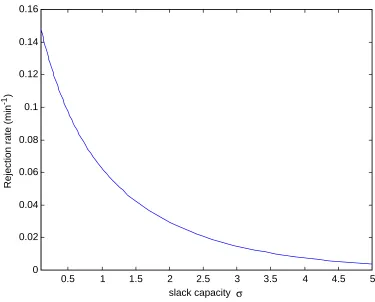
3.1 A Markov Chain model . . . 54
3.2 MTTR as a function of spare capacity . . . 56
3.3 Closeness of the exponential approximation for the TTR . . . 57
3.4 An example of function 1/MTTR, continuous version . . . 59
3.5 Loss of convexity with finite upper bound . . . 64
3.6 Construction of tree network from 3DM . . . 70
3.7 An illustration of the function . . . 75
3.8 Numerical results: small networks (N∈[5,10]) . . . 81
3.9 Numerical results: larger networks (N∈[11,16]) . . . 82
3.10 Numerical results: maximumr ≥20 . . . 82
3.11 Numerical results: maximumr <20 . . . 83
3.12 Numerical results: minimumr ≥.2 . . . 83
3.13 Numerical results: minimumr < .2 . . . 84
3.14 Numerical results: maximum load≥OC-20 . . . 84
3.15 Numerical results: maximum load<OC-20 . . . 85
4.1 An illustration of Wireless Mesh Networks . . . 87
4.2 An example shows the interference model in [1] is overly restricted . . . 95
4.3 Relaxation may be insufficient . . . 95
4.4 Bounds On the Maximum Concurrent Flow . . . 105
4.5 Maximum concurrent flow vs. number of radios vs. number of channels . . 106
4.6 Maximum concurrent flow vs. power decay vs. SNR threshold . . . 106
List of Tables
2.1 Variants of the Dynamic Grooming Problem . . . 45
2.2 Literature Summarization . . . 46
3.1 Rejection rates obtained for randomly generated sample of instances, all al-gorithms . . . 85
4.1 Wireless Mesh Networks Literature Review . . . 90
4.2 Algorithm that solves Problem II . . . 102
4.3 Primal-Dual Algorithm . . . 103
Part I
The design of networks plays an important role in the deployment of networks. Generally speaking, the network design is an optimization problem that, given various in-puts such as the availability of network resources and traffic demands, outin-puts a solution such that some kind of objective function is optimized. The solution, i.e., the design of the network, has different content in different environment. For example, in optical networks, it can be the topology of the networks routing and wavelength assignment and traffic groom-ing. In wireless networks, it can be the network deployment, channel assignment, routing and scheduling, etc. Similarly, different networks may have very different constriants and objectives. For example, in optical networks, the number of wavelengths, the availability of wavelength converters are normally considered as expensive resources, thus impose im-portant constraints on the design. It turns out that one of the well accepted objectives in optical network design is to minimize the cost of the network. However, in wireless net-works, resources different from those in optical networks may be more constrained. For example, in Sensor Networks, because the batteries can not be recharged easily, the design of the network should keep the power consumption as low as possible. In addtion, based on the media sharing nature of wireless networking, the interference among different wireless attennas also imposes a vital constriant on the availability of resources. The objectives in wireless networks are usually the throughput, delay, etc.
Part II
Chapter 1
Wavelength Routed Networks
In this information age, we have witnessed the relentless demand for computer networks of higher bandwidth and lower costs. In order to fulfill this requirement, copper cables have been replaced by optic fibers in the core network for the much larger band-width optic fibers provide. It is well understood that optic fibers will eventually extend to individual homes (FTTH or Fiber To The Home) as a result of higher capacity demands of personal usage and lower costs of optic fibers and optical equipment. To fully utilize the large capacity of optic fibers, different modulation schemes have been proposed. Among them, a two-dimensional approach in both time domain and frequency domain multiplexing has been studied and widely accepted as likely to be dominant in the near future. The first generation of optical networks, those using optical fiber and communication at the physical layer, but not exploiting optical speed and reliability in switching or routing, have been deployed for some years. These networks typcially employ only time division multiplexing, and operate at typical speeds of 2.5 Gbit/s for the fiber. New optical technology has opened up the possibility of much higher bandwidths on a fiber, all the way up to the Tbit/s level. It is generally accepted that networks utilizing such technology and such bandwidth will prove indispensable for the commerce, business, education, and critical infrastructure of the coming decades, and will form the backbone of the next generation of wide area optical networks [2, 3, 4]. However, these advances also give rise to a more complicated network and many new problems previously not considered by network engineers.
it is possible to multiplex several wavelength channels on a single optical fiber. The number of such wavelengths that can be multiplexed on a fiber now stands at about 200. Each wavelength on a fiber in such a WDM system can be viewed as a channel that provides an optical connection between two nodes. We call such a channel a lightpath. Traffic demands are aggregated into data frames by conventional TDM methods, which traverse lightpaths. Multiple lightpaths are now multiplexed on a fiber link using WDM. Lightpaths are originated from electronic traffic streams at the network node originating the traffic and terminated into electronic traffic streams at the node for which the traffic is destined by electro-optical Line Terminating Equipment (LTE), which are among the costliest of the network components used in such an architecture.
In the architecture of first generation optical networks, each wavelength channel would need to be electronically terminated at each intermediate node as well, and recon-verted into an optical signal after being forwarded electronically. This so called OEO routing (Opto-Electro-Optic) would not only require many more costly LTEs, but interpose elec-tronic processing and buffering in between optical transport segments, and hence increase delay, variability of delay, and the possibility of loss due to buffer overflow tremendously. However, advancement in the technology of wavelength routing gives us the capability of selectively bypassing some lightpaths optically, instead of converting every lightpath coming in on a single optical fiber to electronic signals. That is, a lightpath can traverse one or more intermediate nodes optically without the need of LTEs.
with the objective of minimizing the electronic routing load on the network has been named
Chapter 2
Dynamic Traffic Grooming
Computer and communication networking have been maturing over the past sev-eral decades, and has moved beyond the age of survival to the age of sophistication. The expectations of the end user from the network have also changed, and the concept of Qual-ity of Service (QoS) and Service Level Agreements (SLA) have become pervasive. Until recently, it was assumed that such concerns were operative primarily in transport networks, that is at the highest level of aggregation of traffic in the planetary network hierarchy. At lower levels of aggregation, the network was seen to be composed of traffic networks, where QoS was neither feasible nor desired.
In this context,traffic groomingbecame an active area of research starting from the late 1990s. The new generation optical networks utilizing Wavelength Division Multiplexing (WDM) are currently in the process of being deployed to form the backbone networks of tomorrow. In WDM, multiple wavelength channels can be used over the same physical link of optical fiber using frequency multiplexing. Each wavelength channel can carry 10 Gbps with current technology, and higher rates are foreseen for the near future. Further, wave-length routing technology makes it possible to forward an optical signal at an intermediate node entirely at the optical plane, forming clear end-to-end optical channels that are called
smaller bandwidth than the capacity of a single wavelength channel. Moreover, the traffic demands will be various different rates. For example, in generalized MPLS (GMPLS) [5, 6] networks, the traffic carried by this virtual layer are label switched paths, which can be of arbitrary bandwidth requirements. Because of the significant disparity between the the typical bandwidth request of a traffic component and the much higher capacity of a wave-length, it is well recognized that, to reduce the network cost, low speed traffic (referred to as subwavelength traffic) must be multiplexed (using Time Division Multiplexing) into lightpaths.
However, wavelength routing only allows the entire wavelength channel to be switched at the optical plane. If differentiated routing and forwarding of subwavelength traffic components contained in a wavelength channel is required, the optical signal must be terminated using Line Terminating Equipment (LTE), converted into digital eletronic signals, and input to an electronic logic device such as a traditional electronic router. At the end of the electonic routing operation, the packets must again be converted to optical signal and injected into outgoing lightpaths. This operations is called Opto-Electro-Optic (OEO) conversion, and is generally not desirable because it offsets the high speed and reliability of optical transport, and the OEO device is significantly more expensive than the optical switching equipment. Thus the subwavelength traffic must be packed into full wavelengths such that the cost of such OEO conversion may be optimized globally. This is the problem usually referred to as traffic grooming. The reader is referred to [4] for a survey.
In this literature, researchers have generally assumed that the magnitudes of traffic demands (given as a single traffic matrix) do not change with time. This assumption is reasonable for the following two reasons. First, in many core networks, low speed traffic requests are aggregated over several hierarchical levels of networks, and at many levels the bandwidth of the higher level network is sufficient to carry the aggregated flows from the tributary networks in terms of the average rates, but not the peak rates. Thus there is periodic buffer buildup and drainout, leading to some smoothing of traffic burstiness in such networks. Second, because of the importance of high speed traffic demands (in terms of the revenue the carrier will obtain), the network is designed such that the peak rates of traffic demands, which do not change drastically, are satisfied. Both reasons make the problem amenable to the static analysis.
Net-works (WAN) but also in Metropolitan Area NetNet-works (MAN) and Local Area NetNet-works (LAN), traffic demands have shown different dynamics. At the same time, the emergence of end-to-end QoS concerns has made it desirable to apply network design and resource pro-visioning techniques that were considered more suited to backbone networks to these lower level networks. In such networks, the magnitudes of traffic demands are more appropriately modeled as some functions of time. The traffic grooming problem has been generalized into this arena, giving rise to dynamictraffic grooming.
Traffic Demands
Physical Topology Virtual Topology
Routing
Assignment
Grooming
Wavelength
Figure 2.1: Dynamic traffic grooming subproblems
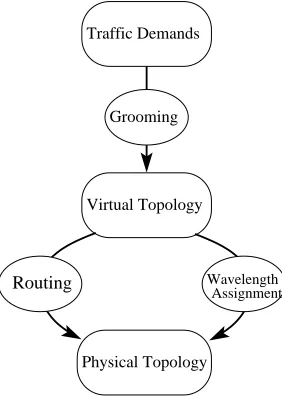
Routing and Wavelenth Assignment (RWA) problem, which has been extensively discussed and studied in optical networking literature; see [4] and references thereof for a detailed discussion. Finally, the subwavelength traffic demands must be routed over the lightpaths formed, so that each traffic demand is carried by a sequence of lightpaths that form a path in the virtual topology which carries the traffic from its source to its destination. Traffic is transferred from one lightpath to the next in the sequence by OEO routing. Global mini-mization of OEO routing or OEO equipment required at network nodes is often the goal of static traffic grooming, as mentioned above.
The dynamic traffic grooming problem can be understood in terms of exactly the same subproblems. However, the objective of grooming must be seen in a new light. Unlike the static problem, in the dynamic traffic grooming problem the solutions to these subproblems need to satisfy time-varying traffic. Thus the solution itself must vary with time. At the least, the mapping of traffic demands to the virtual topology must change. Also, network designers can take the advantage offered by reconfigurable optical switches to dynamically adjust the virtual topology in response to traffic demand changes, in that case the RWA must also be readjusted to map the changed virtual topology onto the unchanging physical topology.
It is important to note that the focus of grooming traffic shifts as a consequence of the above. Reduction of OEO costs may continue to be an objective of traffic grooming. But the primary objective may now well be a minimization of the blocking behavior of the network; this is not particularly relevant in static traffic grooming because with good planning the entire traffic matrix is expected to be carried by the network, but making a similar 100% guarantee under statistically described dynamic traffic may be prohibitive in cost and not desirable. Similarly, the consideration of fairness is not relevant for the static problem, but may become an important one for the dynamic case.
this distinction is less significant in the static case. Thus in various ways, the goal and priorities of grooming changes in the dynamic traffic context, and this is what we refer to as the changing role of traffic grooming. Finally, as the field evolves, it is likely to come to be perceived as a general class of network design problems where the cost component is largely concentrated into specialized network node equipment that will enter the mainstream in the future, such as optical drop-and-continue, wavelength converters, or OTDM switches.
The connection with the work in the Internet Engineering Task Force (IETF) in the GMPLS context is worth remarking upon. The original definition of Multi-Protocol Label Switching (MPLS) in the Networking Working Group of the IETF, building on earlier paradigms of tag switching and cut-through switching, was motivated by the need to reduce the forwarding burden on core routers. In label switching, an additional header is attached to Internet packets that carry information regarding flows to which each packet belongs. Once a flow, called a Label Switched Path (LSP) in MPLS, is set up, a Label Switching Router (LSR) in the path can forward packets bearing the label corresponding to the flow with much less processing than for a normal packet. In Generalized MPLS (GMPLS) [5, 6], time slot positions for TDM transport and wavelength channels for optical transport can also act as labels. It was soon realized by the networking community that label switch routing could also serve as an enabling mechanism for traffic engineering (TE), and flow-level QoS, because it allowed the identification of flows to routers. There has been significant recent work in defining extensions and signaling for the interaction of GMPLS and underlying networking layers, including SONET and other optical transports, and the communication of traffic engineering information between underlying networks and GMPLS [7, 8, 9].
However, these developments have focused (as appropriate for the role of the IETF) on enabling technology rather than design strategies. In keeping with the original guiding principles of the Internet, the network administrator is provided mechanisms to set up TE or QoS actions; but what actions are to be taken is left up to the administrator, who must look elsewhere for algorithms that provide policy or strategy decisions. To put it simply, all the mechanisms to set up LSPs is provided, but what LSPs to set up must be decided by the network administrator or operator. It is in this sense that research work such as traffic grooming provides a necessary complement to the development of enabling technology.
dynamic traffic. At the lower layer, in the legacy Synchronous Optical Network (SONET) or the Synchronous Digital Hierarchy (SDH) networks, the hierarchical rates defined for mul-tiplexing/demultipexing make it inefficient to carry dynamic traffic requests. To overcome this intrinsic inefficiency, two mechanisms, Virtual Concatenation (VCAT) (as defined by the International Telecommunication Union in its recommendation [ITU-T G.707]) and the Link Capacity Adjustment Scheme (LCAS) (as defined in [ITU-T G.7042]) have been devel-oped for Next Generation SONET. At the higher layer, part of the motivation to generalize MPLS to GMPLS has been to provide a uniform control plane to LSRs that operate at IP/MPLS level as well as network equipment that operate at fiber, wavelength and circuit level. Dynamic traffic grooming is thus a timely and emerging research area. Our focus in this survey is this research area, which is expected to provide algorithms that supply designs or policies for network operation.
While a significant number of studies have appeared recently on dynamic traffic grooming, there is as yet no single resource that provides a comprehensive introduction to the problem as well as to the literature. In this chapter, we hope to fill this void by providing an insight into the factors that must be considered in formulating a dynamic traffic grooming problem, and presenting a survey of the literature.
The rest of the chapter is organized as follows. In Section 2.1, we briefly discuss network node architectures for traffic grooming networks, because it is an important factor in dictating the goals of the network design problem. We provide discussion regarding the formulation of the dynamic traffic grooming problem either as a resource allocation problem or a policy design problem in Section 2.2. This also allows us to present a classification of the literature in Section 2.3, followed by a detailed literature survey according to our classification. We conclude with a few remarks on future directions in Section??.
2.1
Node Architectures
Generally speaking, the traffic entering/leaving a node equipment can be described by a tuple (optical fiber, wavelength, time-slot). Thus, a “perfect” switching node would perform a complete permutation, i.e. the traffic from any fiber, any wavelength, and any time slot would be possible to switch to any other fiber, wavelength, time slot. However, due to considerations of cost and scalability, different node architectures are deployed in reality that have less than perfect switching capability. These impose different constraints on the grooming problem. We will show in Section 2.2.3 how a mathematical formulation for the dynamic traffic grooming problem requires careful examination of the node archi-tectures. A generic modeling of the constraints that applies to different architectures is also an interesting problem.
The basic conceptual building blocks of such switches can be broadly divided into optical components, which manipulate optical signals, and thus operate at the level of entire wavelength channels, and electronic or digital components, which are capable of manipulating individual bytes and packets as electronic signals, as in traditional routers and electronic computers. Optical networking switches will in general have some of each type of component, and can be characterized by the capabilities of each of these. When a number of signals are multiplexed into a carrier, multiplexers (MUX) and de-multiplexers (DEMUX) are required at the sender and receiver respectively. If an equipment has the capability to de-multiplex signals, then selectively switch some of them to another switching equipment at the same node, while passing others through to a multiplexer for outgoing signals, it is called an Add-Drop-Multiplexer(ADM). Such an equipment performs only one decision for each de-multiplexed flow (whether to drop it or to pass it through). If, in addition, the equipment has the capability to choose which of several outgoing ports a signal is passed through to, it is called aCross-connect (XC).
handle multiple input and output fiber ports. DXCs, which perform switching at time-slot level, can be characterized byp/q, whereprepresents the port bit rate andq represents the bit rate that is switched as an entity. For a comprehensive description of SONET/SDH, see [11].
SADM OADM
MUX
1
DEMUX
λ λ
n
SADM
Figure 2.2: An OADM Architecture
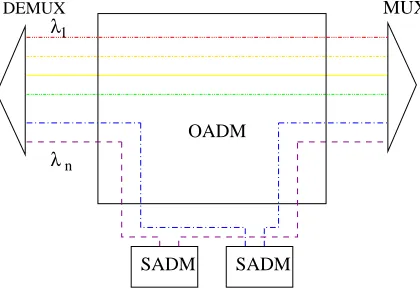
For WDM networks, multiple wavelength channels are frequency multiplexed in each fiber links, and lower rate traffic streams are time division multiplexed in each wave-length channel. The digital equipment at the node can perform switching actions on the lower rate traffic streams by utilizing Synchronous Transport Signal (STS) in the optical signal. In WDM ring networks, an Add-Drop method as above can be used, but now Op-tical ADMs (OADMs) are used to selectively by-pass some wavelengths along the ring, while others are dropped into digital equipment, which may be SADMs. This forms the simplest node structure that can be used in optical grooming networks, and is shown in Fig. 2.2. The various wavelength channels frequency multiplexed in the fiber are represented byλ1. . . λn.
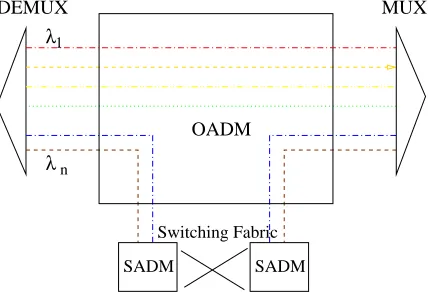
the same wavelength on the fiber links it traverses. For each added/dropped wavelength, an SADM is dedicated to process the traffic the wavelength carries electronically. The number of SADMs at a node determine the number of wavelength channels for which traffic can be switched at the timeslot level, thus this number characterizes in part the switching power of the node. It is well recognized that the cost of transceivers is the main contributor to the network cost, therefore the number of SADMs available at an OADM is usually either the objective to minimize, or a constraint to which the optimization problem is subject. This problem is referred to as ADM constrained grooming in [12]. Furthermore, if the SADMs on the different wavelengths are isolated (as shown in Fig. 2.2), not only lightpaths but traffic components need to obey the wavelength-continuity constraint because the traffic dropped at a wavelength has to be sent onto the same wavelength in order to be forwarded to its destination, as in [12]. This constraint can be relaxed if a digital switching fabric is available such that the traffic added/dropped by SADMs can be reshuffled and re-injected into other SADMs, resulting in a more powerful switching node. Fig. 2.3 shows an example of such a node, with optical MUX/DEMUX and OADM, and SADMs on each dropped wavelength connected by a DXC.
n
MUX 1
OADM DEMUX
Switching Fabric
SADM SADM
λ
λ
Figure 2.3: An OADM architecture that allows cross-connect of local traffic
In contrast to OADMs, which usually have predetermined add/drop wavelengths,
λ
DEMUX MUX
OADM
SADM SADM
Switching Fabric
1
λ
n
Figure 2.4: An ROADM architecture
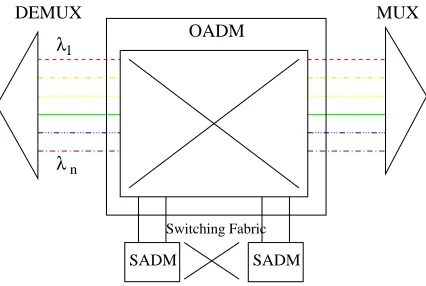
characterizes the power of the switch, as well as the digital switching capability (as before). For a comparison of different ROADM architectures, refer to [13]. An example is shown in Fig. 2.4.
Fiber m
DXC
OXC MUX
λ1
n
λ
λ1
n
λ
Input
Outgoing Fiber 1
Outgoing Fiber m Fiber 1
DEMUX
Input
Figure 2.5: An OXC architecture that has grooming capability
Optical Cross-connect Generic Requirements GR-3009-CORE):
• Fiber switch cross-connect : the entire signal carried by an incoming fiber is switched to an outgoing fiber, cannot perform different actions for different wavelength channels of timeslots.
• Wavelength Selective Cross-connect : can switch a subset of the wavelengths from an input fiber to an output fiber, obeying wavelength continuity constraint.
• Wavelength Interchanging Cross-connect : WSXC with wavelength conversion capa-bility.
In addition, time slot multiplexing/demultiplexing and grooming can be performed by a DXC if it is incorporated in the node. Fig. 2.5 shows an example of OXC that has grooming capability, with m input and m output fiber ports. (Usually, the number of input fiber ports is equal to the number of output fiber ports; however, in [14], the design of strictly non-blocking OXCs with different numbers of input and output fibers has been studied.) An OXC usually has two separate switching fabrics, the wavelength switching fabric that switches traffic at the wavelength level, and the grooming fabric that switches traffic at the time-slot level [15]. Since the grooming fabric can be viewed as a DXC, to avoid confusion, the cost is usually modeled in terms of the number of transceivers, instead of SADMs as in SONET ring networks. Note that both the transceiver and the SADM can be seen as terminating a lightpath into digital equipment; thus this cost measure can be generalized as the number of LTEs required.
Other node capabilities related to the ones described above are possible. A node intermediate in power between an ROADM and an OXC called Optical Add-Drop Switch
the same authors, a network with heterogeneous node architecture is studied. However, this framework does not address the case of a node which combines different node architectures. For example, while the added/dropped wavelengths can interchange time slots through the switching fabric, an OADM has some bypassing wavelengths (trunks) in which time slots can not be switched.
As the above discussion shows, depending on the node architecture, a node can operate at the fiber, wavelength, or time-slot level, and at each level, it may have full or limited functionality. In addition, some variants are worth mentioning. For instance, to avoid the cost of full grooming DXCs, the grooming functionality can be separated into two levels, where the higher level is a coarse groomer that deals with high speed traffic streams and the lower level is a finer groomer that deals with low speed traffic streams. The authors of [18] consider such a situation, and remark that using the proposed mixed-groomer node architecture is beneficial in terms of reducing both the switching cost and the number of wavelengths required. In the node architecture introduced in [19], an extra waveband layer is inserted between the wavelength and the fiber layer. In [20], the authors describe a node architecture, Multicast-Capable Grooming Optical Cross-connect. Using the embedded strictly non-blocking splitter-and-delivery (SaD) switches, the proposed dynamic tree grooming algorithm can be supported. In [21], another Multicast-Capable Optical-Grooming Switch architecture is introduced. Instead of using SaD switches, it has two stages of optical switching. Multicast traffic leaving the first stage optical switch is sent to a splitter bank and then switched by the second stage optical switch.
2.2
The Dynamic Traffic Grooming Problem
sub-wavelength traffic is seen to be the required multiplexing, because such studies are more appropriately considered to fall under the more established research areas of routing design and resource allocation with multiplexing. These considerations prompt us to consider out of scope studies such as [22], which is in effect static grooming study; or [23], which is more appropriately considered a restoration strategy design at the lightpath level. We use the concepts developed in this section to present a categorization of the literature and a detailed survey in Section 2.3.
2.2.1 Design and Analysis Problems
In [24], we classified the dynamic traffic grooming problem into two broad cate-gories: thedesign problemand theanalysis problem. The distinction, while not an absolute, is a practically useful one in understanding approaches to the problem and categorizing them.
• The network design problem focuses on the state space; a time-varying one for the dynamic problem. Given a model of behavior of the network and some quantities of interest to optimize, the design problem attempts to find optimal settings of control-lable parameters.
• The network analysis problem focuses on modeling the behavior. Given an a priori
policy of network control under dynamic traffic events, such as arrival, departure, increment, decrement; the analysis problem attempts to develop a predictive model of some quantities of interest, under changing values of input parameters, such as arrival rates.
At the end of this section, in Table 2, we use the distinction between design and analysis problems as our first categorization of literature on the dynamic traffic grooming problem. In Section 2.3, we include surveys of both categories of literature.
2.2.2 Quantities of Interest in Design
We briefly list the basic quantities in terms of which the design problem is defined, with accompanying notation.
• Let N be the set of nodes and A be the set of directed fiber links in the physical topology graph. We assume that the physical topology does not change with time. • Let S be the set of traffic demands denoted by the source-to-destination node pairs
in the network;S may consist of all distinct ordered pair of nodes, but may also be a subset of it because some node pairs do not have traffic between them.
• Let Λ|N|×|S|= [λs
n(t)] be the traffic matrix, whereλsn(t) is the time varying traffic flow
for the node-flow pair (n, s). Specifically, λs
n(t) is λs, if at time t, the traffic demand
sis sourced from noden, and has magnitudeλs. Similarly,λsn(t) is −λs, if the traffic
demand s is destined to node n, and 0 if n is neither the source not the destination of the traffic demands. We supposeλs for everysis in units of a basic rate, and the
capacity of a wavelength is C, in the same units.
• Let the number of wavelength channels available on each physical fiber link by W, wavelengths are numbered from 1 toW on each fiber.
• Let the matrix of the physical topology beP|N|×|A|= [pn(a)], wherep(na) is 1 if the fiber
ais sourced from node n,−1 if it is destined ton, 0 otherwise.
• LetL be the set of lightpaths, and let V|N|×|L|×W = [vn,w(l) (t)] be the matrix of
wave-length layered virtual topology, where vn,w(l) (t) is 1 if at time t, lightpath l is sourced
from nodenand uses wavelength w,−1 if it is destined tonand uses wavelength w, 0 otherwise.
• LetR|A|×|L|×W = [r(a,wl) (t)] represent how the virtual topology is routed on the physical
topology and assigned wavelengths, wherer(a,wl) (t) is 1 if lightpathluses the wavelength
• Let G|L|×|S| = [gl(s)(t)] represent how the traffic demands are routed on the virtual
topology, where gl(s)(t) is λs if the traffic demand s traverses lightpath l at time t,
0 otherwise. This represents the case that traffic bifurcation is not allowed; addi-tional variables can be introduced to represent bifurcated or diverse routing of traffic demands.
In general terms, theinput to the dynamic traffic grooming problem are:
(i) the traffic demand matrix Λ, a function of time,
(ii) the resource availability (includes physical topologyP, number of wavelength channels
W, etc.), generally not varying with time, and
(iii) the node architecture (limits to grooming capability, etc.), also generally not varying with time.
The output of the dynamic traffic grooming problem are:
(i) the virtual topologyV,
(ii) the routing and wavelength assignment V for the virtual topology on the physical topologyP, and
(iii) the routing G of the traffic demands on the lightpaths of the virtual topology.
In general, all of the outputs are functions of time.
2.2.3 Basic Constraints
Constraints on the node architecture
• As we observed in Section 2.1, the total OEO processing capability of a node is directly constrained by the finite number of LTEs (SADMs or transceivers) at the node. This is expressed as:
max
X
l:v(n,wl) >0 X
w
vn,w(l) (t), X
l:vn,w(l) <0 X
w
−v(n,wl) (t)
≤LTEn ∀n (2.1)
• In Section 2.1, we have shown that different node architectures may also result in different constraints on the feasible grooming solutions. For instance, the unavail-ability of wavelength converters imposes the wavelength continuity constraint in the RWA problem. Because the wavelength converters are expensive, most researchers assume that they are absent in the network. Consequently, lightpaths must obey the wavelength continuity constraint. That is;
v(n,wl) (t) is 1 if at timet lightpathl is sourced from noden,−1 if at time tlightpathl
is destined to noden, 0 otherwise.
Depending on the node architecture, there may be further constraints on the set of wavelengths a local transmitter can be tuned to. For example, practically, transmit-ters may be equipped with lasers with limited tunability (e.g., a recent OADM card provided by a major vendor can only be tuned to a band that has two predetermined wavelengths). However, if the wavelengths that are dropped/added are reconfigurable and completely selective, such a constraint is not required.
Constraints on the RWA problem
To ensure correct RWA, we can use the following constraint or similar:
P|N|×|A|R|A|×|L|×W =V|N|×|L|×W (2.2)
To ensure one wavelength on a fiber is assigned to at most one lightpath, we can use:
X
l
r(a,wl) (t)≤1 ∀a, w (2.3)
Constraints on the traffic routing
We use V|N|×|L| = [vn(l)(t)] to denote the virtual topology at time t. vn(l)(t) is 1 if
the lightpath l is sourced from node n at time t,−1 if the lightpath l is destined to node
V|N|×|L|=X
w
V|N|×|L|×W (2.4)
The following constraint ensures the traffic demands are properly routed on the virtual topology.
V|N|×|L|G|L|×|S|= Λ|N|×|S| (2.5) To ensure the capacity of a lightpath is obeyed, we have:
X
s
g(ls)(t)≤C ∀l (2.6)
2.2.4 Static and Dynamic Formulations of Design
Static Formulation - Resource Allocation
While traffic demands change with time, the change may be partly or wholly pre-dictable. As an extreme case, the nature of variation of traffic with time may be completely deterministic. If the value of the traffic demands at all times (over a period of interest) is known with certainty beforehand, the problem can be seen as some variation of a general
resource allocationproblem, and a static formulation of the problem is most appropriate. In this model, the traffic is deterministically given over some period of interest, possibly as a sequence of traffic matrices, Λ(t0), . . . ,Λ(tn). The period may be infinite,
Dynamic Formulation - Policy Design
On the other hand, unpredictability or uncertainty may be seen as an essential characteristic of the traffic model. In such cases, the dynamic nature of the problem needs to be explicit in the problem formulation. The problem must be seen as one of supplying a policy design for the network, that is an algorithm that the network control plane can employ to make decisions in response to traffic change events, with state and action space defined as follows:
State space: Since traffic events can occur and network actions can be taken only at discrete points in time, we represent Λ(t) as a discrete-time temporal process, Λi is the
traffic matrix at time epoch ti (a time epoch is defined as an instant at which a dynamic
traffic event occurs). Then, each Λi is associated with a virtual topology Vi, a routing and
wavelength assignmentRi, and a traffic routingGi. The tuple{Vi, Ri, Gi} is referred to as
the grooming solution at time ti. Then, the network state at time ti can be described by
the tuple {Λi, Vi, Ri, Gi}.
Action space: According to the layer it will affect, the actions taken by the network control algorithm can be classified as follows:
• Call Admission Control (CAC) actions, where two possible actions are reject and accept. If a traffic change is accepted, actions on other layers may follow. Note that while we use the term “call”, the events may be more general ones than ar-rivals of entire subwavelength traffic demands; for example it may be an increment or decrement to the magnitude of a traffic connection already established. However, the network action must still start with a decision regarding whether to accept or reject the increment.
• Network layer routing actions. Once a change is accepted, the changed traffic will be either routed on the existing virtual topology, or it will trigger virtual layer ac-tions. The actual route of the subwavelength call on the virtual topology must also be determined according to some policy. When the change is in the nature of a traf-fic decrease, network layer action may also be triggered to rearrange the routing of remaining traffic, see below.
combination of new lightpaths, which may be further utilized in conjunction with ex-isting lightpaths to route the changed traffic component. For new lightpaths, routing and wavelength assignment is performed. Similarly when traffic decreases, lightpaths may be also torn down in response.
• Re-routing Actions. Furthermore, if disruption of existing traffic is allowed, the ac-tions may include rerouting (or even terminating) some existing traffic. Existing subwavelength traffic may be rerouted on the virtual topology, or existing lightpaths may be rerouted on the physical topology.
For each action, {Vi, Ri, Gi} will change to {Vj, Rj, Gj}. The goal of the policy
will be always to maximize some reward function, akin to the objective function for a static formulation; we discuss some possible goals later in this section.
Referring back to our discussion regarding Fig. 2.1, we see that the physical topol-ogy at the lowest layer does not change with time, and the highest layer, the traffic demands to be carried, do change with time. Thus dynamic traffic grooming strategies can be seen as the algorithms executed by the network to perform a time-varying mapping of the traf-fic onto the network resources, using the routing, wavelength assignment, and grooming, to satisfy the demands and satisfy some goal of network operation such as operating cost minimization or maximization of utilization.
2.2.5 Models of Non-deterministic Traffic Variation
For the dynamic formulation, traffic variations are not wholly predictable, but the time-variation of traffic may nevertheless be modeled or characterized to some extent. Different models can be designed to reflect realistic network conditions, we list a few below. • Λ(t) is a Poisson process, and the model is simply one of subwavelength traffic com-ponent arrival/departure. In the general context of dynamic traffic grooming, it is reasonable to assume that|Λ(t)−Λ(t+ ∆t)|is small for a short time period ∆t, which motivates this model.
every traffic component specifies a window of time within which the traffic component must be carried. The arrival process may again be Poisson, or some other process. • Traffic demands are restricted by specified bounds. Such bounds may be provided by
the traffic components themselves, or they may be imposed by the available resources. For example, the number of SADMs available at the node (referred to as t-allowable traffic in [26]). Let SADMn be the number of SADMs at node n, then the traffic
matrices must satisfy:
max
X
s:λ(ns)>0
λ(ns)(t), X
s:λ(ns)<0
−λ(ns)(t)
≤SADMn·C ∀n
• Traffic components change in magnitude over time inincrementsanddecrements. The process by which increments and decrements occur may be Poisson or some other. • Entire traffic matrices are specified as in the deterministic model, but the time epochs
ti are not deterministic, and varies according to some random process.
2.2.6 Design Goals
The goal of either resource allocation or policy design is to minimize some measure of cost in provisioning and operating the network, and/or to maximize the benefit from the network. This can be embedded as cost function(s) in a static formulation, and reward function(s) in a decision formulation. In the literature, different goals have been articulated, some representative ones include:
• Minimize the network cost; these are more suitable for the static, resource allocation, view:
– Number of ports at network nodes (converters, LTEs, wavelengths). – Amount of OEO processing.
• Maximize the revenue by providing better service or better utilization of the network resource; more appropriate for the dynamic, policy design, view:
– Minimize the provisioning time (time to setup a connection for an arrival, traffic delay, etc.)
– Minimize the disruption to traffic already being carried.
– Minimize the unfairness (e.g., traffic demands having different bandwidth re-quests should have approximately the same blocking probability).
These goals are usually correlated in a way that makes it impossible for them to be opti-mized simultaneously. Therefore, some kind of trade-off or preference must be considered. For example, in [29], the network architectures for WDM SONET rings that have the min-imal SADM cost are studied, but subject to a limited number of wavelengths. In [25], an MILP for the dynamic traffic grooming problem with the objective of minimizing the SADM cost is solved by two phases, where, in the first phase, the number of wavelengths is minimized. In [30], the authors propose a connection admission control mechanism that provides good fairness without over-penalizing the overall blocking probability. In [26, 31], the objective is to design networks with the minimal SADM costs while keeping the existing traffic undisrupted (non-blocking in the strict sense).
2.3
Survey of Literature
2.3.1 Literature Classification
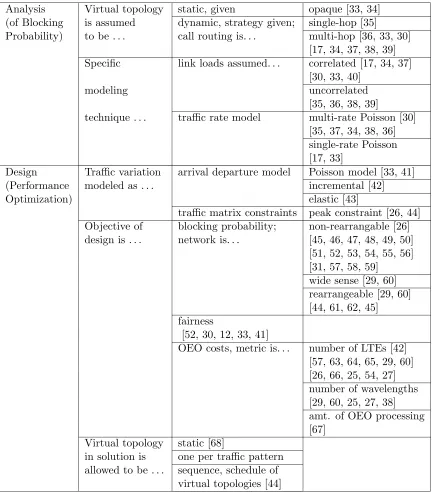
Based on the observations we made in the last section, we present an organized view of the literature on the dynamic traffic grooming problem in Table 2. Because all the categories are not orthogonal, several papers appear in multiple places in this table. Thus this table should be thought of as an organization, even more than a categorization.
non-blocking or rearrangeable non-non-blocking network, both the problems of resource design and policy design (to route new arrivals) are likely to be addressed.
In the remainder of this section, we go on to survey the literature in more detail. Table 3 contains the list of all papers surveyed below, with short descriptions that, combined with Table 2, indicate where the detailed survey of each paper appears below. A fuller description of some of this literature may be found in [32].
2.3.2 Analysis Studies
As we have discussed in the previous sections, the resource and policy design prob-lems are in essence optimization probprob-lems. In order to evaluate the performance (usually, the blocking probability) of a design, practitioners often resort to massive simulations. As simulation results are generally specific to the input (arrival and departure rates, etc.) and time consuming, analytical modeling is not only interesting in its own right but practically meaningful. In literature, the metric of greatest interest is the blocking probability, i.e., the ratio of the number of accepted arrivals to the total number of arrivals. In order to accept an arrival, the subproblems described in Fig. 2.1 should be solved. We distinguish two cases, the single-hop case and the multi-hop case (referred to as dedicated-wavelength TDM and shared-wavelength TDM in [16]). In the former case, a new arrival is accepted if it can be routed on a single lightpath (either an existing one or a new one to be established) from source to destination. In the latter case, the arrival is allowed to traverse multiple lightpaths, which could be a combination of existing lightpaths and newly established light-paths. In addition, some routing and wavelength assignment algorithms must be assumed, e.g., the shortest path routing and random wavelength assignment algorithms considered in [16, 17]. In queuing networks, we also distinguish single-rate and multi-rate requests. In the single-rate model, all traffic demands have the same magnitude. The model simplifies the analysis significantly. However, in grooming networks, the multi-rate model may be more realistic because traffic demands are usually subwavelength, thus in units of some basic rates (say, OC-3).
All these challenges and difficulites make the exact queuing analysis intractable. Accordingly, researchers have made different assumptions and simplifications. In the fol-lowing section, we survey related works in this field.
Multihop models with correlation
In this section we describe those studies which make the more general assumption that end-to-end traffic components may be carried either on a single lightpath from source to destination, or on a sequence of lightpath. Additionally, these studies attempt to represent the correlation between the link loads in some manner.
As previously mentioned in Section 2.1, in [16], Srinivasan et al. had presented a framework for analyzing the performance of Time-Space Switched optical networks. In [17], this framework is applied to networks with heterogeneous node architectures. Assuming a single rate model, the blocking probability for a path is computed recursively from a two-hop path model. The authors assumeMarkovian correlation, i.e., the traffic on a link only depends on its previous link. In [37], the authors extend the work to the multi-rate case.
Washington et al. also study the mulithop model with correlations [34]. ithey consider the blocking probability on tandem networks, i.e., a unidirectional path virtual topology. The authors consider the multi-rate arrival model on existing lightpaths. A path network is first decomposed into subsystems consisting of two adjacent nodes and analyzed exactly by a modification of Courtois’ method. The first step of the Courtois’ method that requires solving a system of equations is replaced by solving a multi-rate model for theexact
conditional steady-state probabilities. After that, the link load correlation is considered by proposing an iterative method.
Uncorrelated models
In some studies, a simplifying assumption of uncorrelated link loads is made. Xin et al. study the blocking performance analysis problem on traffic grooming in single hop mesh networks using such an uncorrelated model [35]. A closed-form formula is derived by some simplifications. For example, a single-wavelength link (SWL) blocking model is introduced and the multi-rate arrivals are converted into bulk arrivals and approximated departures. The authors also assume that overflow traffic is Poisson. Then a reduced load model is used to compute the end-to-end blocking probability.
By the same authors, the work in [36] is an extension of [35] that takes multi-hop routing into consideration. The authors propose a simple admission algorithm at a source node for each incoming traffic demand. A routing strategy is given such that the SWL model introduced in [35] can be extended to include multi-hop traffic arrivals. Instead of the sequential overflow model, a random selection of two-hop paths for the overflow multi-hop traffic demand is performed.
Other models
The study in [43] deals with the traffic models in traffic grooming networks. The aim of the paper is to investigate how traffic elasticity, the reactivity of traffic with respect to the changing environment (load, e.g.), impacts grooming. The authors argue that even in core networks, the traffic is elastic in nature. Therefore, it is inappropriate to model them as the traditional circuit switched traffic. Specifically, two traffic grooming policies, one preferentially using existing lightpaths and the other preferentially setting up new light-paths, are studied under two traffic models that have some feature of elastic traffic. The first model, which is less complex, captures the decrease of throughput of traffic when there is a congestion. The more complex model captures the fact that the more congested the network, the longer flows remain in the network. Different combinations of the traffic mod-els and the grooming policies are simulated and compared. The simulation results show that the interaction between the IP and optical layer gives rise to some complex behaviors, which suggests that neither grooming policies are suited for the management of an IP over WDM grooming network, because they do not take the interaction between the IP and optical layer into consideration.
As we have mentioned in Section 2.2.5, [28] studies the “sliding scheduled traffic model”. Specifically, a traffic demand is given by a tuple {s, t, n, l, r, τ, p}, where s and t
are the source and destination respectively,nis the bandwidth requirement,landr are the starting and ending time respectively, and τ is the duration of the request; p is a binary parameter representing the priority of the demand. The traffic demand is required to be scheduled within the time windowltor (i.e., it should start between the time interval lto
2.3.3 Design Studies
Studies of the design problem usually contribute both in formulating the problem with a particular objective, and then obtaining a solution to it. Therefore, two major concerns are how accurate the formulation is and how amenable it is to a solution. In dynamic traffic grooming networks, one important challenge that impacts the accuracy of the model is how to model traffic variations. As we have seen in Table 2, different traffic models have been proposed. We have already mentioned that the problem can be formulated as an ILP when the traffic model is deterministic, or specifies that the traffic changes entirely to a new traffic matrix while the network is running [61].
Obtaining a solution corresponding to the formulation also poses a separate chal-lenge. Since the general static traffic grooming problem is NP-Complete [66, 67], obviously the general dynamic traffic grooming problem with the static formulation, which has signif-icantly more time dependant variables is also NP-Hard. It has been previously shown that the static problem may be even inapproximable [67]. Because of this, most research focuses on heuristic approaches.
Objective of minimizing blocking characteristics
As we have discussed in section 2.3.2, it is generally very hard (if not impossible) to find a closed-form solution to the blocking probability in grooming networks. Therefore, many researchers propose heursitic traffic grooming algorithms and compare their perfor-mance in terms of blocking probability. We distinguish different kinds of network charac-teristics desired in terms of blockings. In non-rearrangable networks, the algorithms can not disrupt the existing traffic. In rearangable networks, the existing traffic and/or virtual topology can be reconfigured or rerouted, which generally serves to lower the blocking.
4.3.1.1 Non-rearrangable Approaches
operations that will be performed to accommodate an arrival. Heuristic algorithms are advanced to decide between establishing a new lightpath or routing on the existing IP topology for an arriving LSP request. The decision is based on monitoring the current level of congestion in the network, because routing on the IP topology may increase congestion, but depending solely on new lightpaths will exhaust network resources quickly. In [53], the same authors extend the same idea to provide differentiated services based on the priority. High priority LSP requests should have lower blocking probability than the low priority requests. Low priority requests will be blocked if no lightpath can be set up due to the wavelength or transceiver limit. However, high priority requests will be routed on the IP/MPLS layer. The algorithm proposed is further modified by introducing the Average Path Inflation Index , which takes the holding time of LSP requests into account. The authors claim this algorithm can be extended to handle more than two priority classes.
Sabella et al. propose a strategy for dynamic routing in GMPLS networks [68]. The proposed strategy has two phases. First, an IP/MPLS topology is considered, where there is an MPLS link between two nodes if and only if there is at least one lightpath interconnecting them. Based on this topology, a proposed routing algorithm extends the least resistance routing weight method [48] to the multi-layer GMPLS paradigm, where subwavelength LSPs are routed. The second phase is the grooming phase, where the LSP is groomed into lightpaths. Two policies, the packing policy that prefers the most loaded lightpath and the spreading policy that prefers the least loaded lightpath, are addressed.
In [31], the authors use a genetic algorithm to find a grooming solution in a strictly non-blocking manner for all-to-all traffic demands. New traffic demands are satisfied with-out re-rwith-outing and reconfiguration. To realize the strictly non-blocking property, the chro-mosome is decoded by a first fit approach incorporated with a local greedy improvement algorithm.
4.3.1.2 Auxiliary Graph Algorithms
and be suitable for on-line use, but can take cross-layer information and heterogeneous node architectures into consideration. Different studies propose different auxiliary graph constructions. Many of these studies are inspired by [49].
The study in [49] creates an auxiliary graph that has an access layer, a lightpath layer and W wavelengths layers, whereW is the number of wavelengths on a fiber. Each layer has an input port and an output port. Different edges representing different node capabilities are inserted between ports. An edge has a property tuple that states its capacity and weight, which reflects the cost of each network element (transceiver, wavelength-link, wavelength converter, etc.), and/or a certain grooming policy. Different grooming policies are achieved by applying different weight-assignment functions to the auxiliary graph, which reflect various objectives. In [15], Zhu et al. study a more specific resource provisioning problem where network nodes have different grooming architectures. Without wavelength converters, the graph model proposed in [49] is simplified to consist of four layers, the access layer, the mux layer, the grooming layer and the wavelength layer. By splitting the lightpath layer in [49] into the mux and grooming layers, the model is able to support different types of lightpaths distinguished by the source and/or destination node grooming capabilities. Using this model, the authors illustrate how different traffic engineering optimization goals can be achieved through different grooming policies.
The auxiliary graph constructed in [56] has two layers, the virtual topology layer and the physical topology layer. An improvement to the previous work is the introduction of the link bundling (or more accurately wavelength bundling). In particular, following con-straints are taken into consideration: the transceiver constraint and the generalized wave-length continuity constraint, which allows nodes equipped with different kinds of conversion capability. The Link Bundled Auxiliary Graph simplifies the auxiliary graph representation in [49] by aggregating at most the number of wavelengths available on a link into one arc. Based on the graph, an algorithm is proposed to find a feasible path and a feasible wave-length assignment. As multiple feasible paths may exist, grooming policies are introduced to select the preferred one.
dedi-cated layer for each wavelength and different edges describing existing lightpaths, potential lightpaths, potential extended lightpath and sub-lightpath. By assigning them different weights using different grooming policies that are essentially the same as those in [49], a shortest path algorithm is used to find the best solution. Note that without the intermediate dropping and extension capability, this algorithm becomes identical to that of [49].
In [20], the same authors use a similar approach, but specifically for unicast traffic. A difference of the constructions between this paper and [50] is the introduction of the grooming layer. Based on the auxiliary graph, a dynamic tree grooming algorithm, which has the weight assignment strategy (referred to as routing polices) as a sub-routine, is proposed. As in [50], the edges are assigned weights by different policies. Accordingly, the shortest path algorithm is used by the algorithm to setup a connection for an arrival. Specifically, the connection is set up either by establishing a new tree of drop-and-continue nodes along the vertices on the optical hop or extending an existing tree to cover the remaining vertices.
In [46], Two auxiliary graphs, namely the virtual graph and the layered graph, are introduced. In a virtual graph, the edges (so called partially available edges) represent the existing lightpaths that have spare capacity. The edges in a layered graph are fully available edges. Upon these two graphs, a two-layered routing algorithm is proposed, which tries to route a traffic demand on the virtual graph first, then tries the layered graph if the first step fails. Then, a single layered routing algorithm based on an integrated graph, which does not distinguish partially available edges and fully available edges, is proposed. The shortcoming of this algorithm is that using the shortest path algorithm on an integrated graph may result in a route that uses more new transceivers. A third algorithm is proposed to combine the advantages of the first two. The algorithms are compared in terms of the blocking probability and the joint routing algorithm outperforms the others irrespective of whether the number of transceivers is small or large.
lightpath is found or resources are exhausted. In [58], based on the same idea, the authors propose a dynamic traffic grooming algorithm. In the first phase, to reduce the complexity of constructing an auxiliary graph of the entire network, a reachability graph that includes all the possible logical paths between the source and the destination is constructed. Based on the graph, the second phase is to find the optimal route by a cost-constraint algorithm, where the cost of interest is the sum of the cost of grooming fabrics and the penalty paid for wasted wavelength bandwidth.
4.3.1.3 Wide-Sense Non-blocking Studies
While all such studies aim at minimizing the blocking probability, in general the result is some low value of blocking. A few studies are able to propose approaches that result in a completely non-blocking network under specific conditions, and we discuss them separately here. The non-blocking achieved iswide-sense, that is the algorithm provided must be used exclusively for routing calls in that network, otherwise blocking may appear.
4.3.1.4 Rearrangable Approaches
The disruption caused by rearrangement of traffic being currently carried by the network may be an acceptable tradeoff for the reduced blocking that is usually obtained by using the added flexibility of rearrangement. In such studies, one main concern is when and how the network should be reconfigured to effect the rearrangement, and when rearragement should not be attempted.
Kandula and Sasaki study the dynamic traffic grooming problem with rearrange-ment on ring networks [44]. The authors provide a reconfiguration algorithm, called bridge-and-roll, such that the number of LTEs is reduced while keeping the network as bandwidth efficient as a fully opaque network. Putting different constraints on the resources, some in-teresting traffic models are introduced to illustrate the algorithm. In addition, to reduce the cost of traffic disruption, bounds are provided in terms of the number of reconfigurations.
In [62], Gencata and Mukherjee also study the reconfiguration problem. The traffic is assumed to fluctuate slowly compared to the observation period. In each observation period, the network load is monitored and compared with a high and a low watermark, which indicate if the link is under-utilized or congested. In an observation period, exactly one action, setting up a new lightpath or tearing down an lightpath, can take place. The duration of the observation period is adjustable to make a trade-off between efficiency and traffic disruption. If some links are congested, one new lightpath is setup in the observation period. If some links are under-utilized, one lightpath is torn down. The authors first formulate the problem as an MILP problem, with a goal to minimize the maximum load, with constraints that ensure the correct action is triggered and the virtual topology changes correspondingly. Then, the authors propose a heuristic adaptation algorithm. If some links are congested, the algorithm simply picks the link that has the maximum load and the maximum traffic component that traverses the link, then sets up a new lightpath for the selected traffic component. The authors use actual observed traffic traces for validation.
current primary and backup routes is found, all backup routes (end-to-end or segmented) are considered. The “best” route for a backup route is found if rerouting the backup on this route can satisfy the new arrival. Finally, existing traffic without protection requirements or with end-to-end backups are considered for dropping or rerouting.
The authors of [45] also study rerouting. When a traffic request arrives, rerouting is performed only if the existing routing fails to accommodate the request. The rerouting can be at lightpath level or connection level. The former changes the virtual topology while the latter only changes the routing of traffic on it. Both approaches have advantages and disadvantages. Lightpath rerouting may have lower time complexity because the input is the set of lightpaths, which are much fewer than the traffic requests. However, it is subject to a longer time of disruption because of the laser re-tuning time involved. Connection rerouting, although more complicated, provides a finer granularity of adjustment. Prac-tically, a combination of both approaches may be more appropriate. Based on these two approaches at different layers, two algorithms are proposed. The first algorithm initially finds the set of critical wavelength of a path (the set of wavelengths that are used on only one link along the path), then the lightpath using this critical wavelength is rerouted such that a traffic request can traverse the path. Similarly, the latter algorithm finds the set of critical connections for a path and a connection request and reroutes the critical connection so that the new request can be satisfied.
Objective of maximizing fairness
pre-established agreement between the user and the service provider or the resource avail-ability. In the context of optical grooming networks, we expect that some “old” concepts (e.g., QOS) will be re-examined by taking the virtual layer into consideration. As we have mentioned, when a new call arrives, the basic actions to take areacceptandreject. Without CAC, a call will be rejected only if the available resources are unable to accommodate it. However, in a network with service differentiations, this simple strategy may not lead to an optimal overall utilization/revenue.
In [30], a CAC algorithm is proposed to deal with the capacity fairness, which is achieved when the blocking probability of m calls of line-speed n is equal to the blocking probability of n calls of line-speed m, and this is true for every pair m, n of line-speed. The overall blocking probability is defined as the blocking probability per unit line-speed of the call requests. The fairness ratio Fr is defined as the ratio of the estimated blocking
probabilities of calls of lowest and highest line-speeds. Therefore, the goal of the CAC algorithm is to makeFras close to 1 as possible while keeping the overall blocking probability
acceptable.
policy.
In [52], the authors study the fairness problem based on an auxiliary graph model, which consists of wavelength planes and different kinds of edges, which represent the avail-ability of wavelengths, availavail-ability of grooming capavail-ability, the availavail-ability of transceivers and the source and destination of the traffic demand. In addition to grooming policies, two fairness policies are proposed. The fairness is evaluated in terms of the blocking proba-bilities of traffic demands with heterogeneous requests. The first policy sets a wavelength quota for each class of connections, distinguished by the rates they request. Since traffic demands requesting higher rates are more likely to be blocked, these classes receive more quota. Based on the quota, a dynamic grooming algorithm called wavelength quota method is proposed. The next policy is transceiver quota policy. Instead of counting the wavelength quota, transceiver quota is used to groom heterogeneous traffic demands in a manner as fair as possible.
Objective of minimizing OEO
We noted in Section 2.2 that OEO minimization is a common theme of static grooming. In this section we discuss literature that addresses the same objective in the dynamic context.
In [26], Berry and Modiano address the dynamic traffic problems in SONET ring networks. The problem is defined as minimizing the number of ADMs while being able to satisfy a set of allowable traffic requests. The authors first lower bound the number of ADMs, which corresponds to the no grooming solution. A bipartite matching approach is then proposed to combine two solutions such that any one of the traffic requests can be satisfied while keeping the number of ADMs minimized. To study a specific and realistic dynamic traffic model, thet-allowable traffic model is introduced (see Section 2.2.5). The authors lower bound the number of ADMs and model it as a bipartite matching problem. Unnecessary ADMs are removed by applying a necessary and sufficient condition to support thet-allowable traffic. The authors extend the work to support dynamic traffic in a strictly non-blocking manner and show how hub nodes and tunability can further reduce the number of ADMs.