An Experimental Study on Parametric
Variations during Composting of Municipal
Solid Wastes
G.V.R. Srinivasa Rao1, T.P. Sreejani2, P.V.R. Sravya3
Professor, Dept. of Civil Engineering, Andhra University, Visakhapatnam, India1
Research Fellow, Dept. of Civil Engineering, Andhra University, Visakhapatnam, Inida2
Asst. Professor, Dept. of Civil Engineering, Anil Neerukonda Institute of Tech. & Sciences, Visakhapatnam, India3
ABSTRACT
:
An attempt is made in this present work to study the variations of various parametric values during the composting of Municipal Solid Wastes by conducting experiments on laboratory scale models. The organic waste needed for the present study is obtained from the University hostels and local markets and segregated into fine, coarse and mixed samples. The prepared samples are kept for composting along with the soil collected from local dumping yard in alternate layers, in the boxes of size 40x20x20 cm. During the study period of 60 days the samples are analysed for the parameters, viz., Carbon, Nitrogen, Phosphorus, Potassium, C/N ratio, Temperature, Moisture content. The compost with Nitrogen (N), Phosphorus (P), Potassium (K) values 1.41, 0.62 and 0.7% by weight respectively is obtained at the end of the 60 day composting period. It is observed from the experiments that, the finer the particles the faster the rate of reaction and larger the peak temperatures obtained. The temperatures raised sharply and reached the peak values of 60° C to 71° C during the first 20 days of composting period. It is observed that the peak temperatures decreased with the increase in C/N ratios. It is also observed that the composting period varied with the moisture content. It is noted that the rate of composting is fast in the watered sample when compared with that of un-watered sample.KEYWORDS: Municipal Solid Waste, Carbon, Nitrogen, Phosphorous, Potassium, Carbon/Nitrogen Ratio, Temperature, Moisture Content.
I.INTRODUCTION
One of the problems being faced in highly urbanized and industrialized cities is the disposal of the huge amount of solid wastes generated every day. If proper arrangements for the collection and disposal of these wastes are not made, they will go on accumulating and create such a foul and insanitary conditions and reduce the quality life of public in towns and cities. Thus, to ensure better sanitary environment for the people, proper collection of solid wastes, their handling and subsequent disposal with minimum possible nuisance to public became fundamental to the solid waste management. And hence, the recovery, recycling and conversion of solid wastes into a useful product became an important objective of the comprehensive solid waste management program in the urban areas.
II. RELATED WORK
As a biological process composting has all the advantages and limitations of a biological process. Chief among the limitations is the fact that the potential capacity and performance of all composting systems are determined by those of their microbial content. Limiting factor principle which limits the growth and activities of the organisms that are active in the composting process is guided by nutritional and non-nutritional (environmental) factors (Golueke and Diaz [3] (1990)). The nutritional factors include Carbon, Nitrogen, C/N ratio and other nutrients, which are intermediate between macro and micronutrients such as phosphorous, potassium and calcium. The non-nutritional factors include aeration i.e., molecular oxygen supply, moisture oxygen supply, moisture content and temperature. However, no single factor can stand alone to draw sufficient conclusions on composting.
In recent times there is an increased rate of substrate cultivation which necessitated for an increase in the organic content of the substrate. The use of compost results in a significant increase in the total solids of the substrate and decrease in the porosity, thus improving the physical property of the soil which in turn leads to the increased plant growth. (Siminis and manios [12] (1990)).
The concentration and biological influences of both beneficial and potential harmful compounds may bring in considerable change in the characteristics of the compost. (Walker and Michael [8] (1991)).
The incorporation of certain components like waste paper in the bio-waste fraction may increase the C/N ratio to an optimum ratio for bio-degradation i.e., 25 or more from the typical C/N ratios ranging from 15 to 20 and increase in the C/N ratio will result in lessening the odour problems. (Baere [9] et. al, (1992)).
To be used in agriculture, the compost should have a complete maturity, assimilating fertilizing elements (N, P, and K), low levels of heavy metals and exemptions of phyto-pathogenic and pathogenic bacteria the minimum time required to produce mature compost depending upon the size of the particle composted.However,though the granulometry seems to have a positive effect on composting, the finer granulometry sometimes may induce aerobic to anaerobic fermentation. (Hachicha [5] et. al, (1992))
Laboratory studies on dry anaerobic digestion of mixture of paper, kitchen food wastehave demonstrated the optimum performance at total solids (TS) at the range of 30-35% and the thermophilic process (at 55°C) was found to be superior to a mesophilic (35°C). (Jan A. Oleszkiewicz [6] et al (1997))
The C mineralization which takes place in soil and during composting is the best way of obtaining Carbon stabilization, which is an important factor in soil conservation and reclamation. (Bernal.M.P. [2] et. al (1998))
The feasibility of aerobic composting of sewage sludge under cold climate conditions indicated a significantly negative impact on microbial processes, as shown by poor decrease in the C/N ratio and the low moisture content is a more limiting factor forcomposting than low temperature. (Rosa Margesin [10] et al (2006)).
The effects of temperature on microbial communities and mass reduction in composting indicated that mesophillic composting is more effective for mass reduction in cattle manure composting than thermophillic composting. (Jing-Chun Tang [7] et al (2007)).
The results of a pilot study that was conducted to assess the feasibility of composting of source separated organic matter of municipal solid waste (MSW) in Jabalpur city have shown the presence of high percentage of biodegradable organic matter, acceptable moisture content and C/N ratio. (Gautam S.P. [4] et al (2010))
The temperatures of the windrow in all seasons reach the maximum after 4 weeks of composting and then decrease by the end of the composting period. Also in the summer and autumn seasons microbial activities are faster because the favourable environmental conditions for supporting the proper wastes degradation, therefore, better quality of compost can be obtained in these two seasons than rainy season. (Shyamala D.C. and Belagali S.L [11] (2014))
The quality of the compost depends largely on the level of C/N startup ratio and also the quality of its constiuents within the mixture. (Azim. K.[1] (2014))
III. METHODOLOGY
retained on 60 mm sieve are considered coarse material. The mixed sample consists both fine and coarse particles in equal proportions. The prepared sample is then kept in wooden boxes of size 40x20x20cm in alternate layers along with soil covers. Initially, the soil layer of 1 cm thickness is arranged in the box, over which the solid waste is laid with thickness of 5 cm, which is then covered with a soil cover of 1 cm thickness. Thus, the solid waste sample is kept in the box to a depth of 15 cm in alternate layers with soil covers of 1cm each making the entire depth of the sample to be composted to 18 cm and leaving 2 cm as free board. Separate boxes are arranged with fine, coarse and mixed samples to study N, P, K, C/N and Variation of Temperature w.r.t, varying C/N ratios. The solid waste samples kept in for composting with optimum moisture content of 50% for a period of 60 days and are analysed once in every 10 days for N (nitrogen), P(Phosphorous), K (Potassium), C/N (Carbon Nitrogen ratio) and organic matter as per standard procedures.Also the temperatures are measured at different depths every time and the average values are taken into account.
Anotherset of experimental boxes with mixed solid waste are arranged for the study on effects of moisture on the duration of composting. The initial moisture content of these boxes are arranged at 60% by weight. The experimental boxes are left un-watered and the periodical check-up of the fall in the moisture content by weight is measured.In another set of experiments the fall in the moisture content is compensated with suitable amount of water to maintain optimum moisture content of 50% of composting till to 80th day. Suitable conclusions are drawn for the effect of moisture content on composting duration.
To study the variation of temperature during the composting period with reference to varying C/N ratios, a set of experimental boxes are arranged with mixed solid waste samples. The solid waste samples are modified by adding fine paste of newspaper to keep the sample with varying C/N ratios varying from 30 to 60. Care is taken during the entire period of composting to maintain the C/N ratios with an experimental variation of ±5 %. The temperatures during the composting are measured at regular intervals.
IV. RESULTS AND DISCUSSIONS
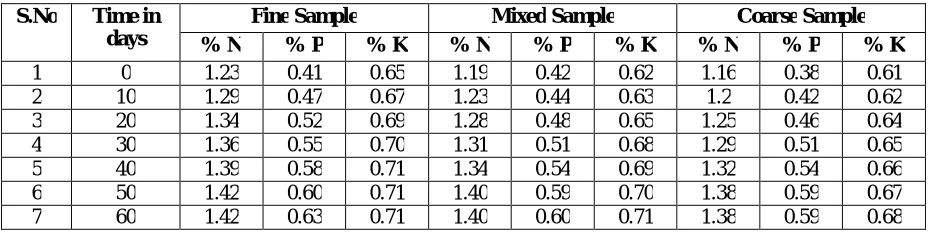
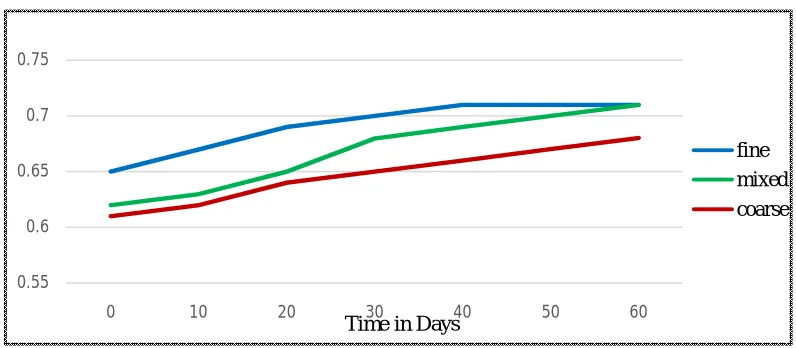
a. N, P, K values: The variations of N, P, K values against the durations of composting are presented in the following table 1 and figures 1, 2, 3. It is observed that the N, P, K values are gradually increased and stabilized after 50 to 60 days of composting. The values of Nitrogen (N) varied from 1.14% to 1.41% by weight and stabilized at an average value of 1.41% by weight. The values of Phosphorous (P) increased from 0.36% to 0.63% by weight during the composting period and stabilized at an average value of 0.62% by weight at the end of composting period. Similarly, the value of Potassium (K) varied from 0.57% to 0.71% by weight and stabilized at an average value 0.7% by weight at the end of composting period. The N, P, K values in the final compost are observed to be 1.41, 0.62 and 0.70% by weight, which are on par with the N, P, K values of the compost being marketed by the A.P government as organic manure in the local rythu bazaars.
Table No. 1. Variations of N, P, and K values for Fine, Mixed and Coarse samples.
S.No Time in days
Fine Sample Mixed Sample Coarse Sample % N % P % K % N % P % K % N % P % K
1 0 1.23 0.41 0.65 1.19 0.42 0.62 1.16 0.38 0.61
2 10 1.29 0.47 0.67 1.23 0.44 0.63 1.2 0.42 0.62
3 20 1.34 0.52 0.69 1.28 0.48 0.65 1.25 0.46 0.64
4 30 1.36 0.55 0.70 1.31 0.51 0.68 1.29 0.51 0.65
5 40 1.39 0.58 0.71 1.34 0.54 0.69 1.32 0.54 0.66
6 50 1.42 0.60 0.71 1.40 0.59 0.70 1.38 0.59 0.67
Fig 1. Varition of %N vales for for Fine, Mixed and Coarse samples.
Fig 2. Varition of % P vales for for Fine, Mixed and Coarse samples.
Fig 3. Varition of % K vales for for Fine, Mixed and Coarse samples.
0 0.5 1 1.5
0 10 20 Time in Days30 40 50 60
fine mixed coarse
0 0.2 0.4 0.6 0.8
0 10 20 30 40 50 60
Time in Days
fine mixed coarse
0.55 0.6 0.65 0.7 0.75
0 10 20 30 40 50 60
Time in Days
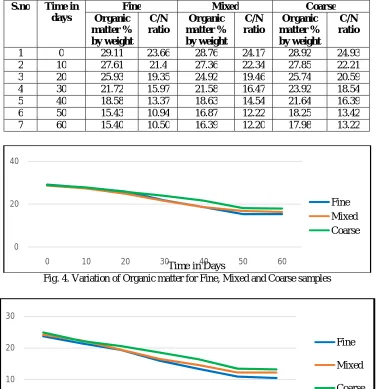
b. Organic matter and C/N ratio: The organic matter in the solid waste during the composting period and the C/N ratio are determined periodically. From the figures 4 & 5 it is observed that both Organic matter and C/N ratios decreased slowly and stabilized after the composting period of 50 to 60 days. The organic matter decreased from an initial value of 27% by weight and stabilized at an average value of 15.4% by weight at the end of composting period. Similarly, the C/N ratio decreased from an initial value of 24.9% and stabilized at an average value of 10.5%. The stabilized values of Organic matter and C/N ratio are found to be similar to that of earlier studies.
Table No. 2. Variation of Organic matter and C/N ratio for Fine, Mixed and Coarse samples.
S.no Time in days
Fine Mixed Coarse Organic
matter % by weight
C/N ratio
Organic matter % by weight
C/N ratio
Organic matter % by weight
C/N ratio
1 0 29.11 23.66 28.76 24.17 28.92 24.93
2 10 27.61 21.4 27.36 22.34 27.85 22.21
3 20 25.93 19.35 24.92 19.46 25.74 20.59
4 30 21.72 15.97 21.58 16.47 23.92 18.54
5 40 18.58 13.37 18.63 14.54 21.64 16.39
6 50 15.43 10.94 16.87 12.22 18.25 13.42
7 60 15.40 10.50 16.39 12.20 17.98 13.22
Fig. 4. Variation of Organic matter for Fine, Mixed and Coarse samples
Fig. 5. Variation of C/N ratio for Fine, Mixed and Coarse samples
0 20 40
0 10 20 30Time in Days40 50 60
Fine Mixed Coarse
0 10 20 30
0 10 20 30 40 50 60
Time in Days
Fine
Mixed
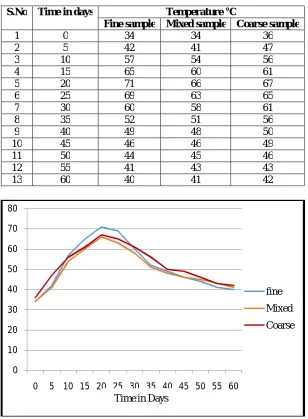
c. Variation of temperature: From the figure 6 it is observed that for all the three types of samples i.e., fine, coarse and mixed, the temperature is sharply increased and reached the peak in and around 20 days of composting. Then onwards, the temperature gradually decreased and stabilized at 40 °C (approx) at the end of 60 day composting period. The peak temperatures ranged from 64°C to 71°C i.e. for coarse to fine samples. It is observed that, the finer the particles the faster the rate of reaction and larger the peak.
Table No. 3. Temperatures during different days of Composting
S.No Time in days Temperature °C
Fine sample Mixed sample Coarse sample
1 0 34 34 36
2 5 42 41 47
3 10 57 54 56
4 15 65 60 61
5 20 71 66 67
6 25 69 63 65
7 30 60 58 61
8 35 52 51 56
9 40 49 48 50
10 45 46 46 49
11 50 44 45 46
12 55 41 43 43
13 60 40 41 42
Fig. 6.Temperatures during different days of Composting
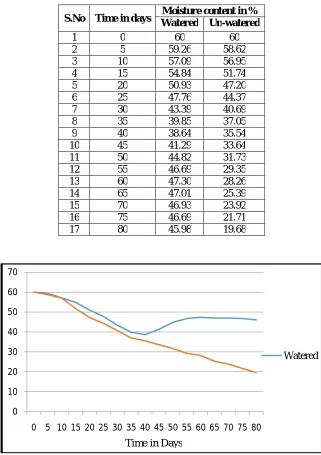
d. Effect of Moisture content on Composting:The experimental box where in the moisture content is maintained at an optimal of about 50% showed early maturity and the final compost with N, P, K values as 1.42, 0.61, 0.73% by weight is obtained at the end of the 60 days of composting period. Whereas, the experimental box kept un-watered
0 10 20 30 40 50 60 70 80
0 5 10 15 20 25 30 35 40 45 50 55 60
fine
Mixed
Coarse
throughout the composting period yielded compost with N, P, K values of 1.33, 0.51, 0.63% by weight at the end of the 80 day composting period. These results clearly show that if the moisture content during the composting period at an optimum level of 50% is maintained, the period of composting will be lessened.
Table No. 4. Variation of Moisture content with Time.
S.No Time in days Watered Un-watered Moisture content in %
1 0 60 60
2 5 59.26 58.62
3 10 57.09 56.95
4 15 54.84 51.74
5 20 50.93 47.20
6 25 47.76 44.37
7 30 43.39 40.69
8 35 39.85 37.05
9 40 38.64 35.54
10 45 41.29 33.64
11 50 44.82 31.73
12 55 46.69 29.35
13 60 47.30 28.26
14 65 47.01 25.39
15 70 46.93 23.92
16 75 46.69 21.71
17 80 45.98 19.68
Fig. 7. Variation of Moisture content with time.
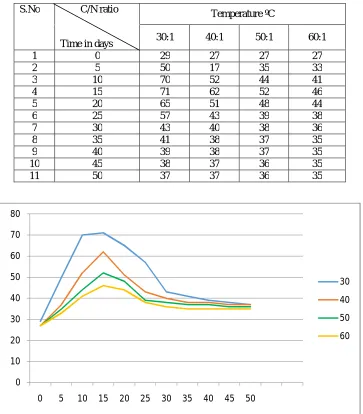
e. C/N ratio vs. Temperature variation:Solid waste samples with varying C/N ratios are allowed for composting and the rise and fall of temperature during the composting period is measured periodically. From the results it is observed
0 10 20 30 40 50 60 70
0 5 10 15 20 25 30 35 40 45 50 55 60 65 70 75 80
Watered
that, the temperature had a steady and steep rise during the first 20 days and from there onwards the temperature gradually decreased till to the end of the composting period. The peak temperatures of 71ºC, 62ºC, 52ºC, 46ºC are observed for the solid waste samples with C/N ratios 30, 40, 50 and 60 respectively. The organisms that decompose organic matter use carbon as a source of energy and Nitrogen for building the structure. If too much Carbon is available in the waste, the decomposition process slows down. The higher C/N ratios represent the presence of more carboneaceous material and as per above theory the rate of reaction may be slow. This situation may be indicated by the slow rise of temperature and the lower values of peak temperatures. The experimental results which show high peak temperatures against low C/N ratios are in accordance with this theory.
Table No.5. Temperature variation with varying C/N ratios
.
S.No C/N ratio
Time in days
Temperature ºC
30:1 40:1 50:1 60:1
1 0 29 27 27 27
2 5 50 17 35 33
3 10 70 52 44 41
4 15 71 62 52 46
5 20 65 51 48 44
6 25 57 43 39 38
7 30 43 40 38 36
8 35 41 38 37 35
9 40 39 38 37 35
10 45 38 37 36 35
11 50 37 37 36 35
Fig. 8. Temperature variation with varying C/N ratios.
0 10 20 30 40 50 60 70 80
0 5 10 15 20 25 30 35 40 45 50
30
40
50
V. CONCLUSIONS
For the sample under study it took nearly 60 days for the formation of final compost with the N, P, K values 1.41, 0.62, 0.7% by weight which is on par with the N, P, K values of the organic manure marketed by Andhra Pradesh Government.
The organic matter decreased from initial value of 27% to 15.4% during the composting period of 60 days, which shows a considerable decomposition of organic matter. The C/N ratio also decreased from an initial value of 24.9 to 10.5% at the end of composting period.
The temperatures rose sharply and reached the peak values of 67 ºC to 71ºC during the first 20 days of composting period, for all the three types ofSolid waste samples, i.e., fine, coarse and mixed solid waste samples. A gradual decrease of temperature is observed during the later part of composting period. It is also observed that the finer the particles, the faster the rate of reaction and larger the peak temperatures.
When the waste sample is not watered during the composting period it is observed that the composting period extended up to 80 days to obtain the final compost with N, P and K values of 1.41, 0.62, 0.7% by weight whereas, when the moisture content of 50% is maintained during the composting the compost with the said N, P and K values is obtained at the end of 60 – day composting period.
It is observed that the variation in the C/N ratios in the solid waste samples had shown an effect on the rate of reactions and subsequent rise and fall in the temperatures during the composting period. Though there is a similar steep rise of the temperature during the initial period of composting, the peak temperatures varied from 71ºC to 46ºC for the C/N ratios varying from 30 to 60.
REFERENCES
[1] Azim K, Ouyahia K, Amellouk.A, Perissol, C,ThamiAlami I, and Soudi, B, “Dynamic composting optimization through C/N ratiovariation as a start-up parameter”,Proceedings of the 4th ISOFAR Scientific Conference.‘Building Organic Bridges’, at the Organic World Congress 2014, pp. 787-790, 2014.
[2] Bernal M.P., M.A. SaÂnchez-Monedero, C. Paredes, A. Roig, “Carbon mineralization from organic wastes at differentcomposting stages during their incubation with soil”,Agriculture, Ecosystems and Environment, pp. 175-189, 1998.
[3] Clarence G. Golueke and Luis F. Diaz, “Understanding the basics of composting”, Bio-cycle, pp. 56-59, 1990.
[4] Gautam S.P., P.S. Bundela, A.K. Pandey,M.K.Awasthi and S. Sarsaiya, “Composting of Municipal Solid Waste of Jabalpur City”, Global Journal of Environmental Research, pp. 43-46, 2010.
[5] Hachicha. R, Hassen. A, Jedidi. N and Kallali. H, “Optimal conditions for MSW composting”, Bio-cycle, pp. 76-77, 1992.
[6] Jan A. Oleszkiewiczand Hector M. Poggi.Varaldo, “High-Solids Anaerobic digestion of Mixed municipal and industrial waste”, Journal of Environmental Engineering, Vol. 123, No. 11, pp. 1087-1092, 1997.
[7] Jing-Chun Tang, Atsushi Shibata,Qixing Zhou, and Arata Katayama, “Effect of Temperature on Reaction Rate and Microbial Community in Composting of Cattle Manure with Rice Straw”, Journal of Bioscience and Bioengineering, Vol. 104, No. 4, 321–328. 2007
[8] John M. Walker and Micheal J.O’ Donell, “Comparative assessment of MSW compost characteristics”, Bio-cycle, pp. 65-69, 1991.
[9] Lue De Baere, Winfried six, Richard Tillinger and Willy Verstraete, “Waste paper improves bio waste composting”, Bio-cycle, pp. 70-71, 1992.
[10] Rosa Margesin, Jan Cimadom, and Franz Schinner, “Biological activity during composting of sewage sludge at low temperatures”, International Bio deterioration&Biodegradation, pp. 88–92, 2006.
[11] Shyamala D.C. and Belagali S.L, “Seasonal Variations of Microbial Populationsduring Composting Processes of MunicipalSolid Wastes”, International Journal of Innovative Research in Science,Engineering and Technology, Vol. 3, Issue 6, pp. 14126-14134, 2014.