New Media: The Evolution of Promotion to Holistic Marketing Strategy
Abstract
New media has resulted in communication strategy evolving to a more integral component of marketing strategy, where the two are converging. This paper discusses the implications of this shift in terms of integrated marketing communication, drawing on the existing academic and practitioner literature. It is suggested that the effective use of new media means
communication activities will direct tactics and strategy, rather than being driven by them.
Introduction
The media landscape has changed substantially over the past decade. Digital content has moved beyond the Internet alone and can be found in radio, TV, cellular phones as well as on interactive screens in public places. Digital formats allow for more dynamic advertising over a wider array of platforms. A challenge for marketers is the effective use of these new
dynamic, interactive media. The combination of media proliferation, media fragmentation and audience fragmentation has given rise to major challenges and opportunities.
Marketers are uncertain of the challenges posed by emerging new media (Barwise, Elberse, and Hammond 2002; Louvieris and Driver 2001). The Internet is more than another media channel. It has evolved to exploit a range of high capacity networks and convergent devices such as interactive digital television, online games, next generation cell-phones and more (Barwise et al. 2002). The internet has facilitated a host of other electronic communications which provide opportunities for real time communication, virtual experiences and the capacity to collect rich data about prospects. As such, new media provides interactive, real time
opportunities for dialogue and non-linear access to differentiated contents.
New media has changed the interface between consumers and organisations. Most
importantly there has been a shift in power between the media and the consumer. The rise of consumer generated media has turned consumers into content creators. Consumers now expect greater control over what, when, where and how they are exposed to corporate communications, blurring traditional boundaries between public and private, producers and consumers. Shifting power relations have not only changed the consumer’s expectations, but also have changed purchasing decision making and the way that business is transacted.
Signs that consumers are changing their media habits are well established and there is extensive evidence of a decline in traditional media usage (Danaher and Rossiter 2006; Levine 2006). In response, marketers are shifting expenditure away from traditional media and investing in newer media options, which are often untested (Barwise and Styler 2003; PQ-Media 2006). The new media environment is more than just a new way of reaching consumers, but has transformed many aspects of brand marketing – from segmentation and targeting through to positioning, distribution, customer relationship management (CRM) and the customer value chain.
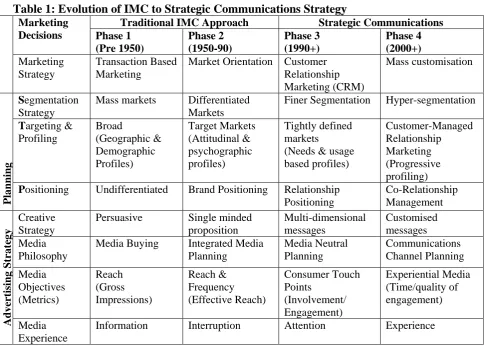
themes in regards to what new media means for IMC. The literature seems to suggest that marketing decisions which were once treated as discrete, separate steps in planning – segmentation, positioning, promotional strategy, distribution and communications - are converging. We argue that concepts in advertising strategy can be organised into four key evolutionary phases – two ‘traditional’ and two ‘contemporary’. Taken collectively, these phases suggest a future direction for communications strategy.
Table 1: Evolution of IMC to Strategic Communications Strategy
Traditional IMC Approach Strategic Communications Marketing
Decisions Phase 1 (Pre 1950) Phase 2 (1950-90) Phase 3 (1990+) Phase 4 (2000+) Marketing Strategy Transaction Based Marketing
Market Orientation Customer Relationship Marketing (CRM)
Mass customisation
Segmentation
Strategy
Mass markets Differentiated
Markets
Finer Segmentation Hyper-segmentation
Targeting &
Profiling Broad (Geographic & Demographic Profiles) Target Markets (Attitudinal & psychographic profiles) Tightly defined markets
(Needs & usage based profiles) Customer-Managed Relationship Marketing (Progressive profiling) Plannin g
Positioning Undifferentiated Brand Positioning Relationship
Positioning
Co-Relationship Management Creative
Strategy
Persuasive Single minded
proposition Multi-dimensional messages Customised messages Media Philosophy
Media Buying Integrated Media
Planning Media Neutral Planning Communications Channel Planning Media Objectives (Metrics) Reach (Gross Impressions) Reach & Frequency (Effective Reach) Consumer Touch Points (Involvement/ Engagement) Experiential Media (Time/quality of engagement) Advertisin g Strate gy Media Experience
Information Interruption Attention Experience
Segmentation, Targeting and Profiling
The segmentation-targeting-positioning (STP) sequence is fundamental to integrated
marketing communications (IMC). Conventional planning employs a linear planning model, in which segmentation is the essential first step. Positioning and marketing programs are dependent on careful segmentation, typically based on purchasing combined with
demographic or attitudinal variables (Sausen, Torsten, and Herrmann 2005). Profiling is used to reveal rich insights about the target market necessary to inform effective brand positioning, marketing and communication strategy. Thus STP is essentially a brand-driven approach.
Technological developments have made hyper-segmentation a reality (Christian 2005;
Louvieris and Driver 2001). Marketers can use interactive communications to query prospects across information interactions, thereby continuously refining the customer profile (Market-First c. 2005; Spethmann 1999). Each successive interaction is capable of yielding rich data enabling continuous micro-segmentation.
The process is also referred to as progressive profiling in the CRM literature and addressable advertising in the interactive media industry, the (Christian 2005; Dureau 2004; Gal-Or et al. 2006). Both approaches are distinctive forms of hyper-segmentation. Progressive profiling uses interactive media to address targeted questions across transactions and interaction points. Insights from consumer responses facilitate further segmentation on the basis of brand
preferences, desired level of customisation or purchase readiness (Christian 2005; Dureau 2004; Gal-Or et al. 2006). Addressable advertising exploits the potential of personal video recorders to gather information on viewing patterns and advertising preferences. A major advantage of hyper-segmentation is that it can be used to make inferences about latent needs, which in conventional marketing, have been elusive.
As consumers provide additional information, it is possible for marketers to tailor strategies, as both the message and the offer can target individual customers. Through continuous adjustments to message delivery, hyper-segmentation not enhances message relevancy within real time campaign timelines, it also reduces potential message wear-out and assists with scheduling message frequency based on customer-defined expectations. Hyper segmentation transforms marketing communications from an “interruption” model to an “attention” model.
It has been argued that mass customisation; marketing to “an audience of one,” is a theoretical reality (Kara and Kaynak 1997; Sheth, Sisodia, and Sharma 2000), even though strategy and implementation are not prepared for such finely tuned segments. The implications of hyper-segmentation extend beyond marketing communications because of the ability to develop truly unique positioning strategies at the level of an individual customer.
Positioning
Positioning provides a central link between the brand, its core benefits and the market (Rossiter and Percy 1997). Brands must not only differentiate, but also identify ways to communicate unique brand values effectively. The traditional view is that consumers develop relationships with brands or companies. Advertising’s role is largely confined to the
consumer’s pre-purchase cognitive and affective states. Advertising media is used to generate brand awareness, contribute to brand attitude, strengthen purchase intent, encourage trial and frame consumer expectations (Rossiter and Percy 1997; Vakratsas and Ambler 1999). Product experiences, via ongoing transactions, are required to confirm (or disconfirm) expectations, reinforce the positioning theme and develop enduring relationships.
offer even greater rewards to both the consumer and the marketer (Gilmore and Pine 2002; Koontz and Gibson 2002)
Computer power is central to the use of new media and improved relationship management (Hoekstra and Huizingh 1999; Kapoulos, Murphy, and Ellis 2002; McCullough-Johnston 2001; Park and Kim 2003). Terms such as e-relationship marketing and technologicalship marketing have been coined to reflect the growing importance of computer-mediated relationships (Zineldin 2000). It has been suggested that relationship marketing represents a paradigm shift (Brodie et al. 2000; Gronroos 1994). Yet, it has also been suggested that CRM remains product-centric rather than customer focussed (Law, Lau, and Wong 2003).
It is unclear whether consumers believe that a relationship formed in a computer mediated environment is different than one based on personal encounters. Zineldin (2000) has argued that computer-mediated relationships are fundamentally different. A recent study found that internet based relationships were generally weaker and that internet customers placed different weights on expected benefits. That is, social benefits were less significant for internet customers who, valued personal advice and quick response to problems (Colgate, Buchanan-Oliver, and Elmsly 2005). As such electronic relationships might be sufficiently different that they required specialized management, which moves beyond traditional marketers’ expertise.
Within new media landscape, the consumer’s role as a content creator is an issue that has not been extensively researched. The rise in popularity of consumer generated media points to shifting power relations between consumers, companies and media. To reflect a more customer centric approach, it has been argued that CRM should be envisioned as co-relationship (Sheth et al. 2000) while others have applied the term “customer-managed relationships”(Peters 1998).
Media Strategy
In early practice mass media was used to reach unsegmented mass markets. Marketers were constrained by limited media choices, thus a buying philosophy prevailed. Some have argued that remnants of the buying mindset have persisted within advertising agencies to the present day (Kitchen et al. 2004), which might inhibit their ability to embrace new media.
The mid-twentieth century saw media proliferation and audience fragmentation. The basic requirement of media selected is its capacity or the ability to convey the campaign’s creative content in a way that achieves the campaign’s communications objectives (Rossiter and Percy 1997). Media decisions centred on the optimal media mix and schedule. Media objectives were expressed in terms of impressions rather than creative fit. This may explain why much of the literature has explored issues associated with effective frequency, reach and continuity and the impact on sales or brand preferences (Vakratsas and Ambler 1999).
More recently, theorists and practitioners have urged advertisers to embrace the framework of media neutrality (Grounds 2003; Kaye 2000; O'Regan 2003), where each medium is treated as potentially appropriate depending on the specific marketing objectives (Tapp 2005). Media neutrality attempts to provide an unbiased approach to media selection that emphasises planning around consumer touch-points. Media are viewed from the consumer’s perspective, and selected media connect with consumers whenever and wherever they are most receptive (Benady 2004). It has been pointed out this customer-driven approach places media strategy at the forefront of the creative process (Mcmains, Sempley, and Gregory 2006) and moves away from a brand focused perspective.
Communications channel planning is the logical extension of media neutrality, driven by advertisers wanting far more sophisticated combinations of media and communications. In this planning framework, measures of effectiveness focus on qualitative measures such as consumer “engagement” and “involvement.” Emerging concepts such as “media richness” may become the way of conceptualising the relationship between consumers, brands and the media (Kaye 2000; Zambardino and Goodfellow 2003), where there is a focus on the
channel’s ability to convey varying levels of desired content (Simon and Peppas 2004). New media tend to be richer due to interactivity, with inflexible traditional media tending to be considered ‘leaner’. Empirical research on media richness is only just emerging; there is some evidence that modern consumers prefer rich media. For example, Simon and Peppas (2004) found that consumers’ general preference for richness increased with complexity of products and Scherf (2005) found that younger consumers prefer richer media.
In the new paradigm, it is no longer a choice of traditional versus new media, it is important to consider media complementarity. Effective promotion strategies using new-emerging media require support from traditional media. However, traditional media’s role may be more supportive, to drive consumers onto interactive platforms, where marketers can deliver optimized messages, targeted at tightly defined audiences, provide virtual brand experiences and build relationships with consumers.
Conclusions
Table 1 provides our summary of how the changes to media discussed will affect the
components of planning and strategy associated with the new media. The concepts discussed in this paper need significant additional development. What is clear based on the existing academic and practitioner literature to date is the fact that the frameworks used plan and implement communication strategies are no longer applicable. New media mean that strategy evolves as consumers interact with marketers, which results in redefining strategy for specific micro-segments, i.e. mass customisation.
The effective use of new media requires a more integrative framework were firms start with one communication program that is sufficiently flexible to then deal with multiple segments, all seeking divergent and overlapping interactions all at the same time. This requires that communication strategy is embedded in broader marketing strategic activities and in fact the delineation between the two may ultimately disappear. This area has not been researched and extensive investigation needs to consider the design and assessment of different new media approaches. Research also needs to consider the broader design and management issues, to identify how organisations can effectively leverage new media to achieve broader
References
Barwise, P., A. Elberse, and K. Hammond (2002), "Marketing and the Internet," in Working Paper 01-801, Future Media Research Programme. London <online: www.london.edu>.
Barwise, P. and A. Styler (2003), "Marketing Expenditure Trends: 2001-2004." London Business School <online:www.london.edu>.
Benady, A. (2004), "The Rise of Media Strategy," in Campaign (UK) Vol. 20 October, 2004.
Brodie, R., R. Coviello, R. Brookes, and V. Little (2000), "Towards a Paradigm Shift in Marketing? An Examination of Current Marketing Practices," Journal of Marketing Management, 13 (5), 383-406.
Christian, P. (2005), "Addressable IPTV Advertising: Dramatically Increasing Revenue per Viewer," IPTV Magazine, October, 2005, pp 68-75 <online:www.iptvmagazine.com>.
Colgate, M., M. Buchanan-Oliver, and R. Elmsly (2005), "Relationship Benefits in An Internet Environment," Managing Service Quality, 18 (5), 426-36.
Danaher, P. and J.R. Rossiter (2006), "A Comparison of the Effectiveness of Marketing Communication Channels: Perspectives from Both Receivers and Senders," in Occasional Paper. University of Auckland, New Zealand <online:www.business.auckland.ac.nz>.
Dureau, V. L. (2004), "Addressable Advertising on Digital Television," in Broadcast Asia International Conference 2004 Vol. 12. Singapore: BroadcastAsia.
Gal-Or, E., M. Gal-Or, J.H. May, and W.E. Spangler (2006), "Targeted Advertising Strategies on Television," Management Science, 52 (5), 713-25.
Gilmore, J.H. and B.J. Pine (2002), "Customer Experience Places: The New Offering Frontier," Strategy and Leadership, 30 (4), 4-11.
Gronroos, C. (1994), "From marketing mix to relationship marketing- Towards a Paradigm Shift in Marketing," Management Decision, 32 (2), 322-39.
Grounds, J. (2003), "Media Neutral Planning and Evaluation: The Chicken and the Egg of Integrated Communication," International Journal of Nonprofit and Voluntary Marketing, 8 (3), 202-06.
Hamel, G. and C.K. Prahalad (1994), Competing for the Future. Boston, Mass: HBS Press.
Hoekstra, J.C. and E.K. R. E. Huizingh (1999), "The Lifetime Value Concept in Customer-Based Marketing," Journal of Market Focussed Management, 3 (3/4), 257-74.
Kara, A. and E. Kaynak (1997), "Markets of a Single Customer: Exploiting Conceptual Developments in Market Segmentation," European Journal of Marketing, 31 (11/12), 873-85.
Kaye, T. (2000), "Media Neutral Planning: Just Today's Buzz Word or a Genuine New World Order?," in Marketing Society (UK). London <online:www.marketing-society.co.uk>.
Kitchen, P., D.E. Schultz, I. Kim, D. Han, and T. Li (2004), "Will Agencies Ever "Get" (or Understand) IMC?," European Journal of Marketing, 38 (11/12), 1417-36.
Koontz, M.L. and I.E. Gibson (2002), "Mixed Reality Merchandising: Bricks, Clicks and Mix," Journal of Fashion Marketing and Management, 6 (4), 361-96.
Law, M., T. Lau, and Y.H. Wong (2003), "From Customer Relationship Management to Customer-Managed Relationships: Unveiling the Paradox with Co-Creative Perspective," Marketing Intelligence and Planning, 21 (1), 51-60.
Levine, M. (2006), "The Value Equation of Innovation," in Admap, Vol 47. March <online:www.roymorgan.com.au>.
Li, H., T. Daugherty, and F. Biocca (2003), "The Role of Virtual Experience in Consumer Learning," Journal of Consumer Psychology, 13 (4), 395-407.
Li, H., T. Doherty, and F. Biocca (2002), "Impact of 3-D Knowledge on Product Knowledge, Brand Attitude and Purchase Intent: The Mediating Role of Presence," Journal of Advertising, 31 (2), 43-57.
Louvieris, P. and J. Driver (2001), "New Frontiers in Cybersegmentation: Marketing Success Depends on IP Adresses," Qualitative Market Research, 4 (3), pp 169-81.
Market-First (c. 2005), "Increased Revenue and Accelerated RIU With Effective Lead Management," White Paper (Ed.).
McCullough-Johnston, K. (2001), "Why E-Business Must Move Beyond Market Orientation: Applying Human Interaction Models to Computer-Mediated Corporate Communications," Internet Research: Electronic Networks and Policy, 11 (3), 213-25.
Mcmains, A., K. Sempley, and S. Gregory (2006), "Different Paths But One Idea: Reclaim Media Strategy," in AdWeek Vol. 47, No. 31, p.8.
O'Regan, M. (2003), "Media Neutral Planning- A New Role for Marketing Databases?," Journal of Database Marketing, 10 (4), 291-92.
Park, C-H. and Y-G. Kim (2003), "A Framework of Dynamic CRM: Linking Marketing Strategy with Information Strategy," Business Process Management Journal, 9 (5), 622-71.
Peters, L. (1998), "The New Interactive Media: One to One, But to Whom?," Marketing Intelligence and Planning, 16 (1), 22-30.
Rossiter, J. and L. Percy (1997), Advertising Communications and Promotion Management. Boston, Mass.: Mc Graw-Hill.
Sausen, K., T. Torsten, and A. Herrmann (2005), "Development of a Taxonomy of Strategic Market Segmentation: A Farmework for Bridging the Implementation Gap Between
Normative Segmentation and Business Practice," Journal of Strategic Marketing, 13 (3), 151-73.
Sheth, J.N., R.S. Sisodia, and A. Sharma (2000), "The Antecedents and Consquences of Customer-Centric Marketing," Journal of the Academy of Marketing Science, 28 (1), 55-66.
Simon, S.J. and S.C. Peppas (2004), "An Examination of Media Richness Theory: in Product Web Site Design," Info, 6 (4), 270-81.
Spethmann, B. (1999), "Can We Talk? Relationship Marketing," American Demographics, 21 (3), 42-45.
Tapp, A. (2005), "Media Neutral Planning: A Strategic Perspective," Database Marketing and Customer Strategy Management, 12 (2), 133-41.
Tedlow, R.S. (1990), New and Improved: The Story of Mass Marketing in America. Oxford: Heinemann.
Vakratsas, D and T Ambler (1999), "How Advertising Works: What Do We Really Know?," Journal of Marketing, 63 (1), 26-43.
Zambardino, A. and J. Goodfellow (2003), "Account Planning in the New Marketing and Communications Environment," Marketing Intelligence and Planning, 21 (7), 425-34.