https://doi.org/10.5194/nhess-18-2011-2018 © Author(s) 2018. This work is distributed under the Creative Commons Attribution 4.0 License.
Mapping accessibility for earthquake hazard response in
the historic urban centre of Bucharest
Cristina Merciu1, Ioan Ianos1, George-Lauren¸tiu Merciu2, Roy Jones3, and George Pomeroy4
1Interdisciplinary Centre of Advanced Research on Territorial Dynamics, University of Bucharest,
Blvd. Regina Elisabeta, 4–12, Bucharest, Romania
2Faculty of Geography, University of Bucharest, Blvd. Nicolae B˘alcescu, 1, 030018 Bucharest, Romania 3Geography Discipline Group, Curtin University, Perth, Western Australia 6845, Australia
4Geography – Earth Science Department, Shippensburg University of Pennsylvania, 1871 Old Main Drive,
Shippensburg, PA 17257, USA
Correspondence:Ioan Ianos ([email protected])
Received: 19 February 2018 – Discussion started: 1 March 2018 Accepted: 26 June 2018 – Published: 25 July 2018
Abstract.Planning for post-disaster accessibility is essential for the provision of emergency and other services to protect life and property in impacted areas. Such planning is partic-ularly important in congested historic districts where narrow streets and at-risk structures are more common and may even prevail. Indeed, a standard method of measuring accessibil-ity, through the use of isochrones, may be particularly inap-propriate in these congested historic areas. Bucharest, Ro-mania, is a city with a core of historic buildings and narrow streets. Furthermore, Bucharest ranks second only to Istan-bul among large European cities in terms of its seismic risk. This paper provides an accessibility simulation for central Bucharest using mapping and geographic information sys-tem (GIS) technologies. It hypothesizes that all buildings in the risk 1 class would collapse in an earthquake of a similar magnitude to those of 1940 and 1977. The authors then sim-ulate accessibility impacts in the historic centre of Bucharest, such as the isolation of certain areas and blockages of some street sections. In this simulation, accessibility will be sub-stantially compromised by anticipated and extensive build-ing collapse. Therefore, policy makers and planners need to fully understand and incorporate the serious implications of this compromised accessibility when planning emergency services and disaster recovery responses.
1 Introduction
A longitudinal analysis of natural hazards in major urban ar-eas shows an incrar-easing awareness of the frequency of disas-ters and especially of earthquakes (Eshghi and Larson, 2008; Arma¸s, 2012; Lu and Xu, 2014). Indeed, earthquakes are among the natural disasters that generate the greatest hu-man and material losses (Geis, 2000; Arma¸s and Avram, 2008; Atanasiu and Toma, 2012). Their impacts demand a prompt response from decision makers and the wider popu-lation, through the proper management of emergency situa-tions (Waugh and Streib, 2006). In any disaster situation, one of the most important factors across all the disaster phases is public–private emergency cooperation for post-disaster ac-cessibility and efficient intervention. By developing a model to harmonize this strong cooperation, Wiens et al. (2018) identify efficient ways to improve the logistics of these oper-ations during crisis management.
vulner-ability, especially when there are strong pressures for rapid development. Finally, the characteristically long time lags between pairs of strong earthquakes (Schweier and Markus, 2006) can dull public awareness of the potential impacts of such disasters and render those in charge of emergency man-agement complacent.
Earthquakes require a specific disaster planning approach (Arma¸s, 2008; Bo¸stenaru Dan and Arma¸s, 2015). This is be-cause, unlike disasters that can be anticipated in the short term (such as storms), there is little or no delay between the occurrence of the earthquake and the subsequent loss of life and property damage. Therefore, emergency response activi-ties must be executed very quickly and efficiently (Wegschei-der et al., 2013). For cities with a high earthquake risk, an important factor is public awareness of such events. This conditions the population towards the importance of quick response measures, which can help to reduce property dam-age and, more importantly, the number of casualties (Arma¸s and Avram, 2008). However, no matter how well organized the mitigation process, the disastrous effects of major earth-quakes cannot be totally avoided (Momani and Salmi, 2012). Post-disaster recovery needs to transfer the most debated academic concepts (disaster resilience, for example) into ap-propriate politics and transform them into real tools for ade-quate planning. Governments have an important task: to pre-pare the population and all stakeholders for future similar events (Comerio, 2014).
In recent years, seismic risk management has been more fully studied and developed so as to establish a series of pri-orities related to the rehabilitation of those buildings consid-ered to be of major importance, including schools (Grant et al., 2007; Raffaelle et al., 2013; Panahi et al., 2013), pub-lic institutions, historic buildings, and monuments (Grasso and Maugeri, 2009; Pessina and Meroni, 2009). Urban earth-quake planning therefore needs to be more proactive (Bo¸ste-naru Dan et al., 2014), and there is a demonstrated require-ment for coherent urban policies (Ianos et al., 2017) to mit-igate the inevitable occurrence of blockage points during emergency interventions.
In emergency situations, the key response element is rapid accessibility to places where possible casualties may be lo-cated. Timely intervention within the first 2 h is critical in saving the wounded and in identifying the safest access routes for specific emergency equipment. As Fiedrich (2007) suggests, the disaster responses made during the first 3 days are fundamental. After that, the main goals are invariably res-cuing trapped victims and treatment of the injured, though ongoing fire control may also be required in some cases.
In general, natural hazard management includes the devel-opment of impact scenarios before the actual disasters occur (Bakillah et al., 2013). In this context, geographic informa-tion systems (GIS) techniques may be particularly useful in developing decision-making and response scenarios for po-tential earthquake disasters.
Our study shows that special attention should be paid to accessibility in the historic centres of large cities (Ianos and Cepoiu, 2009). Historic city centres are characterized by in-tense pedestrian traffic and by a high proportion of attraction points (clubs, restaurants, hotels, etc.) which result in high concentrations of people. Since the core of the historic cen-tre of Bucharest is characterized by a high number of build-ings that were strongly affected by earthquakes in the last century, we can reasonably speculate that determining their accessibility in an emergency situation will facilitate quick intervention in areas where injured people – either direct ca-sualties or victims of earthquake-related phenomena such as fires, gas accumulations, or local flooding – are likely to be concentrated. The main objective of the study is to integrate geospatial data using thematic mapping products with GIS techniques in order to provide seismic risk management so-lutions for Bucharest. We therefore seek to provide concrete data and comprehensible information that can enable deci-sion makers to implement and prioritize their disaster man-agement strategies. A similar study, based on different haz-ard scenarios and a deep analysis on social vulnerability in Bucharest, identifies the importance of fire stations, hospi-tals, and parks in post-disaster situations (Arma¸s et al., 2016). Unlike most studies of community response following an earthquake occurrence and the critical analysis of the emer-gency situations management generated thereby (Pollino et al., 2012; Wegscheider et al., 2013; Lu and Xu, 2014), the present study demonstrates the importance of GIS analyses in detecting potential congestion and inaccessibility issues in areas where buildings are most likely to collapse and acces-sibility issues are most likely to arise as a result of an earth-quake.
2 Case study
Bucharest is Romania’s largest city (with over 2 million inhabitants), the national capital, and one of the great metropoles of southeastern Europe (GROSEE Espon Project, 2014). Its urban evolution has been very rapid, largely oc-curring from the second half of the 19th century. Currently, the city occupies an area of 228 km2and possesses a hous-ing stock predominantly consisthous-ing of multifamily apart-ment buildings, built during the communist period (Ianos et al., 2016). Located about 135 km from the epicentre of the Vrancea seismic area (Lungu et al., 2000), in close proxim-ity to the Southern Carpathian Mountains and at the junc-tion of the Eastern European, Intra-Alpine, and Moesia plates (M˘armureanu et al., 2011), the city is extremely vulnera-ble to earthquakes. Indeed, in a classification of European metropolitan areas with respect to potential loss of life and damage to property, Bucharest is ranked second after Istan-bul (Bala, 2014).
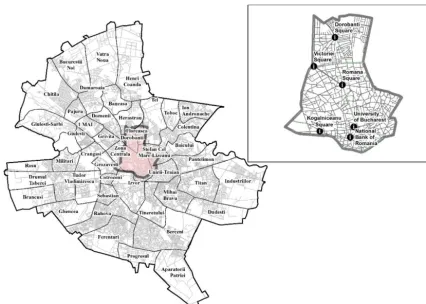
(Tat-Figure 1.The city of Bucharest and its surrounds.
evossian and Albini, 2010). The Vrancea seismic area is re-sponsible for the highest seismic risk in Romania (Pavel et al., 2014; Ardeleanu et al., 2005). Over the past 76 years, Bucharest has been affected by four earthquakes with a mag-nitude of between 6.9 and 7.7 on the Richter scale (Novem-ber 1940, March 1977, August 1986, and May 1990).
The study area for this paper is confined to central Bucharest, an area of approximately 8.33 km2(Fig. 1). The oldest part of the city is situated in the south of this area, which comprises the historic centre (from the 16th and 17th centuries) and the central and northern parts dating from the 18th and 19th centuries. All four earthquakes mentioned above have impacted this case study area, with the most powerful being the earthquakes of 1940 and 1977. This se-quence of earthquakes has had a cumulative effect, which explains the relative lack of buildings dating back more than 200 years.
The most serious problem is presented by the large num-ber of buildings from the late 19th century within the historic centre, which has structurally degenerated over time and no longer meets the current building standards with regard to as-sessment of the ground motion levels for the Vrancea (Roma-nia). Not only does Bucharest have a high level of exposure to earthquake hazards; it also suffers from poorly organized civil protection services and a low level of public awareness and education concerning these seismic risks (Arma¸s, 2006).
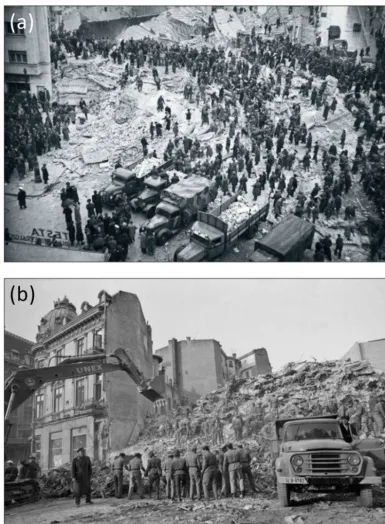
Nevertheless, anticipation and anxiety are building, given the length of time that has passed since the 1977 major earth-quake. In essence, there is a fear that the city will be no better prepared than it was in 1940 (Fig. 2a) or in 1977 (Fig. 2b). These figures show only a slight improvement in the standard of the disaster measures between the two dates, and there is a growing recognition that greater levels of preparedness are needed.
Figure 2. (a)The collapse of the Carlton block in Bucharest in 1940. Source: https://upload.wikimedia.org/wikipedia/commons/6/60/Iosif_ Berman_-_Marele_cutremur_din_anul_1940.jpg (last access: 3 June 2017).(b)The collapse of the Continental block in Bucharest’s histori-cal centre in 1977 blocked the access streets, so clearance was delayed by more than 12 h. Source: Agerpres.
these cosmeticized blocks are still among the most expensive in the city due to their central location and spaciousness.
Accordingly, the Romanian government has established the National Committee for Emergency Situations and the
exist-ing meetexist-ing points (two in Bucharest and other in the village of Ciolpani to the north), and there is a special strategy to bring in instantaneous support from 24 counties surrounding the city.
3 Data and methods
This assessment of seismic hazard and vulnerability includes quantitative and qualitative data analysis that incorporates physical, environmental, social, and economic factors; po-tential impacts from existing risk maps; and estimates of the population that would potentially be affected (Mândrescu, 1990; Arma¸s, 2012; Rufat, 2013; Pollino et al., 2012). The accessibility analysis takes into consideration the specifici-ties of each urban district, especially the urban context (Noto, 2017).
3.1 Data
The authors have used several data sets (buildings classified by seismic risk and emergency categories, i.e. the presence of hospitals and fire stations) in order to provide a realistic de-piction of the impact that a potential earthquake could have in the historical centre of Bucharest. Only those fire stations and hospitals within the municipal limits of Bucharest are in-cluded. The main data sources were provided by public insti-tutions. Every year the municipality of Bucharest publishes a technical report classifying buildings with relation to four seismic risk criteria and three emergency criteria to assess their level of public safety. Table 1 shows the distribution of Bucharest’s buildings by risk and emergency categories. Special attention is paid to the historic centre of Bucharest, which contains the largest concentration of buildings which represent a public safety risk.
To represent the accessibility patterns prior and subse-quent to an earthquake, it was necessary to digitize all el-ements of the transport infrastructure, construction, green spaces, alleys, sidewalks, and property limits.
Several different map sources were used to identify build-ing locations, includbuild-ing cadastral maps at scales of 1 : 500 and 1 : 2000 (IGFCOT, 1974–1975). Other map types and sources include old maps of Bucharest produced by the To-pographic Military Directorate and orthophotomaps (2014) taken from the National Agency for Cadastre and Real Estate Advertising. The authors have overlaid accessibility patterns on a numerical model of the land, given the absence of natu-ral barriers, since the municipality of Bucharest is located on a plain.
3.2 Methods
An important methodological contribution on the capacity of a city to resume urban functions after a seismic event is the study by Goretti et al. (2014) on how the Crotone urban sys-tem could better respond to such disasters. This study shows
the importance of rapid accessibility to collapsed buildings and to injured people. Our study therefore emphasizes the importance of immediate accessibility for emergency inter-vention mechanisms and the need to provide information to facilitate the proactive actions of decision makers, who need clear and straightforward directions.
The main methodological steps in mapping accessibility in the central area of Bucharest were (a) setting up a refer-ence database of all the buildings with seismic risk; (b) trans-ferring this information to a detailed map of the identified buildings; (c) identifying indicators of building density and age, and traffic (including pedestrian) intensity; (d) showing the locations of all hospitals and fire stations; (e) calculat-ing present-day (before a possible earthquake) accessibility levels; (f) identifying specific locations of potential conges-tion resulting from the collapse of buildings included in the highest risk class; and (g) determining, by simulation, the immediately inaccessible or poorly accessible areas for the intervention crews in the case of an earthquake, taking into account those buildings that might collapse if an earthquake occurs.
In the scientific literature, “access” is mainly measured as a physical distance or travelling time (Sotoudehnia and Comber, 2011). In this study, mapping the accessibility of the central area of Bucharest was completed using GIS tech-niques incorporating spatial analysis. The calculation of ac-cessibility was initially based on the geometric structure of the public transport network (busses, trams, and under-ground services), but not on the walking and cycling net-works, which, although they have been included in other studies, are less amenable to emergency service access in this context (Graeme and Aylward, 1999; Parker and Campbell, 1998; Naphtali, 2006; Svensson, 2010; Weiping and Chi, 2011; Sotoudehnia and Comber, 2011; ESPON TRACC In-terim Report, 2011; ESPON GROSEE Final Report – Scien-tific Report, 2014; Blandford et al., 2012; Coffee et al., 2012; Yiannakoulias et al., 2013; Vojnovic et al., 2014).
The Kernel Density tool was used to calculate the density of point and line features in a neighbourhood around those networks. After modelling the road network using the Ar-cGIS Network Analyst extension, the authors used an assort-ment of analytical tools. These included the New Route tool to check the road network, the New Closest option to deter-mine the closest emergency facility (hospital, fire station) to each point, and the New OD matrix function to determine optimal routes (depending on road distance and travel time) following the principle of the shortest possible route to es-tablish links between each pair of points.
Table 1.Building condition data for the historic centre of Bucharest (number of restored buildings is at the historical centre level; number of fire stations and hospitals is at the municipality level). RI–RIV: seismic risk categories; U1–U3: emergency categories.
R I R II R III R IV U1 U2 U3 Total Buildings with seismic risk in Bucharest 343 344 97 7 309 615 650 2365 Buildings with seismic risk in the historical 65 1 2 1 82 9 5 165 centre of Bucharest
Buildings with seismic risk in the core 50 1 1 41 2 2 97 of the historical centre of Bucharest
Number of buildings restored to an 17 adequate seismic standard
Fire Stations 13
Hospitals 32
Source: processed data using the list of buildings with seismic risk, published by the municipality of Bucharest (http://amccrs.pmb.ro/docs/Lista_imobilelor_expertizate.pdf, last access: 15 October 2017).
public transport from the city centre, had been used to assist in urban transport planning in the 1950s (Kok, 1951, Rowe, 1953 quoted by O’Sullivan, et al., 2000). These isochrones were generated using GIS.
In addition, the Kriging kernel interpolation calculation and local polynomial interpolation were used. For exact in-terpolation, the inverse distance weighted (IDW) method was used. These methods identified support elements for more proactive management that have the potential to bring about a decrease in both the material damage and the human casu-alties resulting from a strong earthquake. Using a database in a GIS environment enabled an assessment and estimation of the potential damage that could be caused by such an event. At the same time, GIS is a valuable method of analysis for this purpose because the databases can be regularly updated, allowing for ongoing mapping of the changing risk scenarios and the updating or reassessment of potential damage. The risk scenarios also provide useful identification of the vul-nerable areas and population groups (Sinha et al., 2008).
The penultimate methodological step was to identify likely congestion locations. The initial simulation assumed that all the buildings categorized as possessing the highest degree of risk would collapse. For the core of the historical centre, this permitted the identification of some important sites and street segments which would be blocked in the case of a strong earthquake using the location of each highest-risk building, their age and number of floors, and the local configuration of the street network.
Our intention is not to propose a precise correlation be-tween the vulnerability of buildings (based on all their char-acteristics) and the intensity of the next earthquake. Rather, especially by taking into account that some of buildings in this area have partially collapsed in the absence of a direct seismic cause, we contend that an earthquake of similar
mag-nitude to the 1977 event would produce outcomes compara-ble to our simulation.
From this information several maps were developed taking into account the region’s particular seismogenic characteris-tics (Mäntyniemi et al., 2003). Two offer general images of accessibility at the city level closely correlated with the terri-torial distribution of fire stations and hospitals. Another iden-tifies areas or street segments potentially isolated by building collapses.
In recent years, scientific approaches to risk reduction of natural events, such as earthquakes, have used resilience as an important concept, which could offer new theoretical and practical tools for better civil protection (Fekete and Fiedrich, 2018). Using this concept, scientists are paving the way for reinvigoration of the expectations, by joint actions with deci-sion makers and civilians (Anhorn, 2018). These ideas ask whether other complementary issues are connected with a higher accessibility to the affected areas.
Our approach, focusing on the single issue of accessibility in a situation of crisis management, shows empirically how GIS technologies can be used to make recommendations to authorities to improve their preparedness levels and response speeds in post-earthquake interventions. Within this study, GIS is used solely as a tool to identify accessibility as a start-ing point for disaster management (Nushi and van Loenen, 2013). These GIS solutions are demonstrably important ap-plications in relation to the first two phases (risk mitigation and disaster preparedness) of Alexander’s (2002) four-phase sequence of emergency management activities.
4 Results
Figure 3.Road traffic intensity and the location of buildings with a high seismic risk. (1) Building; (2) core of the historic centre; (3) Dâm-bovi¸ta River; (4) study area.
winding street pattern dating back to medieval times; the poor structural condition of many of the buildings; and lim-ited access to important points from the emergency response activity locations are all of critical importance.
In such a context, accessibility to specific disaster sites is critical, and this requires that urban areas of this nature be treated with special attention. The biggest challenge may be caused by traffic congestion compounded by debris, which can isolate critical areas, making rapid intervention to put down fires and save human lives impossible.
The official identification of buildings with a high seis-mic risk combined with precise mapping of their location can be related to the density of road traffic in the historic ar-eas (Fig. 3). If traffic is very high on the main access streets, this could inhibit rapid intervention, especially in a situation of general panic such as that generated by a potential earth-quake. It would also be difficult to use narrow streets, where the pedestrian traffic and partially collapsed buildings could block the access of emergency service vehicles. In this con-text, there is a need for proactive measures, to mitigate the risk of late arrival of assistance at the affected buildings.
The most important area of the historical centre is the one delimited by Armeneasc˘a, Mo¸silor, and C˘al˘ara¸si streets; Splaiul Independen¸tei; Calea Victoriei; and Carol and Regina Maria boulevards. Within this area, the building density exceeds 2.5 units ha−1; in some places, it even exceeds
10 units ha−1. In the areas of the highest density, most of the buildings have two or three floors, and, because of their un-certain legal status after 1990, many exhibit an advanced and increasing degree of dilapidation. Restoration and reinforce-ment of these buildings by both public authorities and private entrepreneurs are only proceeding at a maximum rate of two buildings per year.
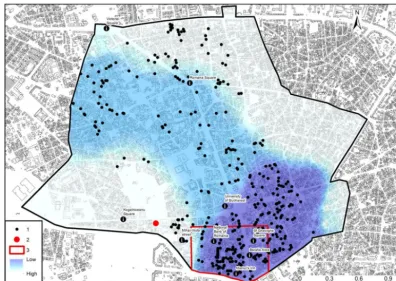
The number of buildings with the highest seismic risk (computed with the Kernel Density tool) shows a very high concentration in the historical centre of Bucharest (Fig. 4). When looking at a map of seismicity at the level of Bucharest, it becomes obvious that the inherent risks from earthquake damage are greatest in central Bucharest, includ-ing the historical centre (Rufat, 2011). Even though most of the buildings located in the historical centre date from the early 20th century, they were built on the foundations of 19th-century structures (Arma¸s, 2008).
Figure 4.Density of buildings with a major seismic risk. (1) Building; (2) Dâmbovi¸ta River; (3) core of the historic centre.
area, using the Bellman–Kalaba algorithm. These minimal road applications were applied for various types of emer-gency service: transport, ambulance, fire, police, etc.
It was noted that both firefighting and ambulance service accessibility were high or very high for most parts of the cap-ital city, including the downtown area, which is especially well served by firefighter and ambulance services. There are 13 large fire stations in Bucharest. However, the lowest levels of potential accessibility by fire services to individual houses in the city of Bucharest occurred in the historic centre area, mainly due to the configuration of the street pattern (Fig. 5). The lowest values were registered in an area between Calea Victoriei, Doamnei Street, Br˘atianu Boulevard, and Splaiul Independen¸tei, in the core of the historic centre. Low values occur to the east of Br˘atianu Boulevard, even though some important access axes (Armeneasc˘a, Calea Mo¸silor, Hristo Botev, Negustori) are located nearby. Overall, if fires broke out at several different points in the historic centre core dur-ing a seismic event, this would present huge problems.
The map of ambulance accessibility (Fig. 6) presents a very similar picture. However, access is better in the northern part of the historic centre due to the location of Col¸tea Hospi-tal. Figure 7 shows two areas where it would be difficult for ambulances to arrive in a timely manner, one in the core of the historical centre and the other in the surrounds of Mihai Vod˘a Street, which would be accessed by ambulances from University Emergency Hospital.
5 Discussion
Should an earthquake occur, an important consideration is the challenge presented by building collapses which obstruct road access. Identifying individual buildings with the high-est levels of seismic risk highlighted the possibility of con-centrated building collapses in certain locations within the historic centre. In these the locations, some buildings would become isolated, and rapid intervention by fire or ambulance services would be impossible.
This general analysis indicates that the central area seems to be favoured due to the possibility of intervention from several emergency service points into this part of the city. However, and in spite of this, pedestrian and vehicular con-gestion is highly likely to inhibit rapid access by firefighters and ambulances in several areas within the central district. Also, several locations in the downtown area, which previ-ously appeared to have high emergency accessibility levels, were shown to possess high probabilities of multiple building collapses. These events could well obstruct access by emer-gency vehicles, despite the high levels of accessibility that were identified initially.
Dom-Figure 5.Firefighting accessibility levels within the study area. (1) Fire station; (2) study area; (3) core of the historic centre; (4) Dâmbovi¸ta River.
Figure 7.The accessibility of buildings with high seismic risk to firefighting services after a potential earthquake occurrence. (1) Building; (2) fire station; (3) core of the historic centre.
neasc˘a”; Covaci Street; and Smârdan Streets, for example). These buildings characteristically house restaurants, cafes, or pubs, which contain huge quantities of furniture, a fur-ther important source of fire. If emergency action does not occur promptly, in such locations, the probability of numer-ous fatalities is high. In addition, water supply and sewerage systems may be damaged, resulting in basement and ground floor flooding. It would therefore be advisable to provide sup-plementary emergency response materials at a large number of locations within this district. This would allow access to such equipment at the local scale as an alternative to the pro-vision of emergency materials and services from elsewhere which may be unobtainable in the event of an emergency.
Assuming that, in the event of a large-scale disaster, cer-tain clusters of buildings may become isolated and inaccessi-ble to emergency services, it is therefore recommended that smaller-scale aid stations be established within these dis-tricts. These smaller-scale aid stations could then provide critical assistance in areas isolated by building collapses.
A detailed analysis highlights the fact that in the south-western part of the historical center of Bucharest there is an area that includes several buildings of national impor-tance (the parliament building, the headquarters of several ministries and other public institutions). In the proximity of this area are located several emergency services that may be oriented to ensure the protection of these public institutions,
rather than the provision of services to areas with high den-sities of buildings with high seismic risk.
The map which shows both the distribution of the highest seismic risk buildings and the location of the nearest fire sta-tions (Fig. 7) illustrates the need for greater proximity (and hence access) of fire stations to the two areas of maximum density of highest-risk buildings: one in the Lipscani area and the other in the B˘ar˘a¸tiei area. The western area (Grivi¸ta–Gara de Nord) could be placed under the authority of the two exist-ing fire stations. These areas of high vulnerability should be connected to a permanent emergency water supply (since the normal water sources would be disrupted by an earthquake). They should also possess a minimum, yet sufficient, level of equipment for a local first response.
Figure 8.The territorial distribution of hospitals in the central area and their relationship to buildings with a high seismic risk. (1) Building; (2) hospital; (3) core of the historic centre.
To increase the efficiency of emergency response, the lo-cation and number of potential casualties must be more pre-cisely determined. Consideration needs to be given to the availability of specific medical services at individual hos-pitals and other medical facilities. The provision of surgi-cal wards, imaging laboratories, and orthopaedic facilities is more uneven than the provision of hospitals more generally across the city. Depending on the territorial distribution of these specific hospital services, the buildings with highest seismic risk should be assigned to specific emergency hos-pital services so that accessibility levels can be maximized. Obviously, this implies the designation of dynamic territorial structures, which, depending on the gravity of the reported seismic events and their human consequences, would include access to other hospitals at greater distances from the central area (Toma-D˘anil˘a, 2013).
There are some studies on firefighting simulation outside of the historical centre of Bucharest, for example on Magheru Boulevard, which reveal the importance given to this related phenomenon with an earthquake event (Fiedrich, 2007). In the event of a powerful earthquake, a partial or even total breakdown of communication systems is likely. This eventu-ality would cause many people to make direct contact with friends and relatives by moving around the city by car. Rapid intervention by the traffic police would be vital to minimize
congestion in those areas of the city where the need for emer-gency intervention is greatest.
The unpredictable nature of this phenomenon may well lead to traffic bottlenecks at unanticipated locations along the transportation network, which in turn would further compli-cate rescue, relief, and evacuation efforts. In these circum-stances, communication systems between those who would be mapping the collapsed or damaged buildings and those who would be ensuring the traffic flow need to function as smoothly as possible in order to allow the wounded to be transported to hospitals and the fire engines to move towards critical spots in the city. Where the simultaneous collapse of buildings, especially in the medieval area of the city, made rapid intervention impossible, lifesaving equipment, indi-vidually transported by specially trained persons, would be needed to provide immediate assistance.
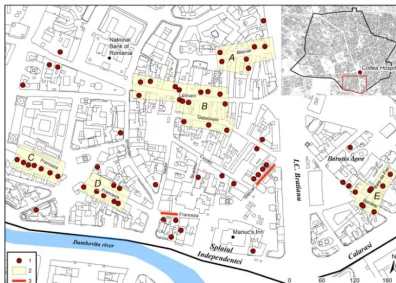
Figure 9.The anticipated spatial effects of building collapse in a similar earthquake to that of March, 1977. (1) Building in the first category of risk (R1); (2) Isolated areas resulting from the hypothesis that all buildings belonging to the R1 class would collapse; (3) Blocked street segments.
These potential blockages are most likely to occur in five areas, identified in Fig. 9 as A, B, C, D, and E. Area A (Bl˘a-nari area) is small and delimited by building no. 2 (built in 1865, three floors) and the buildings from no. 9 (1880, five floors) to no. 14 (1935, six floors). Area B (Lipscani– Gabroveni area) is the largest site and contains a group of 15 vulnerable buildings. Possible street blockages could be pro-duced by the collapse of buildings on Lipscani Street, such as no. 26 (1864, five floors) or no. 29 (1934, nine floors) along with no. 76 (1906, four floors), and on Gabroveni Street, such as buildings no. 2 (1940, nine floors) and no. 12 (1924, six floors). Two other areas, C and D, are respectively located on Francez˘a Street between buildings no. 6 (1869, five floors) and no. 22 (1900, six floors), and between buildings no. 30 (1870, five floors) and no. 42 (1870, five floors). On the west side of the main boulevard, Bulevardul Ion C. Br˘atianu, area E (B˘ar˘a¸tiei) contains building no. 8 on Baia de Fier Street (1930, five floors) and buildings no. 37 (1870, three floors) and no. 50 (1824, four floors) on B˘ar˘a¸tiei Street.
A final consideration is that, for much of the day, the core of the historic centre normally contains between 1000 and 5000 visitors in addition to the area’s residents and workers. This only adds to the need to devise proactive earthquake intervention and mitigation strategies.
We therefore suggest the following proactive measures to mitigate the risks associated with a seismic disaster in the city of Bucharest, especially within the core of the city’s historic centre:
– the constitution of a technical team of decision makers to identify optimal response strategies for a future earth-quake, whose main task would be to identify the critical points and areas for emergency intervention in the most congested areas (Tuns et al., 2013);
– the prioritization of building consolidation, correlated with the buildings’ locations and their potential to block street segments and critical access routes in the event of their collapse;
– the re-evaluation of the number and locations of fire sta-tions;
– the development of a system of emergency medical aid posts within the historic centre, taking into account both the area’s access problems and the fluctuating popula-tion of the area resulting from its entertainment role; – reorganization of Col¸tea Hospital, including the
hos-pital should become the most important point of emer-gency intervention in the historic centre of Bucharest in the event of a strong earthquake.
6 Conclusions
This study demonstrates that GIS can be used effectively as an analytical and decision-making tool in planning for hazard mitigation. GIS, when properly employed, can provide infor-mation concerning emergency response accessibility in areas where physical structures are degraded and pose a higher risk of collapse. Such knowledge is critical in anticipating the im-pact of a disaster. Injury, loss of life, and damage to property can be minimized through more effective and rapid emer-gency response.
In Europe, Bucharest ranks second, after Istanbul, in its exposure and risk related to earthquakes. It is not enough to be familiar with the distribution of the high-seismic-risk buildings. Emergency intervention is also vital to minimize the consequences of such an event. In order to save lives, knowledge of accessibility levels and related rapid interven-tion potential is essential in the event of an earthquake. How-ever, the current status and priorities of natural hazard and emergency response planning in the city of Bucharest (and at the national scale) are such that they are unlikely to mit-igate the effects of a potential disaster to a sufficient extent. Across several measures – the training of specialists, public awareness and education, infrastructural improvements, and building improvements – current efforts are inadequate.
The passivity of urban decision makers in relation to the very large number of buildings in the highest risk class is perhaps the most surprising element here. These buildings are concentrated in the most populated and attractive areas of the city in terms of leisure and entertainment. Even if Bucharest’s inhabitants are partially aware of this risk, the vast majority of tourists are unlikely to realize what could happen should an earthquake occur.
The most recent major disaster event that took place in Bucharest – the fire in Club Colectiv on the night of 30 Oc-tober 2015, which led to the deaths of 63 people and serious injury to around 150 – brought the major risk that an earth-quake can pose to the attention of the local and national au-thorities. In response, a ban was imposed on all shops, restau-rants, and clubs operating in buildings with high seismic risk, but there are not enough resources to refit the high-risk build-ings that continue to be inhabited. This event reminded the population and the authorities that an earthquake event or dis-aster of similar scale will occur again at some point and that it is necessary to have a clearly defined policy that relies upon concrete measures to reduce the human and material losses.
Our study reveals both the importance of accessibility to buildings for emergency intervention and the shortcomings in the current provision of major emergency response ser-vices. Our methodology, using simple tools, offers analysts
and decision makers a credible means of developing a proac-tive vision of and a management strategy for emergency re-sponse in congested historic areas. GIS is a commonly used tool for analyses of this type, and its results, since they can be expressed cartographically, can be more widely understood than is often the case when other statistical and computa-tional techniques are employed.
Data availability. Lists of technically tested buildings in terms of seismic risk are freely available at http://amccrs.pmb.ro/docs/Lista_ imobilelor_expertizate.pdf (last access: 15 October 2017, Munici-pality of Bucharest, 2017).
Competing interests. The authors declare that they have no conflict of interest.
Author contributions. CM and II designed the study. GM, CM, and II established and set up the maps. II, CM, RJ, GM, and GP anal-ysed and interpreted the results. II and CM wrote the paper with substantial input from all co-authors. RJ revised the English.
Acknowledgements. This work has been partially supported by the project UB 2008.
Edited by: Sven Fuchs
Reviewed by: two anonymous referees
References
Alexander, D.: Principles of emergency planning and management, Oxford, Oxford University Press, 2002.
Anhorn, J.: Nepal and the “Urban Resilience Utopia”, in: Ur-ban Disaster Resilience and Security, edited by: Fekete A. and Fiedrich, F., The Urban Book Series, Springer, 13–26, https://doi.org/10.1007/978-3-319-68606-6, 2018.
Ardeleanu, L., Leydecker, G., Bonjer, K.-P., Busche, H., Kaiser, D., and Schmitt, T.: Probabilistic seismic hazard map for Romania as a basis for a new building code, Nat. Hazards Earth Syst. Sci., 5, 679–684, https://doi.org/10.5194/nhess-5-679-2005, 2005. Arma¸s, I.: Earthquake perception in Bucharest, Romania,
Risk Anal., 26, 1223–1234, https://doi.org/10.1111/j.1539-6924.2006.00810.x, 2006.
Arma¸s, I. and Avram, E.: Patterns and trends in the perception of seismic risk. Case study: Bucharest Municipality/Romania, Nat. Hazards, 44, 147–161, https://doi.org/10.1007/s11069-007-9147-9, 2008.
Arma¸s, I.: Social vulnerability and seismic risk percep-tion. Case study: the historic centre of the Bucharest Municipality/Romania, Nat. Hazards, 47, 397–410, https://doi.org/10.1007/s11069-008-9229-3, 2008.
Arma¸s, I., Ionescu, R., Gavri¸s, A., and Toma-D˘anil˘a, D.: Identify-ing seismic vulnerability hotspots in Bucharest, Appl. Geogr., 77, 49–63, https://doi.org/10.1016/j.apgeog.2016.10.001, 2016. Atanasiu, G. M. and Toma, A.-M.: On seismic vulnerability
eval-uation in dense urban residential areas using spatial information system SIS, Proc. ASTR Annu. Conf. Acad. Tech. Sci. Rom., 114–121, Agir Publishing House, Bucharest, 2012.
Bakillah, M., Domínguez, J., Zipf, A., Liang, S. H. L., and Mostafavi, M. A.: Multi-agent evacuation simulation data model with social considerations for disaster management context, in: Intelligent systems for Crisis management, Geo-information for Disaster Management (Gi4DM), edited by: Zlatanova, S., Peters, R., Dilo, A., and Scholten, H., 3–18, Springer-Verlag, Berlin Hei-delberg, 2013.
Bala, A.: Quantitative modelling of seismic site amplification in an earthquake-endangered capital city: Bucharest, Romania, Nat. Hazards, 72, 1429–1445, https://doi.org/10.1007/s11069-013-0705-z, 2014.
Blandford, J. I., Kumar, S., Luo, W., and MacEachren, A. M.: It’s a long, long walk: accessibility to hospitals, maternity and inte-grated health centres in Niger, Int. J. Health Geogr., 11, 1–15, https://doi.org/10.1186/1476-072X-11-24, 2012.
Bo¸stenaru Dan, M. and Arma¸s, I.: Earthquake impact on settle-ments: the role of urban and structural morphology, Nat. Hazards Earth Syst. Sci., 15, 2283–2297, https://doi.org/10.5194/nhess-15-2283-2015, 2015.
Bo¸stenaru Dan, M., Arma¸s I., and Goretti, A.: Earthquake Hazard Impact and Urban Planning – An Introduction, in: Earthquake Hazard Impact and Urban Planning, edited by: Bo¸stenaru Dan, M., Arma¸s, I., and Goretti, A., 1–14, Springer, Dordrecht, Hei-delberg, New York, London, 2014.
Coffee, N., Turner, D., Clark, R. A., Eckert K., Coombe, D., Hugo, G., van Gaan D., Wilkinson, D., Stewar S., and Tonkin, A.: Measuring national accessibility to cardiac services using geographic information systems, Appl. Geogr., 34, 445–455, https://doi.org/10.1016/j.apgeog.2012.01.007, 2012.
Comerio, M. C.: Disaster Recovery and Community Renewal: Housing Approaches, Cityscape: A journal of Policy Develop-ment and Research, 16, 51–68, 2014.
Crowley, H., Colombi, M., Pinho, R., Meroni, F., and Cassera, A.: Application of a prioritisation scheme for seismic intervention in school buildings in Italy, in: 14th World Conf. Earthq. Eng. Beijing, China, 12–17, 2008.
Eshghi, K. and Larson, R. C.: Disasters: lessons from the past 105 years, Disaster Prev. Manag., 17, 62–82, 2008.
ESPON TRACC Project: Transport Accessibility at regional-local scale and patterns in Europe 2013, Applied Re-search 2013/1/10, Final Report, 274 pp., available at: https://www.espon.eu/sites/default/files/attachments/TRACC_ FR_Volume2_ScientificReport.pdf (last access: 3 March 2016), 2015.
ESPON GROSEE Project: Growth Poles in South-East Eu-rope Emergence of Growth Poles Network in South-East of Europe 2013, Applied Research 2013/2/19, Final Report-Scientific Report, 367 pp., available at: https://www.espon.eu/programme/projects/espon-2013/ targeted-analyses/grosee-growth-poles-south-east-europe, (last access: 12 May 2015), 2014.
Fekete, A. and Fiedrich, F.: Introduction to “Urban Disaster Re-silience and Security – Adressing Risks in Societies”, in: Ur-ban Disaster Resilience and Security, edited by: Fekete A. and Fiedrich F., The Urban Book Series, Springer, 1–12, https://doi.org/10.1007/978-3-319-68606-6_1, 2018.
Fiedrich, F.: An HLA-Based Multiagent System for Optimized Re-source Allocation After Strong Earthquakes, Proceedings of the 2006 Winter Simulation Conference, Monterey, CA, USA, 3– 6 December 2006, https://doi.org/10.1109/WSC.2006.323120, 2006.
Geis, D. E.: By design: the disaster resistant and qual-ity of life communqual-ity, Nat. Hazards Rev., 1, 151–160, https://doi.org/10.1061/(ASCE)1527-6988(2000)1:3(151), 2000.
Goretti, A., Vetta, S., Palmieri, F., Adamo, F., Berlingeri, M., and Palmieri, L.: The Urban System of Crotone, Italy, Facing the Earthquake Impact. in: Earthquake Hazard Impact and Urban Planning, edited by: Bo¸stenaru, D. M., Arma¸s, I., and Goretti, A., Springer, Dordrecht Heidelberg New York London, 151–170, 2014.
Graeme, H. and Aylward, R.: Using Geographical information sys-tem (GIS) to establish access to aged care residential services in non-metropolitan Australia, Proc. 5th Nat. Rural Health Conf., Adelaide, South Australia, available at: http://ruralhealth.org. au/PAPERS/5_gis.pdf\T1\textbackslash#F (last access: February 2016), 1999.
Grant, D. N., Bommer, J. J., Pinho, R., Michele Calvi, G., Goretti, A., and Meroni, F.: A Prioritization Scheme for Seismic Interven-tion in School Buildings in Italy, Earthq. Spectra, 23, 291–314, https://doi.org/10.1193/1.2722784, 2007.
Grasso, S. and Maugeri, M.: The road map for seismic risk analysis in a Mediterranean city, Soil Dyn. Earthq. Eng., 29, 1034–1045, https://doi.org/10.1016/j.soildyn.2008.12.001, 2009.
Ianos, I. and Cepoiu, L.: The importance of intraurban structures of the Romanian cities for crisis and emergency situations manage-ment, Rom. Rev. Polit. Geogr., 11, 19–29, 2009.
Ianos, I., Sîrodoev, I., Pascariu, G., and Henebry, G.: Di-vergent patterns of built-up urban space growth follow-ing post-socialist changes, Urban Stud., 53, 3172–3188, https://doi.org/10.1177/0042098015608568, 2016.
Ianos, I., Merciu, C., and Sorensen, A.: Incoherence of urban planning policy in Bucharest: Its potential for land use conflict, Land Use Pol., 60, 101–112, https://doi.org/10.1016/j.landusepol.2016.10.030, 2017. IGFCOT: Cadastral plan of Bucharest Municipality, Institute of
Geodesy, Photogrammetry, Cartography and Organization of Territory, 1974–1975.
Lu, Y. and Xu, J.: The progress of emergency response and rescue in China: A comparative analysis of Wenchuan and Lushan earthquakes, Nat. Hazards, 74, 421–444, https://doi.org/10.1007/s11069-014-1191-7, 2014.
Lungu, D., Aldea, A., Arion, C., and Baur, M.: Vulnerability of ex-isting building stock in Bucharest, Proc. 6th Intern. Conf. Seis-mic Zonation, Palm Springs, California, 12–15 November 2000, 837–846, 2000.
M˘armureanu, G., Cioflan, C. O., and M˘armureanu, A.: Inten-sity seismic hazard map of Romania by probabilistic and (neo)deterministic approaches, linear and nonlinear analyses, Rom. Rep. Phys., 63, 226–239, 2011.
Mäntyniemi, P., Mârza, V. I., Kijko, A., and Retief, P.: A new probabilistic seismic hazard analysis for the Vrancea (Romania) seismogenic zone, Nat. Hazards, 29, 371–385, https://doi.org/10.1023/A:1024787621646, 2003.
Momani, N. M. and Salmi, A.: Preparedness of schools in the province of Jeddah to deal with earth-quakes risks, Disaster Prev. Manag., 21, 463–473, https://doi.org/10.1108/09653561211256161, 2012.
Municipality of Bucharest: Lists of technically tested buildings in terms of seismic risk, Municipal Administration for Consolida-tion of Seismic Risk Buildings, Municipality of Bucharest, avail-able at: http://amccrs.pmb.ro/docs/Lista_imobilelor_expertizate. pdf, last access: 15 October 2017.
Naphtali, Z. S.: Delivering health-care services to an urban popula-tion, in: GIS for urban environment, edited by: Maantay J. and Ziegler, J., ESRI Press, Redlands, California, 341–347, 2006. Noto, G.: Combining system dynamics and performance
manage-ment to support sustainable urban transportation planning, J. Ur-ban Reg. Analysis, IX, 51–71, 2017.
Nushi, B. and van Loenen, B.: The STIG: Framework for the stress-test for infrastructures of geographical information, in: Intelli-gent systems for Crisis management, Geo-information for Disas-ter Management (Gi4DM), edited by: Zlatanova, S., PeDisas-ters, R., Dilo, A., and Scholten, H., Springer-Verlag, Berlin, Heidelberg, 289–298, https://doi.org/10.1007/978-3-642-33218-0_20, 2013. O’Sullivan, D., Morrison, A., and Shearer, J.: Using desktop
GIS for the investigation of accessibility by public transport: an isochrones approach, Int. J. Geogr. Inf. Sci., 14, 85–104, https://doi.org/10.1080/136588100240976, 2000.
Panahi, M., Rezaie, F., and Meshkani, S. A.: Seismic vulnera-bility assessment of school buildings in Tehran city based on AHP and GIS, Nat. Hazards Earth Syst. Sci., 14, 969–979, https://doi.org/10.5194/nhess-14-969-2014, 2014.
Parker, E. B. and Campbell, J.L.: Measuring access to pri-mary medical care: some examples of the use of geo-graphical information systems, Health Place, 4, 183–193, https://doi.org/10.1016/S1353-8292(98)00010-0, 1998. Pavel, F., V˘ac˘areanu, R., Ionescu, C., Iancovici, M., and
¸Ser-c˘aianu, M.: Investigation of the variability of strong ground mo-tions from Vrancea earthquakes, Nat. Hazards, 74, 1707–1728, https://doi.org/10.1007/s11069-014-1273-6, 2014.
Pavel, F. and V˘ac˘areanu, R.: Assesment of the ground motion levels for the Vrancea (Romania), November 1940 earthquake, Nat. Hazards, 78, 1469–1480, https://doi.org/10.1007/s11069-014-1273-6, 2015.
Pollino, M., della Rocca, A. B., Fattoruso G., La Porta L., Lo Curzio S., Arolchi A., James, V., and Pascale, C.: Open Source GIS tools to map earthquake damage scenarios and to support emergency. GEOProcessing: The 4th Intern. Conf. Adv. Geogr. Infor. Sys., Appl. Serv., 152–157, 2012.
Pessina, V. and Meroni, F.: A Web GIS tool for seismic hazard sce-narios and risk analysis, Soil Dyn. Earthq. Eng., 29, 1274–1281, https://doi.org/10.1016/j.soildyn.2009.03.001, 2009.
Raffaelle, D., Mezzina, M., and Tosto, A.: Instructions overview on the regional scale analysis of school buildings in Puglia
(Italy), in: ECCOMAS Thematic Conf. Comp. Meth. Struct. Dyn. Earthq. Eng., edited by: Papadrakakis, M., Papadopoulos, V., and Plevris, V., https://doi.org/10.7712/120113.4801.C1239, 2014.
Rufat, S.: Transition post-socialiste et vulnerabilité urbaine à Bu-carest, University of Bucharest Publishing House, Bucharest, 2011.
Rufat, S.: Spectroscopy of urban vulnerabil-ity, Ann. Assoc. Am. Geogr., 103, 505–525, https://doi.org/10.1080/00045608.2012.702485, 2013.
Salvati, L.: Urban growth and the spatial structure of a changing region: an integrated assessment, J. Urban Reg. Analysis, 6, 5– 14, 2014.
Schweier, C. and Markus, M.: Classification of collapsed buildings for fast damage and loss Assessment, B. Earthq. Eng., 4, 177– 192, https://doi.org/10.1007/s10518-006-9005-2, 2006. Sinha, R., Aditya, K. S. P., and Gupta, A.: GIS-based urban seismic
risk assessment using risk, J. Earthq. Tech., 45, 41–63, 2008. Sotoudehnia, F. and Comber, L.: Measuring perceived
ac-cessibility to urban green space: an integration of GIS and participatory map, in: Proc. 14th AGILE Conf. Ge-ogr. Inf.: Adv. Geoinf. Sci. Changing World, available at: https://agile-online.org/conference_paper/cds/agile_2011/ contents/pdf/shortpapers/sp_148.pdf (last access: 2 December 2016), 2011.
Svensson, J.: Accessibility in urban areas for citizens with impair-ments: using GIS to map and measure accessibility in Swedish cities, in: Universal Design: emerging research and develop-ments, edited by: Maisel, J. L., Bentham Publishing House, New York, 122–131, 2010.
Tatevossian, R. and Albini, P.: Information background of 11th-15th centuries earthquakes located by the current cat-alogues in Vrancea (Romania), Nat. Hazards, 53, 575–604, https://doi.org/10.1007/s11069-009-9448-2, 2010.
Toma-D˘anil˘a, D.: Transport network vulnerability assessment methodology, based on the cost-distance method and GIS In-tegration, in: Intelligent systems for Crisis management. Geo-information for Disaster Management (Gi4DM), edited by: Zla-tanova, S., Peters, R., Dilo, A., and Scholten, H., Springer-Verlag, Berlin, Heidelberg, 199–213, 2013.
Török, I.: Assessment of Social Vulnerability to Natural Hazards in Romania, Carpath. J. Earth Env., 12, 549–562, 2017.
Tuns, I., T˘ama¸s, F.-L., and Pa¸scan, V.: Structural analysis of an ex-isting building on the fulfilment of level of assurance to seismic actions, J. Appl. Eng. Sci., 16, 109–116, 2013.
Vatseva, R., Solakov, D., Tcherkezona, E., Simeonova, S., and Trifonova, P.: Applying GIS in seismic hazard assessment and data integration for disaster management, in: Intelligent systems for Crisis management. Geo-information for Disaster Manage-ment (Gi4DM), edited by: Zlatanova, S., Peters, R., Dilo, A., and Scholten, H., Springer-Verlag, Berlin, Heidelberg, 171–183, 2013.
Waugh, Jr. W. L. and Streib, G.: Collaboration and leadership for effective emergency management, Public Adm. Rev., 66, 131– 140, 2006.
Wegscheider, S., Schneiderhan, T., Mager, A., Zwenzner, H., Post, J., and Strunz, G.: Rapid mapping in support of emergency response after earthquake events. Nat. Hazards, 68, 181–195, https://doi.org/10.1007/s11069-013-0589-y, 2013.
Weiping, H. and Chi, W.: Urban road network accessibility evalua-tion method based on GIS spatial analysis techniques, in: Proc. Int. Arch. Photogr., Remote Sens. Spat. Inf. Sci. Conf., 38, 114– 117, 2011.
Wiens, M., Schatter, F., Zobel C. W., and Schultmann, F.: Ur-ban Disaster Resilience and Security, edited by: Fekete A. and Fiedrich, F., The Urban Book Series, Springer, 145–168, https://doi.org/10.1007/978-3-319-68606-6, 2018.