Vocational Education Development in a
Work-Based Learning Programme
Submitted in partial fulfillment of the requirements
for the degree of
Doctor of Education
School of Education
Faculty of Human Development
Victoria University.
By
Mallika Modrakee
B.A., (The University of the Thai Chamber of Commerce)
M.A., (National University, San Diego)
DECLARATION
I formally declare that unless otherwise stated, the work presented is my own work and has not been submitted previously in whole or part for any other academic award. The work submitted is less than 60,000 words.
ACKNOWLEDGMENTS
Writing a doctoral dissertation requires not only academic rigour, and dogged
determination, but the support of many individuals. I would like to show appreciation therefore, to all those who were there to guide me through this process, and to give me words of encouragement, which greatly motivated and fortified me through stressful moments.
Above all, Dr David Maunders, my advisor, deserves very special recognition for directing me through this study. His advice and commitment has sustained me throughout. I am so grateful for his step-by-step support through the dissertation journey.
My gratitude also to my co-advisor Dr Somyot Jedjaroenruk, who has played an important part in my progress, always being helpful, and giving wise counsel. Very special thanks to Dr Margaret Malloch, who was so kind and helpful
at the initial stages of my research, and Dr Jill Sanguinetti also, who made a valuable, and constructive contribution.
In addition, I thank my colleagues at school who have made such an important
contribution to the study, especially my assistant Orawan, who has helped me with the collection of the research material, and word-processing, and Tim Waite, who has assisted me with my English.
To my parents, Nikom and Kanjana, and my sister, Pavena, I am so grateful for their encouragement over the past four years. To my dear friend Jiraporn, a very special thank you for her reassurance and friendship. Finally to my husband, Yongyuth, my thanks for all your support and understanding.
TABLE OF CONTENTS
Page
Declaration……….………...i
Acknowledgements………..ii
Table of contents………..………..iii
List of figures………vii
List of tables……….………..ix
List of abbreviations………..…….x
Abstract………..…xi
C H A P T E R 1 INTRODUCTION.………...…….1
Background……….1
Vocational education in Thailand ………...………..….4
The context of the study………...………...…...7
T h e w o r k - b a s e d l e a r n i n g p r o g r a m m e a t A k s o r n S c h o o l of Technology Pattaya……….….10
2 LITERATURE REVIEW……….12
Introduction………...12
Status of vocational schools in Thailand………...13
Theoretical foundations of work-based learning………...16
Context and background to work-based Learning……….21
Reservations about work-based learning………...28
Work-based learning to acquire workplace competency………...31
The benefits of work-based learning……….36
Examples of work-based learning programmes………....39
How action research is appropriate methodology for a work-based learning programme………..…42
Conclusions from what the literature review has shown………….…….46
3 METHODOLOGY.……….….49
Context……….49
Student sample to be studied………53
Data collection……….….53
Data analysis……….……54
Action research cycles……….….55
Cycle 1……….….57
Cycle 2……….….67
4 SCHOOL-BASED PRACTICAL PROGRAMME FOR GROUP 1..………...76
Student views of work-based learning prior to practical activities……...76
W o r k - b a s e d l e a r n i n g p r o g r a m m e o n c a m p u s (School-based preparation)………...…81
Student assessment of the practical experience………....89
Reflection……….….93
5 WORK PLACEMENT PROGRAMME ARRANGEMENTS AND FORMAT FOR GROUP 1………96
Context……….….96
Orientation and induction……….…97
The placement experience……… 100
Page
Reflection………..………...136
6 SCHOOL-BASED PRACTICAL PROGRAMME FOR GROUP 2…………...141
Student views of work-based learning prior to practical activities….….141 School based practical programme………..144
Week 1……….150
Weeks 2 and 3………..154
Week 4……….155
Reflection……….165
7. WORK PLACEMENT PROGRAMME ARRANGEMENTS AND FORMAT FOR GROUP 2…..……….………...………...168
Context……….…168
Orientation and induction………169
The placement experience………...172
Student views of the work-based learning programme after the practical experience……….………..194
Reflections……….………...197
8. CONCLUSIONS……….……….202
Implication from the results of the research…….………...…202
Summary of findings……….………..203
Conclusion……….……….….205
Future considerations/ recommendations………….………...…206
Further work-based learning programme development….…………...207
Work-based learning and professional development…….…………...215
Page
References……….…..……...……..217
A p p e n d i x
A Student’s open-ended questions………...242 B Student journal……….244 C Teacher and supervisor assessment (observation form)…….………...………..246
LIST OF FIGURES
Figure Page
1 Clusters of key generic skills……….…….…… 33
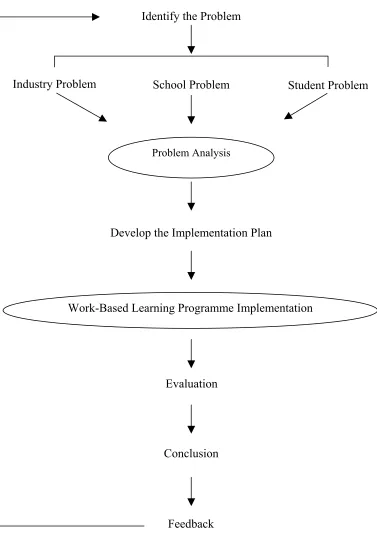
2 Action research cycle of Work-Based Learning Programme……….……… 55
3 The process of Work-Based Learning Development……….……… 56
Group 1
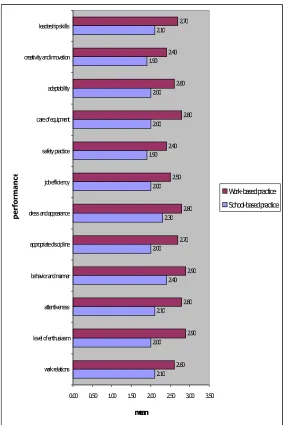
4 Means of student performance at school
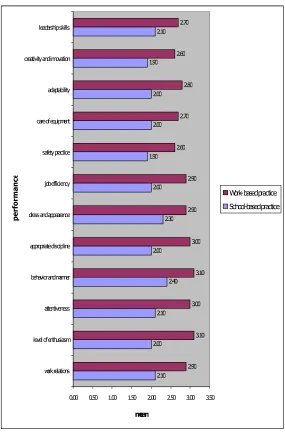
and Banglamung Electric Authority ……….…….….….. 103
5 Means of student performance at school
and Banglamung Electric Authority (contractor)………..……..….. 109
6 Means of student performance at school
and Sophon Cable Television Company………...………….. 116
7 Means of student performance at school
and A and Air service (Banglamung Electric Authority contractor)……….. 122
8 Means of student performance at school and Sahamit Air
Figure Page
Group 2
9 Means of student performance at school
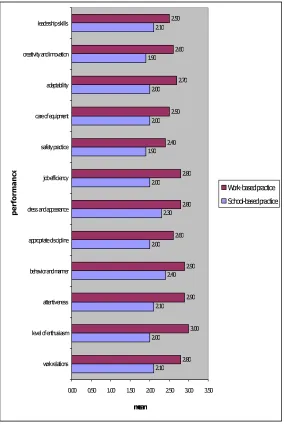
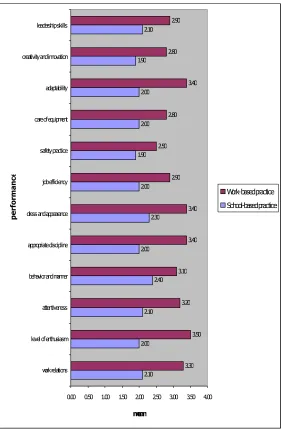
and Banglamung Electric Authority……….. 180
10 Means of student performance at school
and Sophon Cable Television Company ...……… 191
11 Three dimensions of ACE pedagogy………. 213
LIST OF TABLES
Table Page
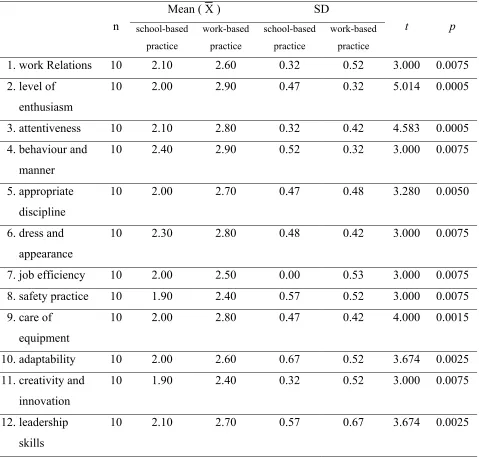
1 Twelve performance criteria between school-based practice
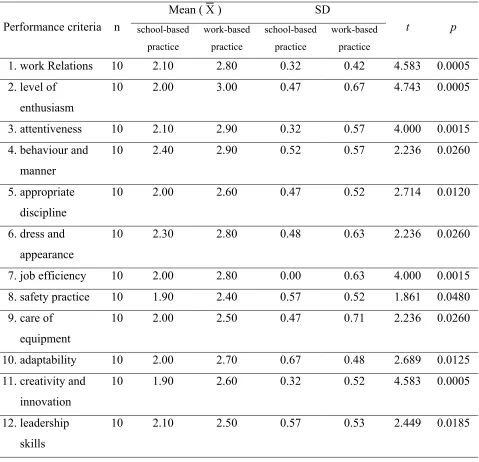
and work-based practice at Banglamung Electric Authority……….…………. 105
2 Twelve performance criteria between school-based practice
and work-based practice at Banglamung Electric Authority (contractor)...…… 111
3 Twelve performance criteria between school-based practice
and work-based practice at Sophon Cable Television Company………. 118
4 Twelve performance criteria between school-based practice and work-based practice at A and Air service
(Banglamung Electric Authority contractor)……….….. 124
5 Twelve performance criteria between school-based practice and work-based practice at Sahamit Air Cooling Service
(Banglamung Electric Authority contractor)………..…………. 130
6 Twelve performance criteria between school-based practice
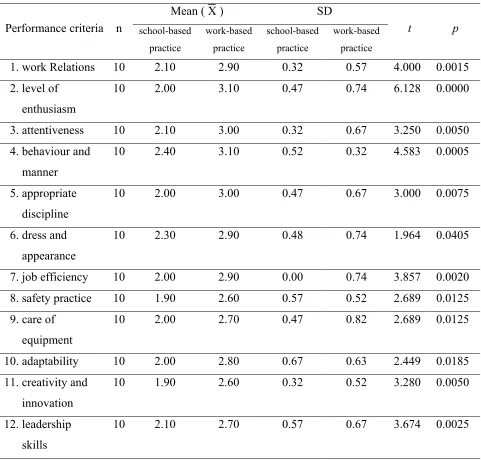
and work-based practice at Banglamung Electric Authority………...…… 182
7 Twelve performance criteria between school-based practice
LIST OF ABBREVIATIONS
CBI Confederation of British Industry DfES Department of Education and Skills DOVE Department of Vocational Education HMIE Her Majesty’s Inspectorate of Education
HMI-OFSTED Her Majesty’s Inspectorate, Office for Standards in Education IMD The International Institute for Management Development MOE Ministry of Education
NCVER National Council for Vocational Education Research NSO National Statistical Office
OEC Office of the Education Council
OECD Organisation for Economic Co-operation and Development ONEC Office of National Education Commission
PISA Program for International Student Assessment
SCANS Secretary’s Commission on Achieving Necessary Skills
ABSTRACT
VOCATIONAL EDUCATION DEVELOPMENT IN
A WORK-BASED LEARNING PROGRAMMEThis study is an action research investigation to develop a work-based learning programme for vocational students at Aksorn School of Technology Pattaya,
Thailand. Historically, vocational education has been primarily school-based with the emphasis on teacher-led instruction and scant workplace experience. This resulted in major weaknesses in student preparation and readiness for the work environment. The aim of this study was to install a work-based learning programme to give students better preparation for the workplace, and give them contextual experience of work practice through work placements, and then evaluate the outcomes of the experience. By providing students with greater practical exposure to the workplace culture and conditions, the study endeavoured to foster skills, competencies, and a mindset suitable for the world of work.
The project was overseen by a committee of stakeholders, and facilitated by the researcher. The study followed two cohorts of ten students over two action research cycles of three months each. Data were collected via student focus groups,
CHAPTER 1
INTRODUCTION
1.1 Background
Since the early 1980s, Thailand has seen a progressive transformation in its growth and development from an agriculture-based economy to a burgeoning industrial market-driven economy. This transformation and new direction in economic growth has demanded a change in the types of human resource and capabilities needed. Moreover, many commentators agree that the economic crisis which hit Thailand in 1997, was exacerbated by Thailand’s frail human capital resource (ONEC, 2003). There has been a marked decline in skills proficiency in recent years, especially in science and technology.
Education, especially vocational education, can perform a vitally important function in the restructuring process and the country’s economic development. It can make a significant contribution to the creation of a skilled workforce by producing the manpower to serve the labour market demand and encourage continuing tertiary education in the technical and scientific fields.
The vocational system in Thailand has played an important role producing middle level manpower to fulfil the actual need of the labour market, and the development of the country. However, vocational education has been criticised for not providing a sufficient theoretical foundation for graduates to continue learning and adapting throughout their working lives. For some time, an inflexible and rigid learning environment has been identified as a major cause of the failure to meet the private sector’s employment requirements.
In recent years, administrators in the vocational education field have worked hard to overcome the stigma that has long branded vocational education as inferior to traditional academic curricula (MOE, 2002). In fact, many vocational programmes have evolved to blend strong academic knowledge with cutting-edge technical and career skills. Pure academic education, on the other hand, seems irrelevant or incomprehensible to many students. Combining the two may improve students’ academic performance and develop work-related capabilities at the same time. They will have not only the necessary academic background, but also a better understanding of how their schooling relates to a desired career.
Vocational education by itself is also inadequate, because it does not equip students to apply their abstract knowledge or to learn in the context of practical problem-solving.
Employees must now have competencies in the new technologies, higher levels of knowledge and self-learning abilities. To meet the new challenge educators, politicians and administrators all agree that the current Thai education and teaching system needs significant reform to help re-establish Thailand’s competitiveness in the global economy.
In response to the perceived failure of traditional education and training to prepare students for more learning-intensive work, the government implemented the
quality of life for all. Moreover, it pledged “to improve education to be in harmony with economic and social change” (ONEC, 2002a).
Article 20 of the 1999 Education Act stipulates that occupational training should be provided for educational institutions belonging to the state or the private sector and affiliates, organised through co-operation with educational institutions and enterprises to meet the National Education Act requirements.
However, according to the Ministry of Education publication Education in Thailand 2004 “ the number of students wishing to enter vocational education in both state and private educational institutions has significantly and constantly decreased for several years, from 585,166 in 1999 to 571,267 in 2003, despite an increasing demand for skilled labour”(OEC, 2004).
The need for educational reform can be rationalised in the contexts of national and international developments. Internationally, communities are changing from industry-based to knowledge-industry-based societies where the assimilation and distribution of
information plays an increasingly important role in individual and community development. It is axiomatic, therefore, to develop an education model, which will encourage and promote knowledge-based learning, communication skills and life-long learning. Global experience shows that changing practices in education depends on the whole system, from the state down and not just in the classroom.
According to the present National Scheme of Education BE 2542, vocational education aims to enable learners to develop vocational knowledge and skills useful for working both as entrepreneurs and as paid workers (ONEC, 1999). Moreover, in order to meet the requirements, the National Education Act will serve as the
ONEC (1999) suggests that it should focus on educational management at the vocational education school, as it is responsible to ensure the development of three major qualities in its students. They must have knowledge and understanding, vocational skill, and a positive attitude.
The Thai education system is currently in the process of radical and comprehensive reforms, and all elements in the system are involved. Furthermore, it is planned that the Ministry of Education (MOE), after the re-organisation of the administrative structure will de-centralise the public educational administration and management to local organisations, and education institutions (ONEC, 2002a). It must be hoped that the de-regulation and increase in autonomy of local organisations will bring
flexibility and fresh ideas. For what is now required is a properly integrated and controlled school programme to link educational establishments and industry. Of paramount importance will be the focus on appropriate work experiences for students.
1.2 Vocational education in Thailand
The learner-centred perspective is at the core of the Thai education reform and placing the learner at the hub of the learning process has been a central tenet of the
programme (ONEC, 1999). From my own experience in the past there have been work placements where vocational students have been seconded to various
commercial organisations. These experiences, however, were not properly integrated, and the students had no induction and orientation at school prior to the work
placement. The students often complained that the placement had no bearing on the vocational subject they were studying at school and found the employer was often unprepared for their secondment and would give out menial and irrelevant jobs for the students to undertake. This resulted in dissatisfaction all-round. The employers had a poor perception of student placements and the students felt they were exploited, or not taken seriously by the employers.
It was within this context that we had to re-build employer confidence and
commitment to the work-based learning programme, and re-establish the merit and future benefits of the scheme to ensure a cohesive and coherent programme.
In Thailand, the research into work-based learning initiatives is very limited and there is a paucity of significant legitimate data. One of the key objectives my study in Thailand attempted to achieve was to foster student accountability and responsibility in the workplace.
One initiative is on record, however. In 1988 the Department of Vocational Education (DOVE) formed an alliance with the German government to solve the problem of inadequate student skills which were not compatible to industry’s requirements. Dual vocational training, based on the German system was
learning in the real setting. Details of the German system are outlined in Chapter 2, pages 14-15.
The trainees enrolled with a technical or vocational school where they were taught theory-oriented vocational subjects as a foundation for the occupation they wished to pursue. They spent two days a week normally at school and the remainder with the work provider. The programme was installed in numerous state vocational schools throughout Thailand. Although the scheme has been in operation for many years, there have been difficulties in the execution, mainly through lack of a support structure and lack of integration and cohesion among the stakeholders involved.
All programmes are in the development stage, and have been organised
independently. Many universities and vocational schools wanted to launch their own programme. They realised it was a significant method to develop their own
organisation and professional development. However, it was very difficult for other schools to implement their own programme because of lack of information models, and an absence of direction from central government.
Thus, the present status of vocational education is not encouraging. The need to produce the right skills for work is widely recognised, but the practical
implementation is more problematic. There is a major gap between what the schools are producing in terms of students’ all-round abilities, and skills and what employers demand.
Furthermore, stronger bonds between school and work must be tied and all educators realise the importance of experienced-based learning as the best way to help graduates make the transition from school to work.
It is now a matter of urgency and expediency that Thailand reforms its vocational education practices to ensure the future workforce is competent and skilled to
1.3 The context of the study
I am the Administration Manager at Aksorn School of Technology Pattaya, which is a private full-time vocational school. There are currently 401 private institutions, with 380,767 students enrolled and 412 public institutions with 817,100 students enrolled at vocational and high vocational levels accredited by the Ministry of Education (OEC, 2004). The students have to study for 3 years for the vocational certificate. Students on the higher vocational certificate programme enter at eighteen and study for 2 further years for the higher vocational certificate. I have long been conscious of the deficiencies and shortfalls in our system to prepare students for the job market. Our procedures and teaching methods have followed the same format and dogma for a century without regard to the rapidly changing world about us. In the future I am determined that the education we are providing should give the best possible learning facility to enable the students to fulfil their ambitions and aspirations, and give them comprehensive preparation for their careers. Work-based learning can be used as an instrument to overcome vocational student problems, and can facilitate continuous learning in the context of work. A logical implication for initial education and
training is that schools should give students some experience in work-based learning. By gaining practice in the deliberate use of work to develop knowledge and skill, students can be better prepared for a lifetime of learning at work.
Previously, vocational education in Thailand focused on teacher-led instruction in the classroom although vocational education differs from secondary education because it concentrates more on vocational pathways by having a curriculum to link to specific occupations. However, it is still bound by the old traditional methods with an
Traditional teaching methods are often a barrier to graduates wanting to apply contextual knowledge in a practical context (Resnick, 1987). Academic and
vocational education using traditional methods, therefore, has limitations and will not serve students well in the longterm. The students have played a passive, and
subservient role. There has been little attention paid to the needs of the workplace and the skills required by employers today and in the future. The educational reforms in train, and planned, as discussed, are shaped to address the teaching methods and the training strategy needed to produce a change in attitude and perception from students, teachers, and the wider community.
We have an obligation to the community, and also to support the Education Act requirement, by ensuring our students are responsible and productive members of their community. Our school is located in East Thailand, and the near environs include the Eastern Seaboard port, where many diverse industries are situated. Pattaya City is a renowned tourist resort, with a huge employment market, covering many job areas. There is a constant demand for the school to provide a wide range of quality employees.
However, from previous experiences we have had difficulties with student outcomes. There have been many obstacles with the work experience programme that was part of the normal curriculum. Furthermore, the school often received adverse comments from employers about under qualified graduates.
Vocational schools at least have some work experience built into the curriculum which gives students an opportunity to get someworkplace experience to practice the concepts they are studying. They are required to experience at least 380 mandatory hours of work in an industry. However, the placements lacked planning and
supervision. There was little co-ordination between the school and workplace.
Further problems were experienced with the quality of the students to manage the rate of technological change, which meant the designation of work became more
It was seen that the work experiences the students engaged in previously were not properly co-ordinated and organised and often resulted in them carrying out menial tasks which had no relevance to their school vocational course. The students as a result became disillusioned and apathetic, with poor self-esteem, and ill-prepared for the workplace. For these reasons, I wanted to construct a programme, which could bring about radical change and reform in my school and provide a study platform which could serve as a research model for future programmes.
Prior to the commencement of the programme, a seminar was held to debate and analyse the issues which we needed to address. All stakeholders were present, including representatives from the local employers.
Some of the negative comments were as follows:
Students
-
The students’ lack basic generic skills and a code of conduct for behaving properly at the workplace.
- The students lack motivation and do not have any appreciation of a career path.
- There is a problem of incompatibility between what they are taught at school and what industry requires from them.
Teachers
- Teachers lack hands-on experience with the latest technology.
- Teachers have not had experience of the work site. Most have only taught in the school environment.
Trainers from industry.
- Trainers do not have teaching skill techniques.
- Trainers do not understand the nature of students.
- Trainers do not understand the ethos of the school.
- Trainers do not appreciate the routine content of the class and what to teach.
1.4 The work-based learning programme at Aksorn School of
Technology Pattaya
In February 2003, the school initiated a work-based learning programme for preparing the students for the workplace in accordance with the objective of the National
Education Act. We used work-based learning as the core strategy to support school development.
The purpose therefore of this study was to evaluate the effects of running a work- based learning programme in a vocational school to produce the following outcomes:
- Increase motivation overall in students in order to change attitude and perceptions to prepare for their future career.
- Increase the students’ technical and academic competencies and enhance their employability opportunities to meet global demands.
This study focuses on important characteristics of learning situations in the work environment that use work-based learning as a key strategy to develop vocational students. Work-based learning also provided the experience in school-based
instruction to help students to be prepared to enter the workplace. It is hoped that this enquiry will serve as a significant contribution to the local community, and will act as a research foundation upon which we can build knowledge for the future. An
appropriately skilled, globally competitive workforce, is what we are aspiring to and the workplace must look to us as partners in this aspiration.
CHAPTER 2
LITERATURE REVIEW
2.1 Introduction
In Thailand there has been very little research conducted into the effects of vocational education and its function in preparing students for work. However, reports have shown that vocational students have had scant preparation for their roles in the working environment (ONEC, 2002b). It has affected all sectors of the nation’s workforce. The impact of new technology and competition as a result of the global economy has left many young job seekers without the necessary workplace skills and training required. It is widely acknowledged in the current job market that aspiring entrants need to continually adjust and adapt to the ever-changing conditions. There is an urgent need for more contextual preparation, through work-based learning.
According to the Ministry of Education’s goal, what vocational education inThailand requires is a radical vision to link schools to business and industry and provide the channels for a mutual flow of information (ONEC, 2002b). More recently, and as part of the initial responses of nations to the changing contexts of work, vocational
education has been re-conceptualised as a process more closely linked to human resourcedevelopment.
It is important to establish the context and climate in which the enquiry was conducted, and therefore a brief review of vocational education and training in Thailand is given. An appreciation of work-based learning and its history is outlined to put into perspective the historical relevance of the concept. The review looks at the importance of placements with work providers, and illustrates some studies from which to draw inferences. A rationale for the action research methodology is
explained, and finally conclusions are given as to how the research review has helped put into context the reasons and warranty of the enquiry.
2.2 Status of vocational schools in Thailand
There are many vocational institutions that provide work placements as part of the curriculum and students attend workplaces for a period of supervised participation in work activities. Students can gain access to knowledge about the world of work and industry can have input and influence on what is taught at school before coming to the workplace.
Currently there are over 800 public and private institutions providing formal and informal VET programmes, and over 1 million participants in the programmes (OEC, 2004). In June 2003, The Education Reform Committee of ONEC recognised three priority areas:
• Re-orienting
• Re-organising and
• Re-financing and re-mobilising of resources
Thailand’s Competitiveness
Statistical Office Labour Force Survey for 2004 (NSO, 2004) over 60% of the workforce attained only primary education or lower. Of particular concern is
Thailand’s performance compared with other countries in basic education. The OECD Programme for International Student Assessment (PISA) found Thailand had
problems in its reading performance (OECD, 2004) and under-performed compared to other OECD countries in Science and Problem- solving (OECD, 2004).
The incidence and importance of work experience in vocational education is growing, in the amount of learning time, didactic elaboration and importance in the curriculum. The standards are improving, but some anomalies remain. The integration between learning in and out of school seems very difficult, if only because school is discarded in student consciousness as soon as the student is in the workplace (MOE, 2002). Conversely, schools have difficulties disseminating what was learned in the
workplace and relating it to the school curriculum. Systematic reflection is difficult to arrange (MOE, 2001). At the same time critical remarks remain the same over the years. The main reason for this is not the absence of models or templates but the actual gap between learning in school and in the workplace (ONEC, 2001b). The advance of new approaches and competence-oriented didactic concepts could be a promising way to narrow the gap.
Many new initiatives have been launched at university and vocational school level to give students practical experience of the work site. One example is the Co-operative Education work-based learning programme initiated by Suranaree
University. The programme was launched in 1996, and enabled students in their last two years of study to experience the workplace on a paid industry placement. The concept was to provide students with real experiences, where they could develop skills in thinking, observation and decision-making, and deal with problem-solving, which they would not encounter in the normal classroom environment (Jinjid, 2002).
For example, an association was formed between Daimler Chrysler (Thailand) Ltd., and Samut Prathan Technical College in Bangkok to operate a training centre facility at Daimler Chrysler’s plant. The students in the scheme spent a day and a half at school, and the remaining time at the training centre or out at the dealerships getting on-the-job training. The idea was to replicate as far as practical the system used by the company in Germany (Northern Vocational Inspectorate Chiang Mai, 2000).
A summary of the Dual Vocational Training (1995-1997) concluded that the
curriculum was not relevant to the workplace practice, because the school and work providers were not co-ordinating the programme to produce and develop a cohesive and practical plan. This resulted in an inappropriate curriculum for the workplace. The Ministry of Education reported that an obstacle to the dual system was the quality of the trainers in the workplace and the standard of the students who were under-qualified (DOVE, 1998a). This view was supported by Kasipar (1995) who, in a study of the training needs of technicians and engineers, concluded that the training of appropriately skilled teachers was paramount.
Deewoon (1999), in a study of problems in dual vocational training by vocational college administrators and industrial executives, found that the students lacked maturity, fundamental skills and responsibility, whilst Suriya’s enquiry (1996) about training for technical students revealed deficiencies in ability due to the disparity in equipment between school and work. Sripongwiwat (1998) however, in her study about student assessment at the workplace found that the lack of cohesion and
understanding between work providers and school made the provision for assessment very difficult to co-ordinate.
develop a Thai Vocational Qualifications Framework (British Council, 2001). Kasipar (2003), who has worked with the British Council proposed:
Learning now and in the future must be self-learning by using ICT,
and face-to-face systems. Learning in the future should be learned by three modes:
1. Learning in the school system
2. Learning outside system at work (work-based learning) 3. Learning authentically: life skills and other skills.
2.3 Theoretical foundations of work-based learning
Over the last twenty years educational researchers have been persuaded that learning in context is more effective than traditional methods and it is argued that an active, experiential learning approach is a potent formula to motivate effective school to work transition programmes.
Vocational studies have found that practical hands-on activity is the most effective way of learning, and from our limited experience we have found students react more favourably to contextual learning (Mitchell, Henry and Young, 2001). They need exposure to the real world to give them time to learn at their own pace. Vocational students in work-based learning programmes need to be oriented and encouraged towards self-learning to change student perceptions of learning and inspire them to think about the important link between school and work. Work-based learning theory has many facets, which can be used to enrich and develop their organisation and themselves (Mitchell, Henry and Young, 2001).
Work-based learning as a learning environment
is involved in real work, gives the students an opportunity to experience authentic activities to apply skills learned at school and the workplace and learn new skills in a realistic environment (Stasz and Kaganoff, 1997). Further views are supported by Abbott (1995) who “believes that learning needs to be in context” and the
Confederation of British Industry (2000), describes it as “taking place in an
environment where many feel comfortable learning, away from the formality of the classroom and written examinations. It offers the opportunity to apply skill or knowledge in a practical environment”.
Onstenk (1997) proposes the idea that “the real work situation is the learning environment”. This proposition is supported by Kirschner, who suggests:
that, in order to learn, learning needs to be situated in problem solving in real-life contexts where the environment is rich in information and where there are no right answers (embedded knowledge). The tasks must be authentic and are best learnt through cognitive apprenticeship on the part of the learner in a rich environment.… (Kirschner, 2000).
Stasz and Kaganoff (1997) are careful to distinguish between work-based learning and work experience explaining “that work-based learning differs from regular work experience because it links work to the school curriculum”. Since the outcomes of work-based learning rest on the quality of the learning experiences provided to students, it makes sense to develop a way to understand workplaces as a learning environment.
Some critics support the argument for the workplace as a learning environment in different overlapping methods. At this stage it will be useful to review the
Experiential learning
The literature describes experiential learning as learning and developing by
experience and cites the workplace as alearning environment. It is in the workplace that further learning can occur to supplement conventional education and nurture personal development through work activities and career opportunities (Kolb, 1984). Moore (1980, 1981) has been influential in the debate by providing an analysis of the social aspects of education in a non-school environment. He found that the quality of learning in a work-based learning environment can have diverse results depending on the efficacy of the organisation and the integrity of the programme.
Workplace learning
Learning in the workplace can be defined as a practical acquisition of skills and
attributes related to work, where the student learns through the problems presented and the learning environment provides the learning material and the authentic work
location (Onstenk, 1997). I have found this resonant of my own experience of student’s preference for practical learning. As Kessels et al., (2002) argue,
competencies can be developed and knowledge built by personal involvement in real situations and exposed to the realistic and meaningful contexts in the workplace:
studentswill have an easier time acquiring abstract and generalizable domain knowledge and meta cognitive skills than in a program intended to impart abstract, theoretical knowledge through lecture courses (Kessels et al., 2002).
Adult education
One of the prime objectives in my research was to get the students to be more
accountable for their learning and take up the challenge to graduate to adult learning. Meeting this challenge requires, in the first instance, an understanding of the
complexities of adult learning in an organisational context; that is, in the context of the workplace. As Zuber-Skerritt (1992) proposes this can lead to “a revitalisation of action learning through action research”.
Knowles (1975), a renowned adult educator, distinguished between adult learning (andragogy), and teacher-directed learning (pedagogy). In adult learning, the learners are given more responsibility and autonomy in their activities. Work-based learning and adult learning are indivisible, and share a common philosophy themselves. I drew comparisons from Knowles in my study, when he explained that adult learners’ life experiences are a prime source for self-directed learning and problem-solving in groups. They also provide a path for life-long learning and the way adult learners put meaning to their experiences (Knowles, 1985).
Our work-based learning programme was based on practical activities and encouraged flexibility through communication between the learners and their environment and was designed to promote adult learning.
Learning organisations
We wanted this project to direct student focus to encourage self-learning, learner responsibility and move towards an andragogical concept of learning and graduate to the practice of a learning organisation. Mezirow (1981, 1990); Schon (1983, 1987); Kolb (1984); Marsick (1987); Marsick and Watkins (1990); Boud (1997); Boud, Keogh and Walker (1985); Aygyris (1990, 1993) and Garrick (1998) emphasised the importance of learning within an organisation in the workplace, as separate from learning within formal education. The inferences from this research on organisational transformation are that individual work-based learning can, under certain conditions, ‘lead to organization learning and transformative change’ (Henry, Mitchell and
learning programme by supporting student self-direction, independent decision-making and autonomy coupled with critical thinking and reflection. This may lead also to the transformation of the technical school.
Billett (1993, 1994); Brown, Collins and Duguid (1989); Lave and Wenger (1991); Vygotsky (1978); Wenger and Snyder (1998, 2000) and Young (2000) argued that organisations, and the workplaces within them, construct contexts for individual learning and ‘communities of practice’.
Learning at work
Colley et al., (2002) examined a wide range of literature to investigate the concepts and dimensions of formality and informality. Their summation was that it might be more practical to look at how they connect and inter-react with one another.
Billett (2001a, 2001b, 2002) however, is critical of the terminology and contends that the learning is authentic and the learning outcomes are socially shaped whether the learning comes from everyday work activities or supervised learning. There are however, caveats Billett warns, as some workplaces do not give equal learning opportunities to all, and Down (2003) challenges the assumption that because a learner has been through formal learning at school the learner will be prepared for learning in the workplace. She advances the view that formal education isfashioned by rigid structures and established patterns, whereas workplace learning is fashioned by a pragmatic approach of trial and error and much reflection to solve problems.
In the enquiry we were interested to test the notion of learning through group practice, and had set up a workshop format to achieve this end. Learning in a group can be extremely effective and there has been a shift from what vocational students needed to know, to how students learn particularly at work. Vygotsky’s (1978) studies on social cognition and Lave and Wenger’s (1991) enquiries into situated learning and
practice stimulated by the interaction of the participants in the group rather than an individual activity. Lave and Wenger (1991) posit that communities can promote learning by shared practice. They see the shared participation as a means of learning.
However, as we found in the workshop experience and as Smith (2003) reasons, for a community of practice to work effectively, it must be democratic and share
knowledge, and resources among its members to demonstrate the requirements for lifelong learning.
Boud and Middleton (2002) examined the nature of learning in workplaces and who benefits. They reported that there is a very wide range of people who influence learning, many of whom are not official trainers or supervisors. They discovered, however, that not all workgroups are communities of practice and do not build identity and meaning. In the quest to understand more about the learning potential of the workplace and vocational learning and communities of practice there has been renewed interest in apprenticeship as a model for learning competencies (Fuller and Unwin 2001a, 2001b). Indeed, Gonczi (2002) proposes that the apprenticeship model should be the standard for all vocational learning as apprenticeship offers a
community of practice where good judgement can be exercised, together with the practice that comes from experience in the real world.
2.4 Context and background to work-based learning
The literature reviewed in this section looks at work-based learning programmes that deliberately use the workplace as a site for student learning. The purpose of this review is to draw together literature on work-based learning from many educational sectors, industry sectors, and stakeholders. Although vocational education has
Our enquiry was concerned with giving students better preparation for the workplace with a work-based learning programme, to provide a pivotal bridge between school and work and essential for getting young people to see the relevance of school and work.
Before launching into a discussion of the issues addressed in this study we begin by clarifying some of the terms that will be used throughout the enquiry. A review of relevant literature shows a lack of a consistent definition of work-based learning. The two-sided aspect to work-based learning can cause confusion. Work-based learning can convey the notions both of learning that takes place in the workplace, and learning that takes place for the workplace, or the employer more specifically (Glass, Higgins and McGregor, 2002).
Work-based learning is learning that takes place in a social context, in school, industry, office, or agency. Work-based learning is formal, structured, and
strategically organised by instructional staff, employers, and sometimes, other groups to link learning in the workplace to students’ work-based learning activities to their career goals. It is an umbrella term to explain a selection of student activities to learn about the world of work. These activities embrace structured work experiences, internships, mentorships, and community service learning occasions. Its prime purpose is to combine learning with practical, real life activities in the community, and to encourage students to commence lifelong career development.
An essential part of our work-based learning programme, and process was to create the right environment to enable students to understand the relationship, and link between school and work, so that they were able to better acclimatise and make the transition to the workplace. There are numerous definitions and descriptions and the following are relevant and apposite to this inquiry. Trigwell and Reid (1998) offer a definition developed at the University of Technology Sydney as follows:
A range of educational practices which involves students in authentic work settings. The curriculum is significantly influenced by issues and challenges which emerge from the exigencies of work rather than predetermined academic content driven requirements.
Hoerner and Wehrley (1995) support a broader view of work-based learning and link education and work in one over-arching theme:
The knowledge learning imparted to every student from the beginning of schooling that maintains a theme or focus that people work to live and that there is a positive connectedness between the schooling process and living productive lives.
This definition is sympathetic and compatible with the changes and philosophy we are striving to achieve through the work-based learning programme in Thailand.
Work-based learning should combine theory and practice. A significant component in our programme was a school-to-work transition programme which was designed to orientate and simulate work experiences in the working environment. It was
important to fuse and correlate theoretical and contextual learning to give students a comprehensive foundation in the topic under study (Guile and Griffiths, 2001).
Moreover, the workplace can support learners in combining various types of
knowledge, skill and experience, and can embrace apprenticeship, and school-based education (Guile and Griffiths, 2003). They describe the bridge between school and work as ‘connectivity’, and which educators explain as the relationships and contexts between school and work and the symbiosis between theory and practical knowledge (Guile and Griffiths, 2001).
developing economy (Lankard, 1995). Our experience in Thailand accords with the definition from the US linking school to work, where the School-to-work
Opportunities Act (1994) defines work-based learning as planned programmes of work experience linked to school curricula. It further specifies that work-based learning includes training on-the-job, supervision by workplace mentors, and instruction in general workplace competencies and all aspects of the world of work (Stasz and Kaganoff, 1997).
These work-based learning experiences are usually but not always school-credit generating. Hoerner and Wehrley (1995) describe work-based learning strategies that fall into two main categories: job-based and school-based. Work-based learning strategies, whether school-based or job-based, provide the school process with creative methods for delivering hands-on experience for all students; however, the importance of systemically reforming the total curriculum and educational system in order to meet the challenges of the twenty-first century should not be overlooked. Further studies refer to a wide spectrum of workplace activities including: formal training; competence development based on a formal programme or more informal experiential learning; work experience placements; secondments; unstructured self-study/development; and informal learning (HMIE, 2001), youth apprenticeships, job- shadowing, school-based enterprises, simulated work tasks, visiting work sites and service learning (Poczik, 1995); corporations helping teachers develop authentic problem-solving activities for the classroom; opportunities for work site visits by educators ( Hoerner and Wehrley, 1995).
The focus of school-based learning is on individual performance, whereas in the workplace shared learning is emphasised. Schools focus on abstract concepts and symbol manipulation, whilst the workplace requires reasoning related to real events and objects. Linking and integrating school activities to workplace practices and conventions is a vital component of work-based learning (Resnick, 1987).
collective types of work-based learning: action learning, community of practice and action science. Work-based learning integrates theory with practice and knowledge with experience. It acknowledges that the workplace offers as many learning opportunities as the classroom.
Raelin (2000) endorses the view that work-based learning uses many varied techniques, but foremost is the deployment of action projects, learning teams, and other interpersonal experiences, such as mentorships, that permit and foster learning opportunities. Work-based learning differs from conventional training because it features conscious reflection on actual experience. Fundamental to the process is the notion of meta-cognition (Meisel and Fearon, 1996), which means that the researcher consistently thinks about the problem-solving processes. Peters and Smith (1997) refer to programmes of work-based learning as “throwing a net around slippery experience and capturing it as learning”.
Certainly, a key aspect of work-based learning is the direct involvement of employers (Boyer, 2000). Work-based learning is regarded as particularly effective as it gives trainees realistic, hands-on experience and develops skills relevant to employer needs. Furthermore, to prepare individuals for work that demands autonomy and continual learning, many employers now call for education that promotes high-level thinking skills for all students, not just for the elite as in the past. Vocational education, which traditionally has offered practical training for students who were considered to possess relatively low academic ability, is now being reformed and in some places radically reconstituted (Boyer, 2000).
Work-based learning has to depend on individual needs. The form of flexibility is promoted by the learner’s preference. They can choose their own area of study (Trigwell and Reid, 1998). In order to install a work-based learning programme in a vocational school, the school should be aware of the nature of the student, the workplace and the environment. The key to overcome weaknesses in student competency is in the construction of the course activities (Kazis and Goldberger, 1995).
Furthermore, the work-based learning curriculum is particularly influenced by the pressing need of what issues and priorities need to be addressed. It is not governed by prescribed academia-governed imperatives (University of Technology, Sydney, 1997).
2.5 The importance of situational placement in work-based learning
We are committed and convinced that learning in the workplace as Onstenk (1997) proposes will culminate in increased work competencies and the ability to solve problems in the working environment, which is also a learning environment. We believe it is paramount to straddle the school and workplace with a planned and strategic programme, and acknowledge that workplace learning and learning at school can be linked in various ways.
Among these experiences are working in teams, refining core skills, and learning the techniques needed to execute specific job tasks and sometimes sample the types of job available. It is now accepted that learners in the workplace can play a pro-active part in their learning and the notion that they had to play a passive role and ‘soak up knowledge like sponges’ is a false premise (Billett, 1994).
We acknowledge that there is an important link between the school and the workplace and our programme endeavoured to integrate activities at school and the workplace. Dearing (1997) endorsed this proposition by advocating stronger links and
Moreover, Billett (1996) contends that learning’s logical and most effective setting is the workplace, for it is in this arena that real problems arise and can be resolved and the workplace produces daily problem-solving activities which often cements and reinforces knowledge learned elsewhere. Furthermore, Billett (1999b) postulates that the research shows although learning in the school and workplace may differ, both environments were productive forums for practical learning and critical thinking. He stresses the importance of the diverse experiences that is crucial for development and not the location.
Smith and Comyn (2003) confirm “the importance of the workplace as a site for learning and developing employability skills”, and “The development of
employability skills plays an important part in human resource management and training packages”.
Most of the literature tends to be positive and uncritical. The benefits of work placement are assumed. Research shows that the learning benefits of work
placements include practical experiences of what they have learned at school (Benett 1989), and applying theory to real circumstances, and understanding, how practices evolve and change over time (Cleminson and Bradford, 1996). Moreover, students have the chance to learn from practice (Cleminson and Bradford, 1996), experience the real world (Schaafsma, 1996), improve themselves (Waryszak, 1999), create the potential for finding employment (Dow, 1996) and at least enhance employability prospects (Poustie, 1996). Furthermore, students are more motivated to study and learn (Kirschner, 2000) and employers have the chance to look at potential employees (Tilley, 1997).
often give opportunities to practise skills learned on-the-job and school and link between theory and practice (HMIE, 2001).
In our own experience, students were generally enthusiastic about the programme, and as Smith and Wilson (2002) conclude, work experience was thought of by students as a good way of sampling a career path. Furthermore, vocational placements were seen as good locations for learning a particular skill. Some generic skills were also best developed in the workplace namely verbal communication, behaviour on the job, and using initiative.
2.6 Reservations about work-based learning
There are clearly many benefits, in a properly conceived and administered programme, under the right conditions. However, problems can arise when the planning and implementation lack the appropriate structure. Reservations in the literature show poor treatment of students at the hands of employers in some instances ( Cornford and Gunn, 1998), and the ineffectiveness of the training in some
enterprises (Cornford, 1999) due to insufficient instructional expertise.
Joe Kincheloe (1999) believes that vocational educators have a role to play in how students perceive work and how this perception can bring about change in work practices. Vocational education’s function hitherto in Kincheloe’s perception trained students to acquiesce to management and company dictates and play a passive role. He calls for vocational education reform to prepare students to expect and be able to perform ‘good work’ practices in employment experiences. Kincheloe argues that students should become inquiring and curious and critical of their surroundings, and think independently, to be able to better understand their own practices.
take place or will be transferred. Ill-conceived and badly delivered work placement experiences, just like poor instruction in the class room at school, can damage and de-motivate students (Goldberger, Kazis and O’Flanagan, 1994).
This is a very important issue and necessitates careful planning and supervision to maintain proper control and organisation in the programme implementation. Influence over the programme is of paramount importance.
The detail should be carefully worked out to avoid conflicts and misunderstandings. Work-based learning has to depend on each organisation’s condition (NWO, 2003). For the vocational school the curriculum is essential to shape the programme
direction. However, in some cases the school has little control over the curriculum in the workplace, which can lead to problems. Tilley (1997) describes it as “ a gamble” and others also conceded that it was often fraught with difficulties (Ryan, 1997; Harris et al., 1995).
When the students transfer from school to the workplace there is a period of adjustment, and adaptability is essential. During this period, it is accepted that students need guidance when making the transition between school and work.
Research on trainees demonstrates the difficulties experienced by VET students in the variations in learning between their school and work provider (Harris et al., 1998; Smith et al., 2000). It seems a problem of integration, with students battling to come to terms with the teaching styles.
and Harris, 2000). However,they add that they offer great potential where the objectives of placements are clarified, all stakeholders are properly briefed and committed, and issues and arguments are explicit and structured.
A major study carried out for the Australian Department of Education, Training, and Youth Affairs (Miles Morgan Australia, 1998) investigated the feasibility of
expanding placement occasions. They discovered during the investigation a number of problem areas, which included cultural differences between school and work and a lack of student preparation prior to going to the work. For example problem-solving in school is typically well-defined as in solving arithmetical problems, whilst, problems at work tend to be ill-defined, often unrecognised as problems, and have many possible solutions and solution methods (Lave, 1991).
Nevertheless, Billett (1999a) maintains that participation in workplace practices is at the core of understanding learning through work. He suggested:
engagement in routine work activities may reinforce and refine existing knowledge, whereas engaging in new tasks may develop new knowledge.
1. A healthy economy providing job-rich growth
2. Well-organised pathways that connect initial education with work and further study
3. Widespread opportunities to combine study with workplace experience
4.Tightly knit safety nets for those most at risk 5. Good information and guidance
6. Effective institutions and processes
2.7 Work-based learning to acquire workplace competency
It is important to appreciate that in today’s employment market vocational students must have skills, qualities, and all-round competencies, which are portable from one job to another. All-round competencies are the key driver for a programme’s effectiveness. Previous studies have shown employers today need a wide range of abilities, skills, and accomplishments.
Our primary concern in work- based learning was that vocational education should provide students with the attributes for employability. Smith and Comyn (2003) confirm “the importance of the workplace as a site for learning and developing employability skills”. The development of employability skills plays an important part in human resource management and training plans. Lave (1991) supports the view that knowledge and skill are important to the extent that workers can apply them to real problems and situations they face everyday at work. Mayer (1992) defines the employment attributes as follows:
They are competencies essential for effective participation in the emerging patterns of work and work organization. They focus on the capacity to apply knowledge and skills in an integrated way in work situations. Key
competencies are generic in that they apply to work generally rather than being specific to work in particular ways in particular occupations or industries.
The Australian Chamber of Commerce and Industry and the Business Council of Australia (2002) carried out an extensive enquiry into employer’s requirements for employability, and the associated skills necessary for employment. The research revealed a number of attributes or generic skills, which they preferred to term employability skills. These were described as:
skills required not only to gain employment, but also to progress within an enterprise and contribute successfully to enterprises’ strategic direction. Employability skills are also sometimes referred to as generic skills, capabilities, or key competencies.
NCVER (2003) reports the ever-increasing focus and demand by employers for generic skills in Australia and worldwide. Vocational schools increasingly must create and develop training packages1 to meet the demands of the labour market. They must focus on grooming the students to become ‘work ready’ in their generic skill capability.
However, there are variations in different countries as to what employers need in skills and attributes. Joyce (2001) encapsulates the need succinctly by suggesting:
Generic skills, soft skills, behavioural skills, enterprise skills, key
competencies, core skills, employability skills, people skills-many names for the same thing. Basically, they can be defined as those skills that are common to many vocations and are not specific to one job or industry.
1
Kearns in his report (2001) (see figure 1) summarises the attributes needed by employers in four key clusters which lead to ‘personal mastery, autonomy and self direction’:
• Work readiness and work habits
• Interpersonal skills
• Enterprise, innovation and creativity skills
• Learning, thinking and adaptability skills
Figure 1 Clusters of key generic skills (Kearns, 2001)
On the other hand the pragmatic view is one which is sensible in the climate of today, that employability is about ‘gaining initial employment, maintaining employment and making transitions between jobs and obtaining new employment if required’ ( Hillage and Pollard, 1998). CBI (1999) defines the qualities and competencies which make up employabilityas:
Enterprise, Innovation Creativity skills Basic skills Using technology Practicality Business & organising activities Self-management Communication Team skills Customer service Cultural understanding
♦ The interpersonal (or social)
Cluster with underpinning Personal attributes & values e.g. emotional intelligence, self understanding
♦ The cognitive cluster with
underpinning personal attributes e.g. willingness to learn
positive attitude to change & complexity mastery of mental models Enterprise Entrepreneurship Creativity Innovation Learning Thinking Analytical capability Systems thinking Adaptability Work readiness
& work habits
Values and attitudes compatible with work opportunities Basic skills
Defined core skills Customer service skills
Up-to-date job-specific skills and knowledge, and career management skills.
Vocational education tries to keep abreast with the labour market trends. The volatile nature of the market makes it difficult to cover the full range of competencies in technical proficiency. How can work-based learning serve that demand?
Work-based learning can help students acquire generic workplace skills—skills and competencies that are required for most jobs, as distinct from technical knowledge (SCANS, 1991). Generic skills comprise: problem-solving, communications, and teamwork (Stasz, McArthur, Lewis and Ramsey, 1990; Stasz, Ramsey, Eden, Da Vanzo, Farris and Lewis, 1993; Stasz et al., 1996).
However, the issue of how generic skills should be taught is complex. I am persuaded by Dawe (2002) who concludes from the research that generic skills training and technical skills training should be integrated. She reasons that the integration of generic and technical proficiencies makes both mutually dependent and relevant to one another in the workplace context. Moreover, seeing how generic skills relate to the job has a motivating effect. She believes a careful balance of work experiences and learning strategies are essential to produce the desired technical, generic, and transferability of skills to new environments. Waterhouse and Virgona (2004) support this view and emphasise:
Generic skills are those which transfer across vocational areas to enable individuals to work effectively with others, to contribute to the organisation and to achieve personal satisfaction.
However, most commentators agree that the role of teachers and trainers is critical in providing effective training packages to develop the appropriate generic workplace skills (Callan 2003, Waterhouse and Virgona, 2004).
Our study revealed that employers expect the vocational school to play a major role in training and preparing students with the appropriate work-ready attributes (Gibb, 2004). We were aware that there is an urgent need to train our teachers to be able to develop adult learning strategies in generic skill pedagogy (Callan, 2003; Sanguinetti et al., 2004). The professional development of teaching staff is crucial to be able to promote the importance of generic skills, and ensure students understand their relevance in the context of employment (Callan, 2003; Sanguinetti et al., 2004).
However, a cautionary note should be recorded about the role of the vocational school. Increasingly it has been asked to supply students with the skills and attributes determined by the employers. Payne (2000) and Kincheloe (1999) are critical of the power employers wield over vocational institutions. This view is supported by Virgona et al., (2003) citing Payne who warns that “We have reached a point…where skill means whatever employers and policy makers want it to mean”(Payne 2000). Some commentators point out that there are employers who seek ‘aesthetic labour’, where hairstyle, dress, accent, and body shape are pre-determined requirements. The VET sector has to ensure that it resists the more extreme employer driven demands to avoid accusations of inequality and discrimination. As Payne warns:
Not only does this promise to cast the VET system in a new and unfamiliar role of speech training and personal grooming ‘makeovers’, but the fact that individuals may be expected to have their personal and class based identities re-engineered in this way raises major ethical concerns (Payne 2000).
Training packages are acknowledged in the literature (Gibb, 2004) as an effective method to incorporate and deliver generic skills. Tess Julian (2004) in her
contribution to Generic skills in vocational education and training-Research readings
generic skills. Both models teach exclusively a generic skill function. In the embedded unit model the generic skill function is incorporated into the technical application or the work function.
An innovative strategy for teaching generic skills, developed in the United States by Alverno College is that of self-assessment (Denton, 2004). This approach has been adopted by Torrens Valley TAFE in South Australia. Learners assess their own competence in a given generic skill. Teachers then validate the assessment which gives it the authenticity and recognition the student requires. Giving learners the responsibility and control of their own learning including assessment is an established educational benefit and according to Loaker (2000) at Alverno College the ability to make self-assessments generates further learning and a capacity to switch their learning into new contexts. Denton (2004) believes generic skills are more
effectively absorbed through flexible learning, and giving the learner“empowerment to discover for himself the generic skills he must acquire in the workplace, the community, and in life”.
2.8 The benefits of work-based learning
The literature of benefits over the last ten years is well documented and authenticated evidence has accumulated from all over the world. There are various benefits of work-based learning from research reported from school students’ views of their working and learning in the workplace.
Several studies show that work-based learning can help students acquire specific job-related know-how or skills (Bragg, Hamm and Trinkle, 1995; Pauley, Kopp and Haimson, 1995; Urquiola et al., 1997), as well as knowledge of all aspects of an industry (Goldberger et al., 1994; Hamilton and Hamilton, 1997; Nielsen Andrew, 1996; Stern et al., 1995). Furthermore, work-based learning offers essential