R E S E A R C H
Open Access
Analysis and optimization of delayed
channel access for wireless cyber-physical
systems
Li Feng
1, Jiguo Yu
2*, Xiuzhen Cheng
3and Shengling Wang
4Abstract
In wireless cyber-physical systems (CPS), with a growing number of sensors being deployed, more and more data will be transmitted over wireless links. This essentially requires that wireless network protocols should be further studied and amended to improve their transmission efficiency. The delayed channel access (DCA) protocol is of great practical importance in improving channel utilization. DCA is an improved version of IEEE 802.11 distributed coordination function (DCF). In DCA, a node first waits for an extra delay before it enters the normal DCF procedure, so that more packets can be aggregated and transmitted upon each transmission opportunity. However, how the extra delay affects the performance of DCA has never been theoretically investigated. In this paper, we first propose a theoretical model to characterize the impact of a deterministic extra delay on collision probability, throughput, and medium access control (MAC) delay. With this model, we perform asymptotic analysis to calculate the optimal deterministic delay that can maximize the system throughput. We find that the system performance is significantly affected by the relationship between the deterministic delay and the number of nodes; and therefore, carefully choosing a suitable deterministic delay is crucial in improving channel utilization. The extensive ns2 simulations verify that our model is very accurate, and the theoretical optimal deterministic delay can make the system achieve the maximum system throughput. This study is very useful for better designing and implementing the packet aggregation technology that has been adopted by IEEE wireless networking standards including 802.11n and the latest 802.11ac.
Keywords: Cyber-physical systems, Wireless LAN, Delayed channel access, DCA, Performance
1 Introduction
Today, wireless networks such as IEEE 802.11 (WiFi), IEEE 802.15.1 (Bluetooth), and IEEE 802.15.4 (ZigBee) have been widely deployed. Wireless cyber-physical systems (CPS) [1–3] can fully utilize the already deployed wireless network to collect data and send control signals. Among a lot of scenarios, CPS requires an infrastructure-based wireless network for sensing, communication, and actu-ation, where wireless nodes monitor some aspects of the studied object (such as the environment), and relay the processed information to a central node [4]. For exam-ple, precision agriculture [5], patient-centric health-care applications and services [6], and smart home [7] provide
*Correspondence: [email protected]
2School of Information Science and Engineering, Qufu Normal University, 276826 Rizhao, Shandong, China
Full list of author information is available at the end of the article
centralized control of lighting, heating, ventilation, and air conditioning (HVAC), appliances, security locks of gates and doors, and other systems.
In the infrastructure-based wireless network, with more and more sensors being deployed, more and more data are required to be transmitted to the central node. In this situation, the conventional 802.11 distributed coordi-nation function (DCF) protocol [8] (where each node is limited to send at most one data packet upon each trans-mission opportunity) is hard to meet the growing traffic transmission requirements. To improve the transmission efficiency, the frame aggregation technology (i.e., multiple packets are aggregated into a super-frame for one trans-mission) has been proposed and adopted by 802.11 EDCA [8], 802.11n [9–11], and the latest 802.11ac [12, 13]. 802.11 EDCA is an amendment of DCF. It defines a time duration
© 2016 Feng et al.Open AccessThis article is distributed under the terms of the Creative Commons Attribution 4.0 International
called transmission opportunity limit (TXOP limit), in which a node can transmit multiple already arrived pack-ets for each transmission. However, the advantage of the TXOP mechanism is not fully exploited in EDCA, because when a node wins the channel, maybe only a few packets arrive. To overcome the drawback of the TXOP mech-anism, the delayed channel access (DCA) protocol [14] has been proposed, and it has attracted a great deal of attention [15–21]. The basic idea of DCA is that a node first waits for an extra random delay before it enters the conventional contention procedure in 802.11 DCF and EDCA, so that more packets can be aggregated for one transmission.
DCA defines three parameter thresholds to dynami-cally adjust the extra delay. Depending on these threshold settings, the extra delay varies significantly. So far, how to optimize these threshold settings has never been dis-cussed. To solve this problem, we need to answer the fundamental question of DCA: what is the optimal extra delay? Obviously, if the extra delay is too short, only a few packets will be aggregated for one transmission and therefore, the advantage of the frame aggregation technol-ogy is still not fully exploited. On the other hand, if the extra delay is too long, it will cause a negative impact on quality of service for multimedia applications. This paper is devoted to studying the fundamental question of the optimal extra delay.
We note that no matter how we configure the param-eter thresholds in DCA, it desires to make the extra random delay converge to a deterministic optimal delay. In this paper, we assume that the random delay in DCA is a deterministic constant and call such a DCA proto-col the delayed-DCF protoproto-col. This assumption not only simplifies the analysis but also enables us to focus on the fundamental question of DCA. Our contributions are threefold as follows:
• First, we develop a theoretical model to evaluate the performance of delayed DCF. This model can characterize the impact of the non-zero deterministic delayd on the collision probability, throughput, medium access control (MAC) delay mean, and MAC delay variance. We find that the system performance is significantly affected by the relationship between the deterministic delayd in millisecond (ms) and the number of nodesn. For example, the mean MAC access delay of each packet is almost equal tod ms whend>n, and isO(n)ms otherwise.
• Second, with this model, we perform an asymptotic analysis to calculate the optimal deterministic delay that maximizes the system throughput.
• Third, we run extensive simulations to verify that the proposed model is very accurate and the optimal extra delay can maximize the system throughput.
The rest of this paper is organized as follows. Section 2 presents the related works. Section 3 outlines the DCF and delayed-DCF protocols. Section 4 proposes a theoretical model to evaluate the performance of the delayed-DCF protocol. Section 5 analyzes the optimal deterministic delay that maximizes the system throughput. Section 6 verifies the proposed theoretical model via ns2 simula-tions. Finally, Section 7 concludes this paper.
2 Related works
The aggregation technology is extremely useful in minimizing the number of transmissions and thereby improving the channel utilization and saving energy. For wireless routing in sensor networks, this technology enables each node to combine the data coming from dif-ferent sources into a single packet of fixed size according to some aggregation operations such as logical and/or maximum or minimum, therefore reducing the traffic load greatly. The authors in [22–27] have made extensive stud-ies on the technology for wireless sensor networks. For an infrastructure-based wireless network, this technology enables a node to aggregate its multiple own packets into a super-frame for one transmission, thereby improving the channel utilization.
In this section, focusing on the aggregation technol-ogy in the infrastructure-based wireless network, we first overview the packet aggregation mechanism in 802.11 EDCA [8] and 802.11n [9], and then point out its draw-back; after that, we specify the DCA protocol [14], its enhanced versions [15, 16], and the latest works.
802.11 EDCA enhances 802.11 DCF by introducing ser-vice differentiation and packet aggregation. The packet aggregation mechanism can improve channel utilization, because it can reduce the header overhead of PHY- and MAC layers. In 802.11 EDCA, the traffic is divided into four access categories (ACs): voice traffic (AC_VO), video traffic (AC_VI), best-effort traffic (AC_BE), and back-ground traffic (AC_BK). Each AC is configured with four contention parameters: arbitrary interframe spac-ing (AIFS), minimum and maximum contention windows (CWmin and CWmax), and the TXOP limit. The TXOP
limit provides a packet aggregation mechanism: the TXOP limit is a time duration during which a node can transmit multiple already arrived packets for one channel access. 802.11n extends the aggregation mechanism. In 802.11n, there are two types of aggregation: aggregated MAC ser-vice data unit (A-MSDU) and aggregated MAC protocol data unit (A-MPDU). The A-MSDU operation puts mul-tiple MSDUs into a single MPDU, while A-MPDU oper-ation further aggregates multiple MPDUs into one PLCP protocol data unit (PPDU).
assigned to smaller values of CWmin and CWmax and a larger value of TXOP limit, compared with ACs with low priority. However, high-priority flows just produce small aggregated sizes, because the small CW enables a flow to quickly transmit the arrived packets after a short waiting time. As a result, high-priority flows have high overhead and low channel utilization. Skordoulis et al. [16] gave such an example. Consider an HDTV application that has a mean rate of 19.2 Mbps and a constant MSDU size of 1500 bytes. Then, the packet interarrival time at the MAC layer is 625 microsecond (μs). Now, as the first packet arrives at the buffer, the node initiates a channel access using the AC_VI parameters. From [28], the mean MAC access delay (which is the interval between when the packet arrives at the buffer and when the packet arrives at the receiver) for the packet should be equal to about 241μs. Then, by the time the second packet arrives, the first one has already been transmitted and there is no chance for the packets to be concatenated.
To overcome the drawback in EDCA that high-priority flows have low channel utilization, the DCA scheme, [14] proposed deferring the time of entering the conventional contention process, in order to wait for more packet arrivals for one transmission. However, the delay must be designed carefully. For example, a longer waiting time is likely to result in a larger aggregation size, but it could also leave the channel unnecessarily idle even when the packet queue is non-empty, as well as violate the quality of service requirement of a flow. To this end, DCA defines three thresholds:σ (which is a threshold of the aggrega-tion size),τ (which is a threshold of the waiting delay), andα (which is a threshold of the idling time). The first parameter aims at maximizing the channel utilization, the second parameter considers the delay requirement of a flow, while the third parameter delimits the end time of a traffic burst. In DCA, a node will immediately enter the conventional contention process when the number of packets in the aggregation buffer is larger thanσ, when the waiting delay of the first packet in the aggregation buffer is larger thanτ, or when the idling time since the last packet reached the aggregation buffer is larger thanα.
DCA can improve channel utilization. However, DCA might cause an adverse effect when it is applied to transmission control protocol (TCP) flows. TCP is a reliable, robust, and connection-oriented protocol for data delivery that is commonly used over the Internet because of its flexibility and adaptation to network sta-tus change. TCP adopts a congestion control algorithm for each flow. The algorithm defines a congestion win-dow (CWND) which is used to indicate how many packets should be sent. By dynamically adjusting the CWND, TCP can well adapt to the network change. In the algo-rithm, the sender must wait for a number of segments that already had been sent, before it sets the CWND
and carries on with the next set of segments. According to the receiving acknowledgement info, the sender can increase or decrease CWND. When DCA is applied, its first parameterσhampers the adjustment of CWND. For example, if the network status is good, the CWND is lim-ited by σ so that more packets cannot be sent; on the other hand, if the network status is bad, the parameter
σ prevents the sender from transmitting fewer packets immediately.
To solve the aforementioned problem, the adaptive DCA (ADCA) [15] and the selective DCA (SDCA) [16] were proposed, where ADCA dynamically adjusts the DCA parameters so as to adapt to traffic characteris-tics, while SDCA selectively and prudently applies DCA to TCP traffic, in order to avoid adverse effect on the TCP performance. In addition, the authors in [20] pointed out that the extra delay in DCA will affect the quality of service for real-time applications. Our paper [17] inves-tigated the relationship between the extra delay in DCA and the node number. All these related works studied the performance of DCA only via simulation. In contrast, this paper proposes a theoretical model to study how to model the impact of the extra delay and how to optimize the extra delay.
3 DCF and delayed DCF
3.1 IEEE 802.11 DCF protocol
The IEEE 802.11 DCF [8] is based on carrier sense mul-tiple access with collision avoidance (CSMA/CA). DCF has two channel access mechanisms: the mandatory basic access mechanism and the optional request to send/clear to send (RTS/CTS) access mechanism.
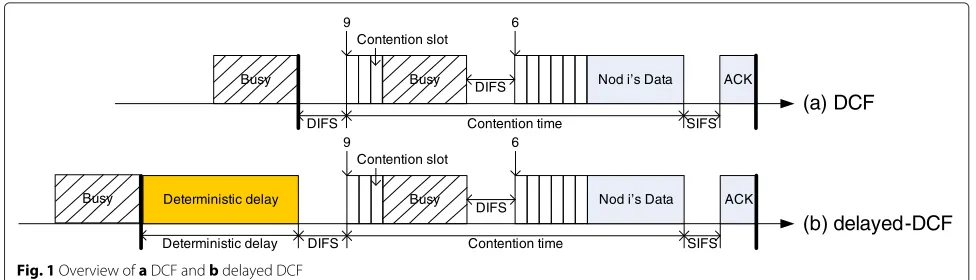
In this paper, we consider the basic access mode only. With the help of Fig. 1a, we now describe the main procedure used in the basic access mode.
Before transmitting a packet, a node must sense the channel for at least a DCF interframe space (DIFS). During the DIFS time, if the channel is sensed idle, the node may begin the transmission process; if the channel is sensed busy, the node will defer access and enter a contention period.
During the contention period, the node employs the binary exponential backoff (BEB) algorithm to resolve collisions. In the BEB algorithm, a node initially gen-erates a random backoff time uniformly distributed in [0, CWmin−1], where CWmin is a given minimum CW
Nod i’s Data ACK
DIFS Contention time SIFS
Contention slot
(a) DCF
Busy DIFS Busy
9 6
Nod i’s Data ACK
DIFS Contention time SIFS
Contention slot
Busy DIFS Deterministic delay
9 6
Deterministic delay
(b) delayed-DCF
Busy
Fig. 1Overview ofaDCF andbdelayed DCF
counter reduces to 6, nodeisuspends the counter because the channel is sensed busy and resumes the counter later after the channel is sensed idle for a DIFS period.
For each successful transmission, the sender will receive an acknowledgement (ACK) frame after a short inter-frame space (SIFS). If the node does not receive the ACK within a certain time (i.e., ACK timeout), it assumes that the data packet was not successfully received at the des-tination node and doubles the CW and repeats the above procedure. Doubling of the CW stops after the maximum window size CWmax is reached. When a retransmission
limit is reached, the sender discards the data packet. Note that according to the 802.11 DCF protocol, two consecutive data packet transmissions of a node are sep-arated by at least a random time uniformly distributed in [0, CWmin−1].
3.2 Delayed DCF
Figure 1b illustrates the delayed DCF. Like DCF, a node in delayed DCF transmits at most one packet upon each transmission opportunity. However, unlike DCF, a node in delayed DCF always waits for a determin-istic delay (denoted by d in this paper) before enter-ing the subsequent DCF procedure. A special case is that when the deterministic delay, d, is equal to 0, the delayed-DCF protocol becomes the legacy DCF protocol.
The delayed DCF protocol actually adopts a mixed-type contention resolution method. One is the deterministic delay, which is independent of the channel status, and its counter are never suspended and will keep counting down once the counter is installed. The deterministic delay post-pones the time that nodes contend for channel. Another is the backoff time, which is greatly affected by the chan-nel status and therefore its counter will be suspended for a busy slot and resumed for subsequent idle slots. The backoff time increases as the contention becomes more intensive. The two types of delays objectively alleviate contention intensity.
This paper concerns the impact of the deterministic delaydon the performance of the subsequent DCF proce-dure, which is never investigated before.
4 Performance analysis
In this section, we propose a theoretical model to eval-uate the performance of the delayed-DCF protocol. We first analyze the collision probability that governs all other performance metrics and then compute the through-put and the mean and variance of the MAC access delay.
We now introduce the terminologies and assumptions that we will use in our analysis: a packet transmission is said to be finishedwhen the packet is either success-fully received at the destination node or dropped due to reaching a retransmission limit; time is measured in MAC time slots unless explicitly indicated. Similar to [29], we assume that (1) all nodes are in saturation operation (i.e., each station always has a packet to transmit) and reside in a single-cell network (i.e., all stations are in the sens-ing range of each other); (2) the collision processes of the nodes can be decoupled; and (3) channel conditions are ideal so that transmission errors are a result of packet collision only.
4.1 Analysis of the collision probability
This section characterizes the collision probability and the attempt rate, which are governed by a fixed-point system described below.
contend-ing nodes. Therefore, we can expressγ in terms ofβ as follows:
γ =1−(1−β)n−1. (1)
We now expressβin terms ofγ, following the approach in [29]. According to the BEB algorithm, a packet can undergo a maximum ofMattempts, where each attempt is preceded by a backoff stage with a randomly selected backoff count ηk at stage k. The probability of j + 1
where the upper term on the right is the probability that the packet suffersjcollisions before success, and the lower term is the probability of eitherM−1 collisions before success orMcollisions.
LetRandX be the number of attempts and the time (in generic slots) excluding DIFS, respectively, incurred by a packet transmission of the tagged node between when the node starts decreasing its deterministic delay and when its targeted packet transmission is finished. Then, X includes two components. The first one is the num-ber of the generic slots (denoted byξ) elapsed during the deterministic delayd. The second one is the number of the generic slots elapsed after the deterministic delay and before the targeted packet transmission of the tagged node is finished. From Eq. (2), we have
R=j+1, w.p.δ(γ,j), 0≤j≤M−1, (3)
X−ξ =j
k=0ηk, w.p.δ(γ,j), 0≤j≤M−1,
where “w.p.” means “with probability”. In Eq. (3),ηkis uni-formly distributed in [0, CWk−1] with meanηk bk =
(CWk−1)/2, where CWk = 2kCW0for 0≤k ≤m−1
and CWk = 2mCW0form≤k ≤M−1;mdetermines
the maximum backoff window size CWmax(i.e., CWmax=
2mCW0); and CW0is the minimum window size. LetR,
We now calculateξ. Letbe the length of a generic slot andbe the mean of. According to the definition ofξ, we have
ξ = d
(5)
and hence, we only need to calculate. The generic slot duration depends on whether a slot is idle or inter-rupted by a successful transmission or a collision. We then defineas
Tsare the mean time for a successful transmission and an unsuccessful transmission, respectively. The parameters Ts andTsdepend on packet payload length, SIFS, DIFS, and other protocol parameters. In Eq. (7),Pbdenotes the probability of a busy slot, where (1− β)n is the proba-bility that none of n nodes transmits packets in a slot; 1−(1−β)nis the probability that at least one node trans-mits a packet and hence it is also the probability of a busy slot.Ps denotes the probability of a successful transmis-sion from any of thencontending nodes.Psdenotes the probability of an unsuccessful transmission from any of thencontending nodes.
From Eq. (6), we can calculateby
=(1−Pb)σ+PsTs+PsTs. (8)
Now, applying the renewal reward theory, we haveβ = R Substitutingβin Eq. (9) into Eq. (1), and solving the fixed-point equation with respect to γ, we can calculate the collision probabilityγ and then the attempt rateβ.
4.2 Computation of throughput and delay
Throughput: For the per-node throughput,, we adopt the expression derived in [29, 30], namely
= Ps
n L
, (10)
whereLis the packet size in bits and Ps
n is the per-node probability of a successful packet transmission.
Mean and variance of MAC access delay: We define the MAC access delay as the interval between when a packet enters the head-of-the-line of its queue and when the packet is successfully received at the destination node. Let Ddenote the MAC access delay and it consists of (1) the deterministic delaydand (2) the random time intervalD1
between when the deterministic delay ends and when the packet is successfully received at the destination node.
LetDandD1denote the mean ofDandD1, respectively.
TACK=the transmission time of an ACK packet,
whereθ1is defined in Eq. (13).
5 Optimal deterministic delay
In this section, we seek the optimal deterministic delay so as to maximize the system throughput. Below, we first find
the optimal attempt rate and then calculate the optimal deterministic delay.
5.1 Optimal attempt rate
This section finds the optimal attempt rate, βopt, that
maximizes the system throughput.
From Eqs. (10) and (8), the system throughput n is given by
Setting the first-order derivative of Eq. (15) in terms of
βto 0, we obtain the equation
1−nβ=η(1−β)n, (16) whereη=1− σ
Ts .
Let ϕ limn→∞nβ be the asymptotic aggregate attempt rate. Assume thatϕexists and apply the Poisson approximation to Eq. (16). We have
1−ϕ=ηe−ϕ
each node can fillKpackets with lengthLbytes into the payload filed of the 802.11 MAC frame and transmit the superframe upon one transmission opportunity. Then, we can keep all deductions from Eqs. (14) to (17) unchanged, except that in Eq. (14), we replaceLbyKL, calculate Ts byKL, and setTs = Tsif the basic access mechanism is adopted and setTs = Trts+Tsifs+Tctsif the RTS/CTS
access mechanism is adopted, whereTrts,Tsifs, andTcts,
respectively, are the RTS transmission time, the SIFS time, and the CTS transmission time.
5.2 Optimal deterministic delay
According to the delayed DCF, a node always first waits for a deterministic delay and then enters the subsequent DCF procedure. Therefore, the deterministic delay is closely connected to the attempt rate. In this section, we calculate the optimal deterministic delay,dopt, that achieves optimal
attempt rateβopt.
From Eqs. (17) and (1), the optimal attempt rateβoptand
the optimal collision probabilityγoptare given by Eq. (18): doptis expressed as follows:
dopt=(βopt)
In the previous two sections, we theoretically analyze the performance of the delayed-DCF protocol and the optimal deterministic delay that maximizes the system through-put. In this section, we verify these theoretical results using the 802.11 simulator in ns2 version 2.28 [33] with some modifications. The purpose of these modifications
is to add a deterministic delaydinto the traditional DCF so as to be consistent with the delayed-DCF protocol.
We consider a one-hop star network with an access point (AP) andnsaturated nodes, where the AP only acts as the receiver of data packets from all nodes. We present the theoretical results under the assumption ofTs = Ts. For practical networks, this assumption does not neces-sarily hold. However, many analytical studies, including [30, 34] and [29], adopt this assumption, and it has also been adopted by the developers of the ns2 simulation tool [33]. The assumption is equivalent to assuming that ACK packets are transmitted at the basic rate, and the ACK timeout after a collision matches the guard time observed by non-colliding nodes.
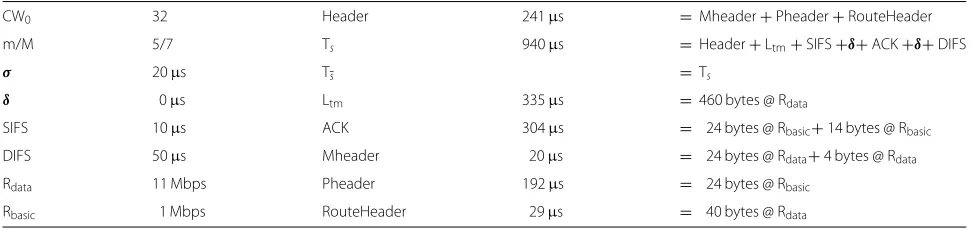
In our simulations, we use the DumbAgent routing pro-tocol and set the simulation time to 100 s. We assume that each node and the AP have an infinite buffer and hence, set the buffer size to 1000 packets. The default param-eter values shown in Table 1 are set in accordance with 802.11b. In addition, in all figures, we use “sim” and “ana” to denote the simulation and analysis results, respectively. Below, we first demonstrate the accuracy of our perfor-mance model in Section 6.1 and then verify our optimiza-tion result in Secoptimiza-tion 6.2.
6.1 Performance evaluation
In this subsection, we study the impact of d on the throughput, the collision probability, the mean and stan-dard deviation of the MAC access delay when the number of nodesnvaries from 4 to 30, whered =5, 10 ms. It has been proven in [31] that for a one-hop WLAN withn con-tending nodes andd = 0 ms, the mean MAC delay of a packet isO(n)ms. We will show that the system perfor-mance of the delayed-DCF protocol varies significantly, relying on the relationship between d and n. The main observation is that the dominant component of the MAC access delay is the deterministic delay ofdms whend>n and is the random delay in DCF ofO(n)ms otherwise. In our simulations, we changenfrom 4 to 30 and setd =5, 10 ms, in order to illustrate this observation.
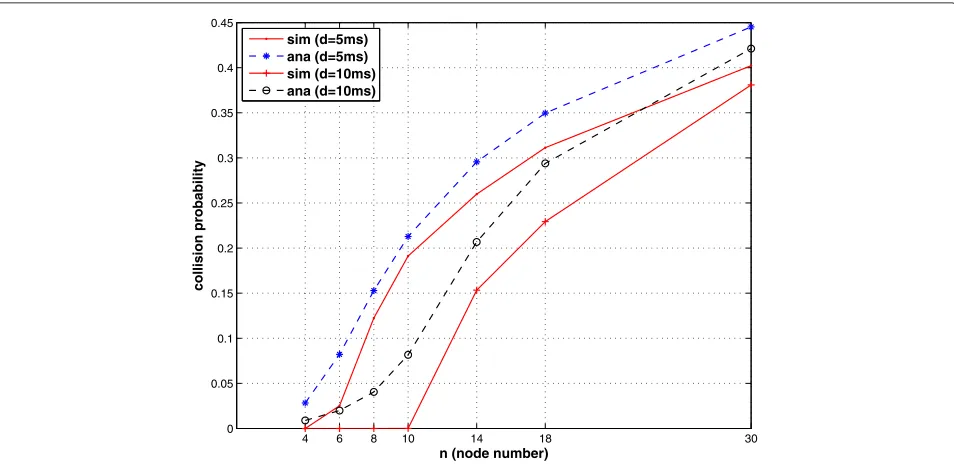
Figure 2 plots the collision probability versus the num-ber of nodes, where the theoretical results are calculated
Table 1Default parameter settings used in this paper
CW0 32 Header 241μs =Mheader+Pheader+RouteHeader
4 6 8 10 14 18 30 0
0.05 0.1 0.15 0.2 0.25 0.3 0.35 0.4 0.45
n (node number)
collision probability
sim (d=5ms) ana (d=5ms) sim (d=10ms) ana (d=10ms)
Fig. 2The collision probability versus the number of nodes
by Eqs. (9) and (1). From this figure, we can see that the collision probability increases as n increases when d = 5, 10 ms. However, for each n, the collision prob-ability when d = 5 ms is obviously larger than that whend = 10 ms. The reason is that the largerdgreatly alleviates the contention intensity, leading to a lower col-lision probability. Particularly, when n increases from 4 to 10, the simulated collision probability whend = 5 ms increases from 0.02 to 0.22, whereas it is zero when d=10 ms.
Figure 3 plots the per-node throughput versus the num-ber of nodes when d = 5, 10 ms, where the theoretical results are calculated by Eq. (10). From this figure, we observe that (a) the per-node throughput whend=5 ms, decreases asnincreases from 4 to 30, while the per-node throughput whend=10 ms, first remains unchanged for n ≤ 10, and then decreases forn > 10; (b) the through-put curve whend = 5 ms is obviously above that when d = 10 ms forn ≤ 10, but the two curves almost over-lap forn> 10. The reasons are as follows: the delay and hence the per-node throughput is governed bydford>n and are governed bynotherwise. Further, for eachd, the theoretical curve (labeled with “ana”) closely matches the simulation curve (labeled with “sim”), manifesting that our theoretical model is very accurate.
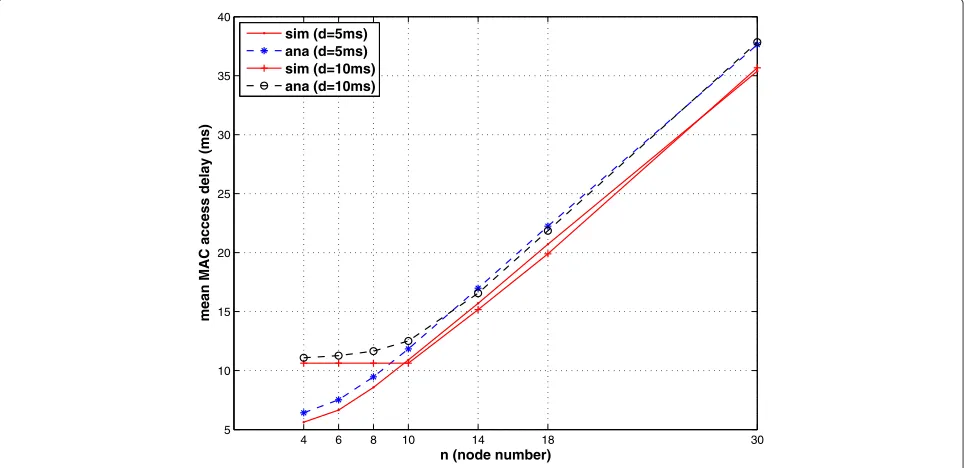
Figure 4 plots the mean MAC access delay versus the number of nodes, where the theoretical results are cal-culated by Eq. (11). From this figure, the MAC access delay when d = 10 ms is almost equal to 10 ms and is obviously less than that whend= 5 ms forn<10; how-ever, it is almost equal and isO(n)ms for each n > 10
when d = 5, 10 ms. This manifests that the dominant component of the MAC access delay is the deterministic delaydms whend>nand is the random delay in DCF of O(n)ms otherwise.
Figure 5 plots the standard deviation of the MAC access delay versus the number of nodes, where the theoretical results are calculated by Eq. (12). From this figure, we can see that the standard deviation increases as n increases whend=5, 10 ms. However, the standard deviation when d=5 ms is obviously larger than whend=10 ms for each n. Particularly, the standard deviation whend = 10 ms for n < 10 is almost zero since the MAC access delay is almost a constant and is equal to 10 ms under this case.
Finally, from all these figures, we can see that all theo-retical results, except the theotheo-retical collision probability which slightly deviates from the simulated value, well match the corresponding simulated results, indicating that our model is very accurate.
6.2 Optimal deterministic delay
In this subsection, we verify the accuracy of the theoretical optimal deterministic delay and illustrate that the optimal deterministic delay can significantly improve the system performance. To this end, we calculate the optimal deter-ministic delay and compare the throughput, the collision probability, the mean and standard deviation of the MAC access delay when the fixed deterministic delayd=5 ms, and the optimal deterministic delay d = dopt are used,
wheredoptis measured in microseconds and is calculated
4 6 8 10 14 18 30 0
0.1 0.2 0.3 0.4 0.5 0.6 0.7
n (node number)
per−node throughput (Mbps)
sim (d=5ms) ana (d=5ms) sim (d=10ms) ana (d=10ms)
Fig. 3The per-node throughput versus the number of nodes
Figure 6 plots the optimal deterministic delay versus the number of nodes when the packet sizeL=460 and 1000 bytes, where the theoretical results are calculated by Eq. (19). From this figure, we can see that the optimal delay increases asnincreases. This is because that a larger node number means higher contention intensity; a larger delay will reduce the number of the nodes that simultaneously attempt to contend for channel. On the other hand, for the same node number, the optimal delay when the packet
size is large is higher than that when the packet size is small. The reason is that a larger packet size means a larger traffic load when the node number is the same; a larger delay can reduce the number that nodes attempt to access channel in a unit time, thereby reducing the contention intensity.
Figure 7 plots the collision probability versus the num-ber of nodes, where the theoretical results are calculated by Eqs. (9) and (1). From this figure, when d = 5 ms,
4 6 8 10 14 18 30
5 10 15 20 25 30 35 40
n (node number)
mean MAC access delay (ms)
sim (d=5ms) ana (d=5ms) sim (d=10ms) ana (d=10ms)
4 6 8 10 14 18 30 0
10 20 30 40 50 60 70 80 90
n (node number)
standard deviation of MAC access delay (ms)
sim (d=5ms) ana (d=5ms) sim (d=10ms) ana (d=10ms)
Fig. 5The standard deviation of the MAC access delay versus the number of nodes
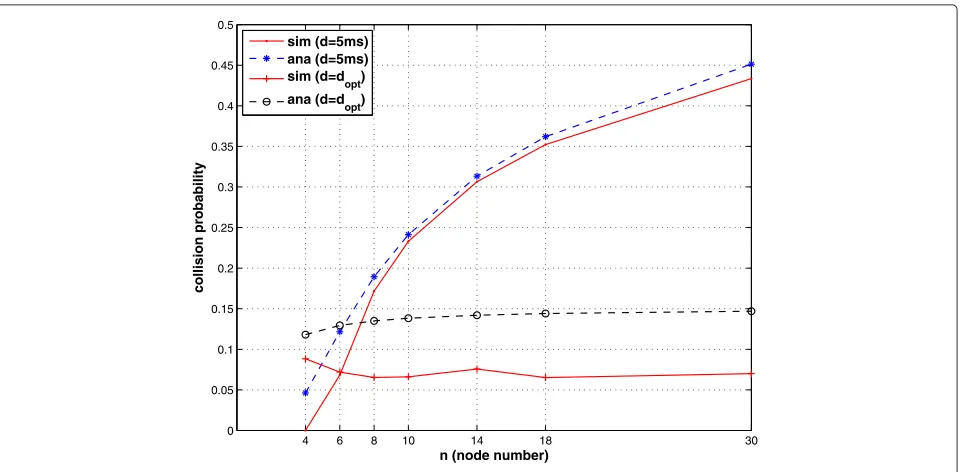
we can see that the collision probability significantly increases from 0 to 0.45 as n increases from 4 to 30. In contrast, when d = dopt, we can see that the
colli-sion probability is always below 0.1, regardless of hown varies.
Figure 8 plots the system throughput n versus the number of nodes, where the theoretical results are cal-culated by Eq. (10). From this figure, when d = 5 ms,
we can see that the system throughput first decreases from 4.8 to 5 Mbps as n increases from 4 to 6 and then decreases from 5 to 4.2 Mbps as n continues to increase from 6 to 30. The reason that the system through-put has a maximum value when n = 6 is as follows: the d = 5 ms approximates the optimal determinis-tic delay. In contrast, when d = dopt, we can see
that the system throughput slightly fluctuates around
4 6 8 10 14 18 30
0 5 10 15 20 25 30 35 40 45
n (node number)
Optimal deterministic delay d
opt
(ms)
ana (L=460) ana (L=1000)
4 6 8 10 14 18 30 0
0.05 0.1 0.15 0.2 0.25 0.3 0.35 0.4 0.45 0.5
n (node number)
collision probability
sim (d=5ms) ana (d=5ms) sim (d=dopt)
ana (d=dopt)
Fig. 7The collision probability versus the number of nodes
5.1 Mbps, which is always larger than that when d = 5 ms.
Figure 9 plots the mean MAC access delay versus the number of nodes, where the theoretical results are cal-culated by Eq. (11). From this figure, the MAC access delay whend = doptis always not larger than that when d=5 ms.
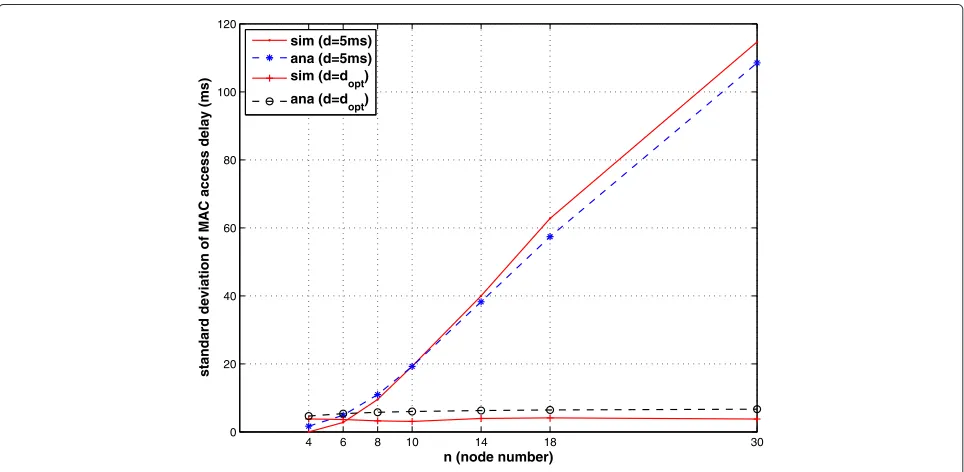
Figure 10 plots the standard deviation of the MAC access delay versus the number of nodes, where the
theoretical results are calculated by Eq. (12). From this figure, when d = 5 ms, we can see that the standard deviation significantly increases from 0 to 115 ms as n increases from 4 to 30. In contrast, when d = dopt, we can see that the standard
deviation is always below 5 ms, regardless of how n varies.
Finally, from all these figures, we can see that all the-oretical results well match the corresponding simulated
4 6 8 10 14 18 30
4 4.5 5 5.5
n (node number)
system throughput (Mbps)
sim (d=5ms) ana (d=5ms) sim (d=d
opt) ana (d=dopt)
4 6 8 10 14 18 30 5
10 15 20 25 30 35 40 45 50 55
n (node number)
mean MAC access delay (ms)
sim (d=5ms) ana (d=5ms) sim (d=dopt)
ana (d=dopt)
Fig. 9The mean MAC access delay versus the number of nodes
results, indicating that the theoretical optimal determin-istic delay is accurate.
7 Conclusions
With more and more data being transmitted in wire-less cyber-physical systems, wirewire-less network protocols should be further studied and amended to improve their transmission efficiency. This paper proposes a theoreti-cal model to study the performance of the delayed-DCF
protocol. With this model, we can accurately character-ize the impact of the deterministic delay parameter in the protocol on the system performance and optimize the deterministic delay parameter setting. The delayed-DCF protocol is a special case of the DCA protocol, whose idea is to introduce an extra random delay so that more packets can be backlogged and transmitted upon each transmission opportunity. The study is very helpful for further modeling of the DCA protocol and for
bet-4 6 8 10 14 18 30
0 20 40 60 80 100 120
n (node number)
standard deviation of MAC access delay (ms)
sim (d=5ms) ana (d=5ms) sim (d=dopt)
ana (d=dopt)
ter designing and implementing of the packet aggregation technology that has been widely adopted by IEEE wireless networking standards including 802.11 n and the latest 802.11 ac.
Competing interests
The authors declare that they have no competing interests.
Acknowledgements
This work is partially supported by the Macao Science and Technology Development Fund under Grants (No. 013/2014/A1 and No. 104/2014/A3), the NNSF of China under Grant 61373027, and NSF of the Shandong Province under Grant ZR2012FM023.
Author details
1Faculty of Information Technology, Macau University of Science and
Technology, Macau, China.2School of Information Science and Engineering,
Qufu Normal University, 276826 Rizhao, Shandong, China.3Department of
Computer Science, the George Washington University, Washington, DC, USA.
4College of Information Science and Technology, Beijing Normal University,
100875 Beijing, China.
Received: 4 November 2015 Accepted: 8 February 2016
References
1. EA Lee, Cyber physical systems: design challenges, Technical Report No. UCB/EECS-2008-8. Available at: http://www.eecs.berkeley.edu/Pubs/ TechRpts/2008/EECS-2008-8.pdf. Accessed 2015
2. W Kang, K Kapitanova, SH Son, RDDS: A real-time data distribution service for cyber-physical systems. IEEE Trans. Industrial Inform.8(2), 393–405 (2012)
3. EA Lee, The past, present and future of cyber-physical systems: a focus on models. Sensors.15, 4837–4869 (2015)
4. S Cheng, Z Cai, J Li, X Fang, inINFOCOM. Drawing dominant dataset from big sensory data in wireless sensor networks, (2015), pp. 531–539 5. https://en.wikipedia.org/wiki/Precision_agriculture. Accessed 2015 6. Y Zhang, M Qiu, C Tsai, M Hassan, A Alamri, Health-CPS: healthcare
cyber-physical system assisted by cloud and big data. IEEE Syst. J. Accepted for publication
7. https://en.wikipedia.org/wiki/Home_automation. Accessed 2015 8. IEEE Std. 802.11-2007, Part 11: Wireless LAN Medium Access Control
(MAC) and Physical Layer (PHY) Specifications, June 2007 9. IEEE 802.11 WG, IEEE P802.11n-2009: Part 11: Wireless LAN Medium
Access Control (MAC) and Physical Layer (PHY) Specifications: Amendment 5: Enhancements for Higher Throughput, IEEE Standards Association Std., Oct. 2009.
10. Y Xiao, IEEE 802.11n: enhancements for higher throughput in wireless LANs. Wirel. Commun. IEEE.12(6), 82–91 (2005)
11. E Perahia, IEEE 802.11n development: history, process, and technology. Commun. Mag. IEEE.46(7), 48–55 (2008)
12. M Gong, B Hart, S Mao, Advanced wireless LAN technologies: IEEE 802.11ac and beyond. ACM Mobile Comput. Commun. Rev. (MC2R). 18(4), 48–52 (2014)
13. F Siddiqui, S Zeadally, K Salah, Gigabit wireless networking with IEEE 802.11ac: technical overview and challenges. J. Netw.10(3), 164–171 (2015)
14. L Changwen, AP Stephens, Delayed channel access for IEEE 802.11e based WLAN. IEEE Int. Conf. Commun., 4811–4817 (2006)
15. D Skordoulis, Q Ni, G Min, K Borg, Adaptive delayed channel access for IEEE 802.11n WLANs. 4th IEEE Int. Conf. Circ. Syst. Commun., 167–171 (2008) 16. D Skordoulis, Q Ni, C Zarakovitis, A selective delayed channel access
(SDCA) for the high-throughput IEEE 802.11n. IEEE Wirel. Commun. Netw. Conf. (WCNC 2009), 1–6 (2009)
17. Q Zhao, Z Ma, H Dai, Performance evaluation of the delayed-DCF scheme in wireless LANs. Int. J. Future Comput. Commun.2(5), 391–394 (Oct. 2013) 18. Z Abichar, JM Chang, Group-based medium access control for IEEE
802.11n wireless LANs. IEEE Transac. Mobile Comput.12(2), 304–317 (2013)
19. G Marta, C Davide, CA Fabio, AJ Singh, MP Elgaard, A multi-QoS aggregation mechanism for improved fairness in WLAN. Veh. Technol. Conf. (VTC Fall), 2013 IEEE 78th, 1–5 (2013)
20. B Maqhat, M Baba, R Rahman, A Saif, Scheduler algorithm for IEEE802.11n wireless LANs. Int. J. Future Comput. Commun.3(4), 224–226 (2014) 21. O Sharon, Y Alpert, The combination of QoS, aggregation and RTS/CTS in
very high throughput IEEE 802.11ac networks. Physical Commun.15, 25–45 (Jun. 2015)
22. J Li, S Cheng, H Gao, Z Cai, Approximate physical world reconstruction algorithms in sensor networks. IEEE Transac. Parallel and Distrib. Syst. 25(12), 3099–3110 (2014)
23. Z Cai, R Goebel, G Lin, Size-constrained tree partitioning: approximating the multicast k-tree routing problem. Theor. Comput. Sci.412(3), 240–245 (2011)
24. S Cheng, Z Cai, J Li, Curve query processing in wireless sensor networks. IEEE Transac. Veh. Technol.64(11), 5198–5209 (2015)
25. X Zheng, J Li, H Gao, Z Cai, inMOBIHOC. Capacity of wireless networks with multiple types of multicast sessions, (2014), pp. 135–144 26. Z Cai, Z-Z Chen, G Lin, A 3.4713-approximation algorithm for the
capacitated multicast tree routing problem. Theor. Comput. Sci.410(52), 5415–5424 (2008)
27. Z Cai, G Lin, G Xue, inCOCOON. Improved approximation algorithms for the capacitated multicast routing problem, (2005), pp. 136–145 28. IEEE P802.11.2, Draft 1.0, Recommended practice for the evaluation of
802.11 wireless performance, IEEE-802.11 WG, April 2007
29. A Kumar, E Altman, D Miorandi, M Goyal, New insights from a fixed point analysis of single cell IEEE 802.11 WLANs. IEEE/ACM Transac. Netw.15(3), 588–601 (2007)
30. G Bianchi, Performance analysis of the IEEE 802.11 distributed coordination function. IEEE J. Sel. Areas. Commun.18(3), 535–547 (2000) 31. T Sakurai, HL Vu, Access delay of the IEEE 802.11 MAC protocol under
saturation. IEEE Transac. Wirel. Commun.6(5), 1702–1710 (2007) 32. RM Corlessa, GH Gonnet, DEG Hare, DJ Jeffrey, DE Knuth, On the Lambert
W function. Adv. Comput. Math.5, 329–359 (1996) 33. http://www.isi.edu/nsnam/ns/ns-build.html. Accessed 2015
34. D Malone, K Duffy, D Leith, Modeling the 802.11 distributed coordination function in non-saturated heterogeneous conditions. IEEE/ACM Transac. Netw.15(1), 159–172 (2007)
Submit your manuscript to a
journal and benefi t from:
7Convenient online submission 7Rigorous peer review
7Immediate publication on acceptance 7Open access: articles freely available online 7High visibility within the fi eld
7Retaining the copyright to your article