FORMULATION AND EVALUATION OF OPHTHALMIC GEL BASED ON
DRUG-POLYMER-POLYMER TERNARY INTERACTION
BHUSHAN S BHOYAR*, ARUN T PATIL
Department of Pharmaceutical Sciences, RTM Nagpur University, Nagpur, Maharashtra, India. Email: [email protected] Received: 09 March 2015, Revised and Accepted: 30 March 2015
ABSTRACT
Objective: The objective was to enhance the amount of active substance reaching the target tissue or exerting a local effect in the cul-de-sac, the approach we use is the application of in-situ gelling systems or phase transition systems, which are instilled in a liquid form and shift to a gel or solid phase in the cul-de-sac. The present study will focus on the development of formulation of ophthalmic gels. The polymer physicochemical properties were studied for the improvement in gel characteristics.
Methods: The formulations were varied by the amount of the anionic and cationic polymer concentration. The 10 and 20-fold excess anionic polymer were used. The 10 and 20-fold excess anionic polymer were used. Further cationic polymers were utilized to see any ternary interaction between drug and polymers.
Results: From the present study it could be shown that most of the formulations were isotropic and could be clearly separated from the anisotropic ones which were situated at the cationic side of the phase diagram only as well as at 10% polyvinyl alcohol. Furthermore, excess 20HA, 10PAA, and 20PAA as well as HCS (HCS/20PAA) contributes to improve drug release control.
Conclusion: The above formulation of were found to be quite stable and useful in the novel format of sol-gel transformations. Further, the physical characteristics gels show better tolerability with anionic and cationic polymer.
Keywords: Cationic, Anionic, Poloxamer, Sol-gel.
INTRODUCTION
Topical application of drugs to the eye is the most popular and well-accepted route of administration for the treatment of various eye disorders. Viscous semi-solid preparations, such as gels and ointments, provide a sustained contact with the eye, but they cause a sticky sensation, blurred vision and induce reflex blinking due to discomfort or even irritation. An alternative approach has been the application of in situ gelling systems or phase transition systems, which are instilled in a liquid form and shift to a gel or solid phase in the cul-de-sac [1]. The phase transition is triggered by the pH of the tears, the temperature at the eye surface or the electrolytes present in the tear film. A further approach to optimize the ocular dosage form was the implementation of the mucoadhesive concept, which was successful in buccal and oral applications [2]. The present study will focus on the development of formulation of ophthalmic gels. In this discovery, we tried to make use of the latest research and novel concepts to explore the drug-polymer-polymer ionic ternary interaction.
The conventional drug delivery systems for ophthalmic administration are affected by heavy drawbacks: The precorneal drug loss due to the lachrymal flow and the palpebral blinking. The ophthalmic availability can be improved increasing the precorneal residence of the formulation [3]. The polymer physicochemical properties, that are recognized to be useful for mucoadhesion, are the presence of groups able to form hydrogen bound, strong ionic charge (anionic or cationic), high molecular weight, chain flexibility, and good spreading properties.
METHODS
Scheme of formulation development
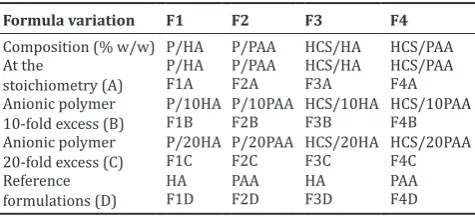
The % (w/w) composition of the formulations prepared. Four formulations P/HA, P/PAA, HCS/HA, and HCS/PAA are based on the stoichiometry of the drug/polymer/polymer ternary interaction products [4]. The formulations were varied by the amount of the
anionic and cationic polymer concentration. The 10 and 20-fold excess anionic polymer were used. Further, cationic polymers were utilized to see any ternary interaction between drug and polymers [5]. A 0.30 w/w ciprofloxacin solution was prepared. The schemes of formulation prepared were shown in Table 1.
Characterization of gels
Fourier transforms infrared (FTIR) spectroscopy
The powder spectra were measured with 2 mg sample with 200 mg of Kbr as a pellet press [6]. The model used was Shimadzu, serial no: A21014301223 LP, P/N: 206-72400-38, FTIR: 8400S, CE.
Thermal stability studies
Thermogram of the ciprofloxacin powder and physical mixture formulation were obtained from (NETZSCH DSC [differential scanning calorimetry] 200F 3 240- 20- 427-L). Phase transition of the physical mixture, powder, and gel were analyzed by DSC. Ciprofloxacin HCL and physical mixture formulation were sealed in an aluminum crucible and heated at the rate of 30°C/minutes up to 400°C under a nitrogen
Table 1: Scheme for preparation of composition of the formulations prepared
Formula variation F1 F2 F3 F4
Composition (% w/w) P/HA P/PAA HCS/HA HCS/PAA At the
stoichiometry (A) P/HAF1A P/PAAF2A HCS/HAF3A HCS/PAAF4A Anionic polymer
10-fold excess (B) P/10HA P/10PAA HCS/10HA HCS/10PAAF1B F2B F3B F4B Anionic polymer
20-fold excess (C) P/20HA P/20PAA HCS/20HA HCS/20PAAF1C F2C F3C F4C Reference
atmosphere (60 ml/minutes). The exact peak temperature and melting point and heat of fusion were automatically calculated. Since DSC can measure directly both the temperature and enthalpy of a transition or the heat of reaction [7].
X-ray diffraction (XRD) analysis
Powder XRD patterns of the ciprofloxacin HCL powder and physical mixture formulation were monitored with an X-ray diffractometer (Brooker, D8 advanced, Germany) using copper as X-ray target, a voltage of 40 KV, a current of 30 mA and with 1.54060 Å wavelength. The samples were analyzed over 2 (2θ) theta range of 10.0116-99.9846° with scanning step size of 0.0130 (2θ) and scan step time 4.8450 seconds [8].
Scanning electron microscopy
Particle size analysis of ciprofloxacin powder and physical mixture formulation were performed by scanning electron microscope. A small amount of sample was suspended in purified water (10 ml). The suspension was ultrasonicated for 5 seconds. Hydrogels were frozen and then lyophilized by a freeze-drying method. Samples were fractured in liquid nitrogen and sputter-coated with gold. A Sirion 400 NC scanning electron microscope was used for determining the surface morphology of drug-polymer-polymer interacting thermo gels [9]. The samples were sputter-coated with gold particles and then scanned at an accelerating voltage of 5 Kv. The resulting dried samples were examined using a scanning electron microscope.
Release measurements
Dialysis bags were filled with a fixed amount of each formulation (1 g) and put into 40 ml of artificial lachrymal fluid used as receptor phase. The receptor phase was stirred and thermostated at 34±2°C. At fixed time 2 ml of the receptor phase were withdrawn and replaced with fresh fluid. The drug released was assayed spectrophotometrically as previously described. The drug release was also performed using distilled water instead of artificial lachrymal fluid in the same experimental conditions.
Viscosity measurements after dilution with lachrymal fluid
The selected formulations which showed the better drug release properties (20HA, 10PAA, 20PAA, and HCS/20HA) were subjected to viscosity measurements after dilution with lachrymal fluid to assess the influence of the diluting and washing action of the tears in-vivo. In particular, the formulations were diluted 1:1 and 1:4. The same dilutions were performed with distilled water for comparison purposes, to take into account the effect of the ionic strength and the dilutions on the formulation consistency.
RESULTS AND DISCUSSION FTIR
The FTIR spectrum for ciprofloxacin shows a characteristic peak at 3414/cm that corresponds for OH vibrations and a band at 2924/cm attributed to CH stretching from CH and CH2 groups [6]. Furthermore, the peaks at 1616/cm and 1402/cm are assigned for asymmetrical and symmetrical vibrations of COO− group and the peak at 1030/cm for the characteristic vibration of C\O\C from pyranose ring. The contribution of each and every component on the final produced scaffold network was confirmed by FTIR (Figs. 1 and 2). Hence, the broad band observed from 3200 to 3550/cm in the polyvinyl alcohol (PVA) spectra assigned to hydroxyls stretching due to the strong hydrogen bond of intramolecular and intermolecular type [10].
Thermal stability studies
DSC thermo gelling systems samples were recorded using a differential scanning calorimeter (HP DSC1, Mettler Toledo, Switzerland), as a thermo-analytical technique for studying phase transitions, such as melting, glass transitions or exothermic decompositions. Thermo gelling are based on polymers having a melting point or glass transition
temperature in the range of 25-65°C. The temperature above 37°C and below 65°C these polymers behave like viscous fluids and flow easily when pushed. It can be suggested that some of these polymeric gelling systems possess low-high transition points and were found highly biocompatible with ciprofloxacin (Fig. 3). Thus, they were found to be transforming from solution to gelling systems [7].
At least two endothermic events are detected, which can be associated with the loss of adsorbed and coordinated water, separately. Therefore, the second weight loss of water has been used to determine the amount of interlayer water in this sample. Compared to the DSC curve of ciprofloxacin with poloxamer, it is found that the third step is probably attributable to the oxidative degradation of the intercalated drug anions. The last step may be due to dehydroxylation of the matrix and burning of excipient [8]. Accelerated aging is one of the most appropriate methods of rapidly and accurately assessing the chemical stability of pharmaceutical dosage forms. This method is appropriate to determine oxidation, hydrolysis, and reaction with reactive excipient impurities and protein denaturation (Figs. 4 and 5).
Therefore, polymers associate to a network structure, reflected by a sharp rise in system viscosity. Ideally, the aqueous polymer solutions flow freely at room temperature and become a gel at body temperature [9]. The high polymer content often changes the osmolarity and consequently negatively influences the tolerability of the formulations.
XRD studies
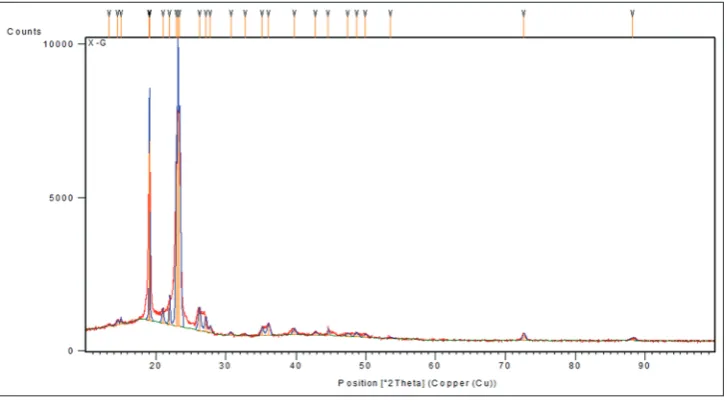
XRD was usually carried out to provide quantitative details of phase structural dimensions and to confirm the internal structure of the liquid crystalline system. As shown in Fig. 6, diffraction peaks represented the reverse hexagonal phase. Many studies have been explored dispersed L2 phase and V2 phase as ocular drug carriers. Poloxamer a nontoxic, biodegradable, and biocompatible polymer, swells in the water, and then spontaneously form well-ordered liquid crystalline phases. The most common liquid crystalline phases are a lamellar phase, inverted hexagonal phase (H2), and cubic phase (V2). These phases were influenced by temperature and water content. It has been reported that gels associated with their bulk phase could retain their internal structure, morphology, and stability, and show some unique properties such as particle size, viscosity, and good biocompatibility. The study refers poloxamer as a promising candidate for the special structural properties of dense packed, infinitely long and straight water filled rods could accommodate water-soluble drugs within the aqueous domains. Therefore, poloxamer could be a promising candidate for gelling systems due to these properties.
Scanning electron microscopy
A Sirion 400 NC scanning electron microscope was used for determining the surface morphology of drug-polymer-polymer interacting thermogels. The samples were sputter-coated with gold particles and then scanned at an accelerating voltage of 5 kV. The PF127 nanostructure in the hydrogels assembled into a transient polymeric network as illustrated in Fig. 7. PF127 exhibited a fibrous structure in cross-sectional view. Enlarging the magnification from 1000 to 5000 Fig. 1: Drug release characteristics of ciprofloxacin formulations
revealed some pores among the fibrous structures. It can be seen that the inner pores of the thermo gelling systems are interconnected and have irregular shapes and highly porous structures. Micrographs of
the thermogels show that the systems are a network with sponge-like structures. The spherical pores are well interconnected throughout the scaffold matrix [9].
Fig. 2: Fourier transforms infrared spectrum of ciprofloxacin HCL+ poloxamer+ chitosan
Fig. 3: Fourier transforms infrared spectrum of ciprofloxacin HCL+ poloxamer+ polyvinyl alcohol
Release properties
Fig. 8 gives the % drug release profiles versus time for the optimized formulations based on the ternary systems. The CIPRO solution shows the fastest % drug release in comparison with F3D and all the formulations based on both the ternary systems CIPRO/P/HA and CIPRO/HCS/HA (p<0.05). P/HA shows a % drug release profile similar to that of F3D. The increase in HA amount improves the control of the drug release, but a synergistic effect of P can be envisaged, because P/20 HA is characterized by a % drug release profiles significantly lower than that of F3D (p<0.05) although they contain the same HA amount. The CIPRO solution shows the highest % drug release profile in comparison with all the formulations based on both the ternary systems CIPRO/P/PAA and CIPRO/HCS/PAA and the reference formulation F2D, F4D (p<0.05).
For these formulations, the HCS/HA and HCS/PAA interactions together with the poor solubility properties of HCS at pH close to neutrality result in the displacement of the drug CIPRO in the drug-polymer complex. P/20HA, P/10 PAA, P/20 PAA, and HCS/20HA, that combined better mucoadhesive and drug release properties, were selected for further characterization.
Viscosity measurements after dilution with lachrymal fluid Table 2 gives the viscosity values (mPa s) (at 100 sK1) of P/20HA, P/10 PAA, P/20 PAA and HCS/20HA after dilution 1:1 and 1:4 with artificial lachrymal fluid and, for comparison purposes, with distilled water. When the dilution medium is the artificial lachrymal fluid, the viscosity values are always lower than those obtained after the same dilution with water to indicate that the ionic strength of the medium interferes with the formulation consistency. The greater differences in viscosity after dilution with distilled water and artificial lachrymal fluid can be observed in particular for the formulation P/20 PAA [4]. While the initial viscosity of the formulations P/10 PAA and P/20 PAA is much higher than that of P/20 PAA and HCS/20 HA, after especially 1:4 dilution, the four formulations show values quite similar and in particular, no statistically significant differences were found between P/20 HA, P/20 PAA, and HCS/20 HA.
CONCLUSION
From the present study, it could be shown that most of the formulations were isotropic and could be clearly separated from the anisotropic ones Fig. 5: Differential scanning calorimetry thermogram of physical mixture ciprofloxacin + poloxamer + chitosan
which were situated at the cationic side of the phase diagram only as well as at 10% PVA. XRD confirmed that all the anisotropic formulations contained crystalline amounts in this respect water content was suggested to be the decisive parameter for anisotropy/crystallinity. Furthermore, the study of crystallinity and relative crystallinity it could be demonstrated that HA was an inferior susceptibility mixture for chitosan. The anionic polymers HA and PAA showed good capability to interact with the drug giving soluble drug/polymer complexes; moreover they were able to form polymer/polymer complexes with poloxamer and HCS, with a stoichiometry depending on the polymers involved. Poloxamer mildly interacted with both HA and PAA resulting in just a slight turbidity, while HCS interaction with the anionic polymers was stronger with a marked opalescence. Furthermore, excess 20HA, 10PAA, and 20PAA as well as HCS (HCS/20PAA) contributes to improve drug release control. The ternary system capability to control drug release is particularly evident when the medium employed is distilled water, confirming the relevance of the ionic exchange mechanism. From the results of the present study, it can be concluded that formulation of
ciprofloxacin ophthalmic solution in phosphate buffer made isotonic with sodium chloride containing combination of methyl- and propylparaben or benzalkonium chloride and ethylenediaminetetraacetic acid or benzalkonium chloride favors corneal permeation of both the drug. Ocular irritancy denotes formulation are quite stable and useful in the novel format of sol-gel transformations.
REFERENCES
1. Robinson JC. Ocular anatomy and physiology relevant to ocular drug delivery. In: Mitra AK, editor. Ophthalmic Drug Delivery Systems. New York: Marcel Dekker; 1993. p. 29-57.
2. Van Ooteghem MM. Factors influencing the retention of ophthalmic solutions on the eye surface. In: Saettone MF, Bucci M, Speiser P, editors. Ophthalmic Drug Delivery. Biopharmaceutical, Technological and Clinical Aspects, Fidia Research Series. Vol. 11., Padova: Livinia Press; 1987. p. 7-17.
3. Greaves JL, Wilson CG. Treatment of diseases of the eye with mucoadhesive delivery systems. Adv Drug Deliv Rev 1993;11(3):349-83.
4. Ceulemans J, Ludwig A. Optimisation of carbomer viscous eye drops: An in-vitro experimental design approach using rheological techniques. Eur J Pharm Biopharm 2002;54(1):41-50.
5. Genta I, Conti B, Perugini P, Pavanetto F, Spadaro A, Puglisi G. Bioadhesive microspheres for ophthalmic administration of acyclovir. J Pharm Pharmacol 1997;49(8):737-42.
6. Suthanthiraraj SA, Kumar R, Paul BJ. FT-IR spectroscopic investigation of ionic interactions in PPG 4000: AgCF3SO3 polymer electrolyte. Spectrochim Acta A Mol Biomol Spectrosc 2009;71(5):2012-5. 7. Elibol O, Alçelik T, Yüksel N, Caglar Y. The influence of drop size
of cyclopentolate, phenylephrine and tropicamide on pupil dilatation and systemic side effects in infants. Acta Ophthalmol Scand 1997;75(2):178-80.
8. Paulsen FP, Föge M, Thale AB, Tillmann BN, Mentlein R. Animal model for the absorption of lipophilic substances from tear fluid by the epithelium of the nasolacrimal ducts. Invest Ophthalmol Vis Sci 2002;43(10):3137-43.
Fig. 7: X-ray diffraction pattern of ciprofloxacin HCL + poloxamer+ chitosan
Fig. 8: Scanning electron micrograph of ciprofloxacin HCL particle
Table 2: Viscosity values after dilution with lachrymal fluid
Dilution With Formulation viscosity values
CIPRO/20HA CIPRO/10PAA CIPRO/20PAA HCS/20HA
1:1 DW 6.81±0.003 10.41±0.15 396.81±5.01 2.31±0.06
Artificial lacrimal fluid 3.32±0.003 7.31±1.02 10.21±0.89 4.21±0.05
1:4 DW 5.32±0.14 16.51±3.10 26.57±1.10 6.79±1.85
Artificial lacrimal fluid 2.16±0.25 5.61±0.29 4.85±1.20 1.89±0.01
9. Pandit JC, Nagyová B, Bron AJ, Tiffany JM. Physical properties of stimulated and unstimulated tears. Exp Eye Res 1999;68(2):247-53. 10. Shah A, Khan AM, Usman M, Qureshi R, Siddiq M, Shah SS.