R E S E A R C H
Open Access
A localized fault detection algorithm for
mobility management in the strongly
t
-diagnosable wireless ad hoc network under
the comparison model
Tzu-Liang Kung
1,4, Yuan-Hsiang Teng
2, Cheng-Kuan Lin
3and Hsing-Chung Chen
1,4*Abstract
Among the many kinds of networking technologies, the wireless ad hoc network is an important one for creating high-performance ubiquitous computing systems. The availability of a wireless ad hoc network (WANET) depends highly upon the level of node reliability. System-level fault diagnosis has long been a subject for the purpose of maintaining system reliability. This paper addresses the comparison-based approach to fault detection, and accordingly, we developed a localized algorithm for detecting faulty nodes in strongly one-stept-diagnosable WANETs. The contributions of this paper are highlighted as follows: (i) A localized fault detection algorithm is proposed for strongly one-stept-diagnosable WANETs under the comparison model, (ii) the proposed algorithm is formally proved, and it incurs only linear time complexity, which is relatively efficient compared to some others in literature, and (iii) some examples are presented for clarifying how to accomplish the comparison-based fault detection process.
Keywords: Reliability, Mobility management, Fault diagnosis, Strongly one-stept-diagnosable, Comparison model, Ad hoc network
1 Introduction
A modern network system contains a large number of computing and storage units, organized in a static or dynamic underlying interconnection topology. Among the many kinds of networking technologies, the wireless ad hoc network (WANET) is a key to high-performance ubiquitous computing systems [2, 3, 9, 22, 26, 28, 31]. A WANET is a type of wireless network in which some nodes are self-organized in a wireless local area net-work. There are three important properties related to WANETs [7]. First, the WANET is deployed on any topol-ogy and managed independently of any preexisting infras-tructure. Second, the nodes with mobility property are the most important components of WANET. According to Grossglauser and Tse [11], mobility can increase the
*Correspondence: [email protected]; [email protected] 1Department of Computer Science and Information Engineering, Asia University, 413 Taichung City, Taiwan
4Department of Medical Research, China Medical University Hospital, China Medical University, 404 Taichung City, Taiwan
Full list of author information is available at the end of the article
capacity of a WANET. Third, it has the scalability prop-erty, such that it could be used in a large deployment. Due to the undecided number of nodes even during a short duration, the main difficulties are mobility property and reasons for node failure. The reasons for node failures are caused by some nodes with low battery situations, self-ish behavior, or suffering from being compromised as well as attacked events, etc. Therefore, the WANET for any topology is needed to possess strong requirements, which must be able to exploit the high-level reliability linking with scalability and fault tolerance without compromising. In addition, many related issues have been addressed. For example, Kumar et al. [16] and Subramaniyan et al. [27] studied selfish node detection in a MANET; Renugadevi and Mala [24] proposed an improved group key agree-ment for MANETs. Hence, the maintaining connectivity in the face of node failures or so-called unit failures is a main concern in this paper.
The availability of a WANET depends greatly upon the node reliability, and the system-level fault detection approaches to achieve high system availability. Preparata,
Metze, and Chien [23] formalized the notion of fault diag-nosis and studied under what condition can a system be one-stept-fault diagnosable. Then, they further proposed a fault-tolerance metric, called the one-step diagnosabil-ity, to evaluate the degree of a system’s fault-tolerance capability. According to their formal definition [23], a WANET ofnnodes is one-stept-fault diagnosable if all faulty nodes within the WANET can be identified without replacement provided the number of faulty nodes present does not exceed t. Among the various models of fault diagnosis [4, 21, 23], Maeng and Malek [21] proposed one classic approach in a comparison-based strategy, as known as the comparison model. Their approach makes an assumption that any node w is capable of playing the role of a “comparator” in differentiating between responses from two of its neighbors,uandv. The com-parison result is 0 if wfinds no difference between the returned responses fromu,v; otherwise, the comparison result is 1. However, w may be either faulty or normal so that the set of comparison results is not absolutely reliable. Thus, both theoretical and algorithmic issues related to comparison-based fault diagnosis/detection have received the attention of many researchers [6, 8, 12–15, 18, 19, 29, 32].
The one-step diagnosability [23] is a reasonable metric for evaluating a network’s fault-tolerance capability, but it cannot exceed the network’s minimum degree. How-ever, for a number of well-known instances of network topologies with one-step diagnosability beingτ, their one-step diagnosability cannot be further increased only when some node happens to have exactlyτfaulty neighbors and no normal neighbor. Motivated by such an observation, Lai et al. [20] first proposed the concept of strongly t -diagnosable systems/networks, in which each of any set of no more thant+1 faulty nodes can be correctly distin-guished if every node has at least one normal neighbor. The aim of the localized fault detection is to identify the status of any given node in a WANET, which is classified as either “normal” or “faulty.” In this paper, we develop a localized fault detection algorithm under the compar-ison model for ease of handling scalability and mobility management in a stronglyt-diagnosable WANET.
The remainder of this paper is structured as follows: We introduce in advance useful graph-theory terminol-ogy about formalizing the process of comparison-based fault diagnosis in Section 2. The localized fault identifi-cation algorithm and its mathematical proof are detailed in Section 3. Examples and applications are presented in Section 4. Our concluding remarks are drawn in Section 5.
2 Preliminaries
A WANET is composed of mobile nodes that can com-municate directly and bi-directionally with the others via wireless communication if they are in the allowable
communication range [3]. Every node is also responsi-ble for forwarding data packets from the other nodes. Therefore, any two individual nodes that are outside their allowable communication range can still communicate indirectly with each other if at least one path, an ordered sequence of communication links, connects them. On this background, a simple, loopless, and undirected graph is an adequate model of a WANET’s network topology. To for-malize the process of comparison-based fault diagnosis in a WANET, we have to define some graph-theory notations in advance. The standard terminology of graph theory is also referred to in [5].
Anundirected graph Gis composed of avertex set V(G), which stands for mobile nodes in a WANET, coupled with anedge set E(G), which symbolizes communication links between nodes in a WANET. Here, we use{x,y}to denote an edge linking adjacent vertices xandy. Two adjacent vertices areneighborsof each other, denoted byNhdG(v)
to the set of all neighbors of a vertexv. Then, thedegree ofvis equal to|NhdG(v)|, which is denoted bydegG(v). In
this paper, we make the following assumption for a given WANET: every node has the same communication range; that is, each node communicates with others within a uni-tary circle. Under this assumption, the network topology of a WANET is further simplified as a unit disk graph, which corresponds to a collection of unit disks in 2D or 3D space - circle/spheres of radius 1. Each vertex in a unit disk graph is associated with the center of an individual unit disk. In a unit disk graph, an edge links two vertices v1andv2if and only if the two disks associated withv1and v2cover bothv1andv2.
2.1 The comparison-based fault detection
For any node in a WANET, its actual status may be either normal or faulty. The fault detection is approached by comparing data generated from two nodes that have over-lapped active areas. Our fault detection scheme is on the basis of the comparison model [21]. In this model, each unitwthat has at least two neighborsu,vis able to play the role of comparator in differentiating between data trans-mitted byuandv:wsends an identical test request tou,v and then compares it with the received responses between u andv. The comparison resultγ ({u,v}w) is set to be 0
if wfinds no difference between the returned responses fromuandv; otherwise,γ ({u,v}w)is set to be 1. When
γ ({u,v}w) = 0, it also means that wagrees that bothu
andvare normal nodes. Becausewmay be either faulty or normal, the comparison model makes the following two assumptions:
1. If the actual status of the comparatorw is faulty, then
w may produce an unpredictable comparison result.
For example,γ ({u,v}w)may be 0 or 1 at random, and
2. If the actual status of the comparatorw is normal,
thenw produces a reliable comparison result:
γ ({u,v}w)=0indicates that bothu and v are
normal; otherwise,u or v is a faulty node.
Table 1 lists every validation rule of the comparison model according to the actual statuses ofu,v, andw.
Thesyndrome setis a set of all comparison results col-lected from a network. However, because a faulty node produces unpredictable comparison results, different syn-drome sets may be consistent with an identical fault set F. Letγ[X] be the set of syndrome sets that are consis-tent with fault setX. Any two different fault setsX1andX2
are calleddistinguishable(respectively,indistinguishable) if the intersection ofγ[X1] andγ[X2] is empty
(respec-tively, non-empty). Sengupta and Dahbura [25] proved topological conditions for characterizing any one-stept -fault diagnosable graphG: Every two fault setsX1andX2
inGhave to be distinguishable if bothX1andX2contain at
mosttvertices. Furthermore, the rules for telling whether or not two fault sets are distinguishable are summarized in the following lemma:
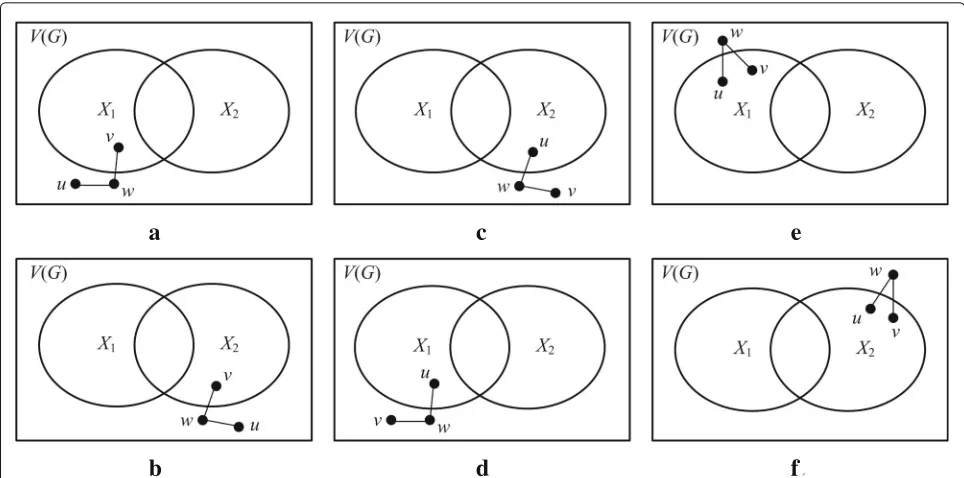
Lemma 1[25]Any two fault sets X1,X2in a graph G are distinguishable if and only if their topological structures can meet one condition(see Fig.1):
1. There exist{u,w} ⊆V(G)\(X1∪X2)and
{v} ⊆X1X2(Fig. 1a, b),
2. There exist{v,w} ⊆V(G)\(X1∪X2)and
{u} ⊆X1X2(Fig. 1c, d),
3. There exist{w} ⊆V(G)\(X1∪X2)and
{u,v} ⊆X1\X2(Fig. 1e),
4. There exist{w} ⊆V(G)\(X1∪X2)and
{u,v} ⊆X2\X1(Fig. 1f),
where both u and v are neighbors of w, and X1X2=(X1\ X2)∪(X2\X1).
Table 1Validation rules of the fault detection under the comparison model [21]
Status of Status of Status of Comparison resultγ ({u,v}w)
nodew nodeu nodev Normal Normal Normal 0 Normal Normal Faulty 1 Normal Faulty Normal 1 Normal Faulty Faulty 1
Faulty Normal Normal Unpredictable, 0/1 Faulty Normal Faulty Unpredictable, 0/1 Faulty Faulty Normal Unpredictable, 0/1 Faulty Faulty Faulty Unpredictable, 0/1
2.2 Strongly one-stept-diagnosable systems
Lai et al. [20] defined the concept of strongly one-step t-diagnosablenetwork systems for investigating potential limitations in the one-step diagnosability. The standard definition of strongly one-step t-diagnosable graphs is presented in Definition 1.
Definition 1[20] A graph G is strongly one-step t-diagnosable if it satisfies either condition(1)or(2):For any two fault sets X1,X2 in G, subject to |X1| ≤ t +1 and
|X2| ≤t+1,
1. X1andX2are distinguishable;
2. X1andX2are indistinguishable, but there exists an
individual vertex x in G such thatX1∩X2covers
NhdG(x).
Definition 1 implies that two arbitrary fault sets X1
andX2, both of which contain at most t+1 elements,
are indistinguishable in a strongly one-stept-diagnosable WANET only whenX1andX2happen to cover all
neigh-bors of some individual node. This special case incurs one potential limitation of the one-step diagnosability. In the remainder of this paper, a setF is arestrictive fault set if F ∩ NhdG(v) = NhdG(v) for each v ∈ V(G).
Definition 2 is an extension to the original notion of one-stept-fault diagnosable systems for meeting the nature of restrictive fault sets.
Definition 2A graph G is restrictively one-step t-diagnosable under the comparison model if every two different restrictive fault sets F1and F2in G, both of which contain at most t elements, are distinguishable.
3 The localized fault detection algorithm
Given a WANET with underlying topology G and any one of its nodeo, the localized fault identification aims to determine the actual status ofo. Kung and Chen [17] first formalized the concept behind the localized fault identi-fication under the PMC diagnostic model. The following definition extends it to the comparison model.
Definition 3For any positive integer t, a node o is one-step t-identifiable under the comparison model if every two distinct fault sets F1and F2in G, with|F1| ≤ t,|F2| ≤ t, and o ∈ F1F2, are distinguishable; furthermore, o is restrictively one-step t-identifiable under the comparison model if for every two different restrictive fault sets F1and F2 in G, with |F1| ≤ t,|F2| ≤ t, and o ∈ F1F2, are distinguishable.
b
a
d
c
f
e
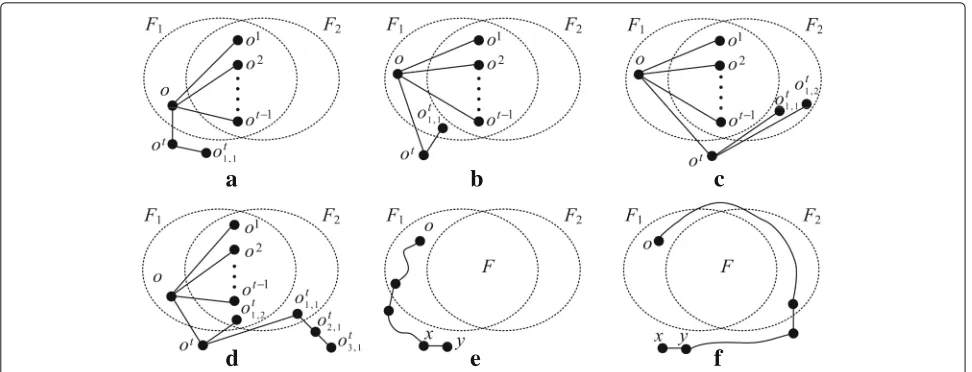
Fig. 1Topological conditions for characterizing a pairX1,X2of two distinguishable fault sets:a&bThe first condition of Lemma 1;c&dthe second condition of Lemma 1;ethe third condition of Lemma 1;fthe fourth condition of Lemma 1
ProofSuppose that G is one-step t-fault diagnosable under the comparison model. If there is some vertex x not one-step t-identifiable inG, thenGcontains a pair of indistinguishable fault sets F1,F2, both of which have
at most t elements so that x is in F1F2 according to
Definition 3. Obviously, G is not one-step t-fault diag-nosable, which is an trivial contradiction against the assumption.
On the other hand, suppose that all vertices of Gare one-stept-identifiable under the comparison model. IfG is not one-step t-fault diagnosable, then G contains an indistinguishable pair F1,F2 of two fault sets that satisfy
|F1| ≤tand|F2| ≤t. SinceF1 =F2, the setF1F2is not
empty; i.e., it has at least one vertex, sayy. Therefore, it fol-lows from Definition 3 thatyis not one-stept-identifiable under the comparison model, which is a contradiction against the assumption.
By the argument of contradiction, the proof is com-pleted.
The next theorem is an extension to the original concept behind Theorem 1 for meeting the condition on restrictive fault sets.
Theorem 2Under the comparison model, a graph G is restrictively one-step t-diagnosable if and only if all vertices in G are restrictively one-step t-identifiable.
ProofSuppose that G is restrictively one-step t -diagnosable under the comparison model. If there is some
vertexxinGnot restrictively one-stept-identifiable, then Gcontains a pair of indistinguishable fault setsF1,F2, both
of which have at mosttelements so thatxis inF1F2, in
accordance with Definition 3. Hence, it follows from Def-inition 2 thatGis not restrictively one-stept-diagnosable, which is an obvious contradiction against the assumption. On the other hand, suppose that all vertices of G are restrictively one-step t-identifiable. If G is not restrictively one-step t-diagnosable, then G contains an indistinguishable pair F1,F2 of two restrictive fault
sets that satisfy |F1| ≤ t and |F2| ≤ t in
accor-dance with Definition 2. Since F1 = F2, the set F1F2 is not empty; i.e., it has at least one
ver-tex, say v. Consequently, it follows from Definition 3 that v cannot be restrictively one-step t-identifiable, which is a straightforward contradiction against the assumption.
By the argument of contradiction, the proof of this theorem is completed.
Lett=degG(o). For anyh≥1, anh-extending star with
rooto is denoted byES(Gh)(o), which is a subgraph ofG defined below:
• V
ES(h) G (o)
= {o} ∪hi=1jt=1{oi,j}.
• EES(Gh)(o)=
t
j=1
{o,o1,j}∪{oi,j,oi+1,j} |h−1≥i≥1if
h≥2, and
• E
ES(h) G (o)
=t j=1
{o,o1,j}
Algorithm 1: FD(ES(G4)(o))
Input:ES(G4)(o).
Output: The status of nodeo, which is 0 (respectively, 1) if
ois normal (respectively, faulty).
begin
t←degG(o);
n0← |{1≤j≤t|γ ({o,o2,j}o1,j)=0,γ ({o1,j,o3,j}o2,j)=
0,γ ({o2,j,o4,j}o3,j)=0}|;
n1← |{1≤j≤t|γ ({o,o2,j}o1,j)=1,γ ({o1,j,o3,j}o2,j)=
0,γ ({o2,j,o4,j}o3,j)=0}|;
ifn0≥n1then
return0 ;
/* The status ofois normal. */
else
return1 ;
/* The status ofois faulty. */
end end
Figure 2a, b illustrates 3- and 4-extending stars, respec-tively. Chiang and Tan [8] developed an efficient method (Algorithm 1) to execute the comparison-based fault diagnosis based on a 4-extending star.
Theorem 3[8]LetES(G4)(o) denote a 4-extending star. The algorithmFD(ES(G4)(o))(Algorithm1)returns a
cor-rect status of the root o ifES(G4)(o)contains at most degG(o) faulty vertices.
Unfortunately, Algorithm 1 is likely to make an incorrect decision if the number of faults in ES(G4)(o) is greater than degG(o), as shown in the following
examples.
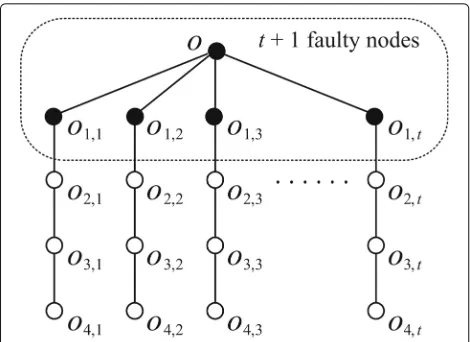
Example 1Suppose that the faulty nodes are distributed as those black nodes shown in Fig.3, whereas white nodes are normal. Since o1,j is now faulty for every 1 ≤ j ≤ t, it makes an unreliable comparison. We assume that
γ ({o,o2,j}o1,j)is 0 or 1 at random for each j. Because both o2,jand o3,jare normal for1≤j≤t, they are able to make a correct comparison. Thus, we getγ ({o1,j,o3,j}o2,j)=1and
γ ({o2,j,o4,j}o3,j) = 0for each j. Accordingly, Algorithm1 computes n0 = n1 = 0and returns 0 as output. That is, the algorithm identifies o as a normal node, which is an incorrect result.
Example 2Suppose that black nodes are faulty and white nodes are normal in Fig.4. Under the comparison model, faulty nodes make an unreliable comparison. Therefore, Algorithm 1 still computes n0 = n1 =
0 and returns 0 as output, which is an incorrect result.
a
b
c
Fig. 3A scenario that the algorithmFD(ES(G4)(o))(Algorithm 1) makes an incorrect decision, in which black and white nodes are faulty and normal, respectively
Abranching star architecturewith rootois denoted by BSG(o), which is a subgraph ofGdefined below:
• V(BSG(o))=
{o} ∪tk=1{ok,ok1,1,o1,2k ,ok2,1,ok2,2,ok3,1,ok3,2}.
• E(BSG(o))=tk=1
{o,ok}∪
{ok,ok1,1},{ok,ok1,2}∪{oki,j,oki+1,j} |1≤i,j≤2.
See Fig. 2c for illustration.
To prove the next theorem, we need an additional term - vertex cover, which can be referred to in [5].
Theorem 4Suppose that degG(o) ≥ 2. Under the com-parison model, o is restrictively one-step (degG(o)+ 1) -identifiable if there exists a branching star architecture with root o in G.
Fig. 4A scenario that the algorithmFD(ES(G4)(o))(Algorithm 1) makes an incorrect decision, in which black and white nodes are faulty and normal, respectively
Proof We assume that G contains a branching star BSG(o)with rooto. Throughout this proof,F1andF2are
two different restrictive fault sets satisfying the following conditions: (1) bothF1andF2has at mostt+1 elements,
and (2)ois inF1F2. By symmetry, we assume thatois in F1. For the sake of convenience, letFdenote the
intersec-tion ofF1 andF2, andpdenote the number of elements
inF. Obviously, the value ofpranges from 0 tot. BothF1
andF2are restrictive fault sets, so is their intersectionF.
Becauseois not inF, we derive the following inequality: r= |F∩NhdG(o)| ≤min{p,t−1}. Without loss of
gener-ality, we can further make an assumption thator+1,. . .,ot are normal; that is,{oi|r+1≤i≤t} ∩F= ∅. Then, we consider the possibilities ofr.
Case I:r = t−1. That is, we have{o1,. . .,ot−1} ⊆ F.
Because bothF1andF2are restrictive fault sets, we obtain ot∈F1∪F2.
Subcase I.1: ot1,1 or ot1,2 is not in F1 ∪ F2. Here
we further make an assumption that ot1,1 ∈ F1 ∪ F2. See Fig. 5a for illustration. Thus, it follows from
Lemma 1 that F1 is distinguishable from F2, and vice
versa.
Subcase I.2:Bothot1,1andot1,2are inF1∪F2. We take
into accounts the following three conditions.
Condition I.2.A:ot1,1orot1,2 is inF1\F2. See Fig. 5b,
in which we assume ot1,1 ∈ F1 \ F2. Consequently, it
follows from Lemma 1 that F1 and F2 form a pair of
distinguishable restrictive fault sets.
Condition I.2.B:Bothot1,1andot1,2are inF2\F1. See
Fig. 5c. By Lemma 1,F1andF2remain to form a pair of
distinguishable restrictive fault sets.
Condition I.2.C:One ofot1,1andot1,2is inF2\F1, and
the other is in F1 ∩F2. Without loss of generality, we
assume ot1,1 ∈ F2 \ F1. Then, ot2,1 and ot3,1 are not in F1∪F2. See Fig. 5d. Again, it follows from Lemma 1 thatF1
andF2constitute a pair of distinguishable restrictive fault
sets.
Case II: r ≤ t −2. Referring to the definition given in [5], acomponentinGis the maximal connected sub-graph of G. Let Co be the component of BSG(o) − F
that obelongs to. Thus,Co contains{o} ∪ti=r+1{oi} ∪
oi1,1,oi2,1,oi3,1,oi1,2,oi2,2,oi3,2\F. It is straightforward to see that the cardinality of any vertex cover S ofCo is at
least [ 2(t−r)−(p−r)]+(t−r)+1=3t−2r−p+1 ifScontainso. Comparing this number with the value of |F1F2| ≤2(t−p+1), we have(3t−2r−p+1)−(2t−
2p+2)=t+p−2r−1≥(p−r)+1≥1. Hence, we get a fact thatShas two nodesx,ythat are adjacent and reside outsideF1F2. So, bothxandyare not inFbecauseCo
is a component ofBSG(o)\F). Accordingly, there exists a
path inCo connecting edge{x,y}and nodeothroughF1
orF2(see Fig. 5e, f). Again, it follows from Lemma 1 that F1andF2form a pair of distinguishable restrictive fault
a
b
c
d
e
f
Fig. 5Illustrating the proof of Theorem 4:aSubcase I.1;bCondition I.2.A;cCondition I.2.B;dCondition I.2.C;e&fCase II
In summary, o is restrictively one-step (t + 1) -identifiable by Definition 3, and the proof is com-pleted.
On the basis of branching star architectures, we develop a localized fault diagnosis algorithmCFD(Algorithm 2) that can detect restrictive faults under the comparison model.
Theorem 5Let BSG(o) denote a branching star with root o. Suppose that o is linked to a normal neighbor. Then, the proposed methodCFD(BSG(o))(Algorithm2) returns a correct status of the root o ifBSG(o) contains at most degG(o)+1faulty vertices.
ProofThe proof proceeds using arguments of contra-diction. Lett=degG(o). Suppose thatBSG(o)contains at
mostt+1 faulty vertices andFdenote the set of all faulty vertices.
Ifγ {ok1,p,ok3,p}ok
2,p
= 1 for somek ∈ {1, 2,. . .,t}and p ∈ {1, 2}, then we assume, without loss of generality,
γ ({o11,2,o13,2}o1
2,2) = 1. Then, at least one ofo
1
1,2,o12,2, and o13,2is faulty. Thus,BSG(o)−ti=1{oi1,2,oi2,2,oi3,2}, which is
isomorphic toES(G4)(o), contains at mosttfaulty nodes. By Theorem 3,FD(ES(G4)(o))is able to identify the true sta-tus ofo. Otherwise, we haveγ {ok1,p,ok3,p}ok
2,p
= 0 for all k∈ {1, 2,. . .,t}andp∈ {1, 2}.
For the sake of convenience, let n[∗] [ 1]= t − n[ 0] [ 0]−n[ 1] [ 0].
Case 1:n[ 0] [ 0]−n[ 1] [ 0]≥0.
Subcase 1.1: n[ 0] [ 0]−n[ 1] [ 0]≥ 1 or n[ 0] [ 0]= n[ 1] [ 0]≥ 1. On the contrary, we assume thatois faulty. When γ ({o,ok1,p}ok),γ ({ok,ok2,p}ok
1,p),γ ({o k
2,p,ok3,p}ok
2,p)
=
(0, 0, 0)for somek∈ {1, 2,. . .,t}andp∈ {1, 2}, then all of ok,ok1,p, andok2,pare faulty. Thus, we derive the following inequality:
|F| ≥ 1+3n[ 0] [ 0]+n[∗] [ 1]
≥ 1+n[ 0] [ 0]+n[ 1] [ 0]+n[∗] [ 1]+n[ 0] [ 0] ≥ 1+t+n[ 0] [ 0]
≥ t+2,
which is a contradiction against the assumption of|F| ≤ t+1. As a result, the status ofois normal.
Subcase 1.2:n[ 0] [ 0]= n[ 1] [ 0]= 0. That is, it means
γ ({ok,ok2,1}ok
1,1) = γ ({o
k,ok 2,2}ok
1,2) = 1 for every 1 ≤
k ≤ t. We further make an assumption that the status ofotis normal. Obviously, the number of faulty nodes in
t−1
k=1{ok,ok1,1,ok2,1,ok1,2,ok2,2} amounts to at least(t− 1).
Moreover,ot1,1orot2,1is faulty;ot1,2orot2,2is faulty. Thus, we can deduce thatt+1≥ |F| ≥(t−1)+2=t+1, and the status ofomust be normal.
Case 2:n[ 0] [ 0]−n[ 1] [ 0]≤ −1.
Subcase 2.1: n[0] [0]−n[1] [0]≤ −2. On the con-trary, we assume thato is normal. When γ ({o,ok1,p}ok),
γ ({ok,ok2,p}ok
1,p),γ ({o k
2,p,ok3,p}ok2,p)
= (1, 0, 0) for some k ∈ {1, 2,. . .,t} and p ∈ {1, 2}, then both ok1,p and ok2,p are faulty. Thus, we get a contradiction as fol-lows: |F| ≥ 2n[ 1] [ 0]+n[∗] [ 1]≥ (n[ 0] [ 0]+2) + n[ 1] [ 0]+n[∗] [ 1]≥t+2.
Subcase 2.2:n[ 0] [ 0]−n[ 1] [ 0]= −1 andn[ 0] [ 0]≥1. If o is normal, then we get a contradiction since|F| ≥ 4n[ 1] [ 0]+n[∗] [ 1]= (n[ 0] [ 0]+1) + 3n[ 1] [ 0]+n[∗] [ 1]=t+1+2n[ 1] [ 0]≥t+3. Hence,omust be faulty.
Algorithm 2: CFD(BSG(o)) Input:BSG(o).
Output: The status of nodeo, which is 0 (respectively, 1) ifois normal (respectively, faulty).
begin t+2, which is a straightforward contradiction violating the assumption of |F| ≤ t + 1. We further claim that
γ ({o,ok1,2}ok) = 1. If not, thenok1,1, ok2,1, and ok2,2 are all
faulty so that|F| ≥ (t−1)+3 = t+2. By contradic-tion, the claim holds. Sinceγ ({o,ok1,2}ok) = 1,ohas to be
faulty. Suppose, by contradiction, thatois normal. Then ok1,1,ok2,1,ok1,2, andok2,2are all faulty and|F| ≥ (t−1)+ 4=t+3, which is an obvious contradiction violating the assumption of|F| ≤t+1.
As a consequence, the algorithmCFD(BSG(o))returns
a correct status of o, provided that BSG(o) contains at
most t+ 1 faulty vertices, and o is linked to a normal neighbor.
The time complexity ofCFD(BSG(o))is analyzed below.
We make an assumption that a comparator takes con-stant time differentiating responses from any two of its neighbors. Then, the time complexity of CFD(BSG(o))
is O(|V(BSG(o))|). Since|V(BSG(o))| = 7degG(o) +1,
the time taken for determining the status of node o is O(degG(o)). We can apply this algorithm to every node
in a WANET one after another. Let denote the maxi-mum degree of a WANET with underlying topologyG. In general, the total time for identifying all nodes isO(N), whereN is the amount of nodes. In literature, Sengupta and Dahbura [25] first presented a diagnosis algorithm whose time complexity is O(N5). Later, Yang and Tang [30] addressed a more efficient fault identification under the comparison model and developed anO(N3δ) algo-rithm with respect to N-node networks, whereδ is the minimum node degree. Compared with these previous results, our approach contributes a significant improve-ment.
4 Applications
This section presents some examples to show how CFD(BSG(o)) (Algorithm 2) does accomplish the fault
detection. In the first example, suppose that
F1= {o,o11,2,o13,1,o33,1,o5,o52,1}
is a set of six faulty nodes in BSG(o). A
possi-ble syndrome set on BSG(o) is illustrated in Fig. 6a.
According to the decision flow (the leading if-else block) of CFD(BSG(o)), since γ {o11,2,o13,2}o1
In the second example, suppose that
F2= {o12,1,o22,2,o3,o5,o51,1,o52,1} In the third example, suppose that
a
b
Fig. 6 aA syndrome set onBSG(o)andbthe remaining syndromes
onES(G4)(o), in which black and white nodes are faulty and normal, respectively, and the number next to each node is the comparison result
is a set of six faulty nodes in BSG(o). A possible
syndrome set on BSG(o) is illustrated in Fig. 7b. Since
γ{ok1,p,ok3,p}ok
2,p
= 0 for every 1 ≤ k ≤ 5 and
p∈ {1, 2}, it runs the else-block and computesn[ 0] [ 0]= 1 and n[ 1] [ 0]= 2. Accordingly, CFD(BSG(o)) returns
1 since n[ 0] [ 0]−n[ 1] [ 0]< 0. That is, o is a faulty node.
The proposed algorithm is also capable of identifying faults in some static network structures including two of the most popular ones, hypercubes and star-graph net-works. These two networks have been approved for their promising topological properties. To apply the proposed algorithm, it suffices to show that branching star architec-tures can be embedded into them.
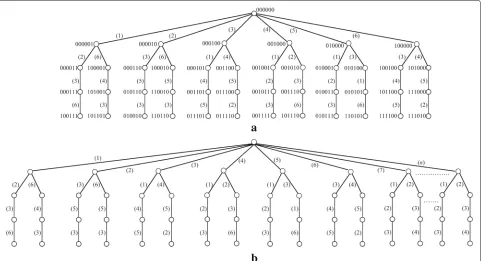
Lai [19] developed anO(n)-time procedure for creating 4-extending stars within ann-dimensional bijective con-nection graphBCn, n ≥ 5. One important instance of BCnis surely then-dimensional hypercubeQn[10]. Below,
we show how to build branching star architectures in the hypercube: A unique n-bit binary string is assigned to each node ofQn. An edge links two nodes in Qn if and
only if they differ at one and only one position. When two nodes differ atith bit withi∈ {1, 2,. . .,n}, the edge linking these two nodes is called an (i)-edge. Figure 8 is a sys-tematic framework to obtain branching star architectures inQn.
Forn ≥ 3,SGnstands for the star-graph network that
has the set of all permutations over{1, 2,. . .,n}to form its vertex set [1]. In SGn, each vertex is labeled by an
individual permutation x1x2. . .xn and is linked to the
other(n− 1) verticesxix2. . .xi−1x1xi+1. . .xn for every
2 ≤ i ≤ n. The edge linking vertices x1x2. . .xn and xix2. . .xi−1x1xi+1. . .xn is an (i)-edge. Figure 9 depicts
a
b
Fig. 7Two syndrome sets onBSG(o), in which black and white nodes are faulty and normal, respectively, and the number next to each node is the
a
b
Fig. 8 aA branching star architecture with root 000000 inQ6;ba branching star architecture inQnforn≥6
an instance of branching star architecture inSGnfor any n≥5.
5 Conclusions
Among various networking technologies, the WANET is critical for creating high-performance ubiquitous com-puting systems. A WANET is a kind of wireless network in which some nodes are self-organized in a wireless local area network. Node mobility is the most important prop-erty for WANETs. According to Grossglauser and Tse [11], mobility can increase the capacity of a WANET. Due to the undecided number of nodes even during a short duration, main difficulties of maintaining a WANET result from the properties of node mobility and frequent node failure. In this paper, a comparison-based approach to system-level
fault detection is addressed, and accordingly, we devel-oped a localized fault detection algorithm for WANETs. The contributions are highlighted as follows:
1. A localized fault detection algorithm,CFD(BSG(o)),
is proposed for stronglyt-diagnosable WANETs
under the comparison model.
2. The proposed algorithm is formally proved to assure its validity.
3. The algorithmCFD(BSG(o))incurs only linear time
complexity, which is relatively efficient compared to some others in literature.
4. Examples are presented to clarify howCFD(BSG(o))
does accomplish the comparison-based fault detection.
a
b
Acknowledgements
The authors would like to thank the anonymous referees and the editors for their thorough review. The suggested comments help us improve the present manuscript significantly. In particular, our gratitude also goes to Prof. Michael Burton, Asia University, for his effort into language editing. This work is supported in part by the Ministry of Science and Technology, Taiwan, Republic of China, under Grants MOST 468-002 and MOST 104-2221-E-468-003.
Competing interests
The authors declare that they have no competing interests.
Author details
1Department of Computer Science and Information Engineering, Asia
University, 413 Taichung City, Taiwan.2Department of Computer Science and
Information Engineering, Hungkuang University, 433 Taichung City, Taiwan.
3School of Computer Science and Technology, Soochow University, Suzhou,
China.4Department of Medical Research, China Medical University Hospital,
China Medical University, 404 Taichung City, Taiwan.
Received: 1 April 2016 Accepted: 29 August 2016
References
1. SB Akers, B Krishnamurthy, A group-theoretic model for symmetric interconnection networks. IEEE Trans. Comput.38(4), 555–566 (1989) 2. I Ambika, V Pillai Sadasivam, P Eswaran, An effective queuing architecture
for elastic and inelastic traffic with different dropping precedence in MANET. EURASIP J. Wirel. Commun. Netw.2014, 155 (2014)
3. M Barbeau, E Kranakis,Principles of ad hoc networking. (Wiley, New York, 2007)
4. F Barsi, F Grandoni, P Maestrini, A theory of diagnosability of digital systems. IEEE Trans. Comput.25(6), 585–593 (1976)
5. G Chartrand, OR Ollermann,Applied and algorithmic graph theory. (McGraw-Hill, New York, 1993)
6. C-A Chen, S-Y Hsieh,(t,k)-Diagnosis for component composition graphs under the MM* model. IEEE Trans. Comput.60(12), 1704–1717 (2011) 7. H-C Chen, TCABRP: A trust-based cooperation authentication bit-map
routing protocol against insider security threats in wireless ad hoc networks. IEEE Syst. J (2015). doi:10.1109/JSYST.2015.2437285 8. C-F Chiang, JJM Tan, Using node diagnosability to determine
t-diagnosability under the comparison diagnosis model. IEEE Trans. Comput.58(1), 251–259 (2009)
9. F-T Chien, K-G Wu, Y-W Chan, M-K Chang, Y-S Su, An effective routing protocol with guaranteed route preference for mobile ad hoc networks. Int. J. Distrib. Sens. Netw.2014(532049), 2014 (2014).
doi:10.1155/2014/532049
10. J Fan, L He, BC Interconnection networks and their properties. Chin. J. Comput.26(1), 84–90 (2003)
11. M Grossglauser, DNC Tse, Mobility increases the capacity of ad hoc wireless networks. IEEE/ACM Trans. Netw.10(4), 477–486 (2002) 12. S-Y Hsieh, Y-S Chen, Strongly diagnosable product networks under the
comparison diagnosis model. IEEE Trans. Comput.57(6), 721–732 (2008) 13. S-Y Hsieh, Y-S Chen, Strongly diagnosable systems under the comparison
diagnosis model. IEEE Trans. Comput.57(12), 1720–1725 (2008) 14. S-Y Hsieh, C-W Lee, Diagnosability of two-matching composition
networks under the MM* model. IEEE Trans. Dependable Secure Comput. 8(2), 246–255 (2011)
15. G-H Hsu, C-F Chiang, L-M Shih, L-H Hsu, JJM Tan, Conditional diagnosability of hypercubes under the comparison diagnosis model. J. Syst. Archit.55(2), 140–146 (2009)
16. J Kumar, A Kathirvel, N Kirubakaran, P Sivaraman, M Subramaniam, A unified approach for detecting and eliminating selfish nodes in MANETs using TBUT. EURASIP J. Wirel. Commun. Netw.2015, 143 (2015) 17. T-L Kung, H-C Chen, Toward the fault identification method for
diagnosing stronglyt-diagnosable systems under the PMC model. Int. J. Commun. Netw. Distrib. Syst.15(4), 386–399 (2015)
18. T-L Kung, H-C Chen, L-H Hsu, inProc. 2015 International Congress on Natural Sciences and Engineering (2015 ICNSE), Kyoto, Japan, May 7–9 2015, Higher Education Forum (HEF). A topological condition for recognizing strongly diagnosable systems under the comparison model, (2015), pp. 314–319
19. P-L Lai, A systematic algorithm for identifying faults on hypercube-like networks under the comparison model. IEEE Trans. Reliab.61(2), 452–459 (2012)
20. P-L Lai, JJM Tan, C-P Chang, L-H Hsu, Conditional diagnosability measures for large multiprocessor systems. IEEE Trans. Comput.54(2), 165–175 (2005)
21. J Maeng, M Malek, inProc.11th Int. Symp. Fault-Tolerant Comput. (FTCS’81), Portland, USA, June 24-26, 1981, IEEE CS. A comparison connection assignment for self-diagnosis of multiprocessors systems, (1981), pp. 173–175
22. S Palaniappan, K Chellan, Energy-efficient stable routing using QoS monitoring agents in MANET. EURASIP J. Wirel. Commun. Netw.2015, 13 (2015)
23. FP Preparata, G Metze, RT Chien, On the connection assignment problem of diagnosis systems. IEEE Trans. Electron. Comput.16(12), 848–854 (1967) 24. N Renugadevi, C Mala, Improved group key agreement for emergency
cognitive radio mobile ad hoc networks. J. Wirel. Mob. Netw. Ubiquit. Comput. Dependable Appl.6(3), 73–86 (2015)
25. A Sengupta, A Dahbura, On self-diagnosable multiprocessor systems: diagnosis by the comparison approach. IEEE Trans. Comput.41(11), 1386–1396 (1992)
26. V Sharma, R Kumar, N Rathore, Topological broadcasting using parameter sensitivity-based logical proximity graphs in coordinated ground-flying ad hoc networks. J. Wirel. Mob. Netw. Ubiquit. Comput. Dependable Appl. 6(3), 54–72 (2015)
27. S Subramaniyan, W Johnson, K Subramaniyan, A distributed framework for detecting selfish nodes in MANET using record- and trust-based detection (RTBD) technique. EURASIP J. Wirel. Commun. Netw.2014, 205 (2014) 28. W Xiong, J Xu, Y Li, N Zhao, X Wan, J Liang, Minimum node degree of
k-connected vehicular ad hoc networks in highway scenarios. EURASIP J. Wirel. Commun. Netw.2016, 32 (2016)
29. M-C Yang, Conditional diagnosability of matching composition networks under the MM* model. Inf. Sci.233, 230–243 (2013)
30. X Yang, YY Tang, Efficient fault identification of diagnosable systems under the comparison model. IEEE Trans. Comput.56(12), 1612–1618 (2007) 31. XM Zhang, Y Zhang, F Yan, AV Vasilakos, Interference-based topology control algorithm for delay-constrained mobile ad hoc networks. IEEE Trans. Mob. Comput.14(4), 742–754 (2015)
32. Q Zhu, G Guo, D Wang, Relating diagnosability, strong diagnosability and conditional diagnosability of strong networks. IEEE Trans. Comput.63(7), 1847–1851 (2014)
Submit your manuscript to a
journal and benefi t from:
7Convenient online submission
7Rigorous peer review
7Immediate publication on acceptance
7Open access: articles freely available online
7High visibility within the fi eld
7Retaining the copyright to your article
![Table 1 Validation rules of the fault detection under thecomparison model [21]](https://thumb-us.123doks.com/thumbv2/123dok_us/936465.1113931/3.595.56.291.593.730/table-validation-rules-fault-detection-thecomparison-model.webp)
![Figure 2a, b illustrates 3- and 4-extending stars, respec-tively. Chiang and Tan [8] developed an efficient method](https://thumb-us.123doks.com/thumbv2/123dok_us/936465.1113931/5.595.58.544.421.713/figure-illustrates-extending-respec-tively-chiang-developed-efficient.webp)