R E S E A R C H
Open Access
A fast and low-complexity matrix
inversion scheme based on CSM method
for massive MIMO systems
Yue Xu
1*, Weixia Zou
1and Liutong Du
2Abstract
Massive multiple-input-multiple-output (MIMO), also known as very-large MIMO systems, is an attracting technique in 5G and can provide higher rates and power efficiency than 4G. Linear-precoding schemes are able to achieve the near optimal performance, and thus are more attractive than non-linear precoding schemes. However, conventional linear precoding schemes in massive MIMO systems, such as regularized zero-forcing (RZF) precoding, have
near-optimal performance but suffer from high computational complexity due to the required matrix inversion of large size. To solve this problem, we utilize the Cholesky-decomposition and Sherman-Morrison lemma and propose CSM (Cholesky and Sherman-Morrison strategy)-based precoding scheme to the matrix inversion by exploiting the asymptoti cally orthogonal channel property in massive MIMO systems. Results are evaluated numerically in terms of
bit-error-rate (BER)and average sum rate. Comparing with the Neumann series approximation of inversing matrix, it is concluded that, with fewer operations, the performance of CSM-based precoding is better than conventional methods in massive MIMO configurations.
Keywords: Massive MIMO, Cholesky-decomposition, Sherman-Morrison lemma, Neumann series, RZF, CSM-based precoding
1 Introduction
Massive multiple-input multiple-output(MIMO), i.e., MIMO with large numbers of transmit and/or receive antennas (massive MIMO technology), is widely accepted as one of the key enabling technologies for next gener-ation(e.g., 5G) wireless communication systems [1, 2]. However, with the increasing of the number of dimen-sions, using conventional MIMO algorithms may not be suitable any more in terms of computational efficiency and new methods must emerge.
Realizing massive MIMO systems has to solve some challenges in practice, one of which is the low-complexity and near-optimal precoding scheme. Conventional pre-coding methods can be divided into nonlinear-prepre-coding and linear precoding. The optimal precoding is the non-linear which is called dirty paper precoding (DPC) [3],
*Correspondence: [email protected]
1KeyLab of Universal Wireless Communications, MOE, Beijing University of
Posts and Telecommunications, 100876 Beijing, People’s Republic of China Full list of author information is available at the end of the article
which can effectively eliminate the interference between different users and achieve optimal performance. How-ever, the most serious drawback of the nonlinear-precoding schemes is high complexity which is unfriendly to hardware. The other nonlinear-precoding schemes, such as lattice-aided precoding [4], can achieve the close-optimal capacity with reduced complexity, but they are still unaffordable when the dimension of the MIMO sys-tem is large or the modulation order is high. Fortunately, due to the characters of massive MIMO systems, such as the columns of channel matrix are asymptotically orthog-onal [5] and the channel hardening [6], the linear coding schemes, such as RZF precoding and MMSE pre-coding, can also achieve the near-optimal capacity, which makes a better trade-off between the complexity and the performance. However, these schemes require computing unfavorable matrix inversion of large size. To solve this problem, based on Neumann series approximation algo-rithm, [7] proposed the Neumann-based precoding which can reduce the complexity by converting the matrix inver-sion into a series of matrix-vector multiplications. Then,
[8–10] proposed SORbased, LSQRbased, and TPE -based schemes, respectively, which are all -based Neumann serise. But, these algorithms’ the reduction in complexity is not obvious and do not consider the property of positive defined Hermitian matrix.
In this paper, we propose CSM-based precoding to reduce the complexity of matrix inversion for classi-cal RZF or MMSE precoding. This is motivated by the fact that the matrix which needs to be inversed in RZF or MMSE precoding is a positive definite Hermi-tian matrix and tends to be diagonal dominant in mas-sive MIMO systems [1], which provides the potential to utilize the Cholesky-Decomposition [11] and Sherman-Morrison lemma [12]. We also conclude that CSM-based precoding can enjoy a better performance and lower com-putation complexity than the Neumann-based precoding and SOR-based precoding. The impact of the algorithms in the average sum rate and BER are evaluated and com-pared via numerical simulations.
Notation: lower-case and upper-case boldface letters denote vectors and matrices, respectively;(·)T,(·)H,(·)−1, det(·)andtr(·)denote the transpose, conjugate transpose, matrix inversion, determinant and trace, respectively;C denotes the set of complex numbers, IN is the N×N identity matrix.
2 System model
We consider the typical downlink transmission of a mas-sive multi-user MIMO system, where each base station (BS) in cells is equipped with N antennas and com-municates with K single-antenna users(K N) [1]. Meanwhile, we also assume that channel state informa-tion (CSI) is known at the BS perfectly, which is a common assumption in massive MIMO systems [13, 14] and can be acquired by the training pilot [15]. More importantly, we assume that time division duplex (TDD) protocols are used so that the channel vectors are equal for both directions. In time division duplex (TDD) massive MIMO systems, the BS estimates the uplink channel by using the pilots that users send in the uplink, and then the down-link CSI can be easily acquired by using existing channel reciprocity in TDD systems.
In the downlink, the received signal atithuser injthcell is:
yj,i=hj,ixj,i+nj,i (1) where,xj,iis the transmit signal after precoding injthcell and hj,i represents the random channel vector fromjth cell’s BS toith user. And nj,i is additive white Gaussian noise (AWGN) and follows the distribution CN(0,σn2). The channel vector from jth cell’BS toith user can be specified as below form:
hj,i=κj,iRj1,/i2zj,i (2)
where, zj,i is small scale fading vector that is inde-pendent and identically distributed (i.i.d) zero mean, circularly-symmetric complex Gaussian random variables CN(0, 1),κj,i is large scale fading coefficient which is accounted by path loss and shadow fading of eachithuser that changes slowly and can remain constant over a coher-ence time interval and known prior andRj,iis the channel covariance matrix.
Thus, the received vector in jthcell, denoted byyj =
yj,1,yj,2,yj,3· · ·yj,KT ∈CK×1, at the receiver is given as:
yj=Hj·xj+nj (3)
where,Hj =
hj,1,hj,2,hj,3· · ·hj,N
∈CK×N is the down-link channel matrix, which contains small scale fading factor, large scale fading coefficient and channel covari-ance matrix. xj ∈ CN×1is signal vector after precoding which satisfies the power limitationE[xj22]≤ K . And nj ∈CK×1is additive white Gaussian noise (AWGN) and follows the distributionCN(0,σ2
n).
For massive MIMO systems, linear-precoding is usually considered, so we have
xj=Tj·sj, (4)
whereTj =
tj,1,tj,2,tj,3· · ·tj,K
∈ CN×K is the precod-ing matrix, andsj =
sj,1,sj,2,sj,3· · ·sj,K
T
∈ CK×1is the transmitted signal vector forKusers. We also denote the total transmit power constraints at BS injthcell as
trHj·HHj
=Pj, (5)
wherePjis the total transmit power injthcell.
In the next section, we will analyze the existing clas-sic massive MIMO precoding method (i.e., RZF precoding and MMSE precoding), as well as the proposed CSM-based scheme.
3 Low-complexity linear-precoding scheme in massive MIMO
In this section, we first give a basic background of the con-ventional RZF precoding and MMSE precoding. Then, we give the relative knowledge of Cholesky-decomposition [11] and Sherman-Morrison lemma [12]. After that, we prove that CSM-based precoding has a lower computa-tional complexity and better performance than Neumann-based precoding and SOR-Neumann-based precoding. Finally, we give the pseudo code of CSM-based precoding algorithm.
3.1 Conventional RZF and MMSE precoding
The conventional RZF precoding and MMSE precoding matrix can be expressed, respectively, as [6]:
Thus, the classical RZF precoding and MMSE precoding matrix injthcell is:
TRZF,j=ρRZF,j·HHj ·(Hj·HHj +φ·IK)−1 (8)
=ρRZF,j·HjH·W−RZF1 ,j (9)
TMMSE,j=ρMMSE,j·HHj ·(Hj·HHj +
σ2
n ·nt
·IK)−1 (10)
=ρMMSE,j·HHj ·W−MMSE1 ,j, (11)
where WRZF,j = (Hj·HjH +φ·IK) and WMMSE,j =
(Hj·HHj +
σ2
n ·nt
·IK). The φj is regularized param-eter which can be adaptively selected according to the different CSI, σn2 is noise power and nt is number of transmitted antenna [6, 16]. And, theρRZF,j or ρMMSE,j is the power normalization factor which makes RZF pre-coding or MMSE prepre-coding satisfy the power limitation. Therefore,ρRZF,jandρMMSE,jcan be computed by:
ρRZF,j=
K
tr
WRZF,j·WHRZF,j
(12)
ρMMSE,j=
K
trWMMSE,j·WHMMSE,j
(13)
So, the signal vectorxcan be rewritten as:
x=TRZF ·s=ρ·HH·W−RZF1 ·s (14) or
x=TMMSE·s=ρ·HH·W−MMSE1 ·s (15) We can observe from the (9) or (11) that a matrix WRZF or WMMSE inversion of K × K size is required which means that the high computational complexity is unexpected and unacceptable. If we compute the inver-sion directly, the resource of hardware would be wasted greatly. Therefore, combining the property of matrix WRZF orWMMSEand some mathematic knowledge such as Cholesky-Decomposition [11] and Sherman-Morrison lemma [12], we design a low-complexity precoding scheme to solve this problem.
3.2 CSM-based precoding
To reduce the computational complexity for precoding, we propose to use CSM-based scheme to avoid the complicated matrix inversion of large size in RZF or MMSE precoding. First, it is necessary to verify that the matrixWRZFandWMMSEare positive definite Hermitian
matrix. Here, assuming an arbitrary nonzero vectort ∈ CN×1, then we can certificate that
t·WRZF·tH =t·(H·HH+φ·IK)·tH (16)
=t·H·(t·H)H+t·(φ·IK)·tH >0 (17) and
t·WMMSE·tH =t·(H·HH+
σ2
n·nt
·IK)·tH (18)
=t·H·(t·H)H+t·(σn2·nt
·IK)·tH >0. (19) Meanwhile,
WHRZF =(H·HH+φ·IK)H =WRZF (20)
and
WHMMSE=(H·HH +σn2·nt
·IK)H =WMMSE. (21)
So, the important conclusion thatWRZF andWMMSE are positive definite Hermitian matrix is clear. Due to RZF precoding is as same as MMSE precoding in decompo-sition and inversion process. Therefore, we just utilize the RZF precoding as an example to demonstrate the CSM-based scheme. Now, we can utilize the Cholesky-decomposition [11] to decompose the matrix WRZF as
WRZF =L·LH, (22)
where matrixLis the lower triangular matrix. Then, we have knowledge that
W−RZF1 =(LH)−1·L−1. (23)
Thus, computing the inversion of matrixWRZF can be transformed into computing the inversion of matrixL . Continue to utilize the Sherman-Morrison lemma [12] to iterate the process of computing theLsmatrix inver-sion. Here, we should introduce the Sherman-Morrison lemma [12].
SupposeAis an invertible square matrix andx,yare col-umn vectors. Suppose furthermore that 1+yH·A−1·x=0 and(A+x·yH)is invertible. Then, the Sherman-Morrison formula states that
A+x·yH−1=A−1− A
−1·x·yH·A−1
1+yH·A−1·x . (24)
This lemma inspires us that we can utilize iteratively method to calculate several times’ simple matrix inversion instead of computing directly complex matrix inversion and eventually simplify the high computational complex-ity to lower computational complexcomplex-ity.
In order to keep our computational complexity lower, we have to continue to decompose matrixL:
whereD =diag(l1,1,l2,2,· · ·,lK,K)is the diagonal matrix which is diagonal component of LandL = (l1,l2,· · ·, lK−1, 0) is a matrix based onL which the diagonal ele-ments ofLare replaced by zero.
Based on above the idea, we can calculate the inversion of matrixL. First, the matrix should be rewritten as the following form: column of matrixL. Thus, we can compute the inversion by:
continue to the inversion ofFK−2:
FK−2−1=(FK−3+l
whereF0 = D. Due to theDmatrix is diagonal matrix,
its inversion process is simple and efficient. Therefore, the whole process of inversion can be calculate by basic mathematical process and simple process of iteration.
Finally, we can compute the inversion ofLby iterating K−1 times.
3.3 Complexity
We evaluate the computational complexity in terms of required number of complex multiplications which is more dominant and complex than other operations for the total computational complexity.
According to [17], we have knowledge that the Cholesky-decomposition can be decomposed quickly and accurately by hardware such as FPGA. So, the computa-tional complexity of the decomposition can be ignored. Observing the numerator (Fi−1)−1·l
i·ei·(Fi−1)−1 in
(29) or in (31), the column vector ofli and the row vec-tor ofeihave many zero elements (much more than half ). Utilizing computing features of sparse matrix and vector from [18, 19], we have knowledge that the computational
complexity of(Fi−1)−1·li·ei·(Fi−1)−1
1+ei·(Fi−1)−1·li
isO(4K+1). Thus, after
K−1 times of the iterative process, the whole computa-tional complexity ofL−1isO(4K2−3K−1). Thus, we
achieve that the computational complexity of CSM-based RZF precoding isO(4K2).
In [7], the Neumann-based precoding is
W−1≈ N ≥ 3 , the complexity of the Neumann-based precod-ing isO(K3), which means the reduction in the complexity
of RZF precoding is not obvious. On the other hand, the computational complexity of proposed CSM-based pre-coding isO(K2). WhenL=2 , complexity of Neumann-based precoding reduces toO(K2), but its performance would be greatly reduced.
In [8], the SOR-based precoding which is an improve-ment of Neumann is utilizing (22) to calculate the result ofW−1·sby iterating
where theDandLare diagonal component and lower tri-angular component respectively and satisfyW =D+L+ LH.t(i+1)denote the result after(i+1)thiterator.ωis the relaxation parameter and can be computed by
ω=a·e−b·(M/K)+c. (36)
Here,a = 0.404,b = 0.323 andc = 1.035. According the analyze the SOR scheme’s computational complex-ity and performance, we have knowledge that when the times of iterating is i = 3, its performance of sum rate is near optimal but the performance of BER worse than CSM-based precoding, even its complexity isO(4K2) which is as same as based scheme. Therefore, CSM-based precoding has lower computational complexity than Neumann-based precoding and SOR-based precod-ing and better performance.
3.4 Pseudo code of CSM-based precoding algorithm
Algorithm 1CSM-based precoding algorithm
1: INPUT: matrixW
2: initializeIkand decompose matrixWto matrixL 3: decompose the matrixLto the matrixDand matrix
L
4: decompose the matrixL to the form asl1·e1+l
2·
e2+ · · · +l
K−1·eK−1+0·eK
5: form=0 toK−1do 6: ifm=0then
7: calculating the inversion ofF0
8: calculating the formula that (F0)−1 −
(F0)−1·l1·e1·(F0)−1
1+e1·(F0)−1·l1
9: earning the inversion ofF1
10: else
11: utilizing the resultsFm−−11which is obtained last
iteration
12: calculating the formula that (Fm)−1 −
(Fm)−1·lm+1·em+1·(Fm)−1
1+em+1·(Fm)−1·lm+1
13: earning the inversion ofFm+1
14: end if
15: inversion ofFK is the matrixL−1
16: end for
17: calculating the product of matrixLand matrixL−1
18: OUTPUT: matrixW−1
4 Simulation result
We provide the simulation results of average sum rate and BER of the proposed CSM-based precoding in a 256×16 massive MIMO system and a 256×32 massive MIMO system. For convenience, we set the regularized parame-terφ = K/SNR. The RZF precoding with exact matrix inversion is also set as benchmark. We compare the per-formance among RZF precoding, CSM-based scheme, Neumann approximate series and SOR-based precoding in one cell.
Figure 1 compares the average sum rate among RZF precoding, CSM-based scheme, Nuemann-based pre-coding and SOR-based prepre-coding. From the figure, we can observe that performance of CSM-based scheme as well as RZF and better than the SOR-based precod-ing and Neumann-based method. In addition, although during the i increasing, e.g. i = 3 which means the computational complexity of the SOR-based precoding and Neumann-based method precoding are O(K3) and O(4K2), respectively, the performance of SOR-based and Neumann-based have improvement in different level, the performance of Neumann and SOR are sitll close to but less than CSM-based scheme. So, the performance of CSM-based is the best among them.
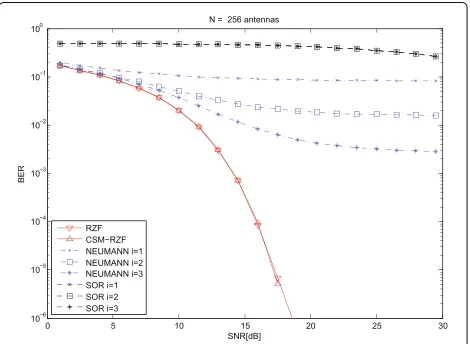
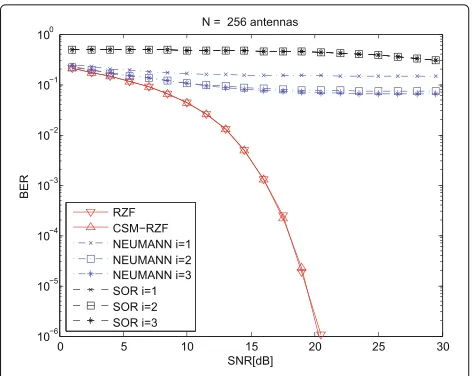
Figures 2 and 3 show that the BER performance com-parison in Rayleigh fading channels. From the two figures,
Fig. 1Average sum rate performance comparison for 256×16 massive MIMO System in Rayleigh fading channels
we can obviously find that when the number of users goes to large in massive MIMO systems, the BER performance of all precoding schemes suffers from severe performance loss due to the limited number of BS antennas in prac-tical systems, but the CSM-based scheme loss less than Neumann-based and SOR-based precoding which means its Robust is the best among them. Then, it is clear that when the i increasing, BER performance of Neumann-based and SOR-Neumann-based precoding have improvement in some extend. But the BER performance of CSM-based precoding is still better than that of Neumann-based pre-coding and SOR-based prepre-coding eveni=3 and close to the RZF. In addition, as SNR increasing, the performance of the proposed CSM-based precoding improves faster.
Fig. 3BER performance comparison for 256×32 massive MIMO System in Rayleigh fading channels
5 Conclusions
In this paper, we exploit the special channel property of massive MIMO systems and some mathematic lem-mas to propose the CSM-based scheme to reduce the computational complexity fromO(K3)to O(K2). Mean-while, CSM-based precoding scheme is able to achieve the near-optimal performance by decomposition and iter-atively approach the exact matrix inversion of large size in RZF precoding or MMSE precoding. Simulation results utilize the RZF-based precoding as an example to illus-trate that when increasing the SNR and keeping theN/K fixed, CSM-based precoding performances of BER and average sum rate are better than Neumann series and other schemes proposed based on Neumann series such as SOR-based precoding. Moreover, CSM-based scheme approaches the near-optimal performance of RZF precod-ing in Rayleigh fadprecod-ing channels.
Acknowledgements
This work was supported by the 863 Program of China under Grant (No.2015AA01A703), the Fundamental Research Funds for the Central Universities under grant (No.2014ZD03-02)NSFC (No. 61571055) and fund of SKL of MMW (No.K201501). Here, it is very grateful to the instructor and above funding for helping my subject.
Competing interests
The authors declare that they have no competing interests.
Author details
1KeyLab of Universal Wireless Communications, MOE, Beijing University of
Posts and Telecommunications, 100876 Beijing, People’s Republic of China.
2State Key Laboratory of Networking and Switching Technology, Beijing
University of Posts and Telecommunications, 100876 Beijing, People’s Republic of China.
Received: 11 June 2016 Accepted: 6 October 2016
References
1. EG Larsson, O Edfors, F Tufvensson, TL Marzetta, Massive MIMO for next generation wireless systems. IEEE Commun. Mag.52(2), 186–195 (2014) 2. L Lu, GY Li, AL Swindlehurst, A Ashikhmin, R Zhang, An overview of
massive MIMO: benefits and challenges. IEEE J. Sel. TopicsSignal Process.
8(5), 742–758 (2014)
3. MH Costa, Writing on dirty paper (corresp). IEEE Trans. Inf. Theory.29(3), 439–441 (1983)
4. JH Lee, Lattice precoding and pre-distorted constellation in degraded broadcast channel with finite input alphabets. IEEE Trans. Commun.58(5), 1315–1320 (2010)
5. F Rusek, D Persson, BK Lau, EG Larsson, TL Marzetta, O Edfors, F Tufvesson, Scaling up MIMO: opportunities and challenges with very large arrays. IEEE Signal Process. Mag.30(1), 40–60 (2013)
6. A Chockalingam, B Sundar Rajan,Large MIMO Systems, India Institute of Science. (Foundations: CAMBRIDGE UNIVERSITY PRESS, Inc., Bangalore, 2004), pp. 17–19
7. H Prabhu, J Rodrigues, O Edfors, F Rusek, inWireless Communications and Networking Conference (WCNC), 2013. Approximativematrix inverse computations for very-large MIMO and applications tolinear pre-coding systems (IEEE, Shanghai, 2013), pp. 2710–2715
8. T Xie, Q Han, H Xu, Z Qi, W Shen, in81st Vehicular Technology Conference(VTC Spring). A Low-Complexity Linear Precoding Scheme Based on SOR Method for Massive MIMO Systems, (IEEE, Glasgow, 2015), pp. 1–5
9. T Xie, Z Lu, Q Han, J Quan, B Wang, in82nd Vehicular Technology Conference(VTC Fall). Low-Complexity LSQR-Based Linear Precoding for Massive MIMO Systems (IEEE, Boston, 2015), pp. 1–5
10. A Mullerx, A Kammounz, E Bjornsonxy, M Debbah, in8th Sensor and multichannel Signal Processing Workshop(SAM). Efficient Linear Precoding for Massive MIMO Systems using Truncated Polynomial Expansion (IEEE, A Coruña, 2014), pp. 273–276
11. A Rontogiannis, V Kekatos, K Berberidis, A square-root adaptiveV-BLAST algorithm for fast time-varying MIMO channels. IEEE Signal Process. Lett.
13(5), 265–268 (2006)
12. J Sherman, WJ Morrison, Adjustment of an inverse matrix corresponding to change in the elements of a given column or a given row of the original matrix(abstract). Ann. Math. Statist.20, 621 (1949)
13. TL Marzetta, Noncooperative cellular wireless with unlimited numbers of base station antennas. IEEE Trans. Wirel. Commun.9(11), 3590–3600 (2010) 14. L Dai, J Wang, Z Wang, P Tsiaflakis, M Moonen, Spectrum and
energy-efficient OFDM based on simultaneous multi-channel reconstruction. IEEE Trans. Singal Process.61(23), 6047–6059 (2013) 15. L Dai, Z Wang, C Pan, Z Yang, Wireless positioning using TDSOFDM signals
in single-frequency networks. IEEE Trans. Broadcast.58(2), 236–246 (2012) 16. BL Ng, JS Evans, SV Hanly, D Aktas, Distributerd downlink beamforming
with cooperative base station. IEEE Trans. Inf. Theory.54(12), 5491–5499 (2008)
17. C-J Wei, C-S Zhang, J Liu, A new method of solving inverse matrix based on Cholesky matrix, Electron. Des. Eng.22(1), 159–164 (2014) 18. N Goharian, D Grossman, T El-Ghazawi, inProceedings: International
Conference on Information Technology: Coding and Computing (ITCC), 2001. Enterprise text processing:A sparse matrix approach (IEEE, Las Vegas, 2001) 19. N Goharian, A Jain, Q Sun, Comparative analysis of sparse matrix