© 2015, IRJET.NET- All Rights Reserved
Page 2278
MANAGEMENT OF RISKS IMPLIED BY CONDITIONS OF CONTRACT AND
SPECIFICATIONS
Chaitali S. Pawar
1, Jalinder R. Patil
2, Suman S. Jain
3, Abhijeet M. Gaikwad
41
Post Graduate Student, Civil Engineering, RMDSSOE Pune, Maharashtra, India
2
Head and Professor, Civil Engineering, RMDSSOE Pune, Maharashtra, India
3
Asso. Professor, Civil Engineering, SCOE Pune, Maharashtra, India
4
Asst. Professor, Civil Engineering, RMDSSOE Pune, Maharashtra, India
---
Abstract-
The study of various risks and their management is becoming pre-requisite for many construction projects and can significantly benefit most all parties. The construction activity involves a number of agencies likeowner, consultant and contractor may have conflicting interests. In order to establish the duties, obligations, rights, responsibilities amongst the agencies, a contract is required to be made between them which will establish a mutual relationship to do a work. The contracts may be used as a risk managing tool to by allocating risks to the various agencies through the various contracts between them and client, contractors and investors. This paper proposes study of risk arises in the condition of contracts and specifications. The qualitative risk analysis is used to analysis helps to predict severity of risks. Risk management includes identification of risks in contract documents, risk classification, risk analysis and then risk control. It has been found that severities of important risks have been calculated considering the suitable control measures from client and contractors point of view. The findings of paper may be used as reference to similar construction projects in India i.e. for local clients, contractors, investors and also for Government.Keywords:
Construction project, Contract documents,
Risks, Qualitative risk analysis, Risk management.
1. INTRODUCTION
A variety of unexpected events may occur in construction projects and many of them can cause losses to the parties involved. Such uncertain events or set of circumstances that have an effect on achievement of one or more of project’s objectives, are commonly called risks. The most
of civil engineering work is performed under contract. A contract provides a “self-contained statement of obligations as between its own parties”. The analysis has also identified several factors responsible for time and cost overruns some within the control of the enterprises and some beyond their control. The contracts are vital to the success of a project is important difficult, costly and lengthy proceedings. The contract documents can be used as a tool to manage risk by allocating risks to the various agencies through the various contracts between them. It is very important for all the agencies that they are aware at all times of the extent of risk exposure or the risks that they have to manage. If this awareness is lacking then it may lead to a number of disputes, disagreements and disruptions. One of the major reasons of disagreement and conflict is inadequate and defective contract documentation and also inappropriate contract arrangements and an unreasonable burden of risk being allocated to one of the parties by the contract [4].
The present study aims to identify the key problems in certain critical areas of a construction contract, which if not attended properly have the potential to become major roadblocks in the progress of the project In the present work, two case studies of infrastructure projects in Mumbai and Pune city of Maharashtra state, India, have been referred. The study includes identification, classification of various risks in a given set of contract documents and on basis of qualitative risk analysis find out severity of these risks, suggests methods to mitigate risks in construction projects from the client’s and contractor’s view point
2. BACKGROUND RESEARCH
© 2015, IRJET.NET- All Rights Reserved
Page 2279
countries,D. W. Stam [6] proposes Project risk Management by suggesting an essential tool for managing
and controlling projects, and L. Y. Shen [5], proposed aRisk a risk management is explained as “a system whic is exposed so that a conscious decision can be taken on
how to manage the risks.” It also include; various risks; agencies involved, their roles; exposure of projects to risk; effects of project phase on risk. Contracting in Construction is also discussed and the contract documents essential are enlisted and their significance is spelt. The bridge between the two topics of Contracting and Risk is then discussed and the qualities of a “good” construction contract are enlisted. There are various techniques are available for assessment of risks as per purpose of study.
2. METHODOLOGY
The research methodologyis used in order to collect data, analysis of data and report on findings and discussions. The research methodology selected for this risk management project consists of comprehensive literature reviews, data collection followed by open interviews and distributing checklists to the various agencies including client, contractors, and consultants of the projects. The collected data has been analyzed using statistical techniques to study variation between responses of contractors and owners. Fig-1 shows the research methodology flow chart used for present study.
Identify Objective and Scope
Identification of Required Data
Data Collection
Literature Reviews ChecklistOpen Interviews
Data Analysis
Results and Discussion
Conclusion and Suggestions
Fig -1:Flow Chart of Research Methodology
3. DATA COLLECTION
For the purpose of this study, two sets of contract documents of the infrastructure projects in Mumbai and Pune city of India have been referred. Table 1 shows the referred contract documents between client and contractor.
Table -1: Referred Contract Documents
Sr. No. Content
1 Tenderer Notice 2 Detailed tender notice 3 Instructions to Tenderers 4 Declaration of the contractor 5 General Conditions of contract 6 Special Conditions of contract 7 Technical Specifications 8 Bill of Quantity
4. RESULTS AND DISCUSSIONS
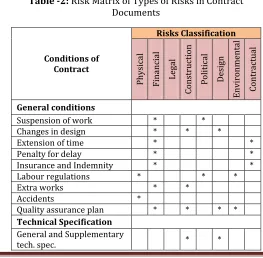
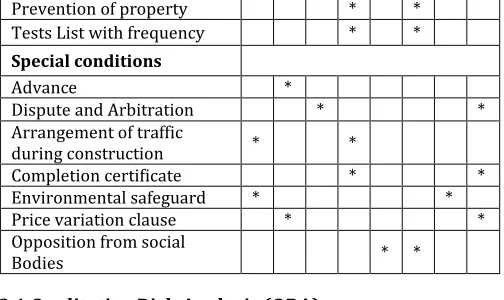
Here the various risk related to the contract document of project are identified, studied, classified and analyzed. From the study of contract document, it found that there are various clauses mentioned, as General conditions, Technical specifications and special conditions. With the help of the checklist given by L.Y. Shen risks are identified and grouped in eight different categories which are physical risk, financial risk, legal risk, construction risk, political risk, design risk, environmental risk & contractual risk. Table 2 shows the matrix of risks and types of risks for condition of contract. The risk assessment matrix is formed according to the impact of risks on client & contractor. Because every clause of contract is may be converted into the risk and it may effects on different perspectives of the project i.e. time, cost, scope, quality.
Table -2: Risk Matrix of Types of Risks in Contract
© 2015, IRJET.NET- All Rights Reserved
Page 2280
Completion certificate * *
Environmental safeguard * *
Price variation clause * *
Opposition from social
Bodies * *
3.1 Qualitative Risk Analysis (QRA)
Qualitative risk analysis determines the importance of addressing specific risks and guides risk responses. It helps to determine the likelihood and potential effect of the risks on the project objectives. It provides a quick and clear picture of risks and is easy to understand. To do this analysis QRA Sheet as shown in table-5 was used which consists of identified risks classified into various types requiring a subjective response on the probability of its occurrence on a 5 point scale of: very low, low, medium, high, very high and on the impact of these risks again on a 5 point scale of, very low, low, medium, high, very high. The responses on QRA sheet were analyzed using median as a measurement of central tendency.
Table -3: Sample of QRA Sheet
From above mentioned risk classification in contract documents, these risks have given rating on the basis of their probability of occurrences & impact related to clients & contractors point of view. Table-4 shows rating for risks identified in Contract Documents of projects in Pune and Table-5 shows rating for risks identified in Contract Documents of projectsin Mumbai.
Table -4: Rating for Risks Identified in Contract
Documentsof Projects in Pune
PMC conditions Owner Contractor
Risks
Medium medium Medium Medium
Dispute and
Arbitration Low Low Low Medium
Extension of time Medium medium Medium High
Insurance and
Indemnity Low Low Low Medium
Prevention of
property Medium medium Low Medium
Price variation Medium High Medium High
Quality assurance Low medium Medium Medium
Labour regulations Low medium Medium Medium
Excessive approval
by government Medium medium Medium High
Material
management Low medium Medium Medium
Traffic diversion Low medium Medium Medium
Table -5: Rating for risks identified in Contract Documents
of projects in Mumbai city
PMC conditions Owner Contractor
Risks
Suspension Medium Low Medium Medium
© 2015, IRJET.NET- All Rights Reserved
Page 2281
Accidents Low Medium Medium Medium
Reduction in time
Direct liability Medium Medium Low Medium
Non- extension of completion date
Medium Medium Low Medium
Encroachment Medium High Low Very Low
Forfeiture of assets Medium Medium Medium Medium
Expense towards taxes
Medium Medium Medium Low
From the study of contract documents various risks in contract are related to client and contractor are summarized. This help to understand the risks associated with the conditions of contract document.
In this paper qualitative risk analysis technique provides an effective insight and clear picture of the risks involved in infrastructure construction in Mumbai and Pune city.This analysis helps to take necessary risk mitigation action for project team of client & contractor.
Finally, methods available to reduce or mitigate construction project risks are identified which are the stable currency of project funding, obtaining more geotechnical data, conducting constructability reviews, set a realistic contract performance times, work and rework cost information, introducing phased pricing, pre-plan for permits, utilities and zoning, pre-define rates, equations and procedures, use of experienced project personnel, proper material management and last but not least use the contracting process as a risk avoidance measure.
Taking an enlightened, proactive approach to construction risk allocation and contracting practices will produce short term and long term benefits for all construction project participants.
5. CONCLUSIONS
The major risks affecting the infrastructure project are systematically examined. For successfulcompletion of any infrastructure construction project, it is necessary to study all aspects of project mentioned in contract documents. The performance of project depends upon control over major risks involved in project and critical factors responsible for cost and timeoverruns.
Based on present study the following conclusions are drawn
The contract documents are used as a tool to manage risk by allocating risks to various agencies through various contracts.
To minimize the chances of failure or under-performance of project, risk management policy must be implements and evaluate regularly into the construction project.
This study may be used as guidelines for researchers and any infrastructure construction projects in India.
ACKNOWLEDGEMENT
This research study was supported by clients, contractors and consultants of projects. The authors would like to thanks all the interviewees and respondents of the survey for their precious comments, opinions, responses, and ideas that have provided me with very useful background data. The word sincere gratitude will not be adequate to express the feelings; I have for my honored guide Prof. Dr. J. R. Patil, Asso. Prof. S. S. Jain and Asst. Prof. A. M. Gaikwad. In addition, I am also thankful to my parents and friends who helped me directly and indirectly to bring this research study in reality.
REFERENCES
[1] S.Q. Wang, M.F. Dulaim & M.Y. Aguria “Risk management framework for construction projects in
developing countries.” Construction Management and
Economics, March 2004,vol.22, pp.237-252
[2] Misbah Jamil, N. H. mufti, A.H. Khan, “Risk
Identification For Construction Projects.” Advancing &
Integrating Construction Education, Research & Practice, Karachi, Pakistan, August 20008, pp.4-5. [3] Lionel Galway, “Quantitative Risk Analysis for Project
Management”, Working Paper, Rand Publication, Feb
2004,
[4] N.J. Smith,“Managing Risk in construction projects”,
Blackwell Science, Oxford, Feb 2000.
[5] L. Y. Shen, George W. C. Wu & Catherine S. K., “Risk
management”, Journal of Construction Engineering
&Management,Jan 2001.
[6] Dvan Well- Stam, “Project risk Management- An
essential tool for managing and controlling projects”,
Kogan Page Limited, Dutch, 2005.
[7] Hamimah Adnan, “An Assessment of Risk Management
in Projects”, Asian Social Science, CCSE, June 2008,
Vol-4, No-6.
[8] Mark H. McCallum, “A Quick Primer on Construction
Risks and Contracting Practices”, American Corporate
© 2015, IRJET.NET- All Rights Reserved
Page 2282
[9] Gary Smith and Caryn M. Bohn, “Small to Medium Contractor Contingency and Assumption of Risk”,
Journal of Construction Engineering and Management, American Society of Civil Engineers (ASCE), 1999, vol. 125 No. 2, p. 101.
[10]BayuAdityaFirmansyah, AlinVeronika and BambangTrigunarsyah,“Risk Analysis in Feasibility Study of Building Construction Project”, The Tenth East Asia-Pacific Conference on Structural Engineering and Construction, Bangkok, Thailand,August 2006, pp. 3-5.
[11]Richard Clough, “Construction Contracting”, Wiley- Interscience, New Mexico, 1972.
[12]Roger Flanagan & George Norman, “Risk management and construction”, Blackwell Scientific Publications, London, 1993.
[13]Roger Graves, “Qualitative Risk Assessment”, PM Network- The Professional Magazine of the Project Management Institute, October 2000, p.80
[14] “A guide to the Project Management Body of
Knowledge”; Project Management Institute,
Edition-2004.
BIOGRAPHIES
Chaitali S. Pawar, B.E., M.E., Student of Civil Engineering, RMD SSOE, Warje, Pune, India.
Dr. Jalindar R. Patil, B.E., M.E., Ph.D., MISSMGE, FIGS, MIRC, MISTE, MISRMTT, Professor of Civil Engineering, RMD SSOE, Warje, Pune, India.
Suman S. Jain, B.E., M.E., Asso. Professor of Civil Engineering, Sinhgad College Of EngineeringPune, India.