DEVELOPMENT AND VALIDATION OF STABILITY INDICATING REVERSED PHASE HIGH
PERFORMANCE LIQUID CHROMATOGRAPHIC METHOD FOR THE DETERMINATION OF
RELATED SUBSTANCES IN FAMPRIDINE DRUG SUBSTANCE AND TABLET DOSAGE FORMS
BABU C
1, NARASIMHA RAO KL
1, DEVANNA N
1, SURESH REDDY KVN
2*
1Department of Chemistry, Jawaharlal Nehru Technological University, Anantapur, Andhra Pradesh, India. 2Department of Chemistry,
GITAM Institute of Technology, GITAM University, Visakhapatnam, Andhra Pradesh, India. Email: [email protected] Received: 09 May 2017, Revised and Accepted: 04 July 2017
ABSTRACT
Objective: The objective of this method is to develop a stability-indicating reversed phase high performance liquid chromatographic method for the quantification of related substances in the drug substance and tablet dosage form of Fampridine.
Methods: Inertsil ODS 3V, (150 mm × 4.6 mm, 5 µm particle size) column was used for the separation of analytes. Mobile phase A was prepared by dissolving 6.8 g of potassium dihydrogen orthophosphate (0.05 mol) and 1 g of 1-octane sulfonic acid into a 1000 ml of water, pH was adjusted to 4.0±0.05 with diluted orthophosphoric acid. Mobile phase B was prepared by mixing the above phosphate buffer (pH 4.0) and acetonitrile in 20:80 (% v/v). Gradient mode was used with the flow rate of 1.0 ml/minutes, and the peaks were monitored at 260 nm.
Results: Linearity results showed that the correlation coefficient (r2) is >0.995 for individual active drug substances as well as their related substances
in the range of limit of quantification to 150% of the specification concentration (0.5% with respect to sample concentration of 0.4 mg/ml). Accuracy of the method was established with their recovery values in the range of 98.5-104.5% with the % RSD not more than 1.7%. The method was proved by highly precise (% RSD of intra-day and inter-day study was not more than 4.3%) and more robust.
Conclusion: Present method is able to separate two related compounds with each other and with the main drug substance with the resolution more than 2.0. The test standard solution and test solution were found to be stable in diluent up to 24 hrs. The mass balance of forced degradation of formulations is close to 99% made this method as a stability indicating method.
Keywords: Fampridine, Related substances, Method validation, Reversed phase high performance liquid chromatographic.
INTRODUCTION
Fampridine (4-aminopyridine [AP]) is an organic compound with the chemical formula C5H4N–NH2. It has been used as a drug, to manage
some of the symptoms of multiple sclerosis (MS) and is indicated for symptomatic improvement of walking in adults with several variations of the disease [1]. The potassium channel blockers AP and 3,4-diaminopyridine increase nerve conduction in demyelinated nerve fibers and have been proposed as a suggestive therapy for people who are suffering with MS [1]. Fampridine-SR is a sustained-release, orally administered potassium channel blocker acting in the central nervous system to enhance conduction in demyelinated axons several small trials have evaluated the safety and efficacy of Fampridine-SR in patients with MS to improve their walking ability [2].
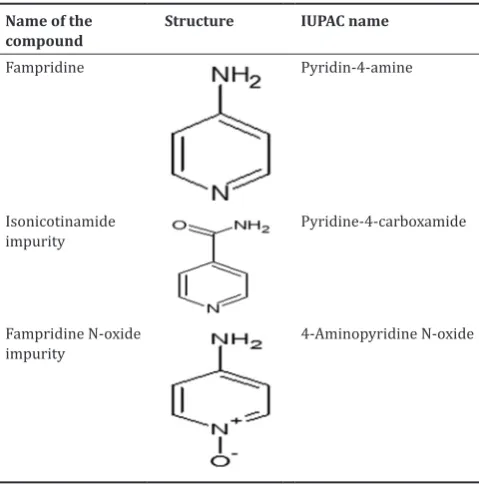
Literature survey showed that few analytical methods were reported for the determination of Fampridine both in active pharmaceutical ingredient and dosage forms through ultraviolet spectrophotometry [3,4], reversed phase-high performance liquid chromatography (RP-HPLC) [5,6] and LC-mass spectrometry method [7]. Thomas et al. [8] reported a method a stability indicating method for the determination of impurities in Fampridine active pharmaceutical ingredient. Jain et al. [9] published a paper on LC method for the determination of genotoxic impurities in Fampridine active pharmaceutical ingredient. As per the literature, no stability indicating method was reported for the related compounds in Fampridine dosage forms. The objective of this study is to develop a stability indicating RP-HPLC method for determination of related substances in Fampridine drug substances and drug product. The chemical names and structures of the analytes are presented in Table 1.
MATERIALS AND METHODS Materials
HPLC grade acetonitrile was procured from Qualigens, India. Potassium dihydrogen orthophosphate and orthophosphoric acid were purchased from Merck, India. All other chemicals and solvents used were of analytical grade of Rankem. Water used in the HPLC analysis was purified by the water purifier (Milli-Q Millipore). Reference standards of Fampridine and impurities are supplied by GSN Pharmaceuticals Private Limited, Hyderabad, India, as gift samples. Tablets of these drugs were purchased from local market.
Instrumentation
The HPLC system was composed of 2695 water alliance system fitted with 2996 photo diode array (PDA) detector with Empower 2 software. Analytical column used for this method was Inertsil ODS 3V with the dimensions 150 mm × 4.6 mm, 5 µm particle size.
Preparation of mobile phase A (buffer)
Mobile phase A was prepared by dissolving 6.8 g of potassium dihydrogen orthophosphate (0.05 mol) and 1 g of 1-octane sulfonic acid into a 1000 ml of water, pH was adjusted to 4.0±0.05 with diluted orthophosphoric acid and filtered through 0.45 µm nylon membrane filter.
Preparation of mobile phase B
Mobile phase B was prepared by mixing of above buffer and acetonitrile in 20:80 (% v/v).
© 2017 The Authors. Published by Innovare Academic Sciences Pvt Ltd. This is an open access article under the CC BY license (http://creativecommons. org/licenses/by/4. 0/) DOI: http://dx.doi.org/10.22159/ajpcr.2017.v10i10.19796
Preparation of diluent
Diluent was prepared by mixing of above buffer and methanol in 80:20 (%v/v).
Standard solution preparation
About 10 mg of Fampridine was taken into a 100 ml volumetric flask, and 75 ml of diluent was added and sonicated for 5 minutes to dissolve and made up to volume with diluent. Standard solution was prepared by taking 2 ml of the above solution into a 200 ml volumetric flask and made up to volume with diluent. The final concentration of Fampridine is 1 µg/ml.
Sample preparation
The amount equivalent to 10 mg of Fampridine, finely tablet powder was weighed and transferred into a 25 ml volumetric flask, added 15 ml of diluent and sonicated for 20 minutes to dissolve, made up to volume with diluent and filtered through 0.45 um nylon filter and the final concentration of Fampridine is 0.4 mg/ml.
Optimized chromatographic conditions
The analysis was performed on Inertsil ODS 3V (150 mm × 4.6 mm, 5 µm) column maintained at 35°C using mobile phase A and mobile phase B in gradient mode (Table 2) with a flow rate of 1.0 ml/minutes. Before delivering the mobile phase into the system, it was degassed and filtered through 0.45 µm nylon filter using a vacuum. The injection volume was 10 µl, and the detection was performed at 260 nm using a PDA detector.
RESULTS AND DISCUSSION
Optimum separation between Fampridine and related substances was achieved with the above-optimized conditions. The aim of method validation is to confirm that the present method is suitable for its intended purpose as described in International Council of Harmonization (ICH) guidelines Q2 (R1). The described method has been validated in terms of specificity, forced degradation, limit of detection (LOD) and limit of quantification (LOQ), linearity, accuracy, precision, robustness, and solution stability.
System suitability
To ensure that the system is working correctly during the analysis, tailing factor, theoretical plates and % RSD of six standard injections
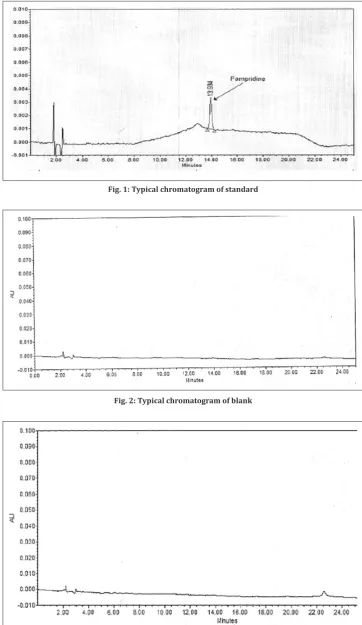
were checked. The parameters such as tailing factor should not be more than 2.0; theoretical plate should be not <4000 and % RSD for six replicate injections of standard solution should not be more than 5.0. The results of system suitability are summarized in Table 3, and the corresponding chromatogram is shown in Fig. 1.
Specificity
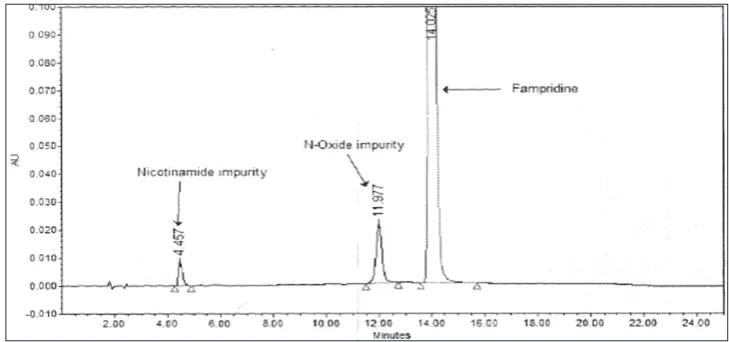
Specificity is the ability to assess unequivocally the analyte in the presence of components which may be expected to be present. The specificity of the method is established by injecting blank, placebo and the impurity spiked sample and their corresponding chromatograms are shown in Figs. 2-4. The results of specificity are presented in Table 4. The chromatograms in figures show that there was no interference of the blank, placebo and main drug substances with impurities and the developed method was successfully separated all the impurities with each other and with the main drug. Hence, the present RP-HPLC method used for the estimation of related substances in Fampridine tablets is very selective and specific.
Forced degradation studies
Forced degradation studies were performed to provide an indication of the stability indicating property and specificity of the proposed method. Intentional degradation was attempted to the samples under conditions such as thermal at 60°C for 7 days, humidity (90% relative humidity) for 7 day, photolytic condition (1.2 million lux h), acid hydrolysis (using 1.0 N HCl at room temperature for 2 hrs), base hydrolysis (using 1.0 N NaOH at room temperature for 2 hrs), and oxidative degradation (using 10.0% H2O2 at room temperature for 2 hrs) to evaluate the ability of the
proposed method to separate degradation products from each other and active ingredients as well. To check and ensure the homogeneity (peak purity) of all peaks in the stressed sample solutions, a wide range of wavelength (200-400 nm) was applied using PDA detector, and the corresponding results are tabulated in Table 5. In forced degradation, it is observed that Fampridine is susceptible for degradation in oxidation stress condition, and found to be stable in all other stress conditions.
LOD and LOQ
LOD and LOQ for Fampridine and two impurities are determined by injecting a series of solutions of known concentration till the signal-to-noise ratio became as 3:1 and 10:1, respectively, and the corresponding values are given in Table 6. The found LOQ values are sufficient to quantify these impurities below 0.2% of the drug concentration as per the limits defined by pharma regulating agencies. The corresponding results are tabulated in Table 6.
Table 2: Gradient program Time (minutes) Mobile phase A
(%v/v) Mobile phase B (%v/v)
Table 1: Chemical names and structures of Fampridine and its two impurities
Table 3: System suitability results S. No. Retention
time (minutes)
Peak area Tailing
factor Theoretical plates
1 13.934 34481 1.1 5214
2 13.938 35412 1.1 5359
3 13.859 34148 1.1 5236
4 13.987 34858 1.0 5128
5 14.015 35025 1.1 5269
6 14.019 35087 1.0 5198
Mean±SD 34835±453.95
% RSD 1.3
Linearity and relative response factor
The series of solutions were prepared by diluting the Fampridine and impurity stock solution at different concentrations from LOQ to 150%,
i.e., with respect to sample concentration (0.4 mg/ml). The correlation coefficients (r2), y-intercepts and relative retention factor values are
given in Table 7, which shows that there is an excellent correlation
Fig. 1: Typical chromatogram of standard
Fig. 2: Typical chromatogram of blank
(r2 is not <0.995) exist between peak areas and concentration of all
analytes.
Precision
The precision of the method was verified by injecting six individual preparations (n=6), spiked with two impurities at 0.5% level with respect to the sample concentration (0.4 mg/ml). Results of method precision
are given in Table 8. Results in Table 8 indicate that the % RSD for two impurities was found below 10.0%. Results of intermediate precision at different days with different lots of analytical columns are included in Table 9, which shows that the % RSD for all impurities was below 10%.
Accuracy
The accuracy of the method was determined by spiking the respective impurities in the sample at LOQ, 50%, 100%, and 150% of specification level (0.5% with respect to the sample concentration 0.4 mg/ml) in triplicate and corresponding recovery values were calculated. The
Table 4: Specificity results of spiked sample
Name RT RT ratio Resolution Purity angle Purity threshold
Isonicotinamide 4.457 0.32 6.2 0.015 0.325
Fampridine N-oxide impurity 11.977 0.85 3.5 0.125 0.645
Fampridine 14.025 - - 0.031 0.978
Fig. 4: Typical chromatogram of spiked sample
Table 5: Forced degradation results Sample
details Degradation (%) Assay (%) Mass balance Peak purity
As such
sample 0.05 100.5 - Pass
Thermal 0.12 99.2 98.8 Pass Photolytic 0.21 99.9 99.6 Pass Humidity 0.32 98.2 98.0 Pass
Acid 0.21 100.2 99.9 Pass
Base 0.18 98.9 98.5 Pass
Oxidative 5.25 94.2 98.9 Pass
Table 6: LOD and LOQ values of analytes along with S/N ratios
Name LOD (%) S/N
ratio LOQ (%) S/N ratio
Isonicotinamide 0.03 3 0.10 12 Fampridine N-oxide
impurity 0.03 3 0.10 11
Fampridine 0.02 3 0.07 10
LOD: Limit of detection, LOQ: Limit of quantification
Table 7: Linearity results for Fampridine and its impurities
Name Correlation
coefficient (r2) Y‑intercept at 100% level RRF
Isonicotinamide 0.995 −1.1 1.12 Fampridine N-oxide
impurity 0.997 0.5 1.35
Fampridine 0.999 1.2
-RRF: Relative retention factor
Table 8: Method precision results (% of impurities) Sample id Isonicotinamide Fampridine
N‑oxide impurity Total impurities
Spl-1 0.49 0.51 0.95
Spl: Sample, SD: Standard deviation, n=6 sample preparations, RSD: Relative standard deviation
Table 9: Intermediate precision results (% of impurities) Sample id Isonicotinamide Fampridine
N‑oxide impurity Total impurities
Spl-1 0.52 0.49 1.01
recovery values are found within the range of 98.5-104.5% with the % RSD of <1.7, which indicate that the method is more reliable and accurate. The results of accuracy study are summarized in Table 10. Robustness
The robustness of the method was checked by intentional changes in flow rate, column temperature and pH of the mobile phase. The flow rate of the mobile phase was changed to 0.9 ml/minutes and 1.1 ml/minutes. The effect of pH was studied at pH 3.9 and 4.1. The effect of column temperature was studied at 25°C and 35°C. The resolution between adjacent peaks of all samples was evaluated, and it was found >2.0.
Solution stability
To check the stability, both standard and impurity spiked samples were kept at refrigerator condition (5°C) and room temperature (25°C). Much change was not observed in the area of the respective impurities. The results of solution stability studies confirmed that both standard and test solutions were stable up to 24 hrs.
CONCLUSION
A specific, linear, precise and accurate stability indicating HPLC method has been developed for the quantification of two impurities in the tablet dosage form. The method has been validated for specificity, linearity, accuracy, precision, robustness, and stability. The method is linear in the range of LOQ to 150% of the specification concentration for two impurities with a correlation coefficient not <0.995. The accuracy of the method is in the range of 98.5-104.5% for two impurities. As the method is validated according to ICH guidelines, it can be used for the analysis of all these two impurities in the tablet dosage forms.
REFERENCES
1. Solari A, Uitdehaag B, Giuliani G, Pucci E, Taus C. Aminopyridines for symptomatic treatment in multiple sclerosis. Cochrane Database Syst Rev 2001;(4):CD001330.
2. Korenke AR, Rivey MP, Allington DR. Sustained-release fampridine for symptomatic treatment of multiple sclerosis. Ann Pharmacother 2008;42(10):1458-65.
3. Madhumathi CH, Padmalatha M, Sneha S, Divya CB. Development and validation of UV spectrophotometry method for the estimation of dalfampridine in tablets. Int J Pharm Sci Res 2014;2:1019-26. 4. Fatatry HM, Hammad SF, Elagamy SH. Validated spectrofluorimetric
determination of dalfampridine in its synthetic mixture and spiked human plasma through derivatization with fluorescamine. J Anal Tech 2013;3:23-6.
5. Dharani NR, Padmini K, Sumakala S. Stability indicating RP-HPLC method development and validation for estimation of dalfampridine in its bulk and formulation. Int J Adv Res 2016;4:184-91.
6. van der Horst A, de Goede PN, van Diemen HA, Polman CH, Martens HJ. Determination of 4-aminopyridine in serum by solid-phase extraction and high-performance liquid chromatography. J Chromatogr 1992;574(1):166-9.
7. Suneetha A, Rajeswari KR. A high throughput flow gradient LC-MS/MS method for simultaneous determination of fingolimod, fampridine and prednisone in rat plasma, application to in vivo perfusion study. J Pharm Biomed Anal 2016;120:10-8.
8. Thomas S, Bharti A, Sanjeev S, Ashutosh A. A stability indicating simultaneous dual wavelength UV–HPLC method for the determination of potential impurities in fampridine active pharmaceutical ingredient. J Pharm Biomed Anal 2012;58(1):136-40.
9. Jain M, Srivastava V, Kumar R, Dangi V, Hiriyanna SG, Kumar A,
et al. Determination of five potential genotoxic impurities in dalfampridine using liquid chromatography. J Pharm Biomed Anal 2016;133:27-31.
Table 10: Accuracy in terms of % recovery (n=3)
Sample name LOQ level 50% level 100% level 150% level % mean SD % RSD
Isonicotinamide 103.2 102.5 99.5 101.5 101.7 1.6 1.6
Fampridine N-oxide impurity 100.2 101.9 98.5 103.2 100.2 1.7 1.7
Total impurities 103.5 102.2 100.4 104.5 102.7 1.8 1.7