R E S E A R C H
Open Access
Application adaptive exponential
synchronization of chaotic dynamical systems
in secure communications
Mahmoud Maheri
1*and Norihan Md Arifin
2*Correspondence:
Full list of author information is available at the end of the article
Abstract
Synchronization of chaotic systems which is defined based on the exponential stability for encrypts of signals is presented in this paper. An adaptive control scheme is proposed, and the convergence of the synchronized error is guaranteed. Masking and modulation methods are applied for encryption. To verify the effectiveness of the proposed schemes, numerical simulation was applied on a well-known system without linear term chaotic using MatLab software. The comparison of the proposed chaotic synchronization in the case of the synchronization rate and in the decryption precision of sent signal and image are shown.
Keywords: synchronization; chaos; exponential; stability; encryption
1 Introduction
Chaotic systems are nonlinearly deterministic and sensitive to initial conditions, they have been studied since the two most recent decades [–]. Chaotic systems have a lot of appli-cations in different sciences such as laser, secure communication, biology sciences, non-linear circuits, neural and computer networks [–].
The control of chaos is one of the main issues in the study of chaotic systems. The synchronization is one of the main control methods of these systems, which were intro-duced in a paper by Pecorra and Carrol in []. In recent years, synchronization of chaotic systems has become very attractive and has been applied in vast area of engineer-ing, physic, computer networks, and so on which aroused increasing interest as regards use in new areas such as cryptography [–].
Up to now, many synchronization methods such as adaptive control, nonlinear feed-back control and sliding mode control were proposed and applied successfully on chaotic systems [–]. But almost all of them used Lyapunov stability theorems to guarantee asymptotically synchronization and convergence is slow to the origin.
The exponential synchronization is another proposed method in this field, which has certain precision and stability in error systems. This method is robust and faster than the Lyapunov stability one. Tonget al.[] applied exponential synchronization for stochas-tic neural networks with multi-delayed and Markovian switching via adaptive feedback control, Yan and Yu [], Lio and Yu [] studied exponential synchronization for some
well-known classical dynamical systems. Yang used exponential stability in synchroniza-tion of a higher order chaotic system []etc.
So far, to the best of the authors’ knowledge, the problem of adaptive exponential syn-chronization and its applications for chaotic dynamical systems have received very little research attention.
In the recent work, the authors have proposed the adaptive based on exponential stabil-ity methods to secure chaos communication through the method of chaos masking and modulation. The general idea in the utilization of chaotic systems in using a transition of the desired signal is integration of it with a chaotic system and production of a chaotic signal. This signal is recoverable after synchronization. There are two major issues in this case; one includes how to produce the chaotic signal; this is usually conducted by both masking and modulation methods [, ].
The other most important issue is the time of transmittance and reception of the signal. The signal is produced and transmitted after synchronization of both slave and master systems. Thus, as the synchronization rate is high, the signal, with regard to its dependency on synchronization error, could be transmitted faster with better approximation.
This paper was conducted by introducing theorems related to the exponential stability and comparison of results in the encryption of signals based on Lyapunov stability and exponential stability.
The main contributions of this paper can be highlighted as follows. () A new adaptive synchronization method is studied for a fully nonlinear chaotic dynamical system based on the exponential stability theorem. () Application of the adaptive exponential synchro-nization obtained in encryption using modulation and masking methods.
The paper was organized as follows. Section , the definitions and theorems related to exponential and Lyapunov stability were provided. In Section , synchronization of a sys-tem without linear term is provided. Transmission and reception of the signal text by the modulation method was given for a well-known system using exponential and Lyapunov stability in Section . Then the masking method and adaptive exponential stability were utilized to transmit a pictorial signal. Concluding remarks were provided in Section .
2 Preliminaries
2.1 Stability of autonomous systems Consider the autonomous system
˙
x=f(x), ()
wheref :D→Rnis the local Lipschitz map of domainD⊂RntoRn.
Definition . Supposex= is one of the fixed points of equation (), in this case [].
• It is stable if, for any, there exists the value ofδ=δ()so that
x()<δ ⇒ x(t)<, ∀t> .
• It is unstable if it is not stable.
• It is asymptotically stable, if it is stable and there existδso that
x()<δ ⇒ lim
For studying stability, a practical way is finding a Lyapunov function in linear and non-linear systems without obtaining the response of them.
Theorem .(Lyapunov stability theorem) Supposex˙=f(x),x∈D⊆Rnto have a fixed
point in the origin.If there exists a real function V in a neighborhood of N at the origin[] where:
• ∂V
∂xi,i= , , . . . ,n,exists and is continuous; • Vis positive definite,
then:
• IfV˙ is semi negative definite,then the origin is a stable fixed point of the system. • IfV˙ is negative definite,then the origin is a fixed point and asymptotically stable. • IfV˙ is positive definite,then the origin is an unstable fixed point.
2.2 Stability of non-autonomous systems Consider the following non-autonomous system:
˙
x=f(t,x), ()
where the functionf : [,∞)×D→Rnis piecewise continuous with respect totand is
local Lipschitz with respect toxon [,∞)×D, which includes the origin. In this casex= is the fixed point of equation () ont= if
f(t, ) = , ∀t≥.
It could be interpreted as follows: the fixed point is located on the origin as a non-zero fixed point or in a more general case, as the non-zero response of system.
The concepts of stability and asymptotically stability of a fixed point in non-autonomous systems correspond to Definition . in autonomous systems unless there is a new case, in that the response of autonomous system only depends on (t–t), and the response of the non-autonomous system also depends on bothtandt. Thus, in the general state, the stability of fixed point depends ont.
Definition . Fixed pointx= related to equation ():
• It is stable if, for any> , the value ofδ=δ(,t)is such that
x(t)<δ ⇒ x(t)<, ∀t≥t≥. ()
• It is uniformly stable if, for any> , the value ofδ=δ()(independent oft) is such that equation () holds.
• It is unstable, if is not stable.
• It is asymptotically stable if is stable and there is a value such asc=c(t) > so that,
for all values ofx(t)<c, we havelimt→∞x(t) = .
• It is uniform asymptotically stable if it is uniformly stable and there is a value such as
c> (independent oft) so that, for all values ofx(t)<c, asttends to infinity,x(t)
monotonically tends to zero with respect tot, in other words, for any> , there exists a value such ast=T()so that
• It is globally uniform asymptotically stable, if it is uniformly stable and, for any pair of positive numbersandc, there is a valuet=T(,c) > so that
x(t)<, ∀t≥t+T(,c),∀x(t)<c.
The uniform stability and uniform asymptotical stability could also be indicated based on specific numerical functions,i.e.classκand classκιfunctions [].
Definition . The continuous functionα: [,a)→[,∞) belongs to classκif it strictly is increasing andα() = . This function belongs toκ∞ifa=∞and withrincreasing to infinity,a(r) also tends to infinity.
Definition . The continuous functionβ: [,a)×[,∞)→[,∞) belongs to classκιif for any specific values, the mappingβ(r,s) with respect torbelongs to classκand also for any specific valuer, the mappingβ(r,s) is decreasing with respect tos, and by increasing sto infinity,β(r,s) tends to zero.
Example . The functionα(r) =arctanris increasing strictly becauseα˙(r) = /(+r) > . This function belongs to classκ, but it does not belong to classκ∞, becauselimr→∞α(r) = π/ <∞.
The following lemma indicates some of explicit features of functions, classκandκι.
Lemma . Supposeα(·)andα(·)in the interval[,a)are classκ functions andα(·) andα(·)to be classκ∞ones.If we show the converse ofαi(·)withα–i (·),then we have[]
• α–(·)is defined in the interval[,α(a)]belongs to classκ.
• α–(·)is defined in the interval[,∞)and belongs to classκ∞. • αoαbelongs to classκ∞.
• αoαbelongs to classκ∞.
• σ(r,s) =α(β(α(r),s))belongs to classκ∞.
The following lemma explains the equivalence definitions for uniform stability and uni-formly asymptotically stability based on classκandκιfunctions.
Lemma .([]) For the fixed point x= related to equation():
• It is uniformly stable,if and only if functionα(·)belongs to classκand there is a positive constantc(independent oft)so that
x(t)≤αx(t), ∀t≥t≥,∀x(t)<c. ()
• It is uniformly asymptotically stable,if and only if functionβ(·,·)belongs to classκι
and there is a positive constantc(independent oft)so that
x(t)≤βx(t), ∀t≥t≥,∀x(t)<c. ()
2.3 Exponential stability
As one of Lemma . results, it could be considered that in the case of non-autonomous systems, the stability and asymptotical stability based on definition () mean that there are functions of classκ andκιso that inequality () and () hold. Because in the non-autonomous systems, the stability and asymptotically stability of origin are uniform with respect to the initial timet.
One particular case of uniform asymptotically stability occurs when, in equation (), the functionβbelongs to classκιasβ(r,s) =kre–γs. This case is very important and could be
considered one of distinctive features of fixed point stability.
Definition . The fixed pointx= related to equation () is exponentially stable, if in-equality () holds for any of the following values:
β(r,s) =kre–γs, k> ,γ> .
In addition, it is globally exponentially stable if the above condition holds for all initial values.
Now, we explain the main theorem.
Theorem . Suppose x= to be one of the fixed points of equation()and D⊂Rnto be a
domain including the origin.In addition,suppose V(x) : [,∞)×D→R to be a continuous and derivable function where for all values of t≥and x∈D the following relations are satisfied:
ω(x)≤V(t,x)≤ω(x), ()
∂V ∂t +
∂V
∂xf(t,x)≤–ω(x), ()
whereω(x),ω(x)andω(x)are positive definite and continuous functions on D.Then the point x= is uniformly asymptotically stable[].
If the classκ functions are of the particular formαi(r) =kirc, its application is easy in
the proof of Theorem .. In this case, it could be shown that the origin is exponentially stable.
Theorem . Suppose all hypotheses of Theorem.are satisfied along with the following conditions:
ω(x)≥kxc, ω(x)≤kxc, ω(x)≥kxc,
when k,k,kand c are positive constants,then x= is exponentially stable.Also,if all globally hypotheses hold,x= is globally exponentially stable[].
Proof The functionsVandV˙ satisfy the following inequalities:
kxcV(t,x)kxc,
˙
V–kxc–k kV(t,x).
By using the deduction lemma, we could write
As a result, the origin is exponentially stable, so that all hypotheses are satisfied globally, the above inequality would hold for all values ofx(t)∈Rn.
3 Synchronization based on the exponential stability
In this section, the synchronization system without linear term is introduced based on exponential and Lyapunov stability using nonlinear control functions.
Consider the nonlinear chaotic system []
˙
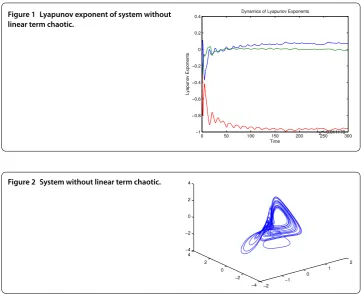
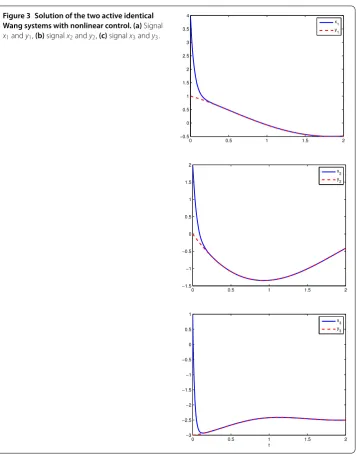
wherex,y andz are the state variables anda,bare real parameters. Figures and show the Lyapunov exponent and the chaotic behavior of the system () fora= . and b= ..
For synchronization, let system () be the drive system and the corresponding response system be written as follows:
˙
whereu,u anduare the input nonlinear control functions. By defining the synchro-nization error ase=x–x,e=y–y,e=z–z, and using equation (), the synchro-nization error dynamics can be written as
Figure 1 Lyapunov exponent of system without linear term chaotic.
Figure 2 System without linear term chaotic.
Definition . The response system () will synchronize exponentially with the drive system () for any initial values if the error system satisfies the following estimation:
E(t)TE(t)≤αe–σ(t–t), ()
whereET= [e
(t),e(t),e(t)] andα,σare positive constants, respectively, dependent and independent fromE(t), which is called the convergence rate. In this case the zero solution of error system () is stable and the two systems () and () are called synchronized [].
Lemma . The system()can be exponentially stabilized at the origin if there exists a positive definite function V(t)such that
kET(t)E(t)≤V(t)≤kET(t)E(t), () ˙
V(t)≤–kET(t)E(t), ()
where k,kand kare positive constants,V(t)≡V(E(t))and k≤k.Therefore,the drive system()and the response system()are exponentially synchronized[].
Proof LetV(t) =E(t)PET(t) wherePis a symmetric positive definite matrix. Choosek=
λmin(P) > andk=λmax(p) > wherekandkare minimum and maximum eigenvalues of the matrixP. Then the time derivative ofV(t) satisfies the inequality
˙ V(t)≤–k
kV(t) = –σV(t), σ= k
It can be concluded that
tially stable and the synchronization of the drive system () and the response system ()
sufficiently achieved.
Lemma . For any k∈R+and x,y∈R the following inequality holds:
|x||y| ≤kx+k–y. ()
Theorem . The drive system()and response system()are exponentially synchro-nized if the nonlinear feedback controls are chosen as
u= –C–ωe,
whereP=diag(/, /, /) is diagonal positive definite matrix. The time derivative of the function () for the error system () and control laws () are
Substituting () in () yields (), the systems () and () are exponentially synchronized.
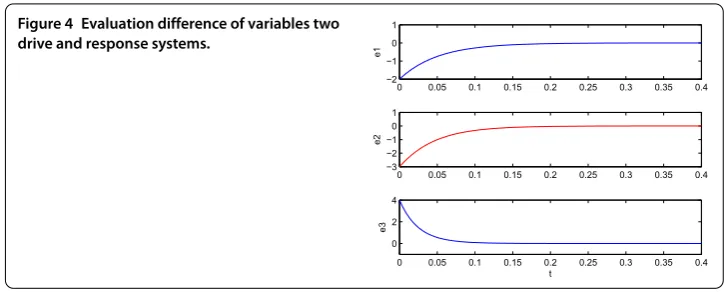
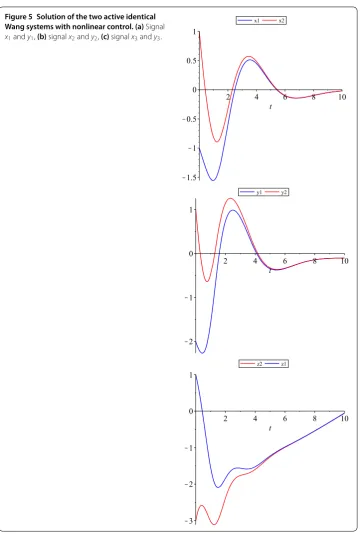
Simulation results: to show the validity of the proposed method, MatLab software is applied for synchronization of the drive system () and the response system () using control laws (). The initial conditions for drive and response systems, respectively, are chosen as (x(),y(),z()) = (, –, ) and (x(),y(),z()) = (, , –). Figures and show the simulation results for the drive-response and error system, which confirms that the error system converges to zero and the two systems are exponentially synchronized.
To show the advantage of our applied exponential synchronization method using a non-linear control function, the results are compared with synchronization based on the Lya-punov stability theorem. For the same system and initial conditions as shown in Figure , it is obvious that our methods have the advantage by compression synchronization times in Figure of almost . second over approximately second in Figure .
Figure 3 Solution of the two active identical Wang systems with nonlinear control. (a)Signal
x1andy1,(b)signalx2andy2,(c)signalx3andy3.
4 Application of chaos to secure communication
Encryption of information is carried out when two persons want to communicate with each other by an insecure communicative channel that can be a telephone or network but the third person could not identify the exchanged information by listening to them. What the first person wants to send to the second person is called the context text; it can be an image or a text by any language that is completely optional. Before sending the message, the transmitter of information should encrypt the information by a specific key. In this case, the context text is converted into the encrypted text. The encrypted text passes through a communicative channel of two individuals and the second person could decrypt the text by using the key and the text is converted into a context text.
Figure 4 Evaluation difference of variables two drive and response systems.
these systems in different applications of secure communication. Here encryption using modulation and the masking method is studied.
4.1 Text modulation via adaptive exponential stability
In chaos modulation the information signal is injected into the transmitter. First we intro-duce some definitions, then we propose a fast mechanism for synchronization the chaotic systems without linear term () based on the drive-response approach. Using exponential synchronization, the secure communication scheme is studied.
Definition .([]) Consider the smooth system that is described by a variables vector X={xi}n ∈Rwhere the output vector is presented byY={yi}m ∈R:
˙
x=f(X,C), Y=h(X), ()
where the functionh(·) is a smooth vector and the vectorC∈Ris for constant parameters. LetYi, denote thejth time derivative of the vectorY. It is said that the vector stateXis observable algebraically, if it is expressed uniquely by
X=φY,Y(), . . . ,Y(i), ()
for integerjand for smooth functionφ.
Definition .([]) With the same conditions of Definition ., if the vector of param-eters,C, satisfies the following equation:
ψ
Y,Y(), . . . ,Y(i)=ψ
G,G(), . . . ,G(i)C, ()
whereψ(·) andψ(·) are, respectively,n× andn×nsmooth parameters matrices, then Cis said to be identifiable algebraically with respect to the output vectorY.
Now, assume the second differential equation of system () to be
x=y˙
Figure 5 Solution of the two active identical Wang systems with nonlinear control. (a)Signal
x1andy1,(b)signalx2andy2,(c)signalx3andy3.
then substituting equation () into the third differential variables of system () leads to
˙
zz+yy˙ =bz. ()
state variablexand the parameterbcan be recovered simultaneously from the two other available outputs.
In the transmitter system, the parameterbis considered to transmit the message signal and the following drive system is defined:
˙
wherex,y,zare the state variables of chaotic system () with the modulation law
b(t) =o(t) +b, ()
whereo(t) is the input message signal, which needs to be transmitted. In the receiver sys-tem, the response system is assumed to be the partly uncertain system () where the avail-able outputs variavail-ables areyandz. Hence, the response system is defined with controllers as follows:
wherex,yandzare the state variables of system () with the modulation laws
ˆ
b(t) =oˆ(t) +bˆ, ()
whereoˆ(t) is the recovered signal andbˆis the approximation of the unknown parameterb. U= [u,u,u]T is the input nonlinear control to achieve synchronization of the systems
() and ().
Subtracting the drive system () from the response system (), the error system is obtained:
Theorem . If the controller in the receiver system()is defined as follows:
with the law parameter and message signal,respectively,chosen as
˙˜
()will synchronize the drive system()exponentially.Moreover,the message signal s(t) will recover by the receiver system(),which is combined into the chaotic transmitter() via the modulation laws()and().
Proof AssumeE= [e,e,e,b˜,o˜], by defining the quadratic Lyapunov function as
by the same proof as Theorem . exponentially stability can be achieved.
To demonstrate and verify the validity of the modulation schemes, we confirmed our analytical studies be numerical simulations via MatLab software. We solve the dynamical systems using the fourth order Runge-Kutta numerical method. At the transmitter sys-tem side, the syssys-tem parameters are chosen asa– .,b= ., while the arbitrary initial conditions are set asx() = ,x() = ,x() = –. At the receiver system side, we fix the arbitrary initial conditions asy() = –,y() = –,y() = ,a= .,bˆ() = and ˆ
o() = .. Suppose the message signalo(t) is a trigonometric signal such as
Figure 6 Error signal between systems (34) and (36) over the time.
Figure 7 Error signal between the original and the recovered message.
Figure 8 The value of the unknown parameterb.
Figure displays the synchronization difference (error) between systems () and (). It confirms that synchronized errors between system () and () converge exponentially to zero. Figure shows the error signal between the original message and the recovered one that confirms the message signalo(t) is recovered accurately. Figure shows the value of the unknown parametersbwhich converge exponentially to the exact value.
4.2 Modulation-based adaptive Lyapunov stability
Consider two drive and response systems, respectively, as drive system
˙ x=ln
a+ey–x,
˙ y=xz,
˙
z=b–xy,
and
We have introduced the three control functionsu,uanduand define the error variables as
e=y–x, e=y–x, e=y–x. ()
Subtracting () from () and using the notation (), we obtain the error system as
˙
Theorem . For any initial conditions,if the controller functions u,u and uare de-signed with
and the updating laws of the unknown parameters are chosen by
˙ˆ
a(t) =a˜ , b˙ˆ(t) =b˜ , ()
whereaˆ=a–a and˜ bˆ=b–b are the estimates of the unknown parameters˜ ,a and b,then the trajectory of the error system converge to zero exponentially.
Proof If the positive Lyapunov function is chosen as
V=
e+e+a˜+b˜,
with the choice of the controller () and updating laws (), then the time derivative of Valong the trajectory of the system () and () is negative definite. So, according to the Lyapunov theorem, the synchronization of systems () and () is achieved under the
chosen controlleruand parameters updating laws.
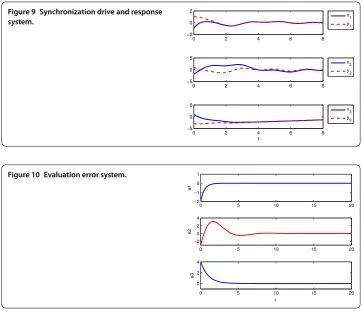
Figure 9 Synchronization drive and response system.
Figure 10 Evaluation error system.
side, the system parameters are chosen asa= .,b= . while the arbitrary initial con-ditions are set asx() = ,y() = ,z() = –. At the receiver system side, we fix the arbi-trary initial conditions asx() = –,y() = –,z() = ,a= .,bˆ() = andoˆ() = .. Suppose the message signal o(t) is trigonometric signal such as o(t) = .sin(πt), which is added on the second state variable of the drive system.
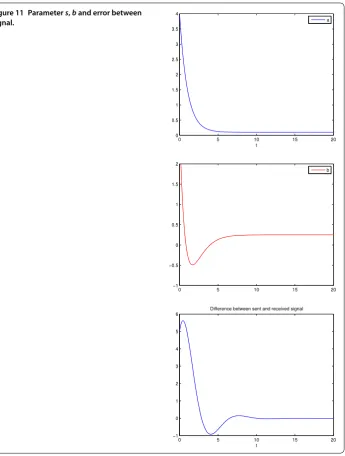
Figure displays the synchronization difference (error) between systems () and (). Figure shows the error signal between the original message and the recovered one that confirms that the message signalo(t) is recovered accurately. Figure shows the value of the unknown parametersa,band the error between sent and received signal.
By compression of results, it is obvious that in exponential synchronization the error system very fast tends to zero, which results in sending and receiving the signal faster with a better accuracy.
4.3 Image encryption using exponential stability
Almost in all cases the image encryption is often conducted along with data compression before be saved or transmitted. This is because of high volume of pictorial data and their adjuncts. Thus, it is so important to combine security demands with compression systems. In view of security, the pictorial data is not sensitive the same as the context data. In block method of encryption, firstly, one encryption key with equal dimensions with designed images one is produced by using of chaotic system and then the primary image encoded by block cipher.
Figure 11 Parameters,band error between signal.
In order to decode, the encrypted image is produced by applying the same chaotic sys-tem and utilization of an equal initial value and by considering inversion methods in the decoding key.
In the masking method for image encryption, the information signal is combined lin-early and added to the drive system. Supposeo(t) is the original image, the transmitted messages(t) is assumed as
s(t) =o(t) +kx(t) +ky(t) +kz(t), ()
whereki> ,i= , , andx,y,zare the state variables. The encrypted signal is masked
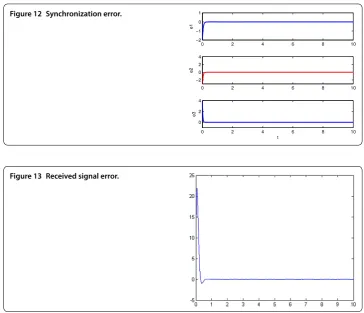
Figure 12 Synchronization error.
Figure 13 Received signal error.
that time. The recovered imager(t) is obtained using the following relation:
r(t) =s(t) –kx(t) –ky(t) –kz(t). ()
Because
r(t) = s(t) –kx–ky–kz
=o(t) +kx+ky+kz–kx–k– y– –kz
=o(t) +ke+ke+ke
∼=o(t). ()
That obviously depends on the synchronization time.
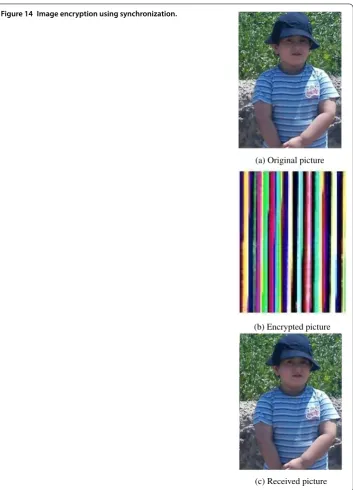
To show the validity of the proposed method, simulation results using Matlab software and the Runge-Kutta method are applied for the initial condition (x(),y(),z()) = (, –, ) and (x(),y(),z()) = (, , –) on the system () without linear term and a digital image as a signal in Figure , Figure and Figure .
5 Conclusion
syn-Figure 14 Image encryption using synchronization.
chronization, cryptography of text and image were given through both modulation and masking methods in both active and adaptive cases. The results confirm the rate and pre-cision of reception and transmittance of the desired signal.
Further research topics include the applying optimal control in the exponential synchro-nization of classical and fractional order chaotic systems and study of the other encryption methods such as the Rivest-Shamir-Adlemen (RSA) and Data Encryption Standard (DES) to compare them with the chaos-based encryption.
Competing interests
Authors’ contributions
All authors jointly worked on deriving the results and approved the final manuscript.
Author details
1Institute for Mathematical Research, University Putra Malaysia (UPM), Serdang, Selangor 43400, Malaysia.2Department of Mathematics, University Putra Malaysia (UPM), Serdang, Selangor 43400, Malaysia.
Publisher’s Note
Springer Nature remains neutral with regard to jurisdictional claims in published maps and institutional affiliations.
Received: 21 October 2016 Accepted: 21 March 2017
References
1. Lorenz, EN: Deterministic nonperiodic flow. J. Atmos. Sci.20(2), 130-141 (1963) 2. Ott, E, Grebogi, C, Yorke, JA: Controlling chaos. Phys. Rev. Lett.64(11), 1196 (1990) 3. Pecora, LM, Carroll, TL: Synchronization in chaotic systems. Phys. Rev. Lett.64(8), 821 (1990)
4. Yu, S, Lu, J, Leung, H, Chen, G: Design and implementation of n-scroll chaotic attractors from a general jerk circuit. IEEE Trans. Circuits Syst. I, Regul. Pap.52(7), 1459-1476 (2005)
5. Yu, F, Wang, C: Secure communication based on a four-wing chaotic system subject to disturbance inputs. Optik 125(20), 5920-5925 (2014)
6. Grassi, G, Mascolo, S: Synchronizing high dimensional chaotic systems via eigenvalue placement with application to cellular neural networks. Int. J. Bifurc. Chaos9(4), 705-711 (1999)
7. Hsieh, J-Y, Hwang, C-C, Wang, A-P, Li, W-J: Controlling hyperchaos of the Rossler system. Int. J. Control72(10), 882-886 (1999)
8. Kapitaniak, T, Chua, LO, Zhong, G-Q: Experimental hyperchaos in coupled Chua’s circuits. IEEE Trans. Circuits Syst. I, Fundam. Theory Appl.41(7), 499-503 (1994)
9. Peng, JH, Ding, EJ, Ding, M, Yang, W: Synchronizing hyperchaos with a scalar transmitted signal. Phys. Rev. Lett.76(6), 904 (1996)
10. Vicente, R, Daudén, J, Colet, P, Toral, R: Analysis and characterization of the hyperchaos generated by a semiconductor laser subject to a delayed feedback loop. IEEE J. Quantum Electron.41(4), 541-548 (2005)
11. Posadas-Castillo, C, López-Gutiérrez, RM, Cruz-Hernández, C: Synchronization of chaotic solid-state Nd:YAG lasers: application to secure communication. Commun. Nonlinear Sci. Numer. Simul.13(8), 1655-1667 (2008) 12. Park, JH: Chaos synchronization of a chaotic system via nonlinear control. Chaos Solitons Fractals25(3), 579-584
(2005)
13. Agiza, HN, Yassen, MT: Synchronization of Rossler and Chen chaotic dynamical systems using active control. Phys. Lett. A278(4), 191-197 (2001)
14. Aghababa, MP: Robust stabilization and synchronization of a class of fractional-order chaotic systems via a novel fractional sliding mode controller. Commun. Nonlinear Sci. Numer. Simul.17(6), 2670-2681 (2012)
15. Aghababa, MP, Aghababa, HP: Synchronization of nonlinear chaotic electromechanical gyrostat systems with uncertainties. Nonlinear Dyn.67(4), 2689-2701 (2012)
16. Mossa Al-Sawalha, M, Salmi Md Noorani, M: Anti-synchronization of two hyperchaotic systems via nonlinear control. Commun. Nonlinear Sci. Numer. Simul.14(8), 3402-3411 (2009)
17. Yang, C-C: One input control of exponential synchronization for a four-dimensional chaotic system. Appl. Math. Comput.219(10), 5152-5161 (2013)
18. Liao, X, Yu, P: Study of globally exponential synchronization for the family of Rössler systems. Int. J. Bifurc. Chaos16(8), 2395-2406 (2006)
19. Wang, Z: Anti-synchronization in two non-identical hyperchaotic systems with known or unknown parameters. Commun. Nonlinear Sci. Numer. Simul.14(5), 2366-2372 (2009)
20. Tong, D, Zhu, Q, Zhou, W, Xu, Y, Fang, J: Adaptive synchronization for stochastic T-S fuzzy neural networks with time-delay and Markovian jumping parameters. Neurocomputing117, 91-97 (2013)
21. Tong, D, Zhang, L, Zhou, W, Zhou, J, Xu, Y: Asymptotical synchronization for delayed stochastic neural networks with uncertainty via adaptive control. Int. J. Control. Autom. Syst.14(3), 706-712 (2016)
22. Tong, D, Zhou, W, Zhou, X, Yang, J, Zhang, L, Xu, Y: Exponential synchronization for stochastic neural networks with multi-delayed and Markovian switching via adaptive feedback control. Commun. Nonlinear Sci. Numer. Simul.29(1), 359-371 (2015)
23. Yan, Z, Yu, P: Globally exponential hyperchaos (lag) synchronization in a family of modified hyperchaotic Rössler systems. Int. J. Bifurc. Chaos17(5), 1759-1774 (2007)
24. Cuomo, KM, Oppenheim, AV, Strogatz, SH: Synchronization of Lorenz-based chaotic circuits with applications to communications. IEEE Trans. Circuits Syst. II, Analog Digit. Signal Process.40(10), 626-633 (1993)
25. Boutayeb, M, Darouach, M, Rafaralahy, H: Generalized state-space observers for chaotic synchronization and secure communication. IEEE Trans. Circuits Syst. I, Fundam. Theory Appl.49(3), 345-349 (2002)
26. Stevens, BL, Lewis, FL, Johnson, EN: Aircraft Control and Simulation: Dynamics, Controls Design, and Autonomous Systems. Wiley, New York (2015)
27. Teschl, G: Ordinary Differential Equations and Dynamical Systems. Graduate Studies in Mathematics, vol. 140. Am. Math. Soc., Providence (2012)
28. Narendra, KS, Annaswamy, AM: Stable Adaptive Systems. Dover, Mineola (2012) 29. Khalil, HK: Nonlinear Systems, 3rd edn. Pearson, Harlow (2002)
30. Shankar, S, Bodson, M: Adaptive Control: Stability, Convergence and Robustness. Dover, Mineola (2011)
31. Aghababa, MP, Khanmohammadi, S, Alizadeh, G: Finite-time synchronization of two different chaotic systems with unknown parameters via sliding mode technique. Appl. Math. Model.35(6), 3080-3091 (2011)
32. Xu, Y, Wang, Y: A new chaotic system without linear term and its impulsive synchronization. Optik125(11), 2526-2530 (2014)