R E S E A R C H
Open Access
Wideband partial response CPM
demodulation via multirate frequency
transformations and decision feedback
equalization
Wenjing Liu
*and Balu Santhanam
Abstract
Continuous phase modulation (CPM) is a popular frequency modulation technique used in mobile communications due to its power efficiency and constant modulus properties. Conventional narrowband CPM demodulation employs the Viterbi algorithm after phase demodulation and requires that the phase states be rational and contain additive white noise. The complexity of the Viterbi approach further increases with the number of phase states. Frequency discrimination approaches that estimate the instantaneous frequency provide a simpler suboptimal approach but are primarily for full response CPM and are not well known for wideband partial response CPM.
In this paper, we investigate an approach that combines multirate frequency transformations for wideband CPM demodulation with decision feedback equalization for memory removal. This combined approach avoids the problems of complexity and restrictive requirements of the Viterbi approach. Simulation results are used to demonstrate the validity of the combined approach.
Keywords: AM-FM demodulation, Continuous phase modulation, Multirate frequency transformations, Energy separation algorithm, Decision feedback equalization
1 Introduction
Continuous phase modulation (CPM) [1–3] is a
popu-lar form of frequency modulation employed in mobile communications [4] and has desirable spectral efficiency [5] and constant modulus properties that facilitate use of class-C amplifiers. Gaussian Minimum Shift Keying (GMSK), a specific form of CPM, is the main ingredient in the Global System for Mobile communications (GSM) [2, 3] used in GPS applications. Pragmatic CPM mod-ulation schemes have recently been studied as capacity attaining low-complexity alternatives to serially concate-nated CPM [6].
The conventional demodulation technique used for nar-rowband signals is phase demodulation [7] followed by unwrapping and maximum likelihood sequence estima-tion (MLSE) using the Viterbi algorithm [2, 3, 8]. This
*Correspondence:[email protected]
Department of Electrical and Computer Engineering, University of New Mexico, Albuquerque, NM, 87106, USA
approach has a complexity that grows exponentially with the number of phase states and restrictions on the modu-lation index that needs to be the ratio of incommensurate integers. Other frequency discrimination approaches [9] rely upon instantaneous frequency (IF) estimation and are not subject to the restrictions required by the Viterbi but have not been investigated for wideband CPM with memory.
In prior work [10, 11], it was shown that frequency discrimination for full response CPM demodulation has the same performance as that of binary phase-shift keying (BPSK) detection in additive white Guassian noise (AWGN). Further, in recent work [12], frequency tracking-based wideband FM demodulation was extended to large wideband to narrowband conversion factors using multirate frequency transformations (MFT). Frequency estimation-based approaches have the added advantage that they are immune to phase distortions introduced by the channel which would adversely affect the Viterbi
approach. In addition, these approaches do not require prior knowledge of the carrier frequency.
In this paper, we investigate the approach that combines the MFT and energy separation algorithm (ESA) [13,14] with decision feedback equalization (DFE) to effectively demodulate wideband CPM with memory. The wideband CPM signal is first converted into narrowband via the MFT and then demodulated by the ESA to obtain the IF estimates. The DFE is eventually applied to equalize the partial response channel generated from the IF esti-mates in order to remove the CPM memory introduced by partial response signaling. Simulation results are used to verify the efficacy of the combined approach for both wideband binary CPM and multilevel CPM.
2 Wideband CPM demodulation
2.1 AM-FM signal model
Monocomponent amplitude-modulation
frequency-modulation (AM-FM) signals are expressed in the form
of time-varying sinusoids by
where theinstantaneous amplitude(IA) is denoted bya(t) and theinstantaneous frequency(IF) is given by
ωi(t)=ωc+ωmqi(t). (2) Note thatωcis the carrier (or mean) frequency, andqi(t) is the normalized baseband-modulated signal.
Specific for sinusoidal FM, where a(t) remains a con-stantA, andqi(t)becomes a sinusoid, the IF can be further expressed as
ωi(t)=ωc+ωmcos(ωft+θ2). (3) Sinusoidal FM signals can be expressed via:
s(t)=A +∞
n=−∞
Jn(β)cos(ωct+nωmt), (4)
whereJnis thenth order cylindrical Bessel function of the first kind. The modulation index of the sinusoidal FM is defined as the ratioβ=ωm/ωf and the associated Carson bandwidth is given by
B=2(β+1)ωf. (5)
If β 1, then it corresponds to the wideband FM according to the literature of FM communication sys-tems. In addition, the carrier-to-information-bandwidth ratio(CR/IB) and thecarrier-to-frequency-deviation ratio (CR/FD) are defined respectively as:
CR
Wideband FM is a popular modulation technique for satellite communications due to its ability to deal with
trans-ionospheric distortion. A particular form of digital FM, multilevel Gaussianfequency-shift keying (FSK) has been proposed as a solution for high bandwidth satellite communications [15–17].
2.2 Continuous phase modulation
CPM can be viewed as a specific form of FM. The standard CPM model depends on its pulse shaping functionp(t), with duration length of symbol periodsLand modulating symbols, i.e, binary PAM symbolsa[k]∈ {−1, 1}. The IF
where ωc is the carrier frequency andh is the modula-tion index of CPM. Note that in the Viterbi algorithm, the modulation index must be rational, which is restricted to be of the form:
h= m
p, (8)
wheremandpare relatively prime positive integers. The deviation of the phase from the carrier phase is given by:
φdev(t;a)=2πh ∞
k=−∞
a[k]q(t−kTb), (9)
where p(t) denotes the pulse shaping function, which is usually normalized and defined in the interval [0,LTb], andq(t) is the corresponding phase pulse shaping func-tion defined by
q(t)=
t
0
p(τ)dτ. (10)
In general, the following conditions are satisfied by the choice ofp(t): pulse, then it is referred to as (L-RAC) CPM. The CPM signal is then obtained via frequency modulation:
r(t)=Acos t
−∞ωi(τ)dτ +θ
. (13)
Usually, the modulation index of a wideband CPM sig-nal is large such that the frequency deviation of its IF is comparable to the carrier frequency.
results in significant increase of complexity for demod-ulation and detection. The memory introduced by CPM depends on the type of its pulse shaping functionp(t)and the corresponding duration lengthL. Sincep(t)is defined over the interval [0,LTb], fornTb< t≤(n+1)Tb, Eq.7
Given the carrier frequency and modulation index, the information conveyed in the IF within the current sym-bol period depends on the most recentLsymbols and the waveform ofp(t).
2.3 Energy separation algorithm
The energy separation algorithm (ESA) as summarized
in [13, 14], based on the Teager-Kaiser energy operator [x(t)]= ˙x2(t)−x(t)x¨(t), is widely used for monocom-ponent AM-FM demodulation, for example, to analyze the oscillation of signals with time-varying amplitude and frequency. The IAa(t)and the IFωi(t)of an AM-FM sig-nalx(t)can be estimated via thecontinuous ESA(CESA) summarized by not vary too fast or too greatly in value compared to the carrier frequencyωc.
2.4 Carrier frequency and amplitude estimation
The IF estimate of the MFT-ESA in the specific case of CPM takes the form of:
ˆ
wherehf(t)corresponds to the pulse shaping function and w(t) corresponds to zero-mean IF noise, which unlike the observation noise is not white. Assuming equiproba-ble symbols and taking expectations on both sides yields:
E{ ˆωi(t)} =ωc. (18)
The carrier frequency and the amplitude of the AM-FM signal can then be estimated from the IF and IA estimates from either algorithm by simple averaging:
ˆ
This is a consequence of the fact that these approaches are bandpass estimation approaches whereas traditional in-phase and quadrature demodulation, employed in nar-rowband communication systems, is a baseband estima-tion approach requiring prior knowledge of the carrier frequency.
2.5 Multirate frequency transformations
The performance of ESA or any other demodulation tech-nique directly applied to wideband FM or CPM signals is poor due to the narrowband constraint, as demon-strated in prior work [12]. In recent work of the authors, frequency transformations enacted via multirate signal processing as shown in Fig.1were used for wideband FM to narrowband FM conversion to enable a wider range of wideband FM signals [10,12] and were also extended to two-dimensional images [18] via multidimensional energy operator [19]. The goal of the multirate processing module is to compress the bandwidth of the FM signal; however, this is accompanied by a reduction in the carrier fre-quency of the FM signal. To compensate, a heterodyning module that translates the FM signal in frequency is intro-duced. After the multirate heterodyne combination, the CR/IB and CR/FD of the transformed signal is constrained in a range, where standard narrowband monocomponent FM demodulation algorithms work optimally. The MFT framework can be combined with a variety of demodu-lation techniques such as theHilbert transform demodu-lation algorithm(HTDA) [20] or the ESA to improve the demodulation perforamnce for wideband FM signals. In particular, the ESA combined with the MFT approach will be employed in this paper.
The MFT framework specifically allows for demodula-tion of wideband CPM signals with a large modulademodula-tion depth as the examples shown in subsequent sections. Since the approach is based on IF estimation, the approach does not encounter the complexity problems or restric-tions related to rational modulation depth as seen in the Viterbi algorithm.
3 Memory removal of partial response CPM
3.1 Partial response channel
The memory introduced by the partial response signaling linearly distorts the transmitted signal and results in the intersymbol interference(ISI) for the IF of the CPM sig-nal within each symbol period. If precise IF estimates of the CPM signal are accessible, the recovery of the original transmitted sequence is similar to equalization of the ISI channel.
A discrete time-invariant channel is generally expressed as
y(t)= ∞
m=−∞
Fig. 1Block diagram of the basic MFT framework. The wideband signal is first sampled above the Nyquist rate, interpolated by a factorR, and then heterodyned by multiplication with cos(ωdn), followed by a discrete FIR bandpass filter with a passband gain to achieve the MFT. Then, it goes
through a demodulation block to generate IF estimates of the compressed heterodyned signal. To obtain the IF of the original signal, the compressed heterodyned IF is then shifted back by subtractingωd, decimated byR, and scaled back appropriately, followed by the DAC module
where hm is the impulse response, x(t) is the input sequence of the channel, and n(t) is the noise of the channel.
In terms of the normalized IF within each symbol period, the partial response channel is a special case of the ISI channel that has a finite-length impulse response and is also causal and monic withh0=1, according to Eq.14. For example, the discrete-time partial response channel using L-REC CPM can be modeled as
m(t)= L−1
k=0
s(t−k)+z(t), (21)
where s(t) is the original transmitted symbol sequence and z(t) is the noise term averaged from the noise of the IF estimates within each symbol period. Unlike the baseband channel assumingadditive white Guassian noise (AWGN), the noise term z(t) for this partial response channel of CPM is not AWGN since the noise presented in the IF estimates cannot be guaranteed as AWGN by any IF demodulation approach.
The output sequencem(t)of the partial response chan-nel can be obtained by demodulating the CPM signals and making decisions on the normalized demodulated IF within each symbol period. Therefore, our goal becomes recovering the original transmitted sequence from the output of the partial response channel.
3.2 Partial response channel estimation via recursive
prediction error method
The channel response is required by general equaliza-tion approaches, in order to remove the memory of the
partial response CPM. In this paper, we perform the chan-nel estimation via the recursive prediction error method based on the ARMAX model as described in [21]. The partial response channel, depicted for example in Eq. (21), is actually a monic moving-average (MA) process. We are capable of estimating the channel response by fitting the output of the partial response channel to an ARMAX model.
In general, the structure of the ARMAX model is described by
na
k=0
aky[t−k]= nb
k=1
bku[t−k]+ nc
k=0
cke[t−k] , (22)
where na, nb, andnc are the number of coefficients for the auto-regressive (AR) part, system input, and moving-average (MA) part, respectively. It can also be written as
A(q)y(t)=B(q)u(t)+C(q)e(t). (23)
whereqis the backward shift operator. Specifically,
A(q) = 1+a1q−1+. . .+anaq−na, (24)
B(q) = b1q−1+. . .+bnbq
−nb. (25)
C(q) = 1+c1q−1+. . .+cnbq−nc. (26)
By assuming A(q) = 1 and B(q) = 0, the ARMAX model can be simplified to the MA model that exactly fits Eq. (21), as described by
y(t)=C(q)e(t)= nc
k=0
ckq−ke(t)= nc
k=0
By satisfying certain conditions,C(q)is actually invert-ible, that is,e(t)can be calculated via an inverse operator
˜ C(q)via
e(t)= ˜C(q)y(t)= ∞
k=0 ˜
cky(t−k). (28)
The coefficient estimation for the ARMAX model can be achieved via an iterative search algorithm that mini-mizes a more robust quadratic prediction error criterion. The parameter vectorθ can be formed by grouping the coefficients of the ARMAX model as
θ =[a1,. . .,ana,b1,. . .,bnb,c1,. . .,cnc] . (29)
The predictor for the ARMAX model is given by
C(q)yˆ(t| θ)=B(q)u(t)+[C(q)−A(q)]y(t). (30)
It can be rewritten as
ˆ
y(t| θ)=B(q)u(t)+[1−A(q)]y(t)+[C(q)−1] (t,θ), (31)
where (t,θ)is defined as the prediction error given by
(t,θ)=y(t)− ˆy(t| θ). (32) Therefore, we can express the predictor in the form of pseudolinear regression via
ˆ
y(t| θ)= ϕT(t,θ)θ, (33)
where we define the data vectorϕ(t,θ)as
ϕ(t,θ)=[−y(t−1),. . .,−y(t−na),u(t−1),. . ., u(t−nb), (t−1,θ),. . ., (t−nc,θ)] . (34)
According to Eq. (31), the gradient of the predictor ψ(t,θ)w.r.tθcan be computed via
C(q)ψ(t,θ)= ϕ(t,θ). (35)
The gradientψ(t,θ)can be obtained by filtering the data vectorϕ(t,θ)through an inverse filter ofC(q).
The cost function for the recursive prediction error method is defined as
Vt(θ,Yt)=γ (t) 1 2
t
k=1
β(t,k) 2(k,θ), (36)
whereβ(t,k)andγ (t)satisfy the following conditions
β(t,k)= t
j=k+1
λ(j), β(t,t)=1, (37)
t
k=1
γ (t)β(t,k)=1, (38)
Note that λ(j) is the forgetting factor, which is often set to a constant less than 1. It controls the convergence rate and leads to compromise between misadjustment and tracking, similar to therecursive least squares(RLS) approach in the context of adaptive filtering [22].
The algorithm of the recursive prediction error method is then summarized via
(t)=y(t)− ˆy(t), (39)
ˆ
θ(t)= ˆ θ(t−1)+γ (t)R−1(t)ψ(t) (t), (40)
R(t)=R(t−1)+γ (t)ψ(t)ψT(t)−R(t−1) , (41)
whereψ(t)andyˆ(t)are short for the resulting approxima-tions ofψ
t,θ(ˆ t−1)
andyˆ
t| θ(t−1)
, respectively.
3.3 Memory removal via decision feedback equalization
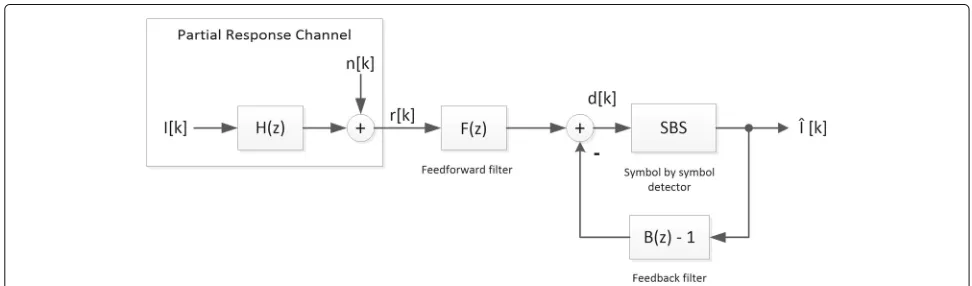
Similar to eliminating ISI,decision feedback equalization (DFE) [23] can be applied to the output sequence of the partial response channel to remove the CPM memory. The block diagram of the general decision feedback equal-izer is illustrated in Fig.2. According to the choice of the feedforward filter and feedback filter, a variety of deci-sion feedback equalizers can be implemented, such as the
zero-forcing DFE that directly inverts the channel and the MMSE-DFE that employs a minimum mean-square error criterion.
3.3.1 ZF-DFE solution
By inverting the partial response channel using the esti-mated channel response, the original symbol sequence can be recovered by applying the inverse filterHinv(q)on the channel output sequencem(t)and classifying the fil-ter output according to the optimal region of each symbol. For the previous case of the 3-REC multilevel CPM, the expression for the inverse filter is given by
Hinv(q)=
1
1+ ˆc1q−1+ ˆc2q−2
. (42)
Note that the inverse filterHinv(q)is an IIR All-pole fil-ter, which can be simply implemented via direct recursion of its difference equation by
ˆ
s(t)=m(t)− ˆc1ˆs(t−1)− ˆc2ˆs(t−2), (43)
where ˆs represents the estimated symbol sequence. It requires the input, i.e., in our case, the partial response channel output sequencem(t), to be nearly perfect; oth-erwise, the error incurred by inaccurate input symbols can be significant. This in turn requires the MFT-ESA demodulation section to produce a sufficiently accurate demodulation result. By incorporating the slicer, i.e., the symbol by symbol detection device into the inverse filter recursion, we can implement the decision feedback ver-sion of the zero-forcing equalizer (ZF-DFE) to eliminate memory induced in the partial response CPM signals.
3.3.2 MMSE-DFE solution
Instead of focusing on just removal of the channel between the IF input and the information symbols, if we further incorporate a MMSE cost function that bal-ances the task of eliminating memory while simultane-ously reducing symbol distortion, we obtain the linear MMSE equalizer that can provide further improvement in the symbol error performance in low signal-to-noise
ratio (SNR) environment. The corresponding decision
feedback version of the linear MMSE equalizer (MMSE-DFE) incorporates both pre-cursor and post-cursor taps. The feedforward filter coefficients of the MMSE-DFE are obtained from the Wiener solution and then used to solve for the feedback filter coefficients. A detailed description of the MMSE-DFE solution is presented in [24].
4 Simulation results
4.1 Performance of carrier frequency estimation
In practice, since prior knowledge of distributions is not available, we replace the expectation with a simple time-average as in Eq.19. While in the discrete-time case, we replace the integral with a time-average sum:
ˆ
c= 1 L
L−1
k=0
i[k] .
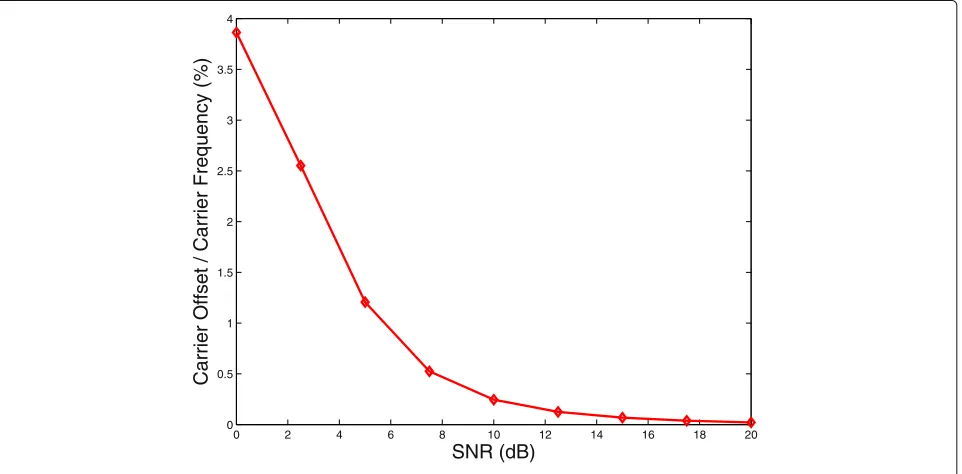
Figure3depicts the carrier frequency estimation error of the MFT-ESA for the case where we have equiproba-ble symbols versus SNR. For larger SNR values, the carrier frequency estimation error approaches zero indicating that the IF yields a reliable carrier frequency estimate.
0 2 4 6 8 10 12 14 16 18 20
0 0.5 1 1.5 2 2.5 3 3.5 4
SNR (dB)
Carrier Offset / Carrier Frequency (%)
4.2 Performance of wideband partial response multilevel CPM demodulation
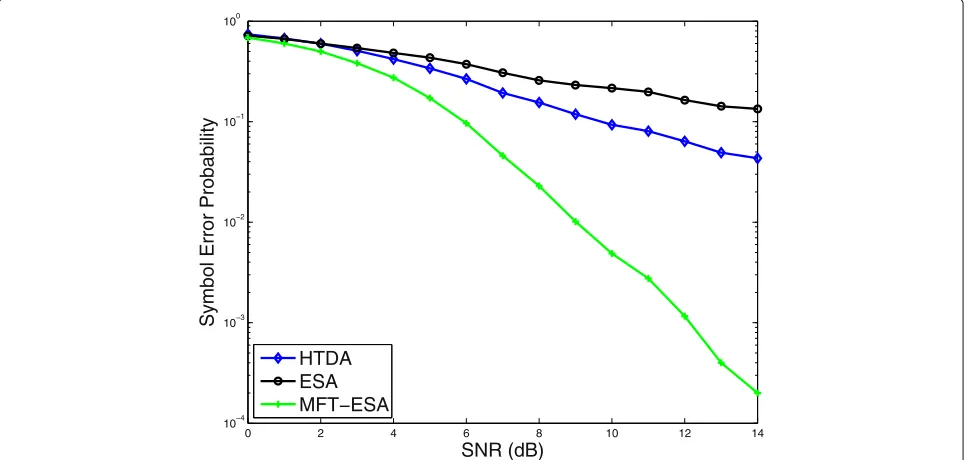
A wideband 3-REC multilevel CPM signal with sym-bols taking values in the alphabet{−3,−1, 1, 3} is used for performance test. The frequency deviation of the IF is equal to the carrier frequency in this extreme wide-band case with modulation index h = 4. The symbol error probability for the proposed MFT-ESA approach is depicted in Fig. 4. Since the 3-REC CPM signal has memory, the symbols here refer to the mixed symbols due to the memory effect of partial response signal-ing as described in Eq. 21. As the SNR increases, the MFT and ESA combination reduces the error dramati-cally. The error eventually drops to zero when the SNR passes certain threshold, while the error performances of the Hilbert transform (HTDA) and the ESA gradu-ally saturate at certain levels due to carry-over effects from incomplete demodulation induced by narrowband constraints.
Unlike the common AWGN channel, the AWGN imposed on the CPM signal is not linearly added to the modulation signals (or symbols) in the partial response channel since the modulation signals (or symbols) are conveyed in the IF of the CPM signal. Therefore, the sym-bol error performance for the CPM signal is different from what is observed with modulation schemes that fit into the AWGN channel analysis, such as the classic Q curve for BPSK modulation. The CPM format provides robustness to noise when the SNR exceeds a certain threshold and if the CPM signal is sufficiently sampled.
4.3 Performance of partial response channel estimation
via recursive error method
The simulation result of the partial response channel estimation via the recursive error method for wideband 3-REC multilevel CPM is illustrated by Fig. 5. With a memory lengthL=3, the partial response channel for the 3-REC multilevel CPM can be expressed via
m[t]=s[t]+c1s[t−1]+c2s[t−2]+z(t), (44)
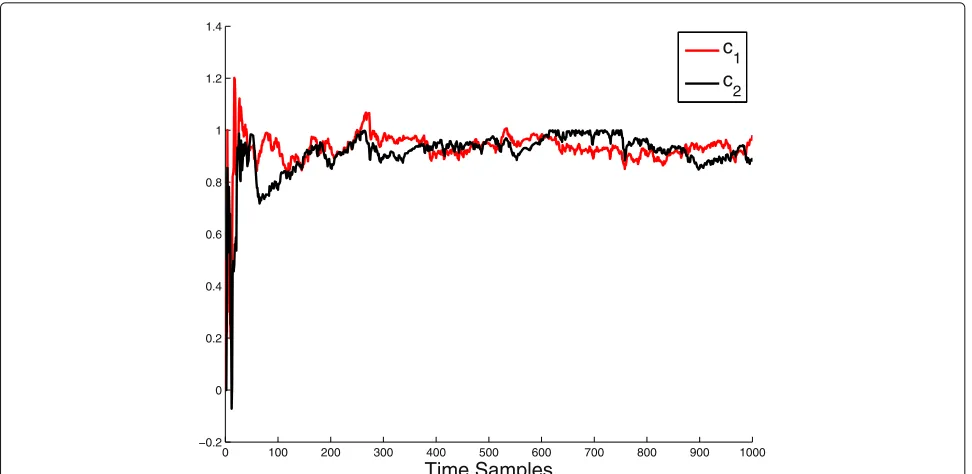
wherec1 = c2 = 1. As we can observe from Fig.5, the estimated coefficients converge close to the true value 1 in the case of REC CPM. They serve as useful estimates when other forms of pulse shaping such as in RAC-COM or SRAC-CPM are employed.
4.4 Performance of partial response CPM memory
removal via decision feedback equalization
The MFT-ESA demodulation module described in the prior sections is then combined with the decisionfeedback equalization for memory removal to obtain estimates of the original information symbols. The channel response required by equalization has been estimated via the recur-sive error method.
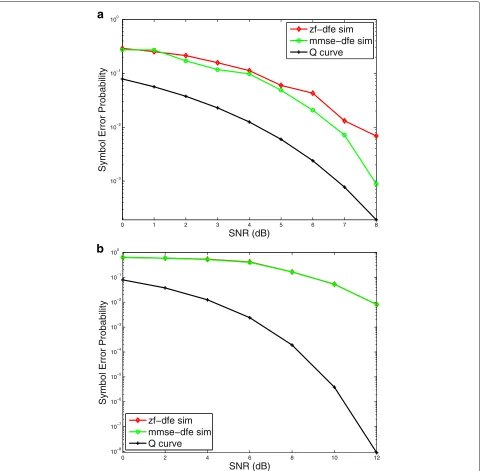
The symbol error probability performance of the pro-posed MFT-ESA demodulation combined with ZF-DFE and MMSE-DFE for memory removal are compared in Fig. 6 for both wideband binary and multilevel 3-REC CPM senarios. Note that the modulation indices of the wideband CPM signals in this example are deliberately
0 2 4 6 8 10 12 14
10−4 10−3 10−2 10−1 100
SNR (dB)
Symbol Error Probability
HTDA ESA MFT−ESA
0 100 200 300 400 500 600 700 800 900 1000 −0.2
0 0.2 0.4 0.6 0.8 1 1.2 1.4
Time Samples
c
1
c
2
Fig. 5Partial response channel estimation for 3-REC multilevel CPM via recursive error method. Note that the multilevel symbols take values in {−3,−1, 1, 3}. The red line indicates the convergence of the estimated coefficientcˆ1, and the black line indicates the convergence of the estimated coefficientcˆ2
chosen such that the implementation of the Viterbi algo-rithm is not practical due to the complexity of its phase states. For binary case, the MMSE-DFE performs slightly better than the zero-forcing DFE in the low SNR region, as shown in Fig.6a. For multilevel case, the performance of both approaches are almost the same as in Fig.6b. Since the multilevel signaling compress the decision region for symbol detection, the resolution of the symbol by symbol detector (or the slicer) is reduced, resulting in degraded performances of both approaches at the same level in the extreme wideband case where the IF deviation is close to the carrier frequency.
From our previous analysis, we know that the error asso-ciated with the mixed symbols (or output of the partial response channel) obtained from the demodulated IF for low SNR environment is significant due to error propa-gation. The recovery of the original symbols for low SNR environment is hence significantly influenced since the proposed memory removal approach is very sensitive to its input. However, as the SNR increases, the output of the partial response channel determined by MFT-ESA demodulation module becomes more accurate, leading to a significant improvement in the ability to recover the transmitted symbols as evident in the symbol error prob-ability. Above a SNR threshold of around 10 dB for the binary case and 12 dB for the multilevel case, the sym-bol error probability becomes negligible attributable to
the fact that inverse filtering solution becomes nearly perfect after that threshold, which has been verified but not shown in Fig.6due to limitations of the log scale.
5 Conclusions
In this paper, we have presented an approach towards wideband CPM demodulation by extending the MFT-ESA approach developed by the authors. The character-istic features of the proposed MFT-ESA approach are (1) unlike the Viterbi algorithm whose complexity increases with the number of phase states induced by m and p as in Eq.8, the complexity of the proposed approach is independent of the modulation index; (2) the proposed approach does not require prior knowledge of the car-rier frequency and this parameter can be extracted from the IF estimates; and (3) the proposed approach accom-modates large modulation indices and multilevel signaling making it conducive to the large bandwidth requirements proposed in the M-ary FSK system for satellite communi-cations [15].
0 2 4 6 8 10 12 10−8
10−7 10−6 10−5 10−4 10−3 10−2 10−1 100
SNR (dB)
Symbol Error Probability
zf−dfe sim mmse−dfe sim Q curve
0 1 2 3 4 5 6 7 8
10−3 10−2 10−1 100
SNR (dB)
Symbol Error Probability
zf−dfe sim mmse−dfe sim Q curve
a
b
Fig. 6Memory removal via decision feedback equalization:asymbol error probability of MFT-ESA approach for binary CPFSK with zero-forcing and MMSE decision feedback equalization to remove memory induced due to partial response signaling andbsymbol error probability for multilevel CPFSK with zero-forcing and MMSE decision feedback equalization. In both cases, 3-REC CPM with parametersTb=1s,fs=50Hz, andfc=12Hz
was employed. The MFT conversion factor wasR=16, and the modulation indices for the binary and multilevel cases wereh=97/21 and
h=19/15, respectively. For equalization purposes, 50 pilot symbols were used. Note that the SEP ofaandbwill drop to zero around 11 and 16 dB, respectively, which are not shown due to limitations of the log scale
of removal of memory introduced by partial response sig-naling. Both the zero-forcing solution based on direct inversion of the memory channel, its corresponding deci-sion feedback verdeci-sion and the MMSE-DFE solution to memory removal were investigated and shown to produce significant reduction in the symbol error probability over no equalization.
Abbreviations
likelihood sequence estimation; MFT: Multirate frequency transformations; MMSE: Minimum mean-square error; RLS: Recursive least squares; SNR: Signal-to-noise ratio; ZF: Zero-forcing
Funding
This paper is based on research sponsored by the Air Force Research Labs (AFRL) under the agreement FA9453-16-1-0067.
Authors’ contributions
Both authors contributed to design of the system and development of the algorithm. Both authors read and approved the submitted version of the manuscript.
Competing interests
The authors declare that they have no competing interests.
Publisher’s Note
Springer Nature remains neutral with regard to jurisdictional claims in published maps and institutional affiliations.
Received: 8 November 2017 Accepted: 12 April 2018
References
1. MJ Gertsman, JH Lodge, Symbol-by-symbol MAP demodulation of CPM and PSK signals on Rayleigh flat-fading channels. IEEE Trans. Commun. 45(7), 788–799 (1997)
2. T Aulin, JB Anderson, C-EW Sundberg,Digital Phase Modulation. (Plenum, New York, 1986)
3. CE Sundberg, Continuous phase modulation. IEEE Commun. Mag.24, 25–38 (1986)
4. S Li, N Zhang, S Lin, L Kong, A Katangur, MK Khan, M Ni, G Zhu, Joint admission control and resource allocation in edge computing for internet of things. IEEE Netw.32(1), 72–79 (2018)
5. S Lin, L Kong, Q Gao, MK Khan, Z Zhong, X Jin, P Zeng, Advanced dynamic channel access strategy in spectrum sharing 5G systems. IEEE Wireless Commun.24(5), 74–80 (2017)
6. A Perotti, A Tarable, S Benedetto, G Montorsi, Capacity-achieving CPM schemes. IEEE Trans. Inf. Theory.56(4), 1521–1541 (2010)
7. W Xue, W Shang, SB Makarov, Y Xu, A phase trajectories optimization method for CPM signal based on Pan-function model. EURASIP J. Adv. Signal Process.2016(1), 55 (2016)
8. JG Proakis, M Salehi,Digital Communications, Fifth Edition. (McGraw-Hill Publishing Company, New York, 1995), pp. 284–290
9. SS Abayesekara, in2015 IEEE International Conference on Digital Signal Processing (DSP). Robust full response M-ary raised-cosine CPM receiver design via frequency estimation, (Singapore, 2015), pp. 935–939.https:// doi.org/10.1109/ICDSP.2015.7252014.http://ieeexplore.ieee.org/stamp/ stamp.jsp?tp=&arnumber=7252014&isnumber=7251315
10. B Santhanam, Generalized energy demodulation for large frequency deviations and wideband signals. IEEE Signal Process. Lett.11(1), 341–344 (2004)
11. M Gupta, B Santhanam, inThe Thrity-Seventh Asilomar Conference on Signals, Systems & Computers, 2003. Adaptive linear predictive frequency tracking and CPM demodulation, vol. 1, (2003), pp. 202–206.https://doi. org/10.1109/ACSSC.2003.1291897.http://ieeexplore.ieee.org/stamp/ stamp.jsp?tp=&arnumber=1291897&isnumber=28782
12. W Liu, B Santhanam, in2015 IEEE Signal Processing and Signal Processing Education Workshop (SP/SPE). Wideband-FM demodulation for large wideband to narrowband conversion factors via multirate frequency transformations, (Salt Lake City, 2015), pp. 7–12.https://doi.org/10.1109/ DSP-SPE.2015.7369519.http://ieeexplore.ieee.org/stamp/stamp.jsp?tp= &arnumber=7369519&isnumber=7369513
13. P Maragos, JF Kaiser, TF Quatieri, Energy separation in signal modulations with application to speech analysis. IEEE Trans. Signal Process.41(10), 3024–3051 (1993)
14. A Potamianos, P Maragos, A comparison of the energy operator and hilbert transform approach to signal and speech demodulation. Signal Process.37(1), 95–120 (1994)
15. M Fitch, K Briggs, Gaussian multilevel FM for high-bandwidth satellite communications. University College of London (2004)
16. D Christopoulos, S Chatzinotas, G Zheng, J Grotz, B Ottersten, Linear and nonlinear techniques for multibeam joint processing in satellite communications. EURASIP J. Wireless Commun. Netw.2012(1), 162 (2012) 17. SK Chronopoulos, C Koliopanos, CT Angelis, inProceedings of the 3rd
international conference on Mobile multimedia communications
(MobiMedia ’07). ICST (Institute for Computer Sciences, Social-Informatics and Telecommunications Engineering). Satellite multibeam signaling for multimedia services (ICST, Brussels, 2007), p. 4
18. W Liu, B Santhanam, Wideband image demodulation via bi-dimensional multirate frequency transformations. J. Optic. Soc. Am. A.33, 1668–1678 (2016)
19. F Salzenstein, AO Boudraa, Multi-dimensional higher order differential operators derived from the Teager-Kaiser energy-tracking function. Signal Process.89(4), 623–640 (2009)
20. FW King,Hilbert Transforms, vol. 2. (Cambridge University Press Cambridge, Cambridge, 2009)
21. L Ljung,System Identification: Theory for the User, Second Edition. (Prentice Hall, New Jersey, 1999), pp. 370–372
22. SS Haykin,Adaptive Filter Theory, 4th Edition. (Prentice Hall Press, Upper Saddle River, 2005), pp. 436–440
23. R Fischer, J Huber, C Windpassinger, Signal processing in decision feedback equalization of intersymbol-interference and
multiple-input/multiple-output channels: a unified view. Signal Process. 83(8), 1633–1642 (2003)