CSEIT172271 | Received: 08 March 2017 | Accepted: 18 March 2017 | March-April 2017 [(2)2: 203-210]
International Journal of Scientific Research in Computer Science, Engineering and Information Technology © 2016IJSRCSEIT | Volume 2 | Issue 2 | ISSN : 2456-3307
203
Identification and Classification of Mango Fruits Using Image Processing
Dameshwari Sahu
*, Chitesh Dewangan
Department of Electronics and Telecommunication Engineering, Bhilai Institute of Technology, Durg, Chhattisgarh, India
ABSTRACT
Image processing technology has been widely used in the agricultural field. Most of it applied to the robot that can be utilized for picking fruit and for inspection vehicle. Identification and classification is a major challenge for the computer vision to achieve near human levels of recognition. The fruits and vegetable classification is useful in the supermarkets and can be utilized in computer vision for the automatic sorting of fruits from a set, consisting of different kind of fruits. The objective of this work is to develop an automated tool, which can be capable of identifying and classifying mango fruits based on shape, size and color features by digital image analysis. Initially, pre-processing techniques will be adopted to obtain the binary image using the texture analysis and morphological operations on digital images of different mango fruits. Later, the processed images will be further classified by suitable classification method. MATLAB have been used as the programming tool for identification and classification of fruits using Image Processing toolbox. Proposed method can be used to detect the visible defects, stems, size and shape of mangos, and to classify the mango in high speed and precision.
Keywords: Image Processing, Mango Classification, Mango Identification, Fruit Grading, Defect Detection.
I.
INTRODUCTION
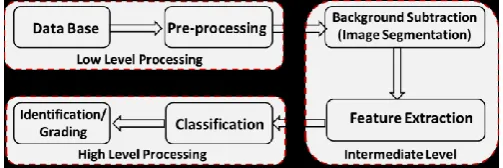
In recent years, many researches have been done on fruit quality detection by using computer vision technology, and a lot of significant results have been obtained. There are many research reports, but so far they are in the experimental stage, and the analysis method is far from practical application. Particularly in the defect detection, the current approach used to deal with very slow, cannot be used in actual online work. In some literature, different methods of recognition of defects are implemented, but the need to use both near infrared and mid-infrared camera equipment, the cost of these two devices, making the application of this method is limited, cannot be widely used in agricultural grading equipment. Therefore, it is of importance to study the classification detection method suitable for production. A generalized block diagram of identification and classification of mango fruits is shown in Fig 1.
Figure 1. Generalized block diagram of identification and classification of mango fruits.
Mango is one of the world‟s favorite tropical fruits with an increasing production trend every year. In general, the color of the fruit indicates its maturity and the presence of defects. Its physical appearance affects its value in the market, so it is important to observe proper handling of fruits after harvesting. Sorters must know the requirements that should be followed so that the fruits can be accepted for export.
human visual system. Uniformity in the classification process is critical so that its output is guaranteed to satisfy the requirements for exporting mangoes. Fruit categorizations in agriculture have changed from traditional grading by humans to automatic classification over the past 20 years. Many companies are moving to automated classification in many crops such as grading on peaches and oranges [1]. To classify mangoes, we need to be aware of the mango-grading standard. Colour and the size are the most important criteria that are used to sort fruits. However, for sorting of mangoes, there is another major factor which is the skin texture of mangoes that can improve the accuracy of the classification system. The purpose of the study was to implement an image-processing algorithm that can help in automating the process of mango classification. The specific objectives were to apply an image analysis algorithm that can measure the size and shape of a mango and at the same time determine its identification and classification of mango system. The main objective of this work is to design an algorithm that can identify and classify mango fruits based on shape and size features by digital image analysis. In more detail, the research objectives are stated as follows. To develop an algorithm for image processing to identify and classify mango fruits, and test and verify the analysis of image processing with experimental results.
This proposed work is an attempt to implement an extensively designed project based on the topics covered. The project involves a proposed problems and solutions with MATLAB programming. Section I includes a brief description plans, motivation, the necessity of identification and classification of mango and purpose of this project. In Section II, some related works are discussed. In Section III, the problems are discussed which arise during mango image analysis. Section IV explains the whole methodology involved in the completion of the proposed work. In Section V, experimental results of proposed work are discussed. In Section VI, conclusion and scope of future work are made. References are included in Section VII. The proposed work explains the objective of the project,
background information, methodology to be followed and expected results.
II.
OTHER IMAGE PROCESSING
IMPLEMENTATION WITH FRUITS
The review of literature is accomplished very carefully and keenly towards the proper definition of the problem. Different methodologies are being investigated to propose and implement the present work. The reviewed literature has been classified into primary heads for the sake of the comprehensive analysis study such a classification shall help to study literature as per their context. The image processing and computer vision systems have been widely used for identification, classification, grading and quality evaluation in the agriculture area. Some of the most important implementation of image processing in agricultural products is:
The image processing method for classification of orange by ripeness is developed. In this work, the proper degree of maturity is determined and based on that orange have been classified by histogram and morphological analysis. It uses standard CODEX benchmark, in that quality level of the commercial types of specified orange [2].
A fusion approach is implemented to for multiclass fruit and vegetable classification task in distribution center and supermarket. A novel unified approach has been introduced, to combine many features and classifier. This method requires less training of data than another method that combines features individually and fed separately to classification algorithm [3].
Using just one image feature to secure the class separability might not be sufficient, so it is necessary to extract and combine those features which are useful for the fruit and vegetable recognition problem. The result of the system depends upon the image segmentation method, so efficient image segmentation must be used. In the literature, available classifiers work on two classes only, but in the classification problem author considered more than two categories, so it is a major issue to use a binary classifier in a multiclass scenario [4].
on the techniques of Fourier descriptors (FD), spatial domain analysis (SDA) and artificial neural network (ANN) [5].
By performing digital image processing, defined as the acquisition and processing of visual information by computer, computer vision systems allow analyzing image data for specific applications to determine how images can be used to extract the required information. Among the most important features for accurate classification and sorting of products, it can be mentioned the shape. In this paper for segmentation, a technique base on Hough Transform is used to detection of object shape [6].
Machine vision has been introduced in a variety of industrial applications for fruit processing, allowing the automation of tasks performed so far by human operators. Such an important task is the detection of defects present on fruit peel which helps to grade or to classify fruit quality. In this paper, a hybrid algorithm, which is based on split and merges approach, is proposed for an image segmentation that can be used in fruit defect detection [7].
Variable lighting condition, occlusions and clustering are some of the important issues needed to be addressed for accurate detection and localization of fruit in orchard environment. This paper summarizes various techniques and their advantages and disadvantages in detecting fruit in plant or tree canopies. The paper also summarizes the sensors and systems developed and used by researchers to localize fruit as well as the potential and limitations of those systems [8].
Image processing is an efficient tool for analysis in various fields and applications in agriculture. Today‟s very advanced and automated industries used more accurate method for different inspection processes of agriculture object. This task is known as robotics task. In Indian agriculture industry, many kinds of activities are done like quality inspection, sorting, assembly, painting, packaging. Above mentioned activities are done manually. By using Digital Image processing tasks done conveniently and efficiently. Using Digital image processing many kinds of task fulfills like object Shape, size, color detection, texture extraction, firmness of purpose, aroma, maturity, etc. In this paper, various algorithms of shape detection are explained, and conclusions are
provided for best algorithm even merits and demerits of each algorithm or method are described [9].
Seasonal fruits, like mango, are harvested from gardens or farms in batches; the mangoes present in each batch are not uniformly matured, therefore, sorting of mangoes into different groups is necessary for transporting them to different locations. With this background, this paper proposes a machine-vision-based system for classification of mangoes by predicting maturity level and aimed to replace the manual sorting system. The prediction of maturity level has been performed from the video signal collected by the Charge Coupled Device (CCD) camera placed on the top of the conveyor belt carrying mangoes. Extracted image frames from the video signal have been corrected and processed to extract various features, which were found to be more relevant for the prediction of maturity level [1]. This paper focuses on the automatic detection of
the pomegranate fruits in an orchard. The image is segmented based on the color feature using k-means clustering algorithm. The K-Means algorithm produces accurate segmentation results only when applied to images defined by homogeneous regions on texture and color. Segmentation begins by clustering the pixels based on their color and spatial features. The clustered blocks are then merged to a specific number of regions. Thus it provides a solution for image retrieval. Thus this paper proposed the simulation results that have been attained using the algorithm [10].
The literature survey gives a keen insight into the various studies done in the field of identification and classification of mango fruit. The study focused mainly on different methods and applications of Mango fruit identification and classification system. A variety of methods has been suggested by the researchers to improve the performance of the system. This literature survey has provided useful insight into different techniques that can be utilized to plan design and development of the proposed method.
III.
PROBLEM IDENTIFICATION
solutions. Image processing approach is a non-invasive technique which provides consistent, reasonably accurate, less time consuming and cost effective solution for farmers to manage fertilizers and pesticides. Some important factors and issues which are needed to be considered while development of identification and classification method for mango fruit is listed below:
A. Background subtraction
It is necessary to extract mango from the cluttered environment, so subtraction of background is essential for proper identification and classification of mango fruits. Background subtraction also reduces the scene complexities such as shading, light variation, background clutter.
B. Feature Extraction
Shape – Region and boundary are two types of shape
description feature. Region-based features include grid-based and moment approaches, whereas finite element models, rectilinear shape, polygonal approximation and Fourier-based shape descriptors are boundary-based shape features.
Colour - Colour Value and Degree of Colour
distribution are measured based on R, G, and B color component ratio. Example: Colour may be different for example; Orange ranges from being green to yellow, to patchy and brown.
Size - Size may be large, medium or small. It is measured from the maximum length or area or calculated volume from several images.
C. Classifier
In classification process different feature such as geometric and, non-geometric features need to be classified. So, it is necessary to address the issue of proper selection of classifier.
IV.PROPOSED METHODOLOGY
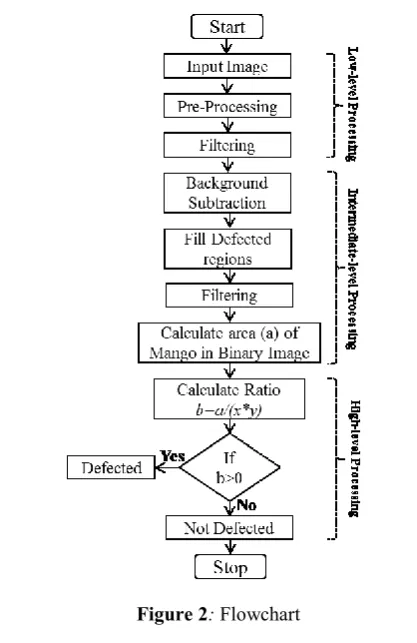
The Proposed algorithm for identification and classification of mango fruits is shown in Fig. 2. Theoretically, proposed algorithm involves three types of processing:
1. Low-level processing: In low-level processing
input image/dataset is pre-processed. Pre-processing includes RGB to gray conversion, image binarization, and image filtering.
2. Intermediate-level processing: Intermediate level
processing involves background subtraction, identification of defected region and filtering.
3. High-level processing: Classification of mango
fruit has been performed in high-level processing.
Figure 2: Flowchart
Algorithm 1: Identification and Classification of Mango Fruits
Start
Step 1: Read each image into the MATLAB from the particular folder of mango dataset.
Step 2: Convert the original image into greyscale image and binary image.
Step 3: Filter the image using a median filter.
Step 4: Remove or subtract the background from pre-processed image.
Step 5: Filter the image using a median filter. Step 6: Calculate area of mango image. Step 7: Calculate quality ratio b=a/(x*y). Step8: Apply condition
if (b> 0)
Mango is defected. else
Mango is not defected. end
Step 9: Finally, we are displaying various results. Stop.
Step-1: Database
Database of 100 calibrated images of mangoes „Kent‟ (50 mangos photographed by both sides) is obtained stored in JPG format due to internet limitations.
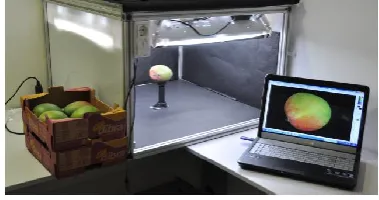
The images were taken by placing each sample inside an inspection chamber in which contained the camera and the lighting system. The vision system used to acquire the images is shown in Fig. 3. The camera was placed at a distance of 20 cm from the samples. Illumination was achieved using four lamps that contained two fluorescent tubes. The angle between the axis of the lens and the sources of illumination was of approximately 45º since the diffuse reflection responsible for the color occurs at 45º from the incident light.
Figure 3: Setup used to capture the images
However, the samples have a curved shape that can still produce bright spots affecting the color measurements. To minimize the impact of these specular reflections cross polarization was used by placing polarizing filters in front of the lamps and the camera lenses. The fluorescent tubes were powered using high-frequency electronic ballast to avoid the flickering effect of the other current and produce a
Initially, captured mango image is pre-processed. For mango size detection, mainly rely on the mango area as the basis for identification.
Table 1.Camera Settings and Parameters X Resolution 72 inch Compression setting Fine White balance Cloudy
Step-3: Background Subtraction
The preliminary background subtraction (segmentation) serves two purposes. The first purpose is to remove most of the background pixels for determination of the coarse mango regions. The second purpose is to determine whether mango pixels as a whole are darker than the background. If so, reverse the intensity of the mango image to make all the images have mango pixels that are brighter than the background and therefore improve the performance of the classifiers.
Step-4: Feature Extraction
Finally, use the function bwarea can calculate the number of pixels in the white area total. Using the ratio of the total to the pixel value (x*y) of the whole image, multiplying the area of the image, we can get the area of the mango relative to the image, and we can use this area for screening.
Step-5: Identification and Classification
In this step, mango is classified into two classes based on features. In the first class, flawless mangos and in second class defected mangoes are classified. Detection of defected mango has been performed based on surface defect (such as scars, dark spots, etc.). The defected mango is identified by extracting the contour of damaged part. Then damaged part has been filled to find its area in the image as the basis for discrimination.
V.
RESULTS AND DISCUSSION
that better results are obtainable using proposed algorithm. MATLAB Implementation of proposed algorithm is as follows:
Pre-processing: Initially, raw RGB mango image
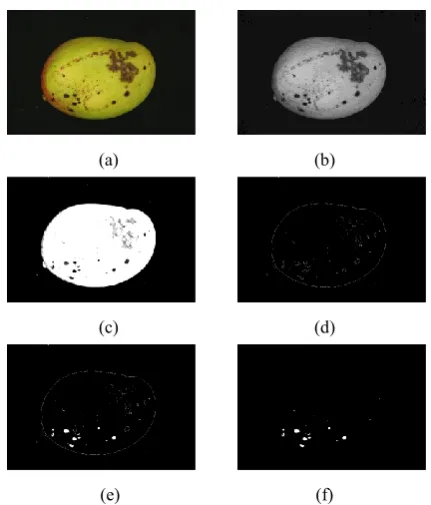
is converted to grey-scale by grey-scale image processing; MATLAB function rgb2gray have been used for this operation. Original RGB image is shown in Figure 5(a) and converted grey-scale image is shown in Figure 5(b).
Background Subtraction: After pre-processing,
grey-scale image is converted to binary image by thresholding by using function im2bw with the 0.2 threshold value is shown on Fig. 4(c). so that the mango area is black, the rest of the region is white. Finally, figure reversal is applied, so that black and white colour area reversed when the apple area is white.
Feature Extraction: Finally, use the function
bwarea can calculate the number of pixels in the
white area total. Using the ratio of the total to the pixel value (x*y) of the whole image, multiplying the area of the image, we can get the area of the mangorelative to the image, and we can use this area for screening.
Classification/ Identification: Then the grey-scale
image is adjusted by using function imadjust.
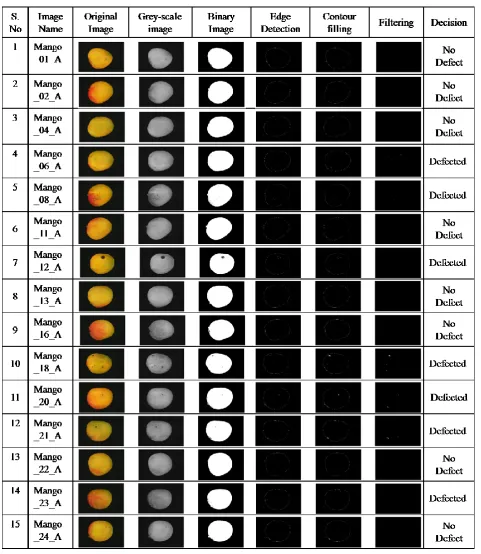
Followed by the median filter is used to filter the image using function medfilt2. Then, edge detection is performed to create a boundary of contours on filtered mango image by using function edge. Edge detected image is shown in Fig. 4(d). Then, contour (defective part) is filled with white pixel using function imfill is shown in Fig. 4(e). Followed by filtering, this is shown in Fig. 4(f). The noise filter for defects in the number of pixels a, the total number of pixels with the picture (x*y) then the ratio of b is our basis for judgment, the program set b = 0.
The proposed algorithm is tested using 15 mango images. Table 2 listed the results at various stages of an algorithm for 15 mango images. It is observed from the Table 2, proposed algorithm efficiently and accurately determines the quality of mango.
Fig. 5 shows that plot of classification of Mango based on quality ratio b=a/(x*y) value. Among fifteen mango images, seven mangos are defected and eight are not defected. It is also verified from Table 2.
(a) (b)
(c) (d)
(e) (f)
Figure 4: Results. (a) Original Image (b) Grey-scale Image (c) Binary Image (d) Edge Detection (e) Contour Filling (f)
Filtered Image.
Figure 5: Classification of Mango based on quality ratio b=a/(x*y) Value
VI. CONCLUSION AND FUTURE SCOPE
perimeter, roundness, and percent defect feature to enhance the accuracy of the algorithm. The roundness and percent defect were used to identify whether the
mango‟s quality was export, local or reject. An optimal and adaptive threshold method can be used for segmentation of mango from the background.
VII.
REFERENCES
[1]. C. S. Nandi, B. Tudu, and C. Koley, “A machine vision-based maturity prediction system for sorting of harvested mangoes,” IEEE Trans.
Instrum. Meas., vol. 63, no. 7, pp. 1722–1730,
2014.
[2]. C. Prieto and D. Carolina, “Classification of Oranges by Maturity, Using Image Processing Techniques,” in Proceedings of 3rd IEEE
International Congress of Engineering
Mechatronics and Automation (CIIMA), 2014, pp.
1–5.
[3]. A. Rocha, D. C. Hauagge, J. Wainer, and S. Goldenstein, “Automatic fruit and vegetable classification from images,” Comput. Electron.
Agric., vol. 70, no. 1, pp. 96–104, 2010.
[4]. S. R. Dubey and A. S. Jalal, “Application of Image Processing in Fruit and Vegetable Analysis: A Review,” J. Intell. Syst., vol. 24, no. 4, pp. 405–424, 2015.
[5]. A. M. Aibinu, M. J. E. Salami, A. A. Shafie, N. Hazali, and N. Termidzi, “Automatic Fruits Identification System Using Hybrid Technique,”
in Proceedings of 6th IEEE International
Symposium on Electronic Design, Test and
Application, 2011, pp. 217–221.
[6]. E. A. Murillo-Bracamontes, M. E. Rosas, M. M. Miranda-Velasco, H. L. Martinez-Reyes, J. R. Martinez-Sandoval, and H. Cervantes-De-Avila, “Implementation of Hough Transform for fruit image segmentation,” in
Procedia Engineering, 2012, vol. 35, pp. 230–
239.
[7]. V. Pham and B. Lee, “An image segmentation approach for fruit defect detection using k-means clustering and graph-based algorithm,” Vietnam J.
Comput. Sci., vol. 2, no. 1, pp. 25–33, 2015.
[8]. A. Gongal, S. Amatya, M. Karkee, Q. Zhang, and K. Lewis, “Sensors and systems for fruit detection and localization: A review,” Comput.
Electron. Agric., vol. 116, pp. 8–19, 2015.
[9]. T. Meruliya, “Image Processing for Fruit Shape and Texture Feature Extraction - Review,” Int. J.
Comput. Appl. (0975, vol. 129, no. 8, pp. 30–33,
2015.
[10]. S. Poorani and P. G. Brindha, “Automatic detection of pomegranate fruits using K-mean clustering,” Int. J. Adv. Res. Sci. Eng., vol. 3, no. 8, pp. 198–202, 2014.
[11]. “Image database: Mango „Kent,‟” 2014. [Online].