doi:10.1155/2011/652789
Research Article
An Effective Numerical Method and Its
Utilization to Solution of Fractional Models
Used in Bioengineering Applications
Ivo Petr ´a ˇs
Institute of Control and Informatization of Production Processes, Faculty of BERG, Technical University of Koˇsice, B. Nˇemcovej 3, 042 00 Koˇsice, Slovakia
Correspondence should be addressed to Ivo Petr´aˇs,[email protected]
Received 13 December 2010; Accepted 1 February 2011
Academic Editor: J. J. Trujillo
Copyrightq2011 Ivo Petr´aˇs. This is an open access article distributed under the Creative Commons Attribution License, which permits unrestricted use, distribution, and reproduction in any medium, provided the original work is properly cited.
This paper deals with the fractional-order linear and nonlinear models used in bioengineering applications and an effective method for their numerical solution. The proposed method is based on the power series expansion of a generating function. Numerical solution is in the form of the difference equation, which can be simply applied in the Matlab/Simulink to simulate the dynamics of system. Several illustrative examples are presented, which can be widely used in bioengineering as well as in the other disciplines, where the fractional calculus is often used.
1. Introduction
Recently, fractional calculus has played an increasing role in modeling complex phenomena in the fields of physics, chemistry, biology, and engineering e.g., 1–4. The main characteristic of fractional derivatives, or more precisely derivatives of positive real order, is so called the “memory effect”. It is well known that the state of many systemsbiological, electrochemical, viscoelastic, etc.at a given time depends on their configuration at previous times. The fractional derivative takes into account this history in its definition as a convolution with a function whose amplitude decays at earlier times as a power-law. Thus, the fractional derivative is natural to use when modeling biological systems in various bioengineering applications.
2. Preliminaries
2.1. Fractional Calculus
Fractional calculus is a topic in mathematics that is more than 300 years old. The idea of fractional calculus was suggested early in the development of regular integer-order calculus, with the first literature reference being associated with a letter, from Leibniz to L’Hospital in 1695. In this letter the half-order derivative was first mentioned.
There are several definitions of the fractional derivative/integral as a one common operator known as “differintegral”see, e.g.,4–6:
The Riemann-LiouvilleRLdefinition is given as
aDtrft
The Caputo’s definition of fractional derivatives can be written as
aDrtft we can write the Gr ¨unwald-LetnikovGLdefinition as
aDrtft hlim→0
For many engineering applications the Laplace transform methods are often used. The Laplace transform of the RL, the GL, and Caputo’s fractional derivative/integral, under zero initial conditions for orderris given by5:
£aD±trft;s s±rFs. 2.4
A function, which plays a very important role in the fractional calculus, was in fact introduced by Humbert and Agarwal7. It is a two-parameter function of theMittag-Leffler type defined as4:
2.2. Fractional-Order Systems
There are several possible interpretations of the fractional-order systems. Here are mentioned three of them.
A general fractional-order linear system can be described by a fractional differential equation of the form4:
anDαnyt · · · a1Dα1yt a0Dα0yt bmDβmut · · · b1Dβ1ut b0Dβ0ut, 2.6
where Dγ ≡ 0Dγ
t denotes the Riemann-Liouville, Caputo’s or Gr ¨unwald-Letnikov frac-tional derivative depending on initial conditions and their physical meaning or by the corre-sponding transfer function of incommensurate real orders of the following form4:
Gs bms
βm · · · b1sβ1 b0sβ0
ansαn · · · a1sα1 a0sα0
Qsβk
Psαk, 2.7
where ak k 0, . . . , n,bk k 0, . . . , m are constants, and αkk 0, . . . , n, βk k 0, . . . , m are arbitrary real or rational numbers and without loss of generality they can be arranged asαn>· · ·> α1 > α0, andβm>· · ·> β1> β0.
The fractional-order linear time-invariant system can also be represented by the following state-space model:
0Drtxt Axt But,
yt Cxt, 2.8
wherex∈Rn,u∈Rm, andy∈Rpare the state, input and output vectors of the system andA∈ Rn×n,B∈Rn×m,C∈Rp×n, andr r1, r2, . . . , rnTare the fractional orders. Ifr1r2· · · rn≡r, system2.8is called a commensurate-order system, otherwise it is an incommensurate-order system.
In this paper, we will also consider the general incommensurate fractional-order nonlinear system represented as follows:
0Dri
txit fix1t, x2t, . . . , xnt, t
xi0 ci, i1,2, . . . , n,
2.9
wherefi are nonlinear functions andci are initial conditions. The vector representation of
2.9is:
Drxfx, 2.10
The equilibrium points of system 2.10 are calculated via solving the following equation
fx 0, 2.11
and we suppose that E∗ x∗1, x∗2, . . . , x∗n is an equilibrium point of the fractional-order nonlinear system2.10.
2.3. Discrete Time Approximation of Fractional Calculus: Numerical Method
In general, if a functionftis approximated by a grid function,fkh, wherehis the grid size, the approximation for its fractional derivative of orderαcan be expressed as8:
yhkh h∓r
ωz−1±rf
hkh, 2.12
wherez−1is the backward shift operator andωz−1is a generating function. This generating
function and its expansion determine both the form of the approximation and the coefficients
9. In this way, the discretization of continuous fractional-order differentiator/integrator
s±rr ∈ Rcan be expressed as s±r ≈ ωz−1±r. It is known that the forward difference rule is not suitable for applications to causal problems8,9.
As a generating function,ωz−1can be used in generally the following formula10:
ωz−1
1
βT
1−z−1 γ 1−γz−1
, 2.13
where β and γ are denoted the gain and phase tuning parameters, respectively, andT is sampling period. For example, when β 1 and γ {0,1/2,7/8,1,3/2}, the generating function2.13becomes the forward Euler, the Tustin, the Al-Alaoui, the backward Euler, the implicit Adams rules, respectively. In this sense the generating formula can be tuned more precisely.
The expansion of the generating functions can be done by power series expansion
PSE. It is very important to note that PSE scheme leads to approximations in the form of polynomials of degreep, that is, the discretized fractional order derivative is in the form of finite impulse responseFIRfilters, which have only zeros11.
In this paper, for directly discretizings±r,0 < r <1, we will concentrate on the FIR form of discretization where as a generating function we will adopt a backward Euler rule. The mentioned operator, obtained from2.13forβγ1, raised to power±r, has the form
ωz−1±r
1−z−1 T
±r
Then, the resulting transfer function, approximating the fractional-order operators, can be obtained by applying the relationship12:
Yz T∓rPSE1−z−1±r
Fz, 2.15
whereYzis theZtransform of the output sequenceykT,Fzis theZtransform of the input sequence fkT, and PSE{u} denotes the expression, which results from the power series expansion of the functionu.
Doing so gives13:
whereD±rzdenotes the discrete equivalent of the fractional-order operator, considered as processes, andPpz−1is the polynomial with degreepof variablez−1.
By using the short memory principle4, the discrete equivalent of the fractional-order integrodifferential operator,ωz−1±r, is given by
For practical numerical calculation of the fractional derivative and integral we can derive the formula from relation 2.17, where the sampling period T is in numerical evaluation replaced by the time step of calculationh, then we get
Obviously, for this simplification we pay a penalty in the form of some inaccuracy. If
ft≤M, we can easily establish the following estimate for determining the memory length
L, providing the required accuracy4:
L≥
M |Γ1−r|
1/r
. 2.20
An evaluation of the short memory effect and convergence relation of the error between short and long memory were clearly described and also proved in4.
For general numerical solution of the fractional differential equation, let us consider the following initial value problem
aDtryt f
yt, t, 2.21
with initial conditions yk0 yk
0 , k 0,1, . . . , n− 1, where n− 1 < r < n. Using
approximation2.19, we obtain the numerical solution, which can be expressed as
ytk f
ytk, tk
hr−
k
jv
cjrytk−j
, 2.22
wheretk kh. For the memory term expressed by sum, a “short memory” principle can be used or without using “short memory” principle, we putv1 for allkin2.22.
3. Fractional-Order Models in Bioengineering Applications
There are many fractional-order models, which were already used in bioengineering ap-plications as for example3,4,15: model of neuron, bioelectrode model, model of respiratory mechanics, compartmental model of pharmacokinetics, and so forth, In this section we mention and describe only three of them, namely model of the cells, nuclear magnetic resonanceNMRmodel, and Lotka-Volterraparasite-host or predator-preymodel.
3.1. Fractional-Order Viscoelastic Models of Cells
Cells have an essential biological roles and often change shape, attach and detach from surface, and sometimes divide. Such activities require the deformation in response to local stress. The rheological behavior of these cells can be modeled with the following fractional differential equation3:
σt Gsθt λ0Dαtθt μ
dθt
dt , 3.1
If we apply the Laplace transform to system3.1, assuming that the initial conditions are all zeros, we obtain
Gs Σs
Θs Gs λs
α μs. 3.2
As it was mentioned in3, the parameterGscan be neglected. For a step functionut in applied stress,σt σ0ut, the creep response can be written as
Θs Σ0 sμs λsα
Σ0s1−α−2
μs1−α λ/μ. 3.3
The inverse Laplace transform of this expression can be written by using a Laplace transform of the Mittag-Leffler function4:
£tβ−1Eγ,β−ztγ
sγ−β
sγ z, 3.4
and we obtain an analytical solution in the form
θt Σ0 μtE1−α,2
−λ
μt 1−α
. 3.5
For numerical solution of the fractional differential equation3.1forGs 0, we can use relations2.18and2.19. The resulting difference equation has the form
θtk
Σ0 μh−1θtk−1−λh−αkjvc α
j θ
tk−j
λh−α μh−1 , 3.6
wheretkkhfork1,2,3, . . . , N, whereN Tsim/handhis time step of calculation, and
θt0is obtained from initial condition, for example,θt0 0 for zero initial condition. Let us assume the following model parameters:λμ Σ0 1, zero initial condition, Tsim5 sec,h0.001, andv1.
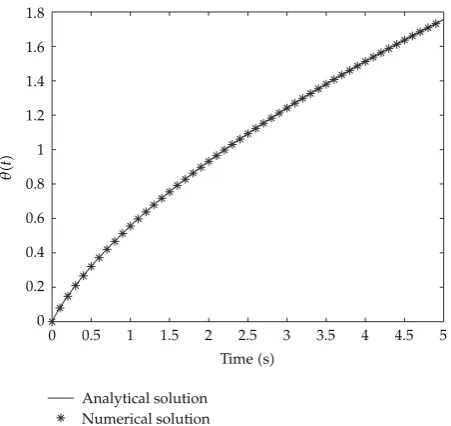
Comparison of the analytical solution3.5 and the numerical solution 3.6 of the fractional differential equation3.1for the parametersGs 0,λ μ Σ0 1, zero initial
condition,Tsim5 sec,h0.001, andv1 is depicted inFigure 1.
As we can observe inFigure 1, the numerical solution fits the analytical solution and we can say that both solutions are consistent.
3.2. Fractional-Order Bloch Equations in NMR
In physics and bioengineering, specifically in NMR or magnetic resonance imaging, the Bloch equations are a set of macroscopic equations that are used to calculate the nuclear magnetizationM Mxt, Myt, Mzt as a function of time when relaxation times are
losing their energy to the surrounding lattice, hence the name spin-lattice relaxation. T2
involves the loss of phase coherence between the protons processing in the transverse plane. Different tissues in the body have different values ofT1 and T2. The values depend on the strength of the magnetic field.
Now, we consider the fractional-order Bloch equations, where integer-order deriva-tives are replaced by fractional-order ones. Mathematical description of the fractional-order system with Caputo’s derivatives is expressed as16
0Dq1 maintain a consistent set of units for the magnetization.
Numerical solution of Bloch equations3.7was obtained by using the relationship
2.22, which leads to solution in the form17:
Comparison of the proposed numerical solution 3.8 with an analytical solution has been done in 17and obtained results show a good consistency of both solutions. In aforementioned work the Matlab function and the Matlab/Simulink model for solution of the fractional-order Bloch equations3.7have also been created, which can be widely used for simulations with various parametersω0,T1,T2, andM0 for desired simulation timeTsim
and initial conditionsMx0,My0,Mz0.
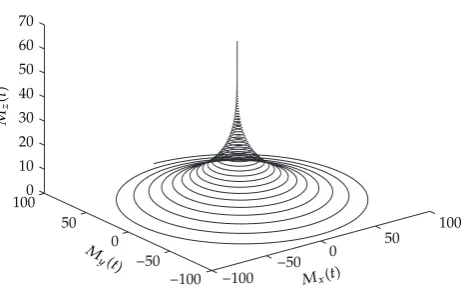
Let us consider the following parameters for tissue—gray matter of brain—for a magnetic field strength of 1.5 T from18:T1900msq,T2 100msq,ω0 401 rad/secq, equilibriumM0100, ordersq≡q1q2q30.9, andq≡q1q2q31.0, respectively.
Numerical solutionstate space trajectoryof the fractional-order Bloch equations3.7
with parameters: q ≡ q1 q2 q3 0.9, T1 900msq, T2 100 msq,M0 100,
0 0.5 1 1.5 2 2.5 3 3.5 4 4.5 5
Figure 1:Comparison of analytical and numerical solutions of fractional-order viscoelastic models of cell
3.3for simulation time 5 sec, steph0.001, andv1 in3.6.
We can observe in both figures that fractional orders in the Bloch equations provide expanded model with different behavior for describing a more general NMR, which can find applications in complex materials exhibiting memory.
3.3. Fractional-Order Lotka-Volterra System
The fractional-order Lotka-Volterra or fractional-order predator-prey model or parasite-hostsystem was proposed and described as19:
−100 proposed by Alfred Lotka in 1910 and independently by Vito Volterra in 1926.
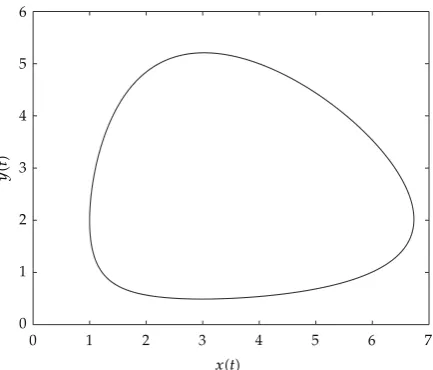
The stability analysis and numerical solutions of such kind of system have been already studied in19. There are two equilibria, when the system3.9is solved forxandy. The above system of equations yields toE1 0; 0andE2 λ/δ;α/βifr0. The stability of the equilibrium pointE1 is of importance. If it were stable, nonzero populations might be attracted towards it. However, as the fixed point at the origin is a saddle point, and hence unstable, we find that the extinction of both species is difficult in the model. The second fixed point E2 is not hyperbolic, so no conclusions can be drawn from the linear analysis. However, the system admits a constant of motion and the level curves are closed trajectories surrounding the fixed point. Consequently, the levels of the predator and prey populations cycle and oscillate around this fixed point.
Numerical solution of the fractional-order Lotka-Volterra system 3.9 is given by using a relation2.22as start pointinitial conditions.
Let us assume the following parameters of system3.9:α2, β1, γ 3, δ1, r
0 and ordersq1q21.0 andq1q20.9, respectively.
Numerical solution state plane trajectory of the fractional-order Lotka-Volterra equations3.9with parameters:α 2, β 1, γ 3, δ 1, r 0, and initial conditions
0 1 2 3 4 5 6 7 8 0
1 2 3 4 5 6
x(t)
y
(
t
)
Figure 4:Numerical solutions of fractional-orderq≡q1q20.9Lotka-Volterra equations3.9in state plane for simulation time 60 sec,h0.005, andv1 in3.10.
0 1 2 3 4 5 6 7
0 1 2 3 4 5 6
x(t)
y
(
t
)
Figure 5:Numerical solutions of integer-orderq≡q1q2q31.0Lotka-Volterra equations3.9in state plane for simulation time 60 sec,h0.005, andv1 in3.10.
According to knowledge of author, there is no exact analytical solution of the fractional-order Lotka-Volterra equations, which could be compared with the numerical solution. The only possibility is to compare proposed numerical method with an approximate solution obtained via different numerical methods as for example homotopy perturbation method, variational iteration method, and so on.
4. Discussion
solution of the fractional differential equation even if the fractional-order derivative in differential equation is Caputo’s or Riemann-Liouville type. It is based on the fact that for a wide class of functions, all three definitions of the fractional derivatives are equivalent
4.
Sometimes the Euler method is not accurate enough; it only has order one. We have to do a numerical analysis, which consists of not only the design of numerical methods, but also analysis of three main concepts.
iConsistency and order. Tell us how well it approximates the solution, we can say, method is consistent if it has an order greater than 0. The method used in this article has order 1 and therefore it is consistent. Order is determined by generating function. Consistency is a necessary condition for convergence, but not sufficient.
iiConvergence. It means whether the method approximates the solution, in other words, a numerical method is said to be convergent if the numerical solutionykh
approaches the exact solutionytas the time step sizehgoes to 0. The method described in this article is convergent because the following condition is satisfied:
lim
h→0k0,1max,...,Tsim/h
ykh−yt0, 4.1
for Tsim > 0. For instance, we can observe a good result in comparison of exact solution and numerical solution shown inFigure 1. The time step wash0.001.
iiiStability and stiffness.It says whether errors are damped out. For some differential equations, application of standard methods exhibit instability in the solutions, though other methods may produce stable solutions. This behavior in the equation is described as stiffness. Method described in article provides a stable solution.
The numerical method2.22proposed for the initial value problem2.21holds all three above-mentioned conditions and can be used for solution of linear and nonlinear fractional differential equations. Based on performed experiments, we can consider what is the optimal choice of time steph in order to get maximum accuracy in the approximated solution for minimum computational cost. We have used the time stepsh0.005,h0.001, and 0.0005. Numerical solutions show than we may accept the results obtained in this way. The size of the time step also depends on desired relative error in the solution.
5. Conclusions
In this paper, we presented an effective numerical method and its application to solution of linear and nonlinear models of fractional order used in bioengineering applications. For some of them, Matlab functions 15, 17, 20 were also published. Here, three illustrative examples have been presented as well. It is worth to note that some other methods are also appropriate for solution of such kind of problem, for example predictor-corrector method
Acknowledgment
This work was supported in part by the Slovak Grant Agency for Science under Grants VEGA: 1/0390/10, 1/0497/11, 1/0746/11, Grants APVV-0040-07 and SK-PL-0052-09.
References
1 R. Caponetto, G. Dongola, L. Fortuna, and I. Petr´aˇs,Fractional Order Systems: Modeling and Control Applications, World Scientific, Singapore, 2010.
2 R. Hilfer,Applications of Fractional Calculus in Physics, World Scientific, River Edge, NJ, USA, 2000.
3 R. L. Magin,Fractional Calculus in Bioengineering, Begell House, 2006.
4 I. Podlubny, Fractional Differential Equations, vol. 198 of Mathematics in Science and Engineering, Academic Press, San Diego, Calif, USA, 1999.
5 K. B. Oldham and J. Spanier,The Fractional Calculus, Academic Press, New York, NY, USA, 1974.
6 A. Oustaloup,La D´erivation non Enti`ere, Hermes, Paris, France, 1995.
7 P. Humbert and R. P. Agarwal, “Sur la fonction de Mittag-Leffler et quelques-unes de ses g´en´eralisations,”Bulletin des Sciences Math´ematiques, vol. 77, pp. 180–185, 1953.
8 R. Gorenflo, “Fractional calculus: some numerical methods,” inFractals and Fractional Calculus in Continuum Mechanics, vol. 378 ofCISM Courses and Lectures, pp. 277–290, International Centre for Mechanical Sciences, Udine, Italy, 1996.
9 Ch. Lubich, “Discretized fractional calculus,”SIAM Journal on Mathematical Analysis, vol. 17, no. 3, pp. 704–719, 1986.
10 R. S. Barbosa, J. A. Tenreiro Machado, and M. F. Silva, “Time domain design of fractional differintegrators using least-squares,”Signal Processing, vol. 86, no. 10, pp. 2567–2581, 2006.
11 L’. Dorˇc´ak, I. Petr´aˇs, J. Terp´ak, and M. Zborovjan, “Comparison of the methods for discrete approximation of the fractional-order operator,”Acta Montanistica Slovaca, vol. 8, no. 4, pp. 236–239, 2003.
12 B. M. Vinagre, I. Podlubny, A. Hern´andez, and V. Feliu, “Some approximations of fractional order operators used in control theory and applications,”Fractional Calculus & Applied Analysis, vol. 3, no. 3, pp. 231–248, 2000.
13 B. M. Vinagre, Y. Q. Chen, and I. Petr´aˇs, “Two direct Tustin discretization methods for fractional-order differentiator/integrator,” Journal of the Franklin Institute, vol. 340, no. 5, pp. 349–362, 2003.
14 L’. Dorˇc´ak,Numerical Models for the Simulation of the Fractional-Order Control Systems, The Academy of Science, Institute for Experimental Physics, Koˇsice, Slovakia, 1994.
15 I. Petr´aˇs and R. L. Magin, “Numerical solution of two compartmental biological system model,” inProceedings of the 4th IFAC Workshop on Fractional Differentiation and Its Applications, University of Extremadura, Badajoz, Spain, October 2010.
16 R. Magin, X. Feng, and D. Baleanu, “Solving the fractional order Bloch equation,”Concepts in Magnetic Resonance A, vol. 34, no. 1, pp. 16–23, 2009.
17 I. Petr´aˇs, “Modeling and numerical analysis of fractional-order Bloch equations,”Computers and Mathematics with Applications, vol. 61, no. 2, pp. 341–356, 2011.
18 A. Webb,Introduction to Biomedical Imaging, John Wiley & Sons, New York, NY, USA, 2003.
19 E. Ahmed, A. M. A. El-Sayed, and H. A. A. El-Saka, “Equilibrium points, stability and numerical solutions of fractional-order predator-prey and rabies models,”Journal of Mathematical Analysis and Applications, vol. 325, no. 1, pp. 542–553, 2007.
20 I. Petr´aˇs, “Fractional Order Chaotic SystemsMatlab toolbox,” MathWorks, Inc., FileExchange, 2010, http://www.mathworks.com/matlabcentral/fileexchange/27336.
21 I. Podlubny, “Matrix approach to discrete fractional calculus,”Fractional Calculus & Applied Analysis, vol. 3, no. 4, pp. 359–386, 2000.
22 I. Podlubny, A. Chechkin, T. Skovranek, Y. Chen, and B. M. Vinagre Jara, “Matrix approach to discrete fractional calculus. II. Partial fractional differential equations,”Journal of Computational Physics, vol. 228, no. 8, pp. 3137–3153, 2009.
23 K. Diethelm, “An algorithm for the numerical solution of differential equations of fractional order,”
24 Ch. Lubich, “Fractional linear multistep methods for Abel-Volterra integral equations of the first kind,”IMA Journal of Numerical Analysis, vol. 7, no. 1, pp. 97–106, 1987.