R E S E A R C H
Open Access
Augmented error system approach to
control design for a class of neutral systems
Yujie Xu
1, Jing Zhang
1*and Fucheng Liao
2*Correspondence: [email protected] 1Department of Basic Courses, Beijing Union University, No. 97 Beisihuan East Road, Chaoyang District, Beijing, 100101, P.R. China Full list of author information is available at the end of the article
Abstract
In this paper, control design based on target tracking for a class of neutral systems is investigated by augmented error system approach. The dynamic equation of tracking error is derived by use of the desired output which is assumed to be known. Based on the main thought of preview control, the augmented error system is constructed. A criterion to guarantee the asymptotic stability of the corresponding nominal system is established. Through control design of the augmented error system, a delay-dependent control and a delay-independent control are respectively presented for the original neutral system. Control design in this paper contains integrators, which can effectively reduce static errors. Examples are given to illustrate the efficiency of the proposed method.
Keywords: neutral system; augmented error system; asymptotic stability; preview control; target tracking
1 Introduction
Time-delay is often encountered in many practical systems such as process control sys-tems, neural network syssys-tems, and nuclear reactor systems (see [, ]). It is well known that time-delay is a major source of instability and oscillation. Therefore, stability analysis and control design of time-delay systems are important in theory and practice (see [–]). As a special class of time-delay systems, neutral systems contain time-delay both in the states and in the derivatives of states, which can reflect the systems’ operation more com-prehensively and accurately. It has been shown that a number of practical systems can be modeled by neutral systems such as heat exchangers, population ecology, and partial element equivalent circuit (PEEC) (see [, ]). Additionally, there exist some time-delay systems which can be transformed into neutral systems by model transformation, includ-ing lossless transmission model, standard delay systems, and standard distributed delay systems (see []). Due to the particularity of time-delay, stability issues of neutral systems are proved to be more complex. They have attracted much attention and hence a lot of research has been done over recent years (see [, ]).
To the best of the authors’ knowledge, though some frequency domain methods, such as the spectral decomposition theory and semi-group theory, are applied to investigate the stability of neutral systems, they are not as popular as Lyapunov-Krasovskii functional (LKF). Through LKF approach, many stability criteria have been proposed (see [–]). Recently, LMIs and free weighting matrices have been widely used in LKF for the
ity of neutral systems (see [–]). For example, by constructing a new LKF with free weighting matrices, stability criteria for uncertain neutral systems were investigated in []. Moreover, free weighting matrices and model transformations were both employed in [] for cross terms. Then a less conservative stability criterion based on LMIs was derived for stochastic neutral systems. However, control design based on these stability criteria is usually the state feedback, which is delay-independent or delay-dependent.
Actually, it is required that the output should track the target in some control systems such as robot routine control systems.H∞output tracking control, where the output of
a control system tracks the output of a given reference model well in the sense, is often adopted as the main way of tracking control for neutral systems (see [, , ]). Aug-mented error system approach is usually used in tracking control by combining the error signal and the state. Sometimes, LKF uses augmented vector to simplify the results (see [, ]).
This paper utilizes the known desired output, but not the reference model, to construct an augmented error system which contains the state vector, the error signal, the desired output, and their derivatives. Thus, control design in the paper contains not only state feedback, but also an integrator, which can effectively reduce static errors and is not sim-ilar to output tracking control (see [, ]). The main thought comes from the theory of preview control, which belongs to tracking control. In this paper, we keep time-delay in the augmented error system, which is different from the ordinary method of preview control (see [–]).
Notations Throughout this paper, the following notations will be used. Rn denotes an n-dimensional Euclidean space. Rn×m is the set of alln×mreal matrices.∗refers to the
symmetric part of a matrix.P> represents thatPis a symmetric positive definite matrix.
Idenotes an identity matrix with appropriate dimensions.
2 Problem statements
Consider the following linear neutral system:
⎧ ⎪ ⎪ ⎨ ⎪ ⎪ ⎩
˙
x(t) –Gx˙(t–h) =Ax(t) +Ax(t–h) +Bu(t),
y(t) =Cx(t), t≥,
x(t) =φ(t), t∈[–h, ],
()
wherex(t)∈Rnis the state vector,u(t)∈Rm is the input of system, andy(t)∈Rp is the
output vector.h> denotes the constant time-delay, which appears in both the state and the derivative of state. The matricesA∈Rn×n,A∈Rn×n,C∈Rp×n,G∈Rn×n,B∈Rn×m
are known real constant matrices. And the initial conditionφ(t) is a continuous vector-valued function ont∈[–h, ]. Define the operatorDx(t) =x(t) –Gx(t–h).
Letr(t) be thep× desired output or the demand vector of system (). Then the tracking error of system () is described as
e(t) =y(t) –r(t). ()
Assumption |λi(G)|< (i= , , . . . ,n), whereλi(G) is theith characteristic value ofG.
Assumption The desired outputr(t)∈Rpis piecewise differentiable with finite
discon-tinuity points. Except its discondiscon-tinuity points,r(t) is differentiable up to thesth order,i.e.,
r(t),r(t), . . . ,r(s–)(t) are all continuous andr(s)(t) =r(s+)(t) =· · ·= .
Remark The stability ofDx(t) can be replaced by the Schur-Cohn stability ofG. It means that if all characteristic values ofGare in unite circle, the operatorDx(t) is stable (see []). So Assumption insures thatDx(t) is stable.
Remark System () is described by differential equations. So it is necessary that the derivatives of desired output are taken to construct an augmented error system. Assump-tion can make sure the method is suitable for more extensive desired output such as staircase signal which is mostly common in signal processing (see []). Additionally, at discontinuity points of the desired output, we can take left or right derivatives as their derivatives for values of limited points do not affect the system’s performance much.
Remark Ifr(t) is derivable for any order, its first tosth derivatives are selected within error range, which is similar to the truncation method of signal procession (see []). Some desired output may be expanded into power series with limited terms if necessary.
The following well-known lemma will be used for providing the main results in the se-quel.
Lemma (Schur complementin []) Given the constant matrices,,,where=
T and <=T,then+T– < if and only if
T –
< , or
–
T
< .
3 Main results
In this section, main results on both delay-dependent and delay-independent control de-sign will be presented for system (). Firstly, an augmented error system is constructed. And then, the stability criterion of its corresponding nominal system is proposed.
3.1 Construction of an augmented error system
In order to make better use of the desired outputr(t), we consider combining the tracking errore(t) with system ().
It follows from () that the dynamic equation of tracking errore(t) is given by
˙
e(t) –α˙e(t–h) =Cx˙(t) –αCx˙(t–h) –r˙(t) +αr˙(t–h), ()
where <α< is a constant. According to (), we have
¨
Letδr(t) =˙r(t) –˙r(t–h). Thus, by (), () and (), the augmented error system is obtained ordinary neutral system. So we consider processing the desired outputr(t). Assume that
R(t) is the vector which contains the available desired output and its first tosth order derivatives, namely
Therefore, the problem tackled in this paper is to design control for system ().
3.2 Asymptotic stability analysis of the nominal system
The nominal system of () is
˙
Now a criterion is presented for the asymptotic stability of system ().
Theorem System()is asymptotically stable if there exist P> and Q> such that the following symmetric matrix inequality holds:
⎡ ⎢ ⎢ ⎢ ⎣
PA˜+A˜TP PA˜G˜ PA˜ I ∗ –Q/ G˜T
∗ ∗ –Q/
∗ ∗ ∗ –Q–
⎤ ⎥ ⎥ ⎥
⎦< . ()
Proof Based on Assumption and <α< , it is easy to get|λi(G¯)|< (i= , , . . . , n+p).
Therefore, we conclude that|λj(G˜)|< (j= , , . . . , n+p+sp), which ensuresDX(t) = X(t) –GX˜ (t–h) is stable (see []).
Consider the following Lyapunov functional:
V(t) =V(t) +V(t),
whereV(t) =DX(t)TPDX(t),V(t) =
–hX(t+θ)
TQX(t+θ) dθ, the matricesP=PT>
andQ=QT> are to be determined.
Taking time derivatives ofV(t) andV(t) along system () yields
˙
V(t) =X˙(t) –G˜X˙(t–h)TPDX(t) +DX(t)TPX˙(t) –G˜X˙(t–h)
=AX˜ (t) +A˜X(t–h)
T
PX(t) –GX˜ (t–h)
+X(t) –GX˜ (t–h)TPAX˜ (t) +A˜X(t–h)
=X(t)TA˜TP+PA˜X(t) +X(t)T–A˜TPG˜+PA˜ X(t–h)
+X(t–h)TA˜TP–G˜TPA˜X(t)
+X(t–h)T–A˜TPG˜ –G˜TPA˜ X(t–h),
˙
V(t) =X(t)TQX(t) –X(t–h)TQX(t–h).
Thus we get
˙
V(t) =X(t)TA˜TP+PA˜+QX(t) +X(t)TPA˜ –A˜TPG˜X(t–h)
+X(t–h)TA˜TP–G˜TPA˜X(t)
+X(t–h)T–A˜TPG˜ –G˜TPA˜ –QX(t–h).
LetM=Q –G˜TQG˜. In view of the definition ofD, the derivative ofV with respect tot
can be rewritten as
˙
V(t) =DX(t)TPA˜ +A˜TP+QDX(t) + DX(t)T(Q+PA˜)GX˜ (t–h)
+ DX(t)TPAX˜ (t–h) –X(t–h)T
M+Q
X(t–h)
+ PAQ˜ –A˜TPDX(t) –X(t–h)T–DX(t)T(Q+PA˜)GM˜ –
are feasible. Then, according to Lyapunov stability theory, system () is asymptotically stable.
By Schur complement, () and (), we get
By Lemma , the above inequality implies that () holds.
As a foundation, Theorem provides a sufficient condition for the asymptotic stabil-ity of system (). In the following sections, the proposed independent and delay-dependent controllers are calculated not only to stabilize the closed-loop neutral system, but also to fully utilize the desired outputr(t).
3.3 Delay-independent control for system (1)
Supposeu˙(t) =KX(t) is a delay-independent control for system (), whereK∈R×[n+(s+)p]
Theorem Suppose Assumptionholds for system().The closed-loop system of()is asymptotically stable if there exist matrices P> ,Q> and K such that
⎡
Theorem Suppose Assumptionholds for system().If there exists a matrix K satisfying
(),the delay-independent control for system()can be expressed as
u(t) = (kC+k) contains state feedback and the integral of state vectorx(t), but also relates to the initial conditionφ(t). Furthermore, both the integrator on tracking error signale(t) and the inte-gral of desired outputr(t) are contained in controlu(t). It is well known that introduction of integrators to control design is helpful to eliminate static errors (see []).
3.4 Delay-dependent control for system (1)
Now we suppose thatu˙(t) =LX(t) +WX(t–h) is a delay-dependent control for system (), whereL∈R×[n+(s+)p]andW∈R×[n+(s+)p]are the feedback gain matrices. Substituting the control into system (), we obtain the closed-loop system as follows:
˙
X(t) –G˜X˙(t–h) = (A˜+BL˜ )X(t) + (A˜ +BW˜ )X(t–h). ()
From Theorem , replacingA˜andA˜ of system () respectively withA˜+BL˜ andA˜ +BW˜
presents the following theorem to guarantee the asymptotic stability of system ().
Theorem Suppose Assumptionholds for().System()is asymptotically stable if there exist matrices P> ,Q> ,L and W such that
wherel= [l,,l,, . . . ,l,s–],w= [w,,w,, . . . ,w,s–]. So
Using variable substitution to the integral terms in which the integrand functions are re-lated to time-delay, we have
u(t) –u(–h) =l
Commonly, time-delayhis much smaller than the system’s run time. So the control law oft≤hhas little effect on the system’s whole running status. Therefore, we only consider the control law whent>h. Fort–h> , it is not difficult to obtain that
Then the control based on target tracking is presented as the following theorem.
Theorem Suppose Assumptionholds for system().If there exist matrices L and W satisfying(),the delay-dependent control for system()can be expressed as
+w
Remark Compared with (), control design in () contains more information to help
the outputy(t) track the desired outputr(t) effectively.
4 Examples
In this section, two examples are given to show the effectiveness of the proposed control design method.
Example Consider system () with the following parameters:
G=
Assume the desired outputr(t) = /t. Obviously, the desired output is derivable for any order. By Remark , we chooses= . And in the dynamic equation ofe(t), we choose
α= ..
Case: Control design independent of time-delay is firstly considered. By Theorem , the feedback gain matrixKis
–. –. . –. –. –. . .
.
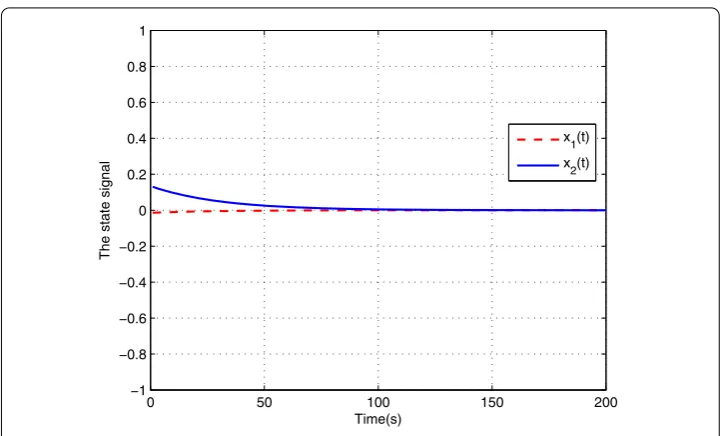
Furthermore, the corresponding state curve and output response curve are shown re-spectively in Figures and .
ChooseE= andDR= when constructing the augmented error system,i.e., remove
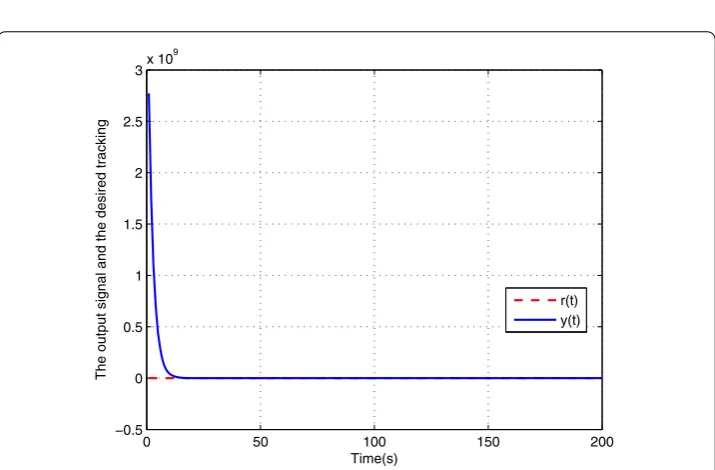
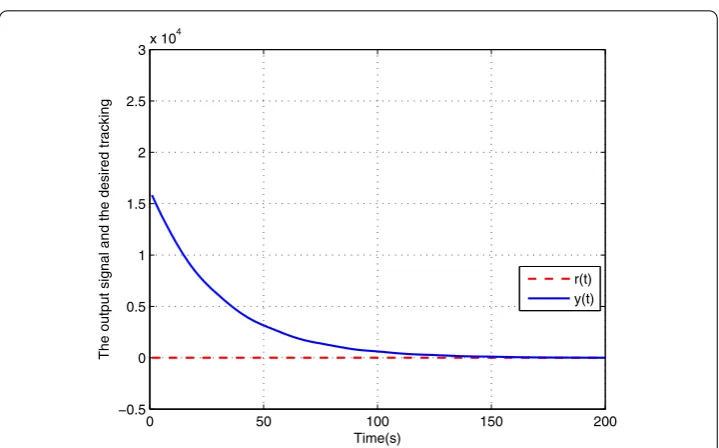
the desired outputr(t) from controlu(t) of Theorem . Then we get the control irrelevant to target tracking and time delay. The state curve and output response curve are shown respectively as Figures and .
From Figures -, we find that when the control is based on target tracking, the state curve and the output response are much smoother, and the curve amplitude is much smaller.
Case: We observe the effect of control design dependent of time-delay. By Theorem , feedback gain matricesLandWare respectively
[–., ., ., –., –., ., ., –.],
[, , , –., ., , –., –.]
Figure 1 State curve of system (1) under delay-independent control based on target tracking.
Figure 2 Output response of system (1) under delay-independent control based on target tracking.
When the control is relevant to time-delay but irrelevant to the desired output, the state curve and output response curve are shown respectively in Figures and .
Comparing these figures, we find that for this system, the amplitude of the state curve and output response is much smaller when the controlu(t) is relevant to time delay.
Example The following system comes from a small test circuit example which consists
Figure 3 State curve of system (1) under delay-independent control without target tracking.
Figure 4 Output response of system (1) under delay-independent control without target tracking.
by
⎧ ⎪ ⎪ ⎨ ⎪ ⎪ ⎩
˙
x(t) – [. –. .]x˙(t– .) = [. –.. .]x(t–h) + [ . –.]x(t) + [–]u(t),
y(t) = [ .]x(t), t≥, x(t) = [–sint/t], t∈[–., ].
Figure 5 State curve of system (1) under delay-dependent control based on target tracking.
Figure 6 Output response of system (1) under delay-dependent control based on target tracking.
The desired output is assumed to be the following stair-step function:
r(t) =
⎧ ⎪ ⎪ ⎨ ⎪ ⎪ ⎩
, t< ;
(t– ), ≤t< ;
, t≥.
And in the dynamic equation ofe(t), we chooseα= ..
Figure 7 State curve of system (1) under delay-dependent control without target tracking.
Figure 8 Output response of system (1) under delay-dependent control without target tracking.
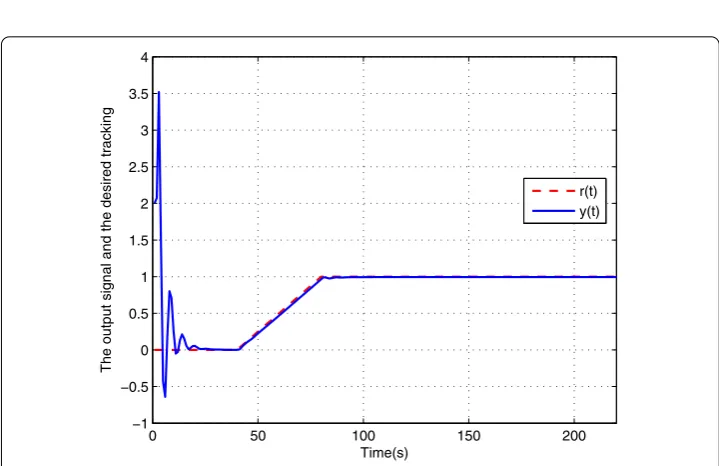
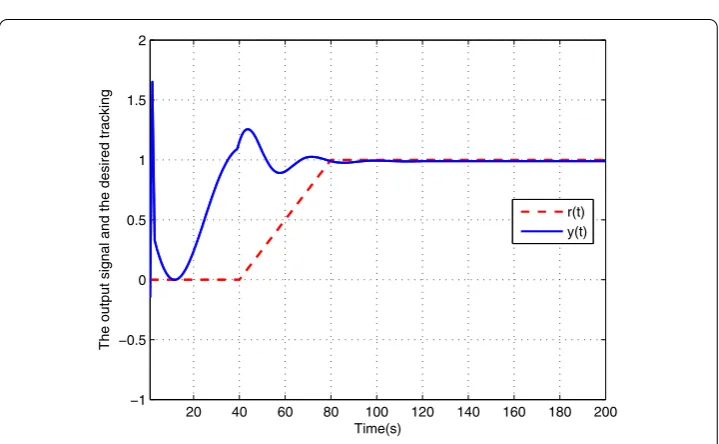
Theorem , the corresponding curves under delay-dependent control design are shown in Figures and .
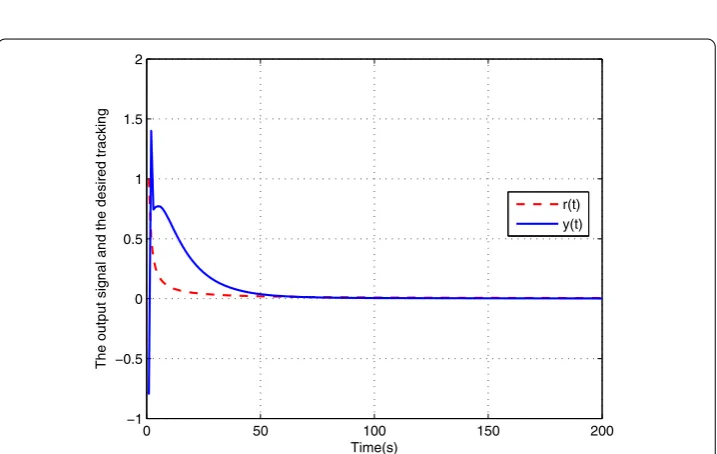
Remark The model in Example comes from partial element equivalent circuits. In [],
Figure 9 State curve of system (19) under delay-independent control design with target tracking.
Figure 10 Output response of system (19) under delay-independent control design with target tracking.
5 Conclusions
de-Figure 11 State curve of system (19) under delay-dependent control design with target tracking.
Figure 12 Output response of system (19) under delay-dependent control design with target tracking.
sired output. We hope that the proposed method in the paper can provide an approach to control design for a class of neutral systems described as system ().
Competing interests
The authors declare that they have no competing interests.
Authors’ contributions
Author details
1Department of Basic Courses, Beijing Union University, No. 97 Beisihuan East Road, Chaoyang District, Beijing, 100101, P.R. China.2School of Mathematics and Physics, University of Science and Technology Beijing, No. 30 Xueyuan Road, Haidian District, Beijing, 100083, P.R. China.
Acknowledgements
The work was supported by ‘New Start’ Academic Research Projects of Beijing Union University (Grant No. Zk10201503), the Importation and Development of High-Caliber Talents Project of Beijing Municipal Institutions (Grant No. IDHT201304089). We are indebted to Professor Wansheng Tang of Tianjin University for many useful comments. We are grateful to the anonymous reviewers for helpful advices that improved the presentation of the article.
Received: 10 February 2015 Accepted: 6 August 2015
References
1. Yamazaki, T, Hagiwara, T: Conversion of linear time-invariant time-delay feedback systems into delay-differential equations with commensurate delays. Int. J. Inf. Syst. Sci.45, 1643-1656 (2014)
2. Lee, TH, Park, M-J, Park, JH, Kwon, O-M, Lee, S-M: Extended dissipative analysis for neural networks with time-varying delays. IEEE Trans. Neural Netw. Learn. Syst.25, 1936-1941 (2014)
3. Chawda, V, OMalley, MK: Position synchronization in bilateral teleoperation under time-varying communication delays. IEEE/ASME Trans. Mechatron.20, 245-253 (2015)
4. Aleksandrov, AY, Hu, G-D, Zhabko, AP: Delay-independent stability conditions for some classes of nonlinear systems. IEEE Trans. Autom. Control59, 2209-2214 (2014)
5. Balasubramaniam, P, Krishnasamy, R, Rakkiyappan, R: Delay-dependent stability of neutral systems with time-varying delays using delay-decomposition approach. Appl. Math. Model.36, 2253-2261 (2012)
6. Liu, S, Xiang, Z: ExponentialH∞output tracking control for switched neutral system with time-varying delay and nonlinear perturbations. Circuits Syst. Signal Process.32, 103-121 (2013)
7. Kolmanovskii, VB, Myshkis, A: Applied Theory of Functional Differential Equations. Kluwer Academic, Dordrecht (1992) 8. Bellen, A, Guglielmi, N, Ruehli, AE: Methods for linear systems of circuit delay differential equations of neutral type.
IEEE Trans. Circuits Syst. I, Fundam. Theory Appl.46, 212-216 (1999)
9. Li, H: Robust Control for Neutral Delay Systems. Northwestern Polytechnical University Press, Xi’an (2006)
10. Pepe, P, Verriest, EI: Lyapunov criteria for stability inLpnorm of special neutral systems. Automatica48, 132-138 (2012) 11. Qian, W, Liu, J, Sun, Y-X, Fei, S-M: A less conservative robust stability criteria for uncertain neutral systems with mixed
delays. Math. Comput. Simul.80, 1007-1017 (2010)
12. Chen, H: New criteria on stability analysis for uncertain neutral system with mixed time-varying delays. Optim. Control Appl. Methods34, 487-501 (2013)
13. Ramakrishnan, K, Ray, G: Robust stability criteria for uncertain neutral systems with interval time-varying delay. J. Optim. Theory Appl.149, 366-384 (2011)
14. Chen, Y, Zheng, W, Xue, A: A new result on stability analysis for stochastic neutral systems. Automatica46, 2100-2104 (2010)
15. Kwon, OM, Park, MJ, Park, JH, Lee, SM, Cha, EJ: New delay-partitioning approaches to stability criteria for uncertain neutral systems with time-varying delays. J. Franklin Inst.349, 2799-2823 (2012)
16. Zhang, D, Li, Y:H∞filtering for linear neutral systems with mixed time-varying delays and nonlinear perturbations. J. Franklin Inst.347, 1374-1390 (2010)
17. Zhong, G, Xu, Z, Li, X: H-infinite output tracking control for neutral systems with time-varying delay and nonlinear perturbations: a less conservative result. Appl. Mech. Mater.48-49, 579-583 (2011)
18. Xia, J, Park, JH, Lee, TH, Zhang, B:H∞tracking of uncertain stochastic time-delay systems: memory state-feedback controller design. Appl. Math. Comput.249, 356-370 (2014)
19. Wu, L-B, Yang, G-H: Robust adaptive fault-tolerant tracking control of multiple time-delays systems with mismatched parameter uncertainties and actuator failures. Int. J. Robust Nonlinear Control (2014). doi:10.1002/rnc.3241 20. Tsuchiya, T, Egami, T: Newest Automatic Control Technique: Digital Preview and Predictive Control. Beijing Science
and Technology Press, Beijing (1994)
21. Katayama, T, Hirono, T: Design of an optimal servomechanism with preview action and its dual problem. Int. J. Control45, 407-420 (1987)
22. Xu, Y, Liao, F: Preview control for a class of time-varying discrete systems with input time-delay. Control Decis.28, 466-470 (2013)
23. Zhao, G: Signal Analysis and Processing, 2nd edn. China Machine Press, Beijing (2006)