Volume 2011, Article ID 307507,13pages doi:10.1155/2011/307507
Research Article
Analytical Study of QoS-Oriented Multicast in Wireless Networks
Andrey Lyakhov and Mikhail Yakimov
Institute for Information Transmission Problems, Russian Academy of Sciences, B. Karetny per. 19, Moscow 127994, Russia
Correspondence should be addressed to Andrey Lyakhov,[email protected] Received 27 January 2011; Accepted 7 March 2011
Academic Editor: Kui Wu
Copyright © 2011 A. Lyakhov and M. Yakimov. This is an open access article distributed under the Creative Commons Attribution License, which permits unrestricted use, distribution, and reproduction in any medium, provided the original work is properly cited.
Multicast is a very popular bandwidth-conserving technology exploited in many multimedia applications. However, existing standards of high rate wireless networks provide no error recovery mechanism (ARQ) for multicast traffic. ARQ absence in wireless networks unreliable by their nature leads to frequent packet losses, which is inappropriate for most of multimedia applications. In this paper, we study new reliable multicast mechanism proposed recently to support multimedia QoS (packet loss ratio, latency, and throughput) with various wireless technologies. This mechanism is based on the concept of multiple ACK-leaders, that is, multicast recipients responsible for acknowledging data packets. We develop analytical models of the mechanism with various leader selection schemes and use the models to study the schemes efficiency and to optimize them. Numerical results show that the novel multicast mechanism with multiple ACK-leaders can be easily tuned to meet specific QoS requirements of multimedia or any other multicast applications.
1. Introduction
Wide spreading of wireless networks increases diversity of wireless multimedia services. However, it is very hard to meet strict QoS requirements of multimedia services in wireless networks because of the error-prone nature of wireless media and random access techniques commonly used in wireless protocols. In wireless networks, an access method based on channel reservation is the best way to provide parameterized quality of service (QoS) for multimedia streams. Channel reservation is easily provided with centralized control, when the access point (AP), also called the base station, schedules data transmissions according to specific demands of multimedia services and applications. Almost all existing wireless MAC protocols include centralized control: the IEEE 802.16 MAC [1] for wireless MANs is centralized as a whole; in the IEEE 802.11 [2] and 802.15.3 [3] MACs for wireless LANs and PANs, the AP controls access to the channel and can provide collision-free operation periodically. With distributed control, collision-free periods can be provided too via a negotiation process between neighbor stations: see MCCA in IEEE 802.11s mesh networks [4] and DRP in WiMedia WPANs [5].
In this paper, we assume that multimedia flows are transmitted in specially dedicated collision-free periods. Arranging such intervals, modern MAC protocols of high rate wireless networks support perfectly parameterized QoS for unicast transmission. As to multicast transmissions, parameterized QoS is not supported because conventional automatic repeat request (ARQ) schemes used for unicast are not applicable to multicast connections.
Multicast itself is known to be a bandwidth-conserving technology that reduces traffic by delivering the same data stream to multiple recipients simultaneously. Stations interested in receiving the data stream are included into the related multicast group and are referred to as multicast group members. At MAC layer, a multicast group is identified by a multicast MAC address. The stream originator sends its packets with the destination address field set to the multicast MAC address.
loss ratio (PLR), and latency, and so forth, implying a large number of devices in the network.
Almost all multicast applications rely on network layer multicast protocols only. However, these multicast solutions do not take advantages of the broadcast nature of the wireless medium. The efficiency of network layer multicast protocols in terms of QoS can be greatly improved by providing additional local QoS support at the underlying MAC layer. In this paper, we focus on multicast QoS support at the MAC layer, that is, reliable data delivery across single-hop wireless links by facilitating local error recovery.
It is known that reliable traffic delivery is one of the main application requirements. The reliability index is PLR. Unfortunately, multicast QoS in part of requirement on maximal PLR is not supported by modern MAC protocols of high rate wireless networks because of ARQ absence for multicast. However, these protocols have potential tools to implement multicast ARQ schemes. In the next section, we give some background on existing ARQ-based MAC layer approaches, which aim to achieve multicast reliability. Fur-ther, in Sections3–5, we focus on reliable multicast schemes which parameters can be tuned to meet application QoS requirements, develop analytical models of these multicast schemes, and use the models to optimize the schemes. Finally, we present numerical results and summarize the paper.
2. Multicast ARQ Schemes
To our best knowledge, all reliable MAC layer multicast proposals have been developed for 802.11 WLANs (some of them have been presented at IEEE 802.11 Working Group sessions), but ideas of the proposals can be extended and/or adapted to other MAC protocols of high rate wireless networks.
In 2001, Kuri and Kasera [6] described leader-based protocol (LBP). In LBP, the only leader is selected from all the multicast recipients. This leader is responsible for sending Clear-To-Send (CTS) frames in reply to ready-to-send (RTS) frames and acknowledgements (ACKs) in reply to data frames. The leader is also allowed to send negative CTS (NCTS) or negative ACK (NAK) in cases when either it is not ready to receive the data because of some reasons, or the received data frame is corrupted. All other multicast recipients are only allowed to send NCTS and NAK. The problem of leader choice is not solved in [6].
Chao et al. proposed in [7] the random leader technique, according to which the leader is chosen randomly among all recipients with equal probabilities. However, this choice technique does not seem efficient because recipients usually operate in different channel conditions.
In 2007, LG Electronics and INRIA used the idea of LBP in their proposal [8] to IEEE 802.11v task group. However, the proposal did not include all original LBP features due to incompatibility of original LBP with conventional IEEE 802.11. NCTS and NAK mechanisms were removed from original LBP, because of their absence in conventional IEEE 802.11. According to the proposed leader selection scheme
[8], the recipient operating in the worst channel conditions is selected as a leader.
Obviously, the only leader may be not enough to provide reliable multicast and thus to meet QoS requirements for all multicast recipients. Batch mode multicast MAC (BMMM) [9], broadcast support multiple access [10] and broadcast medium window (BMW) [11] protocols represent an alternative approach, according to which all recipients are requested to send ACKs. (Further, we refer to this approach as to the BMMM one.)
In BSMA proposed in 2000, the ARQ scheme is based on the NAK frames and thus has the same drawbacks as the original LBP. Furthermore, collisions of CTS frames sent by all recipients are inevitable in BSMA. The idea of the BMW protocol (see Figure 1(a)) is to implement ARQ for every multicast packet as multiple unicast transmissions of CTS, RTS and positive ACK frames, that is, using the conventional IEEE 802.11 DCF MAC with some minor modifications.
Comparing with BSMA which shows little reliability improvement over the legacy IEEE 802.11 multicast, the BMW protocol is more reliable, because the sender retrans-mits the data frame until it receives an ACK from every recipient. In spite of its high reliability, the BMW protocol is inefficient for delay-sensitive applications due to multiple contention phases between consecutive ACKs following a multicast data packet. For example, given N multicast recipients in the network, the protocol needs to performN contention phases to receive an ACK from every recipient.
In 2002, the BMMM protocol was proposed [9], which consolidates N contention phases of the BMW protocol into one phase (see Figure 1(b)). The multicast originator sends unicast RTSs to every device in multicast group. If the originator does not receive a CTS frame from any of the recipients in multicast group, it defers the transmission and enters the contention phase. Otherwise, it sends a multicast data frame and then unicast Request for ACK (RAK) frames to each of the multicast recipients successively.
BMMM and BMW are the most reliable protocols among ones described above. But in contrast to BMW, there are no contention phases between consecutive ACKs in BMMM. However, the BMMM overhead increases with the number of devices in the multicast group. Even with a few number of recipients, the overhead consisting in RTSs, CTSs, RAKs and ACKs is bigger than the multicast packet itself.
In [9], the BMMM extension called location aware multicast MAC protocol (LAMM) was proposed. Authors propose to use location information obtained by means of global position system (GPS) to further improve the BMMM. Since a GPS receiver must be implemented together with IEEE 802.11 transmitter, this may result in considerable increasing of power consumption and cost of IEEE 802.11 devices, while industry and market are moving towards low-power portable mobile devices, which must be as cheap as possible.
1st contention
RTS CTS Data ACK
2nd contention
RTS ACK
· · · ACK RTS Start
npairs
· · · RTS
Contention
CTS · · · RTS CTS Data RAK ACK RAK ACK Start
npairs
(a) BMW
(b) BMMM
nth contention
Figure1: BMW and BMMM protocols.
approaches assume that every device has an additional RF circuit to transmit and receive on busy tones. Additional spectrum bands are needed to utilize the busy tones. Moreover, the intruder hazard becomes the central issue. The tones are absolutely unprotected against clogging. An unauthorized signal emitted by any device in the coverage area of the multicast originator even at one of the tones may lead to complete blocking of multicast data flow.
With regard to above discussion, it becomes clear that an ARQ policy with positive ACKs is preferable to one with NAK. Utilizing additional frequency bands as long as additional transceivers is also unacceptable.
So, in 2007 we developed new reliable multicast scheme called the enhanced leader based protocol (ELBP) [14] using the most appropriate LBP and BMMM approaches as base points. LBP assumes the recipient operating in the worst channel conditions is chosen to be the leader responsible for sending ACKs. This method provides very low delays, but at the expense of high PLRs for nonleader recipients. Assuming every recipient to be a leader, BMMM provides the best reliability and thus the lowest PLR at the expense of high delay. The method we proposed and presented to the IEEE 802.11 VTS (video traffic streaming) study group [15, 16] takes into account the trade-offbetween reliability and delay and can meet specific QoS requirements.
As mentioned above, BMMM overhead that includes a transmission of a lot of ACKs after every packet increases with the number of recipients. To reduce the huge BMMM overhead per packet, ELBP uses the block acknowledg-ment scheme introduced in IEEE 802.11e [17]: a recipient requested by the Block ACK request (BAR) frame acknowl-edges a burst of multiple data frames by only one Block-ACK (B-Block-ACK) frame. B-Block-ACK frame includes a bitmap with positive or negative feedback on each packet transmitted in the burst. To protect data frames in the burst, IEEE 802.11e recommends to carry out the RTS-CTS exchange before the data burst transmission. In scenarios without hidden stations, it is enough to send the RTS frame to only one of recipients (as shown in Figure 2), which can be chosen randomly for every multicast data transmission. Obviously, the RTS/CTS exchange is not needed at all if the ELBP burst is transmitted within a collision-free interval. If the multicast originator exchanges BAR and B-ACK frames with
all multicast recipients (similarly to the BMMM approach), it may cause long transmission delay which is not appropriate for some applications (real-time multimedia streaming, gaming, etc.) due to their QoS requirements, especially when there are many multicast recipients in the network. To reduce the delay, in the ELBP the multicast originator sends BARs not to all recipients, but only to a subset of them. In the extreme case, the number of stations in this subset can be reduced to one as it is in LBP. But the only leader may be not enough to provide reliable multicast and thus, to meet QoS requirements for all multicast recipients. To not rely on the only leader, ELBP uses several leaders which reply with B-ACK and are referred to as ACK-leaders. Figure 2
shows a typical ELBP burst where all frames are separated by SIFS intervals. After transmission of recurrent data burst, the multicast sender prepares multicast packets for the next burst transmission, including both new packets and packets not acknowledged previously by all ACK-leaders and which life time is not expired.
ELBP was actively discussed in the IEEE 802.11aa task group, which was created from the IEEE 802.11 VTS study group in 2008 to enhance the 802.11 MAC for robust audio video streaming. In particular, original ELBP and its modifications were described in [18]. The common goal of these modifications is to decrease the ELBP overhead by sending the only multicast BAR instead of several unicast BARs. If ACK-leaders receiving the multicast BAR reply immediately, B-ACK collisions are inevitable. The collisions can be avoided in different ways. The first way is to use delayed ACKs instead of immediate ACKs, but it increases the delay because of several contention phases separated B-ACKs. The second way is to transmit the ELBP burst, using some protection mechanism (HCCA, MCCA, or PSMP as in [18]), and to schedule strictly B-ACK transmissions within a contention-free interval dedicated for the ELBP burst.
RTS CTS Data Data Data BAR B-ACK BAR B-ACK BAR B-ACK
Unicast Multicast Unicast
· · ·
Figure2: ELBP burst structure (3 ACK-leaders).
BAR
Data Data Data
B-ACK
B-ACK MRG group member 1
MRG group member 2
MRG group member 3
AP · · ·
Not included in the MRG BAR information field
Figure3: 802.11aa more reliable groupcast.
Information field indicating an ordered list of ACK-leaders. An ACK-leader indicated thenth in the list shall transmit B-ACK at a delay of (n+ 1)SIFS +nTB-ACKafter the BAR, where TB-ACKis B-ACK transmission duration.
However, it appeared that IEEE 802.11 channel access method (CSMA/CA) should be changed to transmit B-ACKs according to the strict schedule indicated in the BAR. Due to the reason the MRG service was removed from the draft of the IEEE 802.11aa amendment. The current draft of the IEEE 802.11aa amendment [20] introduces groupcast with Retries (GCR) service with block-ACK retransmission policy which is very similar to the original ELBP approach. The IEEE 802.11aa Task Group approved the GCR service as a base approach of reliable multicasting in IEEE 802.11 standard. Since that, the GCR/ELBP is a very promising reliable multicast technique for infrastructure and mesh IEEE 802.11 networks and is a matter of special interest for analysis and optimization. In the paper, we develop analytical models of the GCR/ELBP mechanism with various leader selection schemes and use the models to study leader selection schemes efficiency and to optimize them.
In [21] we have shown that the ELBP approach, when multiple multicast packets related to the same stream are set as a single burst and a subset of recipients are requested for acknowledgments, can be used also in IEEE 802.16 networks. IEEE 802.16 network operation time is divided into fixed size frames by means of time division duplexing operation mode. A frame consists of a downlink subframe for transmission from the base station to subscriber stations and an uplink subframe for transmissions in the reverse direction. IEEE 802.16 frame structure is shown inFigure 4. In the downlink subframe, the downlink MAP (DL-MAP) and Uplink MAP (UL-MAP) messages are transmitted by the base station, which comprise the bandwidth allocations for data transmission in both downlink and uplink directions, respectively. An ARQ is provided by allocating a special ACK-Channel (ACK-CH) in the uplink subframe for subscriber stations. Bandwidth allocated for this channel depends on how many stations replies with ACK and could not be very
large because the uplink subframe itself is tightly bounded and there are a lot of other data in it.
Forming the DL- and UL-MAP, the base station allocates the necessary channel to transmit a multicast data burst in the downlink subframe and to receive ACKs from ACK-leaders in the uplink subframe. On receiving the DL- and UL-MAP, recipient(s) become(s) aware when the multicast burst is going to be transmitted and if an ACK arrival is expected from the recipient, that is, if an ACK slot in the ACK-CH part of the uplink subframe is allocated for the recipient. By the ACKs, the base station finds out which of burst packets were corrupted and should be retransmitted. (this new functionality can be easily added to the existing IEEE 802.16 base station software, using the novel modular architecture approach developed in the EU FP7 project FLAVIA [22].)
The main open issue of the ELBP approach is how to select ACK-leaders. In the next section, we show that the answer depends on QoS requirements. In Sections 4 and
5, we propose accurate analytical models helping to select ACK-leaders and to tune other ELBP parameters, assuming that ELBP bursts are transmitted in contention-free intervals provided by some protection mechanism.
3. ELBP Parameters and QoS Requirements
In ELBP, there are two interconnected questions to answer. The first question is how many ACK-leaders should be selected. The second question is which recipients are the best candidates to be ACK-leaders or, in other words, how to select the required number J of ACK-leaders from allDL TTG UL RTG
k k+ 1 k+ 3 k+ 5 k+ 7 k+ 9 k+ 11k+ 13k+ 15 k+ 17 k+ 20k+ 23 k+ 26 k+ 29 k+ 30
s s+ 1
s+ 2
s+L
Ranging subchannel
DL
-MAP
DL burst number 3
DL burst number 4
DL burst number 2
DL burst number 5
DL burst number 6
UL burst number 1
UL burst number 2
UL burst number 3
Su
bc
hannel
log
ical
n
u
mber
OFDMA symbol number t
FCH
DL
burst
n
umber
1
(car
ry
ing
the
U
L
-MAP)
P
reamble
DL
-MAP
k+ 32
FCH
P
reamble
UL burst number 4
UL burst number 5 Multicast
ACK-CH
Figure4: IEEE 802.16 frame structure.
performance indices, as well as some other metrics, for example, packet error rate (PER).
Since the way of ACK-leaders selection depends highly on QoS requirements, a precise QoS definition is necessary. In this paper, we consider three QoS requirements.
The first one is the maximum PLRηmax. The PLR index
of any recipient can be defined as the ratio of the number of packets lost by some reason to the total number of packets transmitted by the multicast sender. Obviously, PLRs depend on channel conditions, that is, PER, and thus, may be different for recipients. Multicast transmission is assumed to meet QoS requirement on the maximum PLR, if PLRsηj among all the recipients j=1,. . .,Nin the coverage area are not greater thanηmax, that is,
max
j=1,...,Nηj≤ηmax. (1)
The second QoS requirement is the maximum latency
Tmax. In our case, latency is the time interval spent to
transmit a packet, including possible retransmissions, or in other words, the time interval between the ends of transmissions of consecutive packets. This performance index is very important for delay-sensitive applications. If a packet is not transmitted for Tmax, there is no need to
transmit it further. Thus, the multicast scheme must meet the QoS requirement on the maximum latency. It may be done by setting the MAC layer maximal lifetime of a packet toTmax.
The last QoS requirement we consider is the minimum reserved rate or, in other words, minimum throughputSmin.
In general, throughput Sj of recipient j can be defined as the average number of the considered multicast stream payload bits successfully received by the recipient per time
unit. Obviously, throughput is the major performance index which depends on PLR and, thus, is different for the recipi-ents in various channel conditions. Multicast transmission is assumed to meet QoS requirement on minimum throughput if the throughputsSj of all recipients j = 1,. . .,N in the network are not less thanSmin, that is,
min
j=1,...,NSj≥Smin. (2)
From the above definitions, one can see that measures aimed at improving reliability and performance, are oppo-site. Indeed, if we want to increase the reliability, that is, decrease the PLR, we must retransmit a packet more times, what results in increasing latency and in decreasing the throughput, and vice versa. Thus, some trade-offbetween PLR, latency and throughput must be found to meet all QoS requirements. To achieve the trade-off, we can tune 3 ELBP parameters:
(i) the burst sizeB, that is, the number of multicast data packets in a burst;
(ii) the periodicityT, with which the considered multi-cast stream is granted with bandwidth, that is, the interval between starts of consecutive bursts; (iii) the number J of ACK-leaders for every data burst
transmission.
a given multicast stream. In terms of the introduced ELBP parameters, the optimization criterion is
min
whereTburstis the bandwidth granted with every data burst
transmission;Tpis the bandwidth consumed with one multi-cast data packet transmission followed (or preceded) possibly by an interframe space;Tais the bandwidth consumed with one B-ACK transmission followed possibly by an interframe space;Ois a burst transmission overhead independent from the burst sizeBand the numberJof ACK-leaders. Obviously,
O,TpandTavalues should be determined, depending on the ELBP approach implementation: for the original ELBP (see
Figure 2) working under 802.11 HCCA or 802.11s MCCA protection,
O=DIFS−SIFS, Tp=TDATA+ SIFS, Ta=TBAR+TB-ACK+ 2·SIFS,
(4)
whereTDATA,TBAR, andTB-ACKare durations of DATA, BAR
and B-ACK transmissions, SIFS and DIFS are interframe spaces specified in the IEEE 802.11 standard; for the IEEE 802.11aa MRG,
O=TBAR+ DIFS, Tp=TDATA+ SIFS, Ta=TB-ACK+ SIFS;
(5)
for the IEEE 802.16 ELBP described at the end of the previous section,
Tp=nsptOFDM, Ta=nsatOFDM, (6)
wherensp andnsa are the numbers of OFDM symbols (or
OFDMA slots) per packet and per ACK, respectively, and
tOFDM is OFDM symbol duration. Similarly, periodicity T
also depends on the wireless technology: for 802.11 HCCA and MCCA, T can be of any value larger than Tburst. For
WiMAX networks, T should be multiple of 802.16 frame durationtframe, that is,T=Mframetframeand criterion (3) can
be rewritten in the following form:
min
for 802.11 HCCA and MCCA andTmin = tframefor 802.16
networks.
Leader selection scheme is another ELBP powerful tool. We have already mentioned that equiprobable leader choice may be not the best way to meet QoS requirements for all recipients. Another possible way of ACK-leaders selection is to fix J recipients, based on the experienced PER, and consider them as ACK-leaders for every burst transmission. In particular, we propose to select the recipients with higher PER and fix them as ACK-leaders. Further, we refer to this leader selection scheme as to ELBP with fixed ACK-leaders or just fixed ELBP.
One more scheme is to select recipients as ACK-leaders randomly according to some PER dependent weight function. Every round of multicast transmission, multicast originator selects J ACK-leaders out of all N recipients according to weights assigned to every recipient by some weight functionW(·). Further, we refer to this ACK-leader selection scheme as to ELBP with weighted ACK-leaders or weighted ELBP for short.
In the next two sections, we develop analytical models of fixed and weighted ELBP leader selection schemes. In
Section 6, we use the models to find the best solution for various multicast usecases.
4. ELBP with Fixed ACK-Leaders
4.1. Analytical Study. To develop an analytical model of
this multicast scheme, we need to make some definitions and assumptions, first. Let N and J be the numbers of multicast recipients and ACK-leaders respectively, whereJ∈ [1,. . .,N]. All packets are assumed to be of the same payload size L in bytes. Multicast originator is assumed to work in saturation. Let pj be the PER for the jth recipient. We enumerate recipients in the order of decreasing PERs, that is, the first recipient has the highest PERp1and firstJrecipients
serve as ACK-leaders. Due to 802.11 control frames (as well as ACK messages, DL- and UL-MAP in 802.16) are relatively short and are usually transmitted with highest coding gain, we neglect their error probabilities.
As mentioned above, it is reasonable to set the MAC layer maximal lifetime of a packet toTmaxto meet the QoS
requirement on the maximum latency. Since there may be the only attempt of transmission of a given packet during an interval T, the maximum number K of transmission attempts of a data packet is
K= as the transmission attempt number.
Let us find the probability that all ACK-leaders have received a given packet exactly after k attempts, that is, exactlykattempts appear to be needed to transmit the packet successfully
For probabilitiesπk andπk, the following normalizing
Thus, PLRs for an ACK-leader and nonACK-leader are:
ηACK
To calculate the throughput, first, we find the average number of transmission attempts of a packet with the limitationKon their maximum number. We have:
γK = K
k=1
kπk+KπK (15)
or taking the normalization (11) into account
γK =1 + K−1
k=1
πk. (16)
ThroughputSjfor recipient j can be determined as the ratio of the average number of payload bits delivered by the recipient’s MAC layer to the higher network protocol layer per interval T to this interval duration. During a packet transmission process including possible retries, the recipient can receive this packet successfully several times, but the packet payload is delivered to the higher network protocol layer only once. Since a packet is transmitted γK times in average and recipientjnever receives the packet successfully with probability ηj, then for an arbitrary attempt of the packet transmission, the packet payload is delivered to the higher network protocol layer with probability (1−ηj)/γK.
SinceBpacket transmission attempts (one attempt for each ofBpackets in a burst) are carried out per intervalT, we find the throughput in question:
Sj=Tγ8LB
4.2. Bounds for ELBP Parameters. In the subsection, we
derive the necessary condition with which the QoS satisfac-tion is possible for all recipients. We also find some bounds ofBandJto make their optimization faster and easier. For that, we build a system of inequalities which helps us to find the bounds ofBandJvalues, based on QoS requirements.
First, we consider PLR QoS requirementηmax. Since PLR
sequences{ηACK
j }and{ηnjACK}are nonincreasing, we obtain
the following inequality system representing the necessary conditions with which the requirement is met:
ηACK
Consider the first inequality. Using (8), we obtain that
p1≤ Tmax/Tηmax≤ Tmax/Tminηmax. (20)
Inequality (20) is the necessary condition for reliable multicast. Indeed, if the right inequality in (20) does not hold, the QoS can not be supported by the ELBP. In this case, we recommend to decrease p1 to the necessary value
by decreasing the packet length and/or bit rate.
Using the second inequality in (19), we prove the following theorem.
Theorem 1. Recipients which PERs are less than
pbound=
should not be selected as ACK-leaders.
Proof. We need to prove that with anyJ≥1
ηj< ηmax if pj< pbound, j > J. (22)
First consider the ELBP with the only ACK-leader (J = 1). We haveπk = pk
1. As ηnjACK decreases withK, we can
obtain the following inequality from (14), settingK=2:
ηnACK
Solving the quadratic inequality ηnACK
j (K = 2) < ηmax,
Thus, the PLR of recipients, which PER is less than
pbound, is less thanηmax, and such recipients should not be
selected as ACK-leaders.
Now, we consider throughput QoS requirement Smin.
Since PLR sequences{ηACK
j }and{ηnjACK}are nonincreasing,
According to (10) and (16),γK ≥ γ2 = 1 +π1 andπ1
increases withJ, that is,π1> p1. Hence the inequalityγK ≥
1 +p1holds. At the same time, we have max(ηACK1 ,ηJn+1ACK)≥ pK
1. This allows us to rewrite the previous inequality in the
following form:
andJ < J0 only, whereJ0 is the minimal recipient number
which PER is less thanpbounddefined by (21).
5. Analytical Model of ELBP with
Weighted ACK-Leaders
For the ELBP with weighted ACK-leaders, J ACK-leaders are reselected every time before a burst transmission. The selection is performed from the whole set of recipients, according to their weightswi, i =1,. . .,N. Let us partition all recipients intoMsets. In setm=1,. . .,M, there areNm recipients, which PER is nearly the same and approximately equal topm. Obviously, we assign the same weightswmto all
Nmrecipients of setmthat makes optimization of the weight
distribution easier. This partition makes numerical analysis and optimization of the weighted ELBP much easier in the case of a large number of recipients. Of course, the partition is not reasonable with a small number of recipients. In this case, we just setM=NandNm=1.
As J ACK-leaders are to be selected, the selection procedure is carried out inJsteps. At stepj, an ACK-leader from sethis selected with probability
ξh,j=
to be ACK-leaders in set m after j selection steps. That is, Uj = um,j, m = 1,. . .,M, is a selection vector
indicating which recipients have been selected after j steps. Obviously,U0 =0 and vectorU UJ indicates all current
ACK-leaders responsible for acknowledging the current data burst transmission. The multicast sender stops transmitting a packet when all current ACK-leaders acknowledge the packet and thus, receive the packet successfully.
Taking (26) into account, the probability distribution
ϕ(U)ϕ(UJ) ofUcan be found recursively
To find πk, we consider a process of a given packet transmission. Let us introduce a success vector Vk = vm,k, m=1,. . .,M, wherevm,k=1,. . .,Nmis the number
of recipients in setm, which successfully receive the packet afterktransmission attempts. Obviously,V0=0 andVk−1≤
Vk. The probability of the success vector change fromVk−1
toVkafter thekth attempt, given that the (k−1)th attempt failed for at least one of recipients which were current ACK-leaders, is (k < K) the packet transmission process does not complete successfully and the success vector isVk.πk∗(Vk) is calculated
is the probability that afterkattempts the packet transmis-sion process completes successfully with givenVk. Hence, the probability that not all recipients serving as current ACK-leaders have received the data packet afterkattempts, is
πk=
To find PLR for a fixed recipient from seth, we introduce the probabilityRh(Vk,Vk−1) that the success vector changes
fromVk−1toVkso that the given recipient does not receive
the packet by the end ofkth attempt:
whereδmhis Kronecker symbol.
Thus, the probabilityπh,k(Vk) that after thekth attempt,
success vector isVk, is obtained recursively for allVk such
Now, we can find expressions for probabilitiesρh,k that
kattempts have been carried out to transmit the packet and the given recipient from sethhas not received the packet in any of these attempts. We have:
ρh,1=
Thus, the PLR for a recipient from sethis:
ηh= K
k=1
ρh,k. (36)
Throughput for any recipient from sethis given by (17), where we substituteηhforηj.
6. Numerical Results
In this section, we use our analytical models to investigate and to optimize ELBP multicast schemes with different wireless technologies and in different use cases. As we don’t apply any simplifications and assumptions about original ELBP multicast schemes, our mathematical models are accurate and there is no need to validate them via simulation. Although we use some simulation to obtain the input data (the dependence of recipient’s PER on distance) for our analytical models.
6.1. Fixed ELBP in 802.11 HCCA. As the first usecase, let
us consider an 802.11 HCCA WLAN, where the AP is the source of saturated multicast traffic. We assume that the AP transmits multimedia data packets withL = 1 KB payload at 54 Mbps bit rate, using original ELBP scheme shown in
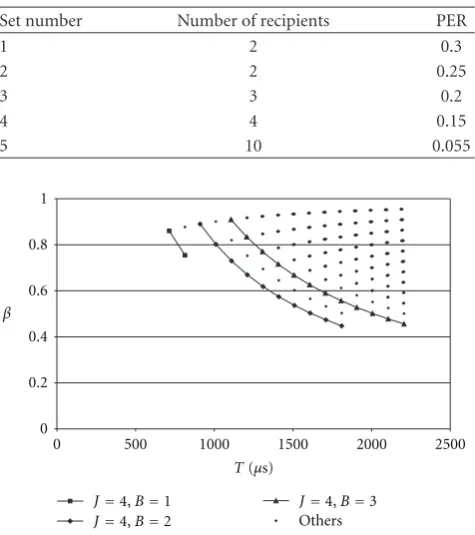
Figure 2(without RTS/CTS exchange since HCCA provides necessary protection). All model parameters correspond to the IEEE 802.11a defaults [23]. Let all recipients be partitioned into sets so that recipients of the same set have the same PERs: seeTable 1for recipients with PER>0.01.
Let fixed ELBP be used. Since the way of ACK-leaders selection depends highly on QoS requirements, we need
Table1: Recipient’s PER distribution.
Set number Number of recipients PER
1 2 0.3
0 500 1000 1500 2000 2500
T(μs)
Figure5: Consumed bandwidth fraction versus periodicity.
to specify them. Let ηmax = 0.08, Smin = 4 Mbps and Tmax = 6.667 ms (thisTmaxvalue corresponds to the usual
latency bound for video applications). Based onTheorem 1, we conclude that recipients from sets 1–4 only can be selected as ACK-leaders, that is,J0=12.
Further, for any tuple (T < Tmax,B > B0(T),J ≤ J0)
we estimate PLR and throughput for every recipient by (12), (14) and (17) and check if QoS requirements (1) and (2) are met. In this way we form an admitted region ofT, BandJ. InFigure 5, we show values of consumed bandwidth fraction
βdefined by (3) with
O=DIFS−SIFS=18μs, Tp=TDATA+ SIFS=196μs, Ta=TBAR+TB-ACK+ 2·SIFS=100μs,
(37)
in the found admitted region. We see that the following 2 tuples are close to optimum: (T=1800μs,B=2,J=4) and (T=2200μs,B=3, J=4). WithT >2200μs orJ <4, QoS requirement on the maximum PLR is not met.
6.2. ELBP with Fixed ACK-Leaders in 802.16 Network. An
R
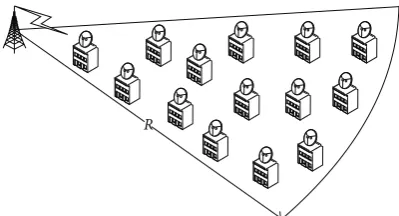
Figure6: Sector with uniformly distributed SSs.
1E−05 1E−04 1E−03 1E−02 1E−01 1E+00
20 21 22 23 24 25
SNR (dB)
PE
R
L=256 simulation
L=512 simulation
L=1024 simulation L=256 approximation
L=512 approximation
L=1024 approximation
Figure7: PER versus SNR.
and set of SSs. So, further results will concern one of such sectors.
Let us assume that the BS is a multicast sender and the only multicast data burst is transmitted in every frame, that is,Mframe =1. We also assume that the BS transmits a data
burst consisted of multicast multimedia data packets with
L= 512 bytes payload at a maximal PHY data rate (R=3/4, 64-QAM) using ELBP mechanism with fixed ACK-leaders. With this PHY, one 512 bytes packet takesnsp = 16 OFDM
symbols, while an acknowledgment takes nsa = 2 OFDM
symbols. The 802.16 frame duration istframe=5 ms and the
maximum latency isTmax=20 ms. So, the maximal number
of retransmissions isK=4, according to (8).
First, we consider more general case shown inFigure 6. In this usecase, the coverage area of the BS is a sector of circle with radiusR=1 km and total numberNof SSs uniformly distributed across the sector.
To start numerical analysis we need to derive the depen-dence of recipient’s PER on distance for the investigated network. We divide the process in two steps. First, we obtain the dependence of signal-to-noise ratio (SNR) on distance according to the path loss model in [24] with a critical parameterν=3.3. After that we find PER(SNR) by MATLAB [25] simulation of IEEE 802.16 PHY for the highest PHY data rate (R = 3/4 , 64-QAM), using AWGN channel as a noise source.
0 2 4 6 8 10 12 14
0 0.02 0.04 0.06 0.08 0.1
ηmax Jopt
N=100 N=50 N=25
Figure8: Fixed ELBP: optimal number of ACK-leaders.
In Figure 7, we show the simulation data for various packet lengths. We also include the analytical approximation of the dependencies obtained by simulation. We approximate the simulation data using the formula
PER (SNR,L)=1−
1−1 2exp
−exp
SNR−ζ α
8L
, (38)
where α = 4.8355 and ζ = 10.479. As it is shown in
Figure 7, the proposed analytical approximation fits perfectly the simulation data. Using (38) withL= 512, we find PER for every recipient. The PER of the most distant SS is 0.1, that is, 10%. The closest SS has the PER equal to 0.
As follows from (10), (12) and (14), PLR depends on station’s PER and the numberJof ACK-leaders only. Thus, for a given numberN of stations and PER distribution, we can find the optimal numberJoptof ACK-leaders minimizing
the bandwidth allocated for a given multicast connection per frame (see (7)), while meeting a certain QoS requirement on PLR for all recipients.
InFigure 8, we show the relationship betweenJoptand the
maximal PLR over the network which containsN = 25, 50 and 100 SSs. The figure shows two of ELBP main advantages. The first advantage is the scalability. Indeed, even if the number of recipients is quite high (N = 100), the optimal number of ACK-leaders is still less than 10 for a wide range of
ηmaxvalues: 2–10%. We can see also that the optimal number Joptof ACK-leaders is nearly proportional to the numberN
of recipients. So, we can conclude the optimal number of ACK-leaders in fixed ELBP scheme is less than 10% over all multicast recipients in wide range of QoS requirements on maximal PLR.
N2
N3 N1
R
Figure9: Sector with multiple sets of SSs.
0 0.02 0.04 0.06 0.08 0.1
0 2 4 6 8 10 12 14 16 18 20
J
Ma
x
{
ηj
}
Weighted-ELBP Fixed-ELBP
Full random QoS
ηmax=0.04
Figure10: Maximal PLR versus the number of ACK-leaders.
ηmaxcannot be less thanpK1 =0.01% at the given bit rate, in
accordance with (20)).
6.3. ELBP with Weighted ACK-Leaders. Let us consider the
case, when there are multiple sets of recipients and recipients of the same set have the same PERs. For certainty, let us assume 3 sets in this usecase, which correspond to 3 small settlements covered by a single sector of an IEEE 802.16 BS as it is shown inFigure 9. The total number of recipients is
N =25. The first set consists ofN1 =5 recipients with PER
=0.1; the second set hasN2 =5 too and PER=0.075, and
the last set hasN3=15 recipients with PER=0.01.
Let us define QoS requirements. Let the maximum latencyTmax be 15 ms and thusK =3, maximal PLR ηmax
be equal to 0.04, and minimum reserved rateSminbe 4 Mbps.
We compare three selection schemes: fixed ELBP, weighted ELBP and full random ELBP. For fixed ELBP scheme, we limit the range ofJ andB byB0 =6 andJ0 =
11, which are obtained by (16) and (17). For weighted ELBP, weights are assigned according to the principle of minimizing PLR over all stations in the network. Full random ELBP is the special case of weighted ELBP ACK-leader selection scheme with equiprobable weightswi=1/N.
The PLR characteristics of these multicast schemes are shown in Figure 10. We can see that for weighted ELBP 4 ACK-leaders is enough to meet QoS requirement on
Smin=4 Mbps
0 2 4 6 8 10 12
0 2 4 6 8 10 12 14 16 18 20
B
Mi
n
{
Sj
}
(Mbps)
QoS
Weighted-ELBP (J=4) Fixed-ELBP (J=8)
Full random (J=11)
Figure11: Minimal throughput versus the burst size.
Smin=4 Mbps
0 50 100 150 200 250 300 350
0 2 4 6 8 10 12
Allocat
ed
B
W
,OFDM
sy
mbols
per
fr
ame
Min{Sj}(Mbps)
QoS
Weighted-ELBP (J=4) Fixed-ELBP (J=8)
Full random (J=11)
Figure12: Allocated bandwidth versus throughput.
maximal PLR, while minimizing β in (7). In contrast, the other schemes need much more ACK-leaders. Fixed ELBP requires 8 ACK-leaders, and full random scheme needs to select 11 ACK-leaders.
The next step of our investigation is to find the optimal burst sizeBopt. For that, we find how throughput depends
on B with optimal numbers Jopt of ACK-leaders found at
the previous step. The throughput characteristics are given in Figure 11. This figure shows that the optimal burst size which minimizesβin (7) is equal to 7 in case of weighted ELBP, while it is equal to 8 for full random selection scheme and 9 for fixed ELBP.
needs 150 symbols and fixed ELBP require 160 OFDM symbols.
Here, we can conclude that weighted ELBP is the optimal approach of QoS support for multicast streaming, although its implementation may be more complicated, comparing with fixed ELBP and full random ELBP.
7. Conclusion
Existing standards of high rate wireless networks consider multicast as unreliable service, which is inappropriate for many multimedia applications making strict QoS demands. In this paper, we study a promising enhanced leader based protocol (ELBP) for reliable multicasting in wireless networks. In ELBP, multicast packets are transmitted in bursts and several multicast recipients called the ACK-leaders are appointed to be responsible for multicast data packets acknowledging.
Specific QoS requirements (maximal packets loss ratio, maximal latency, minimal reserved rate) can be met by varying such ELBP parameters as the number of ACK-leaders as well as the data burst size and periodicity. We consider two types of leader selection schemes: (i) ELBP with fixed ACK-leaders which experience higher PERs than other recipients, and (ii) ELBP with weighted leaders, where ACK-leaders are reselected according to recipients’ weights before every data burst transmission. We develop accurate analytical models to estimate reliability and performance indices with these schemes and to find their optimal parameters. Numer-ical results obtained by the models show that ELBP can be used efficiently to meet specific multimedia application QoS demands, in contrast with well-known LBP and BMMM approaches when either only one recipient or all recipients acknowledge multicast packets. Both fixed and weighted ELBP are scalable multicast solutions: according to our model experiments, even with a large number of recipients it is enough to request a few recipients for acknowledgements to provide reliable multicast for all recipients. Comparing fixed and weighted ELBP, we show that weighted ELBP is more efficient in terms of consumed bandwidth.
Acknowledgment
This work is partially supported by the European Union under project FP7-257263 (FLAVIA).
References
[1] IEEE Std. 802.16-2009, “IEEE Standard for Local and metropolitan area networks—Part 16: Air Interface for Broad-band Wireless Access Systems,” IEEE, 2009.
[2] IEEE Std 802.11-2007, “Revision of IEEE Std 802.11-1999. IEEE Standard for Information Technology—Telecommuni-cations and information exchange between systems—Local and metropolitan area network—Specific requirements— Part 11: Wireless LAN Medium Access Control (MAC) and Physical Layer (PHY) specifications,” IEEE Computer Society, 2007.
[3] IEEE Std. 802.15.3, “Wireless Medium Access Control (MAC) and Physical Layer (PHY) Specifications for High Rates Wire-less Personal Networks (WPANs),” IEEE Computer Society, 2003.
[4] IEEE P802.11s/D3.0, Draft Amendment to Standard [2],Mesh Networking, 2009.
[5] High Rate Ultra Wideband PHY and MAC Standard, Standard ECMA-368, 2005.
[6] J. Kuri and S. K. Kasera, “Reliable multicast in multi-access wireless LANs,”Wireless Networks, vol. 7, no. 4, pp. 359–369, 2001.
[7] H.-C. Chao, S. W. Chang, and J. L. Chen, “Throughput improvements using the random leader technique for the reliable multicast wireless LANs,” inProceedings of the 1st ICN Conference, vol. 2093 ofLecture Notes In Computer Science, pp. 708–719, 2001.
[8] Y. Seok, D. Dujovne, T. Turletti, and P. Cuenca, “Leader based Multicast Proposal,” IEEE 802.11-07/0144r2, 2007.
[9] M.-T. Sun, L. Huang, A. Arora, and T.-H. Lai, “Reliable MAC layer multicast in IEEE 802.11 wireless networks,” in Proceed-ings of the International Conference on Parallel Processing (ICCP ’02), p. 527, IEEE Computer Society, Washington, DC, USA, 2002.
[10] K. Tang and M. Gerla, “Random access MAC for efficient broadcast support in ad hoc networks,” inProceedings of the IEEE Wireless Communications and Networking Conference, pp. 454–459, 2000.
[11] K. Tang and M. Gerla, “MAC reliable broadcast in ad hoc networks,” inProceedings of the IEEE Milcom, pp. 1008–1013, October 2001.
[12] S. K. S. Gupta, V. Shankar, and S. Lalwani, “Reliable multicast MAC protocol for wireless LANs,” in Proceedings of the International Conference on Communications (ICC ’03), pp. 93–97, May 2003.
[13] W. Si and C. Li, “RMAC: a reliable multicast MAC protocol for wireless ad hoc networks,” inProceedings of the International Conference on Parallel Processing (ICPP ’04), pp. 494–501, August 2004.
[14] A. Lyakhov, V. Vishnevsky, and M. Yakimov, “Multicast QoS support in IEEE 802.11 WLANs,” inProceedings of the IEEE Internatonal Conference on Mobile Adhoc and Sensor Systems (MASS ’07), Pisa, Italy, October 2007.
[15] D. S. Bae, A. Lyakhov, D. Pankratov, Y. Seok, V. Vishnevsky, and M. Yakimov, “Reliable multicast with QoS support in IEEE 802.11,” IEEE 802.11-07/2842r0, 2007.
[16] A. Lyakhov, D. Pankratov, Y. Seok, and M. Yakimov, “802.11 Multicast Enhancements for Multimedia Streaming,” IEEE 802.11-07/2842r0, 2007.
[17] IEEE Std 802.11e-2005, “Wireless LAN Medium Access Control (MAC) and Physical Layer (PHY) specifications. Amendment 8: Medium Access Control (MAC) Quality of Service (QoS) Enhancements,” IEEE Computer Society, 2005. [18] B. Hart, L. Qian, and N. Kakani, “More Reliable
Multi-cast/Broadcas (MRMB),” IEEE 802.11-08/0816r2, 2008. [19] IEEE P802.11aa/D0.02, Draft Amendment to Standard [2],
“MAC Enhancements for Robust Audio Video Streaming,” 2009.
[20] IEEE P802.11aa/D3.0, Draft Amendment to Standard [2], “MAC Enhancements for Robust Audio Video Streaming,” 2011.
Networks (Q2SWinet ’07), pp. 63–70, Chania, Crete Island, Greece, 2007.
[22] European Union 7th Framework Programme ICT project FLAVIA,http://www.ict-flavia.eu/.
[23] Wireless LAN Medium Access Control (MAC) and Physical Layer (PHY) Specifications: High-speed Physical Layer in the 5 GHz Band. IEEE Std. 802.11a-1999 (Supplement to IEEE Std 802.11, 1999 Edition).