R E S E A R C H
Open Access
SC-FDMA-based resource allocation and
power control scheme for D2D
communication using LTE-A uplink resource
Syed Tariq Shah
1, Jaheon Gu
1, Syed Faraz Hasan
2and Min Young Chung
1*Abstract
Device-to-device (D2D) communication-enabled cellular networks allow cellular devices to directly communicate with each other without any evolved NodeB (eNB). D2D communication aims to improve the spectral efficiency and increases the overall system capacity. For future mobile networks, intelligent radio resource allocation and power control schemes are required to accommodate the increasing number of cellular devices and their growing demand of data traffic. In this paper, a combined resource allocation and power control scheme for D2D communication is proposed. In the proposed scheme, D2D communication reuses the uplink (UL) resources of conventional cellular user equipments (CUEs); therefore, we have adopted single-carrier frequency division multiple access (SC-FDMA) as UL transmission scheme. The proposed scheme uses fractional frequency reuse (FFR)-based architecture to efficiently allocate the resources and mitigate the interference between CUEs and D2D user equipments (DUEs). In order to guarantee the user fairness, the proposed scheme uses the well-known proportional fair (PF) scheduling algorithm for resource allocation. We have also proposed an intelligent power control scheme which provides equal opportunity to both CUEs and DUEs to achieve a certain minimum signal-to-interference and noise ratio (SINR) value. The
performance evaluation results show that the proposed scheme significantly improves the overall cell capacity and achieves low peak-to-average power ratio (PAPR).
Keywords: D2D communication; SC-FDMA; Resource allocation; Power control; PF scheduling
1 Introduction
Recent years have witnessed rapid increase in the demand of ubiquitous communication services [1,2]. Because of their almost ubiquitous nature, cellular networks have been massively deployed and used ever since their intro-duction in 1980s. Several cellular technologies have surfaced over the past some time. Most recently, the long-term evolution (LTE) and its successor LTE-advanced (LTE-A) have attracted considerable attention in the cellu-lar domain. LTE-A is essentially an improvement on LTE, which aims at offering a variety of new techniques such as carrier aggregation, multiple-input multiple-output (MIMO), device-to-device (D2D) communication, etc.
*Correspondence: [email protected]
1College of Information and Communication Engineering, Sungkyunkwan University, 2066, Seobu-ro, Jangan-gu, Suwon-si, Gyeonggi-do 440-746, Republic of Korea
Full list of author information is available at the end of the article
Unlike conventional cellular technology that conveys information between two user equipments (UEs) via evolved NodeB (eNB), D2D communications allows UE-to-UE data exchange on direct links. By relieving the eNBs from too much relaying, D2D communications improves the overall system capacity and end user data rates [3]. The idea is that the eNB shall help the two UEs in establishing a direct connection between them, and then let the com-munication session evolve on one-hop D2D link. The UEs that are capable of communicating directly are referred to as D2D UEs (or DUEs). In certain situations, it may be imperative for the UEs to send information through the eNB. For instance, if the distance between two UEs is very large, direct communication cannot take place. Therefore, a cellular network that supports D2D communications has two kinds of UEs. One is the DUEs that transmit and receive data without eNB relaying, and the other is conventional cellular UEs (or CUEs) that communicate via the base station [4]. The 3rd Generation Partnership
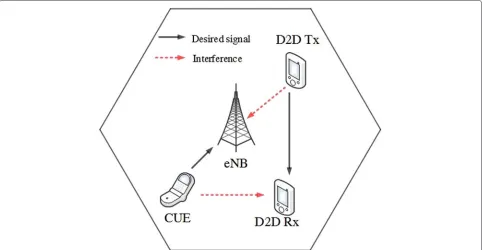
Project (3GPP) has considered two modes of D2D com-munications: mode-1 and mode-2 [5]. In mode-1 D2D communications, D2D users are located in an eNB cover-age zone (i.e., in covercover-age). Thus, the eNB is responsible for D2D connection establishment, resource allocation, monitoring, and so on. On the other hand, in mode-2 D2D communications, D2D users are not located in the cov-erage zone of an eNB. Therefore, D2D users select radio resources autonomously. For D2D service scenarios such as content sharing, proximity-based advertisements, etc., Mode-1 communications is preferred [6-9]. In this paper, we focus on mode-1 D2D communications. Figure 1 shows an example of D2D communications underlying cellular network.
It is intuitive that D2D communications under 3GPP mode-1 category shall result in severe interference if CUEs and DUEs are operating on the same frequency band. This so-called underlay technique requires a sys-tematic frequency reuse strategy in order to prove ben-eficial [3,10]. The other technique that allows CUEs and DUEs to coexist within a cell is the overlay technique. The overlay technique splits the frequency band allocated to a cell and distributes it among the CUEs and DUEs. In the overlay mode, CUEs and DUEs operate at two different frequency sub-bands. While the overlay technique works best in reducing interference, it results in the underutiliza-tion of the frequency resource [3,10]. Almost all previous works on D2D communications prioritize the underlay technique because it can accommodate more UEs on a given frequency band. In order to ensure that interference
is avoided in the underlay technique, various previous works have focused on proposing techniques that (i) intel-ligently allocate frequency resources to CUEs and DUE [11] and (ii) smartly control the transmit power of CUEs and DUEs [12]. This paper focuses on proposing a com-bined method that allows CUEs and DUEs to exist on the same frequency band in a typical LTE-A network.
LTE-A networks use single-carrier frequency division multiple access (SC-FDMA) for uplink transmissions [13]. An SC-FDMA system uses different subchannels to transmit the information symbols in parallel with each other. Compared with OFDMA, SC-FDMA significantly reduces the envelope fluctuations in the transmitted waveform. Thus, SC-FDMA signals have inherently lower peak-to-average power ratio (PAPR) than the OFDMA signals. In SC-FDMA, throughput depends on how the information symbols are applied to the subchannels. There are two possible implementation approaches to SC-FDMA: SC-FDMA with constraints (also known as local-ized SC-FDMA) and distributed SC-FDMA. In SC-FDMA with constraints, each terminal uses a set of adjacent sub-carriers to transmit its symbols. On the other hand, in distributed SC-FDMA, the subcarriers are spread over the entire signal band. It has been shown in [14-16] that SC-FDMA with constraints achieves higher throughput than the distributed SC-FDMA. Therefore, this work employs SC-FDMA with constraints for uplink transmissions. For this kind of SC-FDMA, it has two critical constraints in relation to resource allocation. The first is exclusivity which maintains that a subchannel can only be allocated
to one UE. The second constraint is adjacency, which states that if multiple subchannels are assigned to a UE, all of them must be adjacent to each other in the frequency domain.
1.1 Contribution
Various studies [16-20] have addressed the exclusivity and adjacency constraints for proportionally fair (PF) scheduling-based resource allocation. However, all previ-ous works consider only CUEs and do not consider D2D communications. Hence, PF schedulers used in [16-20] are only for single-tier network where only CUEs exist. In order to apply the resource allocation to both CUEs and DUEs using uplink resources, our previous work has considered SC-FDMA-based resource allocation scheme for D2D communications [21]. Although this scheme avoids the interference between CUEs and DUEs by using the fractional frequency reuse (FFR) concept, it does not guarantee minimum performance requirements for both CUEs and DUEs. For satisfying the minimum SINR requirements, this work enhances the previous scheme with a novel power control technique in conjunction with PF scheduling and SC-FDMA-based resource allocation. To the best of our knowledge, this is the first work that proposes combined power control and resource allocation scheme based on constrained SC-FDMA and PF schedul-ing. In this paper, we show that our proposed scheme significantly improves the overall network performance.
The rest of the paper is organized as follows. Section 2 covers literature review which highlights the works done in the context of frequency allocation and transmit power control. The previous works that address combined resource allocation and power control have also been discussed. Section 3 explains the FFR concept and the proposed radio resource allocation and transmit power control scheme for CUEs and DUEs. The observations on performance evaluation have been reported in Section 4, and this paper is concluded in Section 5.
2 Related work
Considerable research has been conducted on spectrum sharing between CUEs and DUEs and their transmit power control. Some of the relevant works are briefly highlighted in the following.
2.1 Transmit power control
A power control and link selection algorithm with tem-porary removal of DUEs is proposed in [22]. A single-cell CDMA cellular system is considered, where the transmit power of the DUEs is minimized through link selection. The temporary removal algorithm sets the transmit power of DUEs to zero when the required power exceeds the predefined maximum power. Gabor et al. have studied the performance of various power control strategies in
LTE networks that are applicable to D2D communications [23]. The performance of LTE power control scheme and a utility function-based distributed power control scheme are compared, where dynamic resource allocation and mode selection are implemented. In [24], Yu et al. have analyzed different power control schemes for D2D com-munications in a cellular network with orthogonal and non-orthogonal resource sharing. The study focuses on network sum rate maximization by using power control mechanism. Moreover, in a different scenario, CUEs have been prioritized and an upper bound is placed on the maximum transmission rate of all links. It is concluded that reasonable quality of service can be guaranteed with increased sum rate by using rate-constrained power con-trol mechanism. Gu et al. in [25] have proposed a dynamic power control scheme for D2D communications. The scheme excludes eNB, CUEs using the same resource, and the areas of adjacent cells from the coverage of D2D com-munications. This is achieved by periodically adjusting the transmit power of the DUEs. It has been shown that the proposed scheme outperforms the conventional power control schemes. In [26], four different kinds of power control schemes for DUEs are proposed. The authors con-clude that the closed loop power control with a dynamic tuning step may be suitable for D2D communications. It has also been concluded that power control alone is not an effective method to avoid co-channel interference between CUEs and DUEs.
Most previous works on power control prioritize CUEs by guaranteeing a certain signal-to-interference and noise ratio (SINR). However, our proposed transmit power con-trol scheme also provides equal opportunity to DUEs to maintain a reasonable SINR at all times.
2.2 Resource allocation
is more than doubled. In [30], authors have proposed a distance-constrained resource sharing scheme for under-laying D2D communications, which identifies an opti-mal minimum distance between resource sharing D2D pair and the CUE. The scheme mitigates the interfer-ence between CUEs and DUEs and reduces the outage probability of D2D communications. Keeping in mind the adjacency and exclusivity constraint of SC-FDMA [31], Zhang et al. propose a two-step greedy resource allo-cation algorithm which assigns contiguous resources to CUEs [20]. This has been done by maintaining the long-term user fairness and spectral efficiency of the network. In [32], the authors have studied PF frequency domain packet scheduling (FDPS) with contagious resource allo-cation constraint in SC-FDMA. A set of algorithms have been proposed to solve the adjacency constraint in SC-FDMA and to find the near-to-optimal scheme which best emulates the time domain PF criteria. Wong et al. in [17] have proposed an optimal algorithm to assign contiguous resources to CUEs in SC-FDMA-based system. The study mainly addresses the adjacency constraint in SC-FDMA. The proposed algorithm is a reformulation of the problem as a pure binary integer program called the set portion-ing problem. It concludes that the proposed algorithm can maximize the logarithmic sum rate of a SC-FDMA-based system.
It has been argued before that most of the previous works have either used OFDMA in resource allocation for CUEs and DUEs or have used SC-FDMA for CUEs only. Thus, in our preliminary version of this work [21], we have proposed a SC-FDMA-based resource allocation scheme for D2D communications. However, the work only con-siders the resource allocation, and it does not guarantee the SINR of CUEs and DUEs according to their minimum SINR requirements. In order to guarantee the minimum SINR requirements, in this extended work of our previ-ous study, we propose a combined resource allocation and power control mechanism for D2D communications.
2.3 Combined power control and resource allocation Janis et al. propose a resource allocation scheme [33] and a power control scheme [10] for CUEs and DUEs working in an underlay cellular network. The scheme reallocates the CUE resources to DUEs in such a manner that it causes least interference to CUEs. Moreover, resources are allocated to D2D pair if it satisfies a certain minimum SINR threshold for CUEs. In [34], the authors have inves-tigated a joint power control and radio resource allocation scheme for D2D communications underlaying cellular networks. An optimization problem for energy efficiency has also been formulated. The energy efficiency of the sys-tem has been maximized using an iterative combinatorial auction game approach. Gu et al. in [35] have proposed a combined power control and resource allocation scheme
for D2D communications in an OFDMA-based cellu-lar system. The power control scheme ensures a certain threshold SINR for CUEs and imposes a maximum limit on SINR of DUEs. Upon comparison with [33], it has been shown that a better sum rate can be achieved by using the proposed scheme.
In [36], the authors propose an iterative algorithm which jointly optimizes the matching and power control of CUEs and D2D links. The work in [36] also investigates the reuse of downlink radio resource between multiple D2D links and multiple CUEs. Moreover, the scheme imposes a QoS target for each CUE link to ensure better perfor-mance of the cellular network. It has been shown that by proper matching and power coordination, an optimal resource reuse solution can be achieved. It has been high-lighted in [37] that reusing UL and DL resources for D2D communications has different pros and cons in differ-ent environmdiffer-ents. The conclusion is that reusing DL can improve DUE SINR if they are located closer to the eNB. On the other hand, UL is effective for reuse when DUEs are farther away from eNB.
3 Proposed scheme
This section starts with an introduction to the proposed network architecture. A brief review of FFR has been given first. The resource allocation and transmit power control schemes are also proposed later in this section.
3.1 Network architecture
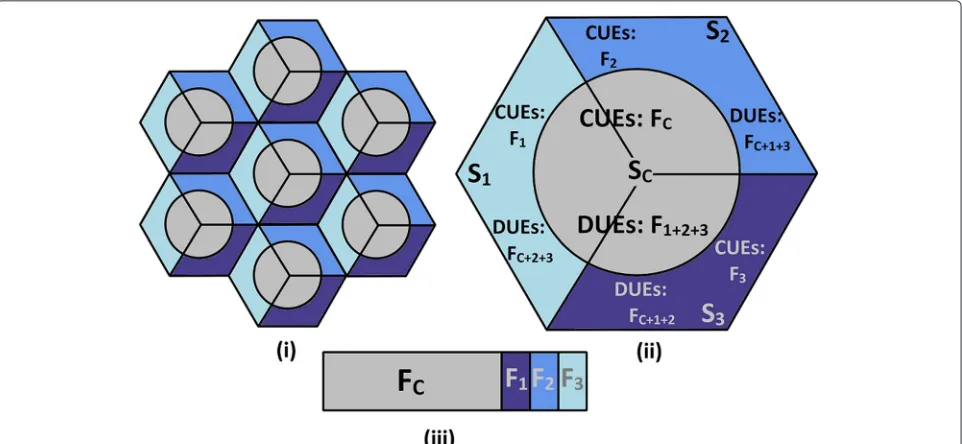
In a typical cellular network, it is possible to divide a cell into inner (or center) and outer zones such that differ-ent sub-bands are allocated to each zone. According to strict FFR [38,39], the center zone has a frequency reuse factor (FRF) of 1 while the outer zones have FRF of N. Figure 2a,b,c shows the deployment of a network using strict FFR withN = 3 at the outer zone. It can be seen from the figures that DUEs in the center zone reuse the frequency of the outer zone of the neighboring cells. It can also be observed from Figure 2a,b,c that strict FFR does not consume the entire frequency band in a single cell. On the other hand, a network employing soft FFR uses the entire spectrum in a single cell and reuses the same spectrum for the neighboring cells. Figure 2d,e shows a network deployment that uses soft FFR withN=3 in the outer zone. The entire frequency spectrum is divided into three partitions such that one partition is a combination of two separate sub-bands. The CUEs in the center zone use the frequency resources that are not used in the outer region of the same cell (F1 and F3 in Figure 2e). On the other hand, DUEs can use the frequency resources that are not currently being used by the CUEs residing in the same region (F2 in Figure 2e).
Figure 2Reference schemes.(i)Strict FFR scheme.(ii)Soft FFR scheme.
shown in Figure 3. The frequency band allocated to a cell is also divided into four partitionsFC,F1,F2, andF3such
that each frequency partition is allocated to each of the four sectors. Note that the central sector,SC, covers the largest area within the cell and hence gets a larger parti-tionFC. Thus, one of the important design parameters is the radius ofSC within a cell. In this work, we assumeSC to be 63% of the total cell area [40].
3.2 System model
The resource allocation scheme proposed here uses FFR for D2D communications underlaying cellular network operating in TDD mode. The proposed scheme uses TTD
configuration 1 because it is the only configuration that can support symmetric downlink and uplink transmis-sions [41]. The uplink resources of CUEs are shared by the DUEs under the constraints of SC-FDMA highlighted ear-lier in Section 1. The main advantage of reusing the uplink resources is that eNB can effectively coordinate interfer-ence between CUEs and DUEs in comparison with the case where downlink resources are reused [42,43]. The proposed scheme works as follows.
Consider a cell withNC CUEs andND D2D pairs.We define C = {c|c = 1, 2,. . .,NC} and D = {d|d = 1, 2,. . .,ND} as the sets of CUEs and DUEs in the cell. Each D2D pair consists of a D2D transmitter Tx and its
corresponding D2D receiver Rx. A CUE residing in any of the four sectors can only use the frequency band allocated to that sector only. For example, a CUE in sectorSC shall use the resource partitionFC. However, a DUE can use any frequency resource except the one allocated to its sector. We assume that the information on which sector a cer-tain UE is located can be determined by using the location services (LCS) as explained in 3GPP Rel-9 [44]. We also define a resource sharing pairfcd(c∈NCandd∈ND)that consists of one CUE and one D2D pair. Note that the CUE and the D2D pair constitutingfcdare located in different
sectors. A typical example of the proposed resource allo-cation has been shown in Figure 3. It has been shown that a D2D pair in sectorS1can only use one of the frequency
sub-bandsFC,F2, andF3but notF1. Thus, each DUE can
choose among three frequency sub-bands that are already being used by their respective CUEs.
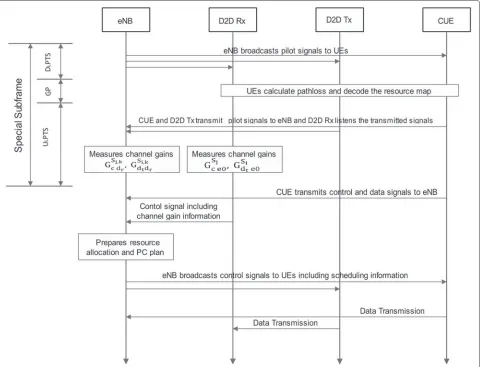
In order to allocate appropriate frequency resources to the UEs, eNB measures the channel quality between itself and the UEs. Figure 4 shows the operational procedure
of channel quality measurement. The procedure starts when eNB gathers information on channel gains of all UEs (CUEs and D2D receivers) in a cell. In the down-link pilot time slot of the special sub-frame, eNB sends pilot signals to all UEs. These pilot signals contain the resource map of the uplink pilot channels allocated to the UEs. All UEs calculate the path loss between themselves and eNB based on the received strength of the down-link pilot signal. UEs transmit a pilot signal back to eNB using the uplink pilot time slot. eNB uses the strength of this signal to measure the channel gain between itself and the UE.
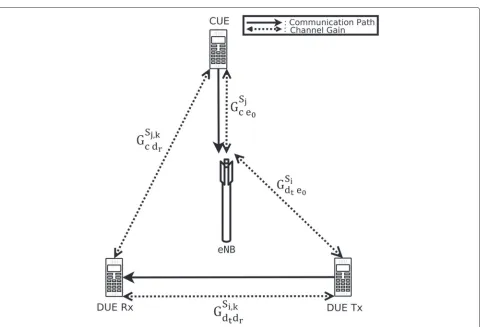
The D2D receivers (Rx) also measure the channel gain between themselves and the CUEs, as well as the gain between themselves and the D2D transmitters (Tx). D2D Rx listens to the uplink pilot signals sent by the CUEs and D2D Tx in order to determine the channel gains. Figure 4 shows the notation for different channel gains between CUEs, D2Ds, and eNB. Gijtr indicates the gain between transmitter t located in sectoriand the receiver r located
in sectorj. As can be seen from Figure 5,GceSj0represents the gain between a CUE c and eNB e0 andGSi,k
dtdris the gain between DUE Tx and its DUE Rx such that Tx is in sector iand Rx is in sectork, and so on. It is obvious thati,j, and k∈SC,S1,S2, andS3.
3.3 Problem formulation
For allocating resources to CUEs and D2D pairs under the constraints of SC-FDMA, eNB first allocates contiguous subchannels to CUEs [16,20]. To begin with, eNB divides the whole bandwidth into several sub-channels. eNB then chooses one CUE for each sub-channel based on the high-est PF metric value. The main target of PF scheduling is to maximize the logarithmic utility functionulogRu, whereRuis the historical average data rate of user u. The maximization of ulogRu can be transformed equiva-lently to the maximization ofulogru
Ru at each transmit time interval (TTI), whereru represents the achievable data rate of user u at the current TTI. We defineλu,n =
ru,n
Ru as the PF metric value for user u on subchannel n. The PF metric in this work is calculated on a per-sector basis as follows:
λSj c,n=
rcS,jn RScj
, (1)
where rSc,jn denotes the achievable data rate of CUE (located in sector j) in current TTI on subchannel n (where n ∈ FC, F1, F2, or F3) and RScj represents the average data rate of CUE in the previous transmission intervals. The optimization problem for the proposed SC-FDMA-based resource allocation scheme with adjacency and exclusivity constraints using multi-tier PF scheduler [45-48] can be formulated as:
max
{A1,...,ANC}∈K and{B1,...,BND}∈K
⎛
⎝
c∈C
log
⎛
⎝
n∈Ac λc,n
⎞
⎠+
d∈D
log
⎛
⎝
n∈Bd λd,n
⎞ ⎠ ⎞ ⎠
(2)
subject to Ac∩Ac = ∅,∀c=c, for c,c∈C Bd∩Bd = ∅,∀d=d, for d,d∈D
Pc,n=Pc/|Ac|, forn∈Ac Pdt,n=Pdt/|Bd|, forn∈Bd .
For simplicity, Equation 2 can also be written in the
whereK is the set of all possible subchannel allocations satisfying the adjacency constraint.Ac(andBd) and|Ac| (and|Bd|), respectively, represent the set of allocated sub-channels and the number of allocated subsub-channels to CUE c(and DUEd). The first and the second constraints show the exclusivity constraints for CUEs and DUEs, respec-tively. In other words, a subchannel cannot be allocated to any other CUE and D2D pair (fcd) in the same TTI, if it is
already allocated to a CUE and a D2D pair. Similarly, the third and the fourth constraints mean that the CUEs and DUEs are using equal transmit power on all allocated sub-channels, wherePcandPdtare the transmit power of CUE
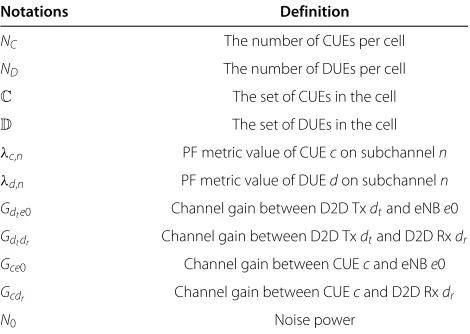
cand DUE Txdt, respectively. The notations used in this paper are summarized in Table 1. The formulated objec-tive problem (2) is NP hard in nature, since it is applied on all subchannes and the setAc do not have the same length.
3.4 Proposed resource allocation
Finally, eNB allocates the resources to DUEs under the constraints of SC-FDMA such that the interference between D2D Tx and eNB is mitigated. For resource allo-cation to DUEs, eNB calculates the PF metric values of CUEs and each D2D pair as follows:
λSj
Table 1 Definition of notations
Notations Definition
NC The number of CUEs per cell
ND The number of DUEs per cell
C The set of CUEs in the cell
Gcdr Channel gain between CUEcand D2D Rxdr
N0 Noise power a CUE c and a DUEd (located in different sectors) on subchannel n. In order to consider the interference between resource sharing pairs, eNB calculates the prod-uct of both PF metric values λSc,jn×λSdi,,nk
. Similarly, eNB shall form the resource sharing pair fcd consisting
of a CUE and D2D pair if the value of λSc,jn×λSdi,,nk
is the highest for this pair among all other combina-tions of CUEs and DUEs. The resource sharing pairs comprising of the rest of the CUEs and DUEs are also formed in the similar manner. Moreover, the proposed resource allocation scheme has computational com-plexity of ONC×NK2
for computing PF metric values for all CUEs on all subchannels. Likewise, computa-tional complexity for allocating resources to DUEs is O(N)D × NK), where NC and ND are the number of CUEs and DUEs, respectively. NK is the number of subchannels. Since resource allocation is performed in parallel, the computational complexity of the entire proposed algorithm is ONC×NK2
+(ND×NK)
. This increase is natural because eNB has to per-form additional computations to allocate resources to DUEs.
3.5 Determining transmit power of DUEs
In the proposed scheme, CUEs use fixed transmit power while the transmit power of DUEs is controlled based on the network condition. We assume that enough sub-channels are available in each sector to support all CUEs. The proposed power control scheme for DUEs is such that it provides equal opportunity to both CUEs and DUEs to maintain a certain SINR level. eNB cal-culates the SINR of the resource sharing pair fcd
using:
knows the values ofN0,PcSjand the channel gains, it deter-mines the transmit powerPSi
dtof D2D Tx with in [0,Pmax], wherePmaxis the maximum possible transmit power of
a UE.
Unlike most of the previous studies on power con-trol [22-26] which only guarantee the SINR of CUEs, the proposed power control scheme not only guaran-tees a threshold SINR of CUEs γc but also provides equal opportunity to DUEs to a maintain a certain a SINR threshold γd. If SINR of a CUE is expected to be lower than γc and D2D SINR is greater than or equal to γd , then DUE limits the interference by adjusting its transmit power. Similarly, if SINR of CUE is greater than γc and D2D SINR is less than γd, then DUE increases its transmit power such that SINR of CUE remains greater than γc. On other hand, if SINR of both CUE and DUE is greater than their respective threshold SINRs (γc and γd), DUE adjusts its transmit power to Pmax while making sure that SINR of CUE
remains higher thanγc.
In all cases where SINR of both CUE and DUE are expected to be less than their respective threshold val-ues (γcandγd), the eNB decides whether to limit DUEs transmit power or to increase it. This decision is based on the difference between the SINR and threshold SINR values. For example, if the difference between CUE SINR and γc is less than that between DUE SINR and γd, DUE decreases its transmit power. On the other hand, if the difference between CUE SINR and γc is greater than that between DUE SINR and γd, DUE increases its transmit power. The idea here is that in the worst conditions, at least one communication session should proceed.
In summary, the transmit power of D2D Tx in fcd is
given by:
whereCˇis the difference between CUE SINR andγc, while ˇ
Dis the difference between DUE SINR andγd, and can be defined as:
To further analyze the proposed power control scheme in terms of D2D energy efficiency (D2D-EE), we have for-mulated and derived the optimal power control for DUEs as [49], Problem (P1) given in Equation 11. We compare
this optimal scheme with our proposed power control method in order to assess its performance. The aim of the formulated problem is to maximize the D2D energy efficiency while meeting the throughput requirements of both CUEs and DUEs. The optimization problem can be expressed as: In Problem (P1), Equation 11 represents the energy efficiency, where Rc, Rd, and Pdt denotes throughput of CUEs , DUEs, and DUEs transmit power, respec-tively. Constraints given in Equations 12 and 13 enforce that the throughputs of both CUEs and DUEs should be respectively greater than or equal to the minimum throughput thresholdRreqc andRreqd . Whereas constraint in Equation 14 ensures that the transmit power of both CUEs and DUEs should not exceed the maximum trans-mit powerPmaxC andPmaxD. In Problem (P1), the
objec-tive function given in Equation 11 is decreasing in both CUEs transmit powerPcand DUEs transmit powerPdt. Therefore, in order to maximize Equation 11, both CUEs and DUEs should transmit with the lowest power (Pcand Pdt) that ensure their threshold throughput requirements. LetP∗c andP∗d
t indicate the optimal solution for Problem (P1). Note that the constraint given in Equations 12 and 13 are equivalent to:
respectively. Whereγc andγd are the minimum thresh-old SINR for CUEs and DUEs, respectively, and can be expressed asγc=2R to obtain the minimum transmit power of both CUEs and DUEs by strictly binding and solving the constraints in Equation 15. Thus, the minimum transmit power (lower bound) of both CUEs and DUEs denoted asPˇcandPˇdtcan
ˆ
which also makes sure that the CUEs transmit power does not exceedPmaxC.
In order to further simplify Problem (P1), we define F(w,Pdt)as:
F(w,Pdt)= 1 Pdt
(Rc+Rd)−w≥0, (18)
where w is an auxiliary decision variable. Moreover, F(w,Pdt)≥0 means that:
thus,wcan be defined as an adjustable threshold, which DUEs energy efficiency should exceed. According to [50], Problem (P1) can be rewritten as:
max ˆ
Pdt≥Pdt≥ˇPdt
w subject to: F(w,Pdt)≥0. (20)
After multiplyingPdt on both sides, Equation 19 can also be written as:
We present the unique optimal solution for Problem (P1) as:
The threshold values ofNandNare given by:
N= GdtdrGce0(N0γcGcdr+N0Gce0)
More detailed derivation process for P∗d
t is provided in Appendix.
4 Performance evaluation
4.1 Simulation environment
To evaluate the performance of the proposed scheme, we conducted C-language-based system-level simulations. A
total of 500 simulations are performed, each with a run time of 1,000 secs. We consider a FFR-based cellular net-work operating in the TDD mode, whereNC CUEs and NDD2D pairs are randomly deployed in a cell with uni-form distribution. The network supports full duplex cel-lular and half duplex D2D communications, where D2D communications reuse the uplink resource of cellular net-work. A full buffer traffic model is considered where UEs always have data to transmit.
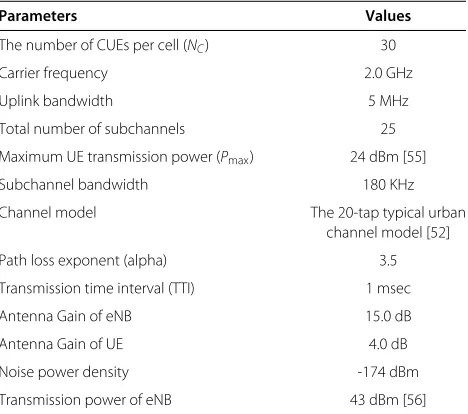
The shadowing standard deviation of the large-scale fading and path loss exponent is set to 8 and 3.5 dB, respectively [51]. For small-scale multipath fading, a 20-tap typical urban channel model [52] is considered. Mod-ulation and coding scheme (MCS) [53] based adaptive modulation and coding scheme is considered for the sys-tem. More detailed simulation parameters are given in Table 2.
To measure the throughput fairness among UEs, we have used Jain’s fairness index indicator [54]. Jain’s fairness indexJcan be calculated as:
J(x1,x2,. . .xn)= ( n
i=1xi)2
n.ni=1x2i, (23)
wherexi andndenote the throughput ofith UE and the total number of UEs, respectively. The value of Jain’s fair-ness index ranges from 0 to 1, so that the values closer to 1 represent higher fairness.
4.2 Simulation results
Figure 6 shows the total cell throughput with varying number of D2D pairs. The values of γc and γd are set to 5 and 0 dB, respectively. The value of NC in all sim-ulations is set to 30. It can be seen from Figure 6 that
Table 2 Simulation parameters
Parameters Values
The number of CUEs per cell (NC) 30
Carrier frequency 2.0 GHz
Uplink bandwidth 5 MHz
Total number of subchannels 25
Maximum UE transmission power (Pmax) 24 dBm [55]
Subchannel bandwidth 180 KHz
Channel model The 20-tap typical urban
channel model [52]
Path loss exponent (alpha) 3.5
Transmission time interval (TTI) 1 msec
Antenna Gain of eNB 15.0 dB
Antenna Gain of UE 4.0 dB
Noise power density -174 dBm
Figure 6Cell throughput. Total cell throughput with varying number of D2D pairs.
the proposed scheme outperforms both strict FFR and soft FFR schemes. Unlike the proposed scheme, strict FFR does not use any power control mechanism and does not utilize the complete frequency spectrum in each cell. This is why strict FFR results in lower cell throughput. While soft FFR utilizes the entire frequency spectrum in each cell, it also does not use any power control schemes. The proposed scheme outperforms both soft and strict FFR schemes because it wisely considers the spatial distance between resource sharing pairs while allocating the resources. Only CUEs scheme (conventional cellular setup with no D2D communications) performs worst as expected.
Figure 7 shows the total throughput of CUEs with vary-ing number of D2D pairs. It is obvious from Figure 7 that the proposed scheme achieves higher throughput
Figure 7CUE throughput. CUE throughput with varying number of D2D pairs.
Figure 8DUE throughput. DUE throughput with varying number of D2D pairs.
for CUEs in comparison with strict and soft FFR schemes. However, the only-CUEs scheme outperforms all other schemes because there is no D2D commu-nications and CUEs do not observe any interference at all.
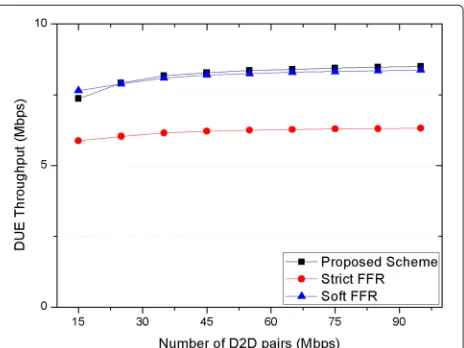
The total throughput of DUEs with varying number of D2D pairs has been shown in Figure 8. As shown in Figure 8, the proposed scheme and soft FFR outper-form strict FFR in terms of DUE throughput. It can also be observed that the proposed scheme performs slightly better than the soft FFR scheme.
The average PAPR of both CUEs and DUEs with different numbers of D2D pairs has been shown in Figure 9. In order to assess the performance of the pro-posed scheme in terms of PAPR, we have compared our results with an OFDMA-based resource allocation
Figure 10CRF of CUEs’ SINR. Cumulative relative frequency (CRF) of CUEs’ SINR forNC=30 andND=25.
scheme [18]. Recall from our earlier discussion that due to the sequential transmission of subcarriers in SC-FDMA, it has low PAPR than OFDMA signals. This is one of the main reasons that LTE-A has opted SC-FDMA for uplink transmission. Our results shows that UEs in the proposed scheme have an advantage of low transmission power compared to the previously pro-posed OFDMA-based D2D communications schemes. However, the performance of the proposed scheme in terms of PAPR is almost similar to strict and soft FFR schemes.
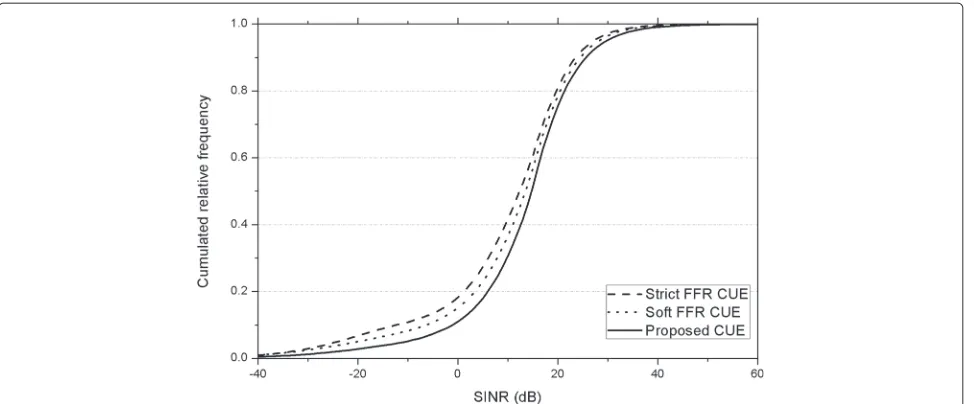
For NC = 30 and ND = 25, Figures 10 and 11 depict the cumulative relative frequency (CRF) of SINR.
Figure 10 shows that our proposed scheme outperforms both strict FFR and soft FFR schemes. Similarly, Figure 11 shows that the SINR of DUEs in the proposed scheme is better than those in both strict FFR and soft FFR schemes. It is because, in order to satisfy the pre-specified minimum SINR, our proposed scheme dynamically con-trols the transmit power of DUEs in every TTI. In pro-posed scheme, the percentage of CUEs achieving their tar-get SINR is greater than both strict and soft FFR schemes. Except the strict FFR scheme, about 20% of the DUEs has experienced SINR lower than 12 dB in the soft FFR and our proposed schemes. The reason is that DUEs reduce their transmit power in order to satisfy the minimum
Figure 12 Jain’s fairness index. Jain’s fairness indexes of both CUEs and DUEs with varying number of D2D pairs.
SINR of CUEs. However, for the rest of 80% DUEs, the proposed scheme outperforms both strict and soft FFR schemes.
Figure 12 shows Jain’s fairness indexes of both CUEs and DUEs with varying number of D2D pairs. For CUEs, the value of Jain’s fairness index is almost the same in all three schemes. However, for DUEs, the pro-posed scheme and soft FFR scheme outperform the strict FFR scheme. It can also be seen that the pro-posed scheme does better than soft FFR in terms of fairness.
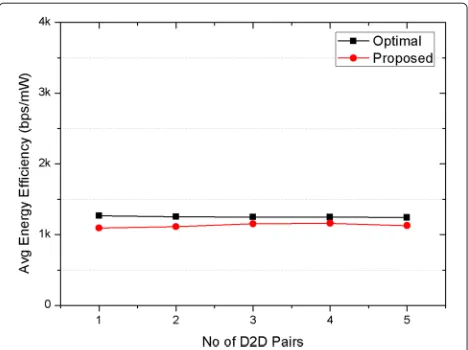
To evaluate the energy efficiency, we consider five CUEs and five DUEs randomly deployed in a cell such that the number of sub-channels is also limited to five. Figure 13 depicts the D2D energy efficiency of both opti-mal and proposed schemes. It can be observed from the figure that in terms of energy efficiency, the proposed scheme performs near to optimal. The slight difference between the optimal and proposed scheme is due to the fact that the proposed scheme does not use any lower bound for its DUEs transmit power. Nevertheless, in a densely populated network, because of severe interfer-ence between resource sharing pairs, it is unlikely for D2D users to achieve their target data rates while transmit-ting with minimum power. In other words, to achieve their target data rates in a densely deployed D2D net-work, DUEs have to transmit with transmission power higher than the lower bound derived in the optimal solution.
Figure 13 Energy efficiency. Average D2D energy efficiency with varying number of D2D pairs.
5 Conclusions
D2D communications reusing the uplink resources of cellular users can significantly improve the network capacity. In this paper, we have proposed an FFR-based resource allocation scheme for D2D communications using SC-FDMA and PF scheduler as a multiple access technique and scheduling algorithm, respectively. The proposed scheme also adopts an intelligent power con-trol mechanism for D2D users which does not only guarantees a certain SINR for CUEs but also provides equal opportunity for DUEs to maintain a minimum SINR value. The simulation result shows that the pro-posed scheme alleviates the throughput of all UEs and improves the overall cell capacity. Furthermore, due to the use of SC-FDMA, the proposed scheme also allevi-ates the high PAPR problem. As a future research work, this approach can be extended by considering the reuse of both uplink and downlink radio resources for D2D communications.
Appendix
In order to maximize the energy efficiency the CUEs should transmit with the powerPcthat guarantees its min-imum throughput which according to Equation 15 isPc=
γc(N0+PdtGdt e0)
Gce0 . By using this setting for Pc in F1(w,Pdt) (Equation 21), its first-order derivative ∂F1(w,Pdt)
∂Pdt becomes:
∂F1(w,Pdt)
∂Pdt
= GdtdrGce0(N0γcGcdr+N0Gce0)
(ln2)· γcGcdrGdte0Pdt+(γcGcdr +Gce0)N0
2 Gdt drGce0Pdt
γcGcdrGce0Pdt+(γcGcdr+Gce0)N0)+1
which shows thatF1(w,Pdt)is concave inPdtbecause the first-order derivative is strictly decreasing inPdt. Hence Problem (P1) is a convex optimization problem. The con-vex nature of the problem allows us to use the Karush-Kuhn-Tucker (KKT) conditions to solve the problem. The first two cases in Eqaution 22 are obtained by taking
ˆ
Pdt andPˇdt into account, which limits the DUEs trans-mit power (Equations 16 and 17). Moreover, we obtain the quadratic equationXP2d
t +YPdt +Z = 0 by setting ∂F1(w,Pdt)
∂Pdt = 0, whose positive root, if it exists, corre-sponds to the third case in Equation 22. The thresholdN andN (forw) are obtained by settingP∗d
t = ˇPdt andPˆdt, respectively.
Competing interests
The authors declare that they have no competing interests.
Acknowledgements
This work was supported by the National Research Foundation of Korea (NRF) grant funded by the Korean government (MSIP) (2014R1A5A1011478).
Author details
1College of Information and Communication Engineering, Sungkyunkwan
University, 2066, Seobu-ro, Jangan-gu, Suwon-si, Gyeonggi-do 440-746, Republic of Korea.2School of Engineering and Advanced Technology, Massey
University, Palmerston North, 4442, New Zealand.
Received: 28 October 2014 Accepted: 24 March 2015
References
1. UMTS Forum, Mobile Traffic Forecasts. 2010–2020, Report no. 44, (2011), http://www.umts-forum.org/component/option,com_docman/task, cat_view/gid,485/Itemid,213/
2. OVUM Plc, Mobile Broadband Users and Revenues Forecast Pack to 2014 (2009)
3. K Doppler, M Rinne, C Wijting, CB Riberio, K Hugl, Device-to-device communication as an underlay to LTE-advanced networks. IEEE Commun. Mag.47(12), 42–49 (2009)
4. G Fodor, E Dahlman, G Mildh, S Parkvall, N Reider, G Miklos, Z Turanyi, Design aspects of network assisted device-to-device communications. IEEE Commun. Mag.50(12), 170–177 (2012)
5. 3rd Generation Partnership Project (3GPP) TSG RAN WG1 Meeting No. 77 R1–141901 Final Report of 3GPP TSG RAN WG1 76bis V1.0.0 (2014) 6. 3rd Generation Partnership Project (3GPP) TR 23.768 V0.3.0, Study on
Architecture Enhancements to Support Group Communication System Enablers for LTE (GCSE–LTE) (2013)
7. 3rd Generation Partnership Project (3GPP) TR 23.703 V0.4.1, Study on Architecture Enhancements to Support Proximity Services (ProSe) (2013) 8. 3rd Generation Partnership Project (3GPP) TS 22.278 V12.3.0, Service
Requirements for the Evolved Packet System (EPS) (2013)
9. 3rd Generation Partnership Project (3GPP) TR 22.803 V12.2.0, Feasibility Study for Proximity Services (ProSe) (2013)
10. P Janis, Y Chia–Hao, K Doppler, C Ribeiro, C Wijting, K Hugl, O Tirkkonen, V Koivunen, Device-to-device communication underlaying cellular communications systems. Int. J. Commun. Netw. Syst. Sci.2009, 169–178 (2009)
11. P Phunchongharn, E Hossain, DI Kim, Resource allocation for
device-to-device communications underlaying LTE-advanced networks. IEEE Wireless Commun.20(4), 91–100 (2013)
12. S MGdRego, TF Maciel, H HdBarros, FR Cavalcanti, G Fodor, inProceedings of IEEE International Symposium on Wireless Communication Systems (Barcelona, Spain). Performance analysis of power control for device-to-device communication in cellular MIMO systems, (2012), pp. 336–340
13. 3rd Generation Partnership Project (3GPP) TS 36.201 V8.1.0, LTE Physical Layer - General Description (Release 8) (2007)
14. HG Myung, J Lim, DJ Goodman, Single carrier FDMA for uplink wireless transmission. IEEE Vehicle Technol. Mag.1(3), 30–38 (2006)
15. Y Jeong, YM Kim, MY Chung, T-J Lee, H Choo, Frequency-domain packet scheduling for low PAPR in 3GPP LTE uplink. Int. J. Smart Home.7(1), 163–172 (2013)
16. B Gilberto, L Temino, S Frattasi, MI Rahman, P Mogensen, OFDMA vs SC–FDMA: performance comparison in local area IMT-A scenarios. IEEE Wireless Commun.15(5), 64–72 (2008)
17. IC Wong, O Oteri, W McCoy, Optimal resource allocation in uplink SC-FDMA systems. IEEE Trans. Wireless Commun.8(5), 2161–2165 (2009) 18. F Liu, Y Liu, inProceedings of IEEE 71st Vehicular Technology Conference
(Taipei, Taiwan). Improved recursive maximum expansion scheduling algorithms for uplink single carrier FDMA system, (2010), pp. 1–5 19. J Kim, D Kim, Y Han, inProceedings of IEEE Global Communications
Conference (GLOBECOM) (Anaheim, CA). Proportional fair scheduling algorithm for SC-FDMA in LTE uplink, (2012), pp. 4816–4820 20. M Zhang, Y Zhu, A greedy resource allocation algorithm for localized
SC-FDMA systems. IEEE Commun. Lett.17(7), 1479–1482 (2013) 21. ST Shah, J Gu, MY Chung, SF Hasan, FFR-based resource allocation
scheme for device-to-device communication. Proceedings of IEEE Global Conference on Consumer Electronics, 622–623 (2014)
22. Y Cheng, Y Gu, X Lin, Combined power control and link selection in device-to-device enabled cellular systems. IET Commun.7(12), 1221–1230 (2013)
23. G Fodor, D Penda, M Belleschi, M Johansson, A Abrardo, inProceedings of IEEE International Conference on Communications (Budapest, Hungary). A Comparative study of power control approaches for device-to-device communications, (2013), pp. 6008–6013
24. C-H Yu, O Tirkkonen, K Doppler, C Ribeiro, inProceedings of IEEE International Conference on Communications (Dresden, Germany). Power optimization of device-to-device communication underlaying cellular communication, (2009), pp. 1–5
25. J Gu, SJ Bae, BG Choi, MY Chung. Proceedings of IEEE International Conference on Ubiquitous and Future Networks (Dalian, China), (2011), pp. 71–75
26. H Xing, S Hakola, inProceedings of IEEE 21st International Symposium on Personal Indoor and Mobile Radio Communications (Instanbul, Turkey). The investigation of power control schemes for a device-to-device communication integrated into OFDMA cellular system, (2010), pp. 1775–1780
27. HS Chae, J Gu, B-G Choi, MY Chung, inProceedings of IEEE Asia–Pacific Conference on Communications (Sabah, Malaysia). Radio resource allocation scheme for device-to-device communication in cellular networks using fractional frequency reuse, (2011), pp. 58–62 28. J Lee, J Gu, SJ Bae, MY Chung, inProceedings of IEEE International
Conference on Ubiquitous Information Management and Communication (Houston, USA). A resource allocation scheme for improving user fairness in device-to-device communication based on cellular networks, (2013), p. 112
29. K Doppler, CH Yu, CB Ribeiro, P Janis, inProceedings of IEEE Wireless Communications and Networking Conference (Sydney, Australia). Mode selection for device-to-device communication underlaying an LTE-advanced network, (2010), pp. 1–6
30. H Wang, X Chu, Distance-constrained resource-sharing criteria for device-to-device communications underlaying cellular networks. Electron. Lett.48(9), 528–530 (2012)
31. G Berardinelli, L Angel, S Frattasi, M IRahman, P Mogensen, OFDMA vs SC–FDMA: Performance comparison in local area IMT-A scenarios. IEEE Wireless Commun.15(5), 64–72 (2008)
32. S-B Lee, L Pefkianakis, A Meyerson, S Xu, S Lu, inProceedings of IEEE INFOCOM (Rio de Janeiro, Brazil). Proportional fair frequency-domain packet scheduling for 3GPP LTE uplink, (2009), pp. 2611–2615 33. P Janis, V Koivunen, R Cassio, J Korhonen, K Doppler, K Hugl, in
Proceedings of IEEE Vehicular Technology Conference (Barcelona, Spain). Interference-aware resource allocation for device-to-device radio underlaying cellular networks, (2009), pp. 1–5
device-to-device communication underlaying cellular networks, (2012), pp. 1–6
35. J Gu, S Bae, SF Hasan, MY Chung, A combined power control and resource allocation scheme for D2D communication underlaying an LTE-advanced system. IEICE Trans. Commun.E96–B(10), 2683–2692 (2013)
36. D Zhu, J Wang, S lehurst, C Zhao, Downlink resource reuse for device-to-device communications underlaying cellular networks. IEEE Signal Process. Lett.21(5), 531–534 (2014)
37. CH Yu, O Tirkkonen, K Doppler, C Ribeiro, inProceedings of IEEE Vehicular Technology Conference, Spring (Barcelona, Spain). On the performance of device-to-device underlay communication with simple power control, (2009), pp. 1–5
38. TD Novlan, RK Ganti, A Ghosh, JG Andrews, Analytical evaluation of fractional frequency reuse for OFDMA cellular networks. IEEE Trans. Wireless Commun.10(12), 4294–4305 (2011)
39. N Saquib, E Hossain, DI Kim, Fractional frequency reuse for interference management in LTE-advanced HetNets. IEEE Wireless Commun.20(2), 113–122 (2013)
40. M Assaad, Optimal fractional frequency reuse (FFR) in multicellular OFDMA system. Proceedings of IEEE Vehicular Technology Conference (Calgary, Canada), 1–5 (2008)
41. 3rd Generation Partnership Project (3GPP) TS 36.211 V 10.4.0, Evolved Universal Terrestrial Radio Access (E–UTRA); Physical Channels and Modulation
42. T Peng, Q Lu, H Wang, S Xu, W Wang, inProceedings of IEEE International Symposium on Personal, Indoor and Mobile Radio Communications (Tokyo, Japan). Interference avoidance mechanisms in the hybrid cellular and device-to-device systems, (2009), pp. 617–621
43. X Shaoyi, H Wang, T Chen, inProceedings of IEEE Vehicular Technology Conference–Fall (Yokohama, Japan). Effective interference cancellation mechanisms for D2D communication in multi-cell cellular networks, (2012), pp. 1–5
44. 3rd Generation Partnership Project (3GPP) TS 23.271, Functional Stage 2 Description of Location Services (LCS) (2013)
45. Xuan Wang, L Cai, Proportional fair scheduling in hierarchical modulation aided wireless networks. IEEE Trans. Wireless Commun.12(4), 1584–1593 (2013)
46. H Kim, K Kim, Y Han, S Yun, inProceedings of IEEE Vehicular Technology Conference–Fall. A proportional fair scheduling for multicarrier transmission systems, (2004), pp. 409–413
47. Hui Zhou, P Fan, J Li, Global proportional fair scheduling for networks with multiple base stations. IEEE Trans. Vehic. Technol.60(4), 1867–1879 (2011) 48. Megumi Kaneko, P Popovski, inProceedings of IEEE International
Conference on Communications (Istanbul, Turkey). Heuristic subcarrier allocation algorithms with multi–slot frames in multi–user OFDM systems, (2006), pp. 1–5
49. Y Wu, J Wang, L Qian, R Schober, Optimal power control for energy efficient D2D communication and its distributed implementation. IEEE Commun Letters.PP(99), 01–04 (2015)
50. S Boyd, L Vandenberghe,Convex Optimization. ch. 6 Approximation and fitting. (Cambridge University Press, 2004)
51. TS Rappaport,Wireless Communications: Principles and Practice. (Second Edition Prentice Hall, 2002)
52. 3rd Generation Partnership Project (3GPP) TR 25.943 V6.0.0, Technical Specification Group Radio Access network, Deployment Aspects (Release 6) (2004)
53. 3rd Generation Partnership Project (3GPP) TR 36.942 V9.2.0, Technical Specification Group Radio Access network, E–UTRA Radio Frequency System Scenarios (2011)
54. R Jain, D Chium, W Hawe, A Quantitative Measure of Fairness and Discrimination for Resource Allocation in Shared Computer Systems, DEC Research Report, TR–301 (1984)
55. 3rd Generation Partnership Project (3GPP) TS 36.101 V10.3.0, Evolved Universal Terrestrial Radio Access (E–UTRA); User Equipment (UE) Radio Transmission and Reception (2011)
56. 3rd Generation Partnership Project (3GPP) TS 36.104 V10.6.0, Evolved Universal Terrestrial Radio Access (E–UTRA); Base Station (BS) Radio Transmission and Reception (2011)
Submit your manuscript to a
journal and benefi t from:
7Convenient online submission
7Rigorous peer review
7Immediate publication on acceptance
7Open access: articles freely available online
7High visibility within the fi eld
7Retaining the copyright to your article