Impact of Pathway Overlap Mobility Models on
MANET Routing Protocols Using OPNET Simulator
Gurjot Singh Sidhu , Praveen Kakkar
Computer Science and Engineering Department DAV Institute of Engineering and Technology
Jalandhar
Abstract—MANET stands for Mobile Ad hoc Network. An ad hoc network is often referred to as an “infrastructure less” network, because the network does not need fixed routers. Every node must discover its local neighbours and through them it will communicate to nodes that are out of its transmission range. Every ad hoc routing protocol has their own advantages based on the performances in the network .These nodes are mobile communicating through wireless medium. =router. It’s characterized by multi-hop wireless connection and frequently changing networks. In this paper we evaluate the performance the performance of ad hoc routing protocols i.e TORA (Temporary Ordered Routing Algorithm), OLSR (Optimized Link State Routing) and GRP (Gathering Based Routing Protocol) under Pathway and Overlap Mobility model with varying node density by undertaking three parameters such as delay, network load, and throughput.
Keywords-MANET, OPNET, OLSR, TORA, GRP I. INTRODUCTION
Mobile Ad hoc Network (MANET) is a collection of independent mobile nodes that can communicate to each other via radio waves. The mobile nodes that are in radio range of each other can directly communicate, whereas others need the aid of intermediate nodes to route their packets. These networks are fully distributed, and can work at any place without the help of any infrastructure. This property makes these networks highly exile and robust. In mobile ad hoc network, nodes do not rely of any existing infrastructure. instead, the nodes themselves form the network and communicate through means of wireless communications. Mobility causes frequent topology changes and may break existing paths. routing protocols for ad hoc networks can be classified into two major types: proactive and on-demand. Proactive protocols attempt to maintain up-to-date routing information to all nodes by periodically disseminating topology updates throughout the network. on demand protocols attempt to discover a route only when a route is needed. The general problem of modelling the behaviour of the nodes belonging to a mobile network has not a unique and straightforward solution. Mobility and disconnection of mobile hosts pose a number of problems in designing proper routing schemes for effective communication between any source and destination.
In Pathway Mobility Model, Initially, the nodes are placed randomly on the edges of the graph. Then for each node a destination is randomly chosen and the node moves towards this destination through the shortest path along the edges. Upon arrival, the node pauses for T time and again chooses
a new destination for the next movement. This procedure is repeated until the end of simulation.
In Overlap Mobility Model, It is a type of RGMP mobility model in which each group has a center, which is either a logical center or a group leader node. For the sake of simplicity, we assume that the center is the group leader. Thus, each group is composed of one leader and a number of members. Different groups with different tasks travel on the same field in an overlapping manner. The movement of the group leader determines the mobility behavior of the entire group. The respective functions of group leaders and group members are described as follows.
II. RELATED WORK
Fan Bai et al.,[1] In this chapter, they survey and examine different mobility models proposed in the recent research literature. Beside the commonly used Random Waypoint model and its variants, we also discuss various models that exhibit the characteristics of temporal dependency, spatial dependency and geographic constraint. Hence, we attempt to provide an overview of the current research status of mobility modeling and analysis. Kuldeep Vats et al.,[5] in “Simulation and performance Analysis of OLSR, GRP, DSR Routing Protocol using OPNET’’2012. In this paper simulation and performance analysis the routing protocols OLSR, GRP, DSR for mobile ad hoc network .Further, the implementation of a network using network simulator OPNET will be done to simulation and performance analysis of these three network protocol for delay, load, traffic sent and received, retransmission and data dropped or throughput using 150 mobile node.
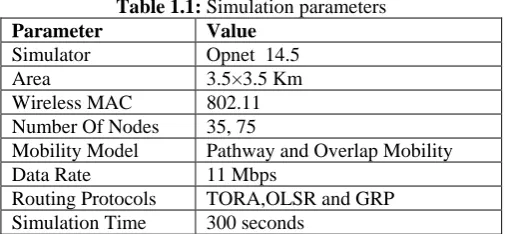
III. SIMULATION SETUP
We check these protocols by three parameters such as throughput, delay and load. We used two scenarios i.e. 35 nodes, and 75 nodes.
Table 1.1: Simulation parameters
Parameter Value
Simulator Opnet 14.5
Area 3.5×3.5 Km
Wireless MAC 802.11 Number Of Nodes 35, 75
Mobility Model Pathway and Overlap Mobility
Data Rate 11 Mbps
IV. RESULTS AND DISCUSSION
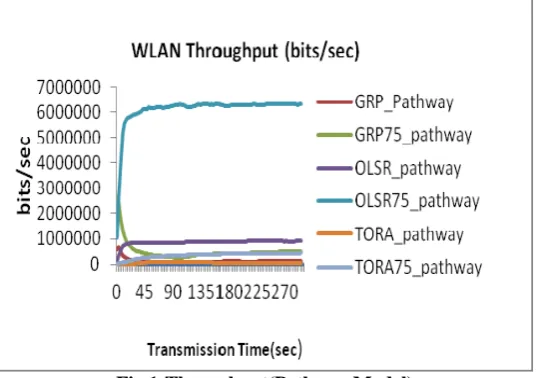
1.Throughput: It is the total size of useful packets that received at all the destination nodes. It is the total number of bits (in bits/sec) forwarded from wireless LAN layers to higher layers in all WLAN nodes of the network.[1]
Pathway Mobility Model: It is observed that: OlSR
outperforms both TORA and GRP in overall performance. As the number of nodes increase throughput for OLSR also increases. It is due to the availability of routing tables before the communication commences. On the other hand, TORA and GRP have to find the path spontaneously. In case of TORA considerable time overhead occurs due to the Route creation process where a source broadcasting and destination reply establishes an acyclic graph.
Overlap Mobility Model: It is observed that: OLSR
outperforms both TORA and GRP in overall performance. As the number of nodes increase throughput for OLSR also increases. It is due to the availability of routing tables before the communication commences. On the other hand, TORA and GRP have to find the path spontaneously. In case of TORA considerable time overhead occurs due to the Route creation process where a source broadcasting and destination reply establishes an acyclic graph. Performance of GRP protocol is almost same for both overlay and Pathway model. For TORA, Overlay model performs better.
Fig.1-Throughput(Pathway Model)
Table 1.2:Throughput (pathway model)
TORA OLSR GRP
35 75 35 75 35 75
Throughput Bits/sec 100012.368 301465.07 905376.648 6700391.067 110943.238 311031.444
Fig.2-Throughput(Overlap Model) Table 1.3 Throughput(Overlap Model)
TORA OLSR GRP
Throughput(bits/sec) 35 75 35 75 35 75
2. Load:
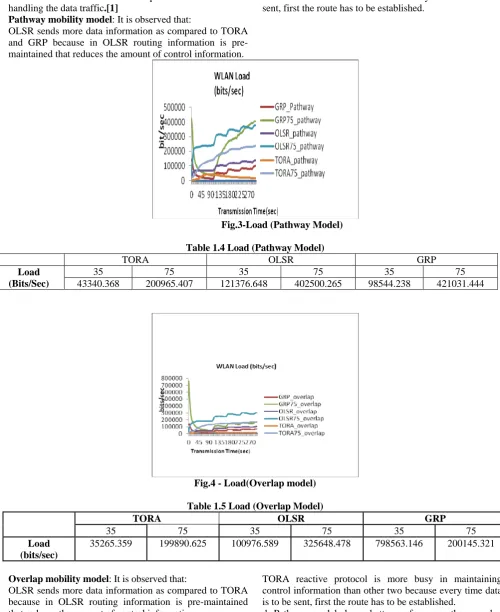
It is the total data traffic ( bits/sec) received by the entire WLAN. Load represents the capacity and efficiency of network. More load means more capable is network of handling the data traffic.[1]
Pathway mobility model: It is observed that:
OLSR sends more data information as compared to TORA and GRP because in OLSR routing information is pre-maintained that reduces the amount of control information.
GRP being a hybrid protocol GRP Shows an average performance with unpredictable changes.
TORA reactive protocol is busier in maintaining control information than other two because every time data is to be sent, first the route has to be established.
Fig.3-Load (Pathway Model)
Table 1.4 Load (Pathway Model)
Fig.4 - Load(Overlap model)
Table 1.5 Load (Overlap Model)
TORA OLSR GRP
35 75 35 75 35 75
Load (bits/sec)
35265.359 199890.625 100976.589 325648.478 798563.146 200145.321
Overlap mobility model: It is observed that:
OLSR sends more data information as compared to TORA because in OLSR routing information is pre-maintained that reduces the amount of control information.
GRP being a hybrid protocol GRP Shows better performance with unpredictable changes than OLSR and TORA.
TORA reactive protocol is more busy in maintaining control information than other two because every time data is to be sent, first the route has to be established.
d. Pathway model shows better performance than overlap model for TORA, GRP as well as OLSR protocol.With increase in number of nodes amount of Load submitted is better in OLSR than two protocols.
TORA OLSR GRP
Load (Bits/Sec)
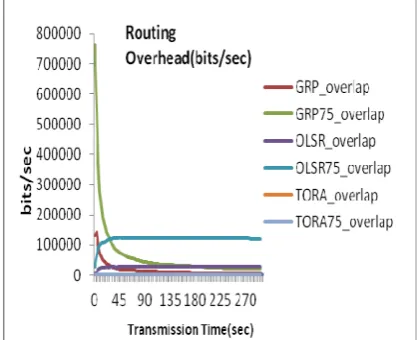
3. Routing overhead
Routing overhead refers to the extra time spent deciding on the routing process. It includes time overhead for path calculation, route allocation. For better performance minimal routing overhead is desired. Following figure provides a comparative analysis of Routing overhead for GRP, TORA and OLSR for 35 and 75 nodes density.
Fig.5- Routing Overhead(Pathway model)
Pathway mobility model - It is observed that
TORA has the minimum routing overhead of all three protocols. Whereas OLSR suffers from largest Routing overhead.
OLSR routing overhead shows sudden changes as the number of nodes are increased.
We observe increase in routing overhead as the number of nodes increase and this is particularly significant in case of TORA. For GRP this increase is relatively small and for OLSR this is medium.
Fig.6- Routing Overhead(Overlap model)
Table 1.6 Routing Overload (Pathway Model)
TORA OLSR GRP
35 75 35 75 35 75
Routing Overhead
(Bits/sec) 10565.253 13056.987 49856.678 165650.473 20456.236 31164.538
Table 1.7 Routing Overload (Pathway Model)
TORA OLSR GRP
35 75 35 75 35 75
Routing overhead
(Bits/sec) 11078.489 15045.326 47564.258 120052.875 21568.489 34789.256
Overlap mobility model- It is observed that
a. TORA has the lowest routing overhead of all three protocols. Whereas OLSR suffers the largest routing overhead.
b GRP routing overhead lies between OLSR and TORA. c We observe increase in routing overhead as the number
of nodes increase and this is particularly in the case OLSR .
d For TORA this increase is relatively small as it performs almost same as in pathway mobility model, we see that when the nodes are 35 in case of TORA the graph line is not seen as it is overlapped with TORA 75 ,but in the case GRP this increase is medium as shown below in the graph.
e Pathway mobility models shows better performance than overlap mobility model in case of TORA,OLSR, and GRP.
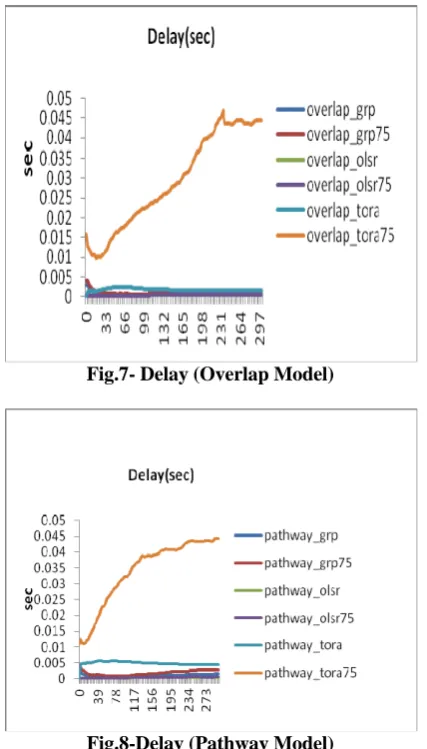
4.Delay
Delay indicates how long it a packet takes to travel from the CBR source to the application layer of the destination. This includes all possible delays caused by buffering during route discovery latency, queuing at the interface queue, retransmission delays at the MAC, propagation and transfer times of data packets.
It is observed that:
Proactive protocol shows better performance that Reactive and Hybrid Protocol.
Route Request and Route Reply messages in Route establishment process makes the TORA slowest of all three protocols. And when nodes increase delay increases rapidly.
Fig.7- Delay (Overlap Model)
Fig.8-Delay (Pathway Model)
Table 1.8 Delay (Pathway & Overlap Model)
Delay (Sec.)
TORA OLSR GRP 35 75 35 75 35 75 Overlap 0.003 0.045 0.001 0.002 0.003 0.001
Pathway 0.006 0.045 0.001 0.002 0.003 0.004
OLSR Protocol shows equal performance in terms of delay in both Overlay and pathway models as it remains same even at doubling the node density.
TORA becomes slow in pathway model at lower density. But GRP delay remains same for lower density.
Overall we can say that OLSR wins the round of Delay among the three competitors
V. CONCLUSION
The routing protocols TORA, OLSR and GRP were simulated with varying node density of 35 and 75 nodes moving randomly in an area of 3.5 * 3.5 kms. We have evaluated the their performance by using two mobility models that are pathway and overlap mobility models and the parameters that are used to analyse are Throughput, Load, Delay and Routing Overhead . From the extensive simulation results, it is found that OLSR shows the best performance in terms of throughput, Routing Overhead and Delay while GRP in Load. So from the above results it is clear that Proactive protocols i.e OLSR is better than Reactive (TORA) and hybrid protocol (GRP).
REFERENCES
[1] Gurjot singh Sidhu , Parveen kakkar(2013) “Performance Evaluation of Ad Hoc Routing Protocols TORA, OLSR and GRP under pathway mobility model.”
[2] Fan bai , Helmy, Ahmed (2006)“A Survey of Mobility Models in Wireless Adhoc Networks.” (Chapter 1 in Wireless Ad-Hoc Networks. Kluwer Academic. 2006).
[3] S. Das, C. E. Perkins, E. Royer, “Ad Hoc On Demand Distance Vector (AODV) Routing”,IETF Draft, June 2002.
[4] S. Mohapatra , P.Kanungo"Performance analysis of AODV, DSR, OLSR and DSDV Routing Protocols using NS2 Simulator"International Conference on Communication Technology and System Design ,2011
[5] Amandeep Verma, Dr. Manpreet Singh" Performance Analysis of Routing Protocols for hoc Networks "Int. J Comp Sci. Emerging Tech Vol-2 No 4 August, 2011 .
[6] Kuldeep Vats, Monika Sachdeva, Dr. Krishan Saluja "Simulation and performanceAnalysisofOLSR, GRP, DSR Routing Protocol using OPNET "International Journal of Emerging trends in Engineering and Development Issue 2, Vol.2 ( March-2012) .
[7] D GEETHA , T SARIKA"Performance Analysis of TORA & DSR Routing Protocols inMobile Ad-hoc Networks"International Journal of Electronics and Computer Science Engineering,2010. [8] N. Adam,M.Y. Ismail,J. Abdullah "Effect of Node Density on
Performances of Three MANET Routing Protocols"2010 International Conference on Electronic Devices, Systems and Applications (ICEDSA2010).
[9] S. R. Biradar, Hiren H D Sarma, Kalpana Sharma, Subir Kumar Sarkar , Puttamadappa C "Performance Comparison of Reactive Routing Protocols of MANETs using Group Mobility Model" International Conference on Signal Processing Systems,2009. 10] Ashish Bagwari,Raman Jee,Pankaj Joshi,Sourabh Bisht"Performance
of AODV Routing Protocol with increasing the MANET Nodes and it’s effects on QoS of Mobile Ad hoc Networks"International Conference on Communication Systems and Network Technologies,2012.
[11] Arindrajit Pal, Jyoti Prakash Singh, Paramartha Dutta”, Paulomi Basu and Doyel Basu"A Study on The Effect of Traffic Patterns on Routing protocols in Ad-hoc Network Following RPGM Mobility Model"International Conference on Signal Processing, Communication, Computing and Networking Technologies (ICSCCN 2011),2011.
[12] Liu Tie-yuan,CHANG Liang,Gu Tian-long"Analyzing the Impact of Entity Mobility Models on the Performance of Routing Protocols in the MANET"Third International Conference on Genetic and Evolutionary Computing,2009.
[13] Fan Bai, Ahmed Helmy" A survey of mobility models in wirelesss Adhoc networks".
[14] Priti Garg, Asma Tuteja” Comparative Performance Analysis of Two Ad-hoc Routing Protocols” International Conference on Network and Electronics Engineering IPCSIT vol.11 (2011), Singapore.
[15] Monika Rajput, Pallavi Khatri, Alankar Shastri, Keshav Solanki” Comparison of Ad-hoc Reactive Routing Protocols using OPNET Modeler”International Conference on mobile computing ,2010. [16] Yogesh Chaba, Yudhvir Singh, Manish Joon” Performance
Evaluation and Analysis of Cluster Based Routing Protocols in MANETs” International Conference on Advances in Computing, Control, and Telecommunication Technologies,2009.
[17] Vasudha Arora, C. Rama Krishna” Performance Evaluation of Routing Protocols for MANETs under Different Traffic Conditions” IEEE,2010.
[18] Shaily Mittal, Prabhjot Kaur “Performance Comparison Of AODV, DSR and ZRP Rouring Protcols in Manet’s” International Conference on Advances in Computing, Control,and Telecommunication Technologies,2009.
[19] D. Johnson, Y. Hu, and D. Maltz, “The Dynamic Source Routing Protocol (DSR) for Mobile”, RFC 4728, Feb 2007.
[20] K. Akkaya and M. Younis, “A survey of Routing Protocols in Wireless Sensor Networks”, Elsevier Ad Hoc Network Journal, 2005, pp 325-349.
[22] L. Hogie, P. Bouvry, and F. Guinand, "An Overview of MANET Simulation," Electronic Notes in Theoretical Computer Science, vol. 150, no. 1, pp. 81-101, 2006.
[23] X. Chang, "Network Simulations with OPNET," Presented at Simulation Conference Proceedings, 1999 Winter, 1999, pp. 307-314.
[24] Suresh Kumar, R.K. Rathy and DiwakarPandey, “TrafficPattern Based Performance Comparison of Two ReactiveRouting Protocols for Ad-hoc Networks using NS2”, 2ndIEEE International
Conference on Computer Science and Information Technology, 2009.