A Review on Implementation and Applications
of Artificial Intelligence
Deepika D Pai1, Akanksha Das2
Assistant Professor, Dept. of ECE, Vemana Institute of Technology, Bengaluru, Karnataka, India1
UG Student, Dept. of ECE, Vemana Institute of Technology, Bengaluru, Karnataka, India2
ABSTRACT: Artificial Intelligence (AI) is a broad area of computer science that aims to automate activities that require human intelligence. Due to its ongoing successful applications and implementations, AI has been adding credentials to its repertoire in this digital era. Be it computerized medical diagnostics or systems that automatically customize hardware to meet user requirements, AI has done it all. Major problems that are being dealt in AI include Perception, Manipulation, Reasoning, Communication and Learning. Perception concerns itself with building models of the physical world such as sensory input (visual, audio). Manipulation is involved in programming and articulating appendages such as mechanical arms, locomotion devices in order to make an impression in the physical world. Reasoning addresses higher level cognitive functions such as diagnosing, designing, planning, drawing inferential conclusions, planning, etc. Communication is concerned with problem understanding and conveying information through the use of language. Finally, learning addresses the issues of improving system performance automatically over time, based on system’s experience. AI concepts are being used to put forth a unified platform that deals with diverse problem areas and that form the foundation of this technical and scientific discipline. The AI algorithms and systemsfunction based on knowledge, based on facts and rules that characterize the proficiency of system’s domain. The elements of knowledge Base consist of some amount of information. Organization and utilization of this information is done automatically by the system to solve the problems that it encounters. This systematic process is usually referred to as a ‘Search’, which is directed towards specific goals. To determine the relevance and reliability of information, the search is made complex. Also, because of the frequent occurrence ambiguous data, the search has to be complex. AI system is provided with a method or rather mechanism for focusing its attention and controlling its search processes by the heuristics.
KEYWORDS: Artificial Intelligence, Perception, Manipulation, Reasoning, Communication, Learning
I.INTRODUCTION
Artificial Intelligence(AI) is a multidisciplinary field that aims to create systems that can function intelligently and quite independently like a human does. The term Artificial Intelligence was first introduced in 1956 by Dartmouth professor John McCarhy. This article, dicusses some of the major aspects and applications of AI in this world.
prove a boon to mankind. AI together with machine learning has taken the world by storm with a few of it’s creations like Sophie and Eve (Eve was in the news recently for being able to discover an element used in the toothpaste that could potentially cure malaria). AI is creating intelligent software and designing a machine that is smart, a machine that has the ability to think, the power to learn and the ability to analyse them to make decisions like humans. For instance, if we want a car to drive by itself(driverless car), then the software installed in the car must be able to implement the driver’s expertise while driving. AI is a man made thinking power. This is exactly what AI does. Intelligence within an artificial system is artificial intelligence. AI has evolved from four main subjects, namely- Psychology, Philosophy, Mathematics and Linguistic. These subjects are playing a pivotal role in the growth and enhancement, and also the right implementation of AI.
II.ARTIFICIAL INTELLIGENCE TECHNOLOGY
Rather than merely developing next-generation artificial intelligence technology, they have aimed to develop a new concept of general-purpose intelligence cognition technology called “Beyond AI”. and to develop an intelligent learning model called “Brain Intelligence (BI)” that generates new ideas about events without having experienced them by using artificial life with an imagine function.
Systems using artificial intelligence match or surpass human-level performance in more and more domains, leveraging rapid advances in other technologies and driving soaring stock prices. Yet measured productivity growth has declined by half over the past decade, and real income has stagnated since the late 1990s for a majority of Americans. Four potential explanations for this clash of expectations and statistics are: false hopes, mismeasurement, redistribution and implementation lags. While a case can be made for each explanation, arguably lags have likely been the biggest contributor to the paradox. The most impressive capabilities of AI, particularly those based on machine learning, have not yet diffused widely. More importantly, like other general-purpose technologies, their full effects won’t be realized until waves of complementary innovations are developed and implemented. The adjustment costs, organizational changes, and new skills needed for successful AI can be modeled as a kind of intangible capital. A portion of the value of this intangible capital is already reflected in the market value of firms. However, going forward, national statistics could fail to measure the full benefits of the new technologies and some may even have the wrong sign.
Presently the intersection of AI and virtual worlds, with focus on AI agents and exploring the potential implications toward the human-level AI, there is a unique multidisciplinary approach to the subject, in order to give a comprehensive view on the elaborated problems and the way they are interrelated. Benefits coming from this kind of broad study are twofold: on one hand, research on advanced AI agents in the virtual worlds is the necessary ingredient of their further evolution; and on the other hand, the virtual worlds represent an excellent platform for research on numerous problems related to the challenging field of AI.
III.APPLICATIONS OF AI
A. AI IN BIOTECH
Companies employing AI and ML promise to make drug discovery cheaper and quicker. Few tech startups are also taking the route of structure-based approach to drug discovery, using AI to figure out small molecules that could be beneficial for therapeutic purposes based on known target structures. Cosidering the fact that AI and ML are branching deeper and deeper into the world of biotechnology, the healthcare sector and their services would eventually benefit mankind.
B. AI IN SPACE
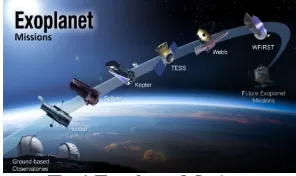
Last year, NASA announced the discovery of a new exoplanet orbiting a distant star some 2500 light years away from here called Kepler 90. But this finding was quite unusual and modern, unlike the previous discoveries. This new exoplanet was detected with the help of artificial intelligence researchers at google using a machine learning technique called neural networking.
Christopher Shallue, a software engineer at google who helped in this discovery said that this was the first time a neural network specifically has been used to identify a new exoplanet.
This latest technology inspired by the human brain is specially designed and programmed to recognise patterns and classify images. It can learn to tell the difference between something like a simple cat and a dog, as well as distinguish exoplanets from cosmic noise.
For this particular discovery, the computer looked at a small chunk of data collected by Kepler from the year 2009 to 2013. The computer program ransacked through 670 star systems from the 150,000 stars represented in kepler collection, for sign of the exoplanets. The astronomers designed the program on a set of about 15000 and it identified the planets correctly, 96% of the time. With this level of accuracy, AI is sure to conquer the world of cosmology detecting new celestial or extra terrestial bodies proving a boon to the astronomers.
Fig 1 Exoplanet Missions
C. AI IN SATELLITES
Fig 2 Application of AI to predict earthquakes
D. AI TO FIND HUMAN ANCESTORY
Scientists say that an artificial intelligence program has helped in identifying a previously unknown human ancestor that had roamed the planet tens of thousands of years ago and has left a genomic footprint in Asian individuals. Researchers at university of Tartu in Estonia, Institute of Evolutionary Biology (IBE), and the Centre for genomic regulation (CRG) in Spain have combined deep learning algorithms and statistical methods and found that the extinct species was a hybrid of Neanderthals and Denisovans and cross bred with modern humans in Asia. This finding would help in explaining the hybrid that was discovered last year in the caves of Denisova- the offspring of a Neanderthal mother and a Denisovan father- was not an isolated case but rather was a part of a more general introgression process. Researchers have used deep learning for the first time ever, successfully, to study human ancestry, paving way for use of AI in other fields such as genomics and evolution.
Fig 3AI in finding human ancestry
E. AI TO PREDICT TENNIS PLAYER’S NEXT HIT
Scientists claim that they have created an algorithm that can predict where a tennis player will hit the next ball by analysing data of thousands of shots played by legendary players like Novak Djokovic, Rafael Nadaland Roger Federer in Australian Open 2019. This new discovery by the researchers at the Queensland University of Technology (QUT) in Australia could lead to new players for professional tennis players to predict their opponent’s moves. This algorithm is termed as the Semi Supervised Generative Adversarial Network architecture can also be used in virtual reality games. This new finding could offer people the chance to go head -to-head with the world’s best players in an accurate but artificial grand slam. This particular algorithm uses Hawk-Eye data from the 2012 Australian Tennis Open, provided by TennisAustralia. The researchers developed this algorithm by narrowing their focus to study just the shot selection of Djokovic, Nadal and Federer because they had the complete data to input into the system on how players’ shot selection changed as the tournament progressed. This algorithm was mimicking the brains of the top players who were already trying to predict their opponent’s next shot. The researchers believe that in less than ten years top level players will be able to use this sort of technique to study the game of an upcoming opponent
.
F. AI IN SATELLITE
transmitter settings while trying to achieve multipleconflicting goals in a continuously changing communication channel. The researchers claim that this can be achieved by leveraging reinforcement learning (RL) and virtual exploration models. The artificial neural network, through RL, can be made adaptable to the conditions of space through multiple trials and experiments. This can be possibly achieved as the algorithm is developed along the similar lines as that of the human brain. Simulation results for CE design were analysed and the average accuracy was 80 percent. This could serve as a starting point and benchmark for other scientists pursuing in the field of space communication.
Fig 4 AI in satellite
G. AI TRANSLATES BRAIN SIGNALS INTO SPEECH
In a major breakthrough, scientists from Columbia university have created an artificial
intelligence-based system that can translate thoughts into recognisablespeech, a boon for people who cannot
speak, to regain their ability to communicate. This system monitors a person’s brain activity and as
a result can reconstruct the words the person hears with unprecedented clarity. This breakthrough
lays the groundwork for helping people who cannot speak, such as those living with amyotrophic
lateral sclerosis, to communicate with the outside world. This newly developed system harnesses
the power of speech synthesisers and AI which could lead to new ways for computers to
communicate directly with the brain.
Fig 5 AI system translates brain signals into speech
H. MAKING HEALTCHCARE SMARTER
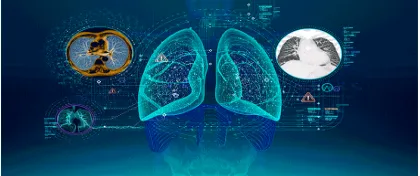
childhood conditions from influenza to meningitis-afterthorough processing of the patient’s symptoms, history, lab results and other clinical data. The researchers are optimistic about this new innovation to be highly accurate and eventually, help doctors in diagnosing rare or complex conditions in humans. This AI developed system has been helping researchers worldwide in testing systems that analyse digital health records in an effort to figure out serious medical conditions such as osteoporosis, hypertension, heart failure and diabetes.
Fig 6 AI in Healthcare
I. AI TO PROTECT WILDLIFE
Scientists all over the world are working towards preventing what could possibly be a devastating biodiversity crisis. AI provides strong help to these researchers in resolving this crisis. Modern day technological advancements and AI have led to several opportunities in areas of conservation and ecology from protecting species and their habitats to exploring the unexplored regions on earth. With the help of AI, researchers have been able to crack down on illegal wildlife activities. One of the recent successes of AI has been integrating AI with relevant technologies in the Ruaha Carnivore Project. This project mainly aims to protect both lions and people locally. Killing a carnivore in Ruaha earns certain tribesmen- respect, status and even gifts from the community. To understand this tradition, the team worked on building relationships in order to make them stop this ritual. The team involved in this project also developed several programmes using the community warriors to defend rather than killing lions, to offering then a monthly wage. To implement this, the team installed camera trapping for lion defenders to monitor this automated camera traps. These cameras are powered by AI which click photos when an animal passes by, automatically and the locals in return would receive points for every photo clicked. These received points generate extra amount for the community-around $5000 per village-every three months, which provides healthcare, veterinary medicine and education. Reduction in illegal poaching and threatening wildlife with the help of AI can prove a boon to the researchers who are working on the current biodiversity crisis that the planet is encountering.
IV. LIMITATIONSOF ARTIFICIAL INTELLIGENCE
Artificial intelligence has to address many concerns including technical and ethical concerns. AI has to take into consideration the customer’s privacy, lack of transparency in some cases, technological complexity, to name a few. AI should consider the loss of control in certain strategic business plans and decisions. From the ethical point of view, growth and advancements of AI should be limited in the field of automatic and autonomous weaponry. AI’s success today,is hindered by the technical and ethical concerns. Its field of application has to be tuned in a manner proving a boon to mankind
.
V. CONCLUSION
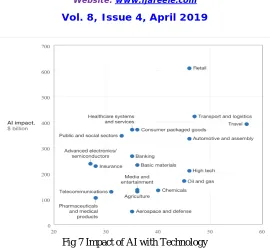
Fig 7 Impact of AI with Technology
At the end, we’ve explored in this research through AI definitions, brief history, implementation and applications of AI in public, applications of AI in military, ethics of AI and the three rules of robotics. AI has just begun, far from the end. There’s more to come; who knows what AI can unleash from its power. Only the future will tell. Today, AI is the center of a completely different and new enterprise, to build computational models of intelligence. It is mainly assumed that intelligence- human or otherwise, can be represented as symbolic structures and symbolic operations which can be programmed using software algorithms. There is much to debate as to whether a programmed algorithm like AI would end up being a mind or would merely simulate one. But AI researchers are loosely interested in the conclusion of the debate. They do not require a computer to model human intelligence. AI programs can outperform human expertise. Various aspects of human intelligent behaviour, such as learning, understanding, drawing conclusions, solving capabilities, have already been coded as software programs and within a limited domain, such as identifying diseases of a legume plant. The greater challenge for AI is to find methods to represent common sense and experience to perform daily activities such as figuring out the exact route in a busy street. Some AI experts predict that AI will be able to do anything that humans can do and even better. A chess computer beating the world chess champion was the first example.
It is for AI to decide whether or not it will be worthwhile to develop a certain field of research-or it may decide that space travel would be an utter waste of time as long as mankind continues to live in poverty on Earth. Most scenarios about AI in the future are hypothetical. A nervous prediction. But AI always presents us with mind boggling questions. It shows that where science stops, philosophy and spirituality begin.
REFERENCES
[1] Huimin Lu,Yujie Li,Min Chen,Hyoungseop Kim,Seiichi Serikawa ,” Brain intelligence: Go beyond Artificial Intelligence “,April 2018, Volume 23, Issue 2, pp 368–375.
[2] “Artificial Intelligence and the Modern Productivity Paradox: A Clash of Expectations and Statistics” (2017 NBER working paper)
[3] M. Petrovic, Vladimir,”Artificial Intelligence and Virtual Worlds – Toward Human-Level AI Agents”, IEEE Access. 6. 1-1. 10.1109/ACCESS.2018.2855970.
[4] Daniel G. Bobrow, J. Michael Brady “Creativity and artificial intelligence”, Volume 103, Issues 1–2,Pages 1-362 ,August 1998. [5] Girimonte, Daniela & Izzo, Dario ” Artificial Intelligence for Space Applications. Intelligent Computing Everywhere”. 10.1007/978-1- 84628-943-9_12.
[6] S. Chien, R. Doyle, A. G. Davies, A. Jonsson and R. Lorenz, "The Future of AI in Space," in IEEE Intelligent Systems, vol. 21, no. 4, pp. 64-
69, July-Aug. 2006.
[8] Gopala K. Anumanchipalli, Josh ChartierEdward F. Chang ,” Speech synthesis from neural decoding of spoken sentences”,Naturevolume 568, pages493–498 (2019)
[9]Hassan Akbari, Bahar Khalighinejad, Jose L. Herrero, Ashesh D. Mehta & Nima Mesgarani “Towards reconstructing intelligible speech from the human auditory cortex”Scientific Reports,volume 9, Article number: 874 (2019)
[10] “Introduction to Artificial Intelligence “By Philip C. Jackson
[11] “Adaptation in Natural and Artificial Systems: An Introductory Analysis with applications to biology,control and artificial intelligence” By John Henry Holland, Professor of Psychology and of Electrical Engineering and Computer Science John H Holland, Senior Lecturer in Human Resource Management Holland