Scholarship@Western
Scholarship@Western
Electronic Thesis and Dissertation Repository
8-26-2015 12:00 AM
Gamification Framework for Sensor Data Analytics
Gamification Framework for Sensor Data Analytics
Alexandra L'Heureux
The University of Western Ontario
Supervisor
Dr. Miriam Capretz
The University of Western Ontario
Graduate Program in Electrical and Computer Engineering
A thesis submitted in partial fulfillment of the requirements for the degree in Master of Engineering Science
© Alexandra L'Heureux 2015
Follow this and additional works at: https://ir.lib.uwo.ca/etd
Part of the Other Electrical and Computer Engineering Commons
Recommended Citation Recommended Citation
L'Heureux, Alexandra, "Gamification Framework for Sensor Data Analytics" (2015). Electronic Thesis and Dissertation Repository. 3200.
https://ir.lib.uwo.ca/etd/3200
This Dissertation/Thesis is brought to you for free and open access by Scholarship@Western. It has been accepted for inclusion in Electronic Thesis and Dissertation Repository by an authorized administrator of
GAMIFICATION FRAMEWORK FOR SENSOR DATA ANALYTICS
(Thesis format: Monograph)
by
Alexandra L’Heureux
Graduate Program in Electrical and Computer Engineering
A thesis submitted in partial fulfillment
of the requirements for the degree of
Master of Engineering Science
The School of Graduate and Postdoctoral Studies
The University of Western Ontario
London, Ontario, Canada
c
I would like to thank my supervisor Dr. Miriam Capretz for all of her support over the last few years. She motivated me to get involved with research during the third year of my undergraduate degree and has since been a motivation to pursue a career in academia. The accomplishment of this thesis would not have been made possible without her support and guidance. Thank you for always supporting me and believing in my capabilities even through difficult times.
I would also like to thank my research team for their support and inspiring ideas: Wilson Higashino, Sara Abdelkader, Mauro Ribeiro, Dennis Bachmann, Daniel Berhane Araya and especially Dr. Katarina Grolinger who has taken countless hours out of her schedule to review my work and help me shape my ideas. I am immensely grateful for everything you have done for me, thank you.
I would also like to thank the team at Powersmiths for helping me develop my research ideas and providing me with all the tools necessary for the success of my thesis. I am very appreciative of your involvement and support in this project.
This thesis would also not have been made possible without the support of my friends and family. I would especially not be where I am today without the support of my partner and best friend Melissa. Thank you for always being there for me through these crazy few years. You have been an indescribable source of support and strength and I could never thank you enough for that. I love you! To my mother France and brother Cyril, thank you for your unconditional love and support through this crazy and often stressful adventure, I love you.
Lastly, I would like thank my dad Jacques. Thank you for teaching me the value of educa-tion and hard work and for always believing in me even when I did not. You showed me how to keep my head up and that I could achieve anything I set my heart out to do. I am so sorry that you were unable to witness what I have accomplished over the last 6 years, I love you and miss you everyday. I dedicate this thesis to you papa.
Abstract
Data in all of its form is becoming a central part of our existence. It is being captured in every facets of our everyday life: social media, pictures, smartphones, wearable devices, smart building etc. One of the main drivers of this Big Data Revolution is the Internet of Things, which enables inert objects to communicate through a multitude of sensors. The data amassed fuels a thirst for information, the extraction of such knowledge is rendered possible through data analytics techniques.
However, when it comes to sensor data our large-scale ability to perform analytics is highly limited by the difficulties associated with collecting sensor data labels. Current crowdsourcing platforms historically used to gather labels are unable to process sensor data due to its low level nature and its reliance upon contextual information. The solution proposed in this thesis enables the deployment of a crowdsourcing platform for sensor data. This research presents a novel solution to acquire sensor labels by leveraging the power of crowdsourcing using gami-fication. The work in this thesis describes not only a framework that facilitates the capture of sensor data label through a flexible gamification architecture but also a solution that outlines the mechanics required to integrate gamification in a variety of contexts. Additionally, the framework is designed in a flexible manner to support any type of sensor data given that hu-mans can readily interact with them. Additionally, the work presented describes and supports both real time and historical data analytics through the captured data and associated labels.
This work was successfully evaluated in the context of a case study performed in conjunc-tion with an industry partner. The gamificaconjunc-tion implementaconjunc-tion was tested for a number of electrical sensors. Real time and historical data analytics were successfully performed with the use of the framework. The robustness of the solution was evaluated though the injection of invalid data and the result showed that the framework is effectively capable of reducing the level of noise in the data labels.
Acknowlegements ii
Abstract iii
List of Figures vii
List of Tables ix
List of Abbreviations x
1 Introduction 1
1.1 Motivation . . . 2
1.2 Contribution . . . 4
1.3 Organization of the Thesis . . . 5
2 Background and Literature Review 7 2.1 Concept Introduction . . . 7
2.1.1 Data Labels and Analytics . . . 7
2.1.2 Clustering . . . 9
2.1.3 Sensor Data . . . 10
2.1.4 Sensor Events . . . 11
2.2 Sensor Data Labelling Techniques . . . 12
2.2.1 Existing Work . . . 15
2.3 Crowdsourcing for Sensor Analytics . . . 18
2.3.1 Crowdsourcing Challenges . . . 18
2.3.2 Crowdsourcing and CrowdSensing Frameworks . . . 19
2.4 Gamification . . . 21
2.4.1 Gamified Crowdsourcing Frameworks . . . 22
2.5 Summary . . . 24
3 Gamification Framework Architecture 26 3.1 Crowdsourcing Dashboard . . . 28
3.1.1 Sensor Parameter Acquisition . . . 29
3.1.2 Gaming Parameters Acquisition . . . 32
3.1.3 Sensor Database . . . 33
3.2 Sensor Interface . . . 34
3.3.1 Game Application . . . 36
3.3.2 Label Acquisition . . . 39
3.3.3 Game Database . . . 41
3.4 Event Detection . . . 43
3.4.1 Pre-processing . . . 44
3.4.2 Event Detection . . . 45
3.5 Event Labelling . . . 46
3.5.1 Stream Merging . . . 47
3.5.2 Label Apposition . . . 47
3.6 Analytics . . . 49
3.6.1 Real Time Analysis . . . 51
3.6.2 Historical Analysis . . . 51
3.7 Summary . . . 51
4 Gamification Framework Implementation 53 4.1 Crowdsourcing Dashboard . . . 55
4.1.1 REST API . . . 55
4.1.2 Sensor Database Design . . . 58
4.2 Sensor Interface . . . 59
4.3 Gamification . . . 61
4.3.1 Game Application . . . 63
4.3.2 Label Acquisition . . . 64
4.3.3 Game Database Deployment . . . 65
4.4 Event Detection . . . 66
4.4.1 Pre-Processing process . . . 67
4.4.2 Event detection process . . . 68
4.5 Event Labelling . . . 70
4.6 Analytics Module . . . 71
4.6.1 Real Time Analytics . . . 71
4.6.2 Historical Analytics . . . 72
4.7 Summary . . . 72
5 Gamification Framework Evaluation 74 5.1 Case Study . . . 74
5.2 Event Detection and Labelling Component Evaluation . . . 79
5.2.1 Event Detection Evaluation . . . 79
5.2.2 Event Labelling Evaluation . . . 80
5.3 Analytical Evaluation . . . 82
5.3.1 Real Time Analytics . . . 82
5.3.2 Historical Analytics . . . 85
5.4 Summary . . . 87
6 Conclusion and Future Work 89 6.1 Conclusion . . . 89
Curriculum Vitae 102
List of Figures
2.1 Diagram of Annotation and Labelling Techniques. . . 13
3.1 Overview of the Framework. . . 26
3.2 Crowdsourcing Sensor Entity Diagram. . . 30
3.3 Crowdsourcing Gaming Entity Diagram. . . 32
3.4 Sensor Reading Database Design. . . 34
3.5 Sensor Interface Design. . . 35
3.6 Gamification Object Relationships. . . 37
3.7 Behaviour Artifact Classes. . . 37
3.8 Reward Artifact Classes. . . 38
3.9 Mechanics Artifact Classes. . . 38
3.10 Action Record Sequence Diagram. . . 39
3.11 Action Capture Interface. . . 40
3.12 Action Polling Sequence Diagram. . . 42
3.13 Game Central Architecture. . . 43
3.14 Event Detection Algorithm. . . 46
3.15 Label Apposition Process. . . 47
3.16 Label Association Algorithm. . . 49
3.17 Standalone Analytics Classes. . . 50
3.18 Shared Analytics Classes. . . 50
4.1 Implementation of the Gamification Framework. . . 54
4.2 Implementation of the Physical Context. . . 55
4.3 Area Creation Form. . . 56
4.4 Meter and Area Association Form. . . 57
4.5 Target QR Code View. . . 58
4.6 Sensor Database ER Diagram for Dashboard Entity. . . 59
4.7 Sensor Service Factory. . . 60
4.8 Sensor Service Creation Process. . . 60
4.9 Sensor Data Gathering Process. . . 61
4.10 Gamification Elements. . . 62
4.11 View of the Game Application. . . 63
4.12 Action Record Sequence Diagram. . . 64
4.13 Action Sourcing Sequence Diagram. . . 65
4.14 ER Diagram of the Game Database. . . 66
5.3 Real Time Analysis Application. . . 83 5.4 Historical Analysis Application. . . 86 5.5 Historical Analysis Application Heat Map View. . . 87
List of Tables
2.1 Machine Learning Algorithms and their Labelling Requirements. . . 8
2.2 Types of Data Labels. . . 8
2.3 Data Clustering Methods. . . 9
2.4 Categories of Sensor Data. . . 11
2.5 Sensor Event Semantic Definitions. . . 11
3.1 Crowdsourcing Sensor Entity Defintions. . . 31
3.2 Crowdsourcing Gaming Entity Definitions. . . 33
5.1 Electrical Sensors Descriptions. . . 76
5.2 Occupancy Sensors Descriptions. . . 77
5.3 Game Application Actions. . . 78
5.4 Lighting Action Targets. . . 78
5.5 False Positive Detection. . . 80
5.6 Wrong Label Detection. . . 81
5.7 Final Dataset Composition. . . 82
5.8 Framework Comparison with Unlabelled Techniques. . . 85
5.9 Electrical Consumption Waste Rules. . . 85
IoT Internet of Things
KNN K Nearest Neighbours
BSS Between Sum of Squares
TSS Within Sum of Squares
Chapter 1
Introduction
The big data revolution vows to turn data into actionable knowledge through big data analytics techniques. Businesses are capturing and storing more and more data with hopes to extract great amounts of valuable information. Indeed, when it comes to products and customer data, that promise of valuable insights is often fulfilled. However in regards to less defined datasets such as those in provenance of sensors, the analysis can be much more complex and the ex-traction of valuable intel much more difficult.
The Internet of Things (IoT) [2] is an ecosystem powered by sensors and microchips to enable the connection and communication amongst real-life objects, environments and people. Through this network of things, sensors and devices such as household appliances, cars, health devices and even buildings are capturing and exchanging enormous amounts of data and there-fore fuelling the big data movement.
However, the data captured from human interactions by sensors is very different from other data collected by humans. Indeed images, social media data and usage information are human interpretable in the capacity that an untrained user can correctly identify what the data repre-sents. Conversely, sensor data cannot typically be easily reconciled and interpreted without prior domain and contextual knowledge.
The functionality of the IoT, depends upon four fundamental steps as suggested by Swan [3] : data creation, information extraction, meaning-making, and action-taking. Therefore, ex-tracting information or knowledge from sensor data is also a crucial piece of the IoT scenario. Data analytics techniques and algorithms can be used to perform such tasks.
Despite that, the human interaction data currently being captured by sensors is often only processed and analyzed by field experts and consequently does not often allow for data
alytics to be performed at large scales. The capture of the activities surrounding sensor data readings is essential to the acquisition of sensor data labels as it is the preferred way to establish the truth value or label of a reading. The lack of labels or of contextual information surrounding sensor readings is one of the root causes of the impracticability of data analytics on sensor data. Therefore there exists an impending need for a sensor data analytics framework that would enable the analysis of sensor data. The solution needs to provide a means of acquiring and labelling sensor data in a flexible manner such that it can be utilized for any type of sensors with which users interact. This thesis will present a solution to such a problem.
1.1
Motivation
Historically, when researchers or users have been working on performing data analytics on datasets they would make use of various techniques. A large number of those methods fall un-der the supervised machine learning algorithms umbrella [4]. Those algorithms rely upon data labels to learn patterns and characteristics from a dataset and subsequently infer knowledge such as classifications or predictions. In order to obtain such labels and build their datasets, researchers would often use crowdsourcing services [5, 6, 7].
Crowdsourcing can be described as the process of using large groups of various individuals to perform specific tasks. In the context of machine learning, those tasks would be to ask users to identify specific data such as images and the result of the identification would serve as the labels. Mechanical Turk [8] is an example of such a framework, it allows for researchers to post tasks to be performed and in exchange for their participation users receive a financial compen-sation. Using those frameworks is particularly effective for datasets where humans are much more effective than computers at performing a task. Unfortunately, when it comes to sensor data, typical crowdsourcing frameworks are ineffective due to the poor human readability of the data.
It is quite challenging to apply a label on sensor readings and identify exactly what in-teractions may have been measured. In certain cases, contextual information may allow for the detection of abnormal behaviours or anomalies [9], however when it comes to identifying or classifying what is being measured, additional information surrounding the readings is re-quired.
be-1.1. Motivation 3
ing measured. Human activity is a context of primary importance, as it jointly describes not only a person’s intention but also the current status of objects [10] which can be used to la-bel sensor data. Although, in order to gather such information, it would be required to know exactly how these sensors are being used and what is happening at the time of the reading. Existing labelling techniques suggest both real time and post processing labelling approaches. In spite of that, it is often not practical or accurate to obtain this information in after the fact, this type of labelling should occur in parallel with the capture of the data.
One of the main challenges when it comes to sensors is that humans are often unable to manually label the data, leaving current techniques unavailing. An incredible amount of sensor data is gathered and saved everyday but there exists a limited amount of options to leverage intelligence from it. For example, electrical sensors in buildings are capturing copious amounts of readings but limited knowledge can be extracted through data analytics without first captur-ing some labels for the data. Existcaptur-ing sensor data labellcaptur-ing techniques are costly both in terms of financials and time. New means of gathering labels for sensor data are required and the need for such techniques provides motivation for this work.
Additionally, in the cases of sensor data, although the potential range of readings may be somehow finite, an almost infinite combination of attributes is possible. In other words, as new events and activities are being measured by the sensors, the model initially trained may no longer be accurate. In order to adequately perform real time analysis of data, a mechanism is required to be put in place to quickly capture and label those new events. The new labelling so-lution must allow for easy and inexpensive addition of labels. This indicates that a static model may not provide the best accuracy and that introducing some interactivity and responsiveness may be key to a successful methodology. This challenge motivated the integration of gamifi-cation within this work. Gamifigamifi-cation, which is defined as the integration or addition of game elements to non-related contexts [11], would be used not only to heighten the participation and interest of the users but also to allow a fast and effective way to acquire new labels.
The main goal of this research is to address these challenges and issues related to the col-lection of sensor data by leveraging the power of gamification.
1.2
Contribution
This thesis contains various contributions, however, only the main contributions of our work will be discussed in this section.
First of all, the prime contribution of this thesis lies in the architecture of the gamification framework itself, through its modularity, adaptability and flexibility.
This framework provides a complete end to end solution for sensor data analytics, from the gathering of data, to its labelling, and lastly through its analytical capabilities. It proposes a ro-bust new sensor data labelling technique which leverages the power of gamification to capture human activities and assign them as sensor labels. It demonstrates how human activities can be translated into sensor events of interest.
As opposed to the work found in literature, which tends to only focus on mobile sensors [12, 13], this framework has the ability to quickly and effectively adapt to support a variety of sensors. It was designed to work with any type of sensors, whether mobile or permanently in-stalled in fixed locations. It supports both the analysis of real time and historical sensor events. The work presented here does not only address the need for easily accessible labelled sen-sor data, it also enables researchers to request labels for specific types of sensen-sor data. The framework therefore enables not only data analytics for end users but also provides a platform for researchers to crowdsource any sensor related task. This was not previously possible with current existing crowdsourcing solutions. Additionally, the framework enables end users to leverage the newly acquired data to perform analysis of both real-time and historical data.
1.3. Organization of theThesis 5
This framework could be implemented with any game or context as long as the outlined requirements are met and design followed. Other solutions found in the literature were tied to a specific game implementation and showed gamification as a secondary piece of the design [14, 15]. They did not highlight nor show how the gamification was tied and integrated within the design itself.
In summary, this thesis presents a solution to robustly and effectively label sensor data while enabling sensor data crowdsourcing. It also proposes an architecture to integrate gamification in a flexible and adaptable manner. The results of the evaluation show that the framework can successfully label sensor data with a low amount of noise. The real time and historical data analytics functionalities are also positively demonstrated.
1.3
Organization of the Thesis
The remainder of this thesis is organized as follows:
• Chapter 2 will provide a combination of some background information and a literature review of the current data labelling techniques and crowdsourcing gamification frame-works. In the first part, an introduction to the various technical terms and concepts used throughout this thesis will be provided as background information for our work. Sec-ondly, a review of the data labelling techniques commonly used to label sensor data will be provided along with a review of academic work in the area of sensor crowdsourc-ing. Thereafter, an introduction to gamification as a paradigm for users motivation and engagement will be provided in conjunction with a state of the art review of the combi-nation of gamification and crowdsourcing. Finally, the contribution of this thesis will be re-iterated in the context of existing work.
• Chapter 4 presents a general implementation of the gamification framework. It intro-duces an implementation for each of the six main components presented in Chapter 3. The details of each of the components will also be discussed and the relations between the architecture and the implementation highlighted. Lastly, a summary of the contribu-tion of the implementacontribu-tion will be presented.
• Chapter 5 depicts the evaluation of the gamification framework. It first introduces a case study performed using the implemented framework and secondly presents the methodol-ogy used to evaluate the framework. The results of the evaluation of the various compo-nents will also be presented along with a short discussion demonstrating the success of the solution.
Chapter 2
Background and Literature Review
This chapter serves a dual purpose: first it introduces the various terms related to the topics discussed in this thesis and secondly it provides an overview of the existing work in regards to gamification and sensor data labelling. More specifically, the literature review will focus on the various existing frameworks built for gamification and crowdsourcing. The research gap addressed by this thesis will also be discussed.
2.1
Concept Introduction
This section will define and discuss the following concepts: data labels and analytics, cluster-ing, sensor data and sensor events. These are essential to the understanding of the framework described herein. They serve as a foundation for the understanding of this work.
2.1.1
Data Labels and Analytics
Data labels are defined as a representation of the ground truth or gold standard [16] of a data sample, that is the accurate value of what a sample represents. Having access to the ground truth or data label of a data reading is critical for data analytics due to its reliance upon machine learning techniques. When performing classification, data labels are referred to as classes.
Data labelling is a critical component of supervised machine learning because this entire class of algorithms is entirely dependent upon labels in order to learn and extract knowledge from data. The performance of the machine learning algorithms is directly related to the quality of the labelled dataset [17]. On the other hand, unsupervised machine learning techniques aim at extracting data patterns or discovering similarities from data without having prior access to the labels [18]. However, the data labels are still important in order to validate the efficiency
and accuracy of unsupervised algorithms. Therefore, proper data labelling is critical to suc-cessful data analytics. Table 2.1 presents the various machine learning algorithm categories and their associated data requirements.
Algorithm Category Data Label Requirement
Unsupervised Requires data labels to validate the accuracy of the
algo-rithms. Labels are also used to gain additional knowledge
from the results such as names for data clusters.
Supervised Requires data labels to learn from the dataset and tune
in-ternal parameters. A substantial data set is required both
for learning and validating the algorithm’s performance.
Semi Supervised Requires some specifically chosen data labels from
which it learns, these algorithms require far less labels
than supervised algorithms. Data labels are also needed
to validate the performance.
Table 2.1: Machine Learning Algorithms and their Labelling Requirements.
Typically, datasets are labelled using human annotation performed by professionals such as annotators, field expert, raters, observers, labourers, onlooker, or judges [19] depending on the type of data to be labelled. However, due to human imperfections and data variability labels are not always absolute. There exists four main categories of data labels presented in Table 2.2 [20].
Label T ype De f inition
Hard Label Absolute confidence in the data label. The data is
associ-ated to one class, all labellers agreed on the assignment.
Soft Label Varying degree of confidence in various data classes.
This may occur when specialists or labellers are not in
agreement with the label.
Noisy Label A label that may contain some erroneous values. For
ex-ample a sex-ample labelled with the wrong class [21].
Multi-Label A sample that is assigned multiple labels.
Table 2.2: Types of Data Labels.
2.1. ConceptIntroduction 9
to accurately train algorithms, validate assumptions and verify analytical results. The data that they contain must be as accurate as possible to ensure that the results obtained are reliable. Ideally, a dataset would be composed exclusively of hard labels with as little noise as possi-ble. However, there exist many issues related to the acquisition of sensor data labels. Those challenges mainly stem from the low level nature of the data itself. For example the labelling process is much more involved due to the abstractness of the data and therefore requires some contextual information surrounding the readings. These challenges will be discussed more in depth in the upcoming sections.
2.1.2
Clustering
Clustering is a technique that aims at grouping data into clusters based on some beliefs of similarity [22]. As an unsupervised technique, clustering can therefore be used to get some insights on the similarity of the data being observed. In the context of data labelling, clustering is often used to assess the quality of the data labels and remove noisy labels [23]. There exists multiple categories of clustering methods used for data analytics, they will be presented in Table 2.3 [24].
Category Idea
Hierarchical Data objects are combined into groups and those groups into other groups creating a hierarchy, which can be visualized as a dendogram.
Partitioning relocation Divides the data objects into subsets and based on a relocation scheme, data objects iteratively get reas-signed to different clusters.
Density-based paritioning Assigns data cluster based on the density and con-nectivity between data points and regions.
Grid-based Data space is translated into a grid then space parti-tioning techniques are applied to cluster the data. Co-occurence Used for categorical data, it relies on the idea of
transactions and uses co-occurence matrices to per-form clustering.
Table 2.3: Data Clustering Methods.
assign a data point to the cluster with the closest mean. The objective function ofk-means is to minimize the squared error between the empirical mean of a cluster and the points in the cluster. The algorithm can be described by the following steps [26] :
1. Select a number of clusters K in which you wish to partition the data.
2. Make an initial partition with K clusters, with either random or selected cluster centroids. 3. Calculate new cluster centers by computing the mean of each cluster.
4. Re-reassign each data point to its closest cluster centre.
5. Repeat steps 3 and 4 until the clusters are stable; meaning that the points remain in the same cluster.
The accuracy of thek-means clustering can be measured using the BSS/TSS ratio [27]. The BSS/TSS ratio is simply the sum of squares between the groups over the total sum of squares for all the observations, thek-means algorithm aims at maximizing this ratio to be as close to 1 as possible.
Additionally, if the ground truth of each cluster is known, clustering algorithms, such as
k-means, can also be used to perform classification tasks [22].
Another well known algorithm that can be used to perform clustering and classification is the k-nearest neighbour or knn algorithm [28]. The idea behind this algorithm is that if a data point belongs to a certain cluster, itsk-nearest neighbours should also belong to that same cluster. This algorithm is considered to be a supervised algorithm as the class or cluster of some data points are needed to verify if the neighbours are within the same cluster.
2.1.3
Sensor Data
Sensor data varies from other data types by its very nature. Sensor data is often defined as spatio-temporal data which means it contains locational, temporal and numerical data [29]. Sensor data is derived from signals and is therefore abstract in comparison to other types of data that may simply contain an object such as image data.
2.1. ConceptIntroduction 11 Data T ype De f inition
Simple Sensor Data Numerical sensor value sent periodically or on re-quest.
Continuous Sensor Data Data is sent continuously either in a summarized form or through data capture at specified intervals. Sensor Event Data Data is sent when the values are over a predefined
threshold.
Table 2.4: Categories of Sensor Data.
However, nowadays with the advent of the IoT [2] most sensors are designed to work with applications requiring continuous sensor data with real time processing capabilities [31]. Therefore, labelling techniques or data analytics frameworks should be designed to support such data.
2.1.4
Sensor Events
In the field of data mining and analytics, an event is described as a “happening of interest”[32]. This could be the accomplishement of a task, if tasks are what we are pursuing.
Table 2.5 presents the definition of various events nomenclature [33]. The definition of the various terms used in relation with sensor events will be defined to facilitate the understanding of this thesis.
Event S emantic T erm De f inition
Occurrence Relates to the event taking place.
Detection Relates to when the event is perceived by the system.
Atomic events or primitive events An event considered indivisible which either does or does
not occur. It is instantaneous and significant [34].
Composite event or complex event An event composed of either a combination of atomic
events or of the sequence of execution of atomic events.
They are often described as the result of a reaction rule
[34].
Point event An atomic event that occurs at a single point in time.
Interval event An atomic event that occurs over an interval of time.
Events can be used to provide a description of what is currently being measured by sensors and can therefore serve as annotation or labels for sensor data. Events may also be referred to as activities.
Due to their nature, in literature events are often treated as anomalies [35]. Much work has been performed in the field of sensor network to use anomaly detection techniques to detect events [36, 37]. However, events in the context of this thesis do not meet the definition of anomalous events which are defined has occurrences that are different from typical patterns [38]. In this framework events are not considered to have abnormal patterns, they are instead events of interest, corresponding to the accomplishment of a task. In our work, the readings directly corresponding to an event shall not look anomalous because they are captured as a result of normal device usage.
Now that a basic definition of key terms has been provided, the various techniques and frameworks upon which this thesis was constructed will be presented.
2.2
Sensor Data Labelling Techniques
This section serves as an introduction to the various data labelling techniques used in various sensor data annotation activities. These techniques will be discussed, as well as, the advantages and disadvantages of each considered.
As opposed to other types of data, sensor data is complex to annotate due to the ambiguous and suggestive nature of each reading. Data labels take different forms depending on the type of data we are performing analysis upon; some labels may be absolute and others may be more suggestive. For example, labelling an image of a banana will be absolute because no matter which observer looks at the image, the consensus should be that the image represents a banana. However, for a sensor reading the data is presented like a signal, it is more abstract and open to interpretation.
2.2. SensorDataLabellingTechniques 13
but would not be able to identify what motion was performed or exactly what was being mea-sured, simply based on low level numerical data. As a result, sensor data is often annotated and labelled with the activity surrounding the data reading. Activity recognition is a way of using sensors to identify activities and provide sensor context awareness to diverse applications [39]. The work presented in this thesis will use the activity performed surrounding the sensors as the ground truth or label for each sensor reading. This is due to the influence of the IoT which is driving sensor data analytics.
Sensor data labelling is an expensive endeavour and each of the techniques chosen to apply labels must make a compromise between accuracy of labelling and cost. Figure 2.1 shows the various methodologies used to label sensor data. Each of the techniques shows its cost/accuracy tradeoffas well as if it is an online or offline method, that is whether it is performed in real time or through post-processing. A description of the techniques and a review of their advantages and disadvantages will also be presented next [1].
T im e Cons um pt ion Label Accuracy Indirect
Observa/ons
Self Recall
Experience Sampling
Prompted Labelling Time Diary
Human Observer
Video/ Audio recordings
= Offline = Online
Figure 2.1: Diagram of Annotation and Labelling Techniques. [1]
• Indirect Observation
and appose label based on their expertise.
• Self Recall
– The self recall technique is performed after the completion of measurements and is therefore considered an offline technique. Users are asked to go back on their day to identify which activities were performed and when. This is highly unreliable and introduces a great degree of human error within the dataset. This type of strategy may work for small datasets and experiments, but it is not a suitable solution for most purposes.
• Experience Sampling
– The idea behind this method is to ask the users periodically and repeatedly which actions they have accomplished. The users must select from a list of appropriate answers. This type of method can be implemented using a mobile application and therefore is suitable for real time labelling. However, the labelling will be limited to the users which are part of the study. Additionally, users may get overwhelmed by the requests and the quality of the label is likely to deteriorate. Furthermore, due to the periodic nature of the labelling certain activities, especially those of short duration, may not be appropriately captured.
• Prompted Labelling
– Prompted labelling is an approach which relies on directly asking the users about the action they have just performed. Through different techniques, the activities of a user are being monitored and when an activity is detected the user is prompted to describe what action was performed. One of the shortfalls of this method is that it relies on the complete participation of the users trough constant probing. Users tend to lose interest which often leads to the introduction of noise within the dataset. Additionally, the detection of the completion of events does not allow for the distinction of actions that may have been executed in a continuous manner without a pause in between.
• Time Diary
2.2. SensorDataLabellingTechniques 15
limitations based on sampling frequency and user participation. Users must be trusted to enter all the activities that they are performing because down time is also considered for labelling. The complete reliance upon the users tends to introduce a high level of noise due to the low level of motivation of the users who are constantly asked to log their information [40].
• Human Observer
– This type of approach makes use of human labellers who are tasked to document the actions of subjects interacting with the sensors. This method is expensive in terms of cost as it requires a high number of labellers which in return limits the dataset size. The large scale deployment of such solution for the recognition of various activities is not considered feasible. Furthermore, this solution does not have the potential to be adapted for automated labelling due to its dependence upon third party labellers.
• Audio and Video Recordings
– Audio recordings can be used for users to document their activities, based on those recordings expert can later apply labels to the data. The main idea behind the use of an audio recording is to mitigate the impact of the labeller on the task being performed. It has been observed that having an observer or video observer present during the accomplishment of various tasks may influence how the task is being performed. Therefore by using speech, we can insure that the label adequately captures the time and duration of the activity without any interferences. However, the cost of this solution is highly prohibitive both in terms of time and computation as it is required to process the speech into labels. This would render this solution infeasible for real time activity labelling.
– Similarly to audio recordings, video recordings are used for labellers to identify the activity being performed at the time of the reading. Based on the video, annotator can very accurately label the data. Although this solution may be ideal for the labelling of very critical tasks, it is not portable to everyday activities for various sensors due to its high cost and real time impracticability.
2.2.1
Existing Work
need to not interfere with the subjects as they perform activities, in order to limit the introduc-tion of any noise within the data. Although the cost of the experiment is extremely high, it does provide a very accurate labelling. It was noted that the online recognition required high alertness from the observers which could eventually lead to erroneous noisy labelling. The offline solution was considered the real ground truth due to the ability of the observers to re-view each activity and accurately provide the label without added the stress from the real time requirement.
The work of Harada et al. [13] presents an audio recording approach using speech to label activities as they are being performed. A dual channel approach is used: one component serves as a means to capture the sensor data and the other captures the voice data necessary for the labelling. It has been observed that having an observer or video observer present during the accomplishment of various tasks may influence how the task is being performed. Therefore by using speech, we can ensure that the label adequately captures the time and duration of the ac-tivity without any interference; we can increase the accuracy of the label and reduce the noise within the data.
In the work presented by Machado et al. [42] the human observer technique was used. The users were asked to perform tasks while accelerometer data was being gathered. The partici-pants were constantly observed by labellers who duly noted the completion of each task along with the beginning and ending timestamps. This type of approach is expensive in terms of cost as it requires a high number of labellers which in return limits the dataset size. The deployment of such solution for the recognition of various activities is not feasible. Furthermore, this so-lution does not have the potential to be adapted for automated labelling due to its dependence upon third party labellers.
Cleland et al. [1] presented a prompted labelling approach where their system was con-stantly attempting to detect the activity performed by the users. Through the use of a mobile application, the system detected when the users ceased to perform an activity and had become still. When such detection occured, the application prompted the user to identify the activity they were just performing. However, although successful within a testing environment it was found that such technique is not very accurate or reliable within real life settings. Multiple ac-tivities may take place before a pause is recorded which introduces erroneous and noisy data, making this solution only valid in highly controlled environment.
2.2. SensorDataLabellingTechniques 17
present an approach based on clustering. Users were provided with a list of activities that they should perform in given order. Based upon their memory, the users then performed the tasks. The tasks from each user were then clustered and the label was apposed upon the cluster based on the list of activities and its order. One of the advantages of this approach is that it did not require any additional application or hardware to log the activities. However, such experiments would be required to be repeated on multiple occasions as sensors or activities change. The approach is not easily adaptable to change nor is it suitable for types of sensors that may be continuous and not measuring solely when the activities are being performed.
A multitude of papers focus on modifying algorithm to reduce the cost such as the work presented by Miu et al. [44] who propose strategies to obtain the best annotation results using various annotation services while reducing the cost as much as possible. They came to the conclusion that there exists a maximum number of annotation a user is willing to provide with-out affecting its labelling accuracy. Additional approaches are proposed to reduce the cost of labelling by modifying the learning algorithms used for analytics. For example active learning methodologies may be used to reduce the number of instances required to train a model [45]. The problem associated with the high cost of data labelling has lead researchers to turn to alter-native methods such as unsupervised techniques or active learning algorithms [46]. However, this type of approach still requires a means to provide labelling [47] and at the lowest possible cost.
Furthermore, the quality of the label is directly affected by the performance of the labeller, by their familiarity with the data and with the activities being performed. The labelling obtained through the use of a third party observer is directly affected by the abilities of this observer to remain alert as well as its knowledge of the tasks at hand [17].
Therefore, a new means of labelling data is required in order to reduce cost and retain labelling accuracy while easily allowing for real time labelling and easy autonomous addition of new labels. The crowdsourcing paradigm provides such a low cost solution with a potential for real time data acquisition and will therefore be described in the following section.
2.3
Crowdsourcing for Sensor Analytics
Crowdsourcing is a solution that leverages the power of crowds to perform tasks at a low cost [50]. It takes tasks normally performed by dedicated workers and outsources them to a large group of people. In terms of labelling, such task would be to identify and provide annotation for data readings. When it comes to sensor data labelling, crowdsourcing has the potential to provide a solution that responds to the need for flexibility and updatability of the sensor real-time requirement in addition to the cost reduction provided by leveraging the power of crowds rather than the assignment of specialized observers.
2.3.1
Crowdsourcing Challenges
There exists various challenges to crowdsourcing but perhaps the main challenge associated with crowdsourcing is its susceptibility to noisy labels.
By outsourcing the tasks to a number of unspecialized individuals there is a possibility that the data gathered by the worker may become noisy or erroneous due to a variety of factors such as lack of interest or of knowledge by the annotator. There exists various ways to mitigate the noise associated with crowdsourcing.
One approach taken in the academic literature is to create multiple labels coming from var-ious labellers for the same data point [51, 52, 53], a consensus approach can then be taken to attempt to reduce the noise attributed to the labeller and choosing the best label.
2.3. Crowdsourcing forSensorAnalytics 19
labelling is limited and tedious when attempting to create easily analyzable data references. Therefore, it becomes clear that a strong crowdsourcing platform contains a way to miti-gate noisy data labels either through validation of the annotations or through restrictions of the annotators.
Another challenge is related to the real time labelling requirements of sensor data in the context of the IoT. Due to the high volatility and changeability of the sensor data and of its related activities (label), labels should be obtainable in real time in an automated fashion. Therefore, typical crowdsourcing platforms such as Amazon’s Mechanical Turk [56] are un-suitable for the real time requirement of sensor data labelling for sensor data analytics. Indeed, synchronous double data channels are often required to merge the labelling and the sensor data [45].
There exists a variety of solutions developed to label sensor data using crowdsourcing which will be discussed in the following section.
2.3.2
Crowdsourcing and CrowdSensing Frameworks
In response to the real time challenges faced by crowdsourcing, a new paradigm variant was developed: crowdsensing. Yang et al. [57] defined crowdsensing as a “new paradigm which takes advantage of the pervasive smartphones to sense, collect, and analyze data”. It enables the usage of the sensors built within smartphones to capture and label data according to re-quested tasks.
Smartphones are considered an integral part of the IoT and play an important role in its deployment, this is often due to the ability of smartphones to act as a bridge between various sensor objects [58] but in the context of crowdsensing they act as information gathering devices themselves.
There exists two main types of crowdsensing: people centric and environment centric. A description of each of these approaches [59] is described below:
• People Centric
• Environmental Centric
– Uses smartphones sensors to document and label the environment surrounding the users.
MCSENSE [60] is a crowd sensing platform for smart cities, it creates a urban data network based on geo-social data. Based on the users’ location they may be asked to perform actions such as taking a picture or a temperature reading. It also matches users based on certain criteria to perform tasks together and rewards its user both monetarily and through social feedbacks. However, it states that infrastructure based sensing is not included in the platform and would require a complementary platform to fully enable smart city sensing.
Various sensor crowdsourcing frameworks are developed for specific types of sensors, each solution either responds to labelling for mobile sensors or for infrastructure based sensors. None of the solutions found in the literature provided a flexible infrastructure that would allow for the real time processing of both mobile and permanent sensors. This lack of adaptability is reflected as a shortfall for real time analytics of the IoT as it is composed of a combination of both sensor types.
The vast majority of crowdsourcing sensor labelling published work utilizes the power of mobile sensors, whether they be health sensors, sensors within the mobile phone or even make use of the users as sensors. However, there exists little work that aim at crowdsourcing the labelling of fixed sensor such as those in smart building powering the IoT.
mCrowd [12] is a crowdsourcing mobile application that brings together three interesting concepts. The use of mobile phone sensors to accomplish labelling tasks though crowdsens-ing, the mobile access to long running crowdsourcing services such as Mechanical Turk and lastly the integration of the various crowdsourcing services within one application. However, mCrowd does not enable crowdsourcing tasks to interact with external sensors in order to ap-pose labels. Once again, this framework does not fully enable real time data labelling for the entirety of the IoT.
2.4. Gamification 21
label data. Once enough data has been gathered through the crowdsourcing tasks, the process is completed. This framework enables the real time gathering and labelling of sensor data as well as the collaboration between physical and mobile sensors. However, the collaboration is not performed in terms of interactions; there still is not any crowdsourcing tasks through the permanent sensors but rather through complementary tasks. Once again, this framework does not enable sensor labelling for all types of sensors in real time.
These solutions all provide a means of labelling human activities and environmental data but do not quite enable the labelling of infrastructure sensors nor do they enable a cost efficient way of labelling data. However, if users are not motivated to participate in the process, the use of the crowdsourcing paradigm to remediate to the expensive cost of data labelling may not be sufficient to successfully gather hard data labels. A way of motivating users to participate in the labelling process without the financial burden typically associated with crowdsourcing applications such as Mechanical Turk is needed. Monetary rewards are often not enough to ensure quality and continued participation. The solution suggested by this thesis is to use gamification to reduce the labelling cost of sensor data while motivating the users to participate effectively. Gamification concepts and existing solutions will be presented in the following section.
2.4
Gamification
The Gamification Summit defines gamification as the use of game thinking and game mechan-ics to engage an audience and solve problems [62].
There exists many different techniques to integrate gamification, all of which aim at creat-ing a long lastcreat-ing and deep engagement between the participants, the non-game activities and the supporting organizations [63].
A key success point of gamification relies on the fact that the gaming feature of an appli-cation enhances internal motivations [63]. If one is not interested in the underlying activity, adding external motivation will not be a long term successful endeavour. However if the gam-ing components can enhance somethgam-ing the individual already cares for, gamification can be a highly successful model.
reduce and lastly a way to reward the user. These components can be implemented in any man-ner. Examples of gaming mechanics are the use of points, levels and leaderboard. The success of a user may be measured by the number of tasks they have accomplished or the level they have reached. Games are related to intrinsic motivation and must therefore aim at modifying a behaviour or increasing a behaviour, this may simply be to increase the loyalty of a user or to change the users’ habits. Lastly, in order for the game to be successful a way of rewarding the users must be integrated. Rewards may be as simple as giving points or providing social feedback through social media.
Through the integration of gamification with basic questionnaire and quizzes, academic research was conducted and the results verified that gamification increases the level of partic-ipation [65]. Additionally, it was noted that the gamification process did not negatively affect the quality of the data and that test subject completed the task with similar performance.
Therefore, gamification due to its direct relation with intrinsic motivation is a suitable way to increase and sustain users participation in crowdsourcing tasks. Not only does gamification increase the fun factor of an application, it also enables the achievement of more accurate work, enhanced retention rate and it does so in a more cost effective manner [66].
Additionally, gamification can be combined with big data analytics and provide users with the best possible experience by utilizing gamification as a big data processing engine [67]. This can be achieved by leveraging the power of gamification to consume, label and analyze data.
The following section will present an overview of the literature regarding gamification and its applications in a context of crowdsourcing.
2.4.1
Gamified Crowdsourcing Frameworks
This section aims at providing an insight and discussion on what has been achieved through gamified crowdsourcing in the literature. The findings shall be put into context with what should be achieved in order to enable real time sensor data analytics.
2.4. Gamification 23
experiment showed a heightened enthusiasm in participating. Additionally, the data gathered was used to perform analysis regarding global warming. This framework demonstrates how the integration of gamification with crowdsourcing is highly beneficial to the enhancement of motivation and resulted in better recruitment and retention of the users.
Urbanopoly [14] is a crowdsensing framework that is environmental centric. It is set out as a game similar to monopoly where users compete against each other to acquire and visit locations. The twist being that locations are actual geographical places or businesses. When the users physically visits those places, they get to edit and enter data corresponding to the lo-cation such as the name and opening schedule. Crowdsourcing and gamifilo-cation come together to provide a labelled venue dataset. One of the main issues related to this framework is the tight coupling between the labelling context and the game implementation. Consequently, the gam-ification architecture cannot be utilized in any other context. Ideally a solution would enable flexibility in the domain of implementation. This is required to facilitate the development of a framework that is flexible enough to support any types of sensors.
Herd It [69] is a crowdsourcing framework that enables the capture of music annotations which it then uses to perform analytics on music data. Furthermore, it uses both supervised and active learning methods to train and request specific data labels. The framework lever-ages crowds to annotate songs through the use of gamification. Users are placed in groups and presented with a song along with suggested tags that describe the song. Points are granted in relation with the agreements of the tag assignment amongst players of the group. Barrington et al [69] investigate the ability of gamification to not only label data but to power analytics. The findings are that this methodology is as effective and accurate as labelling performed by domain experts.
Similarly, SoundsLike [70] leverages gamification to label movie soundtrack in order to utilize the labels to improve the classification of its content. Although this particular research focus on semantic and audio data, the idea of powering analytics directly from the labelling framework is directly in line with the real time analytical requirement of the IoT. This suggests that using crowdsourcing to power analytics is a feasible and successful approach.
implementation is not related to the actual crowdsourcing task, this level of separation is pow-erful as the framework may be deployed for any game for which power ups may be applicable. However, the framework is also limited in the tasks it may ask a user to accomplish due to the fact that no sensor or locational requirements have been established. In this particular imple-mentation, users are asked to accomplish motor and cognitive tasks. The limitation of the tasks to be labelled by this framework presents a disadvantage and render the approach inapplicable for real time sensor analytical purposes.
Gamification has been studied and implemented along with crowdsourcing in many diff er-ent fields of study. It was even implemer-ented to evaluate the performance of a search system in order to gather greater amounts of sample data more quickly, cheaply and effectively [72]. However, of the academic work which was reviewed for this work, none appear to be related with direct intreractions with external sensors.
Additionally, none of the reviewed works provided a means of generating various game applications. Each of the presented frameworks are associated with a specific game or set of games. It does not allow for variance in the way gamification is implemented.
The following section will more clearly define the research gap identified in this thesis.
2.5
Summary
The litterature review presented in this chapter shows the need for a new sensor data labelling technique that would be flexible enough to function on any types of data. With the emergence of the IoT, the new labelling technique must also be adaptable to constantly new and changing sensor data. Current sensor data labelling techniques are too expensive and are not adaptable to this new sensor era.
Additionally, a new means to create quickly and effectively sensor dataset is of utmost importance for data analytics research and the existing crowdsourcing solutions are unable to provide such a solution.
2.5. Summary 25
Gamification Framework Architecture
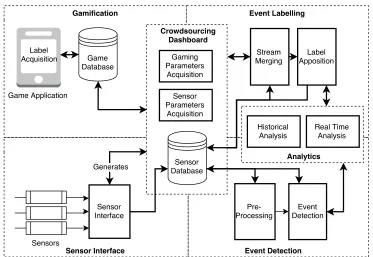
The gamification framework described in this thesis presents a solution to the challenges as-sociated with the labelling of sensor data. The approach proposes to leverage the power of crowds by using gamification to capture and label sensor data in order to enable real-time and historical data analysis. By virtue of gamification, we are able to provide real-time labelling of sensor data by associating sensor readings and the physical actions being performed on the entities being measured by the sensors. This responds to the previously described challenges associated to the post-processing of abstract sensor data while promoting user engagement and enabling data analysis. The overview of the framework is shown in Figure 3.1.
27 The framework was designed using a modular approach, allowing for flexibility, easy upgradability and maintainability of the system. It is composed of six main modules; crowd-sourcing dashboard, gamification, sensor interface, event detection, event labelling and analyt-ics.The idea behind the framework is to use gamification to create gaming related elements in order to accurately label data. Those gaming artifacts within the application will allow for the capture of the activities surrounding sensor readings.
The gamification will enable crowdsourcing by making use of a user bank to accomplish specific gaming tasks. However, the tasks will not be related to the direct identification of the sensor readings but rather related to the identification of what is physically being accomplished during the readings. That is the human activities that are surrounding the sensor readings. The solution will essentially provide a platform for translating sensor data through gamification into human readable labels, these actions will then be used to appose labels on the readings, subsequently enabling data analysis.
The framework relies upon a trust assumption, that is that the majority of the users are being truthful in their participation. Meaning that they are interacting appropriately with the game and are not attempting to cheat. The means by which we detect events and associate labels rely upon this truth model.
There are two main use cases for the framework. The first one is to enable researchers to build substantial datasets by using the framework to crowdsource sensor data. The following example shall illustrate this idea. A researcher may be interested in identifying types of human motion using accelerometer sensors. The researcher wishes to capture accelerometer data to identify whether a user is walking or running. However, it can be difficult and tedious to build a dataset from which to learn. Currently, the researcher could build a small application to collect data on his own, however the size of the dataset would likely be limited to a small number of participants and consequently a small data sample due to the high cost of the data collection.
The second main use case is to employ the framework to obtain data labels in order to per-form analysis and extract inper-formation from existing sensor data. Indeed, the platper-form can be utilized to unveil insights and knowledge from data that has been and continues to be gathered by sensors. An example for this use case could be to use the framework for energy disaggrega-tion. Many homes are now equipped with smart meters collecting real-time usage information, this data has now been stored for a number of years but consumers do not readily have access to actionable insights from their data. Implementing the framework in this context would en-able the capture of data labels within users’ homes and allow for real-time and historical data analysis. The case study presented in Chapter 5 will provide an implementation example for this use case. The framework was designed to function with any sensors measuring data from objects with which users directly interact.
The design of the framework relies on the idea that the users implementing the framework and participating in the data collection are interested and willing to share their data. The pri-vacy aspect related to the unveiling of information was therefore not a concern at this point in the development of this work.
The objectives and the design details of each of the six major components of the framework will be discussed in this chapter.
3.1
Crowdsourcing Dashboard
One of the major contributions of the framework is that it provides a flexible way to gather labels for sensor data. In order to maintain the adaptability of the platform, the framework is designed to work with any sensors capable of measuring data from objects with which users can interact.
The Crowdsourcing Dashboard was designed as the central point of the framework. It is used as the manager which interacts with every other component of the framework and enables the exchange of information necessary to translate the sensor readings and gamification tasks into proper labels.
3.1. CrowdsourcingDashboard 29
dashboard is to provide a means to capture the metadata necessary to the functioning of the framework. The Crowdsourcing Dashboard renders possible the association between the sen-sor environment and the gaming environment. The main purpose of the dashboard is mainly the acquisition of both sensors and gaming parameters in order to enable that connection.
The crowdsourcing dashboard is essential to the establishment of the framework, it plays a crucial role in enabling the labelling of sensor data through gamification tasks. The entirety of the information required by each of the component to perform their functions is held within the
game backbone entity which is responsible for holding the information required to integrate gamification.
The dashboard is a means of entry for all of the entity required by the framework. In order to create the communication layer between each of the components of the framework, specific parameters are required from the users. The communication parameters required can be sep-arated into two sets: the sensor parameters and the gaming parameters. The functionalities related to the acquisition of those parameters will be presented in the subsequent subsections.
3.1.1
Sensor Parameter Acquisition
Figure 3.2: Crowdsourcing Sensor Entity Diagram.
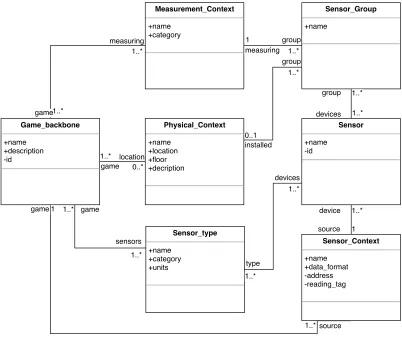
The game backboneentity represents the metadata holder of the framework and is there-fore a part of various components of the framework. The different modules can use this entity to gain access to all of the information they require within the framework.
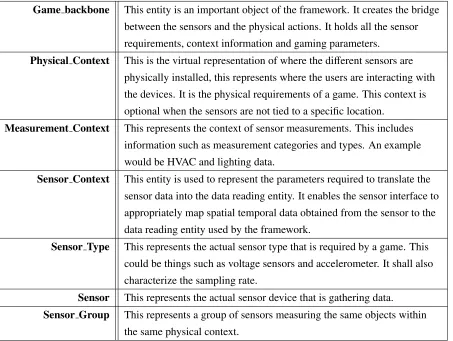
A multitude of information is required for the proper deployment of the framework in order to accurately transform gaming events into sensor labels. This includes the details required in order to obtain the sensor data and extract the sensor readings or the contextual information expressing what the sensors are actually measuring. This type of information is held in the various context artifacts shown in Figure 3.2.
3.1. CrowdsourcingDashboard 31
Game backbone This entity is an important object of the framework. It creates the bridge
between the sensors and the physical actions. It holds all the sensor
requirements, context information and gaming parameters.
Physical Context This is the virtual representation of where the different sensors are
physically installed, this represents where the users are interacting with
the devices. It is the physical requirements of a game. This context is
optional when the sensors are not tied to a specific location.
Measurement Context This represents the context of sensor measurements. This includes
information such as measurement categories and types. An example
would be HVAC and lighting data.
Sensor Context This entity is used to represent the parameters required to translate the
sensor data into the data reading entity. It enables the sensor interface to
appropriately map spatial temporal data obtained from the sensor to the
data reading entity used by the framework.
Sensor Type This represents the actual sensor type that is required by a game. This
could be things such as voltage sensors and accelerometer. It shall also
characterize the sampling rate.
Sensor This represents the actual sensor device that is gathering data.
Sensor Group This represents a group of sensors measuring the same objects within
the same physical context.
Table 3.1: Crowdsourcing Sensor Entity Defintions.
It can be observed that the metadata, represented by thegame backboneentity, is required to establish the translation between gaming events and the sensor readings. This idea also serves as the central contribution of the gamification component of our work. It outlines how to essentially connect two context using gamification.
The metadata is compulsory to the design of all of the other components of the platform as they utilize this metadata to create and capture the various sensors and gamification artifacts. This includes the set of physical and contextual requirements of the sensors as well as the type of action measured by the sensors.
3.1.2
Gaming Parameters Acquisition
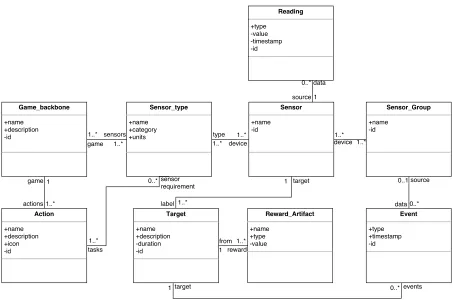
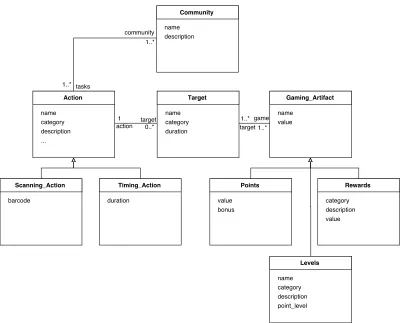
The gaming parameters enable the abstraction between tangible actions and data readings. The crowdsourcing dashboard serves as a means to setup all of the gaming metadata used throughout the entire framework. The game metadata shall contain all possible targets and actions the framework needs to monitor or encourage. Additionally, a gaming reward artifact shall be associated with each target. This will enable the relationships between targets and gamification components. Figure 3.3 depicts the design of the gamification related metadata, held by thegame backboneentity.
Figure 3.3: Crowdsourcing Gaming Entity Diagram.
3.1. CrowdsourcingDashboard 33
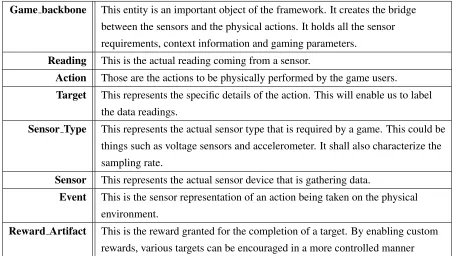
Game backbone This entity is an important object of the framework. It creates the bridge
between the sensors and the physical actions. It holds all the sensor
requirements, context information and gaming parameters.
Reading This is the actual reading coming from a sensor.
Action Those are the actions to be physically performed by the game users.
Target This represents the specific details of the action. This will enable us to label
the data readings.
Sensor Type This represents the actual sensor type that is required by a game. This could be
things such as voltage sensors and accelerometer. It shall also characterize the
sampling rate.
Sensor This represents the actual sensor device that is gathering data.
Event This is the sensor representation of an action being taken on the physical
environment.
Reward Artifact This is the reward granted for the completion of a target. By enabling custom
rewards, various targets can be encouraged in a more controlled manner
Table 3.2: Crowdsourcing Gaming Entity Definitions.
The metadata serves as a structured vessel to hold the data necessary to integrate gamifica-tion within the framework. The various artifacts will be implemented by various classes during the implementation stages. Most of this information will be stored in the sensor database. The design of this component will be described in the following subsection.
3.1.3
Sensor Database
As shown in Figure 3.1, the sensor database shall serve as the central data holding component of the framework. As events are detected, they shall be sent to the sensor database. Simultane-ously, the labelling process is also taking place and the labelled data shall also be saved in the database, linking the detected event with its appropriate label.
The analytical component also relies upon the sensor database in two ways. Firstly it shall retrieve the previously labelled data to perform its analytical duties. Secondly, it shall also send the results of its analysis back to the database.
The sensor database is designed as a central point of entry for all of the sensor data. It shall receive data reading objects from the sensor interface. The sensor database requires sensor readings to follow the format described in Figure 3.4
Figure 3.4: Sensor Reading Database Design.
The sensor interface which enables the framework to connect to any types of sensor and send the readings in the proper format will be described in the following section.
3.2
Sensor Interface
The success of the framework depends on the ability of the sensor interface to adapt to any sensor data format. Many sensors provide the users with some type of API to obtain the sensor readings. However, there does not exist a standard in terms of data format for those readings.
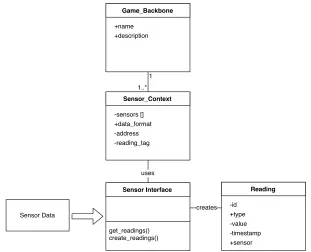
Therefore, a flexible and maintainable solution is required to interface between the sensors and the rest of the framework. Although different in their content and format, sensor readings typically provide spatial time series data. By definition, this type of data contains: attributes, object, time and location information. Based on this insight regarding sensor data, the role of the sensor interface is to utilize the sensor context of the metadata to adequately map the information coming from the sensor stream.
3.3. Gamification 35
Figure 3.5: Sensor Interface Design.
Once, the sensor data is acquired a means of capturing actions through gamification is required, this will be discussed in the following section.
![Table 2.3 [24].](https://thumb-us.123doks.com/thumbv2/123dok_us/7764044.1275717/20.612.118.515.380.635/table.webp)
![Figure 2.1: Diagram of Annotation and Labelling Techniques. [1]](https://thumb-us.123doks.com/thumbv2/123dok_us/7764044.1275717/24.612.129.499.359.596/figure-diagram-annotation-labelling-techniques.webp)