Threshold Sensitive Advance Distributed
Energy Efficient Clustering (TADEEC)
Protocol for Improving Lifetime and Stability
Period of WSN
D.Madhavi1
M. Tech Research Scholar, Department of ECE, DADI Institute of Engineering and Technology, Vishakhapatnam, India1
ABSTRACT: Wireless sensor networks have several routing protocols which are basically used to improve various parameters such as stability period, network lifetime, throughput etc. after the successful implementation of the homogenous protocol there have been a large research work and implementation of heterogenous protocols which has made an impact in routing in WS networks so here in this paper we implement the comparative analysis of DEEC and EDEEC using the different parameters like stability, lifetime and throughput of the network to improve the performance of routing of data here we implement a node which is called as super advance node with the Existing EDEEC which can increase the stability period, lifetime and throughput so here we implement the combination of TEEN and EDEEC and implemented TADEEC. and we analyses this with LEACH and DEEC and EDEEC
KEYWORDS: EDEEC,DEEC,TEEN, TADEEC
I. INTRODUCTION
Wireless Sensors Network (WSN) is the ubiquitous field showing wide spectrum of applications in various sectors. It combines sensing, computation and communication also. It consists of the sensor nodes, which are networked, by deploying network topologies, with each other and also with the based station. Majority of the applications of the WSN lies in information sensing, real time tracking, monitoring of the various physical parameters of industrial, environmental, health, automobile etc sectors. This technology also helps to record the meteorological parameters [1]. Wireless sensor networks (WSNs) have gained worldwide attention in recent years, particularly with the proliferation in Micro-Electro-Mechanical Systems (MEMS) technology which has facilitated the development of smart sensors. These sensors are small, with limited processing and computing resources, and they are inexpensive compared to traditional sensors [3]. These sensor nodes can sense, measure, and gather information from the environment and, based on some local decision process, they can transmit the sensed data to the user[2]. Smart sensor nodes are low power devices equipped with one or more sensors, a processor, memory, a power supply, a radio, and an actuator. A WSN typically has little or no infrastructure. It consists of a number ofsensor nodes (few tens to thousands) working together to monitor a region to obtain data about the environment. There are two types of WSNs: structured and unstructured. An unstructured WSN is one that contains a dense collection of sensor nodes. Sensor nodes may be deployed in an ad hoc manner2 into the field. Once deployed, the network is left unattended to perform monitoring and reporting functions [5]. In an unstructured WSN, network maintenance such as managing connectivity and detecting failures is difficult since there are so many nodes. In a structured WSN, all or some of the sensor nodes are deployed in a pre-planned manner.
1.2 Network architecture and design issues
Depending on the application, different architectures and design goals/constraints have been considered for sensor networks.
1.2.1Network Dynamics:
There are three main components in a sensor network. These are the sensor nodes, sink and monitored events. Aside from the very few setups that utilize mobile sensors, most of the network architectures assume that sensor nodes are stationary. On the other hand, supporting the mobility of sinks or cluster-heads (gateways) is sometimes deemed necessary [6]. Routing messages from or to moving nodes is more challenging since route stabilitybecomes an important optimization factor, in addition to energy, bandwidth etc. The sensed event can be either dynamic or static depending on the application.
For instance, in a target detection/tracking application, the event (phenomenon) is dynamic whereas forest monitoring for early fire prevention is an example of static events[5]. Monitoring static events allows the network to work in a reactive mode, simply generating traffic when reporting. Dynamic events in most applications require periodic reporting and consequently generate significant traffic to be routed to the sink.
1.2.2 Node Deployment:
Another consideration is the topological deployment of nodes. This is application dependent and affects the performance of the routing protocol. The deployment is either deterministic or self-organizing. In deterministic situations, the sensors are manually placed and data is routed through pre-determined paths [9]. However, in self-organizing systems, the sensor nodes are scattered randomly creating an infrastructure in an ad hoc manner. In that infrastructure, the position of the sink or the cluster-head is also crucial in terms of energy efficiency and performance [8]. When the distribution of nodes is not uniform, optimal clustering becomes a pressing issue to enable energy efficient network operation.
1.2.3 Energy Considerations:
During the creation of an infrastructure, the process of setting up the routes is greatly influenced by energy considerations. Since the transmission power of a wireless radio is proportional to distance squared or even higher order in the presence of obstacles, multi hop routing will consume less energy than direct communication[16]. However, multi-hop routing introduces significant overhead for topology management and medium access control. Direct routing would perform well enough if all the nodes were very close to the sink. Most of the time sensors are scattered randomly over an area of interest and multi-hop routing becomes unavoidable.
1.2.4 Data Delivery Models:
Depending on the application of the sensor network, the data delivery model to the sink can be continuous, driven, query-driven and hybrid. In the continuous delivery model, each sensor sends data periodically. In event-driven and query event-driven models, the transmission of data is triggered when an event occurs or a query is generated by the sink. Some networks apply a hybrid model using a combination of continuous, event4 driven and query-driven data delivery[11]. The routingprotocol is highly influenced by the data delivery model, especially with regard to the minimization of energy consumption and route stability. For instance, it has been concluded in that for a habitat monitoring application where data is continuously transmitted to the sink, a hierarchical routing protocol is the most efficient alternative[7]. This is due to the fact that such an application generates significant redundant data that can be aggregated on route to the sink, thus reducing traffic and saving energy[7].
1.2.5 Node Capabilities:
from the normal sensors. While some networks have picked cluster-heads from the deployed sensors, in other applications a cluster head is more powerful than the sensor nodes in terms of energy, bandwidth and memory. In such cases, the burden of transmission to the sink and aggregation is handled by the cluster-head [9]. Inclusion of heterogeneous set of sensors raises multiple technical issues related to data routing.
For instance, some applications might require a diverse mixture of sensors for monitoring temperature, pressure and humidity of the surrounding environment, detecting motion via acoustic signatures and capturing the image or video tracking of moving objects [6]. These special sensors either deployed independently or the functionality can be included on the normal sensors to be used on demand [10]. Reading generated from these sensors can be at different rates, subject to diverse quality of service constraints and following multiple data delivery models, as explained earlier. Therefore, such a heterogeneous environment makes data routing more challenging.
1.2.6 Data Aggregation/Fusion:
Since sensor nodes might generate significant redundant data, similar packets from multiple nodes can be aggregated so that the number of transmissions would be reduced. Data aggregation is the combination of data from different sources by using functions such as suppression (eliminating duplicates), min, max and average. Some of these functions can be performed either partially or fully in each sensor node, by allowing sensor nodes to conduct in-network data reduction. Recognizing that computation would be less energy consuming than communication, substantial energy savings can be obtained through data aggregation. This technique has been used to achieve energy efficiency and traffic optimization in a number of routing protocols[16].
In some network architectures, all aggregation functions are assigned to more powerful and specialized nodes. Data aggregation is also feasible through signal processing techniques. In that case, it is referred as data fusion where a node is capable of producing a more accurate signal by reducing the noise and using some techniques such as beams formingto combine the signals[16].
Fig.1. An example of wireless sensor network
The problem of these protocols is using static sinks. Direct transmission to sink does not guarantee well balanced distribution of the energy load among distribution of the energy load among sensors in WSN and thus increase the network lifetime. The effectiveness of the WSNs lie in their sensing quality, flexibility, coverage, etc.,
they can offer. WSNs naturally become the first choice when it comes to deployment in remote and hazardous environment [14]. The ultimate goal of such WSNs deployed in the above crucial environments is often to deliver the sensing data from sensor nodes to sink node and then conduct further analysis at the sink node. Data collection becomes an important factor in determining the performance of such WSNs.
1.3 CLUSTERING
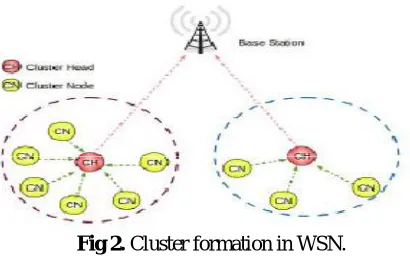
significant energy savings. In the hierarchical network structure each cluster has a leader, which is also called the cluster head (CH) and usually performs the special tasks referred above (fusion and aggregation), and several common sensor nodes (SN) as members. The cluster formation process leads to a two-level hierarchy where the CH nodes form the higher level and the cluster-member nodes form the lower level[12]. The sensor nodes periodically transmit their data to the corresponding CH nodes. The CH nodes aggregate the data (thus decreasing the total number of relayed packets) and transmit them to the base station (BS) either directly or through the intermediate communication with other CH nodes. However, because the CH nodes send all the time data to higher distances than the common (member) nodes, they naturally spend energy at higher rates [13]. A common solution in order balance the energy consumption among all the network nodes, is to periodically re-elect new CHs (thus rotating the CH role among all the nodes over time) in each cluster. The BS is the data processing point for the data received from the sensor nodes, and where the data is accessed by the end user. It is generally considered fixed and at a far distance from the sensor nodes. The CH nodes actually act as gateways between the sensor nodes and the BS. The function of each CH, as already mentioned, is to perform common functions for all the nodes in the cluster, like aggregating the data before sending it to the BS.
In some way, the CH is the sink for the cluster nodes, and the BS is the sink for the CHs. Moreover, this structure formed between the sensor nodes, the sink (CH), and the BS can be replicated as many times as it is needed, creating (if desired) multiple layers of the hierarchical WSN (multi-level cluster hierarchy). In clustering, the sensor nodes are partitioned into different clusters. Each cluster is managed by a node referred as cluster head (CH) and other nodes are referred as cluster nodes. Cluster nodes do not communicate directly with the sink node [4]. They have to pass the collected data to the cluster head. Cluster head will aggregate the data, received from cluster nodes and transmits it to the base station [5]. Thus, minimizes the energy consumption and number of messages communicated to base station. Ultimate result of clustering the sensor nodes is prolonged network lifetime network [13]. It is the bridge (via communication link) between the sensor network and the end user. Normally this node is considered as a node with no power constraints. Cluster: It is the organizational unit of the network, created to simplify the communication in thesensor network. There are many types in clustering techniques used in wireless sensor network. After these techniques wireless sensor networks emerged as a best network for communication field[4]
1.3.1 CLUSTERING PARAMETERS
with regard to the whole clustering procedure in Wireless sensor networks are as follows,
• Number of clusters (cluster count)
• Number of nodes in a cluster
• Nodes and CH mobility
• Nodes types and roles:
• Cluster formation methodology
• Cluster-head selection
• Algorithm complexity
1.4 ADVANTAGES OF CLUSTERING Transmit aggregated data to the data sink
Reducing number of nodes in a transmission
Useful Energy consumption
Scalability for large number of nodes
Reduces communication overhead
II. DESIGN IMPLEMENTATION OF ROUTING PROTOCOLS
2.1 Design issues of routing protocols
Initially WSNs was mainly motivated by military applications. Later on the civilian application domain of wireless sensor networks have been considered, such as environmental and species monitoring, production and healthcare, smart home etc. These WSNs may consist of heterogeneous and mobile sensor nodes, the network topology may be as simple as a star topology; the scale and density of a network varies depending on the application.
To meet this general trend towards diversification, the following important design issues of the sensor network have to be considered.
2.1.1 Fault Tolerance
Some sensor nodes may fail or be blocked due to lack of power, have physical damage or environmental interference. The failure of sensor nodes should not affect the overall task of the sensor network. This is the reliabilityor fault tolerance issue. Fault tolerance is the ability to sustain sensor network functionalities without any interruption due to sensor node failures.
2.1.2 Scalability
The number of sensor nodes deployed in the sensing area may be in the order of hundreds, thousands or more and routing schemes must be scalable enough to respond to events.
2.1.3 Production Costs
Since the sensor networks consist of a large number of sensor nodes, the cost of a single node is very important to justify the overall cost of the networks and hence the cost of each sensor node has to be kept low.
2.1.4 Operating Environment
We can set up sensor network in the interior of large machinery, at the bottom of an ocean, in a biologically or chemically contaminated field, in a battle field beyond the enemy lines, in a home or a large building, in a large warehouse, attached to animals, attached to fast moving vehicles, in forest area for habitat monitoring etc.
2.1.5 Power Consumption
Since the transmission power of a wireless radio is proportional to distance squared or even higher order in the presence of obstacles, multi-hop routing will consume less energy than direct communication. However, multi-hop routing introduces significant overhead for topology management and medium access control. Direct routing would perform well enough if all the nodes were very close to the sink. Sensor nodes are equipped with limited power source (<0.5 Ah 1.2V).Node lifetime is strongly dependent on its battery lifetime[14].
2.1.6 Data Delivery Models
Data delivery models determine when the data collected by the node has to be delivered. Depending on the application of the sensor network, the data delivery model to the sink can be Continuous, Event driven, Query-driven and Hybrid. In the continuous delivery model, each sensor sends data periodically. In event-driven models, the transmission of data is triggered when an event occurs. In query driven models, the transmission of data is triggered when query is generated by the sink[15]. Some networks apply a hybrid model using a combination of continuous, event-driven and query driven data delivery.
2.1.7 Data Aggregation/Fusion
data aggregation. This technique has been used to achieve energy efficiency and traffic optimization in a number of routing protocols
2.2 Classification of routing protocols
The design space for routing algorithms for WSNs is quite large and we can classify the routing algorithms for WSNs in many different ways. Routing protocols are classified as
a. Node centric
b. Data-centric or location-aware (geo-centric) and c. QoS based routing protocols.
a. Node centric
Most Ad-hoc network routing protocols are node-centric protocols where destinations are specified based on the numerical addresses (or identifiers) of nodes. In WSNs, node centric communication is not a commonly expected communication type. Therefore, routing protocols designed for WSNs are more data-centric or geocentric.
b. Data-centric or location-aware
In data-centric routing, the sink sends queries to certain regions and waits for data from the sensors located in the selected regions. Since data is being requested through queries, attribute based naming is necessary to specify
the properties of data [16]. Here data is usually transmitted from every sensor node within the deployment region with significant redundancy.
In location aware routing nodes know where they are in a geographical region. Location information can be used to improve the performance of routing and to provide new types of services.
c. QoS based routing
In QoS based routing protocols data delivery ratio, latency and energy consumption are mainly considered. To get a good QoS (Quality of Service), the routing protocols must possess more data delivery ratio, less latency and less energy consumption.
Routing protocols can also be classified based on whether they are reactive or proactive.Proactive protocol
Proactive protocol sets up routing paths and states before there is a demand for routing traffic. Paths are maintained even there is no traffic flow at that time.
Reactive routing protocol
In reactive routing protocol, routing actions are triggered when there is data to be sent and disseminated to other nodes. Here paths are setup on demand when queries are initiated.
Routing protocols are also classified based on whether they are destination-initiated (Dst initiated) or source-initiated (Sic-source-initiated).
Source-initiated protocol
A source-initiated protocol sets up the routing paths upon the demand of the source nodeand starting from the source node. Here source advertises the data when available and initiates the data delivery.
Destination-initiated protocol
A destination-initiated protocol, on the other hand, initiates path setup from a destination node.
Routing protocols are also classified based sensor network architecture. Some WSNs consist of homogenous nodes, whereas some consist of heterogeneous nodes. Based on this concept we can classify the protocols whether they are operating on
Flat topology
In Flat routing protocols all nodes in the network are treated equally. When node needs to send data, it may find a route consisting of several hops to the sink.
Hierarchical routing
A hierarchical routing protocol is a natural approach to take for heterogeneous networks where some of the nodes are more powerful than the other ones. The hierarchy does not always depend on the power of nodes. In Hierarchical (Clustering) protocols different nodes are grouped to form clusters and data from nodes belonging to a single cluster can be combined (aggregated).The clustering protocols have several advantages like scalable, energy efficient in finding routes and easy to manage.
Similar to other communication networks, scalability is one of the major design attributes of sensor networks. A single-tier network can cause the gateway to overload with the increase in sensors density. Such overloadmight cause latency in communication and inadequate tracking of events. In addition, the single-gateway architecture is not scalable for a larger set of sensors covering a wider area of interest since the sensors are typically not capable of long-
haul communication. To allow the system to cope with additional load and to be able to cover a large area of interest without degrading the service, networking clustering has been pursued in some routing approaches.
The main aim of hierarchical routing is to efficiently maintain the energy consumption of sensor nodes by involving them in multi-hop communication within a particular cluster and by performing data aggregation and fusion in order to decrease the number of transmitted messages to the sink. Cluster formation is typically based on the energy reserve of sensors and sensor’s proximity to the cluster head.
2.3 Network model
Among all topologies-based routing protocols, hierarchal routing protocol technique is more popular regarding the power saving of sensor nodes. This technique works on the formation of several clusters (a sub network within network). Cluster is responsible to transfer data from node to the sink, while direct data sending approach from each node is not supported with this method. Clusters communication works on the basis of cluster leader which can be known as cluster head. Communication with sink can be done with the help of cluster head; they collect data from neighboring nodes and send it to another cluster head, which is responsible for any other cluster, this mechanism continuous until the data reaches to the sink.
Fig 2. Cluster formation in WSN.
to sink. For nodes placed closed to sink, data transmission causes less reduction in energy however for nodes at far distances from sink will die more quickly.
2.4 Existing protocols
Clustering procedures are engaged in dealing with energy control. Description of some of concerned protocols is provided in this section. The different types of protocols proposed are discussed below
2.4.1 Low Energy Adaptive Clustering Hierarchy (LEACH)
LEACH is one of the first hierarchical routing approaches for sensors networks. The idea proposed in LEACH has been an inspiration for many hierarchical routing protocols, although some protocols have been independently developed.
LEACH is a proactive routing protocol. In a network hundred and thousands of nodes dispersed randomly for even distribution of load among nodes. These nodes sense data transmit it to their associated CHs which receive, aggregate and then convey this data to the sink or to the Base Station (BS). All the nodes deployed in field are homogeneous and constrained in energy. To divide burden among nodes, improve network life clusters are formed.
LEACHis a cluster-based protocol, which includes distributed cluster formation. LEACH randomly selects a few sensor nodes as cluster heads (CHs) and rotate this role to evenly distribute the energy load among the sensors in the network. In LEACH, the cluster head (CH) nodes compress data arriving from nodes that belong to the respective cluster, and send an aggregated packet to the base station in order to reduce the amount of information that must be transmitted to the base station. LEACH uses a TDMA/CDMA MAC to reduce inter-cluster and intra-cluster collisions. However, data collection is centralized and is performed periodically. Therefore, this protocol is most appropriate when there is a need for constant monitoring by the sensor network. A user may not need all the data immediately. Hence, periodic data transmissions are unnecessary which may drain the limited energy of the sensor nodes. After a given interval of time, a randomized rotation of the role of the CH is conducted so that uniform energy dissipation in the sensor network is obtained. The authors found, based on their simulation model, that only 5% of the nodes need to act as cluster heads.
2.4.2 Stable Election Protocol (SEP)
Heterogeneity is introduced in SEP protocol, which is based on two levels of heterogeneity. A fraction of total nodes is provided with an additional energy factor , which are called advanced nodes. So, probabilities of normal nodes and advanced nodes to become CHs are respectively, Where is the optimal probability of each node to become CH. CHs election in SEP is done randomly on the basis of probability of each type of node as in LEACH. Nodes sense data and transmit it to associated CH which convey it to BS. By increasing or , we can further improve our system. So, SEP results in increased stability period and network life due to advance nodes however two level heterogeneity also caused increased throughput.
2.4.3 Enhanced Stable Election Protocol (ESEP)
Fig 3Hierarchical Clustering in TEEN
2.5 Proposed protocol
2.5.1 TADEEC: The proposed protocol
In this section, we present a new routing protocol for homogenous networks called TADEEC. our goal is to minimize energy consumption in order to enhance network stability period and network lifetime. for this purpose, weintroduced the concept of pairing. Sensor nodes of same application and at minimum distance between them will form a pair for data sensing and communication. in our TADEEC protocol, we also enhance CHs selection technique, by selecting CHs on basis of remaining energy of nodes. more comprehensive description of coupling among nodes is defined as follows.
2.5.2 Advance coupling network model (ACNM)
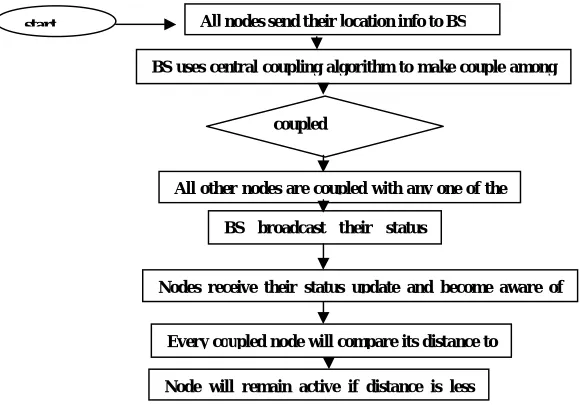
In this section, we explain advance coupling network model(ACNM). initially senor nodes measure their location through GPS (global positioning system). the nodes transmit their location information, application type and node id to the base station (BS). Then, this gathered information isutilized by BS to compute mutual distance between nodes. Which are at minimum distance from each other in their intra cluster transmission range and of same application type are coupled in pair by BS.then BS broadcast pairing information to all the nodes in network Nodes become aware of their coupled node. During coupling process some nodes are left out because they are not in inter cluster transmission range of any other node. according to the proposed scheme, the nodes switch between ”sleep” and ”awake” mode during a single communication interval. Initially node in a pair switch into awake mode also called active-mode if its distance from the BS is less than its coupled node. node in active-mode will gather data from surroundings and transmit this data to CHs. During this period transceiver of the coupled node will remain off, and switches into sleep-mode. Sleep mode nodes cease their communication with CHs and only sense the network status. in next communication interval, nodes in active-mode switch into sleep-mode and sleep-mode nodes switch into awake mode. In this way, we are able to minimize energy consumption because nodes in sleep-modes save their energy by not communicating with the CHs.nodes in sleep-mode also save their energy by avoiding overhearing and idle listening during sleep-mode. Isolated nodes remain in active-mode for every round till their energy resources depleted.
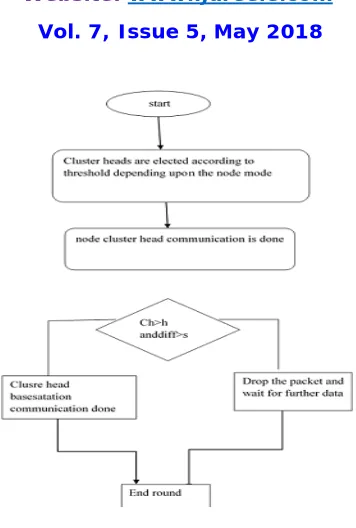
2.5.3 Network settling phase (NSP)
In NSP, optimal number of CHs are selected with the help of distributed algorithm. Initially all nodes have same energy and network is homogenous in terms of energy level. in leach protocol every node decides to become CH or not in current round. the decision Is based on desired percentage of CHS per round which is pd. in order to assure average number of CH for n number of nodes, leach allows each node to become CH after every 1/pd rounds. number of rounds after which a node become CH refer to as epoch. In homogenous network, energy of nodes after first round
selecting CH using distributed algorithm. each node chose a random number between 0 to 1 and compares it to a threshold which is calculated as,
Where, A is the set of nodes which are in active-mode in first round. if the random number selected by node isless then threshold, node will elect itself as a CH and called as parent-cluster-heads (PCHS).when node has been selected as PCH, it broadcasts an advertisement message to whole network. Only active-mode nodes hear the broadcast advertisements from different PCHS, they select their PCHS on the basis of received signal strength indication (RSSI) of advertisements. When an active-mode node decides to which cluster it wants to associate, it transmits a request to that PCH using carrier sensed multiple access (CSMA) MAC protocol to avoid collision. Along with request active-mode nodes also transmit their energy information to the PCH. The PCH computes the remaining energy and its distance from each node and select CH, called child-cluster-head (CCH), for the next round. CCH is selected on the basis of maximum remaining energy of nodes. if different nodes have same remaining energy then a node at minimum distance from PCH is selected as CCH. When PCH selects CCH, it sets up TDMA schedule for associated nodes for communication. PCH then broadcast CCH information and TDMA schedule associated nodes in its cluster. Each node in cluster transmits its data to PCH in its TDMA slot.
2.5.4Network transmission phase (NTP)
In NTP, all nodes in active-mode, transmit their sensed data to CH during their assigned TDMA slots. Nodesin sleep-mode do not take participation in NTP and thus save their energy by turning their transceiver off. CHS aggregates received data from each node and transmit to BS. Data aggregation is a key signaling technique to compress the amount of data. Due to data aggregation technique a noticeable amount of energy is saved. if there are n total number of nodes and k are the optimal number of CHS then the average number of nodes in each cluster will be:
(N K⁄ −1) ………2
Algorithm 1 Node Mode Setup Phase
1: END OF ROUND
2: if ( node == coupled ) then
3: if ( node mode==active && CCH FLAG==1) then
4: node mode=active
5: else if (node mode==active&&CCH FLAG==0) then
6: node mode = sleep
7: else if (node mode==sleep&&neighbor CCH FLAG==1)
then
8: node mode=sleep
9: else if (node mode==sleep&&neighbor CCH FLAG==0)
then
10: node mode=active 11: end if
12: else if (node==coupled&&node neighbor==dead) then
13: node mode=active 14: else
15: node mode = active 16: end if
its CCH flag. If its CCH flag is ON, it will remain in Active-mode. If node is in Active-mode and its CCH flag is not ON it will switch into Sleep-mode. If node is in Sleep-mode, it checks that whether its coupled partner’s CCH flag is on or not. If node’s coupled partner’s CCH flag is on it will remain in sleep mode. If not then node switches to active mode. If coupled partner of a node is dead it will remain active. All that nodes which are left out in coupling process remain active for whole network life time
.
Fig 4Network settling phase algorithm
Fig 5Network transmission algorithm start All nodes send their location info to BS
BS uses central coupling algorithm to make couple among
coupled
All other nodes are coupled with any one of the
BS broadcast their status
Nodes receive their status update and become aware of
Every coupled node will compare its distance to
Fig 6 Flow chat of TADEEC protocol
III. DESIGN VERIFICATION AND SIMULATION RESULTS
3.1.1 TADEEC simulation
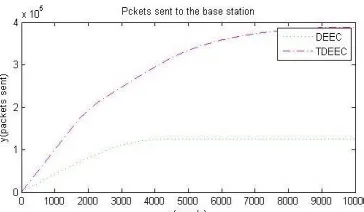
Our goal in doing simulations was to compare performance of TADEEC with DEEC and SEP with LEACH, protocols on the basis of energy dissipation and longevity of network. Performance metrics used in the simulations are: 1) Number of alive nodes per round.
2) Number of dead nodes per round.
3) Throughput, number of packets sent from cluster heads to base station.
Table 1: Parameter settings
Parameters Value
Initial Energy Eo 0.5J
Initial Energy of advanced nodes
0,1J
Energy for data aggregation 50 pj/bit/signal
Number of nodes 100
Packet size 4000bit
Transmission and receiver electronics
50nj/bit
3.2 TADEEC simulation and comparison
To simulate proposed protocol consider a field with dimensions 100m×100m and 100 nodes deployed in specific zones with respect to their energy. Base station is placed in the center of the network field. We are using the first order radio model as used in SEP. MATLAB is used to implement the simulations.
Here, we compare the results of our protocol with SEP and LEACH. We have introduced heterogeneity in LEACH, with the same setting as in our proposed protocol, so as to access the performance of all the protocol in presence of heterogeneity.
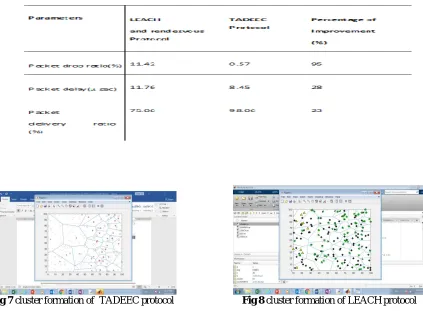
Table 2: Comparison of energy efficient routing protocol at 4000 rounds
Table 3: Comparison Analysis of LEACH and TADECC efficient routing protocol at 4000 rounds
Fig 7 cluster formation of TADEEC protocol Fig 8 cluster formation of LEACH protocol
Protocol No of Alive Nodes
No of Dead Nodes
No of Packets
Sent to Base Station
LEACH 3 98 1.987e+04
SEP 0 100 2.567e+04
DEEC 4 97 2.244e+05
EESAA 18 84 3.225e+04
Fig 9simulation of TADEEC protocol Fig 10 number of packets to base station of DEEC&TADEEC
Fig 11: Number of alive nodes DEEC&TADEEC Fig 12: Number of dead nodes of DEEC&TADEEC
IV. CONCLUSIONS
TADEEC gives the better heterogeneity of nodes for improving the lifetime and better routing in networkin this paper. Thus, we can see that this algorithm improved the communication among the heterogeneous nodes and prolong the lifetime of the nodes to maximize the communication. And better stability period, and throughput of the network.
REFERENCES
[1] W.Heinzelman, A. Chandrakasan, and H. Balakrishnan, "Energy-efficient communication protocol for wireless sensor networks," in the Proceeding of the Hawaii International Conference System Sciences, Hawaii, January 2000.
[2]G. Smaragdakis, I. Matta, A. Bestavros, “SEP: A Stable Election Protocol for clustered heterogeneous wireless sensor networks”, in: Second International Workshop on Sensor and. Actor Network Protocols and Applications (SANPA 2004), 2004.
[3].S. Faisal, N. Javaid, A. Javaid, M. A. Khan, S. H. Bouk and Z. A. Khan, “Z-SEP: Zonal-Stable Election Protocol for Wireless Sensor Networks” Journal of Basic and Applied Scientific Research (JBASR), 2013.
[4].Elbhiri, B. ,Saadane, R. , El Fkihi, S. , Aboutajdine, D. “Developed Distributed Energy-Efficient Clustering (DDEEC) for heterogeneous wireless sensor networks”, in: 5th International Symposium on I/V Communications and Mobile Network (ISVC), 2010.
[5] Parul Saini, Ajay.K.Sharma, “E-DEEC- Enhanced Distributed Energy Efficient Clustering Scheme for heterogeneous WSN”, in: 2010 1st
International Conference on Parallel, Distributed and Grid Computing (PDGC - 2010).
[6].T. N. Qureshi, N. Javaid, M. Malik, U. Qasim, Z. A. Khan “On Performance Evaluation of Variants of DEEC in WSNs”In Seventh International Conference on Broadband, Wireless Computing, Communication and Applications 2012
[7] Fan Xiangning1,2 Song Yulin ”Improvement on LEACH Protocol of Wireless Sensor Network” International Conference on Sensor Technologies and Applications 2007.
[8] Thiemo Voigt, Hartmut Ritter, Jochen Schiller, Adam Dunkels, and Juan Alonso,” Solar-aware Clustering in Wireless Sensor Networks”, In Proceedings of the Ninth IEEE Symposium on Computers and Communications, June 2004.
[10] Aderohunmu, F.A. and Deng, J.D., “An Enhanced Stable Election Protocol (ESEP) for Clustered Heterogeneous WSN”.
[11] S. Faisal, N. Javaid, A. Javaid, M. A. Khan, S. H. Bouk and Z. A. Khan, “Z-SEP: Zonal-Stable Election Protocol for Wireless Sensor Networks” Journal of Basic and Applied Scientific Research (JBASR), 2013.
[12] L. Qing, Q. Zhu, M. Wang, "Design of a distributed energy-efficient clustering algorithm for heterogeneous wireless sensor networks". ELSEVIER, Computer Communications 29, 2006, pp 2230- 2237.
IJCATM : www.ijcaonline.org
[13] Elbhiri, B. ,Saadane, R. , El Fkihi, S. , Aboutajdine, D. “Developed Distributed Energy-Efficient Clustering (DDEEC) for heterogeneous wireless sensor networks”, in: 5th International Symposium on I/V Communications and Mobile Network (ISVC), 2010.
[14] Parul Saini, Ajay.K.Sharma, “E-DEEC- Enhanced Distributed Energy Efficient Clustering Scheme for heterogeneous WSN”, in: 2010 1st International Conference on Parallel, Distributed and Grid Computing (PDGC - 2010).
[15] T. N. Qureshi, N. Javaid, M. Malik, U. Qasim, Z. A. Khan “On Performance Evaluation of Variants of DEEC in WSNs”In Seventh International Conferenceon Broadband, Wireless Computing, Communication and Applications 2012
[16] Parul Saini, Ajay.K.Sharma, “Energy Efficient Scheme for Clustering Protocol Prolonging the Lifetime of Heterogeneous Wireless Sensor Networks”, International Journal of Computer Applications (0975 8887), Volume 6 No.2, September 2010.
BIOGRAPHY