Page | 283
Time Efficient Equations to Solve Calculations of Five Using
Recursion Method
Prasad J Shetty
Department of Mechanical Engineering Dayananda Sagar College of Engineering K.S.Layout, Bangalore-560078, India
Abstract:
In this paper, “Recursion Method”- shortest methods to solve calculations of numbers ending with five have been proposed. Many facts related to the calculation are proposed through which the entire calculation gets reduced to the level of an eye blink. There are many methods in Vedic Mathematics to multiply any two numbers. They are time consuming since they are not specifically meant for numbers ending with five. This describes the method to find the cube of a number ending with five accurately and very fast. It even describes the shortest method to multiply any two numbers ending with five. By using these formulas, calculations involving two numbers ending with five are no more taxing. These formulas can be further used for fast mental calculations and calculations in competitive exams very efficiently. This can be also used in the field of math coprocessors in computers. Algorithms can be developed using this equation for faster multiplications in multiplier (FPGA’s), reducing the processing time and power consumption hence increases the efficiency.
Keywords:
Vedic Mathematics; Multiplier; Algorithm; Coprocessor; FPGA (Field Programmable Gate Array)
Introduction:
We have been doing some of the things in our life since grade 1. Unfortunately we are unable to understand the origin of those basics. In fact we are just like the dumb driven cattle. One of those basic things is calculations involving numbers ending with five. We have been finding cube of numbers
ending with five for long but never know the fact that the answer can end only in four different numbers. Similarly we are unaware of many facts which have been reflected in this paper. No matter how big the numbers are; this formula holds good for all the numbers ending with five. There are many methods in Vedic Mathematics to multiply any two numbers. They are time consuming since they are not specifically meant for numbers ending with five. These calculations can even be done by using Universal Multiplication Equation [1] but its time consuming. These formulas can be developed into a math coprocessor by designing the algorithm. By this method we can reduce the number of steps involved in the multiplication hence reducing the time, area and power in math coprocessor. These methods can be used for mental calculation and calculations in competitive exams. These equations evolved after continuous study on numbers ending with 5, how they occur when they undergo different types of multiplication [2, 3].
1.
To find the cube of a number
ending with five using Recursion
method.
Page | 284
formula. In this method the two step calculation has been reduced to one step which is faster than any other method.
This can be used to calculate mentally, more efficiently and faster [4]. There is a demand of increase in speed of processing in math coprocessor. This speed, power and area can be attained by developing an efficient architecture [5]. This can be only achieved by improvising the method of calculation. The simple formula to find the cube of a number ending with five is
4 (1) )
3 6 4
( X2 X
X
This equation can be used only for numbers ending with five i.e. (X5). To find the cube of a number ending with five, we substitute the value of X in Eq. (1). The answer obtained from the Eq. (1) forms the first part and to get the final answer, we just write the answer obtained from Eq. (1) followed by one of the numbers from Table 1. based on the remainder. To start with we need to follow some steps:
1. Take any number of the form (X5). Example → (85)3
Here X=8
2. Substitute the value of X in Eq. (1) to get the first part of the answer.
4 ) 3 6 4
( X2 X
X = 4 ) 3 8 × 6 8 × 4 ( ×
8 2
Note that the two digit multiplication has been reduced to single digit.
= 4 ) 3 8 × 6 64 × 4 ( ×
8
= 4 ) 3 48 256 ( ×
8
= 4 307 × 8 = 307×2 = 614
3. Ignore the decimal part and consider only the whole number part.
4. Second part of the answer is obtained by remainder basis from the below table. 5. Divide X by 4. Check for the remainder.
Remainder Answer
0 125
1 375
2 625
3 875
Table 1. Recursive remainder
6. When any number is divided by 4, you get remainder only as 0,1,2,3.
When 8 is divided by 4 you get the remainder as 0.
7. Check the table for the second part of the answer. Check for the answer corresponding to zero.
So the second part of the answer is 125.
Therefore, the final answer is 614125
(995)3
Here X=99
Substituting the value of X in the equation
4 ) 3 6 4
( X2 X
X = 4 ) 3 99 × 6 99 × 4 ( ×
99 2
= 4 ) 3 99 × 6 9801 × 4 ( ×
99
= 4 ) 3 594 39204 ( ×
99
= 4 39801 × 99 = 24075×39801 = 985074.75
So the first part of the answer is 985074. Ignore the decimal part (Point no.3 is being illustrated here).
Page | 285
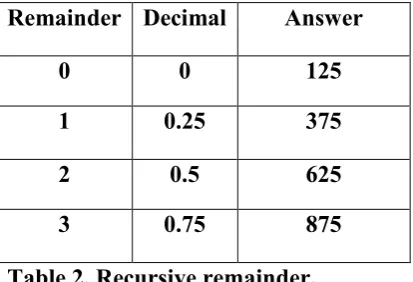
So the second part of the answer is 875. Therefore, the final answer is 985074875. If the decimal part of the first part of the answer and the remainder is observed, some relation could be found in them, which is given in table 2.
Remainder Decimal Answer
0 0 125
1 0.25 375
2 0.5 625
3 0.75 875
Table 2. Recursive remainder.
If we observe this table, we can obtain the second part of the answer through decimal basis also. It can be used as a verification technique.
Here the decimal part is 0.75, hence from table 2. the second part of the answer is 875. There is no method to find the cube of a number directly but this method provides direct result.
The main advantage of this method is that the 3 digit calculation has been reduced to a 2 digit calculation, 4 digit calculation has been reduced to 3 a digit calculation which increases the accuracy and speed.
If we need to find the cube of the number ending with 5 in a traditional school way, we need to find the square of the number, then again we need to multiply the square with the same number which is time consuming and there are chances of going wrong.
We have been finding the cube of a number ending with 5 since class 3 or 4. We might have never observed the fact that a cube of a number ending with 5 can only end with 125, 375, 625, and 875. Hence this equation reveals the fact that cube of number can end only with 125, 375, 625, and 875.
Using this hint, calculations in competitive exams could be solved faster and accurately.
Example → you get a question where you need to find
(235)3and you have the following options a) 12977675 b) 12977725 c) 12977875 d) 12977375
As per the remainder rule options a), b) and d) are ruled out.
Therefore, option c) is the right answer.
2.
Multiplication of two numbers
ending with 5
This part of the paper describes the method to multiply any two numbers ending with five. This calculation could be even solved using Universal Multiplication Equation but is not as efficient as Recursion method and chances of committing mistake is more. The complexity can be reduced by using recursion method. The simple method to find the product of two numbers ending with 5 is
2
2XY X Y
(2)
This equation can be used for any two numbers ending with five i.e. (X5) and (Y5). The values of X and Y are substituted in Eq. (2). The answer obtained from Eq. (2) is clubbed with 25 or 75 to get the final answer. To start with we need to follow some steps:
1. The multiplication should be of the form X5×Y5.
2. X and Y are two numbers ending with 5. Example →135×165
Here X=13 and Y=16 Or
X=16 and Y=13 Commutative property holds good. 3. Substitute the values of X and Y in the
above equation to get the first part of the answer.
2 16 13
13 × 16 ×
2
Page | 286
2
×
208
2
16
13
2
29
416
2 445
= 222.5
4. Ignore the decimal part and take the whole number as the answer of the first part.
5. Take the difference of X and Y. 16-13=3 which is odd.
6. It is not necessary that you need to take difference of 16 and 13. It is enough if you just take the difference of 6 and 3, which is 3! Our aim is not to find the difference but only to find the last digit of the difference and to judge whether it is odd or even. It is satisfied by the last digit of X and Y.
7. If the difference is even then the second part of the answer is 25 else 75.
Here the difference is odd so the answer will end With 75. If the difference had been even then the answer would have ended with 25.
Therefore, the final answer is 22275. Here, again the 3 digit calculation has been reduced to a 2 digit calculation, 4 digit calculation has been reduced to a 3 digit calculation which increases the accuracy and speed. Hence Recursion technique concludes that any multiplication of any two numbers ending with five can end only with 25 and 75!
How beneficial it is in competitive exams. Suppose you get a question where you need to multiply two numbers ending with 5. Example →you get a question where you need to multiply 4525×854465 and you have options as
a) 3866454165 b) 3866454135
c) 3866454185 d) 3866454125 So, the answer is option d)
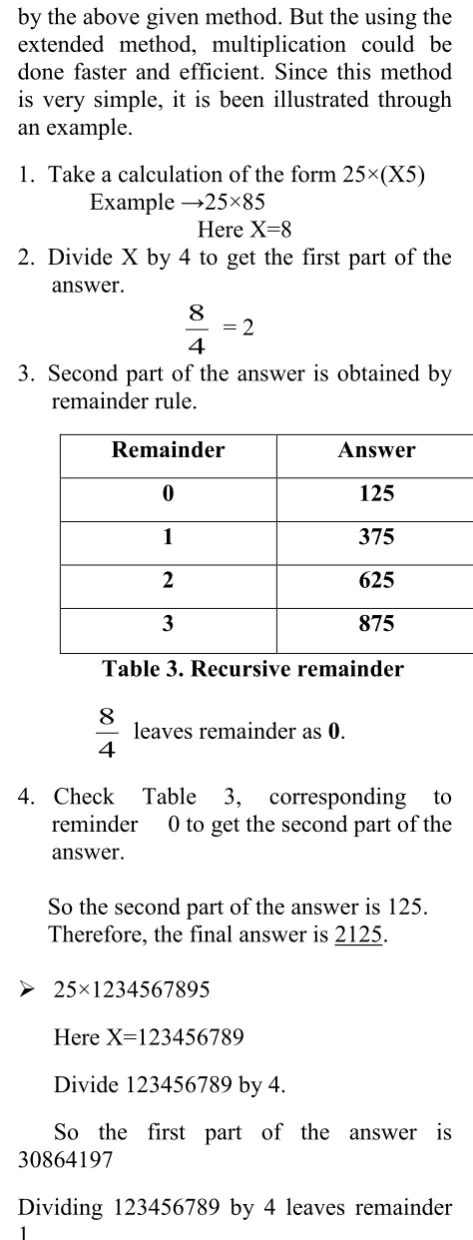
This equation can be extended specifically for the multiplication of any number ending with five with 25. This could be even solved by the above given method. But the using the extended method, multiplication could be done faster and efficient. Since this method is very simple, it is been illustrated through an example.
1. Take a calculation of the form 25×(X5) Example →25×85
Here X=8
2. Divide X by 4 to get the first part of the answer.
4 8
= 2
3. Second part of the answer is obtained by remainder rule.
Remainder Answer
0 125
1 375
2 625
3 875
Table 3. Recursive remainder
4 8
leaves remainder as 0.
4. Check Table 3, corresponding to reminder 0 to get the second part of the answer.
So the second part of the answer is 125. Therefore, the final answer is 2125.
25×1234567895 Here X=123456789 Divide 123456789 by 4.
So the first part of the answer is 30864197
Page | 287
From Table 3. the second part of the answer is 375, since the remainder is 1 and the answer corresponding to 1 is 375.
Therefore, the final answer is 30864197375, which is even out of the calculator’s limit. Hence from Recursion method we come to conclusion that 25 multiplied by any number ending with five can end only with 125, 375, 625 and 875!
25×5 =0125 25×15 =0375
25×45 =1125 25×55 =1375
25×85 =2125 25×95 =2375
25×125=3125 25×135=3375
25×25 =0625 25 ×35 =0875
25×65 =1625 25×75 =1875
25×105=2625 25×115=2875
25×145=3625 25×155=3875
Conclusion:
It can be concluded that the “Recursion method” is an efficient method to multiply any two numbers ending with five. We generally multiply numbers using traditional method which is time consuming and there are chances of making mistakes unlike this method. The main advantage of this method is that the whole of multiplication is divided into two parts and the 3 digit multiplication has been reduced to 2 digit multiplication hence so on, hence chances of making mistakes is less. Not only in the field of calculation but also in the field of math coprocessor, it has a wide application for its efficiency. Results can be synthesised by using this method and can be compared with the results of array multiplier and booth
multiplier [6]. This equation should be used developed for different applications for faster and efficient output.
References:
[1] Prasad J Shetty (2014), “Universal Multiplication Equation for Faster and Efficient Multiplication”, International Journal of Research (IJR), Volume-1,
Issue-8, Page 125-130. ISSN2348-6848. [2] HoqE, Begum J and Bhuiyan M R A
(2014), “Compositional and Optical Properties of Sb Doped ZnO Thin Films”, International Journal of Research (IJR), Volume-1, Issue-4, Page 757-762.
ISSN2348-6848. [3] Irfan Haider and Abdul Mannan (2014),
“Investigation of Factors Affecting Satisfaction Level of Students Studying in University Sub-Campuses: (A Special Case of University of Sargodha)”, International Journal of Research (IJR), Vol-1, Issue-8, September 2014 ISSN 2348-6848. [4] S. A. Rahim (2007), “Lecture on Math
Magic”, MICE Group, Mangalore (India). [5] Himanshu Thapliyal and Vishal Verma
(2003), “High Speed Efficient N X N Bit Multiplier Based On Ancient Indian Vedic Mathematics”, Proceedings of the 2003 International Conference on VLSI (VLSI03),
Las Vegas Nevada. [6] Himanshu Thapliyal and Hamid R.